USMC Captain Jesse G. Folmar shot down a MiG-15 only F4U Corsair MiG kill Korean War Sept 10 1952 Lou Drendel
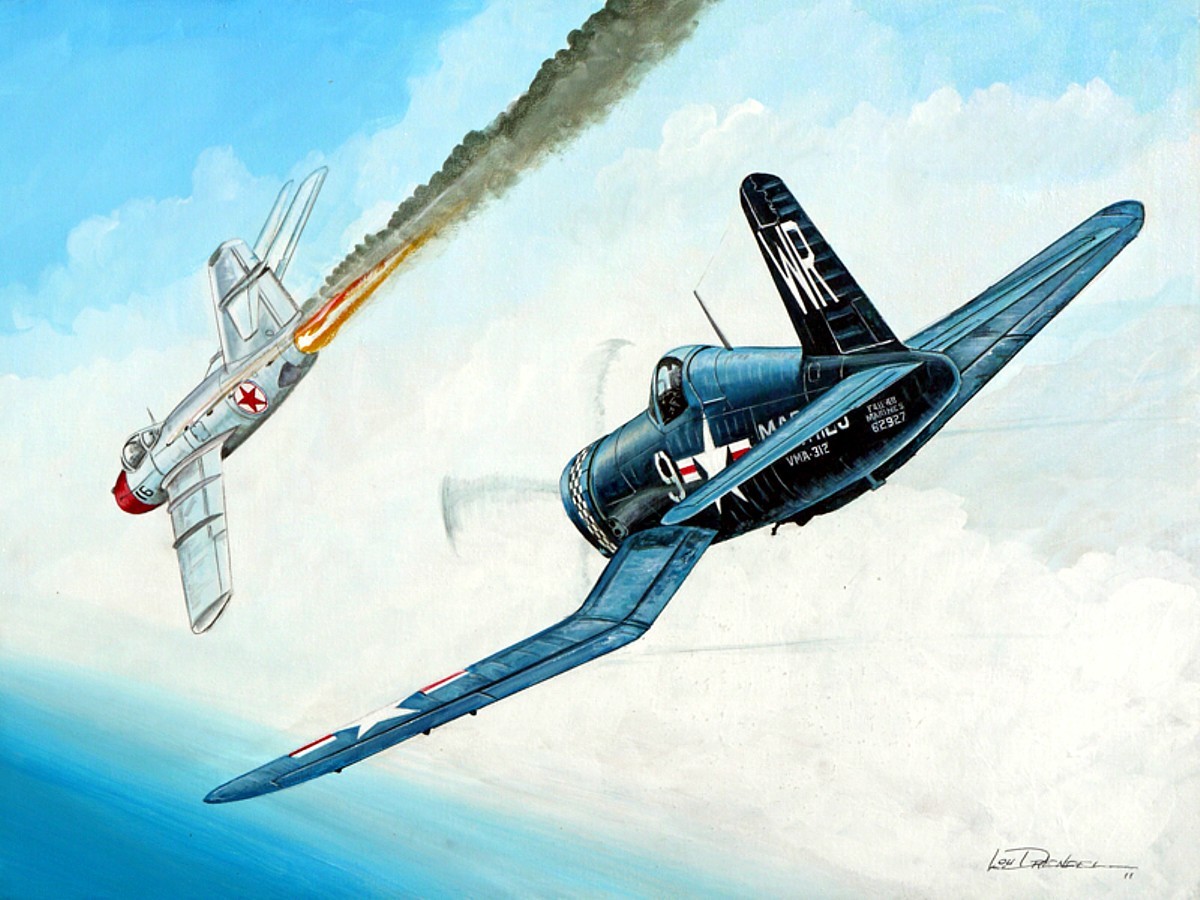
On this day: 70 years ago (September 10, 1952), Captain Jesse G. Folmar (MCSN: 0-26438), from the “Checkboards” of Marine Attack Squadron (VMA) 312 off the jeep carrier USS Sicily (CVE-118), shot down a North Korean (marked) MiG-15 to become the only F4U Corsair pilot to claim a MiG kill during the Korean War. After successfully engaging the MiG, Folmar was himself shot down by four other MiGs. He survived the attack and was rescued.
The performance between the two aircraft is about 200 knots and 10,000 feet in ceiling, to the MiG’s advantage. However, Folmar, age 32 at the time, was no novice to his aircraft.
Born 13 Oct 1920 in Montgomery County, Alabama, he joined the Marines in WWII and learned his trade with against the Japanese.
From Folmar’s Silver Cross citaton (he also earned the Distinguished Flying Cross) for the dogfight:
When the two-plane flight which he was leading to the target area near Chinnampo was suddenly attacked by eight hostile jet interceptors, Captain Folmar immediately initiated effective defensive measures so that he and his wingman could bring fire to bear on the enemy aircraft. Aggressively maneuvering his plane to the inside of one of the attacking hostile jets, he skillfully fired a burst from his guns that ripped into the side of the jet, causing it to burst into flames and forcing the enemy pilot, with his clothing ablaze, to abandon the flaming jet which subsequently crashed into the Taedong estuary.
While Captain Folmar was maneuvering his aircraft to ward off another attack, his plane was hit and severely damaged by hostile fire, forcing him to parachute. With the hostile jets continuing to make firing runs, he landed in the water from which he was rescued by friendly forces.
By his indomitable courage, outstanding airmanship and gallant devotion to duty, Captain Folmar was directly responsible for the complete destruction of a hostile jet aircraft and contributed materially to the safe return of his wingman, thereby upholding the highest traditions of the United States Naval Service.
Folmar died in 2004, aged 83, and is buried in Foley, Alabama. https://www.findagrave.com/memorial/14997565/jesse-gregory-folmar
For reference, the Marines’ “tally sheet” for Korea, showing Folmar as both the last Corsair victory and the only one of a prop plane against a jet. Illustration by Lou Drendel
THANK TO THOSE AIRMAN IN THT POLICE ACTION THAT LEFT 3 MILLION DEAD IN KOREA IT WAS TERMED THE FORGOTTEN WAR WE FOUND WHEN WE CAME HOME IN 55 AND THE TURTH LEFT OUT OF OUR HISTORY BOOKS SERVING ON THE USS YORKTOWN IN 53 TO 55 WE WERE SET TO FORMOSA FOLLOWNG THE SIGNNG OF THE ARMISTIE THAT STOPPED THE FIGHTING BUT NOT THE WAR THAT HAS BEEN GOING ON FOR 70 YEARS LOOKE AT THE COMPUTER NOW AND FIND WHO ACTUALLY DIVIDED KOREA AT THE 38 PARALLEL RESUTING IN THE CIVIL WAR THAT FOLLOWED The “Forgotten War”
The Korean War is called “The Forgotten War.” Not for the 5.7 million Americans who served in it. Not for families of the 54,000 Americans who died in it – including nearly 600 Iowans — and the 104,000 wounded during it. Not for the 2 million Koreans on both sides and Chinese who died in it.
The North Korean army invaded South Korea on June 25, 1950. The United States and its United Nations allies were unprepared, but rallied and drove deep into North Korea. Warnings of Chinese Communist intervention were unheeded. The Americans and UN were overrun, beaten back, but rallied again. The sides battled in stalemate until an armistice was reached July 27, 1953.
An interactive video screen tells the history of that conflict. Our state’s namesake warship, the USS Iowa, saw considerable service during Korea. Naval shells and powder bags sit on a replica section of the ship deck with video elements focusing on the ship’s service. “Faces of the Fallen” chronicling Iowans who died during the war, near a shipping crate for one of their caskets.
Dean Rusk and Charles Bonesteel – were assigned to define an American occupation zone. Working on extremely short notice and completely unprepared, they used a National Geographic map to decide on the 38th parallel as the dividing line. They chose it because it divided the country approximately in half but would place the capital Seoul under American control. No experts on Korea were consulted. The two men were unaware that forty years before, Japan and pre-revolutionary Russia had discussed sharing Korea along the same parallel. Rusk later said that had he known, he “almost surely” would have chosen a different line.[13][14] The division placed sixteen million Koreans in the American zone and nine million in the Soviet zone.[15] Rusk observed, “even though it was further north than could be realistically reached by US forces, in the event of Soviet disagreement
I WS THRE IN 50s On USS Yorktown that is a memorial to other career in Charlston South Carolina and recently those now running that museum think the Yorktown only served in WW II and viet Nam forgetting the 5 yard i Koea and Formosa fighting the Chinese……and so our politicians continue to dumb down our history Speaking as a Korean Vet and History teacher,.
.