The “Sea Force of the Philippines” (the official name of the Philippine Navy) is set to expand its major sea-going surface fleet by some 800 percent -or at least they hope to anyway. Currently ranked 29th when compared to the top 40 largest navies in relative combat power and tonnage, the antiquated fleet is hard pressed to keep Taiwanese poachers out of its waters, never mind confront a noisy and restless China. In the 1960s, the island country had one of the best fleets in Southeast Asia and the infant countries of Indonesia and South Vietnam benefited from Pilipino assistance and training to expand their own maritime forces. After the fall of South Vietnam in 1975, a number of larger naval vessels from that country escaped to the Philippines carrying refugees. These new additions were absorbed into the sea force.

Confronted with having to strip the Navy to pay for a growing counter-insurgency operation in the southern islands in the 1980s coupled with the loss of US assistance for aging vessels in the 1990s the fleet has largely withered away in the past three decades. Today a large portion of the navy’s 24,000-man force is dedicated to its sizable 10-battalion Marine Corps and a small fleet of Guadalcanal-era transports to carry them from island to island. Prior to May 2011, its most effective surface combatant was the 1600-ton BRP Rajah Humabon (PF-11) while the name may not be familiar to Western audiences it may be helpful to think of the USS Atherton (DE-169), for the Humabon and the Atherton are the same ship. A former Cannon-class destroyer escort she originally left the docks in 1943 to look for German U-Boats and is more of a museum piece than a functional craft. In fact, she is even credited with sinking a German U-boat (U-853).

Sadly, she still carries almost the same armament and electronics as she did in 1943. At age 50, she was retired and sat dockside for three years until pressed back into service in 1996 as the flagship of the navy. Now reclassified almost jokingly as a frigate, she started 2011 as the only seagoing (a term that may be considered wishful thinking) naval asset in the Philippine Navy. She carries a trio of 3” guns of the same type that used to be hood ornaments on US diesel submarines in World War 2, and what is rumored to be the world’s only operational Hedgehog ASW mortar device. While these weapons would look great on a museum ship, they are incapable of modern military action.

Enter the Hamilton class high endurance cutters of the US Coast Guard. The Hamilton’s were unique for a number of ‘firsts’ including using gas turbines for propulsion, now a common practice. They performed shore bombardment in Vietnam, captured the largest drug bust ever made at sea, hunted for Soviet submarines and enforced a myriad of maritime laws around the world. The 378-foot, 3250-ton ‘white hulls’ were in effect light ASW frigates. After modernization in the late 1980s they carried Harpoon antiship missiles, Mk.46 sub-killing torpedoes, a light 76mm gun, and a 20mm Phalanx CIWS for point defense. All this for less cost and with a smaller crew and longer endurance than a larger frigate. Now pushing 45 years old, the 12 Hamilton-class cutters are finally being replaced in US service by the new National Security Cutters. The Hamilton herself, lead ship of the class was decommissioned in March by the USCG and quickly turned over to an anxious Philippine government this May. Soon the old BRP Rajah Humabon will be allowed to retire once more as the Hamilton (renamed BRP Gregorio del Pilar) takes her place.

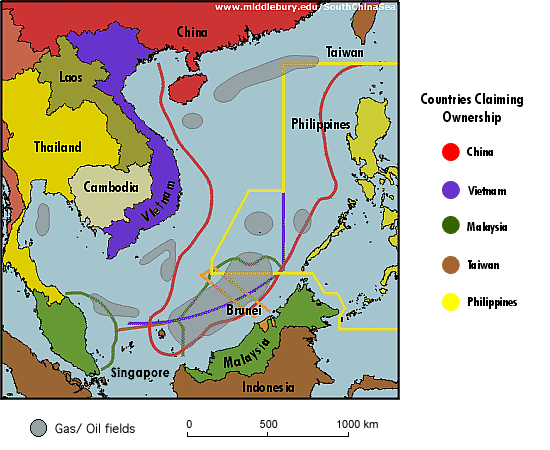
China’s just this week stated that the Philippines is harming China’s maritime rights in the South China Sea, and is dispatching more vessels to the disputed areas around the Spratly Islands. The red giant has recently built a large naval base on Hainan Island, to the north of the disputed waters and seems chomping at the bit to use it. Vietnam, to the south, seems threatened enough by China’s saber rattling that it has boosted its spending on modern military hardware, agreeing to buy a number of Sukhoi SU-30 jetfighters and six Kilo-class diesel submarines from Russia.

The Philippines government has seen this and now wants to add up to 7 more Hamilton’s to its fleet list, while still keeping their nearly 70-year old current flagship as a ‘reserve’ asset. After the end of the Cold War, the cutter’s teeth had been pulled to some degree when their Harpoons, torpedo tubes and sonar were removed, however the spaces still exist to re-install the equipment and with the warming of relations with the US again towards the archipelago nation it may be on the table. The Hamiltons were hot stuff when they came out in 1965, and when compared to the 1943-era tech that they currently have, they still seem pretty good to the Philippines’ naval brass. Especially when you have a Red Dragon breathing at the door. —–Christopher Eger