Tag Archives: Operation Earnest Will

Cold Warriors in Kodachrome

Official caption: “A Helicopter Combat Support Squadron 2 (HC-2) SH-3G Sea King helicopter takes off from the stern of the dock landing ship USS Mount Vernon (LSD 39). A Mark 33 3-inch/50-caliber anti-aircraft gun is in the foreground.”

Note that the autoloaders on the Mk33 are filled with 13-pound shells at the ready while the Sea King, likely of the “Desert Ducks” detachment out of Bahrain, has a beautiful full-color livery.

U.S. Navy image DN-ST-88-03592 via NARA.

Filed October 1987 in the Persian Gulf by PH2 (SW) Jeffrey Elliott, this image dates from Operation Earnest Will in the midst of the Tanker War phase of the Iran-Iraq war which saw Kuwaiti-owned tankers reflagged as American vessels and placed under the protection of the Navy.

Mount Vernon, a 14,000-ton Anchorage-class dock landing ship, was commissioned in 1972 and, as with the other four members of her class, had been fitted with a quartet of MK 33 twin 3-inch AAA DP mounts when constructed, a system that first entered service in 1948.

Another Mount Vernon shot from 1987. The 16-ton MK33 twin mount had a AAA ceiling of 30,400 feet and a surface engagement range of 14,600 yards, capable of 40-50 rounds per minute per gun, at least until the auto-loader ran out. They required an 11-man crew. It was believed one Mk33 was successful in an AAA role, with USS Biddle (DLG-34) credited with damaging a North Vietnamese MiG fighter in the Tonkin Gulf on 19 July 1972.

The fire-control directors for these dated mounts, of questionable use even in the 1970s, were removed from the Anchorage class during the Carter administration, while the first two tubs and then the last four were deleted by the early 1990s as the weapon was sunsetted. They were replaced by a pair of CIWS and another pair of Mk 38 25mm chain guns during late-career refits.

Mount Vernon would be decommissioned on 25 July 2003, the same year the last of her class left active service and was sunk as a target two years later.

The last 3-inch guns in U.S. maritime service were the 3″/50 singles on the 210-foot Reliance class cutters of the Coast Guard, which were removed during the completion of the cutters’ midlife maintenance availability in 1996.

As for the mighty Sea King, which first entered Navy service in 1961, they retired in late 2006 when the final unarmed UH-3H model was paid off from support duty at the Pacific Missile Range Facility, although the “white top” VH-3Ds of Marine One would continue to serve for much longer.

A U.S. Navy Sikorsky VH-3A Sea King (BuNo 150613) and an SH-3G of Helicopter Combat Support Squadron 2 (HC-2) stand on the flight line following their arrival at the Naval Air Station Oceana, Virginia (USA), in 1991. HC-2 was the last squadron that operated the type, finally retiring them in 2006 for H-60 models. Photo by Capt. Joe Mancias, USN – U.S. DefenseImagery photo VIRIN: DN-ST-91-07128.

Welcome back, USS Constellation

I am a sucker for naval tradition and, while 20th Century frigates/destroyer escorts were named either for small towns (see Asheville– and Tacoma-classes) or heroes that are often otherwise forgotten (see Evarts-, Buckley-, Cannon-, Edsall-class, et.al), it was announced yesterday that the fleet’s next frigate class will start off with a familiar name– that of one of the First Six frigates of the newly-formed U.S. Navy, USS Constellation.

Action between U.S. Frigate Constellation and French Frigate Insurgente, 9 February 1799. Painting by Rear Admiral John W. Schmidt, USN (Retired), depicting Constellation (at left) taking position ahead of Insurgente. After an hour-and-a-quarter engagement, the badly outmaneuvered and damaged French frigate surrendered. Constellation was commanded by Captain Thomas Truxtun. Courtesy of the artist. Official U.S. Navy photograph, KN-2882.

Serving from 1797 and named in honor of the collection of 15 stars on the young country’s flag, the original 164-foot, 38-gun Constellation, called “The Yankee Racehorse” due to her speed, endured until 1853 when she was “greatly repaired” at Gosport Navy Yard to become the 179-foot 20-gun sloop-of-war that carried the same name and is currently preserved in Baltimore.

The third completed Connie, of more modern vintage, was the massive Kitty Hawk-class supercarrier which was in service from 1961 to 2003 and is remembered for her hard service in Vietnam, the Cold War, the Tanker War, and Iraq as “America’s Flagship.” Sadly, she was scrapped in 2015.

An aerial port beam view of the U.S. Navy aircraft carrier USS Constellation (CV-64) as crew members form the Battle E awards for excellence on the flight deck of the ship. 1 August 1986 National Archives and Records Administration photo, cataloged under the National Archives Identifier (NAID) 6429186 https://catalog.archives.gov/id/6429186

Now, as announced by SECNAV Kenneth J. Braithwaite this week, USS Constellation (FFG 62) will be the lead ship in the new Guided Missile Frigate (FFG(X)) class.

Appropriately, he made the announcement while aboard the museum ship Constellation in Baltimore’s Inner Harbor.

BALTIMORE (Oct. 7, 2020) Secretary of the Navy Kenneth J. Braithwaite announces USS Constellation (FFG 62) as the name for the first ship in the new Guided Missile Frigate class of ships while aboard the museum ship Constellation in Baltimore Inner Harbor, Baltimore, Md., Oct. 7, 2020. As the first in her class, the future Guided Missile Frigates will be known as the Constellation Class frigates. Braithwaite visited the museum ship Constellation for the announcement to honor the first U.S. Navy ships authorized by Congress in 1794. (U.S. Navy photo by Mass Communication Specialist 2nd Class Levingston Lewis)

The Navy emphasized that the FFG-X will be fighting ships, rather than the LCSs we currently have:

As the next generation of small surface combatants will contribute to meeting the goal of 355 battle force ships. With the ability to operate independently or as part of a strike group, it will deliver an Enterprise Air Surveillance Radar (EASR), Mk 41 Vertical Launching System, and Baseline 10 (BL 10) Aegis Combat System capabilities. The ships lethality, survivability, and improved capability will provide Fleet Commanders multiple options while supporting the National Defense Strategy across the full range of military operations.

It would be great if the next ships of the class repeat other First Six names (Chesapeake, Congress, and President) not currently in use, and carry forward with other famous ship names moving forward (e.g. why do we not have a Ranger, Hornet, Intrepid, etc?).

Either way, it is better than naming them for politicians and labor leaders. 

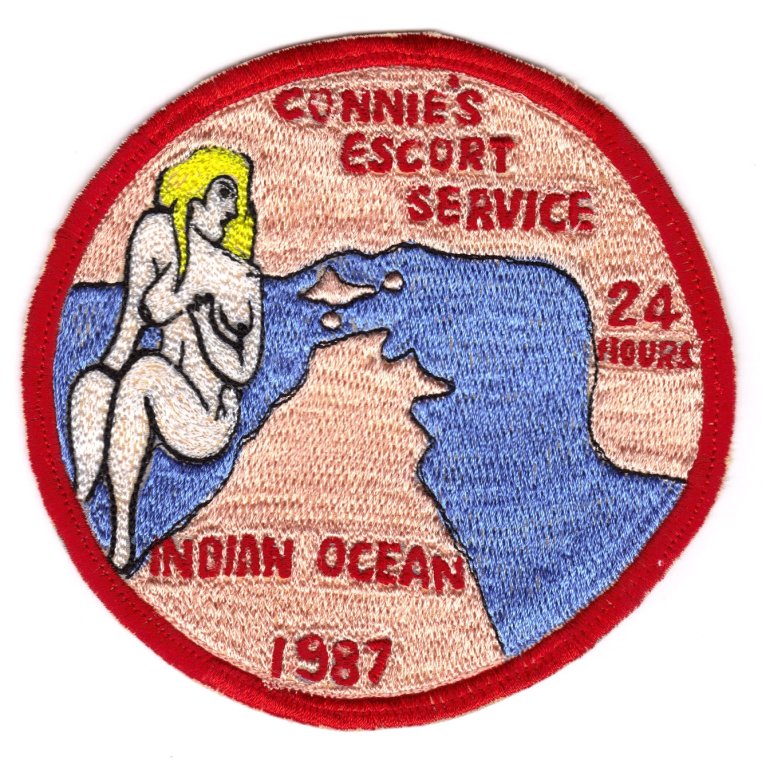
Connie’s Escort Service hard at work, 32 years ago today

In a departure from our standard Warship Wednesday format, here we see an aerial port beam view of the Kitty Hawk-class aircraft carrier USS Constellation (CV-64) in her prime as crew members form the Battle E awards for excellence on the flight deck of the ship, 1 August 1986. Among these is the Pacific Fleet Battle Efficiency Award for an 18-month period. She is pictured off the West Coast just a month before she started a short two-month NorPac cruise, Capt. Melvin David Munsinger, USN, in command.

National Archives and Records Administration photo, cataloged under the National Archives Identifier (NAID) 6429186 https://catalog.archives.gov/id/6429186

About half of her airwing is on deck, and it is a masterpiece of 1980s Red Storm Rising-style carrier warfare.

Forward you can see at least 17 F/A-18A/B Hornets from VF-A-113 and VFA-25 nestled around her starboard Sea Sparrow launcher. Next, are followed a half-dozen S-3A Vikings from VS-37, a collection of 16 KA-6D/EA-6B/A-6Es from VA-196 and VAQ-139, three E-3 Hawkeyes from VAW-113 aft her the island, along with a pair of big ole beautiful SH-3 Sea Kings from the “Eighballers” of HS-8. The huge delta-wing fighters, of course, are the F-14A Tomcats with their variable geometric wings in their closed position, from VF-21 and VF-154. All are of Carrier Air Wing 14 (CVW-14) which deployed on Connie during Vietnam as well as five times between Feb. 1985 and Oct. 1989 before chopping to USS Independence.

The above was taken the year before Connie was sent to help support Operation Earnest Will, the 14-months of nail-biting that came with escorting of re-flagged Kuwaiti tankers in the Persian Gulf as a result of Iranian attacks against international shipping with assets from the Pacific’s Third and Seventh Fleets and the Mediterranean-based Sixth Fleet. This was known by the crew as “Connie’s 24-hour Escort Service” (NSFW).

Connie was decommissioned 7 August 2003 and struck later the same year. She arrived in Brownsville on 16 January 2015 for dismantling and has been going to pieces slowly ever since.

CVW-14 was deactivated effective 31 March 2017, a process which started back in 2011.