Warship Wednesday, Sept 12
Here at LSOZI, we are going to take out every Wednesday for a look at the old steampunk navies of the 1866-1938 time period and will profile a different ship each week.
– Christopher Eger
Warship Wednesday, Sept 12

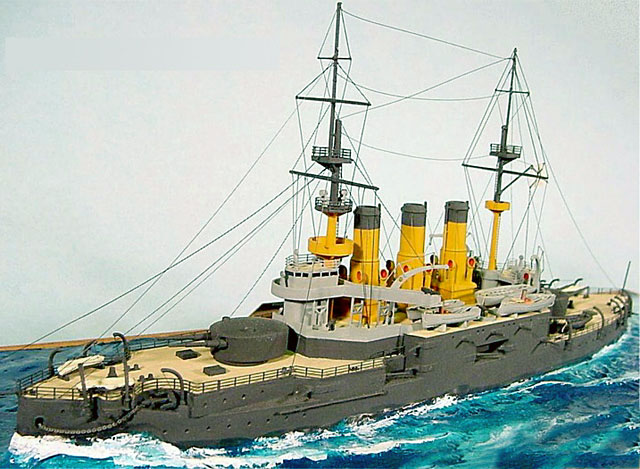
Here we have the Kniaz Potemkine Tavritchesky, ‘Prince Potemkin of Tauris,’ a pre-dreadnought battleship of the Imperial Russian Navy, in model form.
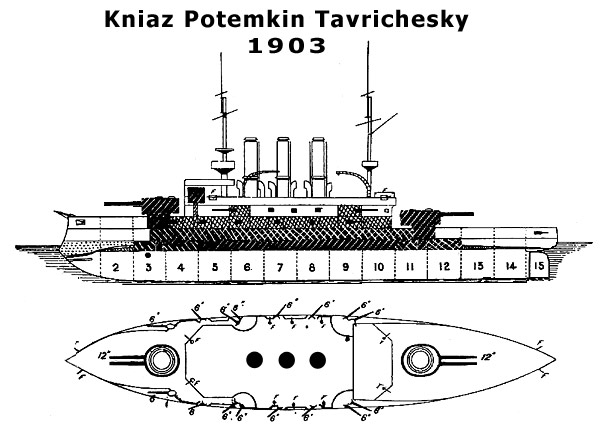
Built at the Nikolayev shipyard 1898-1904, she was a proud warship and one of the strongest in the Black Sea fleet, — a more modern vessel than any ship the Sultan of the Ottoman Empire could muster. She was thoroughly modern, with much help from French, German, and British engineering firms in her design. She was the first Russian battleship with liquid-fueled boilers and a centralized fire control.
Specs:
Displacement: 13500 tons full load
Length: 115 m (377 ft 4 in)
Beam: 22.3 m (73 ft 2 in)
Draught: 8.2 m (26 ft 11 in)
Propulsion:
2 shaft VTE,
22 Bellville coal-fired boilers,
11,300 hp
Speed: 16 knots (30 km/h)
Complement: 18 officers and 763 men
Armament:
4 × 305 mm (12 in) guns in two turrets,
16 × 152 mm (6 in) guns,
14 × 75 mm (3 in) guns,
various small-calibre guns.
5 × 380 mm (15 in) torpedo tubes
Armour:
Krupp armour
6–9 in (150–230 mm), belt
2.5–3 in (63–76 mm), deck
10 in (250 mm), turrets
5–6 in (130–150 mm), casemates
9 in (230 mm), conning tower
When Russia found herself in the middle of the Russo-Japanese War in 1904, the brand new ship, forbidden from ever leaving the Black Sea by international treaty, lost most of her best and most experienced crew. Only raw recruits and an understrength and untalented NCO and officer corps were detailed to the ship. On June 23, 1905 a group of sailors met to plot a mutiny. The next day some 40 sailors are removed from the ship. The battleship put to sea for gunnery training with her inexperienced crew. On June 27th, all hell broke loose.
At 4 am the ship took on a supply of rotten meat. The Russian tars, already pissed at their life of toil, notice the maggots and the revolutionaries start a boycott of the Borscht made with the meat. The ship’s captain, had the 700-man crew assembled on deck and ordered to eat it, of which only 12 sailors obey. The rest are threatened with 20 armed marines, the sailors dispersed. Second-in-command Gilyarovsky calls for tarpaulin so he can execute 30 sailors who did not flee, and not soil the decks. 30 revolutionaries steal rifles from the armory, and take over the signal and engine rooms. They rush aboard, the marines do not fire. Stoker Nikishkin fires the first shot.The captain flees to his cabin. Gilyarovsky shoots Grigory Vakulinchuk then orders the guards to fire, they flee, he is shot. They stop the torpedo boat Ismail from escaping with officers who jumped overboard. 7 officers are killed, 12 arrested. 25 sailors are elected to a committee with Matyushenko chairing. They make ensign Alekseyev, the only one of the 18 officers to side with the mutineers, captain. They raise the red flag and toss the Tsar’s portrait into the sea. At 10pm they arrive at Odessa.
For three days the Potemkin was a revolutionary battleship in Odessa harbor. On the morning of 30 June the three loyal battleships Tri Sviatitelia, Dvenadsat Apostolov, and Georgii Pobedonosets arrived to take the red flag of the Potemkin down, or sink the ship. The crew of the Apostolov refused to ram the red battleship while the Pobedonosets broke into open mutiny. Over the next two days, the mutiny spreads to a great many ships across the entire Black Sea Fleet. Slowly however the risings on the other ships flare up and die out. The commander of the Apostlov, one Captain Kolands even tried to blow his own ship and drown his crew. By July 8th, the revolutionary battleship sailed to Constanta Rumania, where her sea cocks were opened in the harbor and her crew surrendered.

The Tsar decreed that she was, after the events of 1905, renamed the Panteleimon after the patron saint of accidents. Here she is during that time period, in flat paint scheme. From 1906-1917 she was always left to bring up the rear in any naval parade, never to have a position of honor or carry an admiral’s flag.
In October of that year the ship was re-floated and returned to the Tsar. In shame her name was stricken and once she was repaired she was entitled Saint Pantaleon, the patron saint of accidents and loneliness. With a new crew (more than 600 of her old remained in Rumania or emigrated abroad) she quietly served the Tsar. During World War One she fought unremarkably against the combined German-Ottoman forces and in 1917, after the Tsar was deposed, her old name was restored. During the Russian Civil War she was scuttled for a second time, by the British, in April 1919 when the Interventionists abandoned Odessa. Not worth salvaging, the Soviets scrapped the hulk in the 1920s.
Her story, was immortalized in Sergi Einsteins epic 1925 film, The Battleship Potemkin.
The Potemkin was scrapped before the film was shot, however the Soviets dug up the old battleship “Dvenadtsat Apostolov”, (that had refused to ram Potemkin in 1905) as a stand in. That old beater had been removed from active service in 1911 and served as depot hulk without engines or armament until mid-1920s, when the film was made. Despite the fact that she was from a similar period (1892) she was only about half the size of Potemkin (at 8,000-tons and with only two stacks instead of three) and had to be heavily modified externally with dummy gun turrets.
However the film lives on….