|
By Lt. j.g. Sarah Feagles, USS Spruance Public Affairs Officer
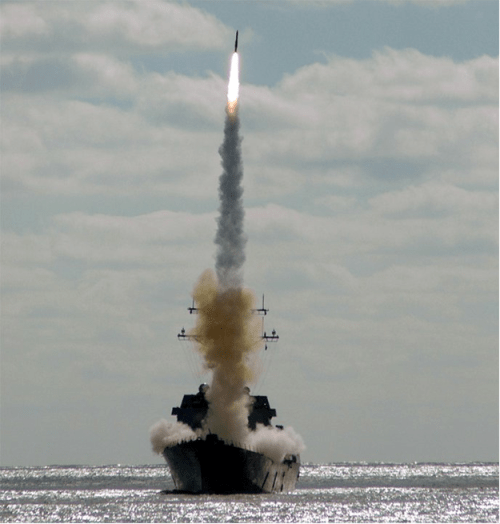
SAN DIEGO (NNS) — USS Spruance (DDG 111) set the Navy record for distance while firing a missile during Combat Systems Ship Qualification Trial (CSSQT), March 13.
Spruance culminated its eighth week of CSSQT events with a record-setting missile shoot.
“The crew is probably getting tired of me saying ‘first ever’ or ‘best ever’ but, when the reality is that we set Navy-wide records the first time we ever do things onboard, it is impossible not to recognize the hard-working Sailors that make it all happen,” said USS Spruance Commanding Officer Cmdr. Tate Westbrook.
Spruance’s fire control team set an Aegis record when they intercepted a long-range air target at the furthest distance in the history of the Aegis and Standard Missile program, breaking the record by more than five miles. The intercept test was only one of three separate events Spruance executed during the weeklong missile firing period.
CSSQT directors developed a rigorous plan to test Spruance’s ability to defend against anti-ship cruise missiles (ASCM) and aircraft. Firing four standard missiles (SM-2), Spruance completed each event within the precise constraints required by CSSQT’s program office.
One of the highlights of the week was Fire Controlman 3rd Class Justin Morrow’s quick reaction while he was missile selection supervisor (MSS).
Instead of firing a shot against a target that was too close to Spruance and invalidating the entire test, his five-second reaction time allowed him to “hold fire” and not shoot the missile. If he would have pressed the “engage” variable action button, the data would not have been within CSSQT’s required parameters and the Navy would have had to pay for another ship to conduct the same test at a later date.
“We have very precise metrics that we need to meet in order to accomplish all of CSSQT’s goals,” said CSSQT test director Joe Norton. “FC3 Morrow’s lightning fast reaction saved the Navy almost $3 million and allowed Spruance to meet every test objective – something that is not common among even the best fleet destroyers.”
A successful week at sea was the product of months of planning, practicing, and executing. Behind the scenes, Aegis technicians like Fire Controlman 3rd Class Neil Opperman spent countless hours with CSSQT engineers grooming the SPY radar system and ensuring that it was radiating and tuned properly before the SM-2 launches. At the “front table” in the ship’s Combat Information Center, the firing team began editing scripts and conducting practice runs as early as September.
“Combat Fire Control (CF) and Combat Missiles (CM) divisions have been training for this week for the past six months,” Fire Control officer, Lt. j.g. Claude Sterling said.
“To see all of our hard work come to fruition is incredibly rewarding, especially because we were able to shoot real missiles, which is not something all ships have the opportunity to do.”
The last event of the week, and the culmination of CSSQT was a simulated small boat attack which allows the 5 inch/62 gun team to defend Spruance against high speed surface threats. Over the past eight weeks, the crew of Spruance has proved it is ready and capable of defending the ship against surface, subsurface, and air attacks and that it is able to launch the offensive attack on ships, submarines, aircraft, and shore installations.
Every weapon system onboard has been officially tested and validated by the CSSQT Program Office, meaning that Spruance is able to enter the fleet as a completely operational platform – bringing 280 more well-trained Sailors and their equipment to the fight.
“The past two months have been nothing short of a complete team effort, and our crew was able to focus on a common goal and achieve record-setting results,” said Westbrook. “As the captain, I can’t ask for anything more than that.”
For more information, visit www.navy.mil, www.facebook.com/usnavy, or www.twitter.com/usnavy. |