Warship Wednesday April 4, 2012
Here at LSOZI, we are going to take out every Wednesday for a look at the old steampunk navies of the 1880s-1930s and will profile a different ship each week.
– Christopher Eger
Warship Wednesday, April 4th
Here we have the three-masted auxiliary-engined sailing ship SMS Seeadler


with her sails reefed
The Seeadler, (Sea Eagle in German) was the most famous German auxiliary cruiser (Hilfskreuzer) in World War I. The former British sailing ship Pass of Balmaha was captured in July 1915 by U 36 at the age of 39 years of age.
As of 1916, German warships had been blockaded by the Allies in the North Sea, and any commerce raiders that succeeded in breaking out lacked foreign or colonial bases for re-supply of coal. This gave rise to the idea of equipping a sailing ship instead, since it would not require coaling.
The Seeadler was equipped with an auxiliary engine, hidden lounges, accommodation for additional crew and prisoners, two hidden 105 mm cannons that could emerge from the deck, two hidden heavy machine guns, and rifles for boarding parties. These weapons were rarely fired, and many of the 16 ships encountered by the Seeadler were sunk with only one single accidental casualty on either side during the entire journey.
On 21 December 1916, she sailed under the command of Kapitänleutnant Felix von Luckner. The ship was disguised as a Norwegian wood carrier and succeeded in crossing the British blockading line despite being boarded for an inspection. The crew had been handpicked partly for their ability to speak Norwegian. Over the next 225 days, she captured 15 ships in the Atlantic and Pacific and led the British and US Navies on a merry chase.
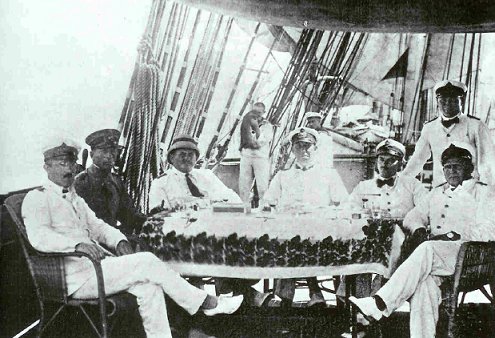
Kapitänleutnant Felix von Luckner and his gang of pimps under the hot Pacific sun, in tropical whites.
Her journey ended wrecked on a reef at the island of Mopelia 450 km from Tahiti in the Society Islands, part of French Polynesia. Luckner and some crew sailed for Fiji, where they were captured and imprisoned. A 100-foot long French schooner, the Lutece, of 126 tons was captured by the remaining crew on 5 September 1917 (making it the 16th ship captured by Seeadler). They sailed to Easter Island as Fortuna, arriving on 4 October and running aground there, after which they were interned by the Chilean authorities
Laid down: R. Duncan & Co. Port Glasgow, 1878
Commissioned: 02.12.1916 (as auxiliary cruiser)
Fate: beached at Mopelia on 02.08.1917
Displacement: 4500 tons (1571 tons gross register tonnage)
Length: 83.5 m/274-feet
Beam: 11.8 m/39-feet
Draught: 5.5 m/18-feet
Propulsion: 1 shaft auxiliary diesel engine, 900 hp
Sail plan: 3 masts, full rig, 2600 m2 sail area
Speed: 9 knots
Complement: 64 including guncrew and marines
Armament: 2 – 105mm guns