Tag Archives: Coldstream guards

The Beards Are Back, in British Service Anyway

With the British Army recently repealing the 100-year ban on beards, the first members of the King’s Guard to have the whiskers arrived on post this week, and personally, I think they look great.

Via the Welsh Guards:

Like it or lump it, the beards are here! Members of Number 2 Company proudly took up their posts on Kings Guard this morning, marching from Wellington Barracks to Buckingham Palace and St James’s Palace.

The new Army regulation says beard length must be between grade 1 (2.5mm) and grade 8 (25.5mm) and well-kept, which, sadly, means you won’t have a return to the days of the old “grenadier’s beards” of the 19th century.

British Colour Sergeant and Private of the Grenadier Guards 1855 Buckingham Palace 1853 enfield IWM Q 71602

1861 India Agra Black Watch 42nd Regiment Royal Highlanders with Enfields, P53 Alkazi Collection

CRIMEAN WAR 1854-56 (Q 71630) Charles Manners, William Webster and Henry Lemmen of the Grenadier Guards. Copyright: © IWM. Original Source: http://www.iwm.org.uk/collections/item/object/205018817

Joseph Numa, John Potter and James Deal, three soldiers of the Coldstream Guards. Crimean War, 1854-56

Spit and Polish in Paris and London

Yesterday was the 120th anniversary of the Entente Cordiale, signed between Britain and France on 8 April 1904. The agreement buried the longstanding proverbial hatchet between the two colonial empires, which at the time included most of Africa and wide swaths of Asia. It also set the stage for the end of “The Great Game” between Britannia and the Tsars, which would solidify in the Anglo-Russian Convention of 1907, which almost made the looming Great War and the 1920s split between Japan and the West inevitable.

To celebrate 12 decades of Fraternité d’armes, Engagement, et Fierté (notwithstanding such unfriendly fire “bumps” as Mers-el-Kébir and Operations Exporter, Stream Line Jane, and Ironclad), there was an unprecedented dual changing of the guard in the old cities.

In London, 32 picked members of 1er Regiment de le Garde Republicaine of the Gendarmerie Nationale were marched to Buckingham Palace by the Band of the Grenadier Guards where they met F Company Scots Guards, the King’s Guard. They then exchanged salutes, with each unit’s commander shaking hands, and stood for inspection by dignitaries from both countries.

Members of the Garde Républicaine, part of the Gendarmerie Nationale, march out of the Buckingham Palace centre gate on completion of the Entente Cordiale changing of the guard. MOD Photos

The French contingent then marched off the forecourt, returning to Wellington Barracks with the Band, leaving the Scots Guards to continue their duties as The King’s Guard.

The Gendarmes had arrived last week and spent a few days drilling under the watchful eye of WO1 Verne Stokes, Garrison Sergeant Major, to ensure they had the pacing correct.

Meanwhile, in Paris, 16 soldiers from Number 7 Company, Coldstream Guards, took part in a similar ceremony with Garde Républicaine, outside the Élysée Palace, the official residence of the French President while the French army choir then sang God Save the King, and La Marseillaise.

It was the first ever instance of soldiers of a foreign state guarding the Élysée Palace (it was unoccupied from 1940-46), and simultaneously the first time a non-British Commonwealth force stood guard at Buckingham.

Livgarde and Livgardet in Reception

We’ve talked about the Swedish Livgardet and Danish Kongelige Livgarde a few different times over the years, as, well, they deserve it. Besides being historic frontline combat units with a long history, and their current dual-hatting as royal guards on public duties while training to fight if things go sideways, they just look great doing it.

Case in point, the Swedish Livgardet late last month fell in for a state reception for King Felipe VI of Spain, complete with their 6.5mm Carl Gustav-made Mausers and bearskin grenadiers helmets.

Likewise, the Danish Livgarde, complete with horse soldiers of the Gardehusarregiment, assembled for a state reception for new ambassadors to Copenhagen. Always nice to see the traditional hussar pelisse hanging over the shoulder of braided dolmans. Of note, the foot guards are in their scarlet gala tunics and bearskins rather than the more commonly seen black tunics. The red tunics are only for special occasions such as royal birthdays.

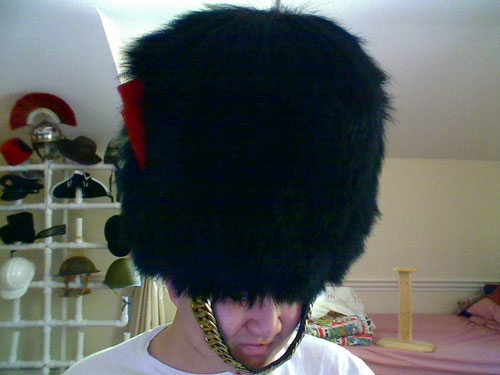
In other, related news, the British Army’s five regiments (actually just single battalions) of foot guards will continue to use bearskin grenadiers’ hats after testing found a synthetic replacement, proposed by animal rights wackos at PETA and urged on by Pam Anderson of all people, “didn’t meet the standards required.”

1st Battalion Irish Guards for a special St Patrick’s Day Parade today at their Barracks in Hounslow, 3.16.2017. MOD photo by Sgt. Rupert Frere.

Some 110 replacement ceremonial caps were purchased by the MOD in 2020 at a cost of £145,000, with the fur coming from Canada’s black bear cull surplus– in other words, pelts that would have been harvested regardless of the Guards. 

Some 14 nations still have bearskin caps in use for military dress uniforms, a practice picked up in most respects from Napoleon’s Old Guard. 

Grenadiers of Napoleon’s Imperial Guard, by Hippolyte Bellangé, 1843

Thats It, Britian is Lost

So, between the riots by Generation X (Y?Z?) rebelling against conformity, unemployment and what they perceive as general wanker-ness by everyone over 25 years of age, and defense cuts, Britain is done.

First, the MoD cut all of the combat aircraft that can fly from its carriers (bit not the carriers themselves), slashed the number of combat air squadrons to its lowest level since London had to worry about Zepplins, and then turned around and went after the land forces.

Among the cuts could be the Coldstream Guards.

The British Royal Guards include the

1. Scots Guards (no, they don’t wear kilts)

2. Welsh Guards

3. Grenadier Guards

4. Tins and Blues and Lifeguards of the Household Cavalry (who ride armored fighting vehicles for battlefield scouting whenever their horses are in the shop)

5. The Irish Guards (even though only six counties remain British)

6. The Coldstream Guards

The guards are the primary garrison for London, and are charged with the protection of the sovereign, currently Queen Elizabeth.

There duties are largely ceremonial, however they do have a very real job to do in the protection of the sovereign and can be called upon as regular units of the British army. All of the regiments have a proud history of military service.

Who are the Coldstreams?

The regiment has a proud history, boasting 13 Victoria Crosses, a George Cross and 117 battle honours in its 360-year history. (Comparatively the oldest Regiment in the US Army is the Old Guard of 3rd Infantry Regiment which has 50-battlestreamers in its 227-year history)

The Coldstream Guards, nicknamed ‘Lilywhites,’ were formed in the English Civil War when Oliver Cromwell gave Colonel George Monck permission to have his own regiment. It took part in the Battle of Dunbar, where the Roundheads defeated the royalist forces of Charles Stuart.
After Cromwell’s death, Monck supported the monarchy and on January 1, 1660 crossed the River Tweed into England at the village of Coldstream and began a five-week march to London.He arrived in London on February 2 and helped in the restoration of the monarchy.  For his help, Monck was given the Order of the Garter and his regiment was assigned to keep order in London.It fought with distinction particularly at the Battle of Waterloo. The regiment suffered terrible casualties in World War One, twice losing all its officers. (Not misplaced, but churned to gruel in the trenches of the Western Front by big ass German shells.)

The guards were  the first to enter Sarajevo in the Balkan conflict and has served in Iraq and Afghanistan.

Now, if the bean-counters get their way. They will hang up their bearskins and muster out leaving only tall thin shadows in history of their accomplishment. No doubt the money saved can be used to fund a small, ineffective and yet politically correct program somewhere for a few years until it too is cut.

Progress!