Here at LSOZI, we are going to take out every Wednesday for a look at the old steam/diesel navies of the 1859-1946 time period and will profile a different ship each week.
– Christopher Eger
Warship Wednesday, May 15

Here we see the light carrier USS Independence (CV/CVL-22). Began as the light cruiser USS Amsterdam (CL-59) in 1940, she was converted while still at New York Shipbuilding Corp., Camden, N.J to help fill the urgent and pressing need for fast carriers after Pearl Harbor. A 30/30 ship, she could make 30+ knots and carry 30+ aircraft while having legs long enough to cross the Pacific and operate on her own for a few weeks before she needed to find an oiler. While she was much smaller than a regular fleet carrier such as the Enterprise that could carry 80-90 aircraft, she could still put a few squadrons in the air.
In effect, she was good-enough.

Above you see a scale model of the USS Duluth (CL-87) compared to the USS Belleau Wood (CVL-24) both are directly related to the Indy. The Duluth is a Cleavland-class cruiser and is what the Indy was originally ordered to be. The Belleau Wood underwent to same conversion that Indy did. Notice the similarity in the hull. Both ships only differed above the 01 deck.
When Independence was commissioned on January 14th 1943, the only other carriers in the fleet of the original 8 that started WWII were the Enterprise and Saratoga who were fighting for their lives off the Solomons, and the small USS Ranger which was up to her ass in U-Boats in the Atlantic. The new USS Essex had commissioned just a couple of weeks earlier and was in shakedown. The old carrier Langley, converted to a seaplane tender, had been lost early in the war, the huge Lexington was sent to the bottom at the Battle of the Coral Sea, Yorktown lost at Midway, Wasp and Hornet (stricken literally the day before Independence was commissioned from the Naval List) lost in the Solomons.

In short, the Indy came just in time and she was put to hard work fast. Before the year was out she was conducting raids off Marcus Island, Rabaul, and the Gilberts– tying down Japanese forces needed elsewhere. It was in these raids that the Indy picked up a torpedo (one of a half-dozen fired at her) in her starboard quarter. As this was repaired, she received a new air-group, an additional catapult, and a new mission– that of a night carrier.

The first full-time night Air Group was Air Group 41, established through the drive and persistence of Lt. Commander Turner F Caldwell. He commissioned VF(N)-79 in January 1944, training at NAAF Charlestown, Rhode Island. While at Charlestown Caldwell sold his idea of an ‘pure’ night air group to anyone who would listen. With the availability of the CVL Independence Caldwell got his wish. VF(N)-75 was dissolved and reformed as VF(N)-41, with an enlarged TBM contingent designated as VT(N)-41. Total size of the Air Group was 14 F6F-5N’s, 5 F6F-5’s and 12 TBM Avengers. Independence sailed for Eniwetok at the end of July 1944 to join Task Force 38. Air Group 41 finished it’s tour in January 1945. In that time it had claimed 46 kills, but lost ten of it’s 35 night fighter pilots in action, A further three were lost to operational causes – a tribute to the high training standards and skill of the group. The CVL Independence was the only light carrier to be completely equipped with a Night Air Group. Later in 1945 several large carriers and even a much smaller Jeep Carrier (CVE-108 Kula Gulf) went to Night Groups including Enterprise, Saratoga and Bon Homme Richard— but the Indy was the first.
By the end of the war she held 8 battlestars.
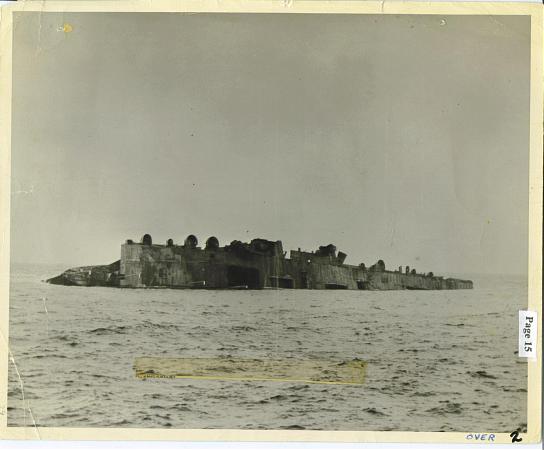
The Japanese couldn’t sink her, so the Navy decided to use her for testing. Since the USN had dozens of brand new fleet carriers of the Essex types, it didn’t need the old Indy anymore. Therefore, she was only 1/2 mile from ground zero on 1 July 1946 when the A-bomb went off in the Bikini Atoll tests. When she didn’t sink, they used her again for another A-bomb test three weeks later. Still afloat, she was only scuttled in 1951 off the coast of San Fransisco. Five of her remaining sisters pressed on and were used during the Cold War as transports, anti-submarine carriers, and as the first modern carriers that the French and Spanish navies had– one, the former USS Cabot, even tested the first Harriers at sea.

Indy is just to the right of the giant column of water that is much wider than she is long….

In the end you can say that the Indy had a hard life in her eight years above water to say the least.
Today, even after being under 3100-feet of seawater for 60 years, she is still on the job. You see ,she took down 70,000 sealed barrels of 1940s radioactive materiel with her which she is guarding in the forever night of the deep ocean and is forbidden to dive on using any means.
In a way, she is still a night carrier, with a very dangerous cargo.

Specs:
Displacement: 11,000 tons standard; 15,100 tons full load
Dimensions (wl): 600′ x 71′ 6″ x 26′ (max) / 182.9 x 21.8 x 7.9 (max) meters
Dimensions (max.): 622′ 6″ x 109′ 2″ / 189.7 x 33.3 meters
Armor: no side belt (2″ belt over fwd magazine); 2″ protective deck(s); 0.38″ bridge; 5″/3.75″ bhds; 5″ bhds, 2.25″ above, 0.75″ below steering gear
Power plant: 4 boilers (565 psi, 850°F); 4 geared turbines; 4 shafts; 100,000 shp (design)
Speed: 31.6 knots
Endurance (design): 12,500 nautical miles @ 15 knots
Armament: 2 single 5″/38 gun mounts (soon removed); 2 quad 40-mm/56-cal gun mounts (in place of 5″ mounts); 8 (soon 9) twin 40-mm/56-cal gun mounts; 16 single 20-mm/70-cal guns mounts
Aircraft: 30+
Aviation facilities: 2 centerline elevators; 1 hydraulic catapult
Crew: approx. 1,560
If you liked this column, please consider joining the International Naval Research Organization (INRO)
They are possibly one of the best sources of naval lore http://www.warship.org/naval.htm
The International Naval Research Organization is a non-profit corporation dedicated to the encouragement of the study of naval vessels and their histories, principally in the era of iron and steel warships (about 1860 to date). Its purpose is to provide information and a means of contact for those interested in warships.
Nearing their 50th Anniversary, Warship International, the written tome of the INRO has published hundreds of articles, most of which are unique in their sweep and subject.
I’m a member, so should you be!


 Tyler Rogoway