Tag Archives: USS Constellation (CV 64)

Carrier Gunnery

How about these great shots, taken 7 August 1976 over NAS North Island, California, of the new class-leading big deck phib USS Tarawa (LHA 1), and the carriers USS Coral Sea (CV-43) and USS Constellation (CV-64).

An aerial view of ships moored at Naval Air Station, North Island. They are, from left to right, the amphibious assault ship USS TARAWA (LHA 1), the aircraft carrier US CORAL SEA (CV 43), and the aircraft carrier USS CONSTELLATION (CV 64). (Substandard image)

These show good details– to include a mix of guns– on the Midway-class Coral Sea and Tarawa. Constellation, as a circa 1960s Kitty Hawk class flattop, was the first class of American fleet carriers going back to USS Langley (CV-1) in 1920, to not mount a single 5-incher.

The Midway class was originally designed to carry 18 long-barreled 5″/54 Mk 16 guns— originally designed for the Montana class battleships– along with a slew of 40mm (21 quad) and 20mm (28 twin) guns.

Coral Sea was seen with her 1947-57 14-gun 5-inch fit, via USS Coral Sea assoc. https://www.usscoralsea.net/shipsweapons.php

They subsequently downgraded by 1960 to just 10 5″/54s, four on the port side and six on the starboard side, while their smaller guns had been replaced by 11 twin-3-inch mountings in place of the former quadruple 40 mm mountings. This was dropped to just six 5″/54s by January 1960 and only three after 1966. Coral Sea and Midway lost their last 5-inchers in 1979/80 to pick up CIWS while middle sister FDR had already been retired by then.

For the record, the first Langley carried four 5″/51s in open mounts during her “covered wagon” period of carrier ops, the mighty USS Lexington (CV-2) and Saratoga (CV-3) toted eight heavy cruiser-worthy 8″/55 guns along with dozen 5″/25s, Ranger (CV-4) had eight 5″/25s, the three Yorktowns and the one-off USS Wasp (CV-7) had eight 5″/38 DPs, and the 24 Essex class fleet carriers had eight 5″/38s in twin turrets and another four in single open mounts.

USS Lexington (CV-2) showing off just a portion of her impressive gun fit. Both Lex and Sara would land their 8-inchers in 1942, with the Army going on to use them for coastal defense around Hawaii

While the Independence and Saipan-class light carriers had to make do with smaller guns, every one of the assorted escort carrier classes (Long Island, Charger, Bogue, Sangamon, Casablanca, and Commencement Bay) carried at least one or two 5-inch guns, with USS Kalinin Bay and White Plains credited with scoring hits on pursuing Japanese heavy cruisers off Samar in October 1944.

Testing 5-inch guns on the escort carrier USS Manila Bay (CVE 61) 3 November 1943. Note fuzed ready shells. 80-G-372778

So it made sense in the 1950s that the new Forrestal-class supercarriers carried eight new style Mk.42 5″/54 caliber mounts, the same style guns as in the Navy’s new DD and FF classes throughout the Cold War.

McDonnell F3H Demon on Forrestal-class USS Saratoga. Not the Mk 42 5 inch gun and S-2 Tracker.

A-3B Skywarrior coming aboard USS Independence note 5-inch guns on carrier

USS Ranger (CVA-61) test firing two of her eight 5-inch 54 Mark 42 guns during a practice drill in 1961.

Check out these 1960 profiles of Midway and Forrestal:

Of course, the Forrestals later had their troublesome 5-inchers removed in later updates, as did Midway and Coral Sea.

Coupled with the retirement of the Essexes (Oriskany still had two 5″/38s aboard when she was decommissioned in 1976), Tarawa and her sisters, which carried three 5″/54 Mk 45s in bow and starboard aft sponsons, were the last American “flattops” to carry such heavy seagoing artillery.

USS Tarawa with her bow 5-inch MK45 guns.

Even these were removed by 1997 to allow for better topside aircraft operations.

It was a good 77-year run.

Welcome back, USS Constellation

I am a sucker for naval tradition and, while 20th Century frigates/destroyer escorts were named either for small towns (see Asheville– and Tacoma-classes) or heroes that are often otherwise forgotten (see Evarts-, Buckley-, Cannon-, Edsall-class, et.al), it was announced yesterday that the fleet’s next frigate class will start off with a familiar name– that of one of the First Six frigates of the newly-formed U.S. Navy, USS Constellation.

Action between U.S. Frigate Constellation and French Frigate Insurgente, 9 February 1799. Painting by Rear Admiral John W. Schmidt, USN (Retired), depicting Constellation (at left) taking position ahead of Insurgente. After an hour-and-a-quarter engagement, the badly outmaneuvered and damaged French frigate surrendered. Constellation was commanded by Captain Thomas Truxtun. Courtesy of the artist. Official U.S. Navy photograph, KN-2882.

Serving from 1797 and named in honor of the collection of 15 stars on the young country’s flag, the original 164-foot, 38-gun Constellation, called “The Yankee Racehorse” due to her speed, endured until 1853 when she was “greatly repaired” at Gosport Navy Yard to become the 179-foot 20-gun sloop-of-war that carried the same name and is currently preserved in Baltimore.

The third completed Connie, of more modern vintage, was the massive Kitty Hawk-class supercarrier which was in service from 1961 to 2003 and is remembered for her hard service in Vietnam, the Cold War, the Tanker War, and Iraq as “America’s Flagship.” Sadly, she was scrapped in 2015.

An aerial port beam view of the U.S. Navy aircraft carrier USS Constellation (CV-64) as crew members form the Battle E awards for excellence on the flight deck of the ship. 1 August 1986 National Archives and Records Administration photo, cataloged under the National Archives Identifier (NAID) 6429186 https://catalog.archives.gov/id/6429186

Now, as announced by SECNAV Kenneth J. Braithwaite this week, USS Constellation (FFG 62) will be the lead ship in the new Guided Missile Frigate (FFG(X)) class.

Appropriately, he made the announcement while aboard the museum ship Constellation in Baltimore’s Inner Harbor.

BALTIMORE (Oct. 7, 2020) Secretary of the Navy Kenneth J. Braithwaite announces USS Constellation (FFG 62) as the name for the first ship in the new Guided Missile Frigate class of ships while aboard the museum ship Constellation in Baltimore Inner Harbor, Baltimore, Md., Oct. 7, 2020. As the first in her class, the future Guided Missile Frigates will be known as the Constellation Class frigates. Braithwaite visited the museum ship Constellation for the announcement to honor the first U.S. Navy ships authorized by Congress in 1794. (U.S. Navy photo by Mass Communication Specialist 2nd Class Levingston Lewis)

The Navy emphasized that the FFG-X will be fighting ships, rather than the LCSs we currently have:

As the next generation of small surface combatants will contribute to meeting the goal of 355 battle force ships. With the ability to operate independently or as part of a strike group, it will deliver an Enterprise Air Surveillance Radar (EASR), Mk 41 Vertical Launching System, and Baseline 10 (BL 10) Aegis Combat System capabilities. The ships lethality, survivability, and improved capability will provide Fleet Commanders multiple options while supporting the National Defense Strategy across the full range of military operations.

It would be great if the next ships of the class repeat other First Six names (Chesapeake, Congress, and President) not currently in use, and carry forward with other famous ship names moving forward (e.g. why do we not have a Ranger, Hornet, Intrepid, etc?).

Either way, it is better than naming them for politicians and labor leaders. 

Camo Truder

A U.S. Navy Grumman A-6E Intruder (BuNo 159899) from attack squadron VA-165 “Boomers” aboard the aircraft carrier USS Constellation (CV-64) on 15 February 1990. Note the non-standard camouflage paint.

DOD Photo DN-SC-04-13039 by PH3 Dewitt, USN

In the background is a Lockheed S-3A Viking (BuNo 160578) from anti-submarine squadron VS-33 “Screwbirds”. Both squadrons were assigned to Carrier Air Wing 9 (CVW-9) for a voyage aboard Constellation from San Diego, California, to Norfolk, Virginia, around Cape Horn from February to April 1990.

Interestingly enough, there is a more standard full-color image of the same Intruder in Navy service from 1981 when she was with the “Green Lizards” of VA-95.

Two U.S. Navy Grumman A-6E Intruder (BuNo 159899, 161103) from Attack Squadron VA-95 Green Lizards in flight. VA-95 was assigned to Carrier Air Wing 11 (CVW-11) aboard the aircraft carrier USS America (CV-66) for a deployment to the Mediterranean Sea and the Indian Ocean from 14 April to 12 November 1981. Via Wiki Commons

Fast forward to today and Intruders, Vikings, Connie, America, the Boomers, Green Lizards, and Screwbirds are long gone, with VS-33 the last one to go, disestablished in 2006.

Low clearance, tight squeeze

The largest Royal Navy warship ever to take to the sea, the fleet carrier HMS Queen Elizabeth (R08), has been in the water for six years. This means a drydocking period to check her hull and strip away the trees that are growing upon it.

While based at HMNB Portsmouth, she was assembled over an eight-year period in the Firth of Forth at Rosyth Dockyard from components built in six UK shipyards (way to subcontract the pork!) and has headed back to her place of birth for the work. This means sailing under the three Forth bridges, for which she was specifically designed to pass through the (temporary) lowering of her mast.

Similarly, the Queen Elizabeth-class were designed with just 39-inches of clearance to pass through the lock into Rosyth Dockyard– weather and tides providing.

It’s not the only case of ships being formatted to meet navigational limitations. For generations, the U.S. Navy’s carriers and battleships were limited to fit the 110-foot-wide and 890-foot-long Miraflores lock chambers of the Panama Canal (the waterline beam of the Iowa-class was 108 feet while they were 888-feet long, providing just a foot on each side to squeeze through).

A bow view of the battleship USS IOWA (BB-61) passing through the Pedro Miguel Locks of the canal. DN-SN-87-09408

It was controversial to construct the Midway-class of carriers in the 1940s as too big to transit the Canal– a first for the Navy.

Further, to be able to reach the Brooklyn Navy Yard, vessels up to the Forrestal and Kitty Hawk-class conventional supercarriers had an allowance to swing their mast so that could get under the Brooklyn Bridge.

Kitty Hawk-class supercarrier USS Constellation (CV-64), which was constructed at Brooklyn Naval Yard, passing under the Brooklyn Bridge in 1962

Previous carriers, the Midways, and Essex-classes included could just make it without de-masting.

Essex-class carrier USS Tarawa (CV-40) passes under the Brooklyn Bridge

As could the tallest lattice masts of dreadnought battleships.

BB-39 Arizona in New York City,1918, colorized by Monochrome Specter

Connie’s Escort Service hard at work, 32 years ago today

In a departure from our standard Warship Wednesday format, here we see an aerial port beam view of the Kitty Hawk-class aircraft carrier USS Constellation (CV-64) in her prime as crew members form the Battle E awards for excellence on the flight deck of the ship, 1 August 1986. Among these is the Pacific Fleet Battle Efficiency Award for an 18-month period. She is pictured off the West Coast just a month before she started a short two-month NorPac cruise, Capt. Melvin David Munsinger, USN, in command.

National Archives and Records Administration photo, cataloged under the National Archives Identifier (NAID) 6429186 https://catalog.archives.gov/id/6429186

About half of her airwing is on deck, and it is a masterpiece of 1980s Red Storm Rising-style carrier warfare.

Forward you can see at least 17 F/A-18A/B Hornets from VF-A-113 and VFA-25 nestled around her starboard Sea Sparrow launcher. Next, are followed a half-dozen S-3A Vikings from VS-37, a collection of 16 KA-6D/EA-6B/A-6Es from VA-196 and VAQ-139, three E-3 Hawkeyes from VAW-113 aft her the island, along with a pair of big ole beautiful SH-3 Sea Kings from the “Eighballers” of HS-8. The huge delta-wing fighters, of course, are the F-14A Tomcats with their variable geometric wings in their closed position, from VF-21 and VF-154. All are of Carrier Air Wing 14 (CVW-14) which deployed on Connie during Vietnam as well as five times between Feb. 1985 and Oct. 1989 before chopping to USS Independence.

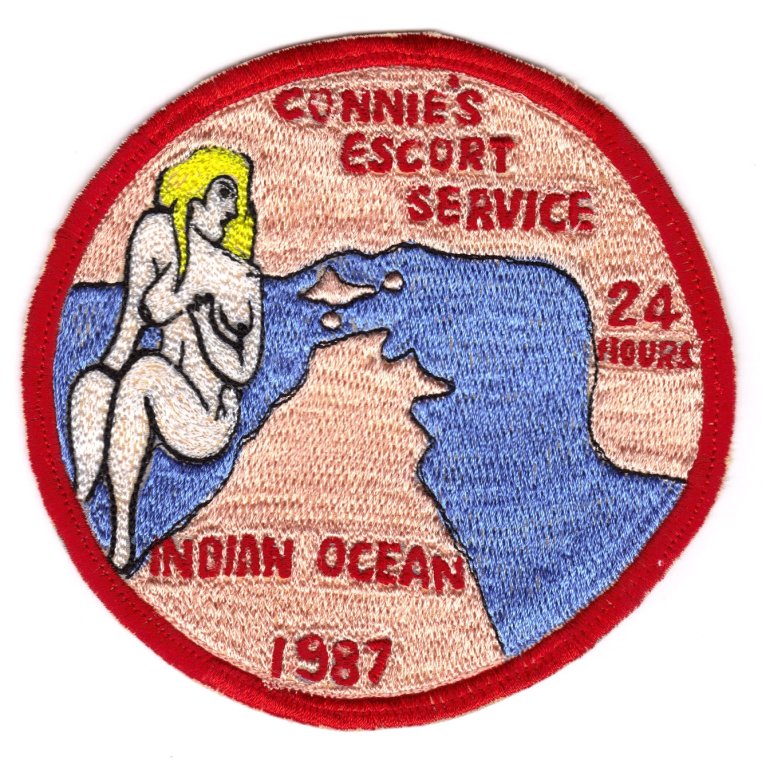
The above was taken the year before Connie was sent to help support Operation Earnest Will, the 14-months of nail-biting that came with escorting of re-flagged Kuwaiti tankers in the Persian Gulf as a result of Iranian attacks against international shipping with assets from the Pacific’s Third and Seventh Fleets and the Mediterranean-based Sixth Fleet. This was known by the crew as “Connie’s 24-hour Escort Service” (NSFW).

Connie was decommissioned 7 August 2003 and struck later the same year. She arrived in Brownsville on 16 January 2015 for dismantling and has been going to pieces slowly ever since.

CVW-14 was deactivated effective 31 March 2017, a process which started back in 2011.

Hanging by a thread, 45 years ago today

F-4J-34-MC Phantom II BuNo.155743 of Fighter Squadron 92 (VF-92, the Silver Kings) photographed aboard the USS CONSTELLATION (CV-64) on 9 December 1972. Note the crew is no longer aboard, courtesy of their Martin-Baker seats!

“The crew (Lt. J. R. Brooke & Lt. G. B. Bastian) was able to hook up the cable, but the plane at a certain point ‘swerved’ suddenly left to the left of the bridge. The two men were able to eject and were recovered shortly after an SH-3 Sea King, but the poor rhino was hanged as a crooked painting until the return to the port of San Diego.”

It was in this same year that, while on Yankee Station off Vietnam, another VF-92 Phantom, F-4J #157269, flown by LCDR James McDevitt and Lt. Curt Dose, shot down a Vietnam People’s Air Force Mikoyan-Gurevich MiG-21 with an AIM-9 Sidewinder.

VF-92 was disestablished on 12 December 1975 but the hapless 155743 was saved, put back into service, and was later even converted to F-4S standard, flying with VF-154 and the Marines of VMFA-312 until 1985 when she was put into storage at the AMARC bone yard. Odds are, she was probably scratched as a target drone sometime later.

“Connie,” on the other hand, remained in service until 2003 and was only recently scrapped at Brownsville, Texas.

F-14s were huge…

Take a close look at the two dozen Grumman F-14 Tomcats arrayed on the 1,092-foot long flight deck of the Roosevelt below.

Atlantic Ocean (March 10, 2006) – F-14D Tomcats are staged in launch position for their departure from the Nimitz-class aircraft carrier USS Theodore Roosevelt (CVN 71) to their home port of Naval Air Station Oceana. VF-213 and VF-31 are completing their final deployment flying the F-14 Tomcat. For the past 30 years, the F-14 Tomcat has assured U.S. air superiority, playing a key role in ensuring victory and preserving peace around the world. The F-14 Tomcat will be removed from service and officially stricken from the inventory in September of 2006. U.S. Navy photo by Photographer's Mate 3rd Class Chris Thamann

Atlantic Ocean (March 10, 2006) – F-14D Tomcats are staged in launch position for their departure from the Nimitz-class aircraft carrier USS Theodore Roosevelt (CVN 71) to their home port of Naval Air Station Oceana. VF-213 and VF-31 are completing their final deployment flying the F-14 Tomcat. For the past 30 years, the F-14 Tomcat has assured U.S. air superiority, playing a key role in ensuring victory and preserving peace around the world. The F-14 Tomcat will be removed from service and officially stricken from the inventory in September of 2006. U.S. Navy photo by Photographer’s Mate 3rd Class Chris Thamann

And on the elevator of the Conny…

030413-N-0295M-004 Arabian Gulf (Apr. 13, 2003) -- Hanger Deck Crew move a F-14D Tomcat assigned to the ÒBounty HuntersÓ of Fighter Squadron Two (VF-2) onto one of four aircraft elevators aboard USS Constellation (CV 64).  Constellation and Carrier Air Wing Two (CVW-2) are deployed in support of Operation Iraqi Freedom.  Operation Iraqi Freedom is the multinational coalition effort to liberate the Iraqi people, eliminate Iraq's weapons of mass destruction and end the regime of Saddam Hussein.  U.S. Navy photo by Photographer's Mate 2nd Class Daniel J. McLain.  (RELEASED)

030413-N-0295M-004 Arabian Gulf (Apr. 13, 2003) — Hanger Deck Crew move a F-14D Tomcat assigned to the Bounty Hunters of Fighter Squadron Two (VF-2) onto one of four aircraft elevators aboard USS Constellation (CV 64). Constellation and Carrier Air Wing Two (CVW-2) are deployed in support of Operation Iraqi Freedom. Operation Iraqi Freedom is the multinational coalition effort to liberate the Iraqi people, eliminate Iraq’s weapons of mass destruction and end the regime of Saddam Hussein. U.S. Navy photo by Photographer’s Mate 2nd Class Daniel J. McLain. (RELEASED)