Warship Wednesday, May 3, 2023: Where Dewey and Halsey Intersect
Here at LSOZI, we take off every Wednesday for a look at the old steam/diesel navies of the 1833-1954 period and will profile a different ship each week. These ships have a life, a tale all their own, which sometimes takes them to the strangest places.- Christopher Eger
Warship Wednesday, May 3, 2023: Where Dewey and Halsey Intersect

Via the estate of Lieutenant C.J. Dutreaux, U.S. Naval History and Heritage Command Photograph. WHI.2014.21
Above we see the splinter-riddled and abandoned Spanish Navy Velasco-class unprotected cruiser (crucero desprotegido) Don Juan de Austria as she appeared some 105 years ago this week, her hull on the bottom of Manila Bay, the first week of May 1898. Lost on the same day with two of her sisters of the “Escuadra Negra,” she would go on to serve a further two decades, albeit under a different flag.
The Velasco class
Built in three Spanish yards (La Carraca, Cartagena, and Ferrol) as well as at the Thames Iron Works in Blackwall, these very slight cruisers were meant for overseas colonial service and diplomatic representation in Spain’s far-flung global territories, not for combat against the armored fleets of modern states. Ridiculously small vessels by any measure, they ran just 210 feet overall with a 1,100-ton displacement. However, they could float in just two fathoms, which was important for their taskings.
Beautiful three-masted iron-hulled barque-rigged steamers with a bowsprit, they carried a quartet of British Humphrys cylindrical boilers to feed on a pair of horizontal compound steam engines that could turn a centerline screw for speeds up to 15 knots, although they typically only made about 12-13 in practice.
The eight-ship class included Velasco, Gravina, Cristóbal Colón, Isabel II, Don Antonio de Ulloa, Don Juan de Austria, and Infanta Isabel, all traditional Spanish naval heroes and regal names.
Only the first two, Velasco and Gravina, carried their maximum armament of a trio of British-made Armstrong M1881 BL 6-inch guns and two smaller 70mm/12cal Gonzalez Hontorias.

Cruiser Gravinia, Spanish Velasco class. The period illustration shows her sailing rig
The six follow-on vessels would carry a more homogeneous four-gun battery of 4.74-inch/35 cal M1883 Hontorias in single shielded mounts amidships, augmented by four five-barreled 37mm Hotchkiss anti-torpedo boat gatling guns, another quartet of 3-pounder Nordenfelts, and two 14.2 inch Schwartzkopff torpedo tubes along the beam.

Period line drawing of Conde de Venadito, note the two broadside sponsons supporting her 4.7-inch guns

The four 12-cm. B. L. Hontoria M1883s on the last six cruisers of the class had a range of 10,500 meters but were slow to reload. Here, is a blistered example seen on the Spanish Cruiser Isla de Cuba.
Our subject, named for the 16th-century Bavarian-born illegitimate son of King Charles I of Spain who went on to become a noted general and diplomat, was laid down at the Arsenal del Cartagena in 1883 and completed in 1889.
Constructed and delivered between 1879 and 1891, they saw much overseas service, with sister Infanta Isabel— the first metal-hulled warship built in Spain– especially notable for her appearance in American waters during the World’s Columbian Exposition in 1893 to celebrate the 400th anniversary of Christopher Columbus’s arrival in the New World.

Infanta Isabel in New York. (1893), Note the great view of her guns and masts

Infanta Isabel at the International Columbian Naval Review in New York in April 1893. Description: Courtesy of Ted Stone, 1981.NH 92029

Infanta Isabel in New York 1893

Spanish Velasco-class Unprotected Cruiser Infanta Isabel towing Nao Santa María out of Havana April 1893
Another, Conde de Venadito, would later transport the remains of Christopher Columbus from Havana to Seville at around the same time.

Cruisers Sánchez Barcaíztegui and Conde de Venadito, Havana, 1895

Spanish Cruiser of the Infanta Isabel Class photographed in U.S. waters, likely either Conde de Venadito or Infanta Isabel, with the river steamer Angler in the background, circa the 1880s or 1890s. NH 46866
As noted by the above images, the class typically carried a gleaming white scheme, which led to sisters assigned to the Philippines who carried more practical, black-painted hulled derided as “the Black Squadron.”
Sadly, they would also prove extremely unlucky to their crews. The English-built Gravina would be wrecked in a typhoon while in Philippines waters in 1884 just three years after she was completed. Meanwhile, the Carraca-constructed Cristóbal Colón ran aground in the Los Colorados shoal near Mantua Pinar del Río Cuba in 1895 then was destroyed by a hurricane before she could be pulled free.
Some saw extensive combat.
For instance, Conde de Venadito provided naval gunfire support during the Margallo War against the Rif in Morocco in 1893. Ulloa was continually active against Philippine insurgents in Mindanao in 1891 then again in 1896-97 in the Tagalog Revolt. Similarly, Velasco would unleash her guns on insurgents in Manila in 1896 and in Bacoor, Vinacayan, Cavite, Viejo, and Noveleta the following year.
Others fought Cuban rebels and those trying to smuggle munitions to them from time to time prior to 1898.
This brings us to…
The Crucible of the Spanish-American War
While fine for service as station ships in remote colonial backwaters, a floating sign to the locals that Spain’s enduring empire still had a modicum of prestige remaining, they just couldn’t slug it out with other modern warships of any size. Of the eight Velascos, two had been lost in pre-war accidents. Conde de Venadito, Isabel II, and Infanta Isabella were in Cuba, with the latter laid up in need of a refit.
Meanwhile, Velasco, Don Antonio de Ulloa, and our Don Juan de Austria were in the Philippines where they had been for a decade.
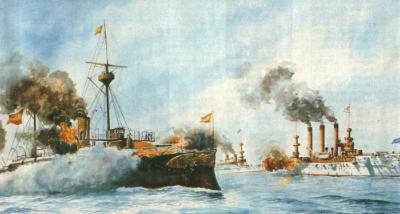
Their fight in the Battle of Manila on 1 May 1898 was brief.
Don Juan de Austria was the first Spanish ship in Admiral Don Patricio Montojo’s battleline to spot Dewey’s Asiatic Squadron, at 0445.

Battle of Manila Bay, May 1, 1898. With Manila, Philippines, in the top center, and the Spanish fleet in the upper right, the U.S. Navy ships listed descending on the left to bottom are: Colliers; USS McCullough; USS Petrel; USS Concord; USS Boston; USS Raleigh; USS Baltimore; and USS Olympia – signaling “Remember the Maine.” Color lithograph by Rand McNally. Courtesy of the Library of Congress.
Placed adjacent to the old Aragon-class wooden cruiser Castilla (c1869, 3342t, 4×5.9-inch guns, 2×4.7-inch guns) to give that ship some protection, by 0630 both vessels were taking hits and were increasingly disabled by American shells (at least 13 large caliber hits on Don Juan de Austria alone) that also killed or wounded several men. By 0830, both were abandoned.
A U.S. Navy boarding party from the gunboat USS Petrel went aboard later that day and set her upper works on fire.

Halftone reproduction of an artwork by E.T. Smith, 1901, depicting a boat party from USS Petrel setting fire to Spanish gunboats near the battle’s end. The party was under the direction of Chief Carpenter’s Mate Franz A. Itrich, who was awarded the Medal of Honor for this operation. Copied from Deeds of Valor, Vol.II, page 354, published by the Perrien-Keydel Co., Detroit, Michigan, 1907. Photo #: NH 79948

Wreck of the Spanish cruiser Castilla off Cavite, shortly after the battle. In the background are (left-to-right): the cruisers USS Olympia, USS Baltimore, USS Raleigh, and two merchant ships. Copied from the USS Baltimore album, page 27. NH 101344
Sister Don Antonio de Ulloa got an even tougher beating, receiving 33 hits (four 8-inch, three 6-inch, one of 5-inch, and the rest of 3- and 6-pounder). Her commander, Capt. José de Iturralde, was killed as were half of her 130-man crew. In a pyrrhic victory, one of her 3-pounder Hotchkiss rifles was credited with firing the last shot at Dewey’s fleet in the battle.

Wreck of Spanish cruiser Don Antonio de Ulloa NHHC WHI.2014
Later that day, Velasco, laid up pending repairs and without her guns installed, was destroyed while anchored in the company of the gunboat General Lezo in the Spanish yard at Cavite.

Wreck of Spanish cruiser Velasco at Cavite, May 1898. NHHC WHI.2014.24
Meanwhile, sisters Infanta Isabella and Conde del Venadito, in poor condition in Cuban waters, survived the war (largely because they did not fight) with the latter hulked soon after her return to Spain. Isabel II, who fought in the battles of San Juan and survived, was likewise scrapped just a few years later.
By 1907, only Infanta Isabella remained in Spanish service from the eight-ship class.

Infanta Isabella’s 1914 entry in Jane’s. She had been rebuilt between 1910 and 11, removing her tubes, old machinery, and guns and replacing them with a single Skoda 70 mm gun and 10 Nordenfelt 57 mm guns. Once she returned to Spain, she continued extensive overseas service in the Canary Islands, the Gold Coast, and Guinean possessions, soldiering on until 1926, a full 39-year career, benefiting from parts from the stripped Conde del Venadito and scrapped Isabel II.
But the battered Don Juan de Austria would sail again.
U.S. Service
Salvaged and repaired in nearby Hong Kong, our Spanish cruiser was commissioned into American Navy as USS Don Juan de Austria on 11 April 1900. Re-rated as a gunboat due to her small size and low speed, she was rearmed with American ordnance to include two 4-inch mounts, eight rapid-fire 6-pounders, and two rapid-fire 1-pounders. Her waterlogged Spanish machinery was replaced with four straight-away cylindrical boilers, and one 941ihp horizontal compound engine, allowing her to make 12 knots.
In this respect, she mirrored another raised Spanish cruiser, the second-class protected cruiser USS Isla de Luzon, which was also one of Admiral Montojo’s warships lost in Manila Bay. A third Spanish cruiser, the Alfonso XII-class Reina Mercedes, sunk as a blockship in the entrance channel of the harbor at Santiago de Cuba, was also raised and put into U.S. Navy service under her old name, becoming USS Reina Mercedes despite the fact she could not even sail under her own power and would serve her second career wholly as a receiving/barracks/prison ship. In each case, the old Spanish Navy names were carefully retained to highlight the fact they were war trophies.
More mobile than USS Reina Mercedes, which earned the unofficial title of the “Fastest Ship in the Navy,” USS Don Juan de Austria did manage to get around quite a bit once her name was added to the Navy List. Her first American skipper was CDR Thomas C. McLean, USN, fresh off his job as commanding officer of the torpedo station at Newport, Rhode Island.

Officers of USS Don Juan de Austria. Photograph taken while at Canton, China, circa September 1900. Note her newly installed USN quarterdeck board. The officers listed are numbered as follows: 1. Lieutenant Junior Grade John D. Barber, Asst. Paymaster, USN; 2. Naval Cadet Allen Buchanan, USN; 3. Lieutenant John L. Purcell, USN; 4. Ensign William L. Littlefield, USN; 5. Naval Cadet Ralph E. Pope, USN; 6. Lieutenant Henry B. Price, USN; 7. Commander Thomas C. McLean, USN, CO; 8. Lieutenant Harold A. Haas, Asst. Surgeon, USN; and 9. Lieutenant Armistead Rust, USN. NH 104885
She soon spent the next three years alternating between standing station off China to protect American interests there, and action in the Philippines where the U.S. was fighting a tough insurgency throughout the archipelago.

USS Don Juan de Austria in Chinese waters circa 1900. Note she now has a white hull, two much-reduced masts, and extensive awnings. NH 54544
Per DANFS:
She was employed in the Philippines in general duties in connection with taking possession of the newly acquired territory, supporting Army operations against the insurgent native forces, transporting troops and stores, blockading insurgent supply routes, and seizing and searching various towns to ensure American control.

USS Don Juan de Austria photographed in the Philippine Islands, circa 1900. Inset shows one of the ship’s boats. Courtesy of Captain R. E. Pope, USN (Ret.) NH 54546
In this, her crew could be nearly halved to send as many as 75 bluejackets ashore as an armed landing force.

Her crew would even take into custody one of the insurgency’s leaders.

Aguinaldo, a cousin of Emilio, Guiando, Captured by the Don Juan De Austria 1900. NH 120409
She departed Hong Kong on 16 December 1903 for the United States, sailing by way of Singapore, Ceylon, India, the Suez Canal, and Mediterranean ports to arrive at Portsmouth Navy Yard on 21 April 1904, where she was placed in ordinary for 18 months’ worth of repairs and refit. This saw her small 4- and 1-pounders removed, and another four 4-inch mounts added, giving her a total of six. Four Colt machine guns were also added.
In December 1905, a young Midshipman by the name of William Frederick Halsey, Jr. (USNA 1904) was transferred to the USS Don Juan de Austria. Promoted to ensign while aboard her the following February, Mr. Halsey served as the gunboat’s watch and division officer for the next two years.

USS Don Juan de Austria, the scene in the wardroom with officers reading circa 1906. Tinted postcard photo. Courtesy of Captain Ralph C. McCoy, 1974. NH 82781-KN

USS Don Juan de Austria, a group photo of the ship’s officers and crew, circa 1907. The officer at the extreme lower right is Ensign William F. Halsey. Note the breechblock of the 4-inch gun to the left. Courtesy of the U. S. Naval Academy Museum NH 54547
Assigned to the Third Squadron, Atlantic Fleet, USS Don Juan de Austria with Halsey aboard would spend most of 1906 off the Dominican Republic “to protect American interests,” clearly swapping being a colonial Spanish cruiser to one on the same mission for the White House.
However, with a new series of much more capable small cruisers joining the fleet, such as the 4,600-ton scout cruiser USS Chester (CL-1)-– which packed eight 5- and 6-inch guns, carried a couple inches of armor protection, and could make 26 knots– Don Juan de Austria was no longer needed for overseas service. With that, she was placed out of commission at the Portsmouth Navy Yard on 7 March 1907. As for Halsey, he joined the brand new USS Kansas at her commissioning five weeks later and made the World Cruise of the Great White Fleet in that battleship.
Nonetheless, the Navy still needed functional warships for state naval militias to drill upon in the days prior to the formation of the USNR, and USS Don Juan de Austria soon shipped by way of the St. Lawrence River to Detroit, where she was loaned to the Michigan Naval Militia.
Likewise, the former Spanish cruiser USS Isla de Luzon, was also loaned at this time to the Illinois Naval Militia, stationed at Chicago, meaning both of these one-time Armada vessels were deployed to the Great Lakes in the decade before 1917.
Our little cruiser became a regular around Detroit and Windsor.


Don Juan de Austria (on the right) is seen looking upriver from the Belle Isle Bridge in Detroit, Michigan during the Parke Davis Excursion. Sometime between July 1907 and April 1917. Library of Congress photo LC-D4-39089

USS Don Juan de Austria, pre WWI postcard, likely while in Naval Militia service. Courtesy of D.M. McPherson, 1976 NH 84404

USS Don Juan de Austria postcard photo, taken while serving as Michigan Naval Militia Training Ship in the Detroit River, circa 1910. Courtesy of Kenneth Hanson, 1977. NH 86031

USS Don Juan de Austria, photographed during the Perry centennial Naval parade, 1913, possibly at Erie, Pennsylvania. She was a training ship of the Michigan Naval Militia at the time. Courtesy of Rear Admiral Denys W. Knoll USN ret., Erie Pennsylvania. NH 75676
Great War recall

USS Don Juan de Austria, 1914 Janes. Compare this to Infanta Isabella’s entry from the same volume above. Note by this time her armament had morphed to two 4″/40 rapid fire mounts, eight 6-pounder rapid fire mounts, two 1-pounder rapid fire mounts and she would later also carry two temporary 3-pounders.
Once the U.S. entered WWI in April 1917, USS Don Juan de Austria would soon leave her familiar birth in Detroit and sail for Newport, where she became a patrol asset for use off of New England.

USS Don Juan de Austria, ship’s Officers, and Crew pose on board, circa 1917-1918. Photographed by C.E. Waterman, Newport, Rhode Island. Donation of Dr. Mark Kulikowski, 2008. NH 105498
Under the command of a USNRF lieutenant, by August 1918 she was escorting slow convoys to Bermuda and a group of submarines back to Newport. Among her final missions was, in April 1919, to escort the ships carrying the 26th Infantry “Yankee Division,” formed from New England National Guard units, back from “Over There” and German occupation duty back home to Boston.

USS Don Juan de Austria in the foreground leading USS America (ID # 3006) up Boston Harbor, Massachusetts, on 5 April 1919, the 26th INF Div aboard. The transport is the former 22,000-ton German Hamburg-America liner SS Amerika, seized by the Navy at Boston in April 1917 where she had been interned for three years. NH 54586
Similarly, Isla de Luzon was used as a recruit training ship in Chicago until September 1918 when she arrived at Narragansett Bay for assignment to the Naval Torpedo Station. There, armed with torpedo tubes for the first time since 1898, she would pull duty with the Seamen Gunner’s Class through the end of the year and remain a yard craft for the Station until disposed of in mid-1919.
USS Don Juan de Austria was decommissioned at Portsmouth on 18 June 1919 and sold on 16 October 1919 to one Mr. Andrew Olsen. She lingered until 1926 when mention of her arose as “abandoned.” I have no further information on her final disposition although it is marginally conceivable, she may have been converted to a tramp steamer.
Epilogue
Few items remain from the Velascos besides a handful of removed Spanish guns that have been on display, typically in small American towns, since 1898.
Also saved is the Hotchkiss rifle captured from the Spanish cruiser Don Antonio De Ulloa which fired the last shot at Dewey’s fleet, preserved at the National Museum of the U.S. Navy.

They endure in period maritime art.

Spanish Armada’s Training Squad before the Spanish-American War of 1898, although the represented ships never sailed together. Oil on canvas painted and signed with initials A.A. by Antonio Antón e Iboleón, around 1897. From left the Battleship Pelayo with insignia, followed by the cruisers Cristóbal Colón, Infanta María Teresa, and Alfonso XIII; to the right, the cruiser Carlos V with insignia, Oquendo and Vizcaya. On the starboard side of the Pelayo sails the Torpedo-gunboat Destructor, and two Terror-class torpedo boats sail on the bows of the Carlos V.
USS Don Juan de Austria almost outlasted her sisters, the Cadiz-built Infanta Isabel, which was only stricken by the Spanish in 1926, and Count of Venadito, which, hulked in 1902, was sunk as a target by the battleship Jaime I and the cruisers Libertad, Almirante Cervera, and Miguel de Cervantes in 1936.
A fitting end to the class.
Ships are more than steel
and wood
And heart of burning coal,
For those who sail upon
them know
That some ships have a
soul.
If you liked this column, please consider joining the International Naval Research Organization (INRO), Publishers of Warship International
They are possibly one of the best sources of naval study, images, and fellowship you can find. http://www.warship.org/membership.htm
The International Naval Research Organization is a non-profit corporation dedicated to the encouragement of the study of naval vessels and their histories, principally in the era of iron and steel warships (about 1860 to date). Its purpose is to provide information and a means of contact for those interested in warships.
With more than 50 years of scholarship, Warship International, the written tome of the INRO has published hundreds of articles, most of which are unique in their sweep and subject.
PRINT still has its place. If you LOVE warships, you should belong.
I’m a member, so should you be!