Tag Archives: coal fired ironclad

Warship Wednesday, Sept 12

Here at LSOZI, we are going to take out every Wednesday for a look at the old steampunk navies of the 1866-1938 time period and will profile a different ship each week.

– Christopher Eger

Warship Wednesday,  Sept 12


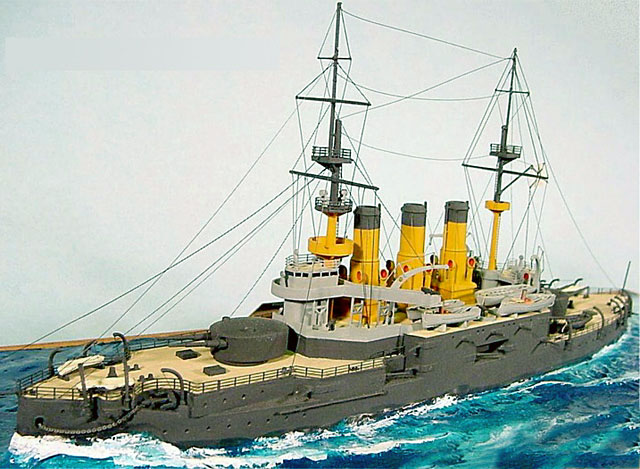
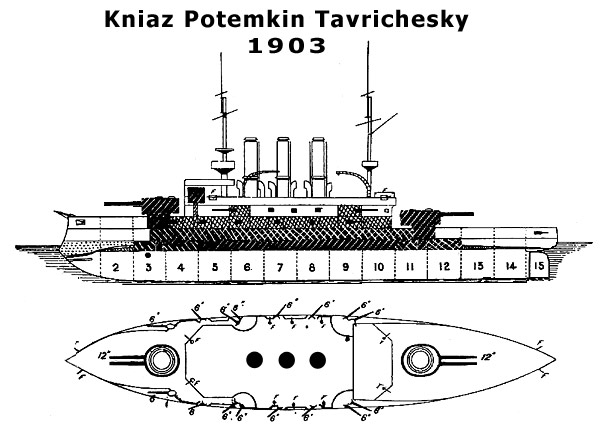
Here we have the Kniaz Potemkine Tavritchesky, ‘Prince Potemkin of Tauris,’ a pre-dreadnought battleship of the Imperial Russian Navy, in model form.

Built at the  Nikolayev shipyard 1898-1904, she was a proud warship and one of the strongest in the Black Sea fleet, — a more modern vessel than any ship the Sultan of the Ottoman Empire could muster. She was thoroughly modern, with much help from French, German, and British engineering firms in her design. She was the first Russian battleship with liquid-fueled boilers and a centralized fire control.

Specs:
Displacement:  13500 tons full load
Length:     115 m (377 ft 4 in)
Beam:     22.3 m (73 ft 2 in)
Draught:     8.2 m (26 ft 11 in)
Propulsion:

2 shaft VTE,
22 Bellville coal-fired boilers,
11,300 hp

Speed:     16 knots (30 km/h)
Complement:     18 officers and 763 men
Armament:

4 × 305 mm (12 in) guns in two turrets,
16 × 152 mm (6 in) guns,
14 × 75 mm (3 in) guns,
various small-calibre guns.
5 × 380 mm (15 in) torpedo tubes

Armour:

Krupp armour
6–9 in (150–230 mm), belt
2.5–3 in (63–76 mm), deck
10 in (250 mm), turrets
5–6 in (130–150 mm), casemates
9 in (230 mm), conning tower
When Russia found herself in the middle of the Russo-Japanese War in 1904, the brand new ship, forbidden from ever leaving the Black Sea by international treaty, lost most of her best and most experienced crew. Only raw recruits and an understrength and untalented NCO and officer corps were detailed to the ship. On June 23, 1905 a group of sailors met to plot a mutiny. The next day some 40 sailors are removed from the ship. The battleship put to sea for gunnery training with her inexperienced crew. On June 27th, all hell broke loose.

At 4 am the ship took on a supply of rotten meat. The Russian tars, already pissed at their life of toil, notice the maggots and the revolutionaries start a boycott of the Borscht made with the meat. The ship’s captain, had the 700-man crew assembled on deck and ordered to eat it, of which only 12 sailors obey. The rest are threatened with 20 armed marines, the sailors dispersed. Second-in-command Gilyarovsky calls for tarpaulin so he can execute 30 sailors who did not flee, and not soil the decks. 30 revolutionaries steal rifles from the armory, and take over the signal and engine rooms. They rush aboard, the marines do not fire. Stoker Nikishkin fires the first shot.The captain flees to his cabin. Gilyarovsky shoots Grigory Vakulinchuk then orders the guards to fire, they flee, he is shot. They stop the torpedo boat Ismail from escaping with officers who jumped overboard. 7 officers are killed, 12 arrested. 25 sailors are elected to a committee with Matyushenko chairing. They make ensign Alekseyev, the only one of the 18 officers to side with the mutineers, captain. They raise the red flag and toss the Tsar’s portrait into the sea. At 10pm they arrive at Odessa.

For three days the Potemkin was a revolutionary battleship in Odessa harbor. On the morning of 30 June the three loyal battleships Tri Sviatitelia, Dvenadsat Apostolov, and Georgii Pobedonosets arrived to take the red flag of the Potemkin down, or sink the ship. The crew of the Apostolov refused to ram the red battleship while the Pobedonosets broke into open mutiny. Over the next two days, the mutiny spreads to a great many ships across the entire Black Sea Fleet. Slowly however the risings on the other ships flare up and die out. The commander of the Apostlov, one Captain Kolands even tried to blow his own ship and drown his crew. By July 8th, the revolutionary battleship sailed to Constanta Rumania, where her sea cocks were opened in the harbor and her crew surrendered.

The Tsar decreed that she was, after the events of 1905, renamed the Panteleimon after the patron saint of accidents. Here she is during that time period, in flat paint scheme. From 1906-1917 she was always left to bring up the rear in any naval parade, never to have a position of honor or carry an admiral’s flag.

In October of that year the ship was re-floated and returned to the Tsar. In shame her name was stricken and once she was repaired she was entitled Saint Pantaleon, the patron saint of accidents and loneliness. With a new crew (more than 600 of her old remained in Rumania or emigrated abroad) she quietly served the Tsar. During World War One she fought unremarkably against the combined German-Ottoman forces and in 1917, after the Tsar was deposed, her old name was restored. During the Russian Civil War she was scuttled for a second time, by the British, in April 1919 when the Interventionists abandoned Odessa. Not worth salvaging, the Soviets scrapped the hulk in the 1920s.

Her story, was immortalized in Sergi Einsteins epic 1925 film, The Battleship Potemkin.

The Potemkin was scrapped before the film was shot, however the Soviets dug up the old battleship “Dvenadtsat Apostolov”, (that had refused to ram Potemkin in 1905) as a stand in. That old beater had been removed from active service in 1911 and served as depot  hulk without engines or armament until mid-1920s, when the film was made. Despite the fact that she was from a similar period (1892) she was only about half the size of Potemkin (at 8,000-tons and with only two stacks instead of three) and had to be heavily modified externally with dummy gun turrets.

However the film lives on….

Warship Wednesday September 5

Here at LSOZI, we are going to take out every Wednesday for a look at the old steampunk navies of the 1866-1938 time period and will profile a different ship each week.

– Christopher Eger

Warship Wednesday,  Sept 5

Here we have the Italian Torpedo Boat MAS 15 racing away from the already dramatically listing Austrian battleship Szent István on 10 June, 1918.  MAS 15 was the only Motor Torpedo boat of any navy in history to sink an enemy battleship and set the bar impossibly high for World War Two.

Italian MTBs of this period were known as Motoscafo Armato Silurante (MAS) which translates as “torpedo armed motorboats”. MTBs were designed for high speed, operating at night, low speed ambush (to keep noise low and to produce no wake)and maneuverability on the water; this was to enable them to get close enough to launch their torpedoes at enemy vessels. With next to no armor, the boats relied upon surprise and their agility at high speed
to avoid being hit by gunfire from bigger ships.


Specs:
Length: 49 feet (15m)
Propulsion: twin gasoline motors (extremly flammable)- 21knots top speed with torpedoes, 30 without.
Construction: thin mild steel hull
Crew: 1 officer, 7 ratings
Armament: Two 14-inch torpedoes in collars that dropped over the side.  Two Marlin machine-guns (1895/15)

The tiny wooden craft sent two torpedos into the hull of the 499-foot 21,689 ton Tegetthoff-class battleship Szent István. At about 3:15 am on 10 June, 1918 two Italian MAS boats, MAS 15 and MAS 21, spotted the smoke from the Austrian ships while returning from an uneventful patrol off the Dalmatian coast. The MAS platoon was commanded by Capitano di corvetta Luigi Rizzo, who had sunk the Austro-Hungarian coastal defense ship SMS Wien in Trieste six months before.The individual boats were commanded by Capo timoniere Armando Gori and Guardiamarina di complemento Giuseppe Aonzo respectively. Both boats successfully penetrated the escort screen and split to engage each of the dreadnoughts. MAS 21 attacked Tegetthoff, but her torpedoes failed to hit the ship. MAS 15 fired her two torpedoes successfully at 3:25 am at Szent István. Both boats evaded any pursuit although MAS 15 had to discourage the torpedo boat Tb 76 by dropping depth charges in her wake. Tegetthoff thought that the torpedoes were fired by submarines and pulled out of the formation and started to zigzag to throw off any further attacks. She repeatedly fired on suspected submarine periscopes until
she rejoined her half-sister at 4:45.

Szent István was hit by two 45-centimetre (18 in) torpedoes abreast her boiler rooms. The aft boiler room quickly flooded and gave the ship a 10° list to starboard. Counter-flooding of the port-side trim cells and magazines reduced the list to 7°, but efforts to use collision mats to plug the holes failed. While this was going on the dreadnought steered for the nearby Bay of Brgulje at low speed. However, water continued to leak into the forward boiler room and eventually doused all but the two boilers on the port side. This killed the power for the pumps and only left enough electricity to run the lights. The turrets were trained to port in a pointless effort to counter the list and their ready ammunition was thrown overboard. An attempt by Tegetthoff to take the crippled battleship into tow was also abandoned after it became clear that Szent István was doomed. Flooding continued, and Szent István capsized at 6:05 am off Premuda Island. Only 89 sailors died—41 from Hungary—the low death toll partly attributed to the fact that all sailors with the KuK Navy had to learn to swim before entering active service.

Film footage exists of Szent István‘s last half-hour, taken by Linienschiffsleutnant Meusburger of the Tegetthoff with his own camera as well as by an official film crew.

The wreck of the Szent István was located in the mid-1970s by the SFR Yugoslav Navy. She is upside down at a depth of 66 metres (217 ft).Her bow broke off when it hit the seabed while the stern was still afloat, but is immediately adjacent to the rest of the heavily encrusted hull. The two holes from the torpedo hits are visible in the side of the ship as is another deep hole which may be from a torpedo fired at Tegetthoff by MAS 21.
Nevertheless, nobody cares about MAS 21, its MAS15 that gets the credit.

Here she is preserved  today some 94 years later:

Capitano di fregata Luigi Rizzo was awarded his second Gold Medal of Military Valor, his first was for sinking the pre-dreadnought battleship Wien in 1917, and appointed a knight in the Order of the Crown of Italy. After the war MAS 15 was installed in the Monument to Vittorio Emanuele II as part of the Museo del Risorgimento in Rome. The anniversary of the sinking has been celebrated by the Regia Marina, and its successor, the Marina Militare, as
its Navy Day

Not bad for a boat the size of your typical cabin cruiser.

Warship Weds Aug 29

Here at LSOZI, we are going to take out every Wednesday for a look at the old steampunk navies of the 1866-1938 time period and will profile a different ship each week.

– Christopher Eger

Warship Wednesday,  Aug 30

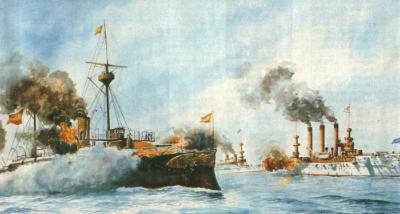
Here we have the Giuseppe Garibaldi-class armored cruiser of the Spanish Navy, Cristóbal Colón.

The Cristóbal Colón was built in Italy in 1895-97 and acquired by the Spanish Government with a war looming in the New World over Cuba. Designed with a large main 10-inch gun the ship was never armed with such as went to war with a staggered armament of 8, 6, and 3-inch weapons along with early machine guns and torpedo tubes.

She was part of Admiral Cervera’s squadron in the harbor of Santiago de Cuba when an American squadron arrived on 27 May 1898 and began a blockade which would drag on for 37 days. Finally, the squadron charged out to tried to break the blockade.

One by one her squadron mates were sent to the bottom by massed firepower of the US Fleet. Cristóbal Colón steamed on alone, the last survivor of Cervera’s squadron. For a time, it seemed that she might get away. Although her machinery was not able to get her up to her top speed after months of hard steaming, she was rated as the fastest ship of either side in the battle, was better armored and armed than her erstwhile squadron mates, and thus far had taken only two 5-inch (127 mm) or 6-inch (152 mm) hits. She was making 15 knots (28 km/h), and the fastest and closest U.S. ship, Brooklyn, was now six miles (10 km) behind her. Vixen was close behind Brooklyn. Armored cruiser USS New York, making 20 knots (37 km/h), was closing, and, farther behind, battleships Texas and Oregon also were making their best speed in pursuit.

By Manuel García García

By Manuel García García. Note the empty turret

After another hour, Cristóbal Colón had run through all of her best coal, switched to an inferior grade, and began to lose speed. At 1220, Oregon fired a 13-inch (330-mm) round which landed just astern of Cristóbal Colón, and soon more 13-inch (330 mm) rounds, as well as 8-inch (203-mm) shells from Brooklyn and New York, were landing around the Spanish ship. In contrast, she had only one 6-inch (152-mm) gun that would bear on her pursuers.

All told, the Spanish cruiser was hit six times.When the range dropped to 2,000 yards (1,830 m), the commanding officer of Cristóbal Colón, Captain Jose de Paredes, decided that after a 50 mile run, the chase was over; in order to save the lives of her crew, he beached her at the mouth of the Tarquino River, 75 miles (65 nmi; 121 km) west of Santiago, at 1315 hours. It was the end of the Battle of Santiago de Cuba.

Some of her sailors made it ashore, although they had to beware of Cuban insurgents, who began to shoot the survivors of the wrecked Spanish ships. Others were rescued by American sailors who came alongside the wreck in small boats to take off survivors.

That night, a U.S. Navy salvage team from repair ship USS Vulcan decided that Cristóbal Colón was worth salvaging and towed her off the rocks. But she lacked watertight integrity and quickly capsized and sank, a total loss. Today she is a popular dive destination off the Cuban coast, especially with Spanish tourists.

Displacement:     7,972 long tons (8,100 t) full load
Length:     366 ft 8 in (111.76 m)
Beam:     59 ft 10 1⁄2 in (18.250 m)
Draft:     23 ft 3 1⁄2 in (7.099 m) maximum
Installed power:     13,655–14,713 ihp (10.183–10.971 MW)
Propulsion:     Vertical triple expansion, 24 boilers
Speed:     19.3–20.02 knots (35.7–37.08 km/h)
Endurance:     4,400 nmi at 10 knots
(8,100 km at 19 km/h)
Complement:     510 to 559 officers and enlisted
Armament:     1 × 10 inch/45-caliber (254 mm) gun (never installed)
2 × 8 inch/45-caliber (203 mm) guns
14 × 6 inch/40 caliber (152 mm)
10 × 3 inch (76.2 mm)/40-caliber
6 × 47 mm guns
2 Maxim machine guns,br />4 × 17.7 inch (450 mm)torpedo tubes.
Armor:     Belt: 4.8 in (122 mm);
Conning tower 4.8 in (122 mmm)
Deck 1.5 in (38 mm)
Turrets 4.8 in (122 mm)
Deck gunshields 2 in (51 mm)
Notes:     1,050 long tons (1,070 t) coal (normal)

Warship Wednesday, Aug 22

Here at LSOZI, we are going to take out every Wednesday for a look at the old steampunk navies of the 1866-1938 time period and will profile a different ship each week.

– Christopher Eger

Warship Wednesday,  Aug 22

One of the great mysteries of the Sea is the cruiser Unebi. We may never know what happened to her.

Here we have the brand new protected cruiser Unebi of the Imperial Japanese Navy leaving the harbor of Le Harve.

The Imperial Japanese government, only just recently opened to outside trade, was fast arming itself to become a regional power. With shipbuilding industry in its infancy, the Japanese government contracted for warships all over the world. The Unebi was designed and built in France by Forges et Chantiers de la Gironde. Unebi was named after the 199.2 meter tall Mount Unebi in Nara prefecture, located near the ancient capital of Asuka. Per Meiji period State Shinto mythology, this mountain was home to Japan’s first Emperor, Jimmu Tenno.

Fast and heavily armed, Japan would miss this speedy slugger in coming naval clashes

She was relatively fast and nimble for her time, and could do over 18-knots. This would be the equivalent of almost 40knots today, and few ships on the water could catch her or outrun her. With a huge armament of 10-inch and 6-inch naval rifles, she had large teeth to go along with her fast legs.

Too bad for Japan, who only seven years later could have used her against Chinese warships in the 1894 Sino-Chinese War, or against the Russians in 1904, the Unebi went missing on her delivery trip to her homeland from France.

She was last seen leaving Singapore in December 1886 with 76 French civilian sailors commanded by a French merchant captain. Seven Japanese naval officers were on board to observe while her Japanese crew awaited her safely in Yokohama.

None wreckage of her was ever found. None of the men were ever recorded. The sea is yet to give her location up and she remains one of the greatest mysteries of naval history.

After watching for her to appear for ten months, the Japanese Navy struck her name from the register and declared her missing. Unebi is the only case of a ship vanishing without a trace in the annals of the Imperial Japanese Navy.

Specs:
Displacement:     3,615 long tons (3,673 t)
Length:     98 m (321 ft 6 in) w/l
Beam:     13.1 m (43 ft 0 in)
Draught:     5.72 m (18 ft 9 in)
Propulsion:     2-shaft VTE, 9 boilers, 5,500 hp (4,100 kW), 700 tons coal
Speed:     18.5 knots (21.3 mph; 34.3 km/h)
Complement:     280-400
Armament:     • 4 × BL 10 inch gun Mk I – IV guns
• 7 × BL 6 inch gun Mk II – VI guns
• 2 × QF 6 pounder Hotchkiss
• 10 × quad 1-inch Nordenfelt guns
• 4 × Gatling guns
• 4 × 356 mm (14.0 in) torpedo tubes
Armour:     Deck: 62 mm (2.4 in)
Upper belt: 125 mm (4.9 in)
Barbette, Turret, Casement: 150 mm (5.9 in)

A memorial monument to the missing crew of Unebi is located at Aoyama Cemetery in Tokyo.

Warship Wednesday Aug 15

Here at LSOZI, we are going to take out every Wednesday for a look at the old steampunk navies of the 1866-1938 time period and will profile a different ship each week.

– Christopher Eger

Warship Wednesday,  Aug 15


Here we see a good color rendering of the circular battleship Popov

One of the most unusual ships of thier day, or any other, the circular battleship Vice Admiral Popov (originally named the Kiev) and her sistership the Novogrod were designed after delivery to the Imperial Russian Navy of several US-built post-civil war era armored clad monitors. Thier father, Vice Admiral Andrei Alexandrovitch Popov (hmm, the name sounds familar…) came up with the idea of a circular floating platform that could move up and down the seacoast and defened weakspots and choke points. Since they could float in just 10-feet of water, they could hide in shallow esturaries where other larger and stronger ships could not follow. From thier with a pair of 11-inch rifled guns they could dish out some lovin to Turk, Swede, or British ships coming too close to the Motherland. (Remember Germany and Austria were Russia’s closest allies until Kaiser Willy Part II changed that) The two ships were built 1870-74.

On the positive, the ship was stable as a gunplatform, it just sailed like crap and was vulnerable to plunging fire, being effectively a large bullseye floating on the water. Her decks were armored with 60mm of plate steel, which was effective for 1870s era mortars and shells, but by the 1900s was totally ineffective. Thus in 1900 the Popov and the Novorgrod were stricken. Utilised as storeships and for the occasional dockside training they were scrapped in 1912 on the eve of World War One. Thier only war use was briefly in the Danube River Flotilla in 1877 where they traded shots with Turkish land batteries.

Specs:
Displacement:     2,491 tons
2,671 tons at full load
Length:     30.8 m
Beam:     30.8 m
Draught:     3.75 m
Propulsion:     8 coal-fired boilers, 6 screws, 2,000 ihp
Speed:     7 knots
Complement:     128
Armament:
2 × 11 inch guns
2 × 4-pounder guns
16 × 37 mm guns
Armour:
Belt: 230 mm
Deck: 60 mm

The Cossacks Are Coming, Aren’t They?

The misinterpreted Russian Navy mission in the U.S. Civil War may have accidentally helped the North win the conflict.

In 1863, it looked as if the mighty British Empire may intervene in the US Civil War on the side of the Confederate States (CSA). War fever had come to London early in the conflict after the “Trent Affair” placed the Her Majesty’s Navy and Army on alert. British firms such as Enfield and Whitworth sold tremendous amounts of arms of all kinds to Confederate agents and these were in turn often smuggled through the US Naval quarantine via British blockade-runners. Confederate raiders including the notorious CSS Alabama and CSS Shenandoah were constructed in English harbors. British war tourist Colonel (later General Sir) Arthur Fremantle in 1863 had just returned from three months among both the US and Confederate commands fighting the war and loudly pronounced that the Confederates would certainly be victorious.

Relations with the Tsar and the Union

Relations between the United States and Tsarist Russia were warmer than with many other European nations at the time. Cassius Marcellus Clay, a well-known abolitionist, was the US Ambassador to the court of Tsar Alexander II during the conflict. It was Clay’s report on the Tsar’s Emancipation of 23,000,000 Russian Serfs in 1861 helped pave the way for Lincolns own Emancipation Proclamation of the 4,000,000 American Negro slaves the next year. American engineers and railway organizers were helpful in starting the early Russian railway system. Clay openly encouraged a military alliance with between the US and Britain, France, and possibly Spain openly thought of Russia as a hedge between what as a possible intervention on the Confederate side.

Cassius Clay…..the original one not the boxer

The Russians Arrive

Suddenly, on September 24, 1863, two separate Russian naval squadrons arrived in US waters unannounced on both the East and West coasts. The Russian Atlantic fleet on the US East Coast had sailed from the Baltic and arrived at New York under command of Rear Admiral Lesovskii with three large frigates and three smaller vessels. The fleet included the new and fearsome 5,100-ton US-built screw frigate Alexander Nevsky with 51 sixty-pounder naval guns. The Russian Pacific fleet that arrived on the West Coast in San Francisco was under command of Rear Admiral Popov and consisted of four small gunboats and a pair of armed merchants cruisers. The ships were saluted and allowed entry as being on a friendly port call.

The 5100-ton frigate Alexander Nevsky was one of the finest ships of any navy in the Atlantic. This is a portrait of her in New York Harbor in 1863 that was in Harper’s Weekly.

The crew of the Russian frigate Osliaba harbored in Alexandria, Virginia, 1863.

The American media and political machine immediately interpreted the reason for these naval visits as clear Russian support for the US cause. The real reason, however, seems to be something quite different. Poland, largely occupied by Russia, was in open revolt in the summer of 1863. The so-called Polish Crisis followed in which there was a possibility that Britain and or France would intervene on the side of the insurgent Poles. The Tsar, fearing that his isolated Pacific and Atlantic naval squadrons would be seized or destroyed by superior British or French units in the event of war, sent them into the neutral US ports to seek refuge. This fact was held from the Americans and the fleet’s Russian officers simply stated that they were in US ports for ‘not unfriendly purposes”

The respective admirals of the Russian squadrons had sealed orders to place themselves at the disposal of the US government in the event of a joint British or French intervention on both Russia and the United States. In the event of Russia entering into war with the Anglo-French forces alone then the Russian ships were to sortie against the commercial fleets of those vessels as best as they could and then seek internment.

Rear Admiral Lesovskii, now that’s an impressive figure. How could the Union NOT think the appearance of this guy in Washington meant that Russia was on their side?

The Outcome of the Visit

Several historians claim that the British government saw this mysterious visit by the Russians in US waters as an open confirmation of a secret military pact between the two future superpowers. This interpretation further helped deter foreign recognition of the Confederate cause and resulted in the extinguishing of the South’s flame of hope. It can also be claimed that it stalled British intervention in the Tsar’s problems in Poland with the thought that it could result in a US invasion of Canada.

When the Polish Uprising crisis abated in April 1864, the Russian fleets were recalled quietly to their respective home waters. The dozen Tsarist warships had conducted port calls and training cruises in the US and neighboring waters for almost seven months during the war while managing to avoid the conflict altogether. In the late fall of 1863 with rumors of Confederate raiders lurking on the West Coast, Admiral Popov confirmed to the governor of California that he and his fleet would indeed protect the coast of their defacto ally if the raiders did actually appear. The effect of this ‘fleet-in-being’ resulted directly in an increase in US-Russian relations.

The US Navy, on the cutting edge of ironclad steam warship design, passed along plans and expertise to their Russian colleagues who had no such vessels. By 1865, the Tsar had a fleet of ten ultra modern 200-foot long ironclad battleships based on the monitor USS Passaic. These ships, known to the Russians as the Uragan (Bronenosetz) class were completed even with two US-designed 15-inch smoothbore Dahlgren guns and far outgunned any other European navy of the time.

Ten of these Uragan class monitors were built in the US for Russia after the Civil War and were the backbone of the modern Tsarist Navy for decades.

In 1867, Russian Ambassador Baron Stoeckel advised US Secretary Seward that the Russian government would entertain bids for the failing colony of Alaska, which was rapidly accepted. Cassius Clay, still in Russia helped to conduct the negations from inside the Winter Palace. The Russians even rapidly transferred control of the territory, which was seen by many to be worthless nearly a year before Congress ratified the transfer and in effect, couldn’t give it back.

This odd incident of the Russian fleets; visit may have prevented what would have certainly been one of the planet’s first and possibly oddest of world wars. The real reasons for the Russian fleet’s visit were only uncovered and publicized nearly fifty years later in 1915 by military historian Frank Golder.

By that time the Uragan class monitors were long scrapped (except for one), Alaska was a US territory and Russia was finally at war with Britain and France- this time as allies against Germany and Austria in World War One.

On the West Coast, there is also a more lingering reminder.

While in San Francisco, a number of crewmen from the Bogatyr, Popov’s flagship, fought a raging multi-block fire in the city’s burgeoning Finacial District and six lost their lives. Buried in the military cemetery at Mare Island Naval Shipyard, in 2010 the Russian Consulate replaced their U.S. Navy headstones from the 19th Century with (unauthorized) new ones at a cost of $20,000.

Warship Wednesday August 8

Here at LSOZI, we are going to take out every Wednesday for a look at the old steampunk navies of the 1866-1938 time period and will profile a different ship each week.

– Christopher Eger

Warship Wednesday,  Aug 8

Here we have the monitor USS Puritan dropping it like its hot shelling the port of Matanzas on the 27th April 1898.

She was laid down ostensibly in 1864 during the Civil War and never completed. However with a smile and a wink naval engineers started a ‘Great Repair’ of this old hulk using all new materials, even on a new graving dock starting in 1874, and just 22 years and a major keel-up redesign later, in 1896 the brand new USS Puritan (BM-1) came down the ways, only 32-years in the making.

By 1896 monitors were passe, kind of like a cop carrying a revolver these days. They still worked if used correctly, but were just dangerously obsolete. Nevertheless, Puritan served admirably (*against rather obsolete Spanish Ships) in the Spanish American War of 1898. Assigned to the Cuban blockade in April, she joined New York and Cincinnati in shelling Matanzas on the 27th. After a stop at Key West in early May, she departed on the 20th to join the force building under Rear Admiral William T. Sampson that would eventually move against Santiago. Puritan linked up on the 22nd and Sampson moved his ships to Key Frances on the Nicholas Channel in order to execute his plan to contain the Spanish Fleet at Santiago. The success of Sampson’s squadron at Santiago on July 3 resulted in almost the complete destruction of the Spanish Fleet. After Cuba, she sailed for Puerto Rico where she landed a party of US Marines and shelled the Spanish positions at the Battle of Fajardo.

After the war she was soon decommissioned again and spent most of the next twenty years at the disposal of various Naval Militias (the precursor of the Navy Reserve) for training dockside before finally being stricken in 1918. With the hulk of the old USS Plunger aboard (see last week’s Warship Wednesday) she was sold four years later, having served in one form or another in the US Navy for 58 years, only about 9 of them on active duty.

Specs:

Type:     Puritan class Monitor
Displacement:     6,060 long tons (6,157 t)
Length:     296 ft 3 in (90.30 m)
Beam:     60 ft 1.5 in (18.326 m)
Draft:     18 ft (5.5 m)
Depth of hold:     5 ft 7 in (1.70 m)
Propulsion:     Steam engine
Speed:     12.4 knots (23.0 km/h; 14.3 mph)
Complement:     200
Armament:     • 4 × 12 in (300 mm) breechloader rifles
• 6 × 4 in (100 mm) breechloader rifles
• unknown × 6-pounder guns
Armor:     Depth: 5 ft 7 in (1.70 m)
Amidships: 14 in (360 mm)
Barbettes: 14 in (360 mm)
Turrets: 8 in (200 mm)
Deck: 2 in (51 mm)

Sometime after 1898 and before 1909…Not a bad looking ship….for a monitor

Warship Wednesday August 1

Here at LSOZI, we are going to take out every Wednesday for a look at the old steampunk navies of the 1866-1938 time period and will profile a different ship each week.

– Christopher Eger

Warship Wednesday,  Aug 1

Here we have the classic old experimental submarine (submersible) USS Plunger SS-2. The tiny ship, only 64-feet long, was only the second official submarine that the US Navy owned. She was commissioned 19 September 1903 and served as an experimental boat. In 1905 she had the distinction of visiting former Secretary of the Navy and then-current President Teddy Roosevelt at Oyster Bay. The Bully Teddy spent three hours aboard, taking the wheel and even submerging five times in the shallow water, the first President to submerge while in office.

Roosevelt wrote from Oyster Bay to Hermann Speck von Steinberg: “I myself am both amused and interested as to what you say about the interest excited about my trip in the Plunger. I went down in it chiefly because I did not like to have the officers and enlisted men think I wanted them to try things I was reluctant to try myself. I believe a good deal can be done with these submarines, although there is always the danger of people getting carried away with the idea and thinking that they can be of more use than they possibly could be.” To another correspondent he declared that never in his life had he experienced “such a diverting day … nor so much enjoyment in so few hours.”

In 1909 she was under the command of one very young and very wet Ensign Chester Nimitz who lead a huge crew of one Chief and five sailors. The small but hearty young boat served for ten years in more or less active duty , then spend almost another ten in mothballs as a target before she was scrapped in 1922. She spent WWI hoisted aboard the hulk of the former Civil War monitor Puritan, then more than 50-years old, a blend of the Navy’s past and future if there ever were one.

Specs:

Displacement:     107 long tons (109 t)
Length:     64 ft (20 m)
Beam:     12 ft (3.7 m)
Draft:     11 ft (3.4 m)
Speed:     8 kn (9.2 mph; 15 km/h) surfaced
7 kn (8.1 mph; 13 km/h) submerged
Complement:     7
Armament:     1 × 18 in (460 mm) torpedo tube

Warship Weds July 25th

Here at LSOZI, we are going to take out every Wednesday for a look at the old steampunk navies of the 1866-1938 time period and will profile a different ship each week.

– Christopher Eger

Warship Wednesday,  July 25


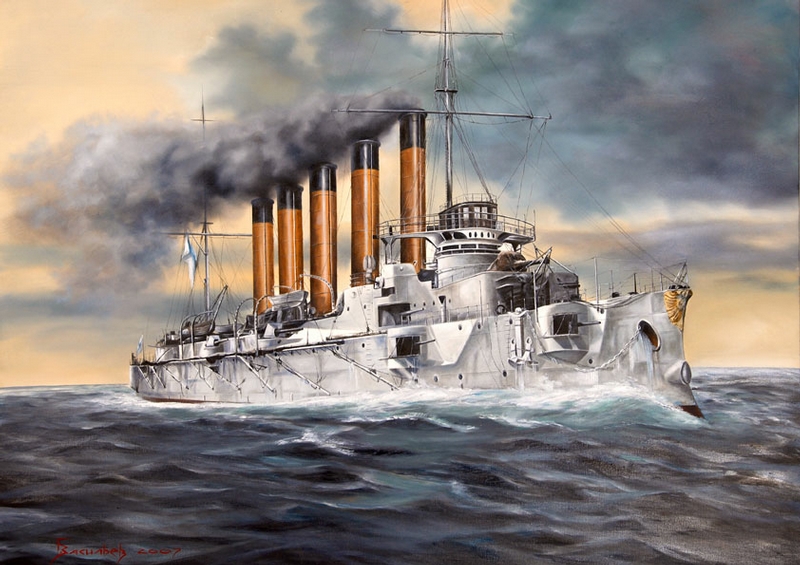
Here we have the great colro painting by Russian naval master Gleb Vasilyev of the Imperial Russian Navy protected cruiser Askold. Bult in 1902 for the very modrn navy of Tsar Nicholas II by the William Cramp Yard in Phildelphia PA, Askold was was named after the legendary Viking hero Askold. Her thin, narrow hull and maximum speed of 23.8 knots (44.1 km/h) were considered shit hot for the time.
Askold had five thin funnels which gave it a unique silhouette for any vessel in the Imperial Russian Navy. This led British sailors to nickname her Packet of Woodbines after the thin cigarettes popular at the time.

It does kinda look like ……….

However, the five funnels also had a symbolic importance, as it was popularly considered that the number of funnels was indicative of performance, and some navies were known to add extra fake funnels to impress dignitaries in less advanced countries. By today’s standards she would be a slow frigate, but by those of 1900 she was quite impressive.

She fougth in and survived the Russo-Japanese War (and was the last Russian ship to visit Japan before the outbreak of war.) During the Battle of the Yellow Sea, she was flagship for Rear Admiral Nikolai Reytsenshteyn’s cruiser squadron during the failed attempt to escape the Japanese blockade and to link up with forces in Vladivostok. Together with Novik, Askold took heavy damage, but escaped from the pursuing Japanese fleet to Shanghai, where she was interned until the end of the war. During WWI she served admirably with the Allied fleet in the MED bombarding Gallipoli. She was back in Russia just after the Revolution and was seized by the Royal Navy who took her back  to Scotland.

She was scrapped in 1922.

Her Specs:
Displacement:     5910 tons full load
Length:     132.5 m (434.7 ft)
Beam:     15 m (49.2 ft)
Draught:     6.2 m (20.3 ft)
Propulsion:     3 shaft Triple expansion steam engines (VTE), 9 Shultz-Thonycroft Boilers – 19,650 hp
Speed:     23.8 knots (44.1 km/h)
Range:     6,500 nautical miles (12,000 km) @ 10 knots
Complement:     580 officers and crewmen
Armament:

12 – 6-inch (152 mm)/L45 Canet guns
12 – 75-millimetre (3 in)L50 Canet guns
8 – 47-millimetre (2 in) Hotchkiss rapid-fire guns
2 – 37-millimetre (1 in) Hotchkiss guns
2 – 7.62 mm Maxim machine guns
6 – 15-inch (381 mm) torpedo tubes

Krupp armour,

2-inch (51 mm) to 4-inch (102 mm) on sloping deck
6-inch (152 mm) at conning tower


Warship Wednesday July 18th

Here at LSOZI, we are going to take out every Wednesday for a look at the old steampunk navies of the 1866-1938 time period and will profile a different ship each week.

– Christopher Eger

Here we have the HTMS Sukhothai (Su-kho-thai) Light Gun Boat/ Coastal Defense ship, built by Armstrong Withworth of England in 1929. She was commissioned 6 June 1930 – After ceremony by King Prajadhipok on 5 June 1930.

In 1926, Vice Admiral Phraia Rachawangsan, Chief of Staff, Royal Siamese Navy, presented a project regarding the naval force called “Memorandum on the Organization of the Siamese Navy” to the Minister of the Navy. He divided the naval force into two fleets as follows:

1). Coastal Defense Division consisting “of four 1000-ton gun boats, three destroyers, four torpedo boats, ten inshore patrol craft, two minesweepers, and a number of minelayers and mines.

2). Offensive Division or Mobile Division consisting of two patrol boats, three destroyers, six speed torpedo boats, four submarines, ten inshore patrol craft, one speed minelayer, and a number of cargo ships and mines.

This project was a guideline for later warship procurement. In 1929, the gun boat HTMS Sukhothai was built with the same design as HTMS Rattanakosin.

She served the Thai Navy for more than forty years including service in the 1940-41 Franco-Thai War, World War Two,  and in protecting the country during the Indochina Conflicts as a SEATO allied naval platform.

She was decommissioned: 15 Dec 1970 after 40 years of service to the crown.

Specs
Length: 53.34 m /175feet OA   Beam  11.21 m/33 feet
Displacement: 886 ton (regular) 1000 Ton (Full)
Armament: Two 152/50 mm cannon, Four 76/45 mm gun, three 20 mm anti-aircraft machine guns, two 40/60 mm gun (additional)
Plant : Two Steam with 3 cylinders 850 HP with twin shafts
Speed: 12.89 knot (max) 10 knot (economical)
Operating range: 1,463 Nautical Miles (max) 1,952 Nautical Miles (economical)
Depth beam: 3.41 m/ 10 feet
complement: 148 men


« Older Entries Recent Entries »