Warship Wednesday Jan 15, 2014 A Tale of the Unlucky Porter
Here at LSOZI, we are going to take out every Wednesday for a look at the old steam/diesel navies of the 1859-1946 time
period and will profile a different ship each week.
– Christopher Eger
Warship Wednesday Jan 15, 2014 A Tale of the Unlucky Porter

Here we see the fine lines of the USS Porter as she steams quietly before WWII. This destroyer, DD-356, looked more like a fast cruiser with her high bridge and four twin turrets. Truly a beautiful ship from that enlighten era where warships could be both easy on the eyes and functional.

The first USS Porter almost sent a torpedo into the cruiser New York in 1898
The name of the USS Porter is something of an albatross with the navy. Drawn from the famed War of 1812 era Commodore David Porter, and his son, Civil War Admiral David Dixon Porter, the first ship with this name, USS Porter (TB-6), a torpedo boat, launched in 1896, was commissioned five years after the passing of the Admiral. This small green torpedo boat almost sank the cruiser USS New York in a nighttime engagement during the Spanish-American War, and would have if the torpedo she fired didn’t miss.
The second USS Porter (DD-59), a Tucker-class destroyer, commissioned in 1916, had to be stricken to comply with the London Naval Treaty.
USS William D. Porter (DD-579), a Fletcher-class destroyer, was a ship of the United States Navy named for Civil War Commodore William D. Porter, son of Commodore David Porter and brother of Admiral David Dixon Porter, continued the curse of the Porter ship name. She almost sank the battleship USS Iowa during the war when she fired a live torpedo at the battlewagon while practicing torpedo runs. The Iowa at the time was carrying President Franklin D. Roosevelt, along with Secretary of State, Cordell Hull and all of the Country’s WWII military brass. When the Iowa saw and evaded the errant fish, she trained all of her guns on the much smaller Porter who’s crew were arrested and made the subject of an FBI probe to make sure the torp was an accident and not an attempted assassination.

- USS William D._Porter (DD-579) sinking after being missed by a kamikaze

She spent the next year on duty in Alaskan waters after everything was cleared up. Then to the Philippines and Okinawa. There, on 10 June 1945 she was attacked by a lone Japanese Val dive bomber who missed the ship but exploded underneath after the craft hit the water. This gave the almost Iowa-killer the dubious distinction of missing a kamikaze but still being sunk by it.

- DD-800

The Fourth Porter (DD-800), a Fletcher-class sister-ship of the William D Porter above, although modern and low mileage, just spent two years on active duty before she was put into reserve. Called back for Korea, she was a member of the little know “Trainbusters Club”of warships that destroyed locomotives with naval gunfire. Decommissioned again 10 August 1953, she was scrapped in 1973, spending only a total of four and a half years of her thirty year life outside of Red Lead Row gathering rust.
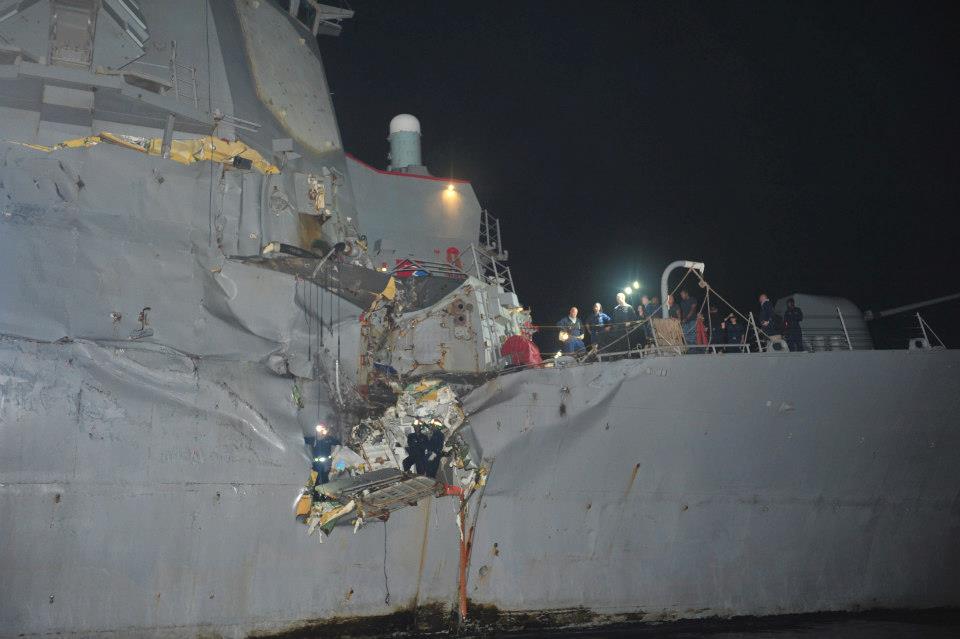
The Fifth USS Porter…
The fifth USS Porter, (DDG-78) is an Arleigh Burke-class destroyer, collided with the MV Otowasan, a Japanese oil tanker, near the Strait of Hormuz in 2012, ripping a huge 10×10 foot hole in the billion dollar Aegis warship that led to the replacement of her skipper.
But we are here to speak of the third Porter, DD-356.

Head of her class of large ‘destroyer leaders’ she was over 1800-tons and 381-feet long overall. Capable of making 35+ knots and carrying a battery of eight 5-inch/38 caliber naval guns over eight 21-inch torpedo tubes, she would have been considered a scout cruiser if she was commissioned in 1919 rather than in 1936.
She was one of the fastest and largest of US pre-WWII destroyer classes and her seven younger sisters provided yeomen service during the war. Her seven sisters earned a combined total of more than 30 battlestars during the war, fighting U-boats, protecting carriers, escorting convoys, and downing enemy aircraft.

All seven of her sisters survived the war to be scrapped in the late 1940s and early 1950s.

This was not to be the luck of the Porter.
Commissioned 25 August 1936 at New York Shipbuilding Corporation, she left immediately for the Pacific Fleet. Leaving Pearl Harbor just two days before the day of infamy, she was at sea off Hawaii when the war started. Joining Task Force 16 after convoy duty off the West Coast, she sailed immediately for the waters off Guadalcanal in 1942.

There, she found herself neck-deep in the Japanese onslaught that was the Battle of the Santa Cruz Islands. This pitted two US carriers, Enterprise and Hornet against three of Yamamoto’s. This battle, fought on 26 October 1942, started off with the Japanese having more planes (199 vs 136) and more surface combatants (40 vs 23).
Halsey’s fleet lost the Hornet, had the Enterprise badly mauled, and had more than 70% of the fleet’s carrier air-wing destroyed. During the fight, with planes ditching left and right around the USS Enterprise, Porter stood by as a plane guard, firing at Japanese aircraft while picking up pilots lost at sea.

To say the Battle of the Santa Cruz Islands was chaotic is an understatement.
One armed US Navy TBF Avenger torpedo bomber crashed near Porter and soon after, as the ship maneuvered to rescue the crew, she was struck by a torpedo of unknown origin. During the war the US blamed it on a Japanese submarine, but post-war study of the Combined Fleet’s records, none of the Emperor’s u-boats claimed the kill.
This had left historians to credit the sinking of the USS Porter, DD-356, to friendly fire.
Her crew was rescued by the nearby USS Shaw (DD-373), whose dramatic Pearl Harbor photographs have immortalized that ship.
The Shaw stood by to sink the stricken Porter in deep water with gunfire.
Her name was stricken a week later from the Naval List where it was given to a new Fletcher class destroyer (DD-800) at her launching on 13 March 1944.
Specs:

Displacement: 1,850 tons
Length: 381 ft (116 m)
Beam: 36 ft 2 in (11.02 m)
Draft: 10 ft 5 in (3.18 m)
Propulsion: 50,000 shp (37,285 kW);
Geared Turbines,
2 screws
Speed: 35 knots (65 km/h)
Range: 6,500 nmi. at 12 knots
(12,000 km at 22 km/h)
Complement: 194
Armament:
As Built:
1 x Mk33 Gun Fire Control System
8 × 5″(127mm)/38cal SP (4×2),
8 × 1.1″(28mm) AA (2×4),
8 x 21″(533mm) torpedo tubes (2×4)
c1942:
1 x Mk33 Gun Fire Control System
8 × 5″(127mm)/38cal SP guns (4×2),
2 X 40mm AA (1×2),
6 x 20mm AA (6×1),
2 x Depth Charge stern racks
If you liked this column, please consider joining the International Naval Research Organization (INRO), Publishers of Warship
International.
They are possibly one of the best sources of naval study, images, and fellowship you can find http://www.warship.org/
The International Naval Research Organization is a non-profit corporation dedicated to the encouragement of the study of naval
vessels and their histories, principally in the era of iron and steel warships (about 1860 to date). Its purpose is to provide information and a means of contact for those interested in warships.
Nearing their 50th Anniversary, Warship International, the written tome of the INRO has published hundreds of articles, most of
which are unique in their sweep and subject.
I’m a member, so should you be!


