Tag Archives: HMS Hermes

Hermes everlasting no more

Laid down at Vickers late during WWII, the Centaur-class fleet carrier HMS Hermes (61/R12) languished on the builder’s ways and was only completed post-Suez, joining the Royal Navy in 1959.

Centaur-class aircraft carrier HMS Hermes (R12) bouncing around the North Atlantic with her bow mostly out of the water in 1977.

However, she more than earned her stripes as the elderly flagship of the British task force sent to reclaim the Falklands in 1982 before going on to serve in the Indian Navy as INS Viraat (R22) for another impressive 31 years, only retiring in 2017 after 58 years of service. Sadly, it seems like she is bound for the breakers.

As noted by the HMS Hermes/INS Viraat Museum Ship Appeal, the group planning to bring the historic carrier back home to England:

The Indian Government has put INS Viraat/HMS Hermes up for sale for scrap in an e-auction on the 17th Dec 2019.

We have been attempting to delay the auction in order to put forward a satisfactory bid from the UK however there are clauses in the sale that would need the Indian Government to make some serious changes to the schedule which now appear very unlikely.

Viraat is not for sale outside of India and the vessel is not to be towed out of Indian waters for any reason. The successful (Indian) bidder has to undertake to remove the vessel from her current berthing in Mumbai within 30 days of a successful purchase.

I am really sorry for this news. We are currently campaigning against the schedule but are unlikely to win.

Hermes, Clamagore, and Newcastle to be no more

Lots of changes among the world’s floating museum ships and those otherwise long in the tooth this week.

Hermes/Viraat

Centaur-class aircraft carrier HMS Hermes (R12) bouncing around the North Atlantic with her bow mostly out of the water, 1977.

Laid down at Vickers-Armstrong on 21 June 1944, two weeks after the Allies stormed ashore at D-Day, as HMS Elephant, the RN carrier HMS Hermes only joined the fleet on 18 November 1959 (after 15 years at the builders) with a much-altered plan that included an angled flight deck to allow the operation of jet-powered aircraft at sea. After legendary Cold War service and a pivotal part in the Falklands War in 1982, she was sold to India in 1987 and took the name INS Viraat (R22) and, homeported in Mumbai, served the Indian Navy for three more decades, undergoing a further five refits while in Indian service.

The last British-built ship serving the Indian Navy, Viraat was the star attraction at the International Fleet Review held in Visakhapatnam in February 2016. Her last Sea Harrier, (White Tigers in Indian service), flew from her deck on May 6, of that year and was given a formal farewell at INS Hansa, in Goa two days later. She was to be preserved as a floating museum, commemorating an amazing career.

Fast forward three years and this is not to be. Deli announced this week that she will soon be scrapped.

Clamagore

In formation on 18 April 1966. The boats seen are: USS BLENNY (SS-324), CLAMAGORE (SS-343), COBBLER (SS-344), and CORPORAL (SS-346)

Subron-21’s GUPPY IIIs in formation on 18 April 1966. The boats seen are: USS BLENNY (SS-324), CLAMAGORE (SS-343), COBBLER (SS-344), and CORPORAL (SS-346)

The submarine USS Clamagore (SS-343), a Balao-class 311-foot “fleet boat” of the type that crushed the Japanese merchant fleet during WWII, commissioned on 28 June 1945– just narrowly too late for the war. However, her Naval service was rich, being converted to a GUPPY II snorkel boat in 1947 and later GUPPY III in 1962– one of only a handful to get the latter upgrade.

Decommissioned in 1973, the boat was still in pretty good shape when she was donated at age 36 to become a museum ship at Patriot’s Point, South Carolina where she has been since 1981, near the WWII carrier USS Yorktown.

The Clamagore (SS-343) being brought to Patriots Point Naval and Maritime Museum, Charleston, SC. 1981. Courtesy Tommy Trapp via Navsource

The Clamagore (SS-343) being brought to Patriots Point Naval and Maritime Museum, Charleston, SC. 1981. Courtesy Tommy Trapp via Navsource

Now, she is suffering from extensive decay and, although a group of subvets is trying to save her (and taking the state to court) Palmetto State lawmakers have voted to spend $2.7 million in public dollars to sink the Cold War-era submarine off South Carolina’s shores.

Newcastle

To replace their aging Adams (Perth)-class DDGs, the Royal Australian Navy in the 1980s ordered a six-pack of Oliver Hazard Perry-class guided missile frigates. Known locally as the Adelaide (FFG01)-class in RAN service, the first four vessels were built in the U.S. at Todd in Seattle, while last two were constructed by AMECON of Williamstown, Victoria.

Besides the names of large Australian cities, the vessels carried the names of past RAN vessels including two HMS/HMAS Sydney’s that fought in WWI and WWII, and Oz’s two aircraft carriers.

Photo by ABPH Tracey Casteleijn/RAN/ #950365-10

Photo by ABPH Tracey Casteleijn/RAN/ #950365-10

Canberra and Adelaide were paid off in 2005 and 2008 respectively, then sunk as dive wrecks. Sydney struck in 2015 and began scrapping soon after, while Darwin was broken up in 2017. Melbourne and Newcastle were to stick it out until the new Hobart-class destroyers arrive to replace them by 2019.

With that, HMAS Newcastle (FFG06), was put to pasture this week after she traveled more than 900,000 nautical miles, visited over 30 countries, conducted six maritime security operations and earned battle honors in East Timor, the Persian Gulf, and the Middle East.

Lieutenant Commander Nick Graney salutes during the national anthem as part of HMAS Newcastle’s decommissioning ceremony at Fleet Base East, Sydney on Sunday 30th June 2019.

Lieutenant Commander Nick Graney, RAN, salutes during the national anthem as part of HMAS Newcastle’s decommissioning ceremony at Fleet Base East, Sydney on Sunday 30th June 2019.

The final Australian FFG, Melbourne (FFG05), is set to be decommissioned 26 Oct 2019 and, like Newcastle, will be sold to Chile to begin a second career on the other end of the Pacific. Should that somehow fall through, the Hellenic Navy has also expressed interest in acquiring these classic but hard-used Perries.

And the beat goes on…

Victory lap for longest serving flattop

HMS Hermes was laid down at Vickers-Armstrong on 21 June 1944, two weeks after the Allies stormed ashore at D-Day. She was the last of the quartet of Centaur-class carriers whose construction was started. Originally to be named HMS Elephant, she picked up the messenger of the gods moniker of the old carrier (Pennant #95) sunk by the Japanese in 1942.

Only finished on 18 November 1959 (after 15 years at the builders) with a much-altered plan that included an angled flight deck to allow the operation of jet-powered aircraft at sea, and carried the RN Ensign for a very solid three decades. She carried the 63 foot long, 30-ton Blackburn Buccaneer–which was the same size as the later F-14 Tomcat and could carry up to 6-tons of ordnance including the British Red Beard or WE.177 tactical nuclear bombs to a range of some 2,300 nautical miles, only she did so off a tiny deck compared with U.S. super carriers.

During the Falklands, Hermes did the bulk of the heavy lifting as the flagship of Rear Adm. Sandy Woodward’s Task Force 317.8 for the war and it was her Harriers, along with HMS Invincible‘s that prosecuted the airwar.

Refitted, she was sold to India in 1987 and took the name INS Viraat (R22) and, home ported in Mumbai, she has served the Indian Navy for 29 continuous years, undergoing a further five refits while in Indian service. While in Indian service, INS Viraat – the Grand Old Lady, as she was fondly referred to – spent 2,250 days at sea covering 1.09 million kms — or encircling the globe 27 times.

The last British-built ship serving the Indian Navy, INS Viraat was the star attraction at the International Fleet Review held in Visakhapatnam in February this year. Her last Sea Harrier, (White Tigers in Indian service), flew from her deck on May 6, and was given a formal farewell at INS Hansa, in Goa two days later.

She sailed under her own power for Kochi on Saturday, her last voyage as a warship.

INS Viraat hms hermes

There, her sensitive and usable equipment will be removed over the next two months. Afterwards, she will be towed back to her base in Mumbai, for formal decommissioning, the date of which has not been finalized.

The Indians are trying to keep her as a museum ship, and two cities, Goa and Visakhapatnam are vying for her, which is a good thing.

With a total of 57 years of active service in two fleets, she beats out the longest serving U.S. carriers: USS Lexington (CV/AVT-16) which put in 48 years; and USS Enterprise (CVN-65) which put in 50. Even USS Midway (CVB/CVA/CV-41), commissioned in 1945 and struck in 1997 though decommissioned five years before that, only served 52 years if you count her time on red lead row.

The next closest competition came from HMS Vengence/NAeL Minas Gerais which was completed 15 January 1945 in time to serve with the British Pacific Fleet in the last days of WWII, continue operations with the Australians and then, from 1960 to 16 October 2001, serve with the Brazilian Navy, for a combined total of 55 years, 9 months under three flags. Ironically, that vessel was scrapped in India in 2004.

Plus Hermes/Viraat‘s hull actually has another 15 years on it before she was even commissioned, so there is that.

The Harrier Carrier. It’s still a thing

harrier 68mm sneb rocket volley

When the Harrier jump jet became a real thing in the late 1960s, the Hawker Siddeley Harrier GR.1/GR.3 and the AV-8A were seen as being able to fight from primitive forward operating bases on the battlefield and help blunt the Soviet tank force should they come across the Fulda Gap or over the top into Norway (or for the Brits, against the Guatemalans in Belize or Argies in the Falklands).

harrierhide3

However, the benefit of using these V/STOL strike craft on abbreviated aircraft carriers without the need for catapults or arresting gear was soon evident.

In fact, it was tested out before the aircraft was even put into production.

The Hawker P-1127 (Harrier prototype) after landing successfully on HMS Ark Royal, 3 February 1962.

The Hawker P-1127 (Harrier prototype) after landing successfully on HMS Ark Royal, 3 February 1962.

In 1974, the Marines began the first shipboard trials on the helicopter assault ship USS Guam and two years later 14 AV-8A Harriers from Marine Attack Squadron 231 (VMA-231) “Ace of Spades” embarked aboard the USS Franklin D. Roosevelt (CV-42) from 1976 to 1977 to prove the concept of integrating the short takeoff and vertical landing (STOVL) Harrier into catapult and barrier configured carrier’s normal Air Wing operations.

harriers uss fdr franklin

Chief of Naval Operations Elmo Zumwalt backed the concept of a cheaply built 13,000-ton Sea Control Ship that could be filled with a couple dozen Harriers and Sea King ASW helicopters at about the same time. Basically a 1970s update to the Jeep Carriers of WWII.

sea-control-ship

Heck, Zumwalt even wanted Harrier optimized Spruance-class destroyers in several different flavors, none of which ever got past the drawing board.

5847322839_80b4a4a790_z

through deck spruance vtol harrier destroyer aviationAs well as a modern battlecruiser based on a nuclear powered Virginia-class hull stretched to form an aviation capable “Strike Cruiser” that could accommodate 6 Harriers and 4 Sea Sprites/Hawks along with a full weapons suite.

strike cruiser harrier

Harriers on everything!

Even though Zum was replaced and a lot of his ideas (including building 100+ Pegasus-class hydrofoil missile boats!) went with him, the Harrier Carrier concept was growing.

In 1977, the Spanish Armada placed an order for a 15,000-ton ship based on Zumwalt’s concept which was commissioned in 1982 as Príncipe de Asturias capable of carrying 29 fixed-wing Harriers (“Matadors” in Spanish service) and rotary-wing aircraft. A larger 26,000-ton ship optimized for amphibious warfare, Juan Carlos I, was ordered in 2003.

Spanish Matadors on carrier Princip de Australias

Spanish Matadors on carrier Princip de Australias

The Royal Navy converted their last legacy carrier, HMS Hermes, with a 12-degree ski jump to help with rolling take-offs of the new Sea Harrier FRS.1 in 1980 while they ordered three specifically designed “carrier cruisers” as they were described at the time, the first of which, HMS Invincible, was commissioned 11 July 1980.

HMS Illustrious, an Invincible-class Britsh Harrier Carrier with a Sea Harrier lifting off her ski jump

HMS Illustrious, an Invincible-class British Harrier Carrier with a Sea Harrier lifting off her ski jump

The British Harrier carriers proved able to do the job in a pinch (see= Falkand Islands).

For further example, in September 1995, just eight FA.2 Sea Harriers from 800 NAS aboard HMS Invincible commenced operations over Serb-held positions in Sarajevo. Over the next ten days, they flew 24 bombing sorties, 42 combat air patrols, and 28 reconnaissance missions, for a sortie rate of 11.75 flights per day, every day for a week and a half, with just eight airframes.

Invincible-class harrier carrier HMS Illustrious late in her career with about the maximum loadout of these hulls: 12 Harriers and 7 Westland Sea King AEW/ASW helicopters. 

Then came others

India began operating its INS Vikrant with Sea Harriers in 1983 later joined by the retired Hermes (as INS Viraat).

The 13,000-ton Italian aircraft carrier Giuseppe Garibaldi (551) came off the ways in 1985, picked up her first Harriers in 1991, and was joined by the nearly twice as large Cavour in 2009.

Cavour (550) aircraft carrier (CVH) is the flagship of the Italian Navy (Marina Militare) with Italian AV-8Bs

Cavour (550) aircraft carrier (CVH) is the flagship of the Italian Navy (Marina Militare) with Italian AV-8Bs

Harrier carriers ITS Giuseppe Garibaldi, left, and ESPS Príncipe Asturias, right, flanking the conventional CATOBAR French carrier Foch, center. 

Thailand’s 11,000-ton HTMS Chakri Naruebet, based on the final U.S. Navy blueprints for a dedicated sea control ship but with the addition of a ski-jump ramp, was commissioned in 1997– flying a handful of Spanish surplus AV-8S Matadors.

Plus of course, all five Tarawa-class and eight Wasp-class LHA/LHDs of the U.S. Navy were designed so they could operate as dedicated Sea Control Ships when needed. This was validated when some 20 AV-8Bs of VMA-331 operated from USS Nassau (LHA-4) in support of Operation Desert Storm, flying 240 combat sorties and dropping 900 bombs.

In all, between May 1976 when USS Tarawa (LHA-1) was commissioned and 2005 when Invincible was taken out of service, no less than 22 Harrier Carriers or their equivalents were built, converted, or building for six navies around the world.

That was the peak.

Since then those numbers have been trimmed as all of the Invincibles and Tarawas, Vikrant and Hermes/Viraat, as well as Príncipe de Asturias, have been decommissioned. Currently, there are but 13 hulls afloat designed to operate these aircraft, which themselves are dwindling and are getting smaller in number every week.

The Harrier was withdrawn from both RN and Thai service in 2006.

The Indians hung up their last jump jet this May.

The Italians still have 16 operational AV-8B/TAV-8Bs they operate from their two carriers and they are very active. For instance, 8 Italian Harriers flying from Garibaldi dropped 160 guided bombs during 1221 flight hours over Libya in 2011.

The Spanish have 13 EAV-8B+/TAV-8Bs capable of operations from Juan Carlos I, though maintenance on these older aircraft is reportedly a problem.

The 2016 Marine Aviation Plan carries 84 AV-8Bs airframes to produce 66 RBA Harriers in 6 operational and one replacement squadron. This is to reduce to 80 aircraft/5 operational squadrons in FY17, 64/4 by FY21, 48/3 in FY22,  32/2 in FY23, 16/1 in FY24 and drop altogether by FY27.

USMC Harriers will be replaced by the F-35C, in theory, by then for which the new LHA-6 class ships will be optimized for.

But speaking of Marine AV-8Bs from their dedicated sea control/amphib ships, they are still getting the job done.

Withness this video last week from USS Boxer (LHD-4) with Harriers of VMA-214 (Blacksheep) assigned to the 13th Marine Expeditionary Unit (MEU), launching missions in support of Operation Inherent Resolve, joining strike aircraft operating from USS Harry S. Truman (CVN 75) in the Mediterranean Sea.

“These missions from the flight decks of USS Boxer, like those from the USS Harry S. Truman, demonstrate the inherent flexibility of naval forces,” said Vice Adm. Kevin Donegan, commander, U.S. Naval Forces Central Command.

“Today, U.S. naval forces are striking ISIL simultaneously from both the Mediterranean and the Arabian Gulf. Of course, the engine of this effort is our nation’s Sailors and Marines serving with the USS Boxer Amphibious Ready Group and the 13th Marine Expeditionary Unit; they, together with our joint and coalition partners, are dismantling and rolling back terrorist networks in Syria, Iraq and elsewhere,” said Donegan.

Here are some beautiful shots of AV-8Bs aboard Boxer.

Just keeping it real.

VMA-214 Blacksheep AV-8B Harrier on USS Boxer, photo by Staff Sgt. Naquan Peterson

A U.S. Marine Corps AV-8B Harrier II aircraft assigned to Marine Medium Tiltrotor Squadron (VMM) 166 sits on the flight deck of the amphibious assault ship USS Boxer (LHD 4) in the Arabian Sea Oct. 20, 2013. The Boxer was underway in the U.S. 5th Fleet area of responsibility supporting maritime security operations and theater security cooperation efforts. (DoD photo by Mass Communication Specialist 3rd Class J. Michael Schwartz, U.S. Navy/Released)

A U.S. Marine Corps AV-8B Harrier II aircraft assigned to Marine Medium Tiltrotor Squadron (VMM) 166 sits on the flight deck of the amphibious assault ship USS Boxer (LHD 4) in the Arabian Sea Oct. 20, 2013. The Boxer was underway in the U.S. 5th Fleet area of responsibility supporting maritime security operations and theater security cooperation efforts. (DoD photo by Mass Communication Specialist 3rd Class J. Michael Schwartz, U.S. Navy/Released)

Warship Wednesday July 22, 2015: The (Giant) Messenger God

Here at LSOZI, we are going to take off every Wednesday for a look at the old steam/diesel navies of the 1859-1946 time period and will profile a different ship each week. These ships have a life, a tale all of their own, which sometimes takes them to the strangest places. – Christopher Eger

Warship Wednesday, July 22, 2015: The (Giant) Messenger God

1977 HMS Hermes R-12 with her bows nearly out of the water.

Here we see the Centaur-class aircraft carrier HMS Hermes (R12) bouncing around the North Atlantic with her bow mostly out of the water in 1977. She currently is the oldest flattop in active service (though armed with just 7 elderly and increasingly cranky Sea Harriers) and has had one hell of a ride.

British carrier problems

During WWII, the Royal Navy saw the writing on the wall in the respect that, to remain a first-rate naval power with a global reach, it needed a fleet of modern aircraft carriers. Entering the war in 1939 with three 27,000 ton Courageous-class carriers converted from battlecruiser hulls, the 22,000 ton battleship-hulled HMS Eagle, the unique 27,000 ton HMS Ark Royal, and the tiny 13,000-ton HMS Hermes (pennant 95, the world’s first ship to be designed as an aircraft carrier)– a total of six flattops, within the first couple years of the war 5/6th of these were sent to the bottom by Axis warships and aircraft.

Further, while two 32,000-ton Implacable-class and four 23,000-ton Illustrious-class carriers, laid down before the war were able to join the fleet, they just made up for the losses of the prewar vessels.

The Brits designed an innovative armed merchantman (CAM ships, for catapult aided merchantman, some 35 freighters armed with a single rocket-assisted Hurricane or Spitfire ready for a one-way trip) and picked up a legion of escort carriers loaned from the Americans to help fight off German Condor patrol bombers and U-boats. However, fleet operations in far-off areas away from the support of land-based RAF fighters needed fast and well-armed flattops.

That’s where the 16 planned Colossus-class light carriers, 4 Audacious-class, 4 Malta-class supercarriers (57,000-tons), and 8 Centaur-class fleet carriers came in. Ordered and designed between 1942-45, these 32 British ships would have been the envy of any navy in the world.

While the Maltas never made it off the drawing board, just 2 Audacious’s were finished (in the 50s), and most of the Colossus-class were likewise completed much after the war (some as late as the 1960s then rapidly sold or junked), the Centaurs were likewise abbreviated to just 4 much-delayed ships. One of these is the hero of our story.

Enter Hermes

HMS Hermes was laid down at Vickers-Armstrong on 21 June 1944, two weeks after the Allies stormed ashore at D-Day. She was the last of the quartet of Centaurs whose construction was started. Originally to be named HMS Elephant, she picked up the messenger of the god’s moniker of the old carrier (Pennant #95) sunk by the Japanese in 1942.

Envisioned to be the middle ground between the Colossus light carriers and the Malta supercarriers, these 737-foot long, 29,000-ton ships were fast enough (28 knots) to serve with the fleet, could cross the Atlantic or steam as far away as the Falklands (remember this) or Cape of Good Hope on a single bunker load of fuel oil and could carry some 60~ piston engine fighters and bombers (smaller than an American carrier of similar size due to their armored flight deck and hangar).

Washdown

NBC Washdown

However, WWII ended before any of the Centaurs could be completed and the four ships under construction, Hermes included, were sidelined.

She languished after the war and was only finished on 18 November 1959 (after 15 years at the builders) with a much-altered plan that included an angled flight deck to allow the operation of jet-powered aircraft at sea.

Hermes10_6

One of the last ships completed with 40mm Bofors DP AAA guns, she could carry as many as 40 aircraft in a mixed flight wing that included downright chunky Supermarine Scimitars, de Havilland Sea Vixen fighters, and turboprop-powered Fairey Gannet ASW aircraft together with Westland Whirlwind (British-built Sikorsky S-55/H-19 Chickasaw) helicopters.

hermes-10-at-sea

Spending most of the 1960s in the Indian Ocean and Persian Gulf area (the Brits were the preeminent naval force in the Gulf at the time), by 1968 Hermes‘ wing had been updated to include a dozen Sea Vixens, 7 Buccaneer strike planes, Wessex choppers (British-built turbine-powered development of the Sikorsky SH-34 Seabat) and 5 Gannets in AEW roles.

The 63 foot long, 30-ton Blackburn Buccaneer was the same size as the later F-14 Tomcat and could carry up to 6-tons of ordnance including the British Red Beard or WE.177 tactical nuclear bombs to a range of some 2,300 nautical miles. The Brits still had these in service as late as 1994, but couldn’t use them in the Falklands as Hermes had her CATOBAR system removed. They likely would have come in very handy if she hadn’t and there were still some in the fleet.

A Sea Vixen launching from HMS Hermes.

A Sea Vixen launching from HMS Hermes.

The F-4 Phantom was successfully tested from her decks, but it was deemed that she wouldn’t be able to carry enough (just 12, landing the rest of wing ashore) to matter.

Rare colour image of two Fleet Air Arm Buccaneers on the catapults of HMS Hermes, 1968. XT282 (325) XV152 (324) of 809 Squadron. She lost her catapults in 1970

Rare color image of two Fleet Air Arm Buccaneers on the catapults of HMS Hermes, 1968. XT282 (325) XV152 (324) of 809 Squadron.

In 1970, her catapults and arrester wires were removed (as were her old Bofors and radars) and she was converted to a “commando carrier” capable of carrying a Royal Marine battalion. Her air wing was some 20 Marine helicopters. She was also given storage and handling areas for 4 LCVP landing craft.

She was modified to carry as many as 800 Royal Marines. Dig those L1A1 SLRs (semi-auto Enfield made FN FALs)

She was modified to carry as many as 800 Royal Marines. Dig those L1A1 SLRs (semi-auto Enfield made FN FALs)

When the Harrier came out, Hermes was given a ski jump to help those VSTOL beauties take off (they would land vertically so no arrester wires were needed) and her wing was fleshed out by ASW helicopters to allow her to carry out the NATO sea control mission concept if needed.

Harrier jump jets on the Deck of HMS Hermes

Harrier jump jets on the Deck of HMS Hermes

By 1982, with the Malta’s never built, the Colossus and Audacious-class carriers all retired, and Hermes‘s own sister ships HMS Centaur (R06), HMS Albion (R07), and HMS Bulwark (R08) decommissioned in 1965, 1972 and 1981 respectively, she was at the same time the largest, oldest and most effective carrier left in the Royal Navy with only the smaller and barely broke-in 19,000-ton “Harrier carrier” HMS Invincible to back her up.

Ironically both carriers were up for sale at the time, as Parliament was determined to get the UK out of the carrier business.

Then came the Falklands.

With the nearest RAF base some 4,000 miles away at Wideawake Airfield, Ascension Island, the aircraft that the RN could carry to the Malvinas were the only ones that would be available to defend the British attempt to retake the colony.

Royal Marines line up for a weapons check in the hanger of HMS Hermes in the South Atlantic on their way to the Falklands in 1982

Royal Marines line up for a weapons check in the hanger of HMS Hermes in the South Atlantic on their way to the Falklands in 1982. Note the hangar crammed full of Harriers and the big Sea Kings on a deck above.

Hermes carried an impressive (for her size) complement of 26 RN Sea Harriers and RAF Harriers (more than half of the British combat aircraft deployed to the conflict) as well as up to 22 big Sea Kings at one time or another (though most were cross-decked to other platforms) and was flagship of Rear Adm. Sandy Woodward’s Task Force 317.8 for the war.

HMS HERMES' flight deck as she sails from Portsmouth for the South Atlantic. Five Sea Harriers of No 800 Squadron Fleet Air Arm

View looking aft down HMS HERMES’ flight deck as she sails from Portsmouth for the South Atlantic. Five Sea Harriers of No 800 Squadron Fleet Air Arm are visible on the crowded flight deck in front of a mass of Sea Kings. At the time of sailing, the crew had not had time to organize the stowing of aircraft or supplies. IWM (FKD 674)

Hermes gunner with a WWII era 20mm in the Falklands

Hermes gunner in anti-flash gear with a WWII era 20mm in the Falklands

The 100~ ship (though only 27 warships) combined fleet, the largest British flotilla formed since 1956 in the Suez crisis, departed the UK on 5 April and after an epic 25-day trip arrived in the 200-mile exclusion zone surrounding Falklands, with the Argentinians beginning their attacks on the force the very next day.

Harrier of No 1 Squadron RAF is prepared for a sortie on the flight deck of HMS HERMES, 1982.

Harrier of No 1 Squadron RAF is prepared for a sortie on the flight deck of HMS HERMES, 1982.

Arriving in the Falklands, her Harriers conducted both air support for the troops ashore and held up a pretty good CAP against attacking Argentine Mirages and Skyhawks. In all the RN and RAF Harriers (just 38 aircraft, mostly operating from Hermes) flew over 1,500 sorties in the 45 days while on station before the British Jack was hoisted over Port Stanley once more, and were credited with 20 air-to-air kills.

Air group at the height of the Falklands Conflict:
800 NAS – 16 Sea Harrier FRS.1
826 NAS – 5 Sea King HAS.5
846 NAS – 5 Sea King HC.4
No. 1 Squadron RAF – 10 Harrier GR.3

Petty officer aboard HMS Hermes crossing equator on way back to the UK from the Falklands

A petty officer aboard HMS Hermes crossing equator on way back to the UK from the Falklands

Steel beach party on HMS Hermes note sea harrier and sea king

Steel beach party on HMS Hermes note Sea harrier and the sea king

When Hermes sailed back into Portsmouth, she and the Task Force was greeted by everything that floated.

HMS Hermes being welcomed back after the Falklands War,

HMS Hermes being welcomed back after the Falklands War

hermes

Her Royal Navy career ended 12 April 1984 and she was paid off while on her 15th skipper.

However, although she was the last of her class afloat and her keel had forty years on it, she was still valuable.

Refitted, she was sold to India in 1987 and took the name INS Viraat (R22) and, homeported in Mumbai, she has served the Indian Navy for 28 continuous years, undergoing a further five refits while in Indian service.

INS Viraat, 2002

INS Viraat, 2002

Her current name means, “Giant” and she was the largest ship ever operated by the Indian Navy until they bought the 65,000-ton Admiral Gorshkov from the Russians and brought her in service as INS Vikramaditya in 2013.

Viramaditya’ (foreground) and ‘Viraat.’ Indian Navy photo

Vikramaditya’ (foreground) and ‘Viraat.’ Indian Navy photo

Admiral-Sandy-Woodward-le-011

Of note, Admiral Sir John Forster “Sandy” Woodward GBE, KCB passed the bar 4 August 2013. In his last public act, he decried the decommissioning of Britain’s carrier force before the new Queen Elizabeth class could be brought online, leaving the country that invented the type without a flattop for the first time in a century.

Hermes/Viraat is currently the last British-built ship serving with the Indian Navy, and the oldest aircraft carrier in service in the world, and with over 70 years under her keel and two new carriers on the builder’s ways, its time for the old girl to retire.

She is to decommission by 2016 and be retained as a museum ship.

From the Hindu Times:

The retirement call was forced, in part, by the dwindling fleet of Sea Harrier fighters operating from the deck of Viraat. While the limited upgrade Sea Harrier (LUSH) programme bestowed the fighters with modern avionics and beyond visual range (BVR) strike capability, the ageing airframe has been a concern. Not more than seven Sea Harriers are available at the moment — some of them cannibalized (used as ‘Christmas Tree’ for spares) to keep the relatively agile ones airworthy.

“Thanks to the Navy’s stringent maintenance regimen, we have been able to operate Viraat without major glitches until now. But the Harrier fleet has dwindled so much that within the Navy, Viraat is often referred to as a ‘One Harrier carrier’. No point flogging it any further,” an official said.

A very active veterans group preserves her memory (as well as that of the other 9 HMS Hermes dating back to 1796) in the UK.

HMS Broadsword with HMS Hermes, Falklands. Official painting by John Alan Hamilton for the MoD. (c) Mrs B.G.S. Hamilton (widow); Supplied by The Public Catalogue Foundation

HMS Broadsword with HMS Hermes, Falklands. Official painting by John Alan Hamilton for the MoD. (c) Mrs. B.G.S. Hamilton (widow); Supplied by The Public Catalogue Foundation

Sadly, the Royal Navy has not carried the name on its roles since 1985.

Specs:

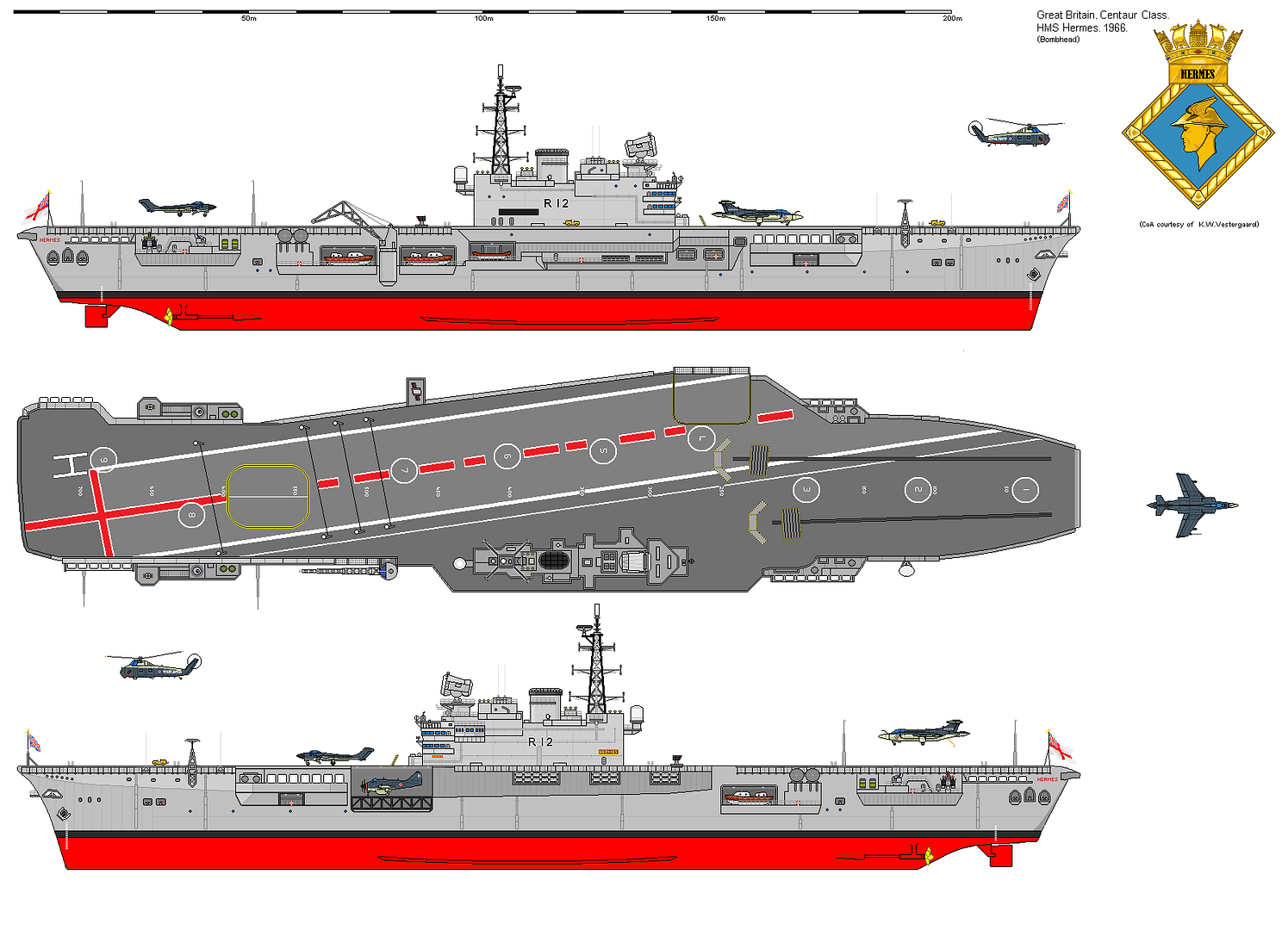
Hermes, 1966, via Shipbucket http://img.photobucket.com/albums/0703/catherine.fisher/Hermes13-31.png~original

Hermes, 1966, via Shipbucket

Hermes, 1982, via Shipbucket http://img.photobucket.com/albums/0703/catherine.fisher/Hermes13-31.png~original

Hermes, 1982, via Shipbucket

As Viraat, 1990, via Shipbucket http://www.shipbucket.com/Real%20Designs/India/CV%20R22%20Viraat%201990.png

As Viraat, 1990, via Shipbucket

Displacement: 22,000 tons 28,700 tons full load
Length: 737 ft. (224.6 m)
Beam: 130 ft. (39.6 m)
Draught: 28.5 ft. (8.7 m)
Installed power: 78,000 hp (58,000 kW)
Propulsion: 2 shaft geared steam turbines, 4 Admiralty 3-drum boilers
Speed: 28 knots (52 km/h)
Range: 7,000 nmi (13,000 km) at 18 kn (33 km/h)
Sensors: Radar Type 982, Type 983, Type 275, Type 974
Complement: 2,100 including carrier air wing. 1970-75 as Commando Carrier: 1500 plus up to 800 Marines.
Armament: 32 40mm Bofors guns (2 × 6), (8 × 2), (4 × 1) removed in 1970, replaced with 2 Sea Cat missile system launchers. During Falklands, her armament was increased with the addition of numerous small gun mounts.
Armor: 1.2-inch flight deck, Hangar deck
Aircraft carried: 7-60 depending on year and role

If you liked this column, please consider joining the International Naval Research Organization (INRO), Publishers of Warship International

They are possibly one of the best sources of naval study, images, and fellowship you can find http://www.warship.org/

The International Naval Research Organization is a non-profit corporation dedicated to the encouragement of the study of naval vessels and their histories, principally in the era of iron and steel warships (about 1860 to date). Its purpose is to provide information and a means of contact for those interested in warships.

Nearing their 50th Anniversary, Warship International, the written tome of the INRO has published hundreds of articles, most of which are unique in their sweep and subject.

I’m a member, so should you be!

Recent Entries »