Tag Archives: Wickes class

Warship Wednesday, July 17, 2024: Under Four Flags

Here at LSOZI, we take off every Wednesday for a look at the old steam/diesel navies of the 1833-1954 period and will profile a different ship each week. These ships have a life, a tale all their own, which sometimes takes them to the strangest places.- Christopher Eger

If you enjoy my always ad-free Warship Wednesday content, you can support it by buying me a cup of joe at https://buymeacoffee.com/lsozi

Warship Wednesday, July 17, 2024: Under Four Flags

Above we see the sailors of the Northern Red Banner Fleet loading the 24-spigot Hedgehog ASW device on their new (to them) Wickes/Town-class destroyer, Zhivuchy/Zhguchiy (“Tenacious”), which they took over from the British some 80 years ago this week, on 16 July 1944.

By this point in the war– her second– she had already passed through American, British, and Canadian hands and still had some fighting left on her dance card.

The Wickes

Our ship was one of the iconic first flights of “Four Piper” destroyers that were designed in 1915-16 with input from no less an authority as Captain (later Admiral) W.S. Sims. Beamy ships with a flush deck and a quartet of boilers (with a smokestack for each) were coupled to a pair of Parsons geared turbines to provide 35.3 knots designed speed– which is still considered fast today, more than a century later.

The teeth of these 314-foot, 1,250-ton greyhounds were four 4-inch/50 cal MK 9 guns and a full dozen 21-inch torpedo tubes.

They reportedly had short legs and were very wet, which made long-range operations a problem, but they gave a good account of themselves. Originally a class of 50 was authorized in 1916, but once the U.S. entered WWI in April 1917, this was soon increased and increased again to some 111 ships built by 1920.

Wickes class USS Yarnall (DD-143): Booklet of General Plans – Inboard Profile / Outboard Profile, June 10, 1918, NARA NAID: 158704871

Wickes class USS Yarnall (DD-143): Booklet of General Plans – Main Deck / 1st Platform Deck / S’ch L’t P’f’m, S’ch L’t Control P’f’m, Fire Control P’f’m Bridge, Galley Top, After Dk. House and 2nd Platform Deck. / June 10, 1918, Hold NARA NAID: 158704873

Wickes class. A close-up of her stern top-down view of plans shows the Wickes class’s primary armament– a dozen torpedo tubes in four turnstiles and stern depth charges.

Of the 111 Wickes completed, there were three subclasses besides the 38 standard-design vessels built at Bath Iron Works, Cramp, Mare Island, and Charleston. Then came the 52 Bethlehem-designed ships built at the company’s Fore River (26 ships) and Union Iron Works (26 ships) led by USS Little, the Newport News-built variants (11 ships) starting with USS Lamberton, and New York Shipbuilding-built variants (10 ships) led by USS Tattnall.

The subclasses were constructed to a slightly different set of plans modified by their respective builders, which made for some downright confusing modifications later. In addition, the Bethlehem-designed Little variants tended to have shorter legs and proved unable to cross the Atlantic in a single hop without stopping in the Azores for refueling or completing an underway replenishment.

Anyway…

Meet Fairfax

Our subject, USS Fairfax (Destroyer # 93), was the first ship named in honor of Virginia-born RADM Donald McNeil Fairfax whose distinguished service in the Civil War included command of USS Cayuga, Nantucket, and Montauk.

Rear Admiral Fairfax, seen as an LCDR/CDR above, served with distinction in the Civil War and retired on 30 September 1881 after 43 years of service. He died at Hagerstown, Maryland, on 10 January 1894, aged 75.

Our tin can was laid down on 10 July 1917 at Vallejo by the Mare Island Navy Yard; named Fairfax (Destroyer No. 93) on 14 July 1917 in General Order No. 311; launched on 15 December 1917; sponsored by the daughter of the yard commandant.

The future USS Fairfax (Destroyer # 93) is being prepared for launching, at the Mare Island Navy Yard, California, circa 15 December 1917. NH 70607

Fairfax was commissioned on 6 April 1918, almost a year to the day that America entered the Great War.

She was beautiful in her original dazzle pattern war paint.

Possibly the best Wickes class profile I’ve ever seen. USS Fairfax (Destroyer # 93) at anchor in the San Francisco Bay area, 21 May 1918. Photographed by the Mare Island Navy Yard during the ship’s trials. NH 2025

USS Fairfax (Destroyer # 93) making smoke while steaming at 25 knots during trials in the San Francisco Bay area, 21 May 1918. NH 55612

USS Fairfax (Destroyer # 93) making smoke while running at 25 knots, during trials in the San Francisco Bay area, 21 May 1918. Photographed by the Mare Island Navy Yard. Note this ship’s pattern camouflage. NH 23

USS Fairfax (Destroyer # 93) at anchor in the San Francisco Bay area, 21 May 1918. Photographed by the Mare Island Navy Yard during the ship’s trials. NH 54131

USS Fairfax (Destroyer # 93) at anchor in the San Francisco Bay area, 21 May 1918. NH 54132

War!

A war baby born an ocean away from the fighting, Fairfax soon found herself with orders for Hampton Roads, where she arrived in early June to escort a convoy across the Atlantic, a role she would continue for the rest of the year.

Destroyers Israel and Fairfax with battleship Virginia in the distance. NH 109504

U.S. Navy Destroyer on convoy duty in 1918. This ship may be USS Fairfax (Destroyer # 93), whose camouflage scheme was very similar, though not identical, to that seen here. Courtesy of Jack L. Howland, 1983. NH 95211

While on a Hampton Roads to Brest convoy on 18 October, she raced to a distress signal from the 6,744-ton American cargo ship SS Lucia, torpedoed and sunk by the German submarine SM U-155 (ex-Deutschland, Korvettenkapitan Ferdinand Studt, commanding) some 1,200 miles off the U.S. East Coast.

SS Lucia, built in 1912, was an Austrian-flagged merchant ship that was interned at Mobile, Alabama in 1914 while the U.S. was still The Great Neutral. Seized by the United States Government in April 1917, she was operated by the U.S. Shipping Board and later by the U.S. Army Quartermaster Corps as ID # 3090. Signal Corps Photo # 165-WW 274A-10 while in Mobile, circa 1917, via NARA.

S.S. Lucia (Austrian/American Freighter, 1912) sinking in the western Atlantic after she was torpedoed by the German submarine U-155, on 17 October 1918. A boatload of survivors is in the process of leaving the ship. This ship was intended to become USS Lucia (ID # 3090) but was lost before the Navy could acquire her. Donation of Dr. Mark Kulikowski, 2005. NH 51459-A

Luckily, Lucia took 22 slow hours to submerge fully, allowing Fairfax to rescue 86 survivors. The only souls lost were four killed in the torpedo explosion. The steamer had been fitted at great cost with controversial Donnelly buoyancy boxes that made her “unsinkable,” which may have had something to do with her slow death.

USS Fairfax Description: (Destroyer # 93) underway with the survivors of S.S. Lucia on board, circa 18 October 1918. They were later transferred to the USS Huntington (Armored Cruiser # 5). NH 54134

Sinking of S.S. Lucia 17 October 1918. Motor launch arrives alongside USS Fairfax (Destroyer # 93) with a load of survivors from the American steamship Lucia. This boat is from the USS Huntington (Armored Cruiser # 5). NH 41727

Sinking of S.S. Lucia 17 October 1918. Motor launch from USS Huntington (Armored Cruiser # 5) leaving USS Fairfax (Destroyer # 93) with survivors from the American steamship Lucia. Fairfax is visible in the background. NH 41728

Immediately after the conflict came to a halt, Fairfax remained overseas, and, on 3 December 1918, she deployed to the Azores to the troop transport George Washington (Id. No. 3018) carrying President Woodrow Wilson, and escort her to Brest so that Wilson could attend the Versailles Peace Conference.

USS Fairfax (Destroyer # 93) view of the ship’s forward and midship superstructure, probably taken at Brest, France, in late 1918 after she shed her camouflage. Photographed by Zimmer. Note the small identification number painted below her pilothouse, canvas weather screens, and the 1-pounder automatic anti-aircraft gun mounted by her forward smokestacks. NH 54135

USS Fairfax (Destroyer # 93) in harbor, circa late 1918. Photographed by Zimmer. NH 54136

That mission completed, she sailed for home on 28 December, arriving at Norfolk on 8 January 1919.

Quiet Peacetime Interlude

No more camo! USS Fairfax (Destroyer # 93) at anchor, 11 October 1919. NH 54137

While many of the Navy’s new Wickes-class destroyers were soon mothballed following the “War to End all Wars”– and many of those later disposed of or converted to other roles such as minelaying/sweeping or tending seaplanes in the 1920s and 30s– the sun shined on Fairfax and, after helping shepherd the historic first aerial crossing of the Atlantic made by Navy seaplanes (towing the crippled NC-1 to shore), she was only laid up for not quite eight years, from 19 June 1922 to 1 May 1930, then recommissioned.

Incidentally, it was in 1920 that she served as the first command of LCDR (later VADM) Willis Augustus (Ching) Lee Jr. (USNA 1908), just after Lee returned from winning seven medals in the 1920 Antwerp Olympics and two decades before he would teach the Japanese just how good radar-controlled gunnery can be at night.

Once brought out of her short stint in mothballs, Fairfax’s peacetime role consisted primarily of conducting training cruises for both East and West Coast members of the Naval Reserve and summer cruises out of Annapolis carrying midshipmen of the U.S. Naval Academy to the Caribbean. She alternated this duty with regular gunnery exercises, fleet reviews, and fleet problems, a stint with the Special Service Squadron out of Balboa in the Canal Zone, and patrols in Cuban waters.

She was captured alongside at Annapolis on 18 March 1939 when the remains of Hiroshi Saito, the late Japanese Ambassador to the United States, were transferred to the cruiser USS Astoria (CA-34) for return to Japan.

Note the large hull numbers. Page from the Japan Times Weekly, published in Tokyo, 20 April 1939, page 523, NH 76141

She also participated in the 1939 New York City World’s Fair.

USS Fairfax (DD-93) at Poughkeepsie, New York, 17 June 1939. Courtesy of Donald M. McPherson, 1969. NH 67728

War, again

When Europe blew the lights out again in September 1939, Fairfax was assigned to the increasingly tense Atlantic neutrality patrol.

All was not calm on this duty, and a sistership, USS Greer (DD–145), was fired upon by German submarine U-652 in September 1941, leading to FDR’s “shoot on sight” order for threatening ships under American escort while supposedly at peace. The next month the destroyer USS Reuben James (DD-245) was sunk by U-552 near Iceland, still six weeks before the attack on Pearl Harbor.

However, by that point, Fairfax had already been transferred to the Admiralty.

White Ensign

With Europe again at war, on 2 September 1940, FDR signed the so-called Destroyers for Bases Agreement that saw a mix of 50 (mostly mothballed) Caldwell (3), Wickes (27), and Clemson (20)-class destroyers transferred to the Royal Navy in exchange for limited basing rights on nine British overseas possessions. Canada would receive seven of these ships including five Wickes, doubling the number of destroyers in the Canadian Navy in days. 

In respect of Canada’s naming tradition for destroyers, all seven RCN flush deckers were named for Canadian rivers (repeated in 2024 by the way), ideally, those that ran in conjunction with the U.S. border, a nice touch. In British service, they would receive names of small cities, and be known therefore as the Town class.

Sailed by scratch USN crews from Philadelphia the “flush deckers” sailed to Halifax in several small groups to prepare for a warm handover.  

Transfer of U.S. destroyers to the Royal Navy in Halifax, Sept 1940. Wickes-class destroyers USS Buchanan (DD-131), USS Crowninshield (DD-134), and USS Abel P. Upshur (DD-193) are in the background. The sailors are examining a 4-inch /50-cal deck gun. Twenty-three Wickes-class destroyers were transferred to the RN, along with four to the RCN, in 1940 under the Destroyers for Bases Agreement. (Library and Archives Canada Photo, MIKAN No. 3199286)

Group of U.S. Navy and Royal Navy ratings who took part in the transfer of destroyers to the Royal Navy and Royal Canadian Navy, Halifax, Nova Scotia, Canada, ca. 23-24 September 1940. LAC A104093

Naval ratings unloading a torpedo before the refit of an unidentified Town-class destroyer of the Royal Canadian Navy, Halifax, Nova Scotia, Canada, March 1941. LAC A105202

Ratings of the Royal Navy taking over former U.S.N. destroyer at Halifax, 1940. LAC A104109

Union Jacks hoisted aboard former U.S.N. destroyers transferred to the Royal Navy, Halifax, 1940. LAC A104096

Decommissioned from the U.S. Navy on 23 October 1940 (she wasn’t struck from the U.S. Navy List until 8 January 1941), Fairfax was taken into custody by RCN personnel in Halifax on 26 November 1940, pending the arrival of an RN crew that would take her to St. Johns for repairs and across the Atlantic to Devonport for fitting British equipment.

During this period, she was commissioned as the sixth HMS Richmond (G 88) on the RN’s list going back to 1655. As such, she carried forth a trio of previous battle honors from those vessels: Quebec, 1759 – Havana, 1762, and Chesapeake, 1781.

Ready for action by June 1941, she was assigned to the 17th Escort Group based in Newfoundland and would ride shotgun on 11 convoys by the end of the year (HX 132, SC 034, OB 339, SC 037, HX 138, ON 001, TC 012B, HX 148, ON 017, SC 047, SC 048, and UR 017).

HMS Richmond G88 passing McNab’s Island, Halifax, NS, via Forposterity’s Sake

In her first convoy of 1942, UR 017, she had the misfortune of encountering the 10,000-ton type EC2-S-C1 Liberty ship SS Francis Scott Key, which crumpled her bow on 31 March 1942. This forced her to Liverpool for five months of repair, after which she was sent back to Halifax to rejoin her convoy defense mission. However, this was cut short when she suffered a collision with the Norwegian cargo steamer SS Reinholt (4801 gt), sending her back to Liverpool for repairs until June 1943.

Oh, Canada

Sent to Halifax once again to get back to convoy work, the twice-cracked Fairfax/Richmond was sheep-dipped into the Royal Canadian Navy, becoming HCMS Richmond in July 1943.

While in Canuk service, she chalked up another nine convoy runs (ON 198, ONS 016, HX 255, SC 142, ONS 018, XB 076, ON 204, HX 262, and ON 207) between just 22 August and Halloween.

The Red Banner

With the Soviets pouting over not getting an immediate slice of the surrendered/interned Italian Navy in late 1943, the Western Allies made a big push to send a nice package of mixed destroyers, submarines, subchasers, cruisers (USS Milwaukee), and even battleships (HMS Royal Sovereign) to appease Stalin. Of course, many of these ships were extremely worn out, mechanically unreliable, and had been repeatedly repaired– so you know Fairfax/Richmond was lumped into this bag.

With that, Fairfax reverted to RN service, arrived back in the Home Isles on 27 December 1943, was paid off, de-stored, and laid up in the Tyne where she sat until taken up by Palmer’s Yard for a brief refit pending transfer to the Russkis.

Her new crew arrived in early July for a fortnight of training on their new vessels, and, officially transferred on 16 July 1944 as Zhivuchy (011), after the name of a destroyer sunk in the Black Sea in 1916, she set out the next day for Loch Ewe as escort for HMS Royal Sovereign (now dubbed Archangelsk), along with seven other high-mileage Wickes/Clemson tin cans that had been part of the Bases for Destroyers deal (Derzkij, Dejatelnyj, Doblestnyj, Dostojnyj, Zarkij, Zguchij, and Zostkij), and 11 SC-497 class 105-foot subchasers. Interestingly, these “Town” class Wickes/Clemsons would be known as the Zhivuchy-class in Soviet service. 

Tagging along with the 33-ship RN convoy JW59 for the White Sea, this little hodge podge of most third-hand warships sortied from Loch Ewe on 15 August and arrived in Soviet waters at the Kola Inlet ten days later. In the running ASW battle to get there, the convoy lost the British sloop HMS Kite (U 87) to U-344 (ace Kptlt. Ulrich Pietsch) which was in turn sunk by a Swordfish from the jeep carrier HMS Vindex (D 15). As a bonus, U-354 (ace Oblt. Hans-Jürgen Sthamer) was sunk on 24 August by HMS Mermaid and HMS Loch Dunvegan.

In Soviet service, Fairfax/Richmond/Zhivuchy, under Captain 3rd Rank Nikolay Dmitriyevich Ryabchenko, spent her career in ASW patrols in the frozen Barents and White Seas. While on such a beat with Dejatelnyj (ex-HMS Churchill, ex-USS Herndon, ex-CG-17) on 8 December, they came across a German U-boat that they had been bird-dogging for three days. When the steel shark broke the surface, Ryabchenko ordered Zhivuchy to ram.

According to Russian sources, it is believed Zhivuchy sank U-387 (Kptlt. Rudolf Büchler) with all hands, although Western sources generally chalk that boat up to the British corvette HMS Bamborough Castle (K412), in roughly the same area at the same time.

Sadly, Dejatelnyj would be sunk just a month later on 16 January 1945 by U-956 (Mohs), taking the commander and 116 men with her. Only seven men were picked up by the Derzkij.

The Northern Fleet destroyer Zhivuchiy (011) is seen wearing her Soviet pennant.

As for the end of her career, the Soviets kept their Wickes/Clemsons for several years after VJ-Day, even if they didn’t need them. Heck, the last one wasn’t returned until 1952!

Fairfax/Richmond/Zhivuchy was eventually repatriated to Rosyth in poor condition on 24 September 1949, scheduled immediately for disposal, and then broken up for scrap by BISCO at Grangemouth the following summer.

She earned two battle honors while under British/Canadian service: Atlantic 1941-43 – Arctic 1942.

Epilogue

Few relics remain of Fairfax. Her engineering drawings and some logs are in the National Archives.

Neither the U.S. nor Canadian fleets have added a second Fairfax or Richmond to their naval lists, however, the Royal Navy has commissioned a seventh Richmond, a Type 23 frigate (F239) that has been in service since 1995.

020612-N-9407M-518 The Atlantic Ocean (Jun. 11, 2002) — British frigate HMS Richmond (F-239) launches an AGM-84A “Harpoon” missile during a joint U.S. and British exercise in which the decommissioned ship USS Wainwright was sunk in the Atlantic Ocean. Ships used in these types of exercises are inspected and made environmentally safe before sinking, and are disguised to create reefs for marine life. U.S. Navy photo by Photographer’s Mate 2nd Class Isaac Merriman. (RELEASED)

She recently deployed to the Red Sea and fired the first Sea Ceptor combat launch in RN history.


Ships are more than steel
and wood
And heart of burning coal,
For those who sail upon
them know
That some ships have a
soul.


If you liked this column, please consider joining the International Naval Research Organization (INRO), Publishers of Warship International.

They are possibly one of the best sources of naval study, images, and fellowship you can find. http://www.warship.org/membership.htm

The International Naval Research Organization is a non-profit corporation dedicated to the encouragement of the study of naval vessels and their histories, principally in the era of iron and steel warships (about 1860 to date). Its purpose is to provide information and a means of contact for those interested in warships.

With more than 50 years of scholarship, Warship International, the written tome of the INRO has published hundreds of articles, most of which are unique in their sweep and subject.

PRINT still has its place. If you LOVE warships you should belong.

I’m a member, so should you be!

Warship Wednesday, Nov. 29, 2023: As Easy as 123

Here at LSOZI, we take off every Wednesday for a look at the old steam/diesel navies of the 1833-1954 period and will profile a different ship each week. These ships have a life, a tale all their own, which sometimes takes them to the strangest places. – Christopher Eger

Warship Wednesday, Nov. 29, 2023: As Easy As 123

Naval History and Heritage Command Photograph NH 109514

Above we see Wickes-class tin can USS Gamble (Destroyer No. 123) steaming into after the review of Pacific Fleet, 13 September 1919, with her sister USS Radford (DD-120) trailing behind.

Brand new and beautiful in this image, she was commissioned 105 years ago today. Gamble would give her last full measure off Iwo Jima and be deep-sixed a month before the end of World War II but don’t worry, she rolled the dice and took a few of the Emperor’s ships with her.

The Wickes

Gamble was one of the iconic first flights of “Four Piper” destroyers that were designed in 1915-16 with input from no less an authority as Captain (later Admiral) W.S. Sims. Beamy ships with a flush deck and a quartet of boilers (with a smokestack for each) were coupled to a pair of Parsons geared turbines to provide 35.3 knots designed speed– which is still considered fast today, more than a century later.

The teeth of these 314-foot, 1,250-ton greyhounds were four 4-inch/50 cal MK 9 guns and a full dozen 21-inch torpedo tubes.

They reportedly had short legs and were very wet, which made long-range operations a problem, but they gave a good account of themselves. Originally a class of 50 was authorized in 1916, but once the U.S. entered WWI in April 1917, this was soon increased and increased again to some 111 ships built by 1920.


Wickes class USS Yarnall (DD-143): Booklet of General Plans – Inboard Profile / Outboard Profile, June 10, 1918, NARA NAID: 158704871


Wickes class USS Yarnall (DD-143): Booklet of General Plans – Main Deck / 1st Platform Deck / S’ch L’t P’f’m, S’ch L’t Control P’f’m, Fire Control P’f’m Bridge, Galley Top, After Dk. House and 2nd Platform Deck. / June 10, 1918, Hold NARA NAID: 158704873

Wickes class. A close-up of her stern top-down view of plans shows the Wickes class’s primary armament– a dozen torpedo tubes in four turnstiles and stern depth charges.

Meet Gamble

Our subject is the first Navy ship to be named in honor of at least two of the quartet of Gamble brothers who served in the War of 1812. The four brothers including Capt. Thomas Gamble (USN) who served aboard USS Onedia during the war and perished while in command of the sloop USS Erie of the Navy’s Mediterranean Squadron in 1818; 1st Lt. Peter Gamble (USN) killed on the USS Saratoga during the Battle of Lake Champlain in 1814; Lt. Francis B. Gamble (USN) who died of yellow fever in 1824 while in command of the USS Decoy of the navy’s West Indies Squadron; and U.S. Marine hero Lt. Col. (Brvt) John Marshall Gamble, the only member of the Corps to command an American warship in battle– the prize ship USS Greenwich in her combat with the British armed whaler Seringapatam in 1813. Only John lived into the 1830s, passing at age 44, still on active duty.

Two of the four brothers Gamble. Midshipman Thomas Gamble, USN (L) via Analectic magazine. Painted by Waldo, and engraved by J.B. Longacre. NH 49483 and Lt. John M. Gamble, USMC (R). Photo from a portrait in possession of his grandson. (Naval History and Heritage Command Photograph NH 49482)

Gamble (Destroyer No. 123) was laid down on 12 November 1917 at Newport News, launched on 11 May 1918 sponsored by a dour relative of SECNAV Josephus “Cup of Joe” Daniels; and commissioned at Norfolk 18 days after the Armistice on 29 November 1918.

Wickes class sisters USS Breese (DD-122) and USS Gamble (DD-123) on the ways at Newport News between November 1917 and May 1918. NH 43018

USS Gamble (DD-123) launched at Newport News, Virginia, on 11 May 1918. Her sistership USS Breese (DD-122) is next to her and launched the same day in a dual ceremony. NH 53813

Same as above, NH 53812

Entering a crowded and rapidly demobilizing fleet that was just coming off the Great War, Gamble would spend the next several months in a series of shakedowns and trials up and down the East Coast from Maine to Cuba but notably was one of the ships escorting the troop transport George Washington, which was carrying President Woodrow Wilson back to the U.S. from peace negotiations in Paris to Boston in February 1919 and again in July.

In May 1919, she was one of the support ships for the legendary first transatlantic flight by the Navy’s Curtiss NC flying boats, helping spot NC-4 through the Azores.

In mid-July 1919, Gamble, along with sisters Breese, Lamberton (Destroyer No. 119), and Montgomery (Destroyer No. 121), were shifted to the Pacific Fleet to join Destroyer Division 12 and made their way to San Diego via the Panama Canal.

USS Gamble (DD-123) and USS Breese (DD-122) photographed circa 1919, probably at Balboa, Panama, Canal zone. Courtesy of Jack Howland, 1983. NH 94956

Once on the West Coast, she would spend most of the next three years haze gray and underway, so to speak, steaming from up and down the West Coast from San Diego to Seattle and out to Pearl and back in a series of tests, maneuvers, and reviews.

Gamble photographed about 1919. NH 53815

Gamble at San Diego, California, circa 1919. NH 53816

USS Gamble (DD-123) photographed on 23 April 1919 with extensive tropical awnings covering her decks. Sister USS Breese (DD-122) is in the background. NH 53814

Gamble with her original DD-123 hull numbers. NH 67684

Destroyers at the Mare Island Navy Yard, 1919 (from left to right): USS Tarbell (Destroyer # 142); USS Thatcher (Destroyer # 162); USS Rizal (Destroyer # 174); USS Hart (Destroyer # 110); USS Hogan (Destroyer # 178); USS Gamble (Destroyer # 123); USS Ramsay (Destroyer # 124); and USS Williams (Destroyer # 108). Donation of Rear Admiral Ammen Farenholt, USN (Medical Corps). NH 42537

USS Gamble (DD-123) at anchor and dressed with flags, circa 1921, following the relocation of her after 4″/50 cal gun to the top of the after deckhouse. NH 59648

Battleship USS Mississippi (BB-41) at sea for maneuvers, during the early 1920s. Wickes class destroyers in the background include USS Radford (DD-120) and USS Gamble (DD-123). NH 46051

Destroyer tender USS Prairie (AD-5) in San Diego Harbor, California, with USS Gamble (DD-123) alongside, circa 1920-1922. NH 105775

U.S. fleet in Balboa, Panama, early 1920s. The center of the photo is the battleship USS New Mexico BB-40, then a cluster of flush deck destroyers including USS Ramsey DD-124, USS Montgomery DD-121, USS Breese DD-122, USS Lamberton DD-119, and USS Gamble DD-123. In the background are the battleship USS Mississippi BB-41, the tin cans USS O’Bannon DD-177, USS MacKenzie DD-175, USS Hugan DD-178, USS Anthony DD-172, and several other destroyers and another battleship in the far distance.

With budget cuts, Gamble was tapped to begin inactivation procedures and was decommissioned on 17 June 1922 and was held in reserve at San Diego.

Recall, and a job change

After nearly a decade on red lead row, Gamble was taken out of mothballs and redesignated a fast destroyer minelayer (DM-15) on 24 May 1930. This saw her head to Mare Island for a general overhaul and conversion.

The Navy had previously converted 14 Wickes and Clemson class ships to this designation in 1920, with the simple swap out of having their torpedo tubes replaced with a set of two 140-foot tracks that could carry approximately 85 1,400-pound Mark VI moored antenna mines (of which the Navy had 50,000 left over from the Great War) to drop over the stern.

The Navy ordered 100,000 Mark VI (MK 6) mines in 1917, carrying a 300-pound charge, and had so many left that even after using thousands during WWII they remained in U.S. service into the 1980s. Gamble and her sisters could carry as many as 85 of these on a pair of rails that ran, port and starboard, down the aft half of the ship.

As noted by Destroyer History.org:

Among the lessons World War I offered the US Navy was the possibility that fast ships could be effective in laying minefields to disrupt enemy operations. The surplus of flush-deckers at the end of the war provided an opportunity to experiment.

The original 14 circa 1920 rated destroyer-minelayers were slowly replaced throughout the 1930s by a smaller group of eight converted flush-deckers taken from mothballs– USS Gamble (DM-15)(DD-123), USS Ramsey (DM-16)(DD-124), USS Montgomery (DM-17)(DD-121), USS Breese (DM-18)(DD-122), USS Tracy (DM-19)(DD-214), USS Preble (DM-20)(DD-345), USS Sicard (DM-21)(DD-346) and USS Pruitt (DM-22)(DD-347).

Jane’s 1931 entry on the type. Note Breese is misspelled as “Breeze.”

Curiously, these ships would retain their white DD-hull numbers but wore Mine Force insignia on their bow, outwardly looking much more destroyer than minelayer.

Wickes-class destroyer USS Ramsey (DM-16)(DD-124) view was taken by Tai Sing Loo, at Pearl Harbor, T. H., circa 1930. Note that she is fitted out as a minelayer (DM) and retains her DD-hull number while wearing a mine-force insignia on her bow. NH 49953

In addition to these minelayers, several Wickes/Clemson class flush deckers were converted during the WWII era to other tasks including eighteen fast minesweepers (DMS), fourteen seaplane tenders (AVD), and six fast “Green Dragon” transports (APD) plus test ship Semmes (AG 24, ex-DD 189) at the Key West Sound School and damage control hulk Walker (DCH 1, ex-YW 57, ex-DD 163) which was reclaimed from commercial service as a dockside restaurant at San Diego.

All eight of the active destroyer-minelayers were formed into Mine Squadron 1 headed up by the old minelayer USS Oglala (CM 4), flagship of Rear Admiral William R. Furlong, commander of Minecraft for the Battle Force of the Pacific Fleet, and forward-based with “The Pineapple Fleet” at Pearl Harbor, where a new conflict would soon find them.

USS Oglala (CM-4); USS Gamble (DD-123/DM-15); USS Ramsay (DD-124/DM-16). (listed L-R) anchored off Cocoanut Island, Hilo Harbor, Hawaii, T.H., 12 December 1931. Mauna Kea Volcano is in the distance. Note that the DMs are still wearing their destroyer hull numbers but with Mine Force insignias. 80-G-409991

Gamble and her crew were busy while in Hawaiian waters in the 1930s, and often helped in search and rescue cases including that of the missing aircraft Stella Australis, the disabled steamer President Lincoln, and the yacht Lanikai.

She was also something of a public relations boat and was tapped to carry Territorial Governor Lawrence M. Judd from Honolulu to Hilo in 1931 then hosted the six-year-old singing and dancing wonder, Ms. Shirley Temple, in 1935.

Besides spending the day on Gamble, Temple was declared a Colonel of the Hawaiian National Guard, inducted as a Waikiki Beach lifeguard, and given a surfboard by Duke Kahanamoku during her 1935 Hawaiian trip.

Gamble (DM-15) dressed with flags while tied up in port, circa 1940 at the Golden Gate International Exposition (World’s Fair) in San Francisco. Note the circular Mine Force insignia, red/blue/white with a black center and outline, on her bow. In the distance is a USCG 240-foot Lake class cutter. Courtesy of the Mariners Museum, Newport News, Virginia. Ted Stone Collection. NH 66812

War!

All MineRon1’s ships were swaying at their berths at Pearl’s Middle Loch on 7 December 1941 when the Japanese attack came in. The squadron was divided into two divisions, with MinDiv2 consisting of Gamble, Montgomery, Breese, and Ramsay.

The response by Gamble, among others, was immediate, opening fire just two minutes after her lookouts saw enemy planes.

From her after-action report:

0745 Heard explosions on Ford Island.
0756 Wave of about 50 Japanese planes attacked battleships and Naval Air Station, Ford Island, planes flying at low altitudes about 500 feet over battleships from the direction of Diamond Head, about 700 feet over Ford Island. Five successive waves of the attack of about 10 planes each.
0758 Went to General Quarters, opened fire with .50 cal. machine guns on planes passing over nest at about 800 feet altitude. Set material condition afirm except for certain protected ammunition passages.
0759 Opened fire with 3″/23 cal. AA guns, firing as planes came within range, fuses set 3 to 8 secs.
0805 Mounted and commenced firing with .30 cal. machine guns on galley deck house.
0810 Commenced making preparations to get underway. Lighted off four boilers.
0925 One Japanese plane shot down by A.A. fire, falling in water on port beam about 1000 yards away from ship. Believed shot down by ROBERTS, W.L., BM2c, U.S.S. Gamble, port machine gunner (#2 machine gun) .50 cal., and JOOS, H.W., GM3c, U.S.S. Gamble (#1 machine gun) starboard.
0930 Division commenced getting underway. U.S.S. Breese underway.
0930 U.S.S. Gamble got underway and cleared mooring buoy.
0937 Japanese planes attacked near main channel entrance.
0955 Temporarily anchored, astern of U.S.S. Medusa.
1005 Underway proceeding out of channel.
1015 Shifted .30 cal. A.A. machine guns to top of pilot house on fire control platform.
1021 Cleared channel entrance. Eight depth charges were armed and the ship commenced off-shore anti-submarine patrol off Pearl Harbor entrance.
1204 Established sound contact with submarine and dropped three depth charges. Position bearing 162° T from Diamond Head Light, distant 2.5 miles.
1255 Proceeded on course 270° T at 20 knots to join friendly forces upon receipt of orders from CinCPac.
1412 Sighted sampan bearing 320° T.
1435 Slowed to investigate but did not search. Sampan position approximately 4 miles south of Barbers point.
1628 Sighted smoke bomb off port bow.
1631 Submarine surfaced.*
1632 Fired one shot 4″ gun and missed, short and to the left. Submarine displayed U.S. colors, and ceased firing. Submarine submerged and fired recognition red smoke bomb.
1647 Proceeded west.
1732 Sighted Enterprise and exchanged calls. Instructed by Commander Aircraft, Battle Force to join Enterprise.
1744 Joined Enterprise and took station as third ship with two other plane guard destroyers.

*The friendly submarine turned out to be the Tambor class boat USS Thresher (SS-200), which was unharmed although a critically ill member of her crew– the reason for her surfacing and heading to port– passed. She again tried to enter the harbor on 8 December but was driven off by depth bombs from a patrol plane and only made it into Pearl under escort from a seaplane tender. Thresher went on to become the most decorated submarine of the war with 15 battle stars and a Navy Unit Commendation.

Gamble would remain off Pearl for the rest of the month, dropping depth charges on at least two further underwater sound contacts, and continue her ASW mission into 1942 when she expanded her operations to Samoa and Fiji, sowing defensive minefields in the waters of both. She also picked up some much-needed extra AAA in the form of a couple of 20mm Oerlikons.

Escorting a convoy to Midway in June, Gamble returned with a high-profile enemy POW, CDR Kunizo Aiso, the former chief engineering officer of the Japanese carrier Hiryu which had been sunk in the pivotal battle.

Carrier flagship Hiryu: Last Moments of Admiral Yamaguchi at the Battle of Midway. oil painting by Renzo Kita, 1943. Most of the ship’s officers chose to ride her to the bottom or were evacuated. Aiso, forgotten in the engineering spaces with a small group of snipes, surfaced after the ship had been left to the sea and managed to take to lifeboats. 

Aiso was the senior Japanese naval officer imprisoned in the U.S. at the time and would be until 1944. Picked up at sea in a crowded lifeboat with 34 other survivors of his carrier after 12 days bobbing around the Pacific some 250 miles west of Midway, the English-speaking officer reportedly did not wish to return to Japan, nor wish his government be informed of his capture, preferring to be recorded as lost with his ship. For the trip to Hawaii, CDR Aiso was issued USN officer khakis and barricaded inside Gamble’s captain’s cabin with the wings cut off the wingnuts of the battle ports.

Finally, picking up 85 Mark VI mines at Pearl for points West, Gamble set off for Espíritu Santo in August 1942 and, from there, Guadalcanal.

DD-123, meet I-123

When it comes to pennant numbers, the meeting that Gamble had on the morning of 29 August some 60 miles east of Savo Island was curious. She came across I-123, a big Japanese I-121-class minelaying submarine, operating on the surface. On her fifth war patrol, she had left Rabaul two weeks prior under the command of LCDR Nakai Makoto and had already given the Marines on Lungga Point heartburn with her deck gun.

Type I-121 Submarine I-23 pictured at Kobe Naval Arsenal on April 28th, 1928

The rolling ship vs submarine combat between DM-15 (formerly DD-123) and I-123 over the course of four hours ended with Makoto and his 71 crewmembers receiving a promotion, posthumously.

Gamble’s report:

While the Japanese lost 131 seagoing Ro- and I-class submarines during World War II (100 by Allied action including mines, 3 in accidents, and 28 by unknown causes) I-123 was only the 12th boat sent to the bottom in the conflict and was one of the Empire’s first early losses.

Gamble was soon back to work.

The very afternoon after she sank I-123, she sped to Nura Island to pick up four shot-down TBF-1 Avenger (Bu. No. 00396) aviators of Torpedo 8 from the Saratoga (LT JG EL Fayle, ARM3c W Velogquz, S1C RL Minning and ARM3c JR Moncarrow), retrieved via her whaleboat from the surf line. She would rescue two more lost Airedales from Palikulo Bay two weeks later, picking up 2nd LT EN Railsbach, USMC, and Ens. EF Grant, USNR, after their SBD burned in.

Gamble was pressed into service at Guadalcanal as a fast troop transport, on the morning of 31 August carrying 158 Marines from Guadalcanal to Tulagi in company with sisters USS Gregory and USS Little, who were equally loaded down with Devil Dogs.

Gamble also was soon performing her primary role once again, that of sowing minefields around the area, planting 42 in a defensive belt in Segond Channel in December 1942.

Speaking of which…

Stopping the “Tokyo Express”

On 7 May 1943, Gamble and sisters Breese and Preble laid mines in the Ferguson Passage/Blackett Strait between Gizo and Wanawana Islands in the Solomons southwest of Rendova. Hidden by a rain squall and with enemy attention diverted by a supporting cruiser-destroyer group, the old four pipers were able to sow 250 sea mines in three rough lines across the strait in just 17 minutes.

Hours later, these mines were stumbled upon by a passing column of first-class Japanese tin cans of DesDiv 15 on an overnight fast troop transport run and sank the Kagero-class destroyer Kuroshio, with 83 lives, and crippled two sisterships– Oyashio and Kagero– which, barely able to maneuver and full of seawater, would be sunk the next day after being spotted by Navy dive bombers from Guadalcanal.

IJN First-class destroyer Hamakaze of the Kagerō-class. Three of her sisters were killed due to mines laid by Gamble and company. 

As noted by Allyn D. Nevitt over at Combined Fleet, “The loss of even one such modern destroyer was fast becoming intolerable to the Japanese; having a crack unit of three erased in one blow was pure catastrophe. American daring and ingenuity in the Blackett Strait had reaped a substantial reward indeed.”

After further service– including supporting the invasion of New Georgia and planting more mines– Gamble was sent to San Francisco in July 1943 for a three-month overhaul at Hunter’s Point Navy Yard. Arriving back in the South Pacific, Gamble spent November 1943 conducting several mining runs off Bougainville in the Solomon Islands in support of the Allied offensive there.

Then, as noted by DANFS:

Through late 1943 and much of 1944, Gamble generally served as convoy escort ship screening for enemy submarines while operating between Guadalcanal and Florida Island in the Solomons; Espíritu Santo; and Noumea, with additional runs to Suva, Fiji; Finschhaven and New Britain Island, New Guinea; Sydney; and Tarawa Atoll in the Gilbert Islands.

Overhaul

In September 1944, Gamble was sent back to the West Coast for four months at the Bethlehem Steel Repair Yard at Alameda. This led to a serious overhaul of her guns, landing all her old 3″/23s and 4-inchers in favor of a homogenized set of 3″/50s and 20mm Oerlikons.

According to her December 1944 plans, her WWII topside armament was mostly emplaced on a series of superstructure platforms except for a forward 3″/50 DP above the CPO quarters just 20 feet from the bow and a 20mm Oerlikon directly behind it in front of the wheelhouse. The ammo magazine was three decks down on the keel amidships and another on astern near the shafts, meaning a chain gang had to be established to hump it up top. The main gun platform was over the galley between the three remaining funnels and held two 3″/50 DPs (port and starboard) with hinged sponsons for the gun crew and two Oerlikons. A small gun tub with two single 20mm Oerlikons (port and starboard) was above Radio 3 next to the stub mast. The stern superstructure gun platform was built atop the crew’s washhouse and armory and held a single 3″/50 DP installed just 22 feet from the stern. Two portable .50 cals were set up midship atop the pilot house and on the main deck at frame 117 (of 177 frames).

She also only had three stacks by this point. 

All told, this fit gave her four 3″/50 DPs, five 20mm Oerlikons, and two .50 cals. She would also be fitted with a twin 40mm Bofors gun, although I am not sure of its placement. Not a lot of throw weight there, but then of course her main armament was in her mine rails and projectors for Mark VI depth charges.

Eight breakaway Carely float-type life rafts were installed to augment the ship’s 26-foot whaleboat and punt. The crew at this time was a skipper (LCDR/CDR) and 8 wardroom officers along with a mix of 132 rates and enlisted (62 Seamans branch, 57 Artificer branch, 4 Special branch, 4 Commissary branch, 5 Messman branch). By this time, she carried SF and SC radar sets and QCL sonar.

She also picked up a new camo scheme.

Camouflage Measure 32, Design 7D drawings prepared by the Bureau of Ships for a camouflage scheme intended for light minelayers of the DM-15 (Gamble) class. This plan, approved by Captain Torvald A. Solberg, USN, is dated 14 June 1944. 80-G-173486 and 80-G-173487.

This readied her for the “Big Show,” the push to Iwo Jima, Operation Detachment, in February 1945.

Back in the thick of it

On D+3, 17 February, Gamble closed into the beach close enough to cover the small minesweepers (YMS) and UDT teams of Sweep 5 and 6 clearing a path in the shoaling waters, shelling Japanese coastal emplacements and positions with her 3-inch and 40mm guns to silence them from harassing the cleaners via the application of 204 rounds of 3-inch AA Common and 254 of 40mm HETSD over seven hours. There, roughly six miles off Mt. Suribachi, she scored a hit on a large ammo dump with secondary explosions as well as silencing several enemy guns and bird-dogging other emplacements for the battlewagons.

Her NGFS report: 

Taking position off the old battlewagon Nevada the next night, she was hit by two small 250-pound bombs dropped by a  Japanese Kawasaki Ki-45 Toryu (Nick) twin-engine bomber that came in low and fast while she was silhouetted by star shells ashore. The bombs effectively wrecked our Gamble.

From her report:

Her crew was removed, and the shattered Gamble was towed to Saipan where she was decommissioned on 1 June 1945, and her name was stricken from the Navy Register three weeks later.

Stripped of anything thought useful, a series of images and videos were captured of her scuttling process, which took place off Guam on 16 July.


“Down Went the Gamble (DM 15).” Gamble was scuttled in June 1945. She was previously hit by Japanese enemy bombs in Feb 1945. Artist: Standish Backus, No.9. U.S. Navy photograph, now in the collections of the National Archives. 428-GX-KN 18978

Gamble received seven battle stars for service in World War II.

Epilogue

As Gamble was scuttled off Guam in deep water, few relics of her remain topside.

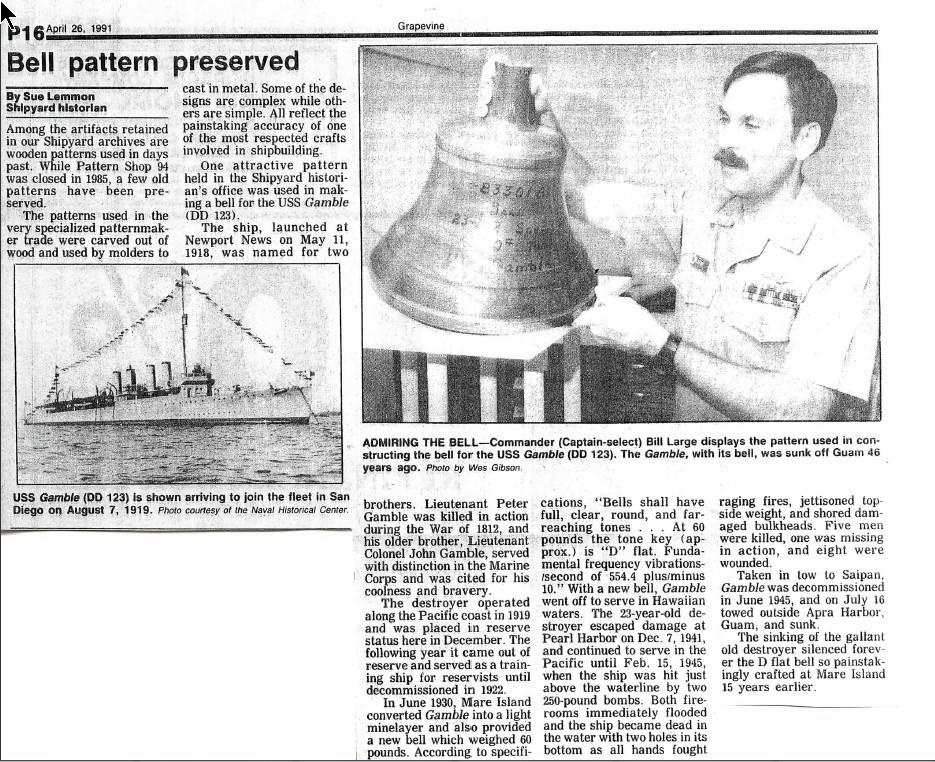
The wooden mold for her D Sharp ship’s bell, cast at Mare Island, resurfaced in 1991.

Her plans, drawings, deck logs, and war history are online in the National Archives. 

As for Shirley Temple, a bosun whistle presented to her by Gamble’s crew in 1935 remained a treasured possession for years. After all, she would meet her future husband, Charles Alden Black, a former Naval intelligence officer, in Hawaii in 1950 so perhaps those long-ago Pearl Harbor USN memories were prized. The whistle remained part of Ms. Temple’s estate and archives until it was sold at a 2015 auction by Theriault’s in New York.

It is undoubtedly in some collector’s display as this is written and perhaps will resurface one day.

Thus far, the Navy has chosen to not reissue the name “Gamble” to a second ship, which is a pity.


Ships are more than steel
and wood
And heart of burning coal,
For those who sail upon
them know
That some ships have a
soul.


If you liked this column, please consider joining the International Naval Research Organization (INRO), Publishers of Warship International

They are possibly one of the best sources of naval study, images, and fellowship you can find. http://www.warship.org/membership.htm

The International Naval Research Organization is a non-profit corporation dedicated to the encouragement of the study of naval vessels and their histories, principally in the era of iron and steel warships (about 1860 to date). Its purpose is to provide information and a means of contact for those interested in warships.

With more than 50 years of scholarship, Warship International, the written tome of the INRO, has published hundreds of articles, most of which are unique in their sweep and subject.

PRINT still has its place. If you LOVE warships you should belong.

I’m a member, so should you be!

Warship Wednesday, June 14, 2023: Shoestring Tin Dragon

Here at LSOZI, we take off every Wednesday for a look at the old steam/diesel navies of the 1833-1954 period and will profile a different ship each week. These ships have a life, a tale all their own, which sometimes takes them to the strangest places.- Christopher Eger

Warship Wednesday, June 14, 2023: Shoestring Tin Dragon

U.S. Naval History and Heritage Command Photograph. NH 60479

Above we see the Wickes (Little)-class four-piper USS Colhoun (Destroyer No. 85) seen wearing her fresh Great War-era Type N-12, Design K, dazzle camouflage, likely in mid-1918. Our tough flush deck would see rough, albeit short, duty in both world wars.

The Wickes

Colhoun was one of the iconic first flights of “Four Piper” destroyers that were designed in 1915-16 with input from no less an authority as Captain (later Admiral) W.S. Sims. Beamy ships with a flush deck and a quartet of boilers (with a smokestack for each) were coupled to a pair of Parsons geared turbines to provide 35.3 knots designed speed– which is still considered fast today, more than a century later.

The teeth of these 314-foot, 1,250-ton greyhounds were four 4-inch/50 cal MK 9 guns and a full dozen 21-inch torpedo tubes.

They reportedly had short legs and were very wet, which made long-range operations a problem, but they gave a good account of themselves. Originally a class of 50 was authorized in 1916, but once the U.S. entered WWI in April 1917, this was soon increased and increased again to some 111 ships built by 1920.

Wickes class USS Yarnall (DD-143): Booklet of General Plans – Inboard Profile / Outboard Profile, June 10, 1918, NARA NAID: 158704871

Wickes class USS Yarnall (DD-143): Booklet of General Plans – Main Deck / 1st Platform Deck / S’ch L’t P’f’m, S’ch L’t Control P’f’m, Fire Control P’f’m Bridge, Galley Top, After Dk. House and 2nd Platform Deck. / June 10, 1918, Hold NARA NAID: 158704873

Wickes class. A close-up of her stern top-down view of plans shows the Wickes class’s primary armament– a dozen torpedo tubes in four turnstiles and stern depth charges.

Of the 111 Wickes completed, there were three subclasses besides the 38 standard-design vessels built at Bath Iron Works, Cramp, Mare Island, and Charleston. Then came the 52 Bethlehem-designed ships built at the company’s Fore River (26 ships) and Union Iron Works (26 ships) led by USS Little, the Newport News-built variants (11 ships) starting with USS Lamberton, and New York Shipbuilding-built variants (10 ships) led by USS Tattnall.

The subclasses were constructed to a slightly different set of plans modified by their respective builders, which made for some downright confusing modifications later. In addition, the Bethlehem-designed Little variants tended to have shorter legs and proved unable to cross the Atlantic in a single hop without stopping in the Azores for refueling or completing an underway replenishment.

Anyway…

Meet Colhoun

Our subject, USS Colhoun, was the first U.S. Navy ship to carry the name of RADM Edmund Ross Colhoun.

Born in 1821 in Chambersburg, Pennsylvania, Colhoun was appointed a midshipman in 1839 and served with Commodores Conner and Perry, at Alvarado and Tabasco, respectively, during the war with Mexico. Master Colhoun resigned from the Navy in 1853 then returned to service as a Commander in the War Between the States with service in both the North and South Atlantic Blockading Squadrons including as skipper of the gunboats USS Hunchback and USS Ladona, and monitors USS Saugus and USS Weehawken.

He wasn’t a bad sketch artist, either:

Gunboat USS Lodona, sketch by Commander Edmund R. Colhoun, from his letter book of 1865-1885 in the Naval Historical Foundation’s Colhoun Collection. He was Lodona’s Commanding Officer during the Civil War. Courtesy of the Naval Historical Foundation, Washington, D.C. NH 51415

Post-war, Colhoun went on to command the South Pacific Station and Mare Island Navy Yard then was promoted to an admiral on the Retired List in 1883. He passed in 1897, aged 75, and is buried at Arlington, Section 1, Grave 617.

Laid down by Fore River at Quincy, Massachusetts, on 19 September 1917, USS Colhoun was launched by RADM Colhoun’s granddaughter on 21 February 1918 and commissioned on 13 June 1918– some 105 years ago this week.

In all, her construction only lasted just 268 days, a wonder of wartime shipbuilding.

Destroyer hulls on the building ways at Fore River, 1 October 1917. Those closest to the camera are the future USS Colhoun (DD-85) and Stevens (DD-86), which had builder’s numbers 280 and 281. The ships on the left are probably the future USS Sigourney (DD-81) and Gregory (DD-82). NH 43019

Ships fitting out at the Fore River shipyard, 19 March 1918. The six “Little” Wickes class destroyers are Little (DD-79), Kimberly (DD-80), Sigourney (DD-81), Gregory (DD-82), Colhoun (DD-8,5) and Stevens (DD-86), which had builder’s hull numbers 274-277 and 280-281 respectively. The freighter at right is Katrina Luckenbach, yard hull # 267, which served as USS Katrina Luckenbach in 1918-19. Most of the equipment on the pier is for her. Note the large submarine being built in the background, under the revolving crane. NH 43022

USS Colhoun (Destroyer # 85) in port, circa late 1918 or early 1919. Note her pattern camouflage and the splinter protection mats hung over the face of her bridge. The ship that is partially visible alongside Colhoun’s starboard side appears to be USS Alert (1875-1922). Donation of Dr. Mark Kulikowski, 2006. NH 104157

Here’s some better details on her camo pattern.

Camouflage Type N-12, Design K plan prepared by the Bureau of Construction and Repair in 1918, for a camouflage scheme for U.S. Navy Flush Deck type destroyers. It shows the ship’s starboard side, bow, set,rn and superstructure ends, and was approved by Naval Constructor John D. Beuret, USN. USS Robinson (Destroyer # 88) is known to have worn this camouflage pattern. USS Colhoun (Destroyer # 85) also appears to have received it. NH 103218

Rushed through construction and further rushed into service, Colhoun was on North Atlantic escort duty just three weeks after she was brought to life, shuttling between New York and European ports, shepherding troopships taking the AEF “Over There” to lick the Kaiser.

USS Colhoun (DD-85) escorting a convoy of troopships, in mid-1918. The two-stack transport beyond her bow is USS Siboney (ID # 2999). Photographed by R. Bowman. Courtesy of Jack L. Howland, 1983. NH 95200

She spent the tail end of 1918 at New London as part of experiments with sound equipment then under development, a job that was interrupted to rush to the rescue of the transport Northern Pacific on New Year’s Day 1919 as she had run aground at Fire Island with a load of Doughboys coming back home. Colhoun embarked 194 of her returning troops and landed them at Hoboken, which was surely a mixed blessing if you have ever been to Hoboken.

USS Colhoun (DD-85) close-up view of the ship’s port side midships area, with her small wartime hull number, probably taken in the Azores circa early 1919. The ship is still painted in World War I dazzle camouflage. Courtesy of the U.S. Naval Library, Treasure Island, California, 1969. NH 67715

Colhoun spent the remainder of 1919 in a series of operations in the Caribbean and off the east coast.

USS Colhoun (DD-85), sans camouflage. Photographed on 15 November 1919. NH 55255

Placed in reduced commission status at Philadelphia Navy Yard on 1 December 1919, Colhoun was given an overhaul and decommissioned there on 28 June 1922, joining almost 100 other tin cans on the yard’s “Red Lead Row” for the next 18 years.

View of part of about 100 U.S. Navy destroyers that saw action in the First World War in storage at the Philadelphia Naval Shipyard in April 1923. Note that the guns and other vital parts that are exposed to the weather are covered with grease so that the ships could be ready for service at a moment’s notice. When in commission each carried 115 enlisted men and 7 officers. One of the ships identified is USS Ellis (DD-154). NH 69126

Dragon days

While no Wickes were lost to the Germans in 1918, two of the class– USS DeLong and USS Woolsey— were lost while on interbellum service.

Then, with the U.S. Navy having dozens of spare destroyers, especially sticky while trying to lobby Congress for modern new ones (derisively termed “Gold-platers” by salty old destroyerman), no less than 29 often low mileage Wickes tin cans were scrapped or sunk as targets in the 1930s, a few as close to WWII as April 1939. Others were converted just prior to and just after the beginning of the war to fast minelayers (DM) and fast minesweepers (DMS).

Another 27 Wickes class destroyers were transferred to the Royal Navy and Royal Canadian Navy in 1940 as part of the Destroyers-for-bases deal– and seven of these well-used ships later passed on to the Soviets in 1944.

Many of the remaining Wickes in U.S. inventory were soon converted to high-speed amphibious transport (APD).

Such conversions meant landing their 4-inch guns, which went on to equip armed merchant ships, as well as their torpedo tubes. Also leaving were half of their boilers, which dropped their speed down to 25 knots. APDs were given a trio of newer high-angle 3-inch/50 guns, one 40 mm AA gun, and five 20 mm AA guns, and the capability to carry up to 300 Marines or soldiers for a brief period. Where torpedo tubes once were, they now carried four 36-foot LCP landing craft on davits– manned by Coast Guard coxswains.

Once converted, these ships, usually painted in an all-over alligator green scheme, became known as “Green Dragons.”

Colhoun was only the second dragon, picking up the hull number APD-2 on 2 August 1940, while mid-conversion at Norfolk where she had been towed in June. She would be recommissioned on 11 December 1940 and would soon embark on a series of training exercises between Norfolk and the Caribbean.

USS Colhoun (APD-2) February 1942. 80-G-464374

USS Colhoun (APD-2) photographed while tied up to a mooring buoy, circa early 1942. NH 97775

From the same set. Note her pattern camouflage. NH 97776

USS Colhoun (APD-2) photographed in port, circa early 1942. NH 97777

Ringbolt-Shoestring

Within weeks of the Japanese attack on Pearl Harbor and the subsequent push into the Solomons that followed the Battle of Midway, Colhoun, under the command of T/LCDR George Bernard Madden (USNA 1931) was ordered to sail for the forward Allied staging area in Noumea, French New Caledonia, where she arrived 21 July 1942.

She had been detailed to Operation Ringbolt, the seizure of Tulagi, Gavutu, and Tanambogo islands off the larger Florida island in the Solomon Islands group in parallel to the more complex Watchtower landings across the Sealark Channel to Guadalcanal.

Colhoun, joined by her converted green dragon sisters Gregory (APD-3)Little (APD-4), and McKean (APD-5), would carry Lt. Col. Merritt Edson’s 1st Marine Raider Battalion to Blue Beach as part of Transport Group Yoke on the morning of 7 August.

Port bow view of the high-speed transport USS Colhoun (APD-2) coming alongside the destroyer USS Mugford (DD-389) off Guadalcanal in early August 1942. The Australian War Memorial (P01233.004) contends that this was takeon n 7 August 1942 off Tulagi as she transports elements of the 1st Marine Raider Battalion. This is possibly the last photo taken of the ship. The University of Utah – J. Willard Marriott Library #941326

Then came what has been termed Operation Shoestring, the thin supply line that kept the Marines on Guadalcanal in the fight for the rest of the month.

As detailed by RADM Samuel J. Cox, Director NHHC: 

Just as the Marines’ supply situation became critical, the four fast transports of Transport Division 12 arrived on 15 August, under orders from Vice Admiral Robert Ghormley, the Commander of the South Pacific Area, to make all efforts to keep the Marines supplied. The fast transports (converted World War I destroyers) Colhoun (APD-2), Gregory (APD-3), Little (APD-4), and McKean (APD-5), under the command of Commander Hugh W. Hadley, USN, mostly delivered supplies and gear intended to make Henderson Field operational. The Marines had the benefit of captured Japanese rations, so food was not a critical issue at that point (the four APDs returned on 20 August with rations for the Marines). Another U.S. ship attempting to supply the Marines, the overloaded converted China riverboat Lakotai, capsized and sank all by herself before reaching Guadalcanal.

It was while on Shoestring that Calhoun suffered what Cox described as what “may be the most accurate bombing of a ship by high-altitude horizontal bombing during the war,” when she was hit by at least four bombs dropped by a flight of Japanese twin-engine bombers on 30 August.

Colhoun sank in under two minutes with the loss of over 50 of her crew. Many of her survivors had to swim to shore and for weeks were counted by the Navy as missing in action, although they were among the Marines.

The report of her loss, filed by her skipper, LCDR Madden, while he was recovering on the cargo ship USS Betelgeuse (AKA-11) along with several other wounded members of his crew:

TransDiv12’s days were numbered.

Just five days later, her sisters USS Gregory (DD-82/APD-3) and USS Little (DD-79/APD-4)— luckily just after transferring a Marine Raider Battalion to Savo Island– would be sunk in a one-sided night action with three much stronger Japanese destroyers. Nimitz observed, “Both of these small vessels fought as well as possible against the overwhelming odds … With little means, they performed duties vital to the success of the campaign.”

Meanwhile, the last of the original four green dragons of TransDiv12, USS McKean (DD-90/APD-5), was sunk in November 1943 by a torpedo from a Japanese G4M Betty bomber off Empress Augusta Bay.

Colhoun earned one battle star for her World War II service.

Epilogue

Plans, reports, and logs of both destroyers Colhoun have been digitized in the National Archives.

There are a few period postcards floating around.

Thomas Crane Public Library. Fore River Shipyard Postcard Collection

As for her Guadalcanal skipper, LCDR Madden earned a Silver Star for his actions on Calhoun. He would go on to command the destroyers USS Williamson (AVD 2), USS Young (DD 580), and USS Shields (DD 596). He retired postwar as a rear admiral.

Besides the ill-fated four DD/APDs of TransDiv12, at least nine other Wickes class destroyers were lost during World War II in U.S. service. The remainder were scrapped between 1945 and 1947.

Today no Wickes-class tin cans survive. The last one afloat, USS Maddox (DD–168), was scrapped in late 1952 after serving in the US, then RN, then Canadian, then Soviet navies.

However, one of the class, USS Walker (DD-163), has been given new life in the excellent alternate history series Destroyermen written by Taylor Anderson.

Meanwhile, the Colhoun name was recycled for a new Fletcher-class destroyer  (DD-801) laid down on 3 August 1943 at Seattle, by the Todd Pacific Shipyards. Sponsored by Capt. Kathryn Kurtz Johnson, WAC, a great-grandniece of the ship’s namesake, she commissioned on 8 July 1944.

USS Colhoun (DD-801) lies to in Puget Sound, 21 July 1944, painted in a disruptive three-color camouflage. Official U.S. Navy Bureau of Ships photo 19-N-7125

DD-801’s career would be much shorter than her predecessor, and she was awarded one battle star for her World War II service at Okinawa, where she was sunk as a result of the first heavy kamikaze raid on 6 April 1945. Some 35 members of Colhoun’s crew died and 21 were injured.

USS Colhoun (DD-801) hit by a suicide bomber off Okinawa, Ryukyu Islands. The destroyer is zigzagging at high speed during the attack. Note the oil slick to the left from a bomber shot down by fire from ship and fighter planes. Photographed by USS Anzio (CVE 57) pilot Lieutenant Junior Grade T. N. Banks, April 6, 1945. U.S. Navy photograph, now in the collections of the National Archives. 80-G-317257

The Navy has not used the name of RADM Edmund Colhoun since then.


Ships are more than steel
and wood
And heart of burning coal,
For those who sail upon
them know
That some ships have a
soul.


If you liked this column, please consider joining the International Naval Research Organization (INRO), Publishers of Warship International

They are possibly one of the best sources of naval study, images, and fellowship you can find. http://www.warship.org/membership.htm

The International Naval Research Organization is a non-profit corporation dedicated to the encouragement of the study of naval vessels and their histories, principally in the era of iron and steel warships (about 1860 to date). Its purpose is to provide information and a means of contact for those interested in warships.

With more than 50 years of scholarship, Warship International, the written tome of the INRO, has published hundreds of articles, most of which are unique in their sweep and subject.

PRINT still has its place. If you LOVE warships, you should belong.

I’m a member, so should you be!