Monthly Archives: January 2014

Concealed Carry and Older Shooters

It was once said in an old Colt advertisement that the modern revolver was great equalizer. For many in our society that are considered seniors, this has never been more of a true statement than today.

In a recent concealed carry class that I was giving for a preparedness group, I ran into a nice older woman named Mary. Her husband, a retired cop, had always said he was going to teach her how to shoot but never got around to it. Sadly, Ms. Mary’s husband walked towards the light and left her alone.

Now, traveling often back and forth several miles to visit grandchildren, work part time, and attend church, Ms. Mary felt she needed to learn.

rossi_m68_38_special_revolver_ 3 inch bbl

Read the rest in my column at Firearms Talk.com

Field Artillery p0rn via Croatia

Found this Series of pictures of a battery of  Croatian army howitzers going boom. Enjoy!

croatian howitzer 1

croatian howitzer 2

croatian howitzer 3

croatian howitzer 4

The gun in the first, second and fourth image is the Argentine made L33 155 mm howitzer Model 77 (CITEFA X1415). Produced in limited numbers in the 1980s to replace WWII era US M114 howitzers, some of these saw combat in the Falklands where the Brits captured four. Since 2000, the Argentine government has sold Croatia a battery of these guns as they are being (slowly) replaced by the L45 CALA 30.

Specs
Weight 8,200 kg
Barrel length 33 gauge / mm
Ammunition 155 mm
Gauge     155 mm
Rate of fire     dpm
Effective Range :
20,000 m (with normal ammo)
24,000 m (with special ammunition)

The gun in the third picture is  a 122 mm howitzer M94, which is a Yugo modernization of the Soviet D-30 with a new muzzle brake, redesigned trail, and improved hydraulic brake. The Soviets invented this gun in the 1960s and its been used around the world from Afghanistan to China  to Bosnia. Oddly enough both the Iranians and the Iraqs used it against each other during the 1980s when they had their late great hate.

Specs:

Weight     Combat: 3,210 kg (7,100 lb)
Length     Transport: 5.4 m (17 ft 9 in)
Barrel length     Bore: 38 calibres
Width     Transport: 1.9 m (6 ft 3 in)
Height     Transport: 1.6 m (5 ft 3 in)
Crew     1+7
Caliber     122 mm (4.8 in)
Recoil     hydropneumatic
Carriage     tripod
Elevation     -7° to 70°
Traverse     360°
Rate of fire     Maximum: 10-12 rpm
Sustained: 5-6 rpm
Effective firing range     15.4 km (9.6 mi)
21.9 km (13.6 mi)
(with rocket-assisted projectile)

The Range Officer Now Comes in 9 Milly

Springfield Armory has announced that they have put their vaunted Range Officer series of .45ACP 1911-style pistols on a new diet. No, we don’t mean Volumetrics, Jenny Craig, or the Ornish diet; we mean the RO now comes in a variant ready to nom
nom nom on 9mm NATO all day…

ro2
Read more in my column at Springfield Forum

Hairy Mary, Quite Contrary

A British armored train during the Second Boer War

A British armored train during the Second Boer War, covered with 6 inch anchor rope, provided by the Royal Navy, to provide it protection. The improvised additional armor was the source of its name, “Hairy Mary”.

Now thats up-armor.

(Photo from the McGregor Museum)

Simo Hayha: The world’s deadliest sniper?

In the annuals of renowned military sniperdom, many names stand out. Carlos Hathcock, Chris Kyle, John Plaster, Vasily Zaytsev, Simo Hayha, and so forth. Wait, Simo who? Well, pull up a chair and lets talk about that.

Born in the small village of Rautjärvi in what was then part of Imperial Russia (Finland did not become independent until 1918), Simo Hayha was a pretty normal man. He wasn’t very tall or robust, standing just 5′ 3?. In 1925, at age 19, he did his mandatory 350 days of active service in the Finnish army but was otherwise an unremarkable soldier at the time. He remained a member of the Civil Guard (much like the US National Guard) and drilled with his reserve unit until 1939. It was in that year that the 33-year old part time soldier and full time farmer picked up his rifle and went to war to repulse a Soviet invasion of his country.

In November 1939 over 400,000 Soviet Red Army troops invaded tiny Finland, whose own Army of some 80,000 was grossly outnumbered in what was later known as the Winter War. Hayha reported to duty and having extensive experience in hunting and target shooting was selected to be a sniper.

The rest, as they say, is history….

Simo was 500 reasons not to mess with Finland

Simo was 500 reasons not to mess with Finland

Read the rest in my column at Guns.com

How can you not love 1911-1920 era Mexican Revolutionaries?

Swagger by the gallon.

Herlinda Perry soldadera de Cd Juarez with Win 92 saddle ring carbine

Herlinda Perry soldadera de Cd Juarez with Win 92 saddle ring carbine. She has a belt of Mauser bullets around her waist that she may be carrying for other fighters.


constitutionalist cavalryman with mauser rifle can almost be confused with a 1900 Boer commando

This Constitutionalist cavalryman with Mauser rifle can almost be confused with a 1900 Boer commando


Another Contitutionlist fighter with winchester lever action rifle, showing how popular these guns were

Another Constitutionalists fighter with Winchester lever action rifle, showing how popular these guns were. The revolver seems to be a S&W topbreak


Mexican revolutionaries pose at the front of a train.

Mexican revolutionaries pose at the front of a train. Gotta love those mauser clips


A fierce peg-legged Villista of the Division del Norte

A fierce peg-legged Villista of the Division del Norte. Would he lose his life in Columbus?


Today, they have a modern comparison in the Anti-cartel fighters that are pushing the drug dealers (and the dirty cops) out of Michocan.


Check these cats out.

Got my AK, got my truck seat, got my comfy shoes...gonna smoke me a square

Got my AK, got my truck seat, got my comfy shoes…gonna smoke me a square


What do you wear to go with an AK and a 75-round banana mag...oh yeah, your skelly suit. What, you dont have one?

What do you wear to go with an AK and a 75-round banana mag…oh yeah, your skelly suit and murse. What, you don’t have one?


Viva Cristo Rey....

Viva Cristo Rey….


A Bersa for your Purse-a

When it comes to so called off-body carry with your firearm, one of the hands-down best choices is a compact Bersa handgun. Long seen as the ‘budget 380’ these durable and well-made little guns are great for going along on your daily missions to work and back, tucked quietly away inside your pocketbook until needed.

bersa pursa
Read the rest in my column at the Bersa Forum

Warship Wednesday Jan 15, 2014 A Tale of the Unlucky Porter

Here at LSOZI, we are going to take out every Wednesday for a look at the old steam/diesel navies of the 1859-1946 time

period and will profile a different ship each week.

– Christopher Eger

Warship Wednesday Jan 15, 2014 A Tale of the Unlucky Porter

porter1

Here we see the fine lines of the USS Porter as she steams quietly before WWII. This destroyer, DD-356, looked more like a fast cruiser with her high bridge and four twin turrets. Truly a beautiful ship from that enlighten era where warships could be both easy on the eyes and functional.

The first USS Porter almost sent a torpedo into the cruiser New York in 1898

The first USS Porter almost sent a torpedo into the cruiser New York in 1898

The name of the USS Porter is something of an albatross with the navy. Drawn from the famed War of 1812 era Commodore David Porter, and his son, Civil War Admiral David Dixon Porter, the first ship with this name, USS Porter (TB-6), a torpedo boat, launched in 1896, was commissioned five years after the passing of the Admiral. This small green torpedo boat almost sank the cruiser USS New York in a nighttime engagement during the Spanish-American War, and would have if the torpedo she fired didn’t miss.

The second USS Porter (DD-59), a Tucker-class destroyer, commissioned in 1916, had to be stricken to comply with the London Naval Treaty.

USS William D. Porter (DD-579), a Fletcher-class destroyer, was a ship of the United States Navy named for Civil War Commodore William D. Porter, son of Commodore David Porter and brother of Admiral David Dixon Porter, continued the curse of the Porter ship name. She almost sank the battleship USS Iowa during the war when she fired a live torpedo at the battlewagon while practicing torpedo runs. The Iowa at the time was carrying President Franklin D. Roosevelt, along with Secretary of State, Cordell Hull and all of the Country’s WWII military brass. When the Iowa saw and evaded the errant fish, she trained all of her guns on the much smaller Porter who’s crew were arrested and made the subject of an FBI probe to make sure the torp was an accident and not an attempted assassination.

USS William D._Porter (DD-579) sinking after being missed by a kamikaze

She spent the next year on duty in Alaskan waters after everything was cleared up. Then to the Philippines and Okinawa. There, on 10 June 1945 she was attacked by a lone Japanese Val dive bomber who missed the ship but exploded underneath after the craft hit the water. This gave the almost Iowa-killer the dubious distinction of missing a kamikaze but still being sunk by it.

DD-800
DD-800

The Fourth Porter (DD-800), a Fletcher-class sister-ship of the William D Porter above, although modern and low mileage, just spent two years on active duty before she was put into reserve. Called back for Korea, she was a member of the little know “Trainbusters Club”of warships that destroyed locomotives with naval gunfire. Decommissioned again 10 August 1953, she was scrapped in 1973, spending only a total of four and a half years of her thirty year life outside of Red Lead Row gathering rust.

The Fifth USS Porter...

The Fifth USS Porter…

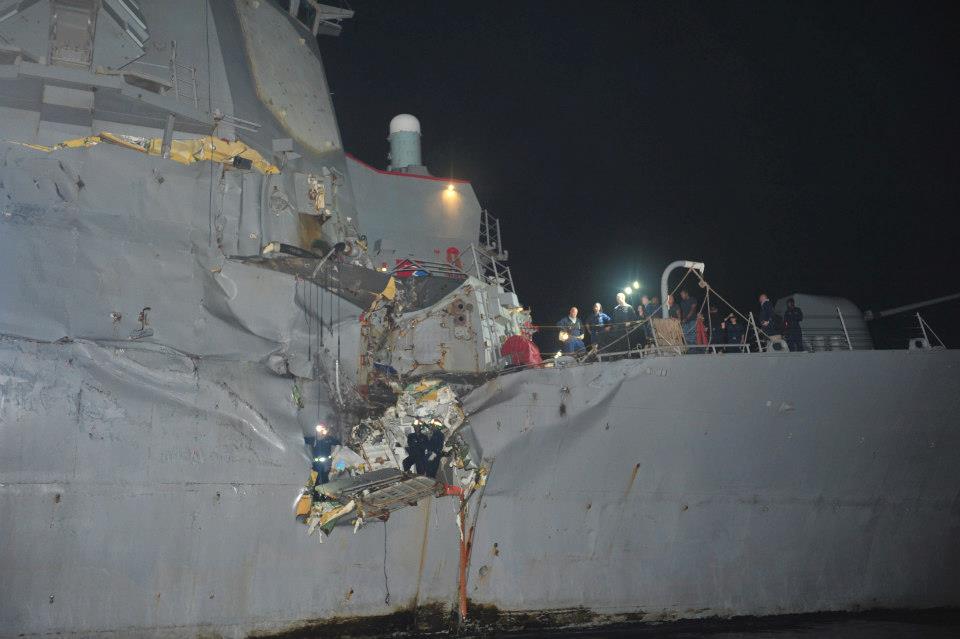
The fifth USS Porter, (DDG-78) is an Arleigh Burke-class destroyer, collided with the MV Otowasan, a Japanese oil tanker, near the Strait of Hormuz in 2012, ripping a huge 10×10 foot hole in the billion dollar Aegis warship that led to the replacement of her skipper.

But we are here to speak of the third Porter, DD-356.

0535613

Head of her class of large ‘destroyer leaders’ she was over 1800-tons and 381-feet long overall. Capable of making 35+ knots and carrying a battery of eight 5-inch/38 caliber naval guns over eight 21-inch torpedo tubes, she would have been considered a scout cruiser if she was commissioned in 1919 rather than in 1936.

She was one of the fastest and largest of US pre-WWII destroyer classes and her seven younger sisters provided yeomen service during the war. Her seven sisters earned a combined total of more than 30 battlestars during the war, fighting U-boats, protecting carriers, escorting convoys, and downing enemy aircraft.

0535611

All seven of her sisters survived the war to be scrapped in the late 1940s and early 1950s.

histor3

This was not to be the luck of the Porter.

Commissioned 25 August 1936 at New York Shipbuilding Corporation, she left immediately for the Pacific Fleet. Leaving Pearl Harbor just two days before the day of infamy, she was at sea off Hawaii when the war started. Joining Task Force 16 after convoy duty off the West Coast, she sailed immediately for the waters off Guadalcanal in 1942.

carrierwarcsg038BattleOfSantaCruzDwightCShepler
There, she found herself neck-deep in the Japanese onslaught that was the Battle of the Santa Cruz Islands. This pitted two US carriers, Enterprise and Hornet against three of Yamamoto’s. This battle, fought on 26 October 1942, started off with the Japanese having more planes (199 vs 136) and more surface combatants (40 vs 23).

Halsey’s fleet lost the Hornet, had the Enterprise badly mauled, and had more than 70% of the fleet’s carrier air-wing destroyed. During the fight, with planes ditching left and right around the USS Enterprise, Porter stood by as a plane guard, firing at Japanese aircraft while picking up pilots lost at sea.

To say the Battle of Santa Cruz was chaotic is an understatement.

To say the Battle of the Santa Cruz Islands was chaotic is an understatement.

One armed US Navy TBF Avenger torpedo bomber crashed near Porter and soon after, as the ship maneuvered to rescue the crew, she was struck by a torpedo of unknown origin. During the war the US blamed it on a Japanese submarine, but post-war study of the Combined Fleet’s records, none of the Emperor’s u-boats claimed the kill.

This had left historians to credit the sinking of the USS Porter, DD-356, to friendly fire.

Her crew was rescued by the nearby USS Shaw (DD-373), whose dramatic Pearl Harbor photographs have immortalized that ship.

The Shaw stood by to sink the stricken Porter in deep water with gunfire.

Her name was stricken a week later from the Naval List where it was given to a new Fletcher class destroyer (DD-800) at her launching on 13 March 1944.

Specs:

uss-dd-356-porter-1940-destroyer
Displacement:     1,850 tons
Length:     381 ft (116 m)
Beam:     36 ft 2 in (11.02 m)
Draft:     10 ft 5 in (3.18 m)
Propulsion:     50,000 shp (37,285 kW);
Geared Turbines,
2 screws
Speed:     35 knots (65 km/h)
Range:     6,500 nmi. at 12 knots
(12,000 km at 22 km/h)
Complement:     194
Armament:

As Built:
1 x Mk33 Gun Fire Control System
8 × 5″(127mm)/38cal SP (4×2),
8 × 1.1″(28mm) AA (2×4),
8 x 21″(533mm) torpedo tubes (2×4)
c1942:
1 x Mk33 Gun Fire Control System
8 × 5″(127mm)/38cal SP guns (4×2),
2 X 40mm AA (1×2),
6 x 20mm AA (6×1),
2 x Depth Charge stern racks

If you liked this column, please consider joining the International Naval Research Organization (INRO), Publishers of Warship
International.

They are possibly one of the best sources of naval study, images, and fellowship you can find http://www.warship.org/

The International Naval Research Organization is a non-profit corporation dedicated to the encouragement of the study of naval
vessels and their histories, principally in the era of iron and steel warships (about 1860 to date). Its purpose is to provide information and a means of contact for those interested in warships.

Nearing their 50th Anniversary, Warship International, the written tome of the INRO has published hundreds of articles, most of
which are unique in their sweep and subject.

I’m a member, so should you be!

Suppressing a Marlin Lever Action Rifle

Offering benefits in hearing protection, increased accuracy, and adding a great advantage to your hunting experience, more than 27,000 legal sound suppressors are sold every year in the United States. With lever action Marlin rifles among the most popular rifles in the country, it is only logical that these two concepts should meet for a little quiet introspection.

Rifles, just like pistols can be suppressed under some circumstances. The best firearms for suppressing are those that have a contained action, so that the gasses of the round being fired do not escape at the moment of firing. In other words, a lever
action rifle is quieter than a semi-auto one as it traps more of those gasses inside the chamber of the gun. Another problem with suppressing a rifle is that many modern high-powered rifle cartridges of today are just too fast to effectively suppress.

You see rounds like the .223 Remington, .30-06, and .308 Winchester travel at well over the speed of sound, creating sonic boom milliseconds after leaving the muzzle. However the old, fat, round-nosed rounds used by a lever action rifle due to its tubular magazine, are usually subsonic. This means a modern M4 carbine shooting military grade 5.56mm is very hard to suppress, while a 100-year old Marlin in .35 Remington can be made to participate in quiet time for a few hundred dollars extra…

Wild West Guns tuned Marlin 1894 with Thompson Machine Isis-2 9mm suppressor.

Wild West Guns tuned Marlin 1894 with Thompson Machine Isis-2 9mm suppressor.

Read the rest in my column at Marlin Forum

How can you not love those zero/zero ejection seats?


A pilot in the Royal Air Force ejects in last possible second from his Harrier. Kandahar Air Base, Afghanistan.

14 May 2009 : A British Harrier GR9A jet crashed in Afghanistan, the Ministry of Defence said. The pilot is believed to have suffered only minor injuries when he ejected from the aircraft before it came down at Kandahar airfield at about 10:30am local time. It is believed there were no other casualties. It is thought that the RAF pilot ejected after he could not land the aircraft properly. The landing gear was not fully extended

« Older Entries Recent Entries »