Category Archives: ccw

The M50 Reising Submachine Gun: HnR does a subgun

You have heard of the M3 Grease Gun, the M1 Carbine, the Garand, the Tommy gun, and almost every other firearm that the US military used in World War 2. Nevertheless, one gun you may not have heard of is the quirky little series of subguns produced by H&R. These guns, named after their inventor, Eugene Reising, were one of the great shouldn’t have beens of the War.

This Coast Guard beach patrolman of WWII is probably better served by the dog than the M50

This Coast Guard beach patrolman of WWII is probably better served by the dog than the M50

In 1940, with the clouds of war gathering on the horizon every arms engineer was looking to build the next great gun. Eugene G. Reising came across the idea to produce a simple submachine gun that could be made cheaper that the then current issue Auto Ordnance M1928A1 Thompson. The Thompson was a beautifully brutal weapon that was made famous in the Prohibition era. The problem with the Thompson was that it was a heavy beast, at nearly 11-pounds empty. Furthermore, beauty was expensive—making the Tommy gun almost $225 per copy, which, over 70 years ago, was a sizable sum. Reising was a pretty clever engineer and had previously worked with John Browning on several designs. He thought he could do better than the Tommy gun and started work on his design….

Read the rest in my column at GUNS.com

reising_m50-2

5 Handguns We Can’t Afford To Shoot

We know, we know.  With ammo shortages abounding, these days it may feel like you can’t really afford to shoot any handguns.  But by the virtue of the thousands of pistols and revolvers out there in thousands unique and familiar calibers, it’s inevitable that some weapons are always going to cost more to shoot than others. There are however those select few pistols that, for whatever reason, cost and have always cost a small fortune to take to the range. Lets look longingly at the shortlist of these diamond shooters.
Check out the rest in my column  at GUNS.com

desert eagle 50

LAPD Sees a Ghost

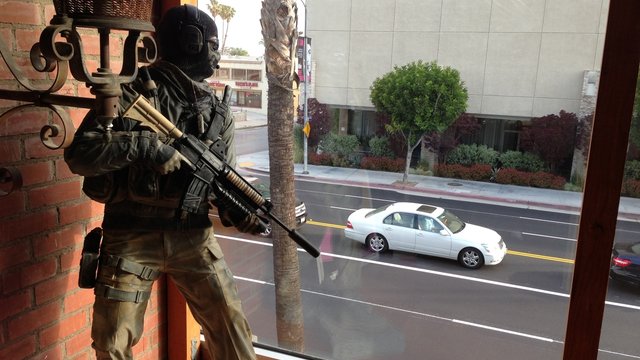
The LAPD almost met its match in a late night encounter with a video game statue last week. Note, I said “almost.” Here is the rest of the story…
Polygon.com reports that the LAPD responded to a tripped duress alarm at Los Angeles-based independent game studio Robotoki. A duress alarm is a panic button that can be pressed to alert the alarm company and/or local law enforcement that a situation such as a robbery or burglary is in progress. They are quite common in commercial and industrial settings, especially in LA, which at one time was the commercial armed robbery capital of the country.

So LAPD responds, guns out, ready to stop a threat and while coming up a staircase at Robotoki, they see what looks like a camouflaged figure wearing a skull balaclava, ballistic hard plate armor, and armed with a M4-style carbine staring back at them.

They literally saw a ghost.
Read the rest in my column at Firearms Talk.com

(Hint- its a statue)

(Hint- its a statue)

Company Debuts Gun Disabling Tech

Last month Yardarm Technologies, a California-based cell phone web products company, unveiled their new Safety First product. This product, if it catches on, could revolutionize the firearms market.

Debuted at the CITA Show in Las Vegas, Yardarm’s product is billed as the “World’s first wireless firearm safety technology for connected gun owners.” With a device that installs into the firearm, it provides location awareness so that you can tell where your gun is at all times, which can come in handy, if lost or stolen. It can be set up to alert you via text message or email if the gun is handled or moved. Once alerted the user can remotely disable the gun, or report it to authorities. Besides this, the product gathers ‘read-only access to real-time and historical reports of a firearm status, location, handling, and use.’

Read the rest in my column at Firearms Talk.com

yardarm-solution-final-chart-

The Winchester Model 12 Shotgun: Once loved, now forgotten

When you say Winchester shotguns, most people think of the Model 97 Trench gun, the Model 1200, or the elegant double barrel Model 21. But what if we told you there was a gun marketed for almost a century that was more advanced than the 97, better made than the 1200, and sold many times as much as the 21. Well it happened, and it was the M12.

In the late 1890s, John Browning had perfected a pump action shotgun for Winchester, the Model 1897 that proved to be one of the best scattergun designs in history. It was a pump-action gun with a under barrel tubular magazine, but as the years ticked by, there was one glaring, antiquated flaw—it had a hammer.

Between 1904-1908 both Savage and Remington came out with ‘hammerless’ designs that replicated Winchester’s gun performance, only with the hammer hidden inside a streamlined receiver. Winchester found itself rapidly losing market share to the more modern designs.

Winchester engineer Thomas Crosley Johnson, a man credited with more than 120 patents and much of the groundwork that led to the legendary Model 70 rifle, was tasked to come up with this new hammerless model.

Read the rest in my column at GUNS.com

the winchester 12

Who is the Man behind Kel Tec

While Kel Tec owners across the world love and enjoy their gun, few know the full story of the forward thinking engineer who started the company and still helms it today. George Kellgren.

George Lars Kellgren (sometimes spelled with just one ‘L’ as Kelgren) was born in Boras Sweden on born May 23, 1943. Kellgren cut his teeth as a firearms designer for Husqvarna and Swedish Interdynamics AB in his native country. It was while working at Interdynamics that the inventor tried his hand at a straight blowback operated submachine gun that fired at a blistering 1000-rounds per minute from a closed bolt. Labeled the MP9 by the company, some 25 prototypes were made and shopped around to various countries including South Africa without success.

Made of inexpensive molded polymers and stamped steel parts it was cheap to manufacture but nobody was buying. In the 1980s, Kellgren immigrated to the United States with some thoughts on his mind about new firearms and some initial backing from Interdynamic.

Read the rest in my column at the Kel Tec Owners Group

The KG99, later known as the Tec9 came from the same mind as the Grendel and

The KG99, later known as the Tec9 came from the same mind as the Grendel and today the Kel Tec

A UPS Driver’s Suggestions for Shipping Firearms

Hattip to Traction Control

As a gun owner and an 11-year UPS driver, I get a lot of questions from people regarding the safest way to ship and ensure firearms through UPS. Theft of firearms and other items by UPS employees, ‘though rare, unfortunately does occur, but there are a lot of surprisingly simple and inexpensive ways to virtually guarantee that you won’t be a victim. Please pass this information along to anyone who may benefit from it.

There are two things that cause thefts from UPS – pilfering and over-labeling. Pilferers are mostly thieves of opportunity. Handguns, jewelry, cameras, and prescription narcotics are their favorite targets because they are easily identifiable and can quickly be shoved into a pocket or inside of a shirt, due to the SMALL SIZE of the packages they come in.

The red and black “adult signature required” (ASR) labels that are legally required to be placed on these packages are often a dead giveaway. These labels are also called “steal-me sticker,” because thieves look for them. Most UPS facilities are fenced, and employees’ belongings are subject to searched exiting, so the size of the item is critical.

3-chain-plates-1024x768

The BEST way to protect your handgun is to simply put it in a big box. One gunsmith on my route “disguises” his handguns by putting them in used Amway boxes! This works VERY well. Look at the box you are shipping your handgun in. If you can stick it inside your pants or under your shirt easily, it is vulnerable. As far as the ASR labels, you are required by law to have them on firearms shipments. What many customers don’t know, however, is that they can get a more discreet ASR label that is incorporated into the UPS tracking label. These are better because the words “adult signature required” are very small and unnoticeable. More importantly, this barcode will electronically “prompt” the driver at the other end to get a signature. In case he accidentally tries to “release” the package on the customer’s porch without getting a signature. He will be unable to do so because the DIAD (that electronic clipboard that you sign) will read the barcode and will force him to get a signature in order to complete the delivery. You can order these special tracking labels through your Customer Service rep, or you can print them yourself with the UPS shipping software.

Another more sophisticated method of theft is “over-labeling.” This involves several conspirators who plan ahead and may get jobs at UPS for that very purpose. What they do is to print up a bunch of fake labels, with generic barcodes and phony return addresses, that are all addressed to a storage unit or apartment that they have rented in advance. One or more employees who are sorting and processing these packages will then slap the phony label over the authentic one, and the package will then proceed along its merry way to the “destination,” where an unsuspecting driver will deliver it to another accomplice who signs for it using a fake name. This will go on for a week or so until the thieves move on to another address to avoid suspicion. Since the original barcode is covered up, it is impossible to even trace these packages and they simply “vanish.”
The thieves who do this will also target handguns and jewelry but, since they are not trying to sneak it past a guard, they have the freedom to target larger packages, such as rifles, TVs, and computers. How do you avoid this?

It’s simple. You put an address label on ALL SIX SIDES of the box. A package so labeled will be passed up by a prospective thief, since he must now try to cover up six labels instead of only one. This is too risky, since the areas where these packages are sorted are often under electronic surveillance. If you are a gunsmith or store owner who ships UPS, and the package you are shipping is worth over $1000, inform the driver who picks it up and have him initial the pickup record. These “high value” packages are audited and are segregated from other packages. They are not sorted or run over conveyor belts, and they are subject to a chain-of-custody type of procedure that will prevent their being stolen. I feel 100% safe in saying that a handgun that is shipped in a larger-than-normal box of good quality, with a discreet ASR barcode, and with address labels on all six sides will NEVER get stolen or lost.

It’s unfortunate that a few of the 16 million pieces a day that we ship are in danger of being stolen but, if you take these simple precautions, you won’t be a victim.

HITRON: Hunting drug dealers from helicopters with the USCG

The United States Coast Guard has, since 1916, been the preeminent maritime law enforcement and search and rescue agency in the country. This odd coin with two very different sides has produced a military force that has to be flexible to meet challenges that no one could imagine a hundred years ago. To stop the myriad of high tech superfast smugglers who try to outrun the fuzz, the Coasties have created a unique unit to take super high-powered rifles to the air. These helicopter borne snipers are the men and women of the Helicopter Interdiction Tactical Squadron (HITRON).

Read the rest where I delve into the weapons of this elite group of coasties at GUNS.com

100223-G-8227N-290 HITRON

The Lahti 20mm Anti-tank Gun: The ‘Finnish Boombeast

You’ve all seen the pictures of the bearded gun guy spooning a gigantic seven-foot long rifle deep in the woods (well, you have now). While we can’t give you an answer as to who the lucky lovebird is, we can identify the object of his affection as the Lahti L39 anti-tank gun. Some just call it the Finnish Boombeast and it’s real.

In the late 1930s, it was thought that any future war would involve the use of armored vehicles. But about that. The tanks and armored cars of say, 1938, were far from the M1 Abrams and M2 Bradleys of today. These early tanks, such as the German PzKpfw I and the Soviet T-26 were small slow tanks (under 20 mph top speeds) with thin armor that ran 6-15mm thick. It was thought that a group of tank hunters—a couple soldiers on foot armed with a very large rifle—could move around the battlefield and pick off these vehicles like big game hunters on safari.  This led to such guns as the British Boys Anti-tank rifle, the German/Swiss Solothurn S-18, and others.

Finland in 1939 was on shaky ice with the Soviet Union, who at the time, shared a border with the small country. As the Soviets had no less than 18,000 tanks, the Finns felt the need to get their own locally made anti-tank rifle ricky tick.
Read the rest in my column at GUNS.com

The Finnish boombeast being spooned in the woods....location undisclosed...

The Finnish boombeast being spooned in the woods….location undisclosed…

5 Rimfire Subguns Ready for War

Today we think of the humble 22LR as a round best left for slaughtering tin cans. But what you may not know is that this much loved pipsqueak has been pressed into both military and police service over the years, in a rather unique series of weapons—rimfire subguns.

Modern shooters have always held the .22 LR round (which dates back to the 19th century and is one of the cheapest and, until 2013, most readily available cartridges available) to be the perfect training round for military and law enforcement and with a lot of familiarity with the round at the target range came a lot of experimentation. It didn’t take these shooters long to discover that if you take this same practice round, put it in a low-recoil select-fire rifle capable of going full-auto and give it a huge magazine, you now have something much different than a cheap to shoot plinker.

Although the 22LR round was never designed as a man-stopper with very marginal one-shot stopping capabilities, a burst of 15-20 of these rounds could ruin what plans you had for the rest of your life. Additionally, guns built around these comparatively low-pressure rounds could use lighter materials than full-sized rifles firing high-velocity cartridges thus keeping the weight and cost down—always buzzwords in military trials. From these humble beginnings, the .22 submachine gun formula was hatched and has been repeated often, with mixed results:
Read the rest in my column at GUNS.com

k 74 kilot1.qxd

« Older Entries Recent Entries »