Here at LSOZI, we take off every Wednesday for a look at the old steam/diesel navies of the 1833-1954 period and will profile a different ship each week. These ships have a life, a tale all their own, which sometimes takes them to the strangest places.- Christopher Eger
If you enjoy my always ad-free Warship Wednesday content, you can support it by buying me a cup of joe at https://buymeacoffee.com/lsozi
Warship Wednesday, Oct. 16, 2024: Skill and Perseverance

Official U.S. Navy Photograph, now in the collections of the National Archives. Catalog #: 80-G-272783
Above we see, some 80 years ago this week, the Cleveland-class light cruiser, USS Houston (CL-81), making like a submarine with her decks nearly awash. This is not an optical illusion. She is seen under tow on 17 October 1944, after she had been torpedoed twice by Japanese aircraft during operations off Formosa. The first torpedo hit Houston amidships on 14 October. The second struck the cruiser’s starboard quarter just 43 hours later while she was limping away.
A ship with a standard design displacement of 11,744 long tons, it was later estimated that, in the above image, she was so full of water that she was at some 20,900 tons.
The Clevelands
When the U.S. Navy took off the shackles of the London Naval Treaty and moved to make a series of new light cruisers, they based the design on the last “treaty” limited 10,000-ton Brooklyn-class light cruiser, USS Helena (CL-50), which was commissioned in 1939 (and was torpedoed and sunk in the Battle of Kula Gulf in 1943).
The resulting Cleveland class was stood up fast, with the first ship laid down in July 1940. Soon, four East Coast shipyards were filling their ways with their hulls.

The Cleveland class, via ONI 54R, 1943
The changes to the design were mostly in the armament, with the new light cruisers carrying a dozen 6″/47 Mark 16 guns in four triple turrets– rather than the 15 guns arranged in five turrets in Helena as the latter’s No. 3 gun turret was deleted.
The modification allowed for a stronger secondary armament (6 dual 5″/38 mounts and as many as 28 40mm Bofors and 20 20mm Oerlikon guns) as well as some strengthening in the hull. Notably, the latter may have worked as one of the class, USS Miami (CL-89), lost her bow to Typhoon Cobra but lived to tell the tale.
Much overloaded at more than 14,000 tons when fully loaded, these ships were cramped and top-heavy, which led to many further mods such as deleting catapults, aircraft, and rangefinders as the conflict went on to keep them from rolling dangerously.
Although 52 hulls were planned, only 27 made it to the fleet as cruisers while nine were completed while on the craving dock to Independence-class light carriers. A further baker’s dozen (of which only two were completed, and those too late for WWII service) were reordered as Fargo-class cruisers, which was basically a Cleveland with a single funnel and a redesigned, more compact, superstructure.
Remarkably, although the Clevelands saw much hard service in WWII, none were lost in action. No other cruiser design in history has seen so many units sail off to war and all return home.

The Cleveland class in the 1946 edition of Jane’s.
Meet Houston
Our subject is the third U.S. Navy warship to carry the name of the Lone Star State’s city which itself is named in honor of Sam Houston.
Originally slated to be named USS Vicksburg, CL-81 was renamed on the ways to honor the sacrifice of the Northampton-class heavy cruiser USS Houston (CL/CA-30) which was tragically lost in a storm of Japanese torpedoes during the Battle of Sunda Strait on 1 March 1942, a vessel whose legacy is cherished in her home state. That ship’s 1,000-man crew all either perished or were “rescued” from the sea by the Japanese and sent to hellish POW camps.
That doomed cruiser had a special link to her “hometown” and would visit it three times between 1930 and 1939, collecting a special Silver Service donated from public subscription from city leaders.

USS Houston (CA-30) view taken at Houston, Texas, in late 1930, when the ship visited the city after which she had been named. Courtesy of Captain Henri H. Smith-Hutton USN ret., 1976 NH 85177
Two months after CA-30 was lost, 1,000 young men, the “Houston Volunteers,” mustered for service to replace those lost on the cruiser and, sworn in by RADM William A. Glassford before a local crowd of 150,000, unveiled a 60-foot model of the vessel before leaving directly for Naval Training Center San Diego aboard five special trains.
Likewise, the Harris County War Bond Drive raised over $85 million, enough to not only replace the USS Houston but also to build the light carrier USS San Jacinto (CVL-30). Don’t mess with Texas, indeed.

30 May 1942. Caption: “1000 men of Houston, Texas are sworn into U.S. Navy in a mass enlistment ceremony to replace 1,000 lost on cruiser ‘Houston’.” University of Houston Libraries Special Collections. do8941zg26p

Building the new USS Houston (CL 81) at Norfolk Navy Yard, Norfolk, Virginia, for launching on June 19, 1943. Workmen lifting a steel deck plate weighing many hundreds of pounds into place. Photograph released May 31, 1943. 80-G-68627

Building the new USS Houston (CL 81) at Norfolk Navy Yard, Norfolk, Virginia, for launching on June 19, 1943. Looking through the huge anchor-eye are John W. Jackson and Wilson Majors, both steamfitters. 80-G-68632
When it came time to find a sponsor for this new cruiser, Mrs. Claud Hamill, who led the campaign to raise funds for the second cruiser Houston, was the logical choice. She led a group of 20 Houstonians to the event and christened the vessel “on behalf of the people of Houston who ensured the perpetuation of a beloved American name in a great fighting ship!”

“Norfolk, Va., 19 June 1943– Mrs. Claude Hammill, of Houston, Texas, smashes a bottle of champagne against the bow of the new cruiser, Houston, as the ship starts down the ways at her launching 19 June 1943 at the Newport News Shipbuilding and Dry Dock Co., Newport News, Va. In the picture reading from the extreme left are Senator Tom Connally, of Texas, Governor Coke Stevenson, of Texas, Jesse Jones, Secretary of Commerce, Mayor Otis Massey, of Houston, Lieutenant Commander Wilson Starbuck, Public Relations Officer of the Fifth Naval District, and (front) Rear Admiral O.L. Cox, Supervisor of Shipbuilding at the Yard.” University of Houston Libraries Special Collections. do9829b816n

Future USS Houston (CL-81) Being christened by Mrs. Claude Hamill at Newport News, Virginia, 19 June 1943. 19-N-47116

USS Houston (CL-81) launched, at the Newport News Shipbuilding and Dry Dock Company shipyard, Newport News, Virginia, 19 June 1943. 19-N-47114
Commissioned on 20 December 1943, she would spend the next four months conducting shakedown and training cruises ranging from Boston to the Caribbean.
Her first skipper was Capt. William Wohlsen Behrens, a 45-year-old Mustang who had served during the Great War as an enlisted man on submarine patrol off the Atlantic Coast later picked up his butter bar after attending Temple University.
And his cruiser was beautiful!

USS Houston (CL-81) off the Norfolk Navy Yard, Virginia, 11 January 1944. She is painted in Camouflage Measure 32, Design 1d. Photograph from the Bureau of Ships Collection in the U.S. National Archives. 19-N-60240

Same as the above. Note her extensive radar fit including SG, SK-2, Mk 13, and twin Mk 25 radars. 19-N-60241

Same as the above. Just a great example of Measure 32, Design 1d for modelers. 19-N-60239

USS Houston (CL-81) vertical photograph of the ship underway off Norfolk, Virginia, 12 January 1944. This gives a fantastic view of her dozen 6″/47s, dozen 5″38s, 24 40mm Bofors, and 21 Oerlikons as well as her twin stern cats. 80-G-214194

USS Houston (CL-81) off Norfolk, Virginia, 12 January 1944. She is painted in Camouflage Measure 32, Design 1d. 80-G-214200

USS Houston (CL-81) underway off the U.S. East Coast, on 26 January 1944 on shakedown. NH 50219
War!
Catching orders to head to the Pacific, Houston arrived at Pearl Harbor on 6 May 1944 via the Panama Canal and San Diego and by the end of the month would join VADM Marc Mitscher’s fast carrier Task Force 58 at Majuro Atoll.
Her baptism of fire would occur in June as she screened those flattops on their raids of the Marianas and the Bonins— losing one of her Kingfishers to an accident on the 12th– before turning to Saipan for the Marianas campaign by mid-month.
After spending two weeks screening TF 58 as its carries haunted Saipan from 90 miles offshore during “The Marianas Turkey Shoot,” Houston was dispatched on 27 June, along with sister USS Miami (CL-89) and six escorting destroyers, as a surface action group with orders to shell Japanese-occupied Guam and Rota.
Houston let her big guns sing for the first time, delivering 542 6″/47 HC shells and 313 of 5″/38 AA Common. Her spotting planes reported her guns to have knocked out a dozen aircraft on the ground and set alight a factory building and three large fuel storage tanks.
Of this action, Behrens noted that “While the expenditure of ammunition was high for the results obtained on targets other than the airfield, I consider it well spent, in view of the experience gained by all hands. Firing at the radio or radar stations at Rota and Guam eliminated the nervousness apparent in firing at these first targets on both islands. The performance of all personnel was most satisfactory.”
Early September found her on another sortie with USS Miami, this time joined by sister USS Vincennes (CL-64), to plaster Japanese positions on Angaur, Peleliu, Ngesebus, and Palau. This time she spent 884 6-inch and 661 5-inch shells. Miami narrowly beat her, ripping off 900 of each.
Houston then rejoined her carrier task force and screened it during airfield reduction strikes in the Philippines before returning to Peleliu to support the forces landing there in mid-September.
October saw her weather a 60-knot tropical storm at Ulithi Atoll on the 3rd before standing out against Nasei Shoto and Formosa as part of Task Group 38.2– the fleet carriers USS Bunker Hill, Intrepid, and Hancock; the light carriers USS Independence (loaded with night fighters) and Cabot; the battlewagons USS Iowa and New Jersey; and the anti-aircraft cruisers USS San Diego and Oakland. By the 10th, the TG was sending aircraft on raids against Okinawa.
On 11 October, Houston’s deck log noted “several enemy snoopers” probing the TG’s boundary and at least one unidentified submarine was spotted.
Behrens noted, “It does not appear that tomorrow’s strike on Formosa will be a complete surprise to the Japanese.”
Indeed, 12 October saw much excitement, with Houston splashing four Japanese land-based torpedo bombers while filling the air with 5,000 rounds of AAA and suffering two men with shrapnel wounds. The aircraft included new radar-equipped Mitsubishi Type 4 Ki-67 Hiryu (flying dragon)(“Peggy”) Army twin-engine heavy bombers of Imperial Army Air Force (IJAAF) Air Combat Group (Hiko Sentai) 98.

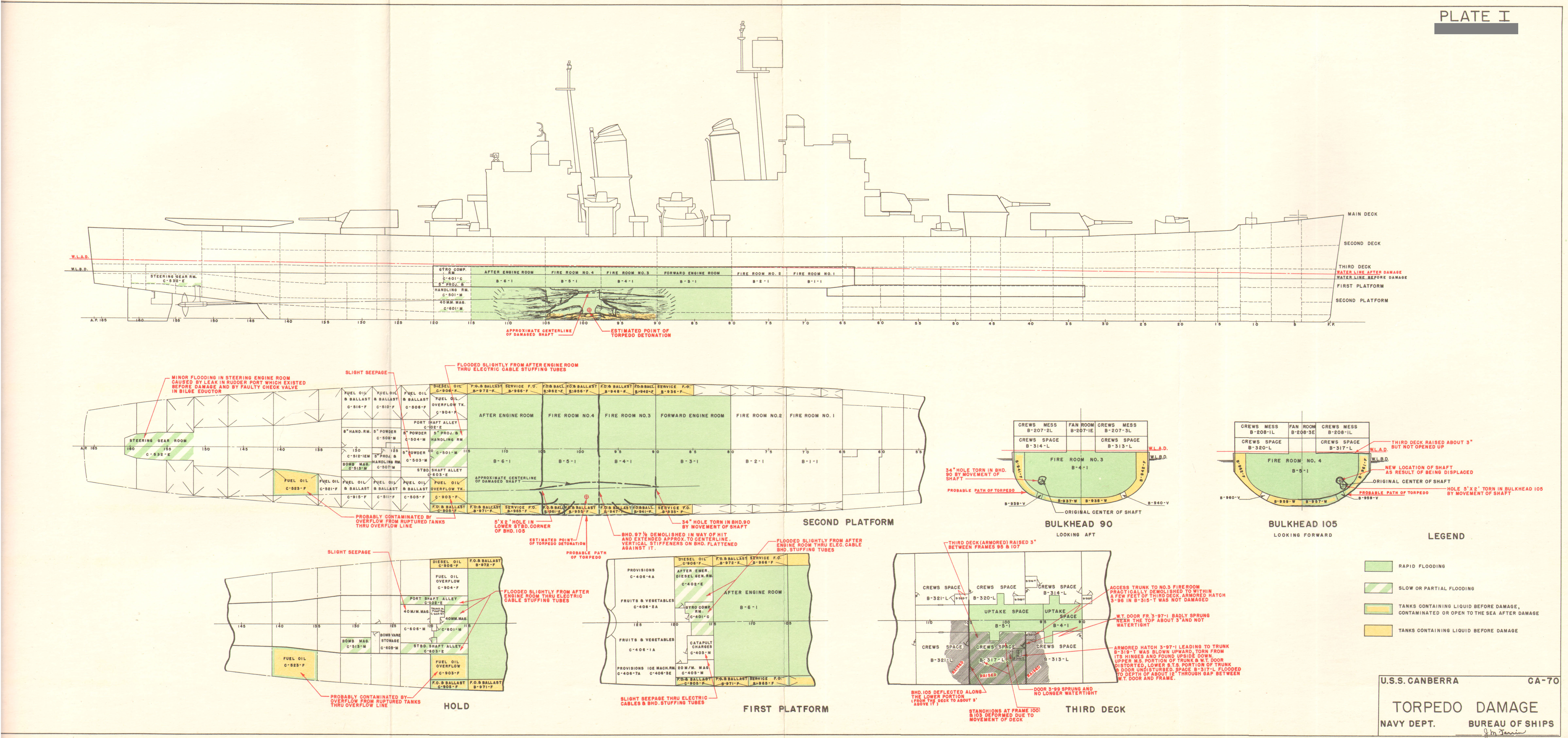
Houston helped repel another attack the next day, in which the brand-new Baltimore-class heavy cruiser USS Canberra (CA-70) suffered damage. The leviathan, part of nearby Task Group 38.2, was holed by a Type 91, Mod. 3 torpedo that hit below her armor belt at the engineering spaces and blew a jagged hole in her side, killing 23 men outright. Due to the location of the wound, a whopping 4,500 tons of water flooded her after fireroom and both engine rooms, leaving the cruiser dead in the water and had to be taken under tow by the cruiser USS Wichita (CA-45).
With Houston ordered to take the limping Canberra’s spot on the screen the next day, just after sunset on the 14th, the flying dragons of Hiko Sentai 98 caught up to her as night fell. She struck down three of the attackers but caught a tough-to-fight torpedo directly under her hull.

USS Houston (CL-81) view looking aft, showing damage to the ship’s stern area resulting from a torpedo hit amidships received off Formosa on 14 October 1944. This photo was taken while Houston was under tow, but prior to the second torpedo hit on 16 October. Note the OS2U floatplane that had been jarred off the port catapult, breaking its wing on impact with the aircraft crane. 19-N-106304
From Behrens’ report:

The Excruciating Limp
As with the stricken Canberra, which was being slowly pulled away from Formosa by Wichita, a heavy cruiser, USS Boston (CA-69), came to the stricken Houston’s aid and took her under tow on the morning of the 15th. By midnight both Canberra and Houston were under tow to Ulithi for repairs at a stately 5 knots.
Houston transferred no less than 776 of her officers and men to escorting destroyers while a force of 450 remained behind to attempt to save their home. The radio room was ordered to destroy most of the ship’s codes and ciphers in case she had to be abandoned.

A destroyer alongside the damaged USS Houston (CL-81) (right) on 15 October 1944, removing excess crewmen after she was torpedoed by Japanese aircraft off Formosa. Photographed from USS Boston (CA-69). Note OS2U floatplane on Boston’s port catapult. 80-G-272781
Her men waged war against the sea and their home’s own warren of twisted steel and buried their found dead in the briny embrace of the warm and unforgiving blue Pacific. Among the dead was her engineering officer, CDR William H. Potts (USNA 1927), killed when Main Engine No. 1 was wrecked. Two other men trapped in the after fire room had been killed by fatal burns.

USS Houston (CL-81). Burial at sea for crewmen killed when the ship was torpedoed off Formosa on 14 October 1944. Photographed while Houston was under tow on 15 October. 19-N-110835.
With an 8-degree starboard list and a draft of 34 feet (against a normal mean maximum of 25 feet), Behrens ordered the cruiser’s port anchor jettisoned and her port chain payed out to 90 fathoms to keep the ship as even as possible.
Everything quickly got primitive as the ship was flooded to the third deck and the heat of the tropics set in:

The fleet tugs USS Munsee (ATF-107) and Pawnee (ATF-74) assumed the tows of Canberra and Houston on 16 October.
Then, that afternoon, the Japanese caught up to Houston once again and she soon caught another torpedo that wrecked her hangar and flooded her steering compartment.

Japanese aerial torpedo explodes against the ship’s starboard quarter, during the afternoon of 16 October 1944. Houston had been torpedoed amidships on 14 October, while off Formosa, and was under tow by USS Pawnee (ATF-74) when enemy torpedo planes hit her again. USS Canberra (CA-70), also torpedoed off Formosa, is under tow in the distance. The original photograph is in the USS Santa Fe (CL-60) Log, a very large photo album held by the Navy Department Library. NH 98825

Behrens noted that, “In the midst of the action, our towing vessel, Pawnee, sent us a very encouraging message saying, ‘We’ll hold on,’ and continued to make the usual 5 knots in the right direction.”
Later that afternoon, Behrens ordered more of his crew taken off by escorting destroyers. By dusk, there only remained 48 officers and 152 men left on board– with six of them too gravely wounded to risk moving. With sick bay in the dark and with no ventilation, the cruiser’s guest cabin was converted to a hospital, and the wounded were brought on deck whenever conditions permitted.
On the 17th, assisted by four gasoline-driven pumps sent over by Pawnee, Houston decreased her draft to 32.5 feet and her list to 6 degrees.
This slow parade continued for days, with the Diver-class rescue and salvage ship USS Current (ARS-22) arriving alongside and sending over experts and the fleet tug USS Zuni (AT-95) taking Houston in tandem tow with Pawnee.
With almost zero reserve buoyancy left, the days were spent lowering–by hand, block, and rope– 130-pound 6″/47 shells from the shell decks of the four main turrets to the lower handling rooms to help shift the cruiser’s center of gravity.
Armored doors were unbolted and, wrestled above deck, were cast overboard. Searchlight and gun director platforms were torched off and either used for patching material or thrown over the side as were many 20mm and 40mm guns. Abovedeck ammo stores were tossed. Anything too vital to Deep Six was transferred to LCVPs and whaleboats to give to escorting destroyers to store. Rank didn’t exist and officers worked on the repair parties alongside ratings.
Luckily, fresh water had been stored in forward voids as ballast and was siphoned off for cleaning and drinking. Behrens observed, “It had a strong paint and rust taste but did much to quench the thirst.”
On the morning of 27 October, with the help of several tugs, a still very wet and soggy Houston slipped through the Mugai Channel and moored alongside the repair ship and floating workshop USS Hector (AR-7) at Ulithi Atoll, wrapping a 1,250nm mile tow that took 13 days, at an average rate of 4 knots.
Behrens finished with this observation:


USS Houston (CL-81) alongside USS Hector (AR-7) at Ulithi Atoll, 1 November 1944. She was under repair after being hit by two Japanese aerial torpedoes on 14 and 16 October, during operations off Formosa. An LCM is passing by in the foreground. 80-G-373678
After temporary repairs, Houston proceeded to Manus on 14 December under tow by the tugs USS Lipan and Arapaho and escorted by a screen of three destroyer escorts and a coastal minesweeper. Making 6.5 knots, the little convoy (Task Unit 30.9.14) made Manus six days later.
The advantage of having a forward-deployed Advanced Base Sectional DryDock (ABSD) became readily apparent. After waiting in Seeadler Harbor over the Christmas holidays, Houston entered ABSD No. 2. after USS Reno (CL-96) floated out on 7 January 1945.

Overhauls of two light cruisers at a Pacific Base inside ABSD, circa 1944-45. USS Reno (CL-96) and USS Houston (CL-81) 80-G-K-2963

USS Houston (CL-81) damage to the ship’s hull, amidships, from a Japanese aerial torpedo hit received off Formosa on 14 October 1944. The torpedo struck the ship on her bottom, inboard of the starboard bilge keel, while she was in a turn, producing the inward displacement of bottom plating seen here. Photographed in an ABSD floating drydock at Ulithi Atoll while Houston was under repair, circa November 1944. 19-N-105803
After three weeks in dry dock, Houston floated out on Valentine’s Day 1945 and, with only No. 2 and 3 main engines and Nos. 1, 2, and 4 boilers available, she was able to operate under her own steam for the first time in four months and logged a remarkable speed of 23.4 knots.
By 16 February, along with the wounded but patched up Reno and the tin can USS Bowers (DE-637), Houston and company left Manus for Pearl Harbor, zig-zagging at 16 knots. Arriving in Hawaii on 24 February, after a three-day port call and much-needed libo, Reno and Houston set course for San Pedro, California on 27 February.
Crossing through “The Ditch” a much different cruiser than when she passed just 10 months prior, Houston eventually steamed to the New York Navy Yard, arriving on 24 March 1945. Reno followed her almost the whole way, only peeling off at Charleston three days prior.
Six months later, with an extensive rebuilding almost complete, the war ended with Houston still in New York.
Houston received three battle stars for World War II service.
Capt. Behrens was relieved and was assigned duty as Commander, Naval Training Center Bainbridge, Maryland, and served there in the rank of Commodore.
Peacetime Showboat
Her repairs complete, our subject visited her namesake city just after VJ Day to show the flag and line the decks for Navy Week in October 1945. Besides, she needed to show the taxpayers and Bond buyers what they paid for back in 1942.

Crowd on shoreline along the Houston Ship Channel to welcome the USS Houston (CL-81) light cruiser during Navy Week, October 1945. University of Houston Libraries Special Collections. do66558f697

Civilians along the Houston Ship Channel welcome the USS Houston (CL-81) light cruiser during Navy Week, October 1945. Sailors in uniform line the decks. University of Houston Libraries Special Collections do26967446b

Civilians along the Houston Ship Channel welcome the USS Houston (CL-81) light cruiser during Navy Week. Sailors in uniform line the decks. The cruiser carries two new Curtiss SC-1 Seahawk floatplanes– a type that only entered service in October 1944– with their wings folded. University of Houston Libraries Special Collections do5460qs96s
From April to December 1946, Houston was sent on a European and Mediterranean cruise, visiting cities in Scandinavia, Portugal, Italy, and Egypt.

Stockholm. Ships include the elderly (circa 1915) 6,700-ton Swedish coastal battleship (Pansarskeppet) HSwMS Sverige along with the light cruiser sisters USS Houston and USS Little Rock (CL-92), while the new Gearing class destroyers USS Perry (DD-844), Glennon (DD-840), Warrington (DD-843) and Cone (DD-866) are arrayed at pier side and in the distance, along with Swedish jageren (destroyers). Eskaderbild.eskader på Stockholms Ström 11. Juli 1946. Sjöhistoriska museet. Fo219541
Following a second Med cruise with Cruiser Division 12 in 1947, upon returning to Philadelphia, Houston decommissioned 15 December 1947.
Placed in reserve, she swayed on Philly’s redlead row until, stricken from the Navy List on 1 March 1959, she was sold for scrap to Boston Metals on 1 June 1961 and scrapped.
Epilogue
The Clevelands, always overloaded and top-heavy despite their hard service and dependability, were poor choices for post-war service and most were laid up directly after VJ Day with only one, USS Manchester (CL-83), still in service as an all-gun cruiser past 1950, lingering until 1956 and seeing much Korean War duty, successfully completing three combat tours with no major battle damage.
Six went on to see further service as Galveston and Providence-class missile slingers after an extensive topside rebuild and remained in service through the 1970s. One of these, USS Little Rock (CL-92/CLG-4/CG-4) has been preserved at the Buffalo Naval & Military Park, the only Cleveland currently above water.
The third USS Houston has a marker at the National Museum of the Pacific War.

She is remembered in maritime art and scale models.


Her war diaries and reports are digitized in the National Archives.
Her 79-page war damage report is epic, noting:
That Houston survived two torpedo hits which produced a precarious stability condition, extensive flooding, serious loss of structural strength amidships and a severe gasoline fire is due for the most part to the intelligent approach of her personnel to the damage control problems with which they were confronted and the skill and perseverance with which they carried out the control measures initiated.

USS Houston (CL-81) Plate I, Torpedo Damage. Formosa. 14-16 Oct. 1944. Profile of Vessel Heeled 30° to Port
As for her wartime skipper, RADM Behrens retired from the Navy in 1947, capping a 30-year career across two World Wars. Not bad for a Mustang.
He earned a Navy Cross for his time on Houston:
“For extraordinary heroism as Commanding Officer of the USS Houston, during action against enemy Japanese forces off Formosa on October 14, 1944. With his ship dead in the water and listing violently in the heavy seas following an enemy aerial attack, Commodore (then Captain) Behrens remained steadfast and calm, efficiently directing damage control measures and the removal of personnel to other ships in the formation before his crippled ship was taken in tow by another cruiser. With his ship again under attack by hostile aircraft two days later, he inspired his officers and men to heroic effort, maintaining control and contributing in large measure to his ship’s successful return to a friendly port. By his valiant leadership, determination, and grave concern for the safety of his ship and her crew. Commodore Behrens upheld the highest traditions of the United States Naval Service.”
RADM Berhens passed in 1965 and is buried in Arlington, Sec: 2, Site 994-1
His son, VADM William Wholsen Behrens, Jr. (USNA 1943), survived WWII service in the Submarine Force with six war patrols and a Silver Star to prove it then was involved in 28 amphibious operations during Vietnam. He capped his service as the first head of the newly organized National Oceanic and Atmospheric Administration in 1972 and passed in 1986. He is also in Arlington. Good genes in that family.
The fourth USS Houston (SSN-713) was an early Flight I Los Angeles class hunter killer. Launched in 1981, this submarine was christened by Barbara Bush, wife of then Vice President George Bush which was appropriate as, while a Navy Avenger pilot (of a plane he named “Barbara”) in WWII, Bush crashed in the Pacific and was rescued by a submarine. The luckiest of her namesakes, she served a long career (33 years, 11 months, and 1 day) without loss and was decommissioned in 2016.

USS Houston (SSN-713) port quarter view of the nuclear-powered attack submarine USS Houston (SSN-713), foreground, and the aircraft carrier USS John F. Kenney (CV-67), background, departing Hampton Roads for a patrol. August 17, 1982. DN-ST-89-01391
The Navy desperately needs a fifth Houston, and maybe a first USS Behrens.
Ships are more than steel
and wood
And heart of burning coal,
For those who sail upon
them know
That some ships have a
soul.
If you liked this column, please consider joining the International Naval Research Organization (INRO), Publishers of Warship International.
They are possibly one of the best sources of naval study, images, and fellowship you can find. http://www.warship.org/membership.htm
The International Naval Research Organization is a non-profit corporation dedicated to the encouragement of the study of naval vessels and their histories, principally in the era of iron and steel warships (about 1860 to date). Its purpose is to provide information and a means of contact for those interested in warships.
With more than 50 years of scholarship, Warship International, the written tome of the INRO has published hundreds of articles, most of which are unique in their sweep and subject.
PRINT still has its place. If you LOVE warships you should belong.
I’m a member, so should you be!