Monthly Archives: July 2015

The Danes keeping it real in the sandbox

The Hunter Corps (Danish: Jægerkorpset) is an elite, special forces unit of the Royal Danish Army that has deployed extensively in teh past decade to support NATO’s war on terror missions. The below is an excerpt from Get Jaeger: At War with Denmark’s Elite Special Forces

The Hunter Corps jagerkorps is an elite, special forces unit of the Royal Danish Army

I do not look like an Afghan—never have, never will. My heavy build, broad jaw, and Scandinavian facial features are far removed from the typical Afghan’s narrow face and long, crooked nose. But I’d dyed my beard and eyebrows almost black, and covered my face and hands in brown skin cream. I wore a lungee, a traditional Afghan turban, on my head and the equally traditional salwar kameez set, which consisted of a khaki tunic and a baggy pair of trousers.

Under the tunic, I was kitted out with a bulletproof vest, a belt carrying a holstered 9mm H&K USP pistol, two extra magazines, a Gerber jack knife, and a radio connected to a discreet, skin-colored, molded ear piece. The Lowa desert boots I wore were the only thing visible that could reveal me as a soldier. But if something went wrong, I needed to be able to stand firmly.

After a few years away, I was back in Afghanistan. This country just wouldn’t loosen its grip on me. I was in one of the larger cities in the central part of the country with five other Jaegers, and had found myself in the most anonymous and self-effacing role of my career. The assignment was top secret. We were operating undercover amongst the local population.

No uniform. No visible weapons. No military vehicles.

With me in the car on this trip was Mikkel, my old friend from the reconnaissance operation in the remote Afghan mountains. We were in disguise and working, as always, at night—while the city slept. In daylight, we would be exposed immediately. But at night, driving an old Toyota with dirty windows in poor street lighting, our chances of evading detection increased dramatically. We adorned the car’s interior with local gadgets and left it unwashed for months, making it merge seamlessly with the environment.

The car’s ramshackle appearance belied its perfect mechanical state. Engine, gearbox, shock absorbers, brakes, and tires were all relatively new. We also pumped fluid into the tires, enabling the car to continue for up to 13 miles with a puncture.

Our undercover status meant we could only use weapons if we were under extreme duress. Still, should the worst possible scenario eventuate, we would certainly put up a decent fight despite our sparse setup.

Our C8 carbines—close-quarter battle (CQB) versions with shortened barrels—were ready for use, hidden under a dark piece of cloth between the front seats of our car. I had a backup gun in a holster between the seats. Six magazines, each containing 28 cartridges, were attached to the door and discreetly covered by cloth. A number of hand and smoke grenades were hidden under the seats. Our snatch-packs, containing extra ammunition, NVGs, a satellite phone, batteries, $500 in cash, water, and an emergency food ration, were also hidden under the seat. Should we be forced to leave the car, it would be absolutely vital that we bring our supplies with us.

SOF Rep has more and the book is pretty interesting

Warship Wednesday July 22, 2015: The (Giant) Messenger God

Here at LSOZI, we are going to take off every Wednesday for a look at the old steam/diesel navies of the 1859-1946 time period and will profile a different ship each week. These ships have a life, a tale all of their own, which sometimes takes them to the strangest places. – Christopher Eger

Warship Wednesday, July 22, 2015: The (Giant) Messenger God

1977 HMS Hermes R-12 with her bows nearly out of the water.

Here we see the Centaur-class aircraft carrier HMS Hermes (R12) bouncing around the North Atlantic with her bow mostly out of the water in 1977. She currently is the oldest flattop in active service (though armed with just 7 elderly and increasingly cranky Sea Harriers) and has had one hell of a ride.

British carrier problems

During WWII, the Royal Navy saw the writing on the wall in the respect that, to remain a first-rate naval power with a global reach, it needed a fleet of modern aircraft carriers. Entering the war in 1939 with three 27,000 ton Courageous-class carriers converted from battlecruiser hulls, the 22,000 ton battleship-hulled HMS Eagle, the unique 27,000 ton HMS Ark Royal, and the tiny 13,000-ton HMS Hermes (pennant 95, the world’s first ship to be designed as an aircraft carrier)– a total of six flattops, within the first couple years of the war 5/6th of these were sent to the bottom by Axis warships and aircraft.

Further, while two 32,000-ton Implacable-class and four 23,000-ton Illustrious-class carriers, laid down before the war were able to join the fleet, they just made up for the losses of the prewar vessels.

The Brits designed an innovative armed merchantman (CAM ships, for catapult aided merchantman, some 35 freighters armed with a single rocket-assisted Hurricane or Spitfire ready for a one-way trip) and picked up a legion of escort carriers loaned from the Americans to help fight off German Condor patrol bombers and U-boats. However, fleet operations in far-off areas away from the support of land-based RAF fighters needed fast and well-armed flattops.

That’s where the 16 planned Colossus-class light carriers, 4 Audacious-class, 4 Malta-class supercarriers (57,000-tons), and 8 Centaur-class fleet carriers came in. Ordered and designed between 1942-45, these 32 British ships would have been the envy of any navy in the world.

While the Maltas never made it off the drawing board, just 2 Audacious’s were finished (in the 50s), and most of the Colossus-class were likewise completed much after the war (some as late as the 1960s then rapidly sold or junked), the Centaurs were likewise abbreviated to just 4 much-delayed ships. One of these is the hero of our story.

Enter Hermes

HMS Hermes was laid down at Vickers-Armstrong on 21 June 1944, two weeks after the Allies stormed ashore at D-Day. She was the last of the quartet of Centaurs whose construction was started. Originally to be named HMS Elephant, she picked up the messenger of the god’s moniker of the old carrier (Pennant #95) sunk by the Japanese in 1942.

Envisioned to be the middle ground between the Colossus light carriers and the Malta supercarriers, these 737-foot long, 29,000-ton ships were fast enough (28 knots) to serve with the fleet, could cross the Atlantic or steam as far away as the Falklands (remember this) or Cape of Good Hope on a single bunker load of fuel oil and could carry some 60~ piston engine fighters and bombers (smaller than an American carrier of similar size due to their armored flight deck and hangar).

Washdown

NBC Washdown

However, WWII ended before any of the Centaurs could be completed and the four ships under construction, Hermes included, were sidelined.

She languished after the war and was only finished on 18 November 1959 (after 15 years at the builders) with a much-altered plan that included an angled flight deck to allow the operation of jet-powered aircraft at sea.

Hermes10_6

One of the last ships completed with 40mm Bofors DP AAA guns, she could carry as many as 40 aircraft in a mixed flight wing that included downright chunky Supermarine Scimitars, de Havilland Sea Vixen fighters, and turboprop-powered Fairey Gannet ASW aircraft together with Westland Whirlwind (British-built Sikorsky S-55/H-19 Chickasaw) helicopters.

hermes-10-at-sea

Spending most of the 1960s in the Indian Ocean and Persian Gulf area (the Brits were the preeminent naval force in the Gulf at the time), by 1968 Hermes‘ wing had been updated to include a dozen Sea Vixens, 7 Buccaneer strike planes, Wessex choppers (British-built turbine-powered development of the Sikorsky SH-34 Seabat) and 5 Gannets in AEW roles.

The 63 foot long, 30-ton Blackburn Buccaneer was the same size as the later F-14 Tomcat and could carry up to 6-tons of ordnance including the British Red Beard or WE.177 tactical nuclear bombs to a range of some 2,300 nautical miles. The Brits still had these in service as late as 1994, but couldn’t use them in the Falklands as Hermes had her CATOBAR system removed. They likely would have come in very handy if she hadn’t and there were still some in the fleet.

A Sea Vixen launching from HMS Hermes.

A Sea Vixen launching from HMS Hermes.

The F-4 Phantom was successfully tested from her decks, but it was deemed that she wouldn’t be able to carry enough (just 12, landing the rest of wing ashore) to matter.

Rare colour image of two Fleet Air Arm Buccaneers on the catapults of HMS Hermes, 1968. XT282 (325) XV152 (324) of 809 Squadron. She lost her catapults in 1970

Rare color image of two Fleet Air Arm Buccaneers on the catapults of HMS Hermes, 1968. XT282 (325) XV152 (324) of 809 Squadron.

In 1970, her catapults and arrester wires were removed (as were her old Bofors and radars) and she was converted to a “commando carrier” capable of carrying a Royal Marine battalion. Her air wing was some 20 Marine helicopters. She was also given storage and handling areas for 4 LCVP landing craft.

She was modified to carry as many as 800 Royal Marines. Dig those L1A1 SLRs (semi-auto Enfield made FN FALs)

She was modified to carry as many as 800 Royal Marines. Dig those L1A1 SLRs (semi-auto Enfield made FN FALs)

When the Harrier came out, Hermes was given a ski jump to help those VSTOL beauties take off (they would land vertically so no arrester wires were needed) and her wing was fleshed out by ASW helicopters to allow her to carry out the NATO sea control mission concept if needed.

Harrier jump jets on the Deck of HMS Hermes

Harrier jump jets on the Deck of HMS Hermes

By 1982, with the Malta’s never built, the Colossus and Audacious-class carriers all retired, and Hermes‘s own sister ships HMS Centaur (R06), HMS Albion (R07), and HMS Bulwark (R08) decommissioned in 1965, 1972 and 1981 respectively, she was at the same time the largest, oldest and most effective carrier left in the Royal Navy with only the smaller and barely broke-in 19,000-ton “Harrier carrier” HMS Invincible to back her up.

Ironically both carriers were up for sale at the time, as Parliament was determined to get the UK out of the carrier business.

Then came the Falklands.

With the nearest RAF base some 4,000 miles away at Wideawake Airfield, Ascension Island, the aircraft that the RN could carry to the Malvinas were the only ones that would be available to defend the British attempt to retake the colony.

Royal Marines line up for a weapons check in the hanger of HMS Hermes in the South Atlantic on their way to the Falklands in 1982

Royal Marines line up for a weapons check in the hanger of HMS Hermes in the South Atlantic on their way to the Falklands in 1982. Note the hangar crammed full of Harriers and the big Sea Kings on a deck above.

Hermes carried an impressive (for her size) complement of 26 RN Sea Harriers and RAF Harriers (more than half of the British combat aircraft deployed to the conflict) as well as up to 22 big Sea Kings at one time or another (though most were cross-decked to other platforms) and was flagship of Rear Adm. Sandy Woodward’s Task Force 317.8 for the war.

HMS HERMES' flight deck as she sails from Portsmouth for the South Atlantic. Five Sea Harriers of No 800 Squadron Fleet Air Arm

View looking aft down HMS HERMES’ flight deck as she sails from Portsmouth for the South Atlantic. Five Sea Harriers of No 800 Squadron Fleet Air Arm are visible on the crowded flight deck in front of a mass of Sea Kings. At the time of sailing, the crew had not had time to organize the stowing of aircraft or supplies. IWM (FKD 674)

Hermes gunner with a WWII era 20mm in the Falklands

Hermes gunner in anti-flash gear with a WWII era 20mm in the Falklands

The 100~ ship (though only 27 warships) combined fleet, the largest British flotilla formed since 1956 in the Suez crisis, departed the UK on 5 April and after an epic 25-day trip arrived in the 200-mile exclusion zone surrounding Falklands, with the Argentinians beginning their attacks on the force the very next day.

Harrier of No 1 Squadron RAF is prepared for a sortie on the flight deck of HMS HERMES, 1982.

Harrier of No 1 Squadron RAF is prepared for a sortie on the flight deck of HMS HERMES, 1982.

Arriving in the Falklands, her Harriers conducted both air support for the troops ashore and held up a pretty good CAP against attacking Argentine Mirages and Skyhawks. In all the RN and RAF Harriers (just 38 aircraft, mostly operating from Hermes) flew over 1,500 sorties in the 45 days while on station before the British Jack was hoisted over Port Stanley once more, and were credited with 20 air-to-air kills.

Air group at the height of the Falklands Conflict:
800 NAS – 16 Sea Harrier FRS.1
826 NAS – 5 Sea King HAS.5
846 NAS – 5 Sea King HC.4
No. 1 Squadron RAF – 10 Harrier GR.3

Petty officer aboard HMS Hermes crossing equator on way back to the UK from the Falklands

A petty officer aboard HMS Hermes crossing equator on way back to the UK from the Falklands

Steel beach party on HMS Hermes note sea harrier and sea king

Steel beach party on HMS Hermes note Sea harrier and the sea king

When Hermes sailed back into Portsmouth, she and the Task Force was greeted by everything that floated.

HMS Hermes being welcomed back after the Falklands War,

HMS Hermes being welcomed back after the Falklands War

hermes

Her Royal Navy career ended 12 April 1984 and she was paid off while on her 15th skipper.

However, although she was the last of her class afloat and her keel had forty years on it, she was still valuable.

Refitted, she was sold to India in 1987 and took the name INS Viraat (R22) and, homeported in Mumbai, she has served the Indian Navy for 28 continuous years, undergoing a further five refits while in Indian service.

INS Viraat, 2002

INS Viraat, 2002

Her current name means, “Giant” and she was the largest ship ever operated by the Indian Navy until they bought the 65,000-ton Admiral Gorshkov from the Russians and brought her in service as INS Vikramaditya in 2013.

Viramaditya’ (foreground) and ‘Viraat.’ Indian Navy photo

Vikramaditya’ (foreground) and ‘Viraat.’ Indian Navy photo

Admiral-Sandy-Woodward-le-011

Of note, Admiral Sir John Forster “Sandy” Woodward GBE, KCB passed the bar 4 August 2013. In his last public act, he decried the decommissioning of Britain’s carrier force before the new Queen Elizabeth class could be brought online, leaving the country that invented the type without a flattop for the first time in a century.

Hermes/Viraat is currently the last British-built ship serving with the Indian Navy, and the oldest aircraft carrier in service in the world, and with over 70 years under her keel and two new carriers on the builder’s ways, its time for the old girl to retire.

She is to decommission by 2016 and be retained as a museum ship.

From the Hindu Times:

The retirement call was forced, in part, by the dwindling fleet of Sea Harrier fighters operating from the deck of Viraat. While the limited upgrade Sea Harrier (LUSH) programme bestowed the fighters with modern avionics and beyond visual range (BVR) strike capability, the ageing airframe has been a concern. Not more than seven Sea Harriers are available at the moment — some of them cannibalized (used as ‘Christmas Tree’ for spares) to keep the relatively agile ones airworthy.

“Thanks to the Navy’s stringent maintenance regimen, we have been able to operate Viraat without major glitches until now. But the Harrier fleet has dwindled so much that within the Navy, Viraat is often referred to as a ‘One Harrier carrier’. No point flogging it any further,” an official said.

A very active veterans group preserves her memory (as well as that of the other 9 HMS Hermes dating back to 1796) in the UK.

HMS Broadsword with HMS Hermes, Falklands. Official painting by John Alan Hamilton for the MoD. (c) Mrs B.G.S. Hamilton (widow); Supplied by The Public Catalogue Foundation

HMS Broadsword with HMS Hermes, Falklands. Official painting by John Alan Hamilton for the MoD. (c) Mrs. B.G.S. Hamilton (widow); Supplied by The Public Catalogue Foundation

Sadly, the Royal Navy has not carried the name on its roles since 1985.

Specs:

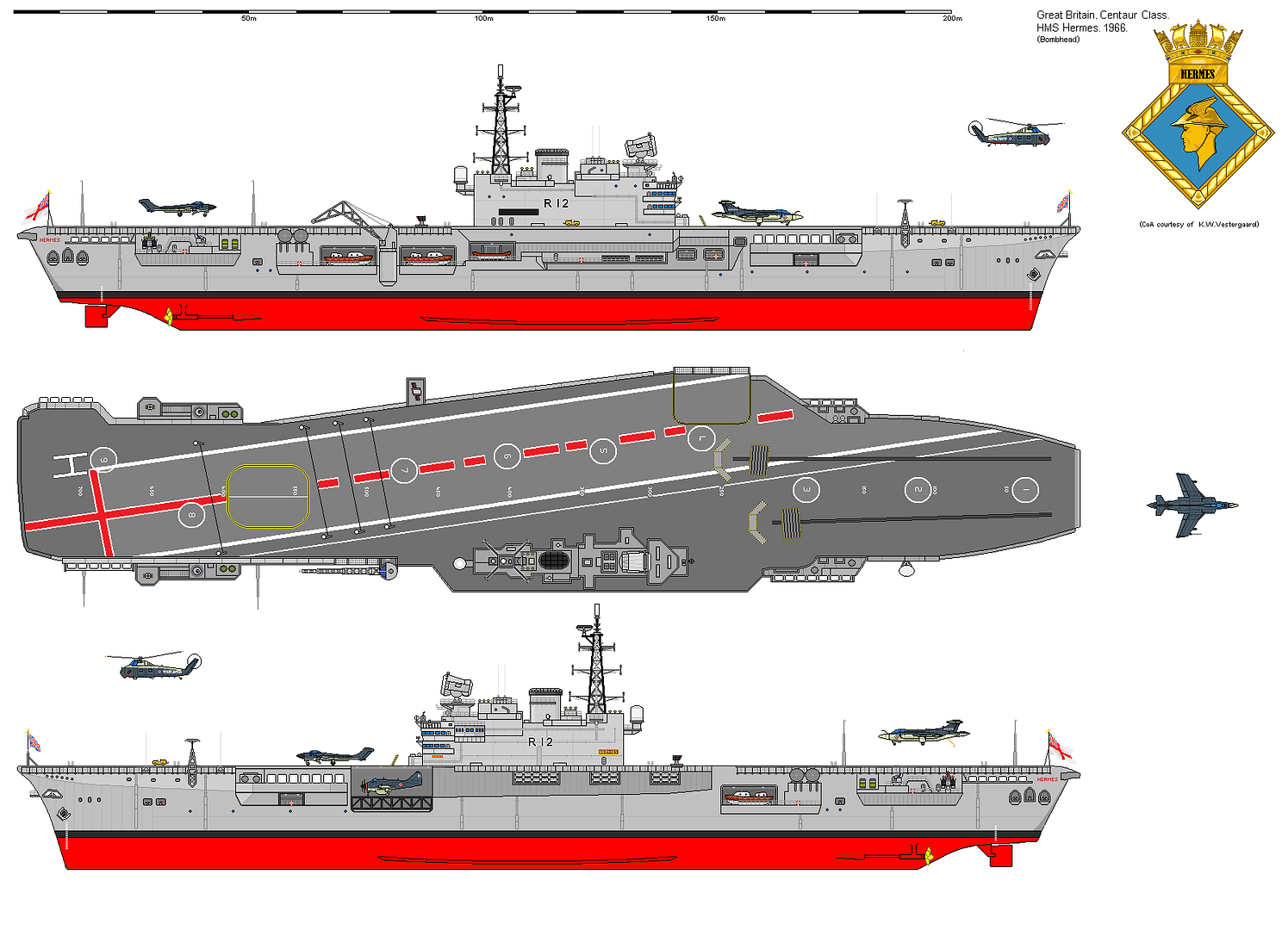
Hermes, 1966, via Shipbucket http://img.photobucket.com/albums/0703/catherine.fisher/Hermes13-31.png~original

Hermes, 1966, via Shipbucket

Hermes, 1982, via Shipbucket http://img.photobucket.com/albums/0703/catherine.fisher/Hermes13-31.png~original

Hermes, 1982, via Shipbucket

As Viraat, 1990, via Shipbucket http://www.shipbucket.com/Real%20Designs/India/CV%20R22%20Viraat%201990.png

As Viraat, 1990, via Shipbucket

Displacement: 22,000 tons 28,700 tons full load
Length: 737 ft. (224.6 m)
Beam: 130 ft. (39.6 m)
Draught: 28.5 ft. (8.7 m)
Installed power: 78,000 hp (58,000 kW)
Propulsion: 2 shaft geared steam turbines, 4 Admiralty 3-drum boilers
Speed: 28 knots (52 km/h)
Range: 7,000 nmi (13,000 km) at 18 kn (33 km/h)
Sensors: Radar Type 982, Type 983, Type 275, Type 974
Complement: 2,100 including carrier air wing. 1970-75 as Commando Carrier: 1500 plus up to 800 Marines.
Armament: 32 40mm Bofors guns (2 × 6), (8 × 2), (4 × 1) removed in 1970, replaced with 2 Sea Cat missile system launchers. During Falklands, her armament was increased with the addition of numerous small gun mounts.
Armor: 1.2-inch flight deck, Hangar deck
Aircraft carried: 7-60 depending on year and role

If you liked this column, please consider joining the International Naval Research Organization (INRO), Publishers of Warship International

They are possibly one of the best sources of naval study, images, and fellowship you can find http://www.warship.org/

The International Naval Research Organization is a non-profit corporation dedicated to the encouragement of the study of naval vessels and their histories, principally in the era of iron and steel warships (about 1860 to date). Its purpose is to provide information and a means of contact for those interested in warships.

Nearing their 50th Anniversary, Warship International, the written tome of the INRO has published hundreds of articles, most of which are unique in their sweep and subject.

I’m a member, so should you be!

New RN ASW chopper finally drops a torp

wildcat firing torpedo for first time

This a Wildcat firing a torpedo for the first time.

825 Naval Air Squadron spent two days over Falmouth Bay practicing torpedo attacks, culminating in the launch of a Sting Rant dummy weapon.

The Wildcat HMA Mk2 is beginning to enter front-line service – the first is currently on deployment with HMS Lancaster in the Atlantic – and although it’s undergone extensive trials and testing over the past five years, until now it’s not dropped a torpedo.

Some 62 Wildcats are set to replace the RN’s and RAF’s aging fleet of Lynx helicopters over the next few years.

More here

Marlin’s compact triple four, the Model 444P Outfitter

Marlin has long been the king of lever action rifles, and without a doubt the .444 Marlin has been one of the most popular heavy rounds of the last half century, which could mean that the briefly made Outfitter model with its abbreviated barrel is the compact king of the woods.

The Design of the .444 Marlin Round

Taking a fat, wide-necked 57mm long case (almost as long as a 7mm Mauser’s); the Marlin Company mashed a .429″ round on top to create a moose of a cartridge. It was longer by almost an inch than the .44 magnum, but overall nearly the same length as a 30.30 Winchester, but without a neck. It looks like an all brass shotgun shell or a throwback to the Kynoch elephant gun rounds of the 19th century, but it is brutally effective. Mounting bullets of 240-300 grains, it has the same ‘throw weight’ as the old .45-70 while being able to feed in a lever action carbine.

444Marlinweb

When compared side by side, the legacy .45-70 shot a 300-grain lead slug at 1600/fps with 1700-ft./lbs. of energy while the .444 Marlin, using the same 300-gran bullet would sling it 2000/fps and impart 1600-ft./lbs. of energy

Better yet the .444 offered a better trajectory over the .45-70’s rainbow of inches over yards traveled. Out to 200-yards, the stout round is more accurate than stock .45-70s while still having more takes down power than a .44-Magnum revolver at the muzzle. It’s rated and proven to be able to take any game in North America.

The original classic .444 chambered rifle was the (wait for it) Marlin Model 444. Introduced in 1965, the Model 444 was a standard Marlin 336 with a strengthened and enlarged action to handle the bruiser of a round. With a straight-grip Monte Carlo stock of uncheckered walnut, it often looks more like the 1895 and is often mistaken for such (although the 1895 was later offered in .444, which further confuses things).

photo_444

With a 24-inch barrel, the 5+1 shot lever gun came in at 42-inches overall and still weighed at a clean 7-pounds. In and out of production since 1965 in a number of variants, it is the primary .444 Marlin shooter out there.

One of its little-know variants (pun intended) was the short-barreled Outfitter model.

2250700_01_marlin_444_p_a_outfitter_640

Why yes, that IS a straight English style stock and a 18.5 inch ported barrel, thanks for asking!

Read the rest in my column at Marlin Forum

Far flung island outpost

guam

On July 21st, 1944, American forces began their assault on the island of Guam against the heavily entrenched Japanese. It would take 20 days of intense fighting for the Americans to reclaim the island.

guam

However, isolated Japanese units and solders continued their own war for months and, in some cases, even years (28 years to be exact)

March 10, 1945: U.S. troops in the Pacific islands continued to find enemy holdouts long after the main Japanese forces had either surrendered or disappeared. Guam was considered cleared by August 12, 1944, but parts of the island were still dangerous half a year later. Here, patrolling Marines pass a dead Japanese sniper. These Marines may belong to the Fifty-second Defense Battalion, one of two black units sent to the Pacific. (Charles P. Gorry, AP Staff/AP Archives)

March 10, 1945: U.S. troops in the Pacific islands continued to find enemy holdouts long after the main Japanese forces had either surrendered or disappeared. Guam was considered cleared by August 12, 1944, but parts of the island were still dangerous half a year later. Here, patrolling Marines pass a dead Japanese sniper. These Marines may belong to the Fifty-second Defense Battalion, one of two black units sent to the Pacific. (Charles P. Gorry, AP Staff/AP Archives)


19th Century Desert Eagle: The mighty Howdah pistol of yesteryear

Many of us today think we have cornered the market on large bore pistols designed for the ultimate in self-defense or emergency backup while hunting dangerous game. If you think that’s true, you don’t know howdah.

The concept

The word “howdah” comes from the Hindi word “houdah” and Arabic “hawdaj” which means something on the order of a “bed carried by a camel” or elephant, or some other creature. In short, if you have ever seen the platform built atop an elephant, then you have seen a howdah. It’s from these platforms that European and American big game hunters and adventurers saw the Indian subcontinent and parts of Africa, often taking to them for hunting safaris for tigers in the high grass.

THIS

THIS

If you have seen this video, you can appreciate the ability of a tiger to levitate out of tall grass to the top of an elephant

Well it only took this happening a few times back in the 1800s for safari hunters to seek out some big medicine for emergency events such as this. The ideal gun for a backup piece on tigers or other dangerous game back then was a large bore flintlock (muzzle loading) pistol. When we say large bore, we are talking about shotgun sizes such as 16 and 20 gauge, crammed with a large (think 600 grain) ball or slug over a max charge of black powder.

In concept, these were either purpose-built short-barreled shotguns or just really big handguns with smoothbore barrels, depending on how you wanted to look at it.

Improvements

As time went by, pistols using percussion ignition replaced flintlocks by the 1840s and by the 1880s, you saw breechloading cartridge guns that used the same mantra of huge bores as a talisman against things that go bump in the night.

1606930_01_howdah_pistol_640

The British, catering both to officers deployed in the extensive colonial empire, and gentlemen hunters traveling for sport abroad, took the lead in modern howdah pistol development. Three gunmakers: Lancaster, Braendlin Armoury and Holland and Holland, among a host of smaller ones, began cranking out large-bore typically multi-barreled pistols in 2, 3 and 4 barrel variants chambered in large (.38 caliber and above) rounds.

lancaster ad

These giant derringers/AOW shotguns were typically hinge-break designs with auto-ejectors and single action triggers with very low pull weight (think 2-3 pounds). This allowed the guns to be carried loaded, but ready to fire at the cock of a hammer with a high-caliber follow up shot just a hammer/trigger pull away.

Typical length ran 10-12 inches long and weight 2.5-3 pounds. All in all, about the size of today’s S&W 500 series, Ruger Super Redhawks or Desert Eagle pistols.

According to the http://www.rockislandauction.com/viewitem/aid/57/lid/1147 consignor's research, this pistol serial number 7659 was sold to Royal Navy Captain A. Moore in April 1885. Arthur William Moore joined the Royal Navy in 1860, was the commander of HMS Orion during the Egyptian War of 1882, and was present at the occupation of Ismailia and Battle of Tel el Kebir. He became Rear Admiral in 1899 and Commander in Chief, Cape of Good Hope and West Coast of Africa Station from 1902-04. He retired in 1912.

According to the consignor’s research, this pistol serial number 7659 was sold to Royal Navy Captain A. Moore in April 1885. Arthur William Moore joined the Royal Navy in 1860, was the commander of HMS Orion during the Egyptian War of 1882, and was present at the occupation of Ismailia and Battle of Tel el Kebir. He became Rear Admiral in 1899 and Commander in Chief, Cape of Good Hope and West Coast of Africa Station from 1902-04. He retired in 1912.

Read the rest in my column at Firearms Talk

Project Whale Tale

In the 1960s the U-2 spy plane was the most advance manned recon aircraft in the world. However, all planes have a finite range. With that in mind, the CIA wanted to test stretching the U-2’s range to help get those “hard to reach” areas by using strategically placed U.S. Navy aircraft carriers as launching, receiving or refueling points. After all, they figured if a B-25 could take off from a 1942-era carrier, why couldn’t a U-2 take off from a larger one in 1962?

Thus began the saga of Project Whale Tale which ran from 1963-69 and saw CIA pilots get carrier qualed on T-2 Buckeye trainers from USS Lexington and test their actual long-winged spy planes from USS Kitty Hawk and USS America.

U-2 on deck of USS America CV-66

U-2 on deck of USS America CV-66

According to The Aviationist, the operational ability to take off from and land on a carrier was used only once, in May 1964, when a U-2G operating off the USS Ranger was used to monitor the French nuclear test range, at Mururoa Atoll, in the South Pacific Ocean, well out of range of any land-based U-2 aircraft.

Still, it was done and who knows what happened that has yet to be declassified. So if an old salt tells you a tale of a visit when he was in the service of a blacked out powered glider with a 103 ft wingspan, don’t write it off as so much fluff.

The shit couldhave happened.  Keep in mind that the U-2 is still in active service.

Here is a neat video (without sound) of some U-2 carrier ops

Moscow Is Having Second Thoughts About Giving Up the Baltic States

So yeah, apparently the Russians are having second thoughts about letting go of Estonia, Lithuania, and Latvia. The last time this happened was in 1939. That’s a pucker factor for NATO right there…

More here

Combat Gallery Sunday : The Martial Art of Tom W. Freeman

Much as once a week I like to take time off to cover warships (Wednesdays), on Sunday, I like to cover military art and the painters, illustrators, sculptors, and the like that produced them.

Combat Gallery Sunday : The Martial Art of Tom W. Freeman

Born in 1952 in Pontiac, Michigan, Tom’s family moved to the East Coast when he was 12. At age 18, Freeman joined the U.S. Marine Corps Reserve in 1970 and left the military during the post-Vietnam draw down in 1977.

Although not professionally trained as an artist, Tom was skilled and had an eye for naval subjects, visiting the offices of the U.S. Naval Institute and pitching artwork that went on to grace the cover of the USNI’s journal, Proceedings (I’ve had a subscription since 9th grade NJROTC and encourage you to do the same!)

In all, he did the covers for 9 issues of Proceedings and 22 issues of Naval History magazine. He became the first artist in residence to the United States Naval Institute.

Freeman's first cover, Feb. 1977, Proceedings.

Freeman’s first cover, Feb. 1977, Proceedings.

He went on to become widely accepted and painted portraits for the White House, National Museum of the U.S. Navy, Annapolis, the SECNAV’s office, the Naval Historical Command, CNET, the NROTC program, and others as well as publish extensively.

Yamato's Final Voyage

Yamato’s Final Voyage

USS Tennessee

USS Tennessee

USS Houston, CA 30 valiantly fights on alone during the night of February 27-28, 1942 against an overwhelming Japanese Naval Force. “They Sold Their Lives Dearly” by Tom Freeman.

USS Houston, CA 30 valiantly fights on alone during the night of February 27-28, 1942 against an overwhelming Japanese Naval Force. “They Sold Their Lives Dearly” by Tom Freeman.

USCG Hamilton, (WMSL-753) interdicts drug runners by tom freeman

USCG Hamilton, (WMSL-753) interdicts drug runners by tom freeman

Pioneers

Pioneers

Pawn Takes Castle during Battle of Midway by Tom Freeman (Akagi means red castle)

Pawn Takes Castle during Battle of Midway by Tom Freeman (Akagi means red castle)

Oil on canvas by the artist Tom Freeman entitled The Harder (SS-257) Rescues Ensign John Gavlin. Date is 1 April 1944. Image via Navsource

Oil on canvas by the artist Tom Freeman entitled The Harder (SS-257) Rescues Ensign John Gavlin. Date is 1 April 1944. Image via Navsource

Too Close

Too Close

Action in the Slot PT-109

Action in the Slot PT-109

IJN Soryu (Blue Dragon) by Tom Freeman

IJN Soryu (Blue Dragon) by Tom Freeman

French helicopter carrier Jeanne d'Arc

French helicopter carrier Jeanne d’Arc

(16 June 2003) Award-winning artist Tom W. Freeman presents his painting "Payment in Iron" to the Honorable Hansford T. Johnson, Acting Secretary of the Navy (SECNAV). The artwork will hang in the main entrance to the Acting SECNAV’s office. U.S. Navy photo by Journalist 1st Class Craig P. Strawser.

(16 June 2003) Award-winning artist Tom W. Freeman presents his painting “Payment in Iron” to the Honorable Hansford T. Johnson, Acting Secretary of the Navy (SECNAV). The artwork will hang in the main entrance to the Acting SECNAV’s office. U.S. Navy photo by Journalist 1st Class Craig P. Strawser.

He delved extensively into Civil War maritime history, a subject that is often left uncovered.

You Can Run, CSS Alabama chases down Yankee clipper.

You Can Run, CSS Alabama chases down Yankee clipper.

url

The Fatal Chase by Tom Freeman. The USS Hatteras engages the Confederate raider CSS Alabama. Hatteras was sunk in the ensuing battle

The Fatal Chase by Tom Freeman. The USS Hatteras engages the Confederate raider CSS Alabama. Hatteras was sunk in the ensuing battle

"Gunfight on the Roanoke," The gun crew of the U.S.S. Miami witnesses the sinking to the U.S.S. Southfield by the C.S.S. Albemarle, April 19, 1864. Via TomFreemanArt.com

“Gunfight on the Roanoke,” The gun crew of the U.S.S. Miami witnesses the sinking to the U.S.S. Southfield by the C.S.S. Albemarle, April 19, 1864. Via TomFreemanArt.com

gotmb_tf-jpg.43930

CSS Fredericksburg at Trent's Reach - Tom Freeman

CSS Fredericksburg at Trent’s Reach – Tom Freeman

Freeman’s magnum opus was a series of 42 paintings and a mural covering the attack on Pearl Harbor on Dec. 7, 1941 for the USS Arizona Museum, who display them prominently in their collection, seen by millions.

Attack on the Tang

Attack on the Tang

Tom_Freeman.jpg~original

Nakajima B5N2 attack bomber taking off from aircraft carrier Akagi, 7 December 1941. Artwork by Tom Freeman.

Nakajima B5N2 attack bomber taking off from aircraft carrier Akagi, 7 December 1941. Artwork by Tom Freeman.

The Last Mooring

The Last Mooring

Fuchida's planes cross the coast, by Tom Freeman.

Fuchida’s planes cross the coast, by Tom Freeman.

DC-242-2356.jpg~original

Sadly, Mr. Freeman crossed the bar last month on June 18 at age 62. Freeman is survived by his wife Ann, five children and 13 grandchildren.

Artist Tom Freeman at Pearl Harbor

Artist Tom Freeman at Pearl Harbor

His official website, Tom Freeman Art.com is up and running and I encourage you visit it.

'A Guest of the King' USS Enterprise arrives in Bahrain for a port call. Tom Freeman

‘A Guest of the King’ USS Enterprise arrives in Bahrain for a port call. Tom Freeman

This month’s Proceedings has a salute to Freeman included and is repeated on their website and they note that his “Guest of the King” might well be the only American painting gracing the palace of King Hamad bin Isa Al-Khalifa of Bahrain.

Thank you for your work, sir.

Breakdown of aircrews for the Battle of Britain

The RAF Benevolent Fund put out this rather interesting infographic commemorating the Battle of Britain’s 75th Anniversary. It seems the campaign was rather symbolic of the World War itself.  Less than 80 percent of the aircrews were from the UK.

75th anniversary battle of britian

Of deference to the graphic however, some 244 Americans served with the three Eagle Squadrons in RAF service between Sept. 1940 and 29 Sept. 1942 when they were absorbed into the USAAF’s Eight Air Force, although only a fraction flew in the Battle of Britian. (Interesting 31 page USAF pdf here on the subject)

« Older Entries Recent Entries »