Category Archives: weapons

Glock’s new pistol turned out to be a super reliable plinker

When it comes to .22LR, the biggest problem is the round itself.

First marketed in 1884 as a black powder round, the little lead-nosed pipsqueak was intended for use in rifles and revolvers, with its rimmed case proving notoriously difficult for pistols to cycle. Compounding this, there is a myriad of loads in circulation, all with slightly different specs and performance. When you magnify those problems with the fact that the rounds are often produced by the millions as economically as possible, especially in the case of bulk-pack budget ammo, and you get a cartridge that tends to be finicky in a lot of semi-auto handguns.

To get it right, Glock spent nearly three years testing and developing the G44– which is why models like the G45, G46, G47, and G48 passed it up in reaching the market while the rimfire chewer was still in R&D.

During that time, they used no less than 141 different rimfire loads in testing, popping over 1.2 million rounds in the process. Federal, which supported the effort, used everything in test guns from 42-grain subsonic to CCI Stingers with no problem. In short, while many 22LR pistols come with the caveat that they are picky about their diet, the Glock is billed as being omnivorous.

Well, I grabbed 2,200 rounds of a wide array of .22LR and headed to the range with a new G44 sent for T&E.

How did it do?

More in my column at Guns.com. 

Dr. Watson, bring your revolver(s)

So I saw this interesting listing pop up from Milestone Auctions, centered on a cased pair of beautiful (although non-sequential) Colt Model 1878 double action cartridge revolvers.

As you may well remember, the Colt 1871 and follow-up 1873 (aka Peacemaker, aka Single Action Army) brought the iconic wheelgun maker back from bankruptcy and into the cartridge revolver-era, and the 1878 being double action, was essentially the most tactical wheelgun on the market when it was released.

With 5.5-inch barrels and a massive .455/476 Enfield Eley Mark III chambering, these big gate-loading Colts were certainly man-stoppers.

Even more interesting, and the caliber may have given it away. is the fact that these two Colts are English silver plated with bird’s head rosewood grips and are covered with both British proof house marks and Colt’s London address on the barrels.

For sure, these were presentation guns for a special occasion or person. A clue is in the auction listing which reads that one of the guns :

“..appears in the copy of Army & Navy sales ledger as sold in England to Caton Jones, Sup FW on Sept 9, 1885, with no details on guns finish. How they ended up together as a pair and plated while in England is a mystery.”

Going to the Army List for that year, we find one Frederick William Caton Jones, MB (Medicinae Baccalaureus), MRCS (Membership of the Royal College of Surgeons), is listed as commissioned 30 May 1885. He was 25 years old.

Bound for India, our good Dr. Caton Jones later turns up in future listings as a Surgeon assigned in 1891 to the Bombay garrison with the Army in India, where he was still posted as of the 1906 Army List. During that period he rose to Major on 30 May 1897 and to Lt. Colonel on 30 May 1905.

As published in The Western Australian, 24 August 1900, Caton-Jones was mixing it up with the Boers while in Kitchener’s brigade.

Surgeon-Major F. W. Caton Jones, of the Royal Army Medical Corps, writing to his sister, Mrs. Cumming from Newcastle, South Africa, under date July 22, says :–

I am just getting over that Ladysmith business now and can get along all right without taking medicine, but it has taken four months to do it. I have a very nice commando of my own now. Am in charge of the 7th Brigade, Field Hospital and Bearer Company. It is an Indian hospital and a perfect unit.

I have under me one officer, R.A.M.C.; two civil surgeons (in place of R.A.M.C. officers); eight assistant surgeons (Indian Apothecaries); one conductor (Indian army); two civilian conductors, four sergeants, and eight nursing orderlies (British army from India); 42 Indian Army Hospital native corps, 126 Indian dhoolee-bearers, and 50 drivers.

I am equipped for a hundred sick in hospital, and put up double that number at a pinch. I can carry 52 men lying down and 12 sitting in my sick transport, 20 lying in the dhoolies, and 94 sitting in my wheeled ambulances, if I put no lying down cases in the latter; a good deal to be responsible for.

Our brigade, under Brigadier General Kitchener, is at Newcastle, on the lines of communication. Of course, we are very sick at not getting forward, but someone must stay behind. Thank goodness, the grass is burnt round the camp. Veldt fires happen every day. One field hospital was burnt, but luckily no one was injured.

This is a fine country, and very healthy. All colonists say we shall have to be much sterner with the Boers before they will give in. I believe sternness would save very many lives both of, theirs and ours. If the Indian hospitals are sent back to India in September, I may go to China.

By 1911, the good doctor was back from his long overseas deployments and stationed in Tidworth Barracks in south-east Wiltshire, England where he remained until 1914.

By 1916, I can find then-Colonel FW Caton-Jones OB, AMS, ADMS (Assistant Director Medical Services), as head of the Medical Board of Officers assembled at No 1 General Hospital, Etretat, in Normandy, serving with the BEF “on the Continent.”

Col. FW Caton-Jones, 1916, via IWM

Why the big pistols for a man of medicine, besides the obvious need for a gentleman of the period to have arms while campaigning?

It seems the good Dr. Caton-Jones was a true English gentleman officer while abroad and was something of a noted big game hunter as well as a man of arts, science, and letters.

In 1914, he contributed a chapter to Major-General A.E. Wardrop’s “Modern Pig-Sticking,” a tome about horse-mounted tiger and boar hunting, particularly centered in India.

An illustration from Modern Pig Sticking, circa 1914

Caton-Jones was uniquely qualified to write the chapter at the time as he was the 1907 winner of the Nagpur Hunt cup. The Spectator called the volume, “one of the pleasantest books on the sport that we have seen for a long time.”

Caton-Jones had previously written other scholarly works for the Journal of Bombay Natural History (“Some Notes on Wild Dogs and Panthers”) as well as for the British Army’s Journal of the Royal Army Medical Corps (“The Sanitation of Standing Camps in India”). He also wrote/co-wrote at least seven papers in the respected The Lancet medical journal. Still other papers appeared in The Medical Press and Circular, and The Journal of the Royal Institute of Public Health.

After moving to the reserve list following the Great War and more than 30 years of military service, Caton-Jones later reappeared in India and Kenya while still submitting articles on both medicine and hunting (see= The Hoghunter’s Annual, Times of India Press, 1930).

At some point, he was made a Companion of the Order of Bath and a fellow of the Royal Institute of Public Health.

Colonel Frederick William Caton Jones, CB, RAMC, Veteran of the Boer Wars, the Great War and assorted Indian campaigns, and scourge of tigers and wild boar, died at his Earlsdale estate on 7 June 1944, aged 83.

No word on if a Mr. Holmes attended his funeral.

Ever thought about a SCAR in 6.5 Creedmoor?

Last year, FN apparently trialed a version of their MK 20 SSR (sniper support rifle) in 6.5 Creedmoor as USSOCOM was flirting with the idea of fielding the new– and increasingly popular– round for future use. Not to let research go to waste, the company just announced they will start selling the commercial variant of the SSR, the FN SCAR 20S, in 6.5CM.

Boom.

More in my column at Guns.com. 

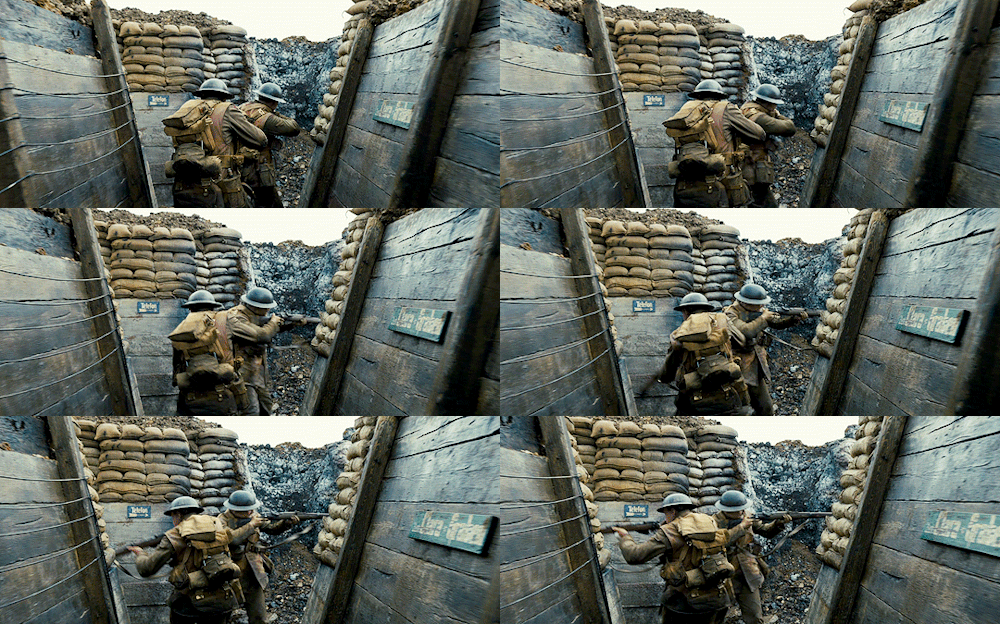
So I saw 1917

Over the weekend I watched 1917, the Great War Western-front epic by British filmmaker Sam Mendes.

Not to spoil too much of the plot, the broad-strokes (which you can get from the preview) is that two humble lance corporals of the fictional 5th Rifles (KRRC)– salty veteran Will Schofield and newcomer Tom Blake– are sent on a last-ditch near-suicide mission to deliver a message to the 2nd Dorsets, the latter of which have broken out and are chasing German troops who they believe are on the run from the Noyon and Bapaume salients.

The reason to stop the Dorsets? The Germans are not running, but are instead evacuating in good order to prepared positions at the massively fortified Siegfriedstellung (aka the Hindenburg Line, from Arras to Soissons) against which the British light infantry, attacking alone, would surely be massacred.

While elements are true (the Hindenburg Line and the relocation from the salients happened as part of the so-called Alberich Maneuver), others were slightly fictionalized. For instance, the 2nd Dorsets never saw France, as they were deployed from India to Egypt and fought in Palestine during the war while the 5th KRRC never stood up in the Great War. The story the film is based was a soldier’s tale passed on by Mendes’s paternal grandfather who served in the KRRC during the conflict, so there is that.

With that being said, I felt there was great attention to detail. For example, the BEF veteran, Schofield, wears older Pattern 08 gear while the newer Tommy, Blake, has elements of modified Pattern 14 leather gear.

P08 vs P14 British gear

Likewise, they use period-correct SMLE Mk III rifles with magazine cutoffs and long P’07 sword bayonets, carry E-tools, wear their puttees correctly, and have Brodie helmets (but, like most actual soldiers, often do not wear said tin caps.)

Further, while threading their way across No Man’s Land, they encounter the most horrific scenes imaginable. One that struck me was the extensive and complex barbed wire entanglements they have to negotiate. Too often in film, barbed wire is shown as a single strand or two, something that could be quickly snipped by a small cutter or a line that an energetic point man could fall across to allow his mates to tread over.

The real thing was far from being that simple:

Ultimately, our two Tommies find themselves in abandoned but excellently-constructed German trenches, complete with concrete blockhouses and an extensive underground bomb-proof barracks. This again was correct to form.

Read Storm of Steel by German field-grade officer Ernst Junger, who spent years in such complexes, and he talks about them on virtually every passage. Even relating that he would on occasion sleep through British bombardments, knowing that his batman would come and fetch him should something pressing develop.

Tales of the German “Labyrinth” at Arras, captured by the British in 1917 during the repositioning, highlighted such installations.

The German “Labyrinth” at Arras, under new management, 1917

It should be remembered that the Kaiser’s men had been in their positions since 1914 in most cases and were determined not to take a step back when they laid them out, hence the extensive fortifications. Some dugouts even had wallpaper and electric lights! The British and French, on the other hand, were always on the assumption their trenches would be only temporary before the “Big Push” came in which they would drive the Jerries/Boche out, so they often would leave their men in muddy holes.

Other scenes in the movie were striking, but I will not cover them as they would be too spoiler-filled.

All in all, for the correctness and “grit” the film does a better job than just about any WWI Western Front movie I have seen prior.

The plot, while slightly far-fetched, is workable enough to move the story along. The Germans are, with the exception of one close-up encounter with a very blonde young man in the middle of the night, faceless and appropriately unseen but no less ominous, and remain deadly even when you think they would not be. The British officers are, for better or worse, very proper English, ala the final season of Blackadder.

I’d watch it again and would recommend it to others. Do yourself a favor and watch it on a big screen rather than a small one should you have an interest.

For a great short work specifically on life in the trenches, check out Eye Deep In Hell by John Ellis. You can often buy used copies for like $3.

More info on the new French Glocks, SCARs

Last week, the French military purchasing agency announced they are picking up 75,000 new Glocks to replace older MAS G1 (Beretta 92) and MAC 50 (Sig P-210ish) pistols. The new handguns will be two-toned (black over Coyote) Gen 5 G17s with Marksman barrels, suppressor-height night sights, ambi slide levers, a lanyard ring (G19X, is that you?) and forward slide serrations.

Voilà

The new French PSA G17

Additionally, to replace the 1980s-era FR F2 bolt-action rifle, the French will be issuing the SCAR-H PR, essentially a SCAR-17 with a heavy barrel. It will be issued with an FN-made QD suppressor, a cleaning kit, four 20-round magazines, and two 10-round magazines.

More details, including videos, in my column at Guns.com. 

Bluebird in Brazil, 98 years ago

A rickety canvas and wood Vought flying machine takes gingerly to the air from a catapult, allowing its 180-horse Wright-Hispano E-3 to claw at the sky. Below is the green-blue water of Rio De Janerio. The date is 11 January 1922.

80-G-410390 VE-9 Vought aircraft, (BuNo# A6463) leaving the catapult of USS Nevada (BB 36) 1922

NARA 80-G-410390

The floatplane, a VE-9H Bluebird (BuNo# A6463), is shown leaving the stern cat of the battleship USS Nevada (BB 36) during the Brazilian Centennial Exposition.

When armed with a single .30-06 machine gun firing through the prop, the two-man VE-7/9 series had a maximum speed of just over 100 mph and was considered to be a fighter at the time.

Only 120 or so were made, split between the Army Air Corps and the Navy. Notably in USN service, the type equipped the Navy’s first two fighter squadrons– VF-1 and VF-2 —, making history in October– ten months after the above photo was taken, when a Bluebird piloted by Lt. Virgil C. Griffin alighted from the deck of the newly commissioned carrier Langley, the Navy’s first carrier takeoff.

Never before, well, not until 1983 anyway

While John Browning’s everlasting M1911 design had long been made in various blued and nickel coatings, up until the early 1980s it had not been cranked out in a production stainless steel model. That’s where the company formed by airline executive Ken Lau and retired Air Force Brig. Gen. Russell Randall, seized the opportunity.

The Randall Firearms Company started off making stainless .45ACP magazines, which sold exceptionally well, then began firearm production in Sun Valley, California and by June 1983 they started marketing, what gun writer Len Davis described that year in American Handgunner, the first “full-size, all-stainless steel .45 ACP autoloader.”

In production for less than two years, the California-made Randall M1911 hails from the Reagan-era and is a solid collectible. And, yes, this one is named in honor of The Big Cigar.

More in my column at Guns.com

Nick’s Heron

An Italian triple-engine floatplane, a CANT Z. 506B Airone (Italian: Heron) rests on a Sicilian beach (possibly on Mondello beach south of Palermo) guarded by an SMLE-armed British soldier in November 1943.

LOC LC-DIG-fsa-8d34157

Originally built in the 1930s as a 12-seat passenger plane for the Italian airline Ala Littoria to zip tourists and businessmen around the Med, the Airone turned out to be a pretty decent search-and-rescue craft and torpedo bomber and as such saw service in WWII with the Italian Air Force (Regia Aeronautica) and Navy (Regia Marina) as well as the by the Luftwaffe in limited numbers.

Another photo from the same set, LC-DIG-fsa-8d34158.

The two above images were shot by Office of War Information photographer Nick Parrino, who crawled around the ETO and the Middle East throughout 1943 and 1944, leaving behind more than 500 amazing images that are available through the Library of Congress.

Postwar, the Airone would remain in service as a SAR aircraft into the 1960s. Of the more than 350 produced, only one is preserved.

The best known invention of the brothers Koucký

Designed by brothers Josef and František Koucký at the CZ factory in then-Czechoslovakia after more than six years of development, the all-steel 9mm parabellum double-stack CZ75 was a broadside response in the 1970s to the S&W 59, Browning Hi-Power and Beretta Model 92, the West’s contemporary 1st gen “wonder nines.” It soon became a hit and was a best seller around the globe that has remained in production ever since.

Known originally in the West as “the Brunner pistol” after its West German exporter, Walter Pomeranski began importing the CZ75 to the U.S. in 1979. In January 1980, no less a shootist than Col. Jeff Cooper wrote in American Handgunner, “I think the Brunner is the best of the conventional nines as it stands, and the best conventional pistol if it is modified to a major caliber.” Notably, Cooper would use it as the basis of his own Bren Ten concept.

Besides clones produced by a myriad of Italian, Eastern European and Turkish firms, CZ themselves have made more than 1 million of these iconic combat pistols in the past 45 years.

Speaking of which, there is a limited edition 45th anniversary CZ 75 for 2020.

More in my column at Guns.com.

Sweet helmets and trapdoors

From the California Military Department Historical Collection:

Cabinet card of Company G (former Shields Guard) of the National Guard of California’s San Francisco based 1st Infantry Regiment, circa the mid-1880s to early 1890s. This was probably taken at the De La Vega training site in Santa Cruz.

The Sergeant in this image is wearing an M1885 dress uniform coat modified with an M1873 style collar. He is also wearing the M1881 dress helmet for dismounted soldiers. The rifles are Springfield trapdoors, which the state troops would continue to use through the Spanish-American War.

« Older Entries Recent Entries »