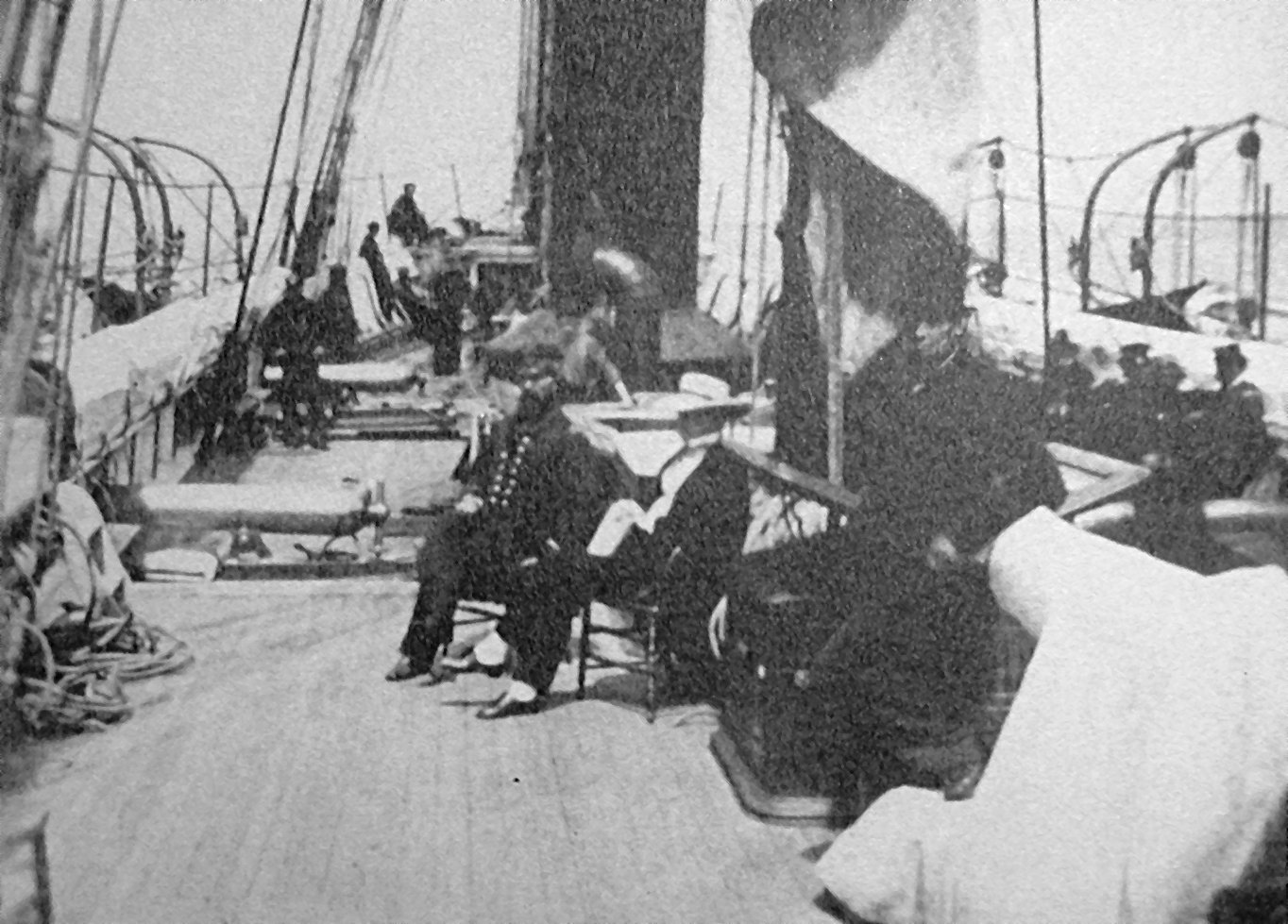
Tag Archives: Revenue Marine Service

Warship Wednesday 21 January 2026: Interdiction Trendsetter

Here at LSOZI, we take a break every Wednesday to explore the old steam/diesel navies of the 1833-1954 period, profiling a different ship each week. These ships have a life, a tale all their own, which sometimes takes them to the strangest places.- Christopher Eger

If you enjoy my always ad-free Warship Wednesday content, you can support it by buying me a cup of joe at https://buymeacoffee.com/lsozi As Henk says: “Warship Coffee – no sugar, just a pinch of salt!”

Warship Wednesday 21 January 2026: Interdiction Trendsetter

From the San Francisco History Center, San Francisco Public Library, call no AAE-1505

Above we see a great period shot of the two-gunned U.S. Revenue Cutter Wolcott in the Bay area circa 1884, with a good view of the flag established by her namesake. A fine steamer with the lines of a yacht, she made history some 140 years ago this week when she made the service’s first large drug bust.

How large? Like 3,000 pounds of opium hidden in barrels at a salmon cannery in southern Alaska kind of large. And her crew did that after a 736-mile race through a storm to secure the stash.

All in a day’s work.

Meet Wolcott

Our subject was the second cutter to carry the name of Oliver Wolcott Jr., a Yale-educated Continental Army veteran who replaced Alexander Hamilton as Secretary of the Treasury in 1795 after serving as the department’s auditor and Comptroller for several years.

It was while in the office that Wolcott, with the approval of President Adams, selected a design for the Revenue Marine’s Cutter ensign and pennant that he described in a letter to his collectors in 1799 as “consisting of sixteen perpendicular stripes, alternate red and white, the Union of the Ensign to be the Arms of the U.S. in dark blue on a white field .” The stripes stood for the States that comprised the Nation at that time. The original 13 States were commemorated by an arch of 13 blue stars in a white field. The flag was also flown over U.S. Customs Houses until the 1900s and, in 1916, was modified into the USCG flag with the addition of that service’s distinctive insignia. Oddly enough, the only two surviving pre-Civil War Revenue Cutter flags both have 13 stripes. 

A Civil War era Revenue Cutter Flag, carrying the correct, as specified, 16 stripes and 13 stars. 

The first cutter named for Wolcott was a light and fast 4-gun Morris-Taney-class topsail schooner of some 73 feet that entered service in 1831. She was one of 11 U.S. Revenue cutters assigned to cooperate with the Army and Navy in the Mexican-American War, but foundered shortly after.

Our subject was built in 1873 for use on the West Coast (which was inherited after the war with Mexico) and was constructed at the Risdon Iron and Locomotive Works in San Francisco.

Risdon Iron Works, Ship-Yard, Potrero, San Francisco – During Repairs to Steamers “Sonoma,” Alameda,” “Australia” and German Ship “Willie Rickmers.” British Ship “Dowan Hill” Discharging. From the San Francisco History Center, San Francisco Public Library AAC-7340

A 155-foot steamer built of white oak and yellow fir from Oregon and Washington, with bilge keels and iron-wire standing rigging and a sheathed hull, she had a standing (vertical cylinder) surface condensing steam engine with a 34-inch stoke and matching 34-inch diameter.

NHHC NH 309

With a beam of 22 feet and a draft of just over 9, the graceful 235-ton cutter could make an average of nine knots under canvas in fair seas with a good breeze or 9.5 with her engine chugging away.

Port Townsend. USRS Oliver Wolcott, Steam Revenue Cutter, 2-mast, Anchored, ‘Stbdside profile, Bunting flying, 4 July 1888, Jefferson County Historical Society. 2004.117.68

She was built to replace the smaller Civil War-era cutter Wayanda, which had served in Alaskan waters since 1868. As such, when Wolcott was commissioned in the summer of 1873, it was the crew of the laid-up and soon-to-be decommissioned Wayanda that cross-decked, bringing much of their equipment with them, to bring the new cutter to life.

Intended for the often lawless stomping grounds of the Bering Sea Patrol, where she would typically be the only government vessel in any direction for several days steaming, she carried a stand of small arms and cutlasses as well as two mounted guns, which the Coast Guard Historian describes as “of unknown type and caliber.”

It should be noted that during this period in the Territory’s history, the USRCS served largely the same role as the Army’s horse cavalry during the settlement of the Old West, being typically the only armed federal force in most of the region.

While I can find no source that details the two guns Wolcott carried, they may have been brought over from her first crew’s last cutter. Wayanda, famous for what may be a 1863 photo of Lincoln aboard with Seward, was armed with several bronze 12-pounder 4.6-inch smoothbore Dahlgren boat howitzers on slide carriages.

Twelve Pound Dahlgren Boat Howitzer (1856) by Ulric Dahlgren

Ranges for the 12 pdr heavy (at just 5 degrees elevation) were 1,150 yards with shrapnel and 1,085 yards with solid shell, the latter of which was practical for shots across the bow.

As those handy 772-pound muzzleloader percussion-fired guns had a history of being swapped among Navy warships and Revenue cutters as late as the 1890s, it is more than likely that Wolcott shipped out with a couple of those– which may, in turn, have had a connection to the famed President in the stovepipe hat.

Her crew was generally eight officers and 31 enlisted, with an August 1877 list of USRM officers listing the cutter with seven filled billets for a captain, first, second, and third lieutenants; a first and second assistant engineer, as well as an acting second assistant engineer– only missing a chief engineer for the eighth chair in her wardroom.

Walking the beat

Homeported to Port Townsend, Washington Territory, at the northeast tip of the Olympic Peninsula at the gate of Puget Sound and just shy of Vancouver, Wolcott settled into a routine of keeping tabs on the passage of goods and timber from that region in the winter, while sorting north to Alaska in the summer months.

The strategic location was the maritime key to the region, and Wolcott, with her two guns, predated the Army’s Fort Worden coast defense complex, which wouldn’t be built to protect Puget Sound from invasion by sea until the 1890s, as well as the Navy’s Indian Island Magazine.

“Business section, looking down Taylor Street with Central Hotel in the center. Ships: Queen of the Pacific and the Ancon at the Union Dock; U.S. Revenue Cutter Oliver Wolcott and sailing ship Mercury in harbor. Photo taken before 1889. Handwritten across the bottom of the photograph: “Port Townsend, W.T. Mount Rainier.  A. Queen of The Pacific. B. The Ancon. C. U.S. Rev. Cutter, Oliver Wolcott. D. ship Mercury.” Port Angeles Public LibraryPTTNBLDX005

“Streetcar on Water Street, Port Townsend, WA;  five ships in harbor, with United States Revenue Service Cutter (USRSC) Oliver Wolcott the furthest ship on the right.” 1891. Note the Key City Boiler Works. Port Angeles Public Library PTTNBLDX021

In August 1881, the cutter was placed at the disposal of a detachment of officers from the 21st Infantry Regiment under one Capt. S.P. Jocelyn to make a reconnaissance for the military telegraph line to be built between Port Townsend and Cape Flattery.

Little is in the CG Historian’s files on Wolcott but a few interesting tidbits are known, such as the fact that her whole crew deserted in 1882 “for unknown reasons although it was probably due to low wages as her commanding officer at the time, Revenue Captain L. N. Stodder, was then ordered ‘to ship crew at port’ with wages not to exceed $40.00 per month.”

Wolcott was, in August 1883, briefly placed at the disposal of General William Tecumseh Sherman, who, accompanied by Colonel Richard Irving Dodge, his former aide-de-camp, was on a 10,000-mile inspection tour of the West. This included a trip around the Sound and across to Victoria.

The same year, at the request of the British Columbia authorities, as no British man-of-war was available in the Pacific, Wolcott was rushed north of the border to Port Simpson with two magistrates aboard, to prevent an “Indian outbreak” near Metlakahtla, which later turned out to be a false alarm.

Opium buster

In the 1880s, the unlicensed smuggling of opium imported from Canada to the Pacific Northwest was a serious matter– and Wolcott wound up in the thick of it.

As detailed by Captain Daniel A. Laliberte, U.S. Coast Guard (Retired) in a 2016 Proceedings piece, by 1887, 13 factories in Victoria were producing more than 90,000 pounds of the drug per year for legal use, but it was being trafficked across the line into Washington without paying the 1883 Tariff Act fees. The Port Townsend collector of customs, Herbert Beecher, worked hand-in-hand with the Wolcott to seize such illegal shipments.

On 26 December 1885, Beecher and 13 officers and men from Wolcott were waiting for the steamer Idaho to make port, acting on a tip from a confidential informant that the ship was packed to the gills with undeclared opium. After much searching, just 30 pounds were found. A bit of a whomp whomp moment that, once addressed, allowed Idaho to soon weigh anchor and continue about her business, headed to Alaska.

Shortly after, an aggrieved and unpaid crewman who had missed the Idaho’s movements came to Beecher and ratted out the whole operation, upset that he was being cut out of his share of the deal. He advised Idaho had stashed 14 barrels of opium in tins at the Kaasan Bay Salmon Fishery, in Alaska, on the freighter’s last trip north, and he could show them exactly where.

Beecher cabled Washington for permission to dispatch Wolcott in pursuit of the drug stash, with all speed, as Idaho may be headed that way.

With permission received and Wolcott steaming north on 10 January 1886 with a bone in her teeth, the little cutter had to fight out gale-force winds that required her to heave to in Metlakatlah Bay for eight hours.

Finally, on the morning of 14 January, Wolcott arrived at Kaasan Bay and anchored, sending Beecher, accompanied by Lieutenant Rhodes and eight men from the cutter, ashore to the cannery. Soon enough, the 14 barrels were located, and 3,012 pounds of tinned Canadian opium were recovered on U.S. territory, without the taxes paid.

Yes, it sounds piddly, but keep in mind the seamanship involved in racing over 700 miles north through the waters of British Columbia and Alaska that were still relatively ill-charted, in the face of a storm in winter, for a ton and a half drug bust.

Wolcott arrived back in Port Townsend on the 18th, with the drugs aboard, a scene no doubt familiar to Coast Guard cutter crews today.

Article clipped from the Daily Alta, California,19 January 1886:

As detailed by Laliberte:

The total of 3,600 pounds of opium confiscated during the case brought in $45,000 when auctioned on 20 April [1886] by the U.S. Marshal’s Service. This was the first seizure of opium by a U.S. revenue cutter and at the time the largest seizure of the drug in U.S. history, both in terms of amount of opium captured and in value of cargo forfeited. As a result of his further investigation, Beecher was able to present sufficient evidence that the U.S. District Court ordered the Idaho forfeited in December.

Wolcott would later go on to seize the steamer SS George E Starr in 1890, after “Two Chinese subjects, together with a quantity of opium, were discovered secreted on board.”

She also made at least one other record-setting bust, as detailed by the National Coast Guard Museum:

Wolcott would make the service’s first at-sea interdiction that included seizure of both opium and the vessel smuggling it, and the arrest of its crew. Prompted by intelligence from customs agents in Victoria, on Jan. 10, 1889, the Wolcott steamed from Port Townsend to nearby Port Discovery Bay. Once there, the cutter hid behind Clallam Spit, just inside the entrance to the bay. That evening, when the British sloop Emerald entered, one of Wolcott’s boats shot out to intercept it. The Emerald’s master and crew immediately began tossing packages overboard, but the Wolcott’s boarding party quickly scrambled aboard and took control. They found nearly 400 pounds of opium on deck.  A subsequent search of the vessel also revealed 12 undocumented Chinese migrants hidden aboard.

Wolcott was also a savior when needed. In 1895, she rescued the survivors of the schooner Elwood, marooned at Killisnoo in Southeast Alaska, and transported Captain E. E. Wyman and his remaining crew to Sitka.

Then, as time does, it marched on and things changed.

Washington became a state in 1889.

Wolcott changed with the times as well, picking up an all-white scheme, with a buff stack and black masts and cap, late in her career.

Port Townsend. USRS Oliver Wolcott, Steam Revenue Cutter, 2-mast, Anchored, ‘Stbdside profile, In PT harbor, boat alongside. Postcard by Fulton, Jefferson County Historical Society. 1995.334.15

With the service moving on to newer, larger, and more capable steel-hulled gunboats, Wolcott was disposed of, sold on 19 February 1897 to Joshua Green of Seattle, Washington, for $3,050. Her spot was replaced by the cutter Corwin, and her crew dispersed among the service.

Epilogue

Wolcott would go on to serve briefly in commercial service during the Klondike rush, even being hired by an Army mapping expedition in 1898. 

She cracked open her hull in January 1900 on a submerged reef now named after her on the windswept West coast of Kodiak Island, and was abandoned.

In 1909, the importation and use of opium for other than medicinal purposes was outlawed, thus ending the war on drugs (right?)

A third Wolcott, a Defoe-built 100-foot steel-hulled patrol cutter, entered service in 1926 to fight rum-runners. She gained a bit of notoriety out of Pascagoula during the sinking of the defiant bootlegger schooner I’m Alone in 1929. The cutter, which was sold at auction in 1936, is still around as a houseboat in California. 

As for drug busts, hot pursuit, and the vertical striped Cutter flag, those very much remain in vogue.

Meminisse est ad Vivificandum – To Remember is to Keep Alive

***

If you like this column, please consider joining the International Naval Research Organization (INRO), Publishers of Warship International

They are possibly one of the best sources of naval study, images, and fellowship you can find. http://www.warship.org/membership.htm

The International Naval Research Organization is a non-profit corporation dedicated to the encouragement of the study of naval vessels and their histories, principally in the era of iron and steel warships (about 1860 to date). Its purpose is to provide information and a means of contact for those interested in warships.

With more than 50 years of scholarship, Warship International, the written tome of the INRO, has published hundreds of articles, most of which are unique in their sweep and subject.

PRINT still has its place. If you LOVE warships, you should belong.

I’m a member, so should you be!

Great War NYC COTP Days

Check out this great image of what looks like circa 1910s U.S. Marines in landing party marching order including packs, leggings, web gear, and M1903 Springfields complete with long M1905 bayonets.

Only, they aren’t Marines, or even Blue Jackets, but, rather, U.S. Coast Guardsmen– you can even make out the surfman’s badge on the collar of the man to the left. The location? Manhattan’s Battery Park, circa 1918.

USCG Photo 210210-G-G0000-1007

The above are from the battalion-sized light infantry force under the command of the NYC Captain of the Port, a USCG unit under Temp. Capt. Godfrey Lynet Carden, which became a familiar sight as it drilled and patrolled along the city’s docks and parks during the Great War.

As detailed by the USCG Historian’s Office:

During WWI, the Coast Guard continued to enforce rules and regulations that governed the anchorage and movements of vessels in American harbors. The Espionage Act, passed in June 1917, gave the Coast Guard further power to protect merchant shipping from sabotage. This act included the safeguarding of waterfront property, supervision of vessel movements, establishment of anchorages and restricted areas, and the right to control and remove people aboard ships. The tremendous increase in munitions shipments, particularly in New York, required an increase in personnel to oversee this activity.

The term “captain of the port” (COTP) was first used in New York, and Captain Godfrey L. Carden was the first to hold that title. As COTP, he was charged with supervising the safe loading of explosives. During the war, a similar post was established in other U.S. ports. However, the majority of the nation’s munitions shipments abroad left through New York. For a period of 1-1/2 years, more than 1,600 vessels, carrying more than 345 million tons of explosives, sailed from this port. In 1918, Carden’s division was the largest single command in the Coast Guard. It consisted of more than 1,400 officers and men, four Corps of Engineers tugboats, and five harbor cutters.

The Coast Guard augmented the Navy with its 223 commissioned officers, more than 4,500 enlisted men, 47 vessels of all types, and 279 stations scattered along the entire U.S. coastline.

As for Carden, he was born in Siam in 1866, the son of a Presbyterian missionary, and attended Annapolis with the class of ’84, although did not graduate.

Rather, on 4 June 1886, he was appointed a cadet in the U.S. Revenue Marine Service and, following two years as a mid in that service, including serval cruises aboard the Revenue Cutter Chase, Mr. Carden was commissioned a 3rd lieutenant in the service.

Over the next decade, he would serve on the cutters Bibb, Manhattan, McLane, Morrill, and Grant.

2nd LT Godfrey L. Carden instructing a 6-pounder gun crew aboard the Revenue Cutter Morill in South Carolina waters, circa 1892. Note the rarely-seen USRSC officer’s sword. USCGH Photo 210210-G-G0000-1002

After combat aboard Manning during the Spanish-American War– during which Carden was in charge of the cutter’s two 4-inch and two 6-pounder guns– he became a go-to ordnance officer for the service and spent much of the next several years on detached duty touring manufacturers, hosting gunnery exhibits on large public events (St. Louis World’s Fair, etc) and would go on to return to Manning in 1910 as her skipper.

He then commanded the cutters Seminole and Mohawk in turn before his assignment as the COTP in New York.

Captain Godfrey L. Carden, as COTP NYC 1917-19

Following the close of hostilities, on 20 December 1918, Carden mustered the remaining men under his command– at the time still over 900– and marched from Washington Square through Fifth Avenue to the 9th Regimental Armory where they were inspected by the Assistant Secretary of the Treasury (Leo Rowe), USCG Commandant Ellsworth Bertholf, and Byron Newton, the Collector of Customs.

Note Carden at the front. USCG Photo 210210-G-G0000-1006

The COTP position endured until August 1919, when the Coast Guard transferred back to the Treasury Department, and Carden, who had reverted to his peacetime rank of LCDR, was relieved that October.

After service with the U.S. Shipping Board, Carden requested to retire in August 1921, capping a 35-year career when he moved to the retired list that same December.

He passed in 1965, aged 98, and is buried at Arlington.

Meanwhile, the COTP concept has become standard since then. 

Warship Wednesday, April 27, 2022: Sparks Paratus

Here at LSOZI, we take off every Wednesday for a look at the old steam/diesel navies of the 1833-1954 period and will profile a different ship each week. These ships have a life, a tale all their own, which sometimes takes them to the strangest places. – Christopher Eger

Warship Wednesday, April 27, 2022: Sparks Paratus

U.S. National Archives Local Identifier 26-G-01-19-50

Here we see the U.S. Revenue Cutter U.S. Grant, in her original scheme, seen sometime late in the 1890s, likely off the coast of New York. With the Union general and 18th President’s birthday today– coincidentally falling on National Morse Code Day– you knew this was coming, and interestingly, the above cutter, which had served during the SpanAm War, was the first post-Civil War U.S. vessel named in honor of Ulysses S. Grant.

Built at Wilmington, Delaware at the yards of Pusey & Jones Corp in 1871, Grant was a one-off Barque-rigged iron-hulled steam cutter ordered for the Revenue Cutter Service at a cost of $92,500. With the Revenue Marine/Cutter Service one that typically ran quick little sloops and schooner-rigged vessels between 1790 and 1916 when it became part of the newly-formed U.S. Coast Guard, Grant was one of the few built for the seagoing service with three masts.

Some 163-feet in length (overall) the 350-ton ship was the largest of four new steam cutters– the other three were paddle-wheelers– authorized by Congress in 1870 as part of a plan by N. Broughton Devereux, head of the Revenue Marine Bureau, in an effort to revitalize the force that had languished in the days immediately after the Civil War despite having been the sole federal agency tasked with patrolling the broad and wild seas off Alaska.

Cutter Grant via the New York Historical Society

Despite the massive amounts of left-over Civil War ordnance being sold as surplus, Grant was given a battery of four bronze M1841 24-pounder muzzleloading howitzers– field guns that had been considered obsolete at Gettysburg– and a small arms locker made up of rare .46 caliber (rimfire) single-shot Ballard carbines. She was known to still have this armament into the early 1890s. Her crew consisted of about 35 officers, engineers, and men.

Her shakedown complete just after Christmas 1871, Grant was assigned to the New York station on 19 January 1872 a cruising ground that covered from Montauk Point to the Delaware.

For the next 20 years, she maintained a very workaday existence in the peacetime Revenue Service. This included going out on short patrols of coastal waters, assisting with the collection of the tariff, catching the occasional smuggler, responding to distress calls (helping to save the crew of the reefed Revenue Cutter Bronx in 1873, saving the schooner Ida L. Howard in 1882, the British steam-ship Pomona bound from this port for Jamaica in 1884, and the demasted three-masted schooner William H. Keeney in 1887), policing posh ocean yacht races (even hosting her namesake President aboard in July 1875 for the Cape May Regatta), taking President Rutherford B. Hayes’ Treasury Secretary John Sherman (Gen. William T. Sherman’s brother) for a tour of all Revenue Cutter stations along the east coast in 1877, searching for lost cargo (notably spending a week in December 1887 along with the sloop-of-war USS Enterprise on the hunt for a raft of logs towed from Nova Scotia hat had departed its line off New England), suppressing mutinies (the steamer Northern Light in November 1883), and getting in the occasional gunnery practice.

In 1877, Grant had the bad fortune of colliding with the schooner Dom Pedro off Boon Island on a hot July night. Standing by, the cutter rescued all nine souls aboard the sinking vessel and brought them safely into Boston. An inquiry board found the Dom Pedro, who had no lights set while in shipping lanes at night, at fault.

In July 1883, Grant inspected– and later seized under orders of the U.S. Attorney’s office and at the insistence of the Haitian government– the tugboat Mary N. Hogan, which had reportedly been fitting out in the East River as a privateer under finance from certain British subjects to carry arms to rebels in Haiti.

Grant would serve as a quarantine vessel hosting Siamese royalty, as well as Hawaiian Queen Kapiʻolani and Princess Liliʻuokalani, the latter royals stopping in New York on their way to attend the Golden Jubilee of Queen Victoria in London.

From November 1888 through April 1889, Grant had her steam plant replaced at the DeLamater Iron Works docks– the same plant that had constructed the steam boilers and machinery for the ironclad USS Monitor.

Shortly afterward, Grant landed her ancient Army surplus howitzers for a pair of brand-new rapid-fire Mark 1 Hotchkiss Light 1-pounders, from a lot of 25 ordered by the Revenue Cutter Service from a Navy contract issued to Pratt & Whitney of Hartford.

Unidentified officers around an early 1-pdr on the gunboat USS Nahant. Detroit Publishing Company Collection Photograph. Library of Congress Photograph ID LC-D4-20046.

Her skipper at the time, a man who would remain with Grant for the rest of her career, was Captain Dorr Francis Tozier. Something of a legend in the service already, the Georgia-born Tozier received his commission from Abraham Lincoln one month before the president’s assassination and was awarded a Gold Medal by the President of the French Republic “for gallant, courageous, and efficient services” in saving the French bark Peabody in 1877, while the latter was grounded on Horn Island in the Mississippi Sound.

Tozier, 1895

In July 1891, it was announced that the 11 large sea-going cutters of the RCS would switch to a white paint scheme– something that the modern Coast Guard has maintained ever since.

In October 1893, as part of beefing up the Bearing Sea Patrol which enforced a prohibitory season on pelagic sealing as well as protecting the Pac Northwest salmon fisheries, the East Coast-based cutters Perry (165 ft, 282 tons, four guns)– which had been based at Erie Pennsylvania to police the waters of Lake Ontario– along with our very own Grant, were ordered to make the 16,000-mile pre-Panama Canal cruise from New York to Puget Sound, where they would be based. The two vessels would join the cutters Rush, Corwin, Bear, and Wolcott, giving the RSC six vessels to cover Alaskan waters, even if they did so on deployments from Seattle.

The re-deployment from Atlantic to Pacific was rare at the time for the RSC, as vessels typically were built and served their entire careers in the same region. Sailing separately, the two cutters would call in St. Thomas, Pernambuco, Rio, Montevideo, Stanley, Valparaiso (which was under a revolutionary atmosphere), Callao, and San Diego along the way.

Leaving New York on 6 December, Grant arrived at Port Townsend on 23 April 1894, ending a voyage of 73 days and 20 hours, logging an average of 8.45 knots while underway, burning 358 pounds of coal per hour.

Late in her career, with an all-white scheme. University of Washington Libraries, Special Collections. Oliver S. Van Olinda Photographs and Ephemera Collection. PH Coll 376, no UW22223

1898!

Rather than chopping as a whole to the Navy as the Coast Guard would do in WWI and WWII, President McKinley’s Secretary of the Treasury, John D. Long, implemented a plan to transfer control of 20 cutters “ready for war” to the Army and Navy’s control during the conflict with Spain.

Supporting the Army, from Boston to New Orleans, were seven small cutters with a total of 10 guns, crewed by 33 officers and 163 men, engaged in patrolling, and guarding assorted Army-manned coastal forts and mine fields.

A force of 13 larger revenue cutters, carrying 61 guns, staffed by 98 officers and 562 enlisted, served with the Navy. Eight of these cutters, including the famed little Hudson, served under the command of ADM Simpson off Havanna while the cutter McCulloch served with Dewey’s Asiatic Squadron for the conquest of the Philippines. Meanwhile, four other cutters (ours included) served with the Navy on the Pacific coast, keeping an eye out for potential Spanish commerce raiders, and filling in for the lack of Navy vessels along the West Coast at the time.

The four cutters patrolling the Pacific:

Arriving at San Francisco from Seattle on 7 April 1898, U. S. Grant and her crew were placed under Navy control four days later, on 11 April, operating as such through June.

Dispatched northward once again to search for a rumored Spanish privateer thought seeking to prey on the U.S. whaling and sealing fleet in Alaskan waters ala CSS Shenandoah-style, Grant found no such sea wolf and returned to the Treasury Department on 16 August, arrived back in Seattle on 18 September.

Back to peace

Returning to her peacetime duties and stomping grounds, Grant ran hard aground on an uncharted rock off Saanich Inlet just northwest of Victoria on 22 May 1901. Abandoned, she languished until her fellow cutters Perry and Rush arrived to help pull her off, patch her up, and tow her to Seattle for repairs.

Portside view of Revenue Cutter Grant at anchor without her foremast, likey after her wreck in 1901. Port Angeles Public Library. SHIPPOWR206

Fresh off repairs, in December she was part of the search for the lost Royal Navy sloop HMS Condor, which had gone missing while steaming from Esquimalt to Hawaii. Never found, it is believed Condor’s crew perished to a man in a gale off Vancouver. Grant recovered one of her empty whaleboats, along with a sailor’s cap and a broom, from the locals on Flores Island, with Tozier, the cutter’s longtime skipper, trading his dress sword for the relics. The recovered boat was passed on to the British sloop HMS Egeria, and Tozier’s sword was later replaced by the Admiralty, a matter that required an act of Congress for Tozier to keep.

Switching back to her role as a law enforcer, Grant was busily interdicting the maritime smuggling of opium and Chinese migrants from British Columbia to the Washington Territory in the early 1900s.

She also was detailed to help look for one of the last of the Old West outlaws, Harry Tracy, “the last survivor of the Wild Bunch.” After a shootout that left six dead in 1902, Tracy was at large in the region, taking hostages and generally terrifying the citizenry.

The Seattle Star, Volume 4, Number 113, 6 July 1902

By early 1903, with Tracy dead, it was announced the aging cutter would be sold.

The San Juan islander February 19, 1903

To tame the airwaves!

Grant, mislabeled as “USS” at Discovery Bay off Washington’s Strait of Juan de Fuca, October 1903. NOAA photo

Nonetheless, as part of a maintenance period, Grant was fitted by the Pacific Wireless Company while berthed in Tacoma with experimental Slaby Arco equipment to receive wireless messages. Regular use of wireless telegraphy by the Revenue Cutter Service was inaugurated by Grant on 1 November 1903. This was an important achievement for the service, as the Navy had only three ships with wireless equipment installed at the time.

As detailed by the Coast Guard Historian’s office: 

Tozier’s initial wireless tests proved successful, allowing the Grant to keep in contact with the Port Townsend Customs House throughout its patrol area—a 100-mile radius from the cutter’s homeport. After testing and adjustment of the new equipment, the Grant was ready for its first practical use of wireless for revenue cutter duties. On April 1, 1904, the Grant switched on its wireless set and began a new era of marine radio communication between ship and shore stations.

The new wireless radio technology proved very effective in directing revenue cutters and patrol boats in maritime interdiction operations. However, it took another three years to convince Congress of the importance of “radio” (which superseded the term “wireless telegraph” in 1906) to both its law enforcement and search-and-rescue missions. In March 1907, Congress finally appropriated the $35,000 needed to fund wireless installations on board 12 cruising cutters.

However, Grant would not get a chance to use her new radio equipment much, and by 1906 she was reported condemned, although still in service.

The San Juan Islander, Volume 15, Number 49, 6 January 1906

Grant’s last official government duty, in February 1906, was to solemnly transport bodies from the Valencia accident from Neah Bay to Seattle for burial. The affair, the worst maritime disaster in the “Graveyard of the Pacific” off Vancouver Island, left an estimated 181 dead.

Epilogue

Grant was sold from government service in 1906 to a Mr. A.A. Cragen for $16,300, and then further to the San Juan Fishing and Packing Co. who rebuilt her as a halibut fishing steamer. The old cutter was wrecked for the last time in 1911 on the rocks of Banks Island.

Her logs are in the National Archives but, sadly, have not been digitized. 

As for her longtime skipper Tozier, while stationed in Seattle he became a renowned collector of local artifacts. As related by the Summer 1992 issue of Columbia Magazine:

The assignment gave Tozier the opportunity to put Grant into remote rivers and harbors where natives were as eager to trade the things they made and used as their forefathers had been to trade fur pelts. He became imbued with collecting fever, realizing that his was a rare opportunity to bring out from the wilderness, to be seen, preserved, and appreciate, the elements of a civilization that was rapidly being superseded by that of the white settlers.

Captain Dorr F. Tozier, USRC Grant, top row right. He brought the cutter around the Horn from New York in the 1890s and remained in command for 14 years. Here he is visiting Numukamis Village on Barclay Sound, Vancouver Island, BC. Photograph by Samuel G. Morse. 21 Jan. 1902. Courtesy of the WA. State Historical Society. # 1917.115.217

In all, once retired from the RSC in 1907, Tozier sold his collection of some 10,000 artifacts including 2,500 baskets, 100 stone chisels and axes, carved jade pipes, harpoons, war clubs, knives of copper, ivory, shell and iron, a war canoe, and “12 mammoth totems, each weighing between 600 to 20,000 pounds.” In all, the collection weighed 60 tons and required 11 large horse-drawn vans to move to the Washington State Art Association’s Ferry Museum in 1908.

A fraction of Capt. Tozier’s artifacts, c. 1905. Model canoe, house posts, sculptures, part of a house front, masks, and a replica of a copper. The collection was first exhibited at the Ferry Museum (Tacoma,) then removed to Seattle in 1909, and finally to the National Museum of the American Indian under the Smithsonian, WA. DC. This photo c. 1905 courtesy of the WSHS #19543.19

When the Ferry Museum was dissolved in the 1930s, the collection was scattered and spread out across the world, with some pieces making their way to the Smithsonian.

Speaking of museums, the last pistol owned by the Outlaw Tracy is on display at the White River Valley Museum in Auburn, Washington. Bruce Dern portrayed him in the 1982 film Harry Tracy, Desperado.

As for Grant’s name, neither the RCS nor its follow-on USCG descendant reissued it.

The Navy only felt the need to bestow the moniker post-1865 to a successive pair of unarmed Great War-era transports before finally issuing it during the centennial of the Civil War to a James Madison-class FBM submarine, USS Ulysses S. Grant (SSBN-631), which served from 1964 to 1992.

The Coast Guard, however, did mention our old revenue cutter in its last HF CW transmission, sent by station NMN from Chesapeake, Virginia, at 0001Z on April 1, 1995. As an ode to the first wireless message transmitted in 1844, “What hath God wrought,” the message concluded with, “we bid you 73 [best regards]. What hath God wrought.”

Specs:

Displacement: 350 tons
Length: 163’
Beam: 25’
Draft: 11’ 4”
Machinery: Barque rigged steamer, vertical steam engine, two boilers, one screw, 11 knots max
Complement: 35-45
Armament:
4 x M1841 24-pounder guns, small arms (1871)
2 x Hotchkiss MK 1 37mm 1-pdrs, small arms (1891)


If you liked this column, please consider joining the International Naval Research Organization (INRO), Publishers of Warship International

They are one of the best sources of naval study, images, and fellowship you can find. http://www.warship.org/membership.htm

The International Naval Research Organization is a non-profit corporation dedicated to the encouragement of the study of naval vessels and their histories, principally in the era of iron and steel warships (about 1860 to date). Its purpose is to provide information and a means of contact for those interested in warships.

With more than 50 years of scholarship, Warship International, the written tome of the INRO has published hundreds of articles, most of which are unique in their sweep and subject.

PRINT still has its place. If you LOVE warships, you should belong.

I am a member, so should you be!