In February 2009 a group of Danish Soldiers accompanied by documentary filmmaker Janus Metz arrived at Armadillo, an army base in the southern Afghan province of Helmand. Metz and cameraman Lars Skree spent six months following the lives of young soldiers situated less than a kilometer away from Taliban positions. Good stuff. 1hr 40mins.
Samuel Colt is well known today as the father of the cartridge revolver but over the past 200
years, the company he founded has also made serious inroads into military rifle production, currently contracted to produce the M4 carbine for the Department of Defense. What you may not know is that Mr. Colt sought to sell the Army a carbine version of his famous revolvers long before the M4 was a glimmer in Eugene Stoner’s eye.
In the 1850s, the standard long arm of the time was the muzzle-loading musket. These guns took a well-trained expert shooter twenty breathless seconds to load and fire. Samuel Colt in 1836 patented his revolving-breech loading, folding trigger handgun named the Colt Paterson.
This revolver could deliver five shots in about as many seconds. After a series of sales to both the military and the discerning public, Colt began to explore the option of a rapid-fire rifle. Such a firearm could fire out to rifle range by using a longer barrel, but deliver the firepower of his proven revolver design.
They’ve been around now for almost seventy years—those little Beretta pocket pistols with the tip up barrels. Just what is the deal with those things and why would you want one? Keep reading.
These small framed, Beretta pistols use a super simple blowback action. This also means the gun has a pretty stout recoil spring to keep the action pushed forward and a short slide—and this makes it hard for some to grip. To get around this, Beretta used a barrel with a pivot pin that pops up and out of battery when a latch is depressed. With the barrel tipped up, you can load, unload, reload, and check to see if you have a loaded chamber with the flick of the lever. The concept has long been used with one of the earliest examples seen on the 1908 Steyr 7.65mm pistol.
Introduced in 1950, Beretta came out with the Model 950B pistol. A single-action semi-auto with a 2.38-inch tip-up barrel, it had an overall length of 4.5-inches. Since the gun fired from a cocked hammer, the tip-up barrel made absolute sense from a safety perspective. Rather than use an extractor, the gun could pop spent casings strait up with the barrel tip lever, giving the gun the sometimes annoying habit of smacking the user with brass right in the forehead. The gun tipped the scales at a handy 9.5-ounces empty. Compare this today to the revolutionar-i-ly small Ruger LCP of 5.16-inches overall and 9.5- ounces, and you see why the 950 was a hit almost immediately…
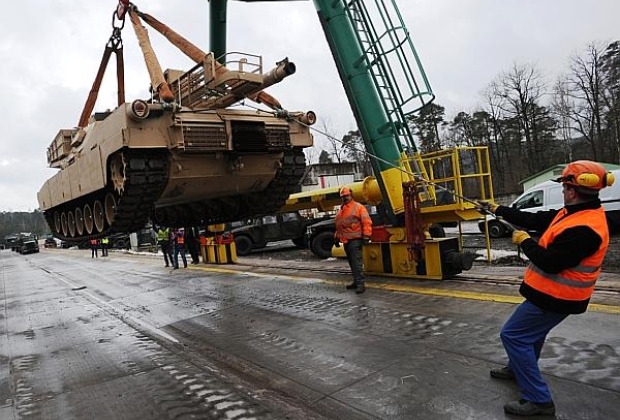
STUTTGART, Germany — The U.S. Army’s 69-year history of basing main battle tanks on German soil quietly ended last month when 22 Abrams tanks, a main feature of armored combat units throughout the Cold War, embarked for the U.S.
The departure of the last M-1 Abrams tanks coincides with the inactivation of two of the Army’s Germany-based heavy brigades. Last year, the 170th Infantry out of Baumholder disbanded. And the 172nd Separate Infantry Brigade at Grafenwöhr is in the process of doing the same.
On March 18, the remaining tanks were loaded up at the 21st Theater Sustainment Command’s railhead in Kaiserslautern where they then made the journey to the shipping port in Bremerhaven, Germany. There they boarded a ship bound for South Carolina.
The tanks belonged to the 172nd along with a mix that were leftover from other units, according to the 21st TSC.
“There is no [U.S.] tank on German soil. It’s a historic moment,” said Lt. Col. Wayne Marotto, 21st TSC spokesman.
Last US M1 tanks leaving Germany this week. Patton would be so sad.
With the suddenly mad scramble to find ammunition in the past few months, one must take a step back and ask yourself the hard question. Shed light on the shadows, pull out the man behind the curtain, and talk to that elephant in the room. Just how much is enough?
Want a 7.62x51mm NATO caliber semi-auto rifle but don’t want the hefty 44-inch long boat oar that is the FAL series? Well Kel-Tec has listened and given the people what they want- a .308-bullpup rifle that is just 26-inches long. We are not making this up.
The .308 Winchester/7.62x51mm NATO round was developed to replace the venerable 30.06 caliber in the US military after WWII. The hearty cartridge has almost all of the same power as the ‘aught-six, while coming in a half-inch shorter and imparting a good bit less felt recoil on the user’s shoulder. The problem with the caliber though, is that most semi-auto rifles that are chambered for it are brutes. The FN-designed FAL series, the Spanish/German CETME/HK3, and the US M14/Springfield M1A rifles all go large. The smallest available on the market is the Springfield SOCOM, which uses a 16-inch barrel to give the user a 37.5-inch gun that still weighs in at 8.8-pounds unloaded.
Here at LSOZI, we are going to take out every Wednesday for a look at the old steam/diesel navies of the 1859-1946 time period and will profile a different ship each week.
– Christopher Eger
Warship Wednesday, April 3
Today we see the last of the US Navy’s WWII Essex-class fleet carriers to commission, USS Oriskany (CV/CVA-34). The Big O, a ‘long-hull’ ship stretched by more than thirty feet, was the 24th Essex commissioned with eight of her sister-ships never completed.
The Essex class was the USS Nimitz of its day, the most powerful and modern aircraft carrier in the world. Ordered August 1942 during the epic sea battles around Guadalcanal Oriskany was not finally completed and commissioned until 25 September 1950. This was because the end of WWII in 1945 brought a near halt to her construction and then a drastic change to her configuration. She earned two battle-stars in Korea, her aircraft pounding North Korean and Chinese ‘volunteer’ positions to gruel.
Oriskany with F4U Corsairs aboard off Korea in 1952. I challenge you to find a more beautiful warplane of the 1950s!
Oriskany, built as the most modern Essex class in the fleet, was the last angled-deck conversion, received a unique SCB-125A refit which upgraded her to 27C standard, and included steam catapults and an aluminum flight deck in 1959.
With Carrier Air Wing 16 aboard, January 1968. Just count all of those A4s and Vigilantes! You can see the difference between the angled flight deck here when compared to her 1940s style strait deck seen in the 1955 image scrolling up.
Oriskany deployed to Vietnam six times in the 1960s and 70s, usually with Carrier Air Wing 16 aboard, winning an additional five battle-stars. Between 10 May and 6 December 1965 alone, she carried out over 12,000 combat sorties (60 per day) and delivered nearly 10,000 tons of ordnance against enemy forces.
The following ships are visible (bottom to top): USS Wiltsie (DD-716), USS Tappahannock (AO-43), USS Oriskany (CVA-34), USS Mars (AFS-1), and USS Perkins (DD-877). The Oriskany, with assigned Carrier Air Wing 19 (CVW-19), was deployed to Vietnam from 16 April to 17 November 1969.
Her 1960s era air wing consisted of two fighter squadrons of F-8J Crusaders, three attack squadrons of A-4E Skyhawks, 4 E-1 AEW Tracers, 4 EKA-3B Skywarriors, and 4 RF-8G photo Crusaders. Not bad for a carrier designed to fly F4F Wildcats.
A-7B of VA-215 standing by on catapult of USS Oriskany (CV-34) in 1976.
In 1970, the three A-4 squadrons were replaced by two squadrons of A-7A Corsair IIs and the Oriskany became the first carrier in the fleet to use the E2 Hawkeye. The F-4 Phantom II and A-6 Intruder were considered too heavy to operate from the Essex-class, and the ships’ jet-blast deflectors were not liquid cooled, a requirement for operating jets like the Phantom which launched using after burner.
The rest of her class being retired in the early 1970s, she was the last Essex-type ship used in regular fleet service as an attack carrier. Her final Western Pacific deployment was from 16 September 1975 – 3 March 1976.
An overhead view of a crowd gathered on the pier at Naval Air Station (NAS) Alameda, California, as the carrier Oriskany (CVA 34) returns from her 15th and final Western Pacific cruise March 3 1976.
The only one of her sisters to outlive her in Navy service, Lexington, had been designated a non-deployable training carrier (AVT-16) in 1969 and spent the last 22 years of her life qualifying nuggets on T-2s out of Pensacola.
Oriskany was decommissioned 30 September 1976 and laid up by the Carter administration, she spent a quiet 13 years in rusty mothballs. Her condition was so bad in fact that when Regan’s Secretary of the Navy John Lehman, architect of the ‘600-ship Navy’ visited the ship in the early 1980s with an eye to recommission her was shocked at her appearance. She was coated with thick rust and had not only grass but small trees growing on her deck. Nonetheless she still was kept as an emergency mobilization asset on the Naval List until the Cold War ended in 1989 then she was removed. Sold for scrap in 1995 she was repossessed by the Navy two years later when her breaker defaulted.
With a 40,000-ton unusable aircraft carrier on their hands, the Navy decided to sink her as a reef.
(Oriskany‘s burial at sea)
Based on EPA’s approval, after a public comment period, the ship was towed to Pensacola, FL in March 2006 for final preparations for sinking under a Navy contract. A team of Navy personnel accomplished the sinking of the ship on 17 May 2006, supported by the Florida Fish and Wildlife Conservation Commission, Escambia County Department of Natural Resources, the U.S. Coast Guard, the Pensacola Police Department, and several sheriff departments of Escambia County and surrounding counties. A Navy Explosive Ordnance Disposal team from Panama City, FL detonated C-4 explosive charges of approximately 500 lb (230 kg) net explosive weight, strategically placed on 22 sea connection pipes in various machinery spaces. 37 minutes after detonation, the ship sank stern first in 210 ft (64 m) of water in the Gulf of Mexico, 24-miles south of Pensacola– the cradle of US Naval Aviation.
Today she is one of the most popular dive destinations in the Gulf.
Specs, as built 1950
Displacement: As built:
30,800 tons (over 40,000 later in life)
Length: As built:
904 ft (276 m) overall
Beam: As built:
129 ft (39 m) overall
Draft: As built:
30 ft 6 in (9.30 m) maximum
Propulsion: As designed:
8 × boilers 565 psi (3,900 kPa) 850 °F (450 °C)
4 × Westinghouse geared steam turbines
4 × shafts
150,000 shp (110 MW)
Speed: 33 knots (61 km/h)
Range: 20,000 nautical miles (37,000 km) at 15 knots (28 km/h)
Complement: As built:
2,600 officers and enlisted
Armor: As built:
2.5 to 4 inch (60 to 100 mm) belt
1.5 inch (40 mm) hangar and protectice decks
4 inch (100 mm) bulkheads
1.5 inch (40 mm) STS top and sides of pilot house
2.5 inch (60 mm) top of steering gear
Aircraft carried: As built:
90–100 aircraft
1 × deck-edge elevator
2 × centerline elevators
If you liked this column, please consider joining the International Naval Research Organization (INRO)
They are possibly one of the best sources of naval lore http://www.warship.org/naval.htm The International Naval Research Organization is a non-profit corporation dedicated to the encouragement of the study of naval vessels and their histories, principally in the era of iron and steel warships (about 1860 to date). Its purpose is to provide information and a means of contact for those interested in warships.
Nearing their 50th Anniversary, Warship International, the written tome of the INRO has published hundreds of articles, most of which are unique in their sweep and subject.
If you are a US Solider or Marine hunkered down in some remote forward base and the perimeter is crawling with what are politely called, ‘unfriendly’, the sweetest call that can be made is for a fire mission. Since 2005, this type of call has increasingly gone to a new, effective, and hard-hitting howitzer– the Triple 7.
During World War 1 (1914-1918), large caliber heavy artillery became the all-encompassing Mother Medusa of the modern battlefield. The United States entered that war behind the technological 8-ball and had to make due with French 155mm guns to provide punch for the dozens of new infantry divisions sent ‘over there’. The French guns weighed 7300-pounds and could fire three 100-pound shells a minute out to 12,400 yards.
Following WWI, the US decided to design their own 155, the 13,000-pound M114 that could fire four shells a minute out to 16,000 yards. In the quest for bigger, faster, and better, the Army replaced this gun with the M198 in 1977. The M198, designed with input from fighting in Vietnam, could fire four rounds per minute out to amazing 24640-yards. That’s 14-miles. The problem was, the gun weighed just a hair under 8-tons. While it could be parachuted into tight spots, or carried by supercargo USMC CH-53E Super Stallion helicopters, it was still a heavy beast.
Since the 1950s, the most common accessory for the well-dressed businessman has been the
briefcase. This innocent clamshell box with a handle is so frequently seen that it is hardly noticed and this very familiarity led German firearms innovator HK to design one with a heck of a surprise inside – an MP5.
In many situations, covert concealment of any select fire weapon is an operators’ (and civilians’) trump card and for business persons or VIPs in a high threat area or industry, employing a low-key protection specialist may be the best option for this. Usually these contractors dress in a manner similar to that of their client in order not to get made as an outsider in the group they are protecting, but there is also the issue of arming these guards discretely without tell tale bulges or awkward equipment. Likewise, an otherwise unseen submachine gun capable of ripping out fifteen shots in a second without reaching for a weapon gives everybody piece of mind and this also went for covert operations in an urban environment, where having an instantly deployable weapon when none is readily visible can save lives and catch bad guys by surprise.
For these types of scenarios, the crafty engineers at Heckler and Koch came up with a special
briefcase in the late 1970s. So special in fact that it’s designated, the Operational Briefcase.