Category Archives: littoral

Robert G. Bradley is Decommissioned

In better days...note the SM-1 launcher forward, long since removed.

In better days…note the SM-1 launcher forward, long since removed.


(Story Number: NNS140328-14 Release Date: 3/28/2014 2:02:00 PM)
By Ensign Christopher M. Cate, USS Robert G. Bradley Public Affairs

MAYPORT, Fla. (NNS) — Nearly 30 years after she was commissioned in 1984, Cmdr. Pete Ehlers, commanding officer of USS Robert G. Bradley (FFG 49), decommissioned the ship March 28, at a Naval Station Mayport ceremony.

Lt. Gen. Joseph L. Votel, commander, Joint Special Operations Command, was the guest speaker; Commodore, Destroyer Squadron 14, Capt. Ryan Tillotson, presided over the decommissioning event. Also in attendance were previous commanding officers, as well as three survivors of USS Princeton (CVL 23).

FFG 49 was the first U.S. Navy ship to be named for a Washington D.C. native. Lt. Robert Graham Bradley served as assistant first lieutenant aboard Princeton, where he led a repair party in efforts to save the ship after it was attacked by a Japanese dive bomber during the battle of Leyte Gulf. Bradley and his repair team lost their lives when the flames spread to an aft torpedo magazine and detonated four, 100-pound bombs. For his actions, Bradley was posthumously awarded the Navy Cross.

“For nearly 30 years this ship has carried Lt. Robert G. Bradley’s name and spirit in defense of our nation,” said Ehlers. “It has been a privilege and an honor to be the commanding officer of the last crew of ‘Bradleymen.’ I could not be more proud of them.”

After participating in UNITAS in the Western Caribbean Sea in September 2012, and completing a Board of Inspection and Survey, the ship departed in late October for a seven-month deployment to the 6th Fleet Area of Responsibility.

Initially assigned an Africa Partnership mission, the crew quickly reconfigured the ship with four MQ-8B Fire Scouts to support Africa Command, Counter-Terrorism Intelligence, Surveillance and Reconnaissance tasking. They completed more than 900 flight hours with the MQ-8B Fire Scouts while on station and conducted the first concurrent Dual-Air-Vehicle mission with another Fire Scout-equipped frigate.

The end of 2013 found the crew assisting in deployment preparations and certifications for USS West Virginia (SSBN 123), George H.W. Bush Carrier Strike Group, and the Bataan Expeditionary Strike Group.

The ship is slated to be offered for foreign military sales.

Note– The Defense Department’s budget proposal for fiscal 2015 is speeding up the retirement of the service’s last Perry-class frigates (FFGs). The Navy plans to decommission 10 frigates in 2015, seven of which will be the last ships in the Naval Reserve Force. The Navy had planned to decommission four Reserve FFGs in 2015 and retire the remaining three by 2019, but the rest of the remaining Perrys, like the Bradley, will soon be withdrawn.

Iranian Navy builds its own super carrier

Well it looks like the mighty Iranian Navy is building its first super-carrier. Instead of a small 15,000-20,000 ton ship that many small navies go for in their first effort, the Persians are building a 1:1.25 scale mock up of a Nimitz class super carrier, even giving it the hull number “68” like the Nimitz herself.

Of course, it has no propulsion system, is more of a barge than a carrier, Iran has no access to catapult technology or carrier training (unless the Russians or Chinese want to pitch in) and the ship, overall, seems like more likely than not a target barge or publicity stunt.

But hey,

Its still creepy

The real Nimitz:

060211-N-0413R-075 Pacific Ocean (Feb 11, 2006) – USS Nimitz (CVN 68) steams through the Pacific Ocean after a Vertical Replenishment (VERTREP) with USS Stennis (CVN 74).  Nimitz is currently preparing for a major propulsion plant examination off the coast of southern California U.S. Navy .  U.S. Navy photo by Photographer's Mate 3rd Class Shannon E. Renfroe.

060211-N-0413R-075
Pacific Ocean (Feb 11, 2006) – USS Nimitz (CVN 68) steams through the Pacific Ocean after a Vertical Replenishment (VERTREP) with USS Stennis (CVN 74). Nimitz is currently preparing for a major propulsion plant examination off the coast of southern California U.S. Navy . U.S. Navy photo by Photographer’s Mate 3rd Class Shannon E. Renfroe.

The mock-up is of a Nimitz-class aircraft carrier. Digitalglobe :

irianain mock up


Warship Wednesday March 12, 100 years of Texas

Here at LSOZI, we are going to take out every Wednesday for a look at the old steam/diesel navies of the 1859-1946 time period and will profile a different ship each week.

– Christopher Eger

Warship Wednesday March 12, 100 years of Texas

BB-35 Texas, 24 March 1914, 100 years ago this month, just two weeks after commissioning (click bigger)

BB-35 Texas, 24 March 1914, 100 years ago this month, just two weeks after commissioning (click bigger)

Here we see the classic US naval dreadnought, USS Texas (BB-35), today is her 100th birthday and she is the oldest US battleship afloat.

Awarded 17 December 1910 to the Newport News Shipbuilding Company, she was commissioned on 12 March 1914 for a cost of $5.83 million. Decommissioned 21 April 1948, she served through both World Wars and over the course of her 34-years of service she received five battle stars.

texas 1919

A New York class battleship, Texas was some 27,000 tons. Her 14 Babcock and Wilcox coal-fired boilers with oil spray could push that leviathan at over 21-knots and her 10×14-inch (356mm) guns gave her an impressive arsenal.

After service in Mexico in 1914, World War One saw  her conduct naval gunnery training before she sailed to join the British Fleet. She departed New York on 30 January 1918, arrived at Scapa Flow in the Orkney Islands off the coast of Scotland on 11 February, and rejoined BatDiv 9, by then known as the 6th Battle Squadron of Britain’s Grand Fleet. Texas’s service with the Grand Fleet consisted entirely of convoy missions and occasional forays to reinforce the British squadron on blockade duty in the North Sea whenever German heavy units threatened. She was present at the surrender of the German High Seas Fleet, returning home at Christmas 1918.

Idaho (BB-42) (foreground) and Texas (BB-35), circa 1930.

Idaho (BB-42) (foreground) and Texas (BB-35), circa 1930.

After an extensive overhaul in the 1920s, Texas was shuttled back and forth from Atlantic to Pacific, serving as a flagship more often than not.

On December 7, 1941, she luckily was on Neutrality Patrol on the East Coast and escaped the nightmare that was Battleship Row. She spent 1942 in convoy duty, dodging German U-boats, and stood off of Casablanca for the Torch Landings, with a young war correspondent named Walter Cronkite on board while she provided naval gunfire support ashore.

On D-Day, Texas was the star of the Naval show off Omaha Beach. Her firing area of Omaha was the western half, supporting the US 29th Infantry Division and the US 2nd Ranger Battalion at Pointe du Hoc, and the US 5th Ranger Battalion, which had been diverted to Western Omaha to support the troops at Pointe du Hoc. Closing to within 3000-yards of the beach, she fired all along Dog One, the route made famous in the first ten minutes of Saving Private Ryan. She continued her bombardment as the troops moved inland over the next two weeks, even having her starboard torpedo blister flooded with water to provide a list of two degrees to increase her guns elevation.

USS Texas BB-35 by Ruutiukko

USS Texas BB-35 by Ruutiukko

She later silenced the Germans at Cherbourg, supported the Dragoon landings in the South of France from the Mediterranean.

Dodging German coastal artillery off Cherbourg

Dodging German coastal artillery off Cherbourg

With the war in Europe winding down, she sailed for the Pacific in 1945, moving in close to bombard Okinawa. When the war ended she was in the Ryukyus, preparing to bombard coastal Japan itself in the upcoming big invasions of the main islands.

Her wars finished, the old battle-wagon was obsolete. While the Navy kept the newer 1940s era SoDak and Iowa class ships as well as the Alaska type battle-cruisers, the old WWI era dreadnoughts like Texas were soon to be discarded. Most tragically went to the scrappers. Some, like the Mississippi lived on a few more years as test ships, others, like her sister ship USS New York, Employed as a target ship in the atomic bomb tests at Bikini Atoll, were sunk as targets.

Texas, as she avoided Uboats and kamikazes, dodged this fate as well.

After she was stricken in 1948, she was presented to the state of Texas who made her flagship of the Texas Navy and put her on display at San Jacinto military park. Texas was the first battleship memorial museum in the US.

bangstead-uss-texas-(measure-12-modified)

However, she is threatened by age and decay, on her 100th birthday, will you please visit the Battleship Texas Foundation and do your part for the ship that steamed over 700,000 miles for her nation?

Specs:

(1914)

(1914)

(As built)
Displacement:     27,000 long tons (27,000 t) (design)
Length:     573 ft (175 m)
Beam:     95 ft 3 in (29.03 m)
Draft:     27 ft 10.5 in (8.496 m) (normal)
29 ft 3.25 in (8.9218 m)(full)
Propulsion:    14 Babcock and Wilcox coal-fired boilers with oil spray (replaced by 6 Bureau Express oil-fired boilers in 1925-26); vertical triple-expansion steam engines; 2 shafts; 28,100 ihp
Speed:     21 kn (24 mph; 39 km/h)
Range:     As built: 7,060 nautical miles (13,080 km) at 10 knots
Coal: 1,900 tons
Oil: 267 tons
Complement:     1,042
Armament:

    As built:
10 × 14 inch/45 caliber guns (356 mm) (5×2)
21 × 5 inch/51 caliber guns (127 mm)
(reduced to 16 guns in 1918)
2 x 3 inch/50 caliber AA guns (76 mm) added 1916
4 × 3-pounder (1.4 kg) guns[2]
4 × 21 inch torpedo tubes (533 mm) (submerged)

  After 1925-6 refit:
10 × 14 inch/45 caliber guns (356 mm) (5×2)
16 × 5 inch/51 caliber guns (127 mm)
8 x 3 inch/50 caliber AA guns (76 mm)
torpedo tubes removed
8 x 1.1 inch (28 mm) AA guns (2 x 4) added 1937

After 1942 refit:
10 × 14 inch/45 caliber guns (356 mm) (5×2)
6 × 5 inch/51 caliber guns (127 mm)
10 x 3 inch/50 caliber AA guns (76 mm)
24 × 40 mm Bofors AA guns (6 × 4)
(later increased to 40 guns (10 x 4))
44 × 20 mm Oerlikon cannons
Armor:
Belt: 10 to 12 in (250 to 300 mm) (midships)
6 in (150 mm) (aft)
Bulkheads:
10 in (250 mm) and 11 in (280 mm)
9 in (230 mm) (lower belt aft)
Barbettes:
5 to 12 in (130 to 300 mm)
Turrets:
14 in (360 mm) (face)
4 in (100 mm) (top)
8 in (200 mm) – 9 in (230 mm) (sides)
8 in (200 mm) (rear)
Decks:
1.5 to 3 in (38 to 76 mm)

texas cross section

General characteristics (by 1945)
Displacement:     32,000 long tons (33,000 t) (full load)
Length:     573 ft (175
Beam:     106 ft 0 in (32.31 m)
Draft:     31 ft 6 in (9.60 m)
Propulsion:     2 × dual-acting triple expansion reciprocating steam engines
Speed:     19.72 kn (22.69 mph; 36.52 km/h)
Endurance:     15,400 nmi (17,722 mi; 28,521 km) at 10 kn (12 mph; 19 km/h)
Complement:     1810 officers and men
Sensors and processing systems:
2 × SG surface search radars
1 × SK air search radar
2 × Mk 3 fire control radar
2 × Mk 10 fire control radar

Armament:
10 × 14 in (360 mm)/45 cal guns (5 × 2)
6 × 5 in (130 mm)/51 cal guns
10 × 3 in (76 mm)/50 cal guns
10 × quad 40 mm (1.6 in) mounts
44 × 20 mm (0.79 in) guns

Armor:     Same as 1914 characteristics except:
Turrets:        1.75 in (44 mm) added to turret tops
Aircraft carried:     2 × OS2U Kingfisher

If you liked this column, please consider joining the International Naval Research Organization (INRO), Publishers of Warship International

They are possibly one of the best sources of naval study, images, and fellowship you can find http://www.warship.org/

The International Naval Research Organization is a non-profit corporation dedicated to the encouragement of the study of naval vessels and their histories, principally in the era of iron and steel warships (about 1860 to date). Its purpose is to provide information and a means of contact for those interested in warships.

Nearing their 50th Anniversary, Warship International, the written tome of the INRO has published hundreds of articles, most of which are unique in their sweep and subject.

I’m a member, so should you be!

Chemring Centruion Naval Launcher

The UK Chemring company is pitching a non-deck penetrating naval launcher to the US Navy. The 2500-pound launcher uses multiple 130mm barrels to deliver NATO standard chaff/ir flare soft kill devices, anti-torpedo countermeasures and a range of hard kill (120mm Mortar, Javelin missile) munitions. Of course its short-range, but could be a viable option for small craft, auxiliaries, and LCS type ships in crowded littoral.

Raytheon_Chemring_Centurion-660x371
They call it Centurion

“CENTURION has been designed to offer dynamic soft kill countermeasure protection by delivering accurate payload placement to maximize decoy effectiveness. CENTURION can be configured with a range of 130mm rounds, adaptable to other calibres, to suit mission profiles. It is unique in providing directional deployment of 130mm long-range distraction and short-range seduction rounds, and active rounds. In doing so, it fully contributes to layered defense – an established and proven warfare doctrine”

The only easy day was yesterday

click to embiggen

click to embiggen

CORONADO, Calif. (Jan. 21, 2014) Basic Underwater Demolition/SEAL (BUDs) students participate in Surf Passage at Naval Amphibious Base Coronado. Surf Passage is one of many physically demanding evolutions that are a part of the first phase of SEAL training. Navy SEALs are the maritime component of U.S. Special Forces and are trained to conduct a variety of operations from the sea, air and land. (U.S. Navy photo by Mass Communication Specialist 1st Class Michael Russell/Released)

Camo Frog Frogs

(click to embiggen)

(click to embiggen)

Commando Hubert diver submerged with skrim camouflage and an EOTECH outfitted SIG 550 series rifle. Commando Hubert is a combat swimmer unit assigned to the French Navy’s COFUSCO. Of the five Naval Commando units of the French Navy, Hubert is the dedicated frogman group. The unit is tasked with conducting maritime special operations in support of the French Navy and intelligence services, primarily the DGSE (the French foreign intelligence directorate).

Currently Commando Hubert is composed of 80 men divided into two companies. The first company consists of 50 men and is subdivided into four sections designated A, B, C, and D.

A section is the command and support section. It contains the unit HQ, and the units Hurricane RIBs.

Rapid+casque pare balle+Saint Mandrier 010

B section is the maritime counter terrorism (CT) section. The unit specializes in conducting underwater approaches to terrorist targets. They conduct joint operations with the Navy’s GCMC and GIGN’s diver section. In the event an assault was ordered on a target at sea, B section divers would act as guides for the GIGN team.

C section is the SDV section. The divers of this section receive additional training in the use of SDV’s and their maintenance.

D section contains the units snipers and heavy weapons experts. The section is responsible for performing beach reconnaissance, shipping attacks,underwater demolition operations, providing heavy fire support, and testing new equipment for use by the unit. All members of D section are both HAHO and HALO qualified.

Rapid+casque pare balle+Saint Mandrier 109
Although there have always been lots of jokes about the French military (hey, they were the first army we ever beat, back in the French and Indian War), Hubert divers are as hard as coffin nails. They are constantly out there, unseen in the worst places, and have been in near-constant warfare since 1941.

Somali Pirates video (VICE)

The guys over at Vice put this up about skinny pirates in the HOA. Entitled Fishing Without Nets, it follows the touching coming of age story of a young Somali fisherman in his struggle to find peace, love and an AK that doesn’t jam.

But seriously guys, its not a bad way to spend 17 minutes at work.

Warship Wednesday Feb 19, The Wandering Island of Luzon

Here at LSOZI, we are going to take out every Wednesday for a look at the old steam/diesel navies of the 1859-1946 time period and will profile a different ship each week. – Christopher Eger

Warship Wednesday, Feb 19, The Wandering Island of Luzon

(click to embiggen)

(click to embiggen)

Here we see the spic and span US gunboat USS Isla de Luzon resting quietly at anchor with her 1900s issue white and buff paint scheme. Her life before this moment was a little different. Ordered by the Spanish government for the Armada Española, she was billed as a second-class “protected cruiser” by her government. In actuality, she was, even when new, considered smaller than most other cruisers, not to mention slow and ineffective.

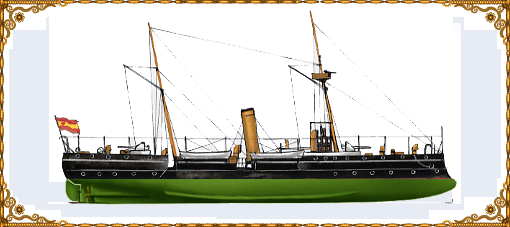
In Spanish service the cruiser had a green and black paint scheme with buff to white superstructures

In Spanish service, the cruiser had a green and black paint scheme with buff-to-white superstructures

Laid down on 25 February 1886 in the UK, she was built by Elswick (Armstrong, Whitworth)  at  Newcastle upon Tyne. She was completed and commissioned in late 1887. Just over 1000-tons, she was 184-feet in length. Beamy at nearly 30 feet, she had a length-to-beam ratio of 1:6 and tended to wallow in heavy seas. She also didn’t have enough ass to push her through the waves, her 2-shaft horizontal triple-expansion engines fed by 2 cylindrical boilers could generate about 14 knots, 15 if she was light. Very lightly armored, she was also lightly armed with a half-dozen 4.7-inch guns as well as some smaller QFs and MGs but her deadliest weapon was a triple set of 14-inch torpedo tubes.

Delivered to the Armada in 1887, she served first in Europe and even dropped some shells on the Rif in Morocco from time to time, practicing true gunboat diplomacy.

Today her size and armament would make her a corvette or offshore patrol vessel. In her time, cruisers were meant to be the fast eyes of the fleet, able to reach out over the horizon, find targets, and alert the main fleet of other vessels. The Isla de Luzon was too slow for that, and she soon found herself in colonial service in the Philippines. There she could visit far-flung Pacific islands and enforce the crown’s law against the locals without too much problem. She was part of the Spanish Pacific Squadron under Admiral Patricio Montojo, which consisted of seven cruisers (of which Isla de Luzon was one of the best) and a few gunboats.

Then came the Spanish-American War.

Dewey in the USS Olympia dropping it like its hot on the moored Spanish fleet

Dewey in the USS Olympia drops it like it’s hot on the moored Spanish fleet. Isla de Luzon would be in the background closer to the shore

On 1 May 1898, Commodore Dewey steamed his Asiatic Squadron into Cañacao Bay under the lee of the Cavite Peninsula east of Sangley Point, Luzon– coincidentally the island she was named after. The resulting Battle of Manila Bay, the first major engagement of the Spanish-American War, left most Spanish ships sunk while Dewey suffered less than forty casualties by the worst estimate.

57447_isla_de_luzo_md wreck

isla de luzon
Isla de Luzon was hit three times by US shells, then was scuttled in shallow water by her crew when the battle was in its final stages. She only had a half-dozen casualties. Bluejackets from the gunboat Petrel swarmed over her stricken hull, looted what they could, and set her alight.

isladeluzonwreck

Raised after the war, she was rebuilt, rearmed with US-pattern guns, painted white, and commissioned USS Isla de Luzon on 11 April 1900.

Former Spanish cruiser Isla de Luzon soon after capture, seen in Pensacola, FL. Note she is wearing an American shield on her bow

USS Isla de Cuba 4

Note twin stacks in US service after 1911

She then served as a gunboat, sailing through the Indian and Atlantic oceans to reach her new homeland in 1903, serving as a station ship in Pensacola until 1907 when she was loaned to the Louisiana Naval Militia on 6 December 1907 and later to the Illinois Naval Militia on the Great Lakes as a training ship. She spent WWI as a torpedo tender in Narragansett Bay, instructing new gunners mates and TMs.

In 1911 she was given a new power plant and two skinny funnels. Here she is as a training ship after that date in haze grey scheme

In 1911 she was given a new power plant and two skinny funnels. Here she is as a training ship after that date in a hazed grey scheme

Decommed and truck 23 July 1919, she was sold the next year to the Bahama & West Indies Trading Co to work as a coastal trading ship in the shallow waters there under the name SS Reviver. Her 1911-installed Babcocks boilers couldn’t handle the strain and she was soon sold to Bahama Salvors, Ltd. of Nassau and scrapped in 1931 at age 44.

The only remnant of her that remains today dates back to 1902. “Following long custom, when she visited Muscat’s picturesque harbor, members of her crew painted “Isla de Luzon” on the steep entrance cliff; in later years this was periodically refurbished by visiting ships of the U.S. Navy Middle East Force Command.”

isla de luzon muscat

Her name can still be seen there today.

Her only sistership, the cruiser Isla de Cuba, was also sunk at the Battle of Manila Bay, also salvaged and commissioned into the US Navy with the unimaginative name of USS Isla de Cuba, paid off in 1912, then picked up by the Venezuelans who used her as the training ship  Mariscal Sucre until 1940.

Specs:

You can best see her Spanish scheme in this line drawing

You can best see her Spanish scheme in this line drawing

(As-built)

Displacement:     1,030 tons
Length:     184 ft 10 in (56.34 m)
Beam:     29 ft 11 in (9.12 m)
Draft:     12 ft 6 in (3.81 m) maximum
Installed power:     1,897 hp (natural draft)
2,627 hp (forced draft)
Propulsion:     2-shaft horizontal triple-expansion, 2 cylindrical boilers
Speed:     14.2 knots (natural draft)
15.9 knots (forced draft)
Complement:     164 officers and enlisted
Armament:     6 × 4.7 in (120 mm) guns
8 × 6 pdr quick-firing guns
4 × machine guns
3 × 14 in (356 mm) torpedo tubes
Armor:     Deck 2.5 in (64 mm)-1 in (25 mm); conning tower 2 in (51 mm)

(1900)
Displacement:     950 long tons (965 t)
Length:     195 ft (59 m)
Beam:     30 ft (9.1 m)
Draft:     11 ft 4.75 in (3.4735 m) (mean)
Propulsion:     2-shaft horizontal triple expansion engine, 535 hp (399 kW)
2-cylinder boilers
160 tons coal
Speed:     11.2 knots (20.7 km/h; 12.9 mph)
Complement: 137 officers and enlisted (1900-07), after 1907 just a small cadre of regular officers and CPOs backed by up to 200 naval militia and trainees.
Armament: Four 4″ mounts and three torpedo tubes
1905 – Four 4″ mounts, four 6-pounder,s and four .30 cal. machine guns
1911 – Four 4″/40 rapid fire mounts, four 6-pounder rapid fire mounts, two 1-pounder rapid fire mounts, and added two temporary 3-pounder rapid fire mounts
Armor:     Deck: 1–2.5 in (25–64 mm), scortched

If you liked this column, please consider joining the International Naval Research Organization (INRO), Publishers of Warship International

They are possibly one of the best sources of naval study, images, and fellowship you can find http://www.warship.org/

The International Naval Research Organization is a non-profit corporation dedicated to encouraging the study of naval vessels and their histories, principally in the era of iron and steel warships (about 1860 to date). Its purpose is to provide information and a means of contact for those interested in warships.

Nearing their 50th Anniversary, Warship International, the written tome of the INRO has published hundreds of articles, most of which are unique in their sweep and subject.

I’m a member, so should you be!

The Dutch like to watch…through a periscope.

Odds are, if you are a sneaky non-nation party rogue state operator and NATO wants to keep ears on you, that cigarette
burning in the corner just offshore may be that of a Dutch submarine skipper.

Commissioned 25 April 1990, the Zeeleeuw (Dutch for Seal) is over twenty years old but is a master of littoral combat. The Dutch have used their quartet of 222-foot long Walrus-class subs, capable of floating in as little as 20-feet of water and submerging in as little as 60, to lie just offshore the bad-guy’s coastline listening for intel while on NATO missions.

These boats have done yeoman’s service off the former Yugoslavia in the 1990s, followed by Iraq, then off Libya a couple years ago, and, as shown in the video, off Somalia and the Horn of Africa. Its rumored that when Hugo Chavez started talking smack about invading the Dutch Antilles in the Caribbean, a Walrus-class sub wandered around the Venezuelan coastline making notes and taking names.

They are well suited for hanging out in shallow waters and soaking up radio intercepts while their radar and sonar get a fix on just what is moving around and where it is going to and from. They have a specialized L-3 KEO mast that is optimized to capture HD footage both day and night– so that beautiful bean footage can be shown round the world if needed.

zeeluew with diffuser

The Zeeleeuw (center) was fitted with an extended mounting on her sail to diffuse her signature and diesel exhaust while near
surface/snorting. All the better to be on the low low with.

Specs

Displacement:     2,350 t surfaced,
2,650 t submerged,
1,900 t standard
Length:     67.73 m
Beam:       8.4 m
Draft:       6.6 m
Propulsion:     3 diesels, diesel-electric, 5,430 shp (4 MW), 1 shaft, 5 blades
Speed:     13 knots (24 km/h) surfaced,
20 knots (37 km/h) submerged
Range:     18,500 km at 9 knot
Test depth:     >300 m
Complement:     50 to 55
Sensors and processing systems:     • Surface Search Radar: Signaal/Racal ZW 07
• Sonar Systems: Thomson Sintra TSM 2272 Eledone Octopus, GEC Avionics Type 2026 towed array, Thomson Sintra DUUX 5 passive ranging and intercept
Armament:     4 × 21 inch (533 mm) torpedo tubes (20 × Honeywell Mk 48 or Honeywell NT 37 torpedoes, mines,
SubHarpoon SSM)

Just in case you see Iranian Boghammers around the Florida Panhandle tomorrow…

Iranian Navy3


20iran1.600

“WAR GAMES DESTIN: Fighters, bombers, soldiers and noise coming Thursday

EGLIN AFB — Residents may experience noise when the 96th Operations Group conducts boat operations in Choctawhatchee Bay and the Gulf of Mexico Feb. 13 and again Feb. 18-21. The operations are part of the 53rd Wing’s Weapon System Evaluation Program, or WSEP. Fighter aircraft will release munitions in the morning around 8 a.m. to 12 p.m. about 20 nautical miles out in the Gulf.

In the afternoon around 1 p.m. to 5 p.m. approximately 30 boats will be used by A-10s and F-15s as visual targets; no
weapons or ammunition will be involved in the testing.

The boats will transverse between the Mid-Bay Bridge and the Highway 331 Bridge or 5 to 20 miles South of Destin in the Gulf of Mexico.

Please be advised the 30 boat operators will be dressed in various military uniforms and white costumes.

They will carry simulated, rubber rifles, painted in high visible colors which will be kept out of view when transiting to/from the
mission area (i.e. passing under bridges, in/through harbors). Some boats will have mock-up, fake deck guns and rocket launcher tubes.

The test will be conducted within a cordoned range safety corridor, notices to mariners will be issued prior to the missions, and
flyers will be handed out at the local marina.”


« Older Entries Recent Entries »