Category Archives: narcosub

Warship Wednesday, June 19th Carriers Under the Sea

Here at LSOZI, we are going to take out every Wednesday for a look at the old steam/diesel navies of the 1859-1946 time period and will profile a different ship each week.

– Christopher Eger

Warship Wednesday,  June 19th

IJN I-401 Pearl Harbor 1946
Here we see the Sen Toku I-400-class (I-yonhyaku-gata Sensuikan) giant submarine aircraft carrier I-401 at sunset. It’s an appropriate picture as the submersible was at the time one of the last remaining units of the WWII Imperial Japanese Navy left afloat in the world. The IJN’s battle flag was the now-infamous Rising Sun, and this beautiful picture was taken of the  I-401 at sunset, as a captured prize ship of the US Navy, sitting in Pearl Harbor in 1946.

20090304144924396_2

In 1942, the war in the Pacific was still winnable for Japan, and Admiral Isoroku Yamamoto conceived of a class of huge submersible warships, 18 overall, that could carry an armada of 54 submarine-launched attack floatplanes to attack far off strategic US targets such as the Panama Canal, or fuel manufacture/storage facilities on the West Coast, or logistical hubs like American Samoa. Furthermore, the ships would be capable of circumnavigating the earth 1.5 times (37,000 miles!)  on one full load of fuel, which would enable even targets on the US East Coast within the reach of the Japanese Navy.

To make such a capable submarine in 1942 under wartime conditions was a challenge.  Nevertheless, you have to admire the audacious plan. Each of these I-400 boats had to be some 400-feet long with a very wide beam to be able to carry and launch up to three combat airplanes. This gave them a displacement of some 6700 tons and an immense crew of over 140, including air wing. When you compare this to the subs of the time, they are super-sized. Even looking at today’s HY-80 steel nuclear propelled boats, the I-400s are larger than many of the modern hunter-killer of the sea. For example, the backbone of the US Navy since 1976, the “688 Boats” of the Los Angeles class SSNs have a length of 362 feet and a surfaced displacement of 6.082-tons.

art1c

The Germans helped a lot with the design, giving the Japanese the plans for the aircraft catapult as well as supplying them with snorkels and periscopes. Unlike many subs of the day, the I-400s had both air and surface search radars as well as a primitive radar warning receiver and sonar absorbing anechoic tile.

HangarDoorI-400Class

The I-400s had a huge armament punch. Not only could they carry a trio of M6A1 Seiran (Mountain Haze) attack planes, each of which could carry a 1800-pound bomb or torpedo load out to 300-miles from the submarine and return, but the ship itself carried 8 21-inch torpedo tubes, with 24 Type 95 torpedos, a 140mm deck gun and a number of 25mm cannons for small surface ships and aircraft defense. The Type 95 is considered by many to be the best torpedo of WWII, being an advanced design of the famous Long Lance, it had a 51-knot speed and a 1200-pound warhead, a performance envelope that is still formidable today.

The Seirans were to be launched via a 85-foot long compressed-air catapult mounted on the forward deck. A well-trained crew of four men could roll a Seiran out of its hangar on a collapsible catapult carriage, attach the plane’s pontoons and have it readied for flight in approximately 7 minutes. Although to get all three airplanes off the boat took up to 30-minutes.

The Gatun Locks at the Panama canal were supposed to be the I401s first target

The Gatun Locks at the Panama canal were supposed to be the I401s first target

Well, all did not go as planned for the  I-400s. After Yammoto was killed in 1943, the Japanese Navy saw little use for the program and started slowly canceling the ships. Just three I-400s were finished and only two, I-400 and I-401, ever went to sea. Their primary reason for being, the Seiran float-plane, had only 28 examples made.

Commissioned 8 January 1945, I-401 was a late comer to the war. Already the US Navy had recaptured the Philipines and was breathing hard on the Japanese home islands. By June the two boats and a crew of float plane pilots were practising on wooden mock-ups of the Panama canal locks in preparation for their first attack. At the last-minute, the plan was halted and the two I-400s were sent to attack Ulithu Atoll, the forward base of the US Navy’s fast carriers. At any given time the US Navy had up to a dozen carriers there on “Murders Row”, taking a break from the war. To give the six Seirans a fighting chance against up to 2000 US aircraft and thousands of anti-aircraft guns in the atoll, they were painted in US markings and refitted as kamikaze aircraft.

 Murderers Row at Ulithi atoll was the target of two submarines and six floatplanes.


Murderers Row at Ulithi atoll was the target of two submarines and six Seiran  floatplanes.

While at sea on the way to the atoll, the war ended and the I-400 and 401 surrendered to US forces. Both ships shot away their torpedoes, threw their artillery shells overboard, and shot their unmanned floatplanes off the deck into the deep ocean. I401 surrendered to the USS Segundo (SS-398), a Balao-class submarine less than half her size.

The floatplanes on the I400 and 401 were given US markings and looked almost like a P-51 with a set of floats.

The floatplanes on the I400 and 401 were given US markings and looked almost like a P-51 with a set of floats.

Both the I400 and I401 were taken to Pearl Harbor by prize crews where they were inspected at length by the US Navy.  Odds were they would have been kept for years, and one of them may have even still been around as a trophy ship had the Soviets not wanted to inspect them. To prevent the Russkis from getting to the amazing Japanese-German hybrid tech of the I400s, the Navy sunk them as targets off Hawaii in 1946.

The US navy had these ships for almost nine months, and they would probably be gracing a museum somewhere, had it not been for the Russians.

The US navy had these ships for almost nine months, and they would probably be gracing a museum somewhere today, had it not been for the Russians.

The I-401 was rediscovered in 2005 about a mile off Barber’s Point in 2600-feet of water. A few of her parts were saved prior to sinking, including the 140mm gun sight which is currently displayed at the Yokohama WWII Japanese Military Radio Museum.

I-401
I-401_12
The only remaining Seiran floatplane, captured intact at the Aichi Aircraft Factory following the end of the war in August 1945, is at the Smithsonian Air and Space Museum on current display.

True to Yammaoto's vision, at least one Seiran made it all the way to Washington DC, just not how he thought it would.

True to Yammaoto’s vision, at least one Seiran made it all the way to Washington DC, just not how he thought it would.

In a twist of fate, the USS Segundo (SS-398), captor of the I-401, was herself sunk as a target by the USS Salmon (SSR/SS/AGSS-573), a Sailfish-class submarine, in 1970, her usefulness past. It should go without saying that the Salmon likewise was sent to the bottom  5 June 1993, as a target by the US Navy. History is funny like that.

I-400 Diagram B
Specs

Displacement:     5,223 long tons (5,307 t) surfaced
6,560 long tons (6,665 t) submerged
Length:     122 m (400 ft)
Beam:     12 m (39 ft)
Draft:     7 m (23 ft)
Propulsion:     Diesel-electric
4 diesel engines, 7,700 hp (5,700 kW)
Electric motors, 2,400 hp (1,800 kW)
Speed:     18.75 knots (21.58 mph; 34.73 km/h) surfaced
6.5 kn (7.5 mph; 12.0 km/h) submerged
Range:     37,500 nmi (69,500 km) at 14 kn (16 mph; 26 km/h)
Test depth:     100 m (330 ft)
Complement:     144
Armament:     • 8 × 533 mm (21 in) forward torpedo tubes
• 20 × Type 95 torpedoes
• 1 × 14 cm/40 11th Year Type naval gun
• 3 × 25 mm (0.98 in) 3-barrel machine gun
• 1 × 25 mm machine gun
Aircraft carried:     3 × Aichi M6A1 Seiran sea-planes

If you liked this column, please consider joining the International Naval Research Organization (INRO)

They are possibly one of the best sources of naval lore http://www.warship.org/naval.htm

The International Naval Research Organization is a non-profit corporation dedicated to the encouragement of the study of naval vessels and their histories, principally in the era of iron and steel warships (about 1860 to date). Its purpose is to provide information and a means of contact for those interested in warships.

Nearing their 50th Anniversary, Warship International, the written tome of the INRO has published hundreds of articles, most of which are unique in their sweep and subject.

I’m a member, so should you be!
German and Italian Sneak Craft – 1945 United States Navy Educational Documentary

Great old CNET documentary about Italian Pig Boats, the Kreigsmarine’s Bieber, and others

The DHS Does OPFOR Submarine Ops…

http://www.dhs.gov/st-snapshot-pluto

Ever Heard of Pluto?

Homeland Security’s ‘narco sub’ PLUTO mimics the real thing

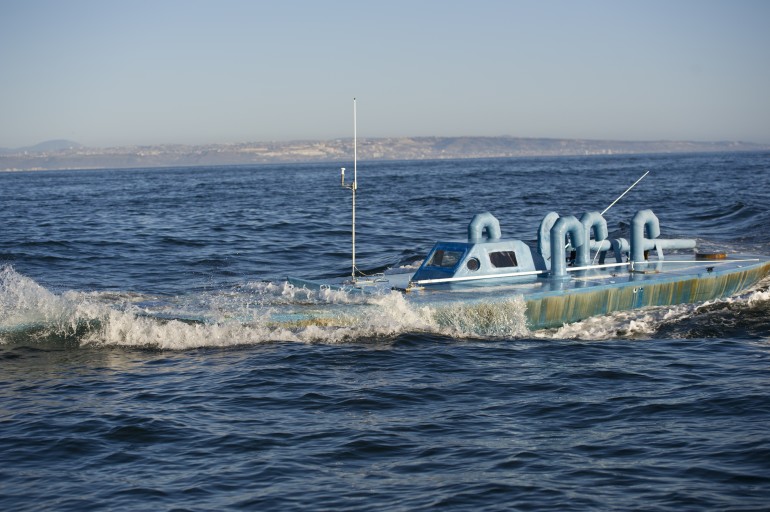
PLUTO seen during tests in San Diego, CA…..If you live around Destin, you may have bumped into it…

Surrogate semi-submersible engineered to mimic the design of the “dark vessels” being used
to bring narcotics and other illicit cargo into the United States. With low profiles and low radar reflectivity, stealthy, drug-running semi-submersibles, “narco subs,” built in southern jungles cut through the ocean at wave height and are nearly impossible to detect.  DHS’ semi-submersible mimics them so that  a variety of sensors can be tested  in the battle  against illegal drug-running.

The erstwhile planet Pluto (now officially an asteroid) was known for decades as a small, dark planet—hidden, difficult to spot, and on a quiet, determined course all its own.  And so, when the DHS Science and Technology Directorate (S&T) needed a target semi-submersible to detect the hidden but determined maritime smuggling operations of the South American drug cartels, it created its own vessel and called it “PLUTO,” after the planet that is so difficult to spot.  S&T’s PLUTO is a small, semi-submersible that is representative of what are popularly called “narco subs,” and serves as a realistic practice target for the detection systems of DHS and its national security community partners.

In the early 90’s, South American drug cartels came up with a new tactic to transport narcotics destined for the United States: small, radar-dodging, self-propelled, semi-submersibles (SPSSs).  Although clandestine semi-submersibles were rumored to exist in the mid-1990s, many believed them to be a myth, hence their name Bigfoots.  Then in 2006, an actual Colombian semi-submersible was captured by the U.S. Coast Guard in the Eastern Pacific Ocean.  Today, drug cartels continue to build their “narco subs.”  With low profiles and low radar reflectivity, these illegal, stealthy, drug-running semi-submersibles cut through the water at wave height and are nearly impossible to detect.

S&T built PLUTO in 2008 to serve as a surrogate SPSS with many of the same features as the vessels built by the cartels.  It is used as a target by DHS and its national security community partners to help test the performance of detection systems and give operators of those systems real world experience under controlled conditions.  This testing helps develop new concepts of operation for seaborne, airborne, and space-borne technologies to spot illegal vessels.

“Small surface vessels, self-propelled semi-submersibles, and now the most recent innovation of fully submerged vessels (FSVs), pose significant challenges to maritime security,” says Tom Tomaiko of S&T’s Borders and Maritime Security Division.  “While some small boats sitting low in the water have legitimate purposes, there are many that are used for illicit purposes.

Dozens of these boats have been captured by the U.S. and partner nation law enforcement agencies in the last few years, sometimes with their cargo still on board, sometimes after it has been thrown overboard.  “When the crews become aware they’ve been spotted, they will typically scuttle the boat immediately, knowing they’ll be rescued by us anyway,” says Tomaiko.

Meanwhile, cramped living conditions within the illegal SSPSs can be horrendous.  There is generally only 3” of space above the waterline, meaning the ride can be very rough.  The small crews of 3 or 4 have little to eat, poor air quality, no toilet facilities, operate with little rest until they reach their destination, and are sometimes watched over by an armed guard.

If the mission is undetected and the drugs successfully delivered, the vessel is typically scuttled and not reused.  “Drug-running is lucrative.  It is cheaper to simply build another vessel than to run the risk of trying to get a vessel and its crew home,” says Tomaiko.

In a typical operation, PLUTO will operate at SPSS cruising speeds of 4 to 8 knots while remote sensor platforms from sea to space attempt to detect and track it at various distances and observation angles.

S&T’s PLUTO is home-ported at Eglin Air Force Base, near Fort Walton Beach, Florida, and is maintained by the Air Force’s 46th Test Squadron.  Various civilian and military
agencies, including the U.S. Coast Guard, Customs and Border Protection/Air and Marine (CBP/OAM), U.S. Navy, U.S. Air Force, and other national agencies have tested their remote sensing capabilities against PLUTO in the Gulf of Mexico, the Atlantic, and the Pacific.

In 2009, Customs and Border Protection tested its Dash 8 maritime surveillance aircraft against PLUTO at the Eglin range and near Key West, Florida.These results helped gauge the performance of the Dash 8’s SeaVue radar against PLUTO and helped determine detection distances and aspect angles for optimal mission performance. In addition, the U.S. Navy tested one of its P-3 aircraft equipped with maritime surveillance radar system against PLUTO.All such tests were instrumental in helping to verify the performance of sensor capabilities, and provided operators with real-world training which will help determine future tactics.

PLUTO is just over 45 feet long, can run roughly 10 knots at maximum speed and can hold a crew of 3 to 4, although it usually operates with only one for safety reasons.  It has VHF and HF radios, and the 46th Test Squadron can install other types of radios and maritime automated identification system (AIS) equipment to meet testing or safety requirements.  Conditions onboard, however, were primarily influenced by the need for crew safety, so PLUTO’s design does not exactly mimic that of illegal SSPSs.

Technical capabilities such as PLUTO are necessary to counter and stay ahead of threats to the country.  Admiral James Stavridis, former Joint Commander for all US forces in the Caribbean, Central and South America, wrote, “Criminals are never going to wait for law enforcement to catch up.  They are always extending the boundaries of imagination, and likewise, we must strive to push forward technology and invest in systems designed specifically to counter the semi-submersible.  We need to be able to rapidly detect and interdict this new type of threat, both for its current effects via the drug trade, and – more troublingly – for its potential as a weapon in the hands of terrorists.”

Looking to buy a “rare russian observation submarine”?

Listed as a NK-300 you can get your own small one man tethered submersible from a unnamed and moody source in the former Soviet Union. Odds are its more of a museum piece at this point and shipping will probably be another $25,000, but hey, grab a piece of Putin’s fleet before he realizes that its missing.

Snapshots of Iranian Subs

Open Source GEOINT has some updates on their observation of the Iranian Ghadir subs. These are the cute little green machines that are said ready at an instant t o throw themselves in front of USN Mk46/50/54 ASW torpedoes for the glory of the Islamic Republic and one true god.

“we can confirm a higher number of Ghadir on satellite imagery at any one time than in the past. A review of historical imagery taken during Iran’s Velayat 89 naval war games show at least 6 x Ghadir (possibly 7) at the Bandar-e Abbas naval port on 6 May 2010. According to press reporting, Iran had up to 10 Ghadir in service at the time.” Private analysis state that as many as 18 may exist…..Lets see that beautiful bean footage!

OSGEOINT (06MAY2010) BeA Ghadir & Nahang

Ghadir:
General characteristics
Tonnage:     120 tonnes
Displacement:     115 tons surfaced [1]
Length:     29 m [2]
Beam:     ~3 m
Draught:     ~2.5 m
Propulsion:     Diesel-electric propulsion
Speed:     11 knots
Complement:     18
Armament:     2 x 533mm torpedoes, mines, can carry the Hoot supercavitating rocket torpedoes.

First 154-foot Cutters in service

The first of upto 58 Fast Response Cutters, the USCGC Cutter Bernard C Webber,  for the US Coast Guard was commissioned this week.

The craft, at $88-mill per, will replace the 1980s era 110-foot Island Class cutters from Iraq to Alaska.

Displacement:     353 long tons
Length:     46.8 m (154 ft)
Beam:     8.11 m (26.6 ft)
Depth:     2.9 m (9.5 ft)
Propulsion:     2 x 4,300 kilowatts (5,800 shp)
1 x 75 kilowatts (101 shp) bow thruster
Speed:     28 knots (52 km/h; 32 mph)
Endurance:     5 days, 2,500 nautical miles (4,600 km; 2,900 mi)
Designed to be on patrol 2,500 hours per year
Boats and landing
craft carried:     1 x Short Range Prosecutor RHIB
Complement:     2 officers, 20 crew
Sensors and
processing systems:     L-3 C4ISR suite
Armament:     1 x Mk 38 Mod 2 25 mm automatic gun
4 x crew-served Browning M2 machine guns

It is sure that the Coast Guard ordered these after several years of using loaned 170-foot Cyclone class Patrol Boats from the Navy.

You can expect these to be showing up anywhere the Navy has littoral issues over the next few decades. Of course they will probably be upgunned (110-foot cutters in the Perisan Gulf carried as many as six M2s and a Mk19 Grenade Launcher in addition to their 25mm hood ornament) when on navy duty in brown water.

They could also be used in the waters of East Africa against pirates and the warm Caribbean waters chasing down narcosubs.

Scratch Another Dope U-Boat

And down goes the fifth drug sub captured by the USCG in the past ten months....

A sinking self-propelled semi-submersible vessel was interdicted in the Western Caribbean Sea March 30, 2012, by the crews of Coast Guard Cutter Decisive, Coast Guard Cutter Pea Island, Joint Interagency Task Force South and the Honduran Navy. The SPSS sank during the interdiction in thousands of feet of water. U.S. Coast Guard photo.

Coast Guard assets spearheaded by  the forty year old 210-foot Decisive caught up with a unidentified narco sub in a story released today

“The cutters’ crews were called in when an Air Station Miami aircrew, working in the Caribbean in support of Joint Interagency Task Force South’s Operation Martillio, spotted a suspicious vessel and notified 7th Coast Guard District watchstanders of the location. Pea Island and Decisive diverted to the position and their pursuit boat crews were dispatched.

With both Pea Island and Decisive’s pursuit boat crews on the case, the SPSS was successfully interdicted and four suspected smugglers were detained. During the interdiction, the drug sub sank in thousands of feet of water, an act that is common as drug traffickers design their vessels to be difficult to spot and rapidly sink when they detect law enforcement.

“Medium endurance cutters like the Decisive are built for multi-week offshore patrols including operations requiring enhanced communications and helicopter and pursuit boat operations,” said Capt. Brendan McPherson, 7th Coast Guard District chief of enforcement. “When combined with patrol boats like the Pea Island, which has superior speed and flexibility, it helps us and our partners to provide the Coast Guard’s unique blend of military capability, law enforcement authority and lifesaving expertise wherever needed to protect American interests.”

I spent some time aboard the Decisive last fall, and the Swamp Rats should be proud, Bravo Zulu!

Swamp Rats icon on the stern of the Decisive, home-ported in the bayous of the Mississippi Gulf Coast in Pascagoula, MS

COAST GUARD SAYS DEEPWATER IS DEAD

Deepwater RIP graphic illustration

USCG graphic by Craig Behrin
  • (Sidebar- The US GAO found that of the 40 former high-ranking Coast Guard officials who left the service from 2005 through 2009, 22 have been compensated by Coast Guard contractors.)

Deepwater RIP – A Leadership Perspective

by Rear Adm. Jake Korn, Assistant Commandant for Acquisition

— Published Dec. 8, 2011

NSC Stratton - click for larger view

USCG photo by PA2 Andrew Kendrick

The Coast Guard Cutter Stratton, the newest cutter in the fleet, transiting the Chesapeake Bay Oct. 31.View and download this image from the Coast Guard Visual Information Gallery.

The time has come for the U.S. Coast Guard to officially drop the Deepwater name from any reference to our acquisition portfolio. The active period of performance for the last line item under the Integrated Coast Guard Systems contract ends in January, and there will be no further work initiated.

The Coast Guard has long since taken over as the lead systems integrator for all acquisition projects, including those which started under the Deepwater umbrella. The Coast Guard, as a whole, has greatly improved our acquisition governance processes and exponentially increased the number of certified acquisition professionals across many disciplines and directorates.

This year, the Government Accountability Office retired Deepwater from the title of its annual audit. The new title is “Management and Oversight of Coast Guard Recapitalization.”

MH-65D First Flight - click for larger view

USCG photo by Dave Silva

The MH-65D Dolphin’s first flight. (Short Range Recovery helicopter)

Deepwater was an innovative idea and in line with conventional wisdom at the time. Moreover, the Coast Guard found ourselves in a position where all our surface assets were in need of recapitalization at nearly the same time, and we needed to elucidate the urgency of this problem. Deepwater was the solution.

However, due to some well-publicized problems in execution, the Deepwater title now has negative connotations. In the end, the general consensus is that we ceded too much responsibility to the contractor, including some functions that should have been reserved for government employees. However, there is a great deal of good that has emerged from this endeavor. We have learned many hard lessons, fostered systems thinking, built our acquisition expertise and are collectively smarter as a service. Chances are good that you, the reader, have one or more acquisition certifications.

HC-130J Super Hercules - click for larger view

USCG photo by Dave Silva

An HC-130J Super Hercules (Long Range Surveillance aircraft)

So why should we care that Deepwater has ended? In short, the collection of acquisitions formerly known as Deepwater was not inclusive of all service acquisition needs and, more importantly, had an artificial end date associated with it. This end date implied that the Coast Guard would be recapitalized, no further Acquisition Construction and Improvement funding would be needed, and all would be well. Of course, we would continue to need an adequate annual stream of funding to avoid getting into the familiar position of outdated assets and infrastructure that mandated the exceptional creativity of a program like Deepwater.

C-144 Maritime Patrol Aircraft - click for larger view

U.S. Coast Guard photo

An HC-144A Ocean Sentry (Maritime Patrol Aircraft)

Before shoveling the last spade of dirt on Deepwater, let’s take stock of our current acquisition projects with a genesis in Deepwater. Depending on how progress is measured, we are probably somewhere between 25 to 50 percent complete. Much of the planning investment and upfront work has been completed across all projects. The Offshore Patrol Cutter, the last major shipbuilding project, is nearly through the analyze/select phase of the acquisition process and is a beehive of activity.

We have delivered about 50 percent of our planned aviation acquisitions and upgrades. Six HC-130Js are in service, with funding in hand for two more. Additionally, 12 HC-144As have been delivered with three more on order. The MH-60T and MH-65 series helicopters are nearly halfway through their periodic upgrade segments at the Aviation Logistics Center. The HC-130Hs have upgraded surface search radars, center wing boxes have been purchased and the avionics upgrade segment is well underway.

USCGC Webber, Fast Response Cutter - click for larger view

U.S. Coast Guard photo

The Coast Guard Cutter Bernard C. Webber prepares to enter the water. (Fast Response Cutter)

Three National Security Cutters have been delivered, with two more under construction, and 12 Fast Response Cutters are being built as I write this article. Delivery of FRC #1, the Bernard C. Webber, is imminent. The 110-foot patrol boats and 210-foot Medium Endurance Cutters have completed the Mission Effectiveness Project at the Coast Guard Yard, and approximately half of the shipyard availabilities for the 270-foot MEC class have been completed.

Our Command, Control, Communications, Computers, Intelligence, Surveillance and Reconnaissance (C4ISR) and small boat projects are also making progress on a regular basis. A total of 126 Response Boats-Medium have been ordered, with 77 delivered. We have awarded contracts for the 7-meter Over-the-Horizon cutter boat and will evaluate four contenders in February. We received proposals for the 11-meter Long Range Interceptor cutter boat. Rescue 21 is nearly complete in the continental U.S. with island sites in progress. The Nationwide Automatic Identification System, Interagency Operation Centers and C4 Common Operational Picture are making regular progress and providing real value to overall maritime domain awareness.

Response Boat-Medium - click for larger view

USCG photo by PA3 Nick Ameen

The crew of a Coast Guard Station Key West 45-foot Response Boat-Medium patrols off Key West April 7, 2010. Station Key West is one of three smallboat stations within Coast Guard Sector Key West, which has a 55,000-square-mile area of responsibility that contains two international borders–Cuba and The Bahamas.View and download this image from the Coast Guard Visual Information Gallery.

The operational successes of our new assets have been well documented. The significant developmental work invested over the last several years has removed the majority of risks from our current acquisition projects. The one significant risk across the board is having the cash flow to finish funding them as efficiently as possible. The business case to do so is compelling given the operational needs and the maturity of the projects.

Failure to finish out these investments will create capability gaps in the future as other recapitalization needs become inexorably more urgent.

Deepwater is officially dead – long live Coast Guard recapitalization.

CGC Mohawk catches 2nd NarcoSub in 13 days

Third time’s a charm: 7 tons of cocaine seized

Monday, October 31, 2011

http://coastguard.dodlive.mil/2011/10/third-times-a-charm-7-tons-of-cocaine-seized/

Posted by: LT Stephanie Young

Rear Adm. Bill Baumgartner, commander of the 7th Coast Guard District, congratulates the crew of Coast Guard Cutter Cypress during the contraband offload. U.S. Coast Guard photo by Petty Officer 3rd Class Michael De Nyse. Rear Adm. Bill Baumgartner, commander of the 7th Coast Guard District, congratulates the crew of Coast Guard Cutter Cypress during the contraband offload. U.S. Coast Guard photo by Petty Officer 3rd Class Michael De Nyse.

While some claim 13 is an unlucky number, the crew of Coast Guard Cutter Mohawk would disagree. In just 13 days Mohawk interdicted two drug subs, keeping seven tons of cocaine, $180 million wholesale, off the streets of our nation.

Mohawk, a medium-endurance cutter, interdicted the self-propelled semi-submersible vessel while on a routine counternarcotics patrol in the Western Caribbean Sea. Used regularly to transport illegal narcotics in the Eastern Pacific, this is only the third Coast Guard interdiction of an SPSS in the Caribbean.

A sunken self-propelled semi-submersible vessel lay on the floor of the Western Caribbean Sea Oct. 19, 2011. Photo courtesy of the FBI Laboratory's Technical Dive Team. A sunken self-propelled semi-submersible vessel lay on the floor of the Western Caribbean Sea Oct. 19, 2011. Photo courtesy of the FBI Laboratory’s Technical Dive Team.

The chase commenced when the crew of a maritime patrol aircraft spotted a suspicious vessel and notified Mohawk’s crew of the location.

“We were about 150 miles away so we were in one of those instances where we really needed to come up to full speed and close that gap so we could interdict this vessel,” said Cmdr. Mark Fedor, Coast Guard Cutter Mohawk’s commanding officer.

With Mohawk steaming forward, their helicopter and boatcrew launched. Joined by the maritime patrol aircraft, the assets moved in and successfully interdicted the drug sub.

“This is the second self-propelled semi-submersibles case for this crew and I am extremely proud we were able to stop millions of dollars of cocaine from reaching the streets of America,” said Fedor. “They are a significant threat to our nation and throughout Central and South America because they can smuggle massive amounts of narcotics as well as other illicit goods or people and we will continue to be out here and stand a vigilant watch.”

With the crew detained, the self-propelled semi-submersible sank along with the contraband, an act that is common as drug traffickers design their vessels to be difficult to spot and rapidly sink when they detect law enforcement.

A member of the FBI Laboratory's Technical Dive Team located at Quantico, Va., recovers bales of cocaine from a sunken self-propelled semi-submersible vessel in the Western Caribbean Sea. U.S. Coast Guard photo. A member of the FBI Laboratory’s Technical Dive Team located at Quantico, Va., recovers bales of cocaine from a sunken self-propelled semi-submersible vessel in the Western Caribbean Sea. U.S. Coast Guard photo.

Because of the shallow depth at which the sub sank, Coast Guard Cutter Cypress, a 225-foot buoy tender, initiated a search with the FBI Laboratory’s Technical Dive Team. Together the crew and dive team conducted multiple search patterns and located the sub.

“The interdiction of a third SPSS in the Caribbean brings to a close an extremely successful fiscal year for the Coast Guard here in Southeast U.S. and Caribbean,” said Rear Adm. Bill Baumgartner, commander of the 7th Coast Guard District. “Working with our interagency and international partners, we detained 98 smugglers and prevented 60,064 pounds of cocaine and 4,412 pounds of marijuana with a combined street value of $727 million from reaching our streets.”

Another Narco Sub Bites the Dust

Mobile, Ala.-based Coast Guard Cutter assists interdiction of semi-submersible vessel in Caribbean Sea

MIAMI — Crewmembers from the Coast Guard Cutter Cypress on scene above a sunken self-propelled semi-submersible vessel as members of the FBI Laboratory's Technical Dive Team, located at Quantico, Va., recover approximately seven tons of cocaine Oct. 19, 2011. The crew of the Coast Guard Cutter Mohawk interdicted the SPSS in the Western Caribbean Sea Sept. 30, 2011, before its crew sank the vessel. U.S. Coast Guard photo.
MIAMI — Crewmembers from the Coast Guard Cutter Cypress on scene above a sunken self-propelled semi-submersible vessel as members of the FBI Laboratory’s Technical Dive Team, located at Quantico, Va., recover approximately seven tons of cocaine Oct. 19, 2011. The crew of the Coast Guard Cutter Mohawk interdicted the SPSS in the Western Caribbean Sea, Sept. 30, 2011, before its crew sank the vessel. U.S. Coast Guard photo.


MIAMI — A sunken self-propelled semi-submersible vessel lay on the floor of the Western Caribbean Sea Oct. 19, 2011. The crew of the Coast Guard Cutter Mohawk interdicted the SPSS in the Western Caribbean Sea Sept. 30, 2011, before its crew sank the vessel. Photo courtesy of the FBI Laboratory's Technical Dive Team located at Quantico, Va.
MIAMI — A sunken self-propelled semi-submersible vessel lies on the floor of the Western Caribbean Sea, Oct. 19, 2011. The crew of the Coast Guard Cutter Mohawk interdicted the SPSS in the Western Caribbean Sea, Sept. 30, 2011, before its crew sank the vessel. Photo courtesy of the FBI Laboratory’s Technical Dive Team located at Quantico, Va.


MIAMI — A member of the FBI Laboratory's Technical Dive Team located at Quantico, Va., recovers bales of cocaine from a sunken self-propelled semi-submersible vessel in the Western Caribbean Sea Oct. 19, 2011. The crew of the Coast Guard Cutter Mohawk interdicted the SPSS in the Western Caribbean Sea Sept. 30, 2011, before its crew sank the vessel. U.S. Coast Guard photo.
MIAMI — A member of the FBI Laboratory’s Technical Dive Team located at Quantico, Va., recovers bales of cocaine from a sunken self-propelled semi-submersible vessel in the Western Caribbean Sea, Oct. 19, 2011. The crew of the Coast Guard Cutter Mohawk interdicted the SPSS in the Western Caribbean Sea, Sept. 30, 2011, before its crew sank the vessel. U.S. Coast Guard photo.


MIAMI — The Coast Guard Cutter Cypress, a sea-going buoy tender, homeported in Mobile, Ala., assisted the crew of the Coast Guard Cutter Mohawk, a medium-endurance cutter homeported in Key West, Fla.,with the interdiction and search for a sunken self-propelled semi-submersible vessel, commonly referred to as a drug sub, in the Western Caribbean Sea, Sept. 30, 2011.

The Cypress commenced searching for the sunken SPSS, Oct. 17. Coast Guard crews and the FBI Laboratory’s Technical Dive Team, located at Quantico, Va., conducted multiple search patterns. The SPSS was located by the dive crew, Oct. 19.

The total interdiction is approximately seven tons and valued at nearly $180 million wholesale. The crew of the Mohawk stopped two SPSS vessels in 13 days. Used regularly to transport illegal narcotics in the Eastern Pacific, this interdiction is only the third Coast Guard interdiction of an SPSS in the Caribbean. The Coast Guard’s first interdiction of a drug smuggling, SPSS vessel in the Western Caribbean Sea happened July 13.

The crew of a maritime patrol aircraft deployed in support of Joint Interagency Task Force South operations in the Caribbean spotted a suspicious vessel and notified the Mohawk crew of the location.

The Mohawk-based Coast Guard helicopter crew and pursuit boatcrew interdicted the SPSS and detained its crew. The SPSS sank during the interdiction along with the contraband.

“The interdiction of a third SPSS in the Caribbean brings to a close an extremely successful fiscal year for the Coast Guard here in Southeast U.S. and Caribbean,” said Rear Adm. Bill Baumgartner, commander of the 7th Coast Guard District. “Working with our interagency and international partners, we detained 98 smugglers and prevented 60,064 pounds of cocaine and 4,412 pounds of marijuana with a combined street value of $727 million from reaching our streets. Although we have been finding highly creative and innovative ways to make our counter drug mission successful, we continued to be challenged by the maintenance requirements and limited capabilities of our aging fleet of larger ships. One of the greatest limitations to our success is the availability of large cutters to patrol the transit zones and new cutters, designed to patrol far offshore in District Seven, will ensure we continue to detect threats at greater distances from U.S. shores and meet the demands of our robust counter-drug mission.”

Built in the jungles and remote areas of South America, the typical SPSS is less than 100 feet in length, with four to five crewmembers and carries up to 10 metric tons of illicit cargo for distances up to 5,000 miles. Drug traffickers design SPSS vessels to be difficult to spot and rapidly sink when they detect law enforcement, thereby making contraband recovery difficult.

“This is the second self-propelled semi-submersibles case for this crew and I am extremely proud we were able to stop millions of dollars of cocaine from reaching the streets of America,” said Cmdr. Mark Fedor, Coast Guard Cutter Mohawk’s commanding officer. “They are a significant threat to our nation and throughout Central and South America because they can smuggle massive amounts of narcotics as well as other illicit goods or people, and we will continue to be out here and stand a vigilant watch.”

The U.S. Coast Guard, U.S. Navy, Customs and Border Protection and partner nation aircraft and vessel crews work together to conduct counter-drug patrols in the Caribbean.

Editor’s Note: For more information on the drug sub interdiction operations, contact the Seventh Coast Guard District External Affairs Office at (305) 415-6696.

Recent Entries »