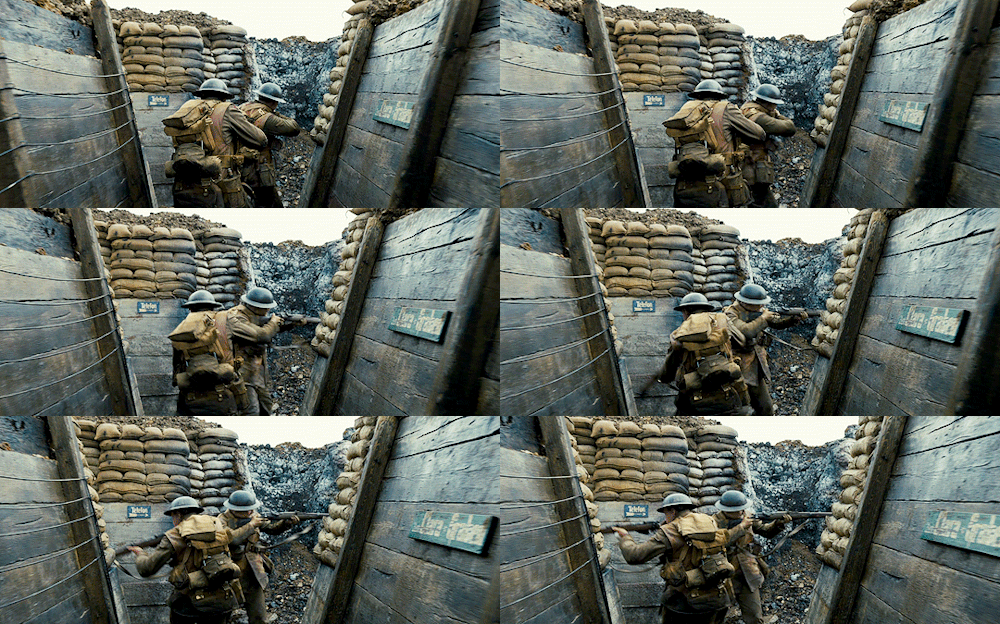
So I saw 1917

Over the weekend I watched 1917, the Great War Western-front epic by British filmmaker Sam Mendes.

Not to spoil too much of the plot, the broad-strokes (which you can get from the preview) is that two humble lance corporals of the fictional 5th Rifles (KRRC)– salty veteran Will Schofield and newcomer Tom Blake– are sent on a last-ditch near-suicide mission to deliver a message to the 2nd Dorsets, the latter of which have broken out and are chasing German troops who they believe are on the run from the Noyon and Bapaume salients.

The reason to stop the Dorsets? The Germans are not running, but are instead evacuating in good order to prepared positions at the massively fortified Siegfriedstellung (aka the Hindenburg Line, from Arras to Soissons) against which the British light infantry, attacking alone, would surely be massacred.

While elements are true (the Hindenburg Line and the relocation from the salients happened as part of the so-called Alberich Maneuver), others were slightly fictionalized. For instance, the 2nd Dorsets never saw France, as they were deployed from India to Egypt and fought in Palestine during the war while the 5th KRRC never stood up in the Great War. The story the film is based was a soldier’s tale passed on by Mendes’s paternal grandfather who served in the KRRC during the conflict, so there is that.

With that being said, I felt there was great attention to detail. For example, the BEF veteran, Schofield, wears older Pattern 08 gear while the newer Tommy, Blake, has elements of modified Pattern 14 leather gear.

P08 vs P14 British gear

Likewise, they use period-correct SMLE Mk III rifles with magazine cutoffs and long P’07 sword bayonets, carry E-tools, wear their puttees correctly, and have Brodie helmets (but, like most actual soldiers, often do not wear said tin caps.)

Further, while threading their way across No Man’s Land, they encounter the most horrific scenes imaginable. One that struck me was the extensive and complex barbed wire entanglements they have to negotiate. Too often in film, barbed wire is shown as a single strand or two, something that could be quickly snipped by a small cutter or a line that an energetic point man could fall across to allow his mates to tread over.

The real thing was far from being that simple:

Ultimately, our two Tommies find themselves in abandoned but excellently-constructed German trenches, complete with concrete blockhouses and an extensive underground bomb-proof barracks. This again was correct to form.

Read Storm of Steel by German field-grade officer Ernst Junger, who spent years in such complexes, and he talks about them on virtually every passage. Even relating that he would on occasion sleep through British bombardments, knowing that his batman would come and fetch him should something pressing develop.

Tales of the German “Labyrinth” at Arras, captured by the British in 1917 during the repositioning, highlighted such installations.

The German “Labyrinth” at Arras, under new management, 1917

It should be remembered that the Kaiser’s men had been in their positions since 1914 in most cases and were determined not to take a step back when they laid them out, hence the extensive fortifications. Some dugouts even had wallpaper and electric lights! The British and French, on the other hand, were always on the assumption their trenches would be only temporary before the “Big Push” came in which they would drive the Jerries/Boche out, so they often would leave their men in muddy holes.

Other scenes in the movie were striking, but I will not cover them as they would be too spoiler-filled.

All in all, for the correctness and “grit” the film does a better job than just about any WWI Western Front movie I have seen prior.

The plot, while slightly far-fetched, is workable enough to move the story along. The Germans are, with the exception of one close-up encounter with a very blonde young man in the middle of the night, faceless and appropriately unseen but no less ominous, and remain deadly even when you think they would not be. The British officers are, for better or worse, very proper English, ala the final season of Blackadder.

I’d watch it again and would recommend it to others. Do yourself a favor and watch it on a big screen rather than a small one should you have an interest.

For a great short work specifically on life in the trenches, check out Eye Deep In Hell by John Ellis. You can often buy used copies for like $3.

More info on the new French Glocks, SCARs

Last week, the French military purchasing agency announced they are picking up 75,000 new Glocks to replace older MAS G1 (Beretta 92) and MAC 50 (Sig P-210ish) pistols. The new handguns will be two-toned (black over Coyote) Gen 5 G17s with Marksman barrels, suppressor-height night sights, ambi slide levers, a lanyard ring (G19X, is that you?) and forward slide serrations.

Voilà

The new French PSA G17

Additionally, to replace the 1980s-era FR F2 bolt-action rifle, the French will be issuing the SCAR-H PR, essentially a SCAR-17 with a heavy barrel. It will be issued with an FN-made QD suppressor, a cleaning kit, four 20-round magazines, and two 10-round magazines.

More details, including videos, in my column at Guns.com. 

Bluebird in Brazil, 98 years ago

A rickety canvas and wood Vought flying machine takes gingerly to the air from a catapult, allowing its 180-horse Wright-Hispano E-3 to claw at the sky. Below is the green-blue water of Rio De Janerio. The date is 11 January 1922.

80-G-410390 VE-9 Vought aircraft, (BuNo# A6463) leaving the catapult of USS Nevada (BB 36) 1922

NARA 80-G-410390

The floatplane, a VE-9H Bluebird (BuNo# A6463), is shown leaving the stern cat of the battleship USS Nevada (BB 36) during the Brazilian Centennial Exposition.

When armed with a single .30-06 machine gun firing through the prop, the two-man VE-7/9 series had a maximum speed of just over 100 mph and was considered to be a fighter at the time.

Only 120 or so were made, split between the Army Air Corps and the Navy. Notably in USN service, the type equipped the Navy’s first two fighter squadrons– VF-1 and VF-2 —, making history in October– ten months after the above photo was taken, when a Bluebird piloted by Lt. Virgil C. Griffin alighted from the deck of the newly commissioned carrier Langley, the Navy’s first carrier takeoff.

Should you be planning on seeing 1917

As I am this weekend, perhaps these behind-the-scenes “making of” 1917 shorts from the Imperial War Museum, who had a supporting role in the film’s production, may be of interest.

I’ll post my own thoughts on the film next week after I see it.

Never before, well, not until 1983 anyway

While John Browning’s everlasting M1911 design had long been made in various blued and nickel coatings, up until the early 1980s it had not been cranked out in a production stainless steel model. That’s where the company formed by airline executive Ken Lau and retired Air Force Brig. Gen. Russell Randall, seized the opportunity.

The Randall Firearms Company started off making stainless .45ACP magazines, which sold exceptionally well, then began firearm production in Sun Valley, California and by June 1983 they started marketing, what gun writer Len Davis described that year in American Handgunner, the first “full-size, all-stainless steel .45 ACP autoloader.”

In production for less than two years, the California-made Randall M1911 hails from the Reagan-era and is a solid collectible. And, yes, this one is named in honor of The Big Cigar.

More in my column at Guns.com

Nick’s Heron

An Italian triple-engine floatplane, a CANT Z. 506B Airone (Italian: Heron) rests on a Sicilian beach (possibly on Mondello beach south of Palermo) guarded by an SMLE-armed British soldier in November 1943.

LOC LC-DIG-fsa-8d34157

Originally built in the 1930s as a 12-seat passenger plane for the Italian airline Ala Littoria to zip tourists and businessmen around the Med, the Airone turned out to be a pretty decent search-and-rescue craft and torpedo bomber and as such saw service in WWII with the Italian Air Force (Regia Aeronautica) and Navy (Regia Marina) as well as the by the Luftwaffe in limited numbers.

Another photo from the same set, LC-DIG-fsa-8d34158.

The two above images were shot by Office of War Information photographer Nick Parrino, who crawled around the ETO and the Middle East throughout 1943 and 1944, leaving behind more than 500 amazing images that are available through the Library of Congress.

Postwar, the Airone would remain in service as a SAR aircraft into the 1960s. Of the more than 350 produced, only one is preserved.

The best known invention of the brothers Koucký

Designed by brothers Josef and František Koucký at the CZ factory in then-Czechoslovakia after more than six years of development, the all-steel 9mm parabellum double-stack CZ75 was a broadside response in the 1970s to the S&W 59, Browning Hi-Power and Beretta Model 92, the West’s contemporary 1st gen “wonder nines.” It soon became a hit and was a best seller around the globe that has remained in production ever since.

Known originally in the West as “the Brunner pistol” after its West German exporter, Walter Pomeranski began importing the CZ75 to the U.S. in 1979. In January 1980, no less a shootist than Col. Jeff Cooper wrote in American Handgunner, “I think the Brunner is the best of the conventional nines as it stands, and the best conventional pistol if it is modified to a major caliber.” Notably, Cooper would use it as the basis of his own Bren Ten concept.

Besides clones produced by a myriad of Italian, Eastern European and Turkish firms, CZ themselves have made more than 1 million of these iconic combat pistols in the past 45 years.

Speaking of which, there is a limited edition 45th anniversary CZ 75 for 2020.

More in my column at Guns.com.

And you think it’s cold shoveling the walk…

How about these nice balmy pictures from the Royal Danish Navy’s Thetis-class offshore patrol frigate HDMS Triton (F358) off the southwest coast of Greenland, where it is something on the order of 20 degrees below 0C?

There is a 76mm OTO Melara under there…

This poor guy

Sweet helmets and trapdoors

From the California Military Department Historical Collection:

Cabinet card of Company G (former Shields Guard) of the National Guard of California’s San Francisco based 1st Infantry Regiment, circa the mid-1880s to early 1890s. This was probably taken at the De La Vega training site in Santa Cruz.

The Sergeant in this image is wearing an M1885 dress uniform coat modified with an M1873 style collar. He is also wearing the M1881 dress helmet for dismounted soldiers. The rifles are Springfield trapdoors, which the state troops would continue to use through the Spanish-American War.

Warship Wednesday Jan 8, 2020: Maru Floatplane Carriers

Here at LSOZI, we are going to take off every Wednesday for a look at the old steam/diesel navies of the 1833-1946 time period and will profile a different ship each week. These ships have a life, a tale all their own, which sometimes takes them to the strangest places. – Christopher Eger

Warship Wednesday, Jan 8, 2020: Maru Floatplane Carriers

Colorized photo by Atsushi Yamashita/Monochrome Specter http://blog.livedoor.jp/irootoko_jr/

Here we see the Kamikawa Maru-class cargo ship, Kimikawa Maru, converted to a Tokusetsu Suijokibokan (special seaplane carrier) of the Imperial Japanese Navy, at Oominato in northern Honshu, in late 1942. As you can tell, this interesting ship and her sisters could carry a serious load of armed, and often very effective, floatplanes.

Constructed in the late 1930s through a joint endeavor of the Japanese shipping firm Ōsaka Mercantile and Kawasaki Kisen in the latter’s Kobe-based shipyard, the five 6,800-ton ships of the class were intended for the Japan-New York route, a trip of some 15,000 nautical miles. This was no sweat as, using a single efficient MAN-designed Kawasaki-made diesel, they had an incredible 35,000nm range at 17 knots.

However, these ships were also ready to chip in should the Empire require it.

As noted in ONI 208-J, the U.S. Navy’s 400+ page WWII intelligence book on the 1,300 assorted Japanese merchant ships over 1,000-tons:

Modern Japanese merchant ship design provides for deck-gun positions up to 5-inch or 6-inch caliber, the largest pieces being hand-loaded under service conditions. Heavier framing and plating and large diameter stanchions (extending down through two decks) are built in integral parts of the hull to support these positions. Ventilator trunks are conveniently arraigned close by for rapid conversion to ammunition hoists. These trunks always lead to specially prepared watertight compartments suitable for use as magazines. Dual-purpose 3-inch guns and anti-aircraft machine guns are often mounted in rows on lateral platforms.

As such, the U.S. Navy was very interested in these ships on the lead-up to the war, with several high-res images of these vessels taken in the 1930s as they transited the Panama Canal, still located in the ONI’s files.

KAMIKAWA MARU Japanese Merchant Ship Port bow view taken off Panama on 23 July 1937 NH 45577

KAMIKAWA MARU Japanese Merchant Ship overhead taken off Panama on 23 July 1937 NH 45576

KUNIKAWA MARU in Gatun Lake, Panama Canal. Altitude 1000 feet, Lens 10 inches. December 22, 1937, NH 111574

Japanese Ship KUNIKAWA MARU. Panama Canal. Altitude 1000 feet, Lens 10 inches. March 11, 1938. NH 111576

Kamikawa Maru-class cargo ship as AP AV, via ONI 208-J 1942

Kamikawa Maru-class cargo ship, via ONI 208-J 1942

With Japan increasingly embroiled in the conflict in China, the Kimikawa Maru-class vessels were soon called up for service, many years before Pearl Harbor.

Notably, four out of the five– Kamikawa Maru, Kiyokawa Maru, Kimikawa Maru, and Kunikawa Maru (nothing confusing about that) were converted to armed seaplane carriers, capable of carrying more than a dozen such single-engine floatplanes aft, for which they had two catapults installed to launch them and large boom cranes for recovery. They would also be equipped with as many as six 4.7- or 5.9-inch guns as well as several smaller AAA mounts and machine guns.

Kawanishi E17K “Alf ” (Japanese floatplane) Being hoisted aboard a Japanese seaplane tender, circa 1939. Note details of the aircraft handling crane NH 82463

Alternatively, twice that many aircraft could be carried stowed below, to be assembled and deployed at some far-off port or atoll if need be. Four similar Mitsubishi-built freighters– Noshiro Maru, Sagara Maru, Sanuki Maru, and Sanyo Maru— were also converted but could only carry about eight seaplanes each. Subsequently, these less successful vessels would be re-rated to transports by 1942.

Notably, many of the IJN’s carrier commanders and admirals learned their trade on these special seaplane carriers to include RADMs Ando Shigeaki, Hattori Katsugi, Shinoda Tarohachi, Matsuda Takatomo, Hara Seitaro, and Yokokawa Ichihei; VADMs Arima Masafumi, Yamada Michiyuki, and Omori Sentaro.

In the late 1930s, their airwing would include Kawanishi E17K (Alf) and Nakajima E8N Type 95 (Dave) scout aircraft, primitive single-float biplanes that couldn’t break 175 knots and carried just a few small bombs and a couple machine guns for self-defense. These would later be augmented by planes like the Mitsubishi F1M2 Pete.

KAMIKAWA MARU (Japanese seaplane tender, 1936) Anchored off Amoy, China, 16 July 1939, with a deck load of KAWANISHI E17K-2 and NAKAJIMA E8N floatplanes both forward and aft. I can count at least 14 aircraft. This vessel, the first of the class converted to a seaplane carrier, saw extensive service in Chinese waters in 1938 to 1940, with her planes often bombing and strafing key Chinese positions. NH 82154

F1M Japanese Pete Kamikawa Maru’s ZII tail code 1940-41

Another view of the same

By 1942, this airwing would grow to as many as 14 much more capable Aichi E13A Type Zero (Jake) armed reconnaissance planes and four Daves– the airwing Kamikawa Maru took to Alaska during the Midway operation. Later types like the Nakajima A6M2-N (Rufe) Type 2 Sui-Sen (‘Rufe’) floatplane version of the Zero fighter soon joined them.

At least four Japanese navy pilots chalked up at least three kills while at the controls of floatplanes, most in the A6M-2N: CPO Shigeji Kawai, WO Kiyomi Katsuki, CPO Keizo Yamaza, and CPO Maruyama, although it should be noted that Katuski downed his first aircraft, a Dutch KNIL PBY, while flying an F1M2 Pete. Katsuki, who had 16 kills, spent at least some of his time flying from Kamikawa Maru.

IJN Seaplane Tender Kamikawa Maru in 1942, likely taken from Kimikawa Maru as her X tail code is on the Jake

E13A-34 Aichi with Kimikawa Maru’s X tail code

Their tail codes:

  • Kamikawa Maru– ZII (15 November 1940) ZI (September 1941) Z (May 1942) YI (14 July 1942)
    L-1 (1943)
  • Kunikawa Maru– YII tail code (November 1942) L-2 (January 1943)
  • Kiyokawa Maru– R (1941) RI (14 July 1942–November 1942)
  • Kimikawa Maru– X (December 1941) C21 (1943)

Once the big balloon went up in December 1941, these four freighters-turned-carriers were used extensively across the Pacific.

Kamikawa Maru would participate in the Malaya campaign and the Battle of the Coral Sea then sail with the fleet for Midway, going on to play a big part in the Aleutians campaign. She would then switch to the Guadalcanal Campaign, and be sent to the bottom by torpedoes from USS Scamp (SS-277) northwest of Kavieng, New Ireland in May 1943.

Mitsubishi F1M2 Pete reconnaissance floatplane on the catapult of the seaplane carrier Kamikawa Maru, 1942

A6M2-N Type 2 floatplane fighter, Sep-Oct 1942, on seaplane tender Kamikawa Maru

Japanese Navy Aichi E13A seaplane, most likely from the seaplane tender Kamikawa Maru. The location of the photo is unknown but may be at Deboyne Islands in May 1942 during the Battle of the Coral Sea.

Kamikawa Maru, with a deck chock full of planes

A6M2-N ‘Rufe’ seaplane pilots deployed from the Kamikawa Maru under the command of ace Kiyomi Katsuki, in middle, digging a trench in the Aleutians, 1943.

Kiyokawa Maru helped capture Guam and Wake Island in December 1941, then was later rerated as a transport. She was ultimately sunk in an air raid at Kaminoseki in 1945 but was later raised and returned to a brief merchant career.

A6M2 Rufe hydro fighters with the R tail code of Kiyokawa Maru

Lae-Salamaua Strike, 10 March 1942 Enlargement of the picture of KIYOKAWA MARU (Japanese seaplane tender, 1937-1945), showing what appears to be a bomb hole aft. Note planes on deck-three Mitsubishi F1M2 (“Pete”) and one E8N2 (“Dave”). Taken by a VT-5 TBD-1, from the USS YORKTOWN (CV-5) air group. NH 95446

Kimikawa Maru, like her sister Kamikawa Maru, would take part in the Midway and Aleutian campaign in 1942-43. A line would be drawn through her name on Poseidon’s ledger in October 1944 after an encounter with the submarine USS Sawfish (SS-276) off Luzon’s Cape Bojeador.

KIMIKAWA MARU (Japanese Seaplane Tender) Photographed in April 1943, at Ominato Bay, Japan, with a load of “PETE” seaplanes aft. NH 73056

Kunikawa Maru would go on to live through a myriad of actions in the Solomons, including the Battle of Santa Cruz Island, and assorted convoy duties until she hit a mine off Balikpapan in March 1944 and was never the same again. She would be finished for good by an airstrike in May 1945 in that Borneo port.

Petes & Rufes on the beach somewhere in the South Pacific, possibly Tulagi Harbor in the Solomons, although I have seen this captioned elsewhere as being in the Marshall Islands. The foreground F1M2 has tail code “L2” of Kunikawa Maru

Another view of the same

By the end of the war, all of the K-Marus had been sunk and their planes either shot down, abandoned or otherwise captured.

Japanese Navy Type 0 Reconnaissance E13A ‘Jake’ at Imajuku, Kyushu Island 1945 

In all, the K-Maru carriers were an interesting concept, a quick and easy way to send a small expeditionary airwing to sea short of converting the ships to more proper escort carriers such as done by the Allies.

A very interesting postwar interrogation of CDR Kintaro Miura, Kamikawa Maru‘s senior air officer from the outbreak of war until December 1942, is in the NHHC archives.

Several scale models of these vessels and their aircraft are in circulation, as is their accompanying artwork, and they have sparked the imagination of warship fans the world over.

Mitsubishi F1M2 Pete floatplane by Robert Taylor. L2 Tail code indicates the plane belongs to the Kunikawa Maru a cargo ship converted to a seaplane tender

Specs:


Displacement: 6,863 tons standard
Length: 479 feet
Beam: 62 feet
Draft: 30 feet
Installed power: 7,600 shp
Propulsion: 1 Kawasaki-M. A. N. diesel, 1 shaft
Speed: 19.5 knots, 17 in military service
Armament: 2 x 5.9-inch, 2 x Type 96 25 mm (0.98 in) AA, 2 x 13.2 mm (0.52 in) MG
Aircraft carried: 12-18 seaplanes (24 stored)
Aviation facilities: Two catapults, cranes

If you liked this column, please consider joining the International Naval Research Organization (INRO), Publishers of Warship International

They are possibly one of the best sources of naval study, images, and fellowship you can find. http://www.warship.org/membership.htm

The International Naval Research Organization is a non-profit corporation dedicated to the encouragement of the study of naval vessels and their histories, principally in the era of iron and steel warships (about 1860 to date). Its purpose is to provide information and a means of contact for those interested in warships.

With more than 50 years of scholarship, Warship International, the written tome of the INRO has published hundreds of articles, most of which are unique in their sweep and subject.

PRINT still has its place. If you LOVE warships you should belong.

I’m a member, so should you be!

« Older Entries Recent Entries »