Dr. Watson, bring your revolver(s)

So I saw this interesting listing pop up from Milestone Auctions, centered on a cased pair of beautiful (although non-sequential) Colt Model 1878 double action cartridge revolvers.

As you may well remember, the Colt 1871 and follow-up 1873 (aka Peacemaker, aka Single Action Army) brought the iconic wheelgun maker back from bankruptcy and into the cartridge revolver-era, and the 1878 being double action, was essentially the most tactical wheelgun on the market when it was released.

With 5.5-inch barrels and a massive .455/476 Enfield Eley Mark III chambering, these big gate-loading Colts were certainly man-stoppers.

Even more interesting, and the caliber may have given it away. is the fact that these two Colts are English silver plated with bird’s head rosewood grips and are covered with both British proof house marks and Colt’s London address on the barrels.

For sure, these were presentation guns for a special occasion or person. A clue is in the auction listing which reads that one of the guns :

“..appears in the copy of Army & Navy sales ledger as sold in England to Caton Jones, Sup FW on Sept 9, 1885, with no details on guns finish. How they ended up together as a pair and plated while in England is a mystery.”

Going to the Army List for that year, we find one Frederick William Caton Jones, MB (Medicinae Baccalaureus), MRCS (Membership of the Royal College of Surgeons), is listed as commissioned 30 May 1885. He was 25 years old.

Bound for India, our good Dr. Caton Jones later turns up in future listings as a Surgeon assigned in 1891 to the Bombay garrison with the Army in India, where he was still posted as of the 1906 Army List. During that period he rose to Major on 30 May 1897 and to Lt. Colonel on 30 May 1905.

As published in The Western Australian, 24 August 1900, Caton-Jones was mixing it up with the Boers while in Kitchener’s brigade.

Surgeon-Major F. W. Caton Jones, of the Royal Army Medical Corps, writing to his sister, Mrs. Cumming from Newcastle, South Africa, under date July 22, says :–

I am just getting over that Ladysmith business now and can get along all right without taking medicine, but it has taken four months to do it. I have a very nice commando of my own now. Am in charge of the 7th Brigade, Field Hospital and Bearer Company. It is an Indian hospital and a perfect unit.

I have under me one officer, R.A.M.C.; two civil surgeons (in place of R.A.M.C. officers); eight assistant surgeons (Indian Apothecaries); one conductor (Indian army); two civilian conductors, four sergeants, and eight nursing orderlies (British army from India); 42 Indian Army Hospital native corps, 126 Indian dhoolee-bearers, and 50 drivers.

I am equipped for a hundred sick in hospital, and put up double that number at a pinch. I can carry 52 men lying down and 12 sitting in my sick transport, 20 lying in the dhoolies, and 94 sitting in my wheeled ambulances, if I put no lying down cases in the latter; a good deal to be responsible for.

Our brigade, under Brigadier General Kitchener, is at Newcastle, on the lines of communication. Of course, we are very sick at not getting forward, but someone must stay behind. Thank goodness, the grass is burnt round the camp. Veldt fires happen every day. One field hospital was burnt, but luckily no one was injured.

This is a fine country, and very healthy. All colonists say we shall have to be much sterner with the Boers before they will give in. I believe sternness would save very many lives both of, theirs and ours. If the Indian hospitals are sent back to India in September, I may go to China.

By 1911, the good doctor was back from his long overseas deployments and stationed in Tidworth Barracks in south-east Wiltshire, England where he remained until 1914.

By 1916, I can find then-Colonel FW Caton-Jones OB, AMS, ADMS (Assistant Director Medical Services), as head of the Medical Board of Officers assembled at No 1 General Hospital, Etretat, in Normandy, serving with the BEF “on the Continent.”

Col. FW Caton-Jones, 1916, via IWM

Why the big pistols for a man of medicine, besides the obvious need for a gentleman of the period to have arms while campaigning?

It seems the good Dr. Caton-Jones was a true English gentleman officer while abroad and was something of a noted big game hunter as well as a man of arts, science, and letters.

In 1914, he contributed a chapter to Major-General A.E. Wardrop’s “Modern Pig-Sticking,” a tome about horse-mounted tiger and boar hunting, particularly centered in India.

An illustration from Modern Pig Sticking, circa 1914

Caton-Jones was uniquely qualified to write the chapter at the time as he was the 1907 winner of the Nagpur Hunt cup. The Spectator called the volume, “one of the pleasantest books on the sport that we have seen for a long time.”

Caton-Jones had previously written other scholarly works for the Journal of Bombay Natural History (“Some Notes on Wild Dogs and Panthers”) as well as for the British Army’s Journal of the Royal Army Medical Corps (“The Sanitation of Standing Camps in India”). He also wrote/co-wrote at least seven papers in the respected The Lancet medical journal. Still other papers appeared in The Medical Press and Circular, and The Journal of the Royal Institute of Public Health.

After moving to the reserve list following the Great War and more than 30 years of military service, Caton-Jones later reappeared in India and Kenya while still submitting articles on both medicine and hunting (see= The Hoghunter’s Annual, Times of India Press, 1930).

At some point, he was made a Companion of the Order of Bath and a fellow of the Royal Institute of Public Health.

Colonel Frederick William Caton Jones, CB, RAMC, Veteran of the Boer Wars, the Great War and assorted Indian campaigns, and scourge of tigers and wild boar, died at his Earlsdale estate on 7 June 1944, aged 83.

No word on if a Mr. Holmes attended his funeral.

STAVE-LCS

I thought this was interesting in how the Navy trains using the Surface Training Advanced Virtual Environment for the Littoral Combat Ship (STAVE-LCS). Hopefully one day the actual ships will mature and fit the bill they were designed to pay, or at least hold the line until a frigate program can be developed.

Warship Wednesday Jan 15, 2020: TF38 Running Amok in the South China Sea

Here at LSOZI, we are going to take off every Wednesday for a look at the old steam/diesel navies of the 1833-1946 time period and will profile a different ship each week. These ships have a life, a tale all their own, which sometimes takes them to the strangest places.- Christopher Eger

Warship Wednesday, Jan 15, 2020: TF38 Running Amok in the South China Sea

Naval History and Heritage Command Photo NH 89378

Here we see, 75 years ago today, the last seconds of the No.1-class landing ship T-14 of the Imperial Japanese Navy after it was sunk by U.S. Navy carrier strike planes in Takao Harbor, Formosa. Note the dramatic concussion ring on the water around the ship.

Under the command of VADM John S. “Slew” McCain Sr, Task Force 38 was organized into four fast carrier task groups (one of those specializing in night fighting). All in all, the force consisted of a whopping 14 fleet and light carriers, embarking around 900 aircraft, and were supported by 8 battleships, 16 cruisers of all sorts, and 68 destroyers. It rightfully could have taken on any circa-1939 navy in the world and won.

And for just under two weeks in January 1945, it absolutely owned the South China Sea in what was termed Operation Gratitude.

Sailing from Ulithi, they plastered Formosa, carried the war to Japanese-occupied French Indochina, raided occupied Hong Kong and Southern China, then departed towards the Philipines.

On 15 January alone, in addition to T-14 above, aircraft from TF 38 sent the tanker Harima Maru, the Kamikaze-class destroyer Hatakaze, the cargo ship Horei Maru, the armed fleet tanker Mirii Maru, and the Momi-class destroyer Tsuga to the bottom. Not bad for a day’s work– and it was a busy week!

A large Japanese cargo ship settles by the bow after she was torpedoed by U.S. Navy carrier planes off Cape St. Jacques, French Indo-China, 12 January 1945. Waves from a torpedo hit in her port bow have not yet subsided. Taken from a USS ESSEX plane. NH 95787

Dockyard hit bombs are shown hitting Taikoo Dock Yard, Hong Kong, China. 16 January 1945. They are from planes of Vice Admiral John S. McCain’s Fast Carrier Task Force. Note the fires in the foreground. Stiff Anti-Aircraft fire was encountered. NH 121586

This photo shows Hong Kong harbor, Hong Kong, China under attack by planes from an Essex Class Carrier of Vice Admiral John S. McCain’s Fast Carrier Task Force. Bombs can be seen hitting ships on the left of the photo. Smoke pours up from several places along the waterfront. The Dock Yard was one of the targets for that day. 16 January 1945 NH 121588

Saigon River Front, French Indochina, Caption: Ships and installations afire after aerial attack by carrier-based planes of US Pacific fleet, 12 January 1945. Taken by plane from USS TICONDEROGA (CV-14) #: 80-G-301944

Saigon River Front, French Indochina, Caption: Ships and installations afire after aerial attack by carrier-based planes of US Pacific fleet, 12 January 1945. Taken by plane from USS TICONDEROGA (CV-14) #: 80-G-301944

In all, TF38 sank no less than 49 enemy ships between 9 January and 16 January. This works out to something on the order of 300,000 tons of Japanese shipping, including the core of the Empire’s remaining tankers– ships vital to carry on the war– and shot down some 600 land-based aircraft that rose to meet them.

The most curious of the Japanese warships sunk was IJN No. 101 the former RN minesweeper HMS Taitam (J210) which had been captured in Hong Kong in 1941 while still under construction.

In return, TF 38 lost 200 carrier aircraft, half of those to accidents flying in horrible conditions, but suffered no vessels sunk.

And yet, the question of Japanese surrender would linger unanswered for another seven months.

If you like this post and other Warship Wednesdays, please check out the INRO.

They are possibly one of the best sources of naval study, images, and fellowship you can find. http://www.warship.org/membership.htm

The International Naval Research Organization is a non-profit corporation dedicated to the encouragement of the study of naval vessels and their histories, principally in the era of iron and steel warships (about 1860 to date). Its purpose is to provide information and a means of contact for those interested in warships.

With more than 50 years of scholarship, Warship International, the written tome of the INRO has published hundreds of articles, most of which are unique in their sweep and subject.

PRINT still has its place. If you LOVE warships you should belong.

I’m a member, so should you be!

Glad I saved my $29…

As a kid in 1986– in an age where action heroes were shirtless, spoke with an Austrian accent or a mumble, and carried a big fixed blade– I downright pined for one of these $29.95 specials every time I browsed the gun mags of the day while camped out at the news rack of the local T.G.&Y.

Glad I wasn’t able to cut enough grass to afford both a wildly addictive Testors scale model habit, as well as my nascent knife wanderlust. That tang-less 420SS thing looks like pure junk-o. But hey, it had a compass!

Ever thought about a SCAR in 6.5 Creedmoor?

Last year, FN apparently trialed a version of their MK 20 SSR (sniper support rifle) in 6.5 Creedmoor as USSOCOM was flirting with the idea of fielding the new– and increasingly popular– round for future use. Not to let research go to waste, the company just announced they will start selling the commercial variant of the SSR, the FN SCAR 20S, in 6.5CM.

Boom.

More in my column at Guns.com. 

So long, Sea Ranger

For decades, anyone who ever looked up to the whop-whop of a low-flying helicopter over the skies of West Florida or along Mobile Bay or the Mississippi Gulf Coast has often spied the distinctive TH-57 Sea Ranger as it put-putted along.

These:

MILTON, Fla. (June 5, 2019) TH-57 Sea Ranger helicopters from Training Air Wing (TW) 5 sit on the flight line at Naval Air Station Whiting Field in Milton, Fla. (U.S. Navy photo by Lt. Michelle Tucker/Released) 190604-N-OU681-1003

A derivative of the commercial Bell Jet Ranger 206, NAVAIR first acquired the TH-57 in 1968 and has been using them, typically out of Whiting Field, to train budding sea service and allied chopper pilots.

As noted by the National Naval Aviation Museum, “Prospective Navy, Marine Corps, and Coast Guard helicopter pilots spend approximately 106 hours flying the Sea Ranger at Naval Air Station (NAS) Whiting Field, Florida, before receiving their wings. Over the course of this period, they learn aerodynamic and engineering qualities of rotary-wing aircraft and in particular, how to hover. They also learn basic instrument techniques, radio navigation, rough terrain landing, night and formation flying, emergency procedures like auto-rotation, shipboard operations, and helicopter tactics.”

Now, after a 52-year run that was stayed by updated airframes in 1981 and 1989, the days of the Sea Ranger are coming to an end.

From DOD:

AgustaWestland Philadelphia Corp., Philadelphia, Pennsylvania, is awarded a $176,472,608 firm-fixed-price contract for the production and delivery of 32 TH-73A aircraft, initial spares, peculiar support equipment, flyaway kits, hoists, sling loads, data in excess of commercial form fit function/operations maintenance instructional training data as well as ancillary instructor pilot and maintenance personnel training. Work will be performed at Philadelphia, Pennsylvania (87%); Mineral Wells, Texas (5%); and various locations outside the continental U.S. (8%), and is expected to be completed in October 2021. Fiscal 2020 aircraft procurement (Navy) funds in the amount of $176,472,608 will be obligated at time of award, none of which will expire at the end of the current fiscal year. This contract was competitively procured via an electronic request for proposal; five offers were received. The Naval Air Systems Command, Patuxent River, Maryland, is the contracting activity (N61340-20-C-0007).

The TH-73A is a variant of Leonardo’s AW119, which had been marketed as the TH-119.

This:

“Today marks a great team effort to procure and deliver a helicopter trainer for the next generation of helicopter and tilt-rotor pilots for the Navy, Marine Corps, and Coast Guard,” said James F. Geurts, assistant secretary of the Navy for research, development, and acquisition. “I’m proud of the aggressive work the team did to leverage the commercial industrial base to get this capability to the warfighters, and our nation, at the best value to the taxpayer. This effort is key to ensure the readiness of our Naval Aviators for decades to come.”

A break between Fallschirmjägers and destiny

TEC5 Thomas “Red” O’Brien, C Company, 101st Infantry Regiment, 26th (Yankee) Division, getting a quick meal in while parked on a snowbank near Mecher, Luxembourg, 75 years ago yesterday.

Photo by TEC5 Arthur Hertz, 166th Signal Photo Company, for Stars and Stripes. Via LOC

O’Brien’s unit had been engaged with elements of the tough German 5. Fallschirmjäger-Division, fighting small unit actions in the snow for the past several days prior to this image being shot. Veterans of the 101st would refer to the Battle of the Bulge as “Our Valley Forge.”

Sadly, CPL. O’Brien was killed less than two weeks after this image was captured, on 25 January, by German sniper fire at a crossroad outside Clervaux, Luxembourg, aged 23. He was a native of Rhode Island but a Massachusetts resident when he volunteered in 1942 and is interred at the American Military Cemetery, Henri-Chapelle, Belgium.

The 101st, as was most of the 26th ID, hailed from New England, where they had previously served as a Massachusetts National Guard and state militia outfit dating back to the Civil War. While the regiment cased their colors in 1993, the 26th is still around as the 26th Maneuver Enhancement Brigade in the MARNG, headquartered at Natick.

So I saw 1917

Over the weekend I watched 1917, the Great War Western-front epic by British filmmaker Sam Mendes.

Not to spoil too much of the plot, the broad-strokes (which you can get from the preview) is that two humble lance corporals of the fictional 5th Rifles (KRRC)– salty veteran Will Schofield and newcomer Tom Blake– are sent on a last-ditch near-suicide mission to deliver a message to the 2nd Dorsets, the latter of which have broken out and are chasing German troops who they believe are on the run from the Noyon and Bapaume salients.

The reason to stop the Dorsets? The Germans are not running, but are instead evacuating in good order to prepared positions at the massively fortified Siegfriedstellung (aka the Hindenburg Line, from Arras to Soissons) against which the British light infantry, attacking alone, would surely be massacred.

While elements are true (the Hindenburg Line and the relocation from the salients happened as part of the so-called Alberich Maneuver), others were slightly fictionalized. For instance, the 2nd Dorsets never saw France, as they were deployed from India to Egypt and fought in Palestine during the war while the 5th KRRC never stood up in the Great War. The story the film is based was a soldier’s tale passed on by Mendes’s paternal grandfather who served in the KRRC during the conflict, so there is that.

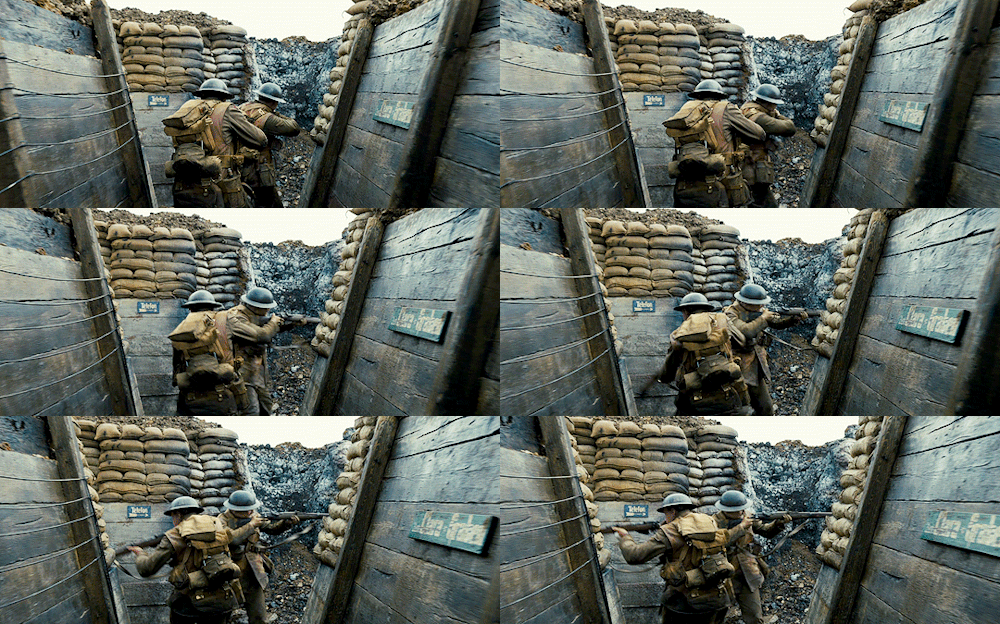
With that being said, I felt there was great attention to detail. For example, the BEF veteran, Schofield, wears older Pattern 08 gear while the newer Tommy, Blake, has elements of modified Pattern 14 leather gear.

P08 vs P14 British gear

Likewise, they use period-correct SMLE Mk III rifles with magazine cutoffs and long P’07 sword bayonets, carry E-tools, wear their puttees correctly, and have Brodie helmets (but, like most actual soldiers, often do not wear said tin caps.)

Further, while threading their way across No Man’s Land, they encounter the most horrific scenes imaginable. One that struck me was the extensive and complex barbed wire entanglements they have to negotiate. Too often in film, barbed wire is shown as a single strand or two, something that could be quickly snipped by a small cutter or a line that an energetic point man could fall across to allow his mates to tread over.

The real thing was far from being that simple:

Ultimately, our two Tommies find themselves in abandoned but excellently-constructed German trenches, complete with concrete blockhouses and an extensive underground bomb-proof barracks. This again was correct to form.

Read Storm of Steel by German field-grade officer Ernst Junger, who spent years in such complexes, and he talks about them on virtually every passage. Even relating that he would on occasion sleep through British bombardments, knowing that his batman would come and fetch him should something pressing develop.

Tales of the German “Labyrinth” at Arras, captured by the British in 1917 during the repositioning, highlighted such installations.

The German “Labyrinth” at Arras, under new management, 1917

It should be remembered that the Kaiser’s men had been in their positions since 1914 in most cases and were determined not to take a step back when they laid them out, hence the extensive fortifications. Some dugouts even had wallpaper and electric lights! The British and French, on the other hand, were always on the assumption their trenches would be only temporary before the “Big Push” came in which they would drive the Jerries/Boche out, so they often would leave their men in muddy holes.

Other scenes in the movie were striking, but I will not cover them as they would be too spoiler-filled.

All in all, for the correctness and “grit” the film does a better job than just about any WWI Western Front movie I have seen prior.

The plot, while slightly far-fetched, is workable enough to move the story along. The Germans are, with the exception of one close-up encounter with a very blonde young man in the middle of the night, faceless and appropriately unseen but no less ominous, and remain deadly even when you think they would not be. The British officers are, for better or worse, very proper English, ala the final season of Blackadder.

I’d watch it again and would recommend it to others. Do yourself a favor and watch it on a big screen rather than a small one should you have an interest.

For a great short work specifically on life in the trenches, check out Eye Deep In Hell by John Ellis. You can often buy used copies for like $3.

More info on the new French Glocks, SCARs

Last week, the French military purchasing agency announced they are picking up 75,000 new Glocks to replace older MAS G1 (Beretta 92) and MAC 50 (Sig P-210ish) pistols. The new handguns will be two-toned (black over Coyote) Gen 5 G17s with Marksman barrels, suppressor-height night sights, ambi slide levers, a lanyard ring (G19X, is that you?) and forward slide serrations.

Voilà

The new French PSA G17

Additionally, to replace the 1980s-era FR F2 bolt-action rifle, the French will be issuing the SCAR-H PR, essentially a SCAR-17 with a heavy barrel. It will be issued with an FN-made QD suppressor, a cleaning kit, four 20-round magazines, and two 10-round magazines.

More details, including videos, in my column at Guns.com. 

Bluebird in Brazil, 98 years ago

A rickety canvas and wood Vought flying machine takes gingerly to the air from a catapult, allowing its 180-horse Wright-Hispano E-3 to claw at the sky. Below is the green-blue water of Rio De Janerio. The date is 11 January 1922.

80-G-410390 VE-9 Vought aircraft, (BuNo# A6463) leaving the catapult of USS Nevada (BB 36) 1922

NARA 80-G-410390

The floatplane, a VE-9H Bluebird (BuNo# A6463), is shown leaving the stern cat of the battleship USS Nevada (BB 36) during the Brazilian Centennial Exposition.

When armed with a single .30-06 machine gun firing through the prop, the two-man VE-7/9 series had a maximum speed of just over 100 mph and was considered to be a fighter at the time.

Only 120 or so were made, split between the Army Air Corps and the Navy. Notably in USN service, the type equipped the Navy’s first two fighter squadrons– VF-1 and VF-2 —, making history in October– ten months after the above photo was taken, when a Bluebird piloted by Lt. Virgil C. Griffin alighted from the deck of the newly commissioned carrier Langley, the Navy’s first carrier takeoff.

« Older Entries Recent Entries »