Last year, FN apparently trialed a version of their MK 20 SSR (sniper support rifle) in 6.5 Creedmoor as USSOCOM was flirting with the idea of fielding the new– and increasingly popular– round for future use. Not to let research go to waste, the company just announced they will start selling the commercial variant of the SSR, the FN SCAR 20S, in 6.5CM.
For decades, anyone who ever looked up to the whop-whop of a low-flying helicopter over the skies of West Florida or along Mobile Bay or the Mississippi Gulf Coast has often spied the distinctive TH-57 Sea Ranger as it put-putted along.
These:
MILTON, Fla. (June 5, 2019) TH-57 Sea Ranger helicopters from Training Air Wing (TW) 5 sit on the flight line at Naval Air Station Whiting Field in Milton, Fla. (U.S. Navy photo by Lt. Michelle Tucker/Released) 190604-N-OU681-1003
A derivative of the commercial Bell Jet Ranger 206, NAVAIR first acquired the TH-57 in 1968 and has been using them, typically out of Whiting Field, to train budding sea service and allied chopper pilots.
As noted by the National Naval Aviation Museum, “Prospective Navy, Marine Corps, and Coast Guard helicopter pilots spend approximately 106 hours flying the Sea Ranger at Naval Air Station (NAS) Whiting Field, Florida, before receiving their wings. Over the course of this period, they learn aerodynamic and engineering qualities of rotary-wing aircraft and in particular, how to hover. They also learn basic instrument techniques, radio navigation, rough terrain landing, night and formation flying, emergency procedures like auto-rotation, shipboard operations, and helicopter tactics.”
Now, after a 52-year run that was stayed by updated airframes in 1981 and 1989, the days of the Sea Ranger are coming to an end.
From DOD:
AgustaWestland Philadelphia Corp., Philadelphia, Pennsylvania, is awarded a $176,472,608 firm-fixed-price contract for the production and delivery of 32 TH-73A aircraft, initial spares, peculiar support equipment, flyaway kits, hoists, sling loads, data in excess of commercial form fit function/operations maintenance instructional training data as well as ancillary instructor pilot and maintenance personnel training. Work will be performed at Philadelphia, Pennsylvania (87%); Mineral Wells, Texas (5%); and various locations outside the continental U.S. (8%), and is expected to be completed in October 2021. Fiscal 2020 aircraft procurement (Navy) funds in the amount of $176,472,608 will be obligated at time of award, none of which will expire at the end of the current fiscal year. This contract was competitively procured via an electronic request for proposal; five offers were received. The Naval Air Systems Command, Patuxent River, Maryland, is the contracting activity (N61340-20-C-0007).
The TH-73A is a variant of Leonardo’s AW119, which had been marketed as the TH-119.
This:
“Today marks a great team effort to procure and deliver a helicopter trainer for the next generation of helicopter and tilt-rotor pilots for the Navy, Marine Corps, and Coast Guard,” said James F. Geurts, assistant secretary of the Navy for research, development, and acquisition. “I’m proud of the aggressive work the team did to leverage the commercial industrial base to get this capability to the warfighters, and our nation, at the best value to the taxpayer. This effort is key to ensure the readiness of our Naval Aviators for decades to come.”
TEC5 Thomas “Red” O’Brien, C Company, 101st Infantry Regiment, 26th (Yankee) Division, getting a quick meal in while parked on a snowbank near Mecher, Luxembourg, 75 years ago yesterday.
Photo by TEC5 Arthur Hertz, 166th Signal Photo Company, for Stars and Stripes. Via LOC
O’Brien’s unit had been engaged with elements of the tough German 5. Fallschirmjäger-Division, fighting small unit actions in the snow for the past several days prior to this image being shot. Veterans of the 101st would refer to the Battle of the Bulge as “Our Valley Forge.”
Sadly, CPL. O’Brien was killed less than two weeks after this image was captured, on 25 January, by German sniper fire at a crossroad outside Clervaux, Luxembourg, aged 23. He was a native of Rhode Island but a Massachusetts resident when he volunteered in 1942 and is interred at the American Military Cemetery, Henri-Chapelle, Belgium.
The 101st, as was most of the 26th ID, hailed from New England, where they had previously served as a Massachusetts National Guard and state militia outfit dating back to the Civil War. While the regiment cased their colors in 1993, the 26th is still around as the 26th Maneuver Enhancement Brigade in the MARNG, headquartered at Natick.
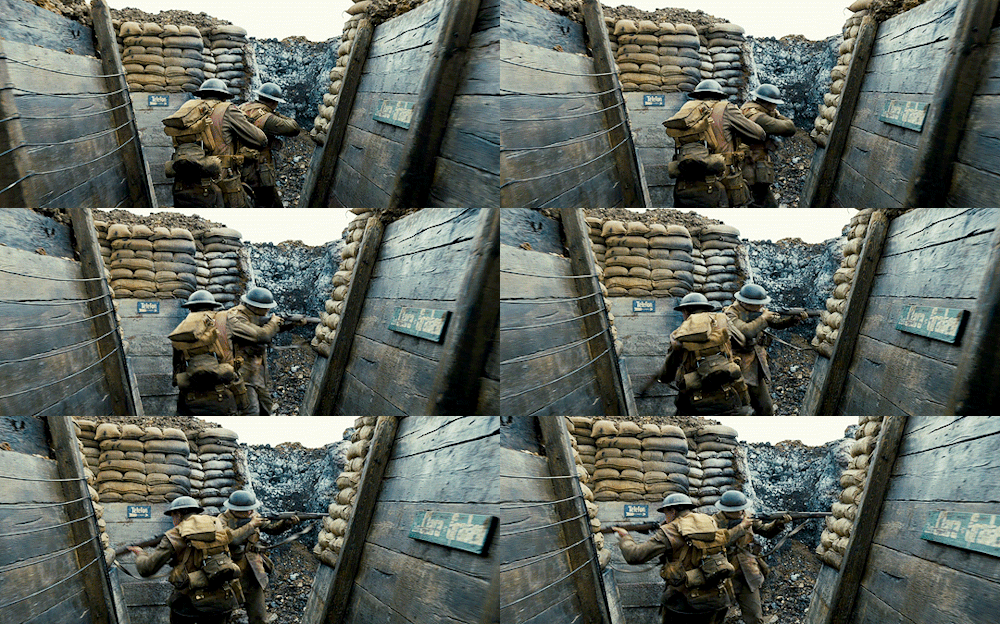
Over the weekend I watched 1917, the Great War Western-front epic by British filmmaker Sam Mendes.
Not to spoil too much of the plot, the broad-strokes (which you can get from the preview) is that two humble lance corporals of the fictional 5th Rifles (KRRC)– salty veteran Will Schofield and newcomer Tom Blake– are sent on a last-ditch near-suicide mission to deliver a message to the 2nd Dorsets, the latter of which have broken out and are chasing German troops who they believe are on the run from the Noyon and Bapaume salients.
The reason to stop the Dorsets? The Germans are not running, but are instead evacuating in good order to prepared positions at the massively fortified Siegfriedstellung (aka the Hindenburg Line, from Arras to Soissons) against which the British light infantry, attacking alone, would surely be massacred.
While elements are true (the Hindenburg Line and the relocation from the salients happened as part of the so-called Alberich Maneuver), others were slightly fictionalized. For instance, the 2nd Dorsets never saw France, as they were deployed from India to Egypt and fought in Palestine during the war while the 5th KRRC never stood up in the Great War. The story the film is based was a soldier’s tale passed on by Mendes’s paternal grandfather who served in the KRRC during the conflict, so there is that.
With that being said, I felt there was great attention to detail. For example, the BEF veteran, Schofield, wears older Pattern 08 gear while the newer Tommy, Blake, has elements of modified Pattern 14 leather gear.
P08 vs P14 British gear
Likewise, they use period-correct SMLE Mk III rifles with magazine cutoffs and long P’07 sword bayonets, carry E-tools, wear their puttees correctly, and have Brodie helmets (but, like most actual soldiers, often do not wear said tin caps.)
Further, while threading their way across No Man’s Land, they encounter the most horrific scenes imaginable. One that struck me was the extensive and complex barbed wire entanglements they have to negotiate. Too often in film, barbed wire is shown as a single strand or two, something that could be quickly snipped by a small cutter or a line that an energetic point man could fall across to allow his mates to tread over.
The real thing was far from being that simple:
Ultimately, our two Tommies find themselves in abandoned but excellently-constructed German trenches, complete with concrete blockhouses and an extensive underground bomb-proof barracks. This again was correct to form.
Read Storm of Steel by German field-grade officer Ernst Junger, who spent years in such complexes, and he talks about them on virtually every passage. Even relating that he would on occasion sleep through British bombardments, knowing that his batman would come and fetch him should something pressing develop.
Tales of the German “Labyrinth” at Arras, captured by the British in 1917 during the repositioning, highlighted such installations.
The German “Labyrinth” at Arras, under new management, 1917
It should be remembered that the Kaiser’s men had been in their positions since 1914 in most cases and were determined not to take a step back when they laid them out, hence the extensive fortifications. Some dugouts even had wallpaper and electric lights! The British and French, on the other hand, were always on the assumption their trenches would be only temporary before the “Big Push” came in which they would drive the Jerries/Boche out, so they often would leave their men in muddy holes.
Other scenes in the movie were striking, but I will not cover them as they would be too spoiler-filled.
All in all, for the correctness and “grit” the film does a better job than just about any WWI Western Front movie I have seen prior.
The plot, while slightly far-fetched, is workable enough to move the story along. The Germans are, with the exception of one close-up encounter with a very blonde young man in the middle of the night, faceless and appropriately unseen but no less ominous, and remain deadly even when you think they would not be. The British officers are, for better or worse, very proper English, ala the final season of Blackadder.
I’d watch it again and would recommend it to others. Do yourself a favor and watch it on a big screen rather than a small one should you have an interest.
For a great short work specifically on life in the trenches, check out Eye Deep In Hell by John Ellis. You can often buy used copies for like $3.
Last week, the French military purchasing agency announced they are picking up 75,000 new Glocks to replace older MAS G1 (Beretta 92) and MAC 50 (Sig P-210ish) pistols. The new handguns will be two-toned (black over Coyote) Gen 5 G17s with Marksman barrels, suppressor-height night sights, ambi slide levers, a lanyard ring (G19X, is that you?) and forward slide serrations.
Voilà
The new French PSA G17
Additionally, to replace the 1980s-era FR F2 bolt-action rifle, the French will be issuing the SCAR-H PR, essentially a SCAR-17 with a heavy barrel. It will be issued with an FN-made QD suppressor, a cleaning kit, four 20-round magazines, and two 10-round magazines.
A rickety canvas and wood Vought flying machine takes gingerly to the air from a catapult, allowing its 180-horse Wright-Hispano E-3 to claw at the sky. Below is the green-blue water of Rio De Janerio. The date is 11 January 1922.
NARA 80-G-410390
The floatplane, a VE-9H Bluebird (BuNo# A6463), is shown leaving the stern cat of the battleship USS Nevada (BB 36) during the Brazilian Centennial Exposition.
When armed with a single .30-06 machine gun firing through the prop, the two-man VE-7/9 series had a maximum speed of just over 100 mph and was considered to be a fighter at the time.
Only 120 or so were made, split between the Army Air Corps and the Navy. Notably in USN service, the type equipped the Navy’s first two fighter squadrons– VF-1 and VF-2 —, making history in October– ten months after the above photo was taken, when a Bluebird piloted by Lt. Virgil C. Griffin alighted from the deck of the newly commissioned carrier Langley, the Navy’s first carrier takeoff.
As I am this weekend, perhaps these behind-the-scenes “making of” 1917 shorts from the Imperial War Museum, who had a supporting role in the film’s production, may be of interest.
I’ll post my own thoughts on the film next week after I see it.
While John Browning’s everlasting M1911 design had long been made in various blued and nickel coatings, up until the early 1980s it had not been cranked out in a production stainless steel model. That’s where the company formed by airline executive Ken Lau and retired Air Force Brig. Gen. Russell Randall, seized the opportunity.
The Randall Firearms Company started off making stainless .45ACP magazines, which sold exceptionally well, then began firearm production in Sun Valley, California and by June 1983 they started marketing, what gun writer Len Davis described that year in American Handgunner, the first “full-size, all-stainless steel .45 ACP autoloader.”
In production for less than two years, the California-made Randall M1911 hails from the Reagan-era and is a solid collectible. And, yes, this one is named in honor of The Big Cigar.
An Italian triple-engine floatplane, a CANT Z. 506B Airone (Italian: Heron) rests on a Sicilian beach (possibly on Mondello beach south of Palermo) guarded by an SMLE-armed British soldier in November 1943.
LOC LC-DIG-fsa-8d34157
Originally built in the 1930s as a 12-seat passenger plane for the Italian airline Ala Littoria to zip tourists and businessmen around the Med, the Airone turned out to be a pretty decent search-and-rescue craft and torpedo bomber and as such saw service in WWII with the Italian Air Force (Regia Aeronautica) and Navy (Regia Marina) as well as the by the Luftwaffe in limited numbers.
Another photo from the same set, LC-DIG-fsa-8d34158.
The two above images were shot by Office of War Information photographer Nick Parrino, who crawled around the ETO and the Middle East throughout 1943 and 1944, leaving behind more than 500 amazing images that are available through the Library of Congress.
Postwar, the Airone would remain in service as a SAR aircraft into the 1960s. Of the more than 350 produced, only one is preserved.
Designed by brothers Josef and František Koucký at the CZ factory in then-Czechoslovakia after more than six years of development, the all-steel 9mm parabellum double-stack CZ75 was a broadside response in the 1970s to the S&W 59, Browning Hi-Power and Beretta Model 92, the West’s contemporary 1st gen “wonder nines.” It soon became a hit and was a best seller around the globe that has remained in production ever since.
Known originally in the West as “the Brunner pistol” after its West German exporter, Walter Pomeranski began importing the CZ75 to the U.S. in 1979. In January 1980, no less a shootist than Col. Jeff Cooper wrote in American Handgunner, “I think the Brunner is the best of the conventional nines as it stands, and the best conventional pistol if it is modified to a major caliber.” Notably, Cooper would use it as the basis of his own Bren Ten concept.
Besides clones produced by a myriad of Italian, Eastern European and Turkish firms, CZ themselves have made more than 1 million of these iconic combat pistols in the past 45 years.
Speaking of which, there is a limited edition 45th anniversary CZ 75 for 2020.