Remington grabs Army FMS contract order

Back last year I had a chance to tour Remington’s mega factory in Huntsville, Alabama where they made, on one giant floor, dozens of different types of platforms for many of their subsidiaries including DPMS, LAR, Bushmaster, AAC suppressors and others. One of the cooler things I saw were Remington Defense (Bushmaster, but for military contracts) Adaptive Combat Rifle lowers on the floor.

Don’t know about Remington Defense? They market militarized versions of papa’s classic 700-series sniper rifles and 870-series shotguns as well as the select-fire Remington R4 and R5 carbines and the ACR itself.

Well, the company just got a big slice of a $28.4 million firm-fixed-price U.S. Army contract for an undetailed quantity of “North Atlantic Treaty Organization commercial off-the-shelf carbines,” with Colt, Daniel Defense, and FN competing with Remington to fulfill the order by July 2019.

The end-user is unannounced, the rifle being supplied is unspecified, and the quantity is also a riddle, but the last big Remington military sale was to the Philippines for over 60,000 R4s, some of which have seen very heavy use in battling Islamic insurgents.

Philippine soldier, Battle of Marawi. The logo on his magwell: Remington Defense.

Those RIMPAC sunsets

Multinational ships, (left to right) guided-missile destroyer USS William P. Lawrence (DDG 110), guided-missile cruiser USS Lake Erie (CG 70), Peruvian Navy maritime patrol boat BAP Ferré (PM 211) [ex-South Korean Gyeongju (PCC-758)] and the Philippine Navy frigate BRP Andrés Bonifacio (FF 17) [ex-USCGC Boutwell (WHEC-719)] sail in formation at sunset at RIMPAC 2018.


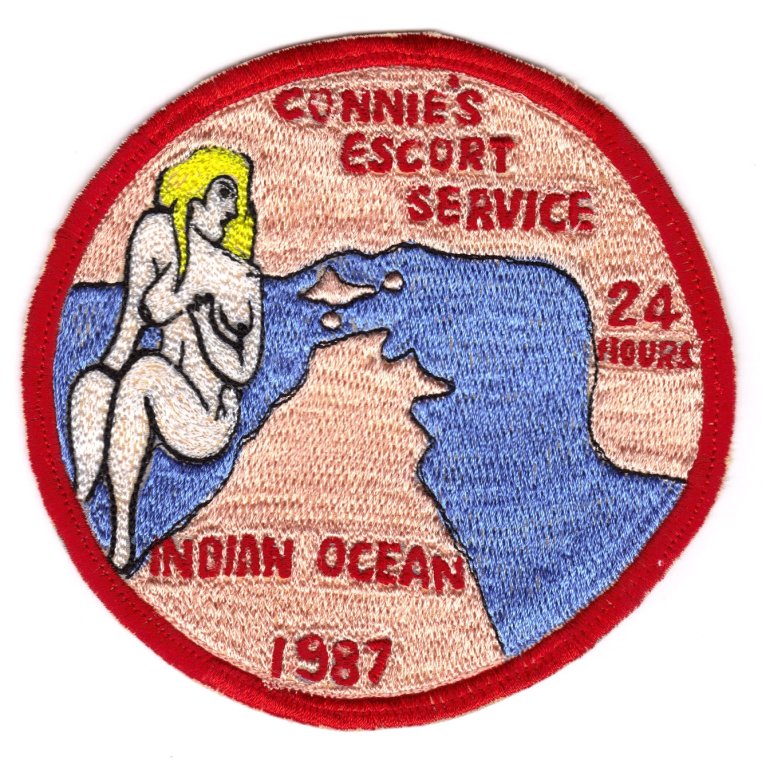
Connie’s Escort Service hard at work, 32 years ago today

In a departure from our standard Warship Wednesday format, here we see an aerial port beam view of the Kitty Hawk-class aircraft carrier USS Constellation (CV-64) in her prime as crew members form the Battle E awards for excellence on the flight deck of the ship, 1 August 1986. Among these is the Pacific Fleet Battle Efficiency Award for an 18-month period. She is pictured off the West Coast just a month before she started a short two-month NorPac cruise, Capt. Melvin David Munsinger, USN, in command.

National Archives and Records Administration photo, cataloged under the National Archives Identifier (NAID) 6429186 https://catalog.archives.gov/id/6429186

About half of her airwing is on deck, and it is a masterpiece of 1980s Red Storm Rising-style carrier warfare.

Forward you can see at least 17 F/A-18A/B Hornets from VF-A-113 and VFA-25 nestled around her starboard Sea Sparrow launcher. Next, are followed a half-dozen S-3A Vikings from VS-37, a collection of 16 KA-6D/EA-6B/A-6Es from VA-196 and VAQ-139, three E-3 Hawkeyes from VAW-113 aft her the island, along with a pair of big ole beautiful SH-3 Sea Kings from the “Eighballers” of HS-8. The huge delta-wing fighters, of course, are the F-14A Tomcats with their variable geometric wings in their closed position, from VF-21 and VF-154. All are of Carrier Air Wing 14 (CVW-14) which deployed on Connie during Vietnam as well as five times between Feb. 1985 and Oct. 1989 before chopping to USS Independence.

The above was taken the year before Connie was sent to help support Operation Earnest Will, the 14-months of nail-biting that came with escorting of re-flagged Kuwaiti tankers in the Persian Gulf as a result of Iranian attacks against international shipping with assets from the Pacific’s Third and Seventh Fleets and the Mediterranean-based Sixth Fleet. This was known by the crew as “Connie’s 24-hour Escort Service” (NSFW).

Connie was decommissioned 7 August 2003 and struck later the same year. She arrived in Brownsville on 16 January 2015 for dismantling and has been going to pieces slowly ever since.

CVW-14 was deactivated effective 31 March 2017, a process which started back in 2011.

Send it!

Recently B Squadron, 1st Armoured Regiment, of Royal Australian Army’s 1st Brigade deployed to Cultana Training Area to conduct live fire field training, where their M1A1 AIM SA Abrams main battle tanks were described as a “ruthlessly accurate platform” by the black berets.

A tank crew conducts a boresight check of its main gun. This is a key component of battle preparation to ensure the tank round hits its target.

The tank of the Officer Commanding B Squadron, 2C “Binh Ba”, engages a target in the distance.

More photos here.

SOCCOM dropping coin on lots of suppressed uppers

Earlier this year in Dallas I got a chance to put some rounds downrange with Sig Sauer’s new SUR300, a suppressed .300 BLK upper that uses a 6.75-inch barrel with a permanently attached Ti suppressor that incorporates 19 baffles. It was hearing safe without earpro (we’re talking ~120dB range), good for 400 meters due to the combined length of the barrel and baffle stack, shorter than a comparable rifle with a threaded barrel and can, and had less blowback in my face when firing.

The SUR300, (Photo: Chris Eger)

While Sig has not released the upper on the commercial market just yet that I can find, they did recently pick up a $48 million contract for SOCCOM’s long-awaited Suppressed Upper Receiver Group (SURG) program, which intends to marry a full-auto capable full-time hushed upper with standard M4A1 lowers, so you can expect lots more quiet time on the sharp end in coming years.

Of triple tails and bugeyes

Here we see the sole type of only fixed-wing aircraft ever built specifically for the U.S. Army since the Air Force was carved away to form a separate service in 1947– the humble Grumman OV-1 Mohawk, a dedicated observation, intelligence and tactical surveillance aircraft that could double in light attack roles in a pinch, replacing the old WWII-era Cessna O-1 Bird Dog “Grasshoppers” used to correct fire for field artillery units and scout just over the front line.

First flying in 1959, they were used in Vietnam and by the 1970s increasingly saw service in Army National Guard units, continuing to put in solid work right into Desert Storm.

This 70s Photo of Oregon’s Army National Guard OV-1s from the 1042nd Aviation Company in Salem flying past Mt. Hood.

Mohawk #926 flown by Curt Degner “SCAN 23” (top) leading a formation of Mohawks. The 2nd (middle) OV-1 is flown by Stephen Hammons “SCAN 21” and the 3rd (lower) OV-1 is flown by George Burns “SCAN 09” as they pass by Mt. Hood. You can just barely make out “926” on the tail of the lead Mohawk.

From a 1996 piece at Air & Space:

“It’s an unsung hero,” says Russ Wygal, a pilot with the Army’s 224th Military Intelligence Battalion at Hunter Army Airfield in Savannah, Georgia, the last stateside unit to fly the Mohawk. Wygal says that when he tells people he flew an OV-1, they often confuse it with the North American OV-10 Bronco, a twin turboprop developed specifically for counter-insurgency campaigns like the Vietnam war. “Then I have to describe what it looks like,” he says. “It’s not like an F-14 Tomcat, where everybody goes, ‘Ooo, aah, Top Gun.’”

As for Mohawk #926 in the above photo, there is a group of guys in Oregon trying to restore her.

Vale, Capt. Kaiss

Capt. Albert L. Kaiss, in effect the last dreadnought skipper in any Navy, had five afloat commands including the destroyer USS Paul F. Foster (DD-964), the cruiser USS William H. Standley (CG-32), and the battleship Missouri— the latter, twice.

Kaiss recommissioned “Mighty Mo” as her 20th skipper in 1986 then left her in the hands of Capt. James Carney as he went on to command the hospital ship USNS Mercy.

Captain (CAPT) Albert L. Kaiss, commanding officer of the battleship USS MISSOURI (BB 63), speaks during the ship’s recommissioning 10 May 1986 PH2 Michael D.P. Flynn National Archives DN-SN-86-06997

Carney later subsequently handed over command of Missouri to Capt. John Chernesky in 1988.

Kaiss returned to Missouri on 13 June 1990 and took her to war for one final time as her 23rd commander. Kaiss steamed the battleship to the Persian Gulf from the West Coast, arriving 3 January 1991, and remaining until 21 March.

“We fired 783 16-inch salvos and 28 Tomahawk missiles at the Iraqis,” said Kaiss, then 51, on the eve of her decommissioning. “I’m proud of every sailor who served with me during the Persian Gulf War. We came home with the same number of people we left with, and none of our personnel was injured,” he noted. “Now we’re part of the history of this great ship.”

Kaiss, the last sailor to leave the ship on 31 March 1992, retired alongside her a few months later, a feat which led him to be described by the U.S. Navy Memorial as the last battleship sailor.

He just recently passed on 25 July, aged 78.

Parker’s fowler, more than just a game-getter

Patriot militia Capt. John Parker stood on the Lexington Green on April 19, 1775, and met a unit of the King’s men in an engagement that produced the “Shot Heard ‘Round the World.” He was armed that day with a .64-bore French-style fowling piece, but before the day was out, courtesy of a follow-up ambush known as Parker’s Revenge, he picked up a discarded British 1756 Long Land (Brown Bess) musket to add to his collection.

How do we know for sure? Both guns are in the collection of the Massachusetts State House and were recently shown off to a group of experts very familiar with the subject.

More in my column at Guns.com

Happy 137th, Smedley

On this day in 1881 in West Chester, PA, Smedley Darlington Butler was authorized one body, human, which he used to join the Marines some 38 days before his 17th birthday during the great national crisis that was the Spanish–American War.

Some 34 years later, he retired as a full Maj. Gen (the highest rank authorised in the Corps at the time) after fighting in the Philippines, China, in Central America and the Caribbean during the “Banana Wars,” and in France during the Great War, earning not just one but two Medals of Honor.

While in the Corps “The Fighting Quaker” wrote on counter insurgency warfare which was later published along with other texts as The Small Wars Manual in 1940 and, five years before his death at the Naval Hospital in Philadelphia, penned the slightly more notorious War is a Racket.

Here is Butler’s campaign hat on display at the National Marine Corps Museum.

Of watercooled Brownings, obsolete landing guns and horse Marines

Marine Corps Photo #530953 entitled “Ready for Anything–Maneuvers outside of Peking” showing some well-outfitted Devil Dogs clad in overseas winter gear to include fur caps readying a Browning M1917 water-cooled 30.06 machine gun while sheltering in what looks like a tilled field. Although the M1919 air-cooled Browning was around, the sustained fire M1917 was a thing of beauty on the defense.

The picture is comparable to one from RN Marines from about 30 years previous:

“The New Maxim-Gun mounting field Service with the Naval Brigade in South Africa 1900.”

While the USMC photo is undated, it likely comes from the late 1920s-30s, the heydey of the famous “China Marines” which saw the whole of the 4th Marine Regiment stationed in Shanghai from March 1927 onward to augment the Legation Guard Marines from Peking and Tientsin in protecting American citizens and property in the International Settlement during outbreak of violence that came with the Chinese Revolution– and, after 1937, the Japanese invasion of China.

“Technical Sgt-USMC-1938, Mounted, by Maj. J.H. Magruder, USMCR” typical of the kit of the 4th Marines in Northern China at the time of the photo at the top of the post.

Reduced over time to just two (sometimes horse-mounted on Mongolian ponies) battalions, each with only two rifle companies of two platoons each and one machine gun company (but augmented by the only fife band in the Corps), by 1940 the Marines were the only large international force in Shanghai as the French and Brits had withdrawn due to pressing needs elsewhere.

A group of horse Marines gallops in formation in Peking, China. These Marines were members of the American Legation Guard. 1936

Horse Marine, China, circa 1913 USMC photo

One of several Mark VII 3-inch landing guns remaining in the hands of the Marine garrison in Peking in service with the 39th Company, Marine Artillery. Just 51 of these handy 1,700-pound guns were built from a German Ehrhardt design 1909-12 and were used extensively by the Marines in the Banana Wars (although not in France in the Great War). China was the last hurrah of these peculiar 3″/23 caliber field guns– and the Japanese captured six of the example in storage at Cavite in 1942.

The 4th Marines was itself pulled from China less than a month before Pearl Harbor. These hardy regulars were withdrawn to the Philippines aboard the chartered Dollar liners SS President Madison and President Harrison, where they were soon ground down against the Japanese to the point that the remnants burned their colors on Corregidor before the surrender there in 1942.

Of the 204 remaining Legation Marines and their Navy support personnel under Col. William W. Ashurst in China not directly assigned to the 4th, their own planned extraction to the PI was interrupted by Pearl Harbor and, on 8 December 1941, they were captured by overwhelming Japanese forces. The men were interned in a prisoner of war camp in Shanghai under harsh conditions until it was liberated, 19 June 1945.

« Older Entries Recent Entries »