Monthly Archives: March 2018

Warship Wednesday, March 21, 2018: After 75 years, take a breather

Here at LSOZI, we are going to take off every Wednesday for a look at the old steam/diesel navies of the 1859-1946 time period and will profile a different ship each week. These ships have a life, a tale all of their own, which sometimes takes them to the strangest places. – Christopher Eger

0616902
Here we see the Cannon-class destroyer escort USS Atherton (DE 169) in a shot taken from a US Navy Blimp as the two team up to sink U-boats in the Atlantic in 1945.

The class, ordered in 1942 to help stem the tide of the terrible U-boat menace in the Atlantic, was also known as the DET type from their Diesel Electric Tandem drive. The DET’s substitution for a turbo-electric propulsion plant was the primary difference with the predecessor Buckley (“TE”) class. The DET was in turn replaced with a direct drive diesel plant to yield the design of the successor Edsall (“FMR”) class In all, although 116 Cannon-class destroyer escorts were planned, *only* 72 were completed. Some of her more famous sisters included the USS Eldridge, the ship claimed to be a part of the infamous Philadelphia Experiment.

Named for contemporary naval hero Lt (JG) John McDougal Atherton, lost on the destroyer USS Meredith (DD-434) when she was jumped by planes from Zuikaku, our hearty destroyer escort was built at Federal Shipbuilding and Drydock Company, Newark, New Jersey, and commissioned at the height of the battle of the Atlantic on 29 August 1943. This hearty little 1600-ton boat, just a hair over 300-feet long was packed with guns, torpedoes, Hedgehog ASW mortars, depth charge racks, and projectors.

By January 1944, she was prowling the Atlantic as part of TF60, escorting convoys from Norfolk and New York City to various ports in the Mediterranean. As noted by DANFs, these ports included Casablanca, Morocco; Bizerte, Tunisia; and Oran, Algeria.

On 6 May 1945, she counted coup on the German submarine U-853 (Oblt. Helmut Frömsdorf and 54 hands) and was given credit for her sinking. She sent her to the bottom 7 miles east of Block Island, Rhode Island, resulting in the loss of her entire crew.

“After four depth charge attacks, pieces of broken wood, cork, mattresses, and an oil slick broke the surface. Atherton, in conjunction with Moberly (PF-63), was later credited with destroying the German submarine U-853,” said DANFS.

USS Moberly conducts a Hedgehog attack on U-853, USS Atherton in distance. HH-NH48872

U-853M-26G2451

The encounter was the day before Generalfeldmarschall Wilhelm Keitel signed the Allied surrender terms, in Berlin, but U-853, a Type IXC/40 submarine, showed no signs of surrendering– she sank the SS Black Point, a small collier out of Boston, just the day before Atherton found her.

According to NHHC, U-853 was one of the final half-dozen German subs sent to the bottom in combat, with three others (U-1008, U-2534, and U-881) being scratched the same day and U-320 meeting Davy Jones on 7 May.
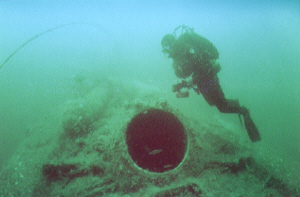
Today the U853 is a popular dive, lying in just 120 feet of water 11 miles off the US East Coast. You can thank the USS Atherton for putting her there.

Today the U853 is a popular dive, lying in just 120 feet of water 11 miles off the US East Coast. You can thank the USS Atherton for putting her there.

The action contributed to Atherton winning her sole battlestar for Atlantic Action in WWII.

Post-VE-Day, she immediately sailed for the Pacific and conducted anti-sub patrols there for a few more months before the Japanese surrendered. The plucky destroyer escort was decommissioned 10 December 1945 and placed in reserve status for 10 years before she got on with her life.

On 14 June 1955, Atherton was transferred to the Japan Maritime Self-Defense Force (JMSDF), becoming one of the first ships of the new Japanese Navy, operating as the destroyer escort JDS Hatsuhi (DE-263, later FF-6) though this is sometimes spelled “Atsuhi” is western sources.

She put in a solid 20 years with the Japanese.

Japanese frigate Atsuhi, commissioned as USS ATHERTON (DE-169). Turned over to JMSDF, 14 June 1955. Paid off June 1975. Transferred to the Philippines, 13 September 1976. NH 46122

DE 263 JDS Hatsuhi – Japan Maritime Self defense Force (1955-75)

NH 46123, Japanese frigate Atsuhi, FF-6

The Japanese returned the then 30-plus-year-old Atherton and her sister-ship, the former USS Amick (DE-168), to the US Navy in 1977. Then, the vintage tin cans began a third career as a Barko ng Republika ng Pilipinas (BRP) naval vessel.

Following a refit in South Korea paid for in part by Washington, the two joined the Philippine Navy 27 February 1980. At the time the island nation was already operating another Cannon-class warship– the former USS Booth (DE-170). The deal also saw Manila buy the condemened sister ships former USS Muir (DE-770) and USS Sutton (DE-771) from the Koreans for a token fee. These two ships were so old and worn out that they were acquired simply with the intention to be cannibalized for spare parts to keep the Atherton, Boothe, and Amick running.

Well, in 1981, Booth (as BRP Datu Kalantiaw PS-76) was sunk during a typhoon, leaving just two DEs in the PI.

The former USS Boothe hard aground after a typhoon in 1981. This left the PI Navy with but two destroyer escorts...

The former USS Boothe hard aground after a typhoon in 1981. This left the PI Navy with but two destroyer escorts…Atherton and Amick

Then Amick, thoroughly worn-out (as BRP Datu Sikatuna PF-5) was scrapped in 1989.

This left Atherton (as BRP Rajah Humabon PF-11), as the only real blue-water warship left in the Philippine Navy. Other than a three-year local refit/lay-up from 1993-1996, this humble 300-foot ship held the line for over two decades.

SOUTH CHINA SEA (April 21, 2009) - Philippine Navy ship BRP Rajah Humabon (PF 11) steams ahead during an exercise with the forward-deployed amphibious assault ship USS Essex (LHD 2) and the amphibious dock landing ship USS Tortuga (LSD 46), as part of exercise Balikatan 2009 (BK09). Essex has been invited by the Republic of the Philippines to participate in BK09, which is an annual combined, joint-bilateral exercise involving U.S. and Armed Forces of the Philippines personnel, as well as subject matter experts from Philippine civil defense agencies. BK09 is the 25th in the series of these exercises, directed by the Joint Chiefs of Staff and requested by the government of the Republic of the Philippines. Essex is commanded by Capt. Brent Canady and is the lead ship of the only forward-deployed U.S. Amphibious Ready Group and serves as the flagship for CTF 76, the Navy's only forward-deployed amphibious force commander. Task Force 76 is headquartered at White Beach Naval Facility, Okinawa, Japan, with a detachment in Sasebo, Japan. (U.S. Navy photo by Mass Communication Specialist 2nd Class Greg Johnson/Released)........Other than the dazzle paint and some commercial navigational radar, she is the same as pictured above in 1945.

SOUTH CHINA SEA (April 21, 2009) – Philippine Navy ship BRP Rajah Humabon (PF 11) steams ahead during an exercise with the forward-deployed amphibious assault ship USS Essex (LHD 2) and the amphibious dock landing ship USS Tortuga (LSD 46), as part of exercise Balikatan 2009 (BK09). (U.S. Navy photo by Mass Communication Specialist 2nd Class Greg Johnson/Released)……..Other than the dazzle paint and some commercial navigational radar, she is the same as pictured above in 1945.

In 2011, the 44-year old USCGC Hamilton (WHEC-715), was transferred to the Philipines by the US State Department and renamed BRP Gregorio del Pilar (PF-15), giving the Atherton her first back up in over 20 years. Another “378” the USCGC Dallas (WHEC-716), was transferred in 2013 as the BRP Ramon Alcaraz (PF-16). A third, ex-USCGC Boutwell (WHEC-719), followed as BRP Andres Bonifacio (FF 17) in 2016.

Today the larger, younger and better equipped Hamilton/Pilar, Dallas/Alcaraz and Boutwell/Bonifacio undertake most blue water missions while the old USS Atherton/JDS Hatsuhi/BRP Rajah Humabon, at a spry 70-years of age, was still considered in active, albeit limited commission, armed, and ready to respond if needed– up until last week.

BRP Rajah Humabon (PS-78)

As such, she was only one of just three ships to still carry working 3-inch Mk22 guns (the other two being a Brazilian river monitor and a Thai sister ship) as well as the last warship in the world to carry the old Oerlikon 20mm in active service. Besides the museum ship USS Slater (DE-766), now sitting dockside in Albany New York, and the pierside training ship USS Hemminger (DE-746) (now HTMS Pin Klao DE-1) in Thailand, Atherton is the last destroyer escort afloat in the world, and the only one since 1992 still in regular naval service.

However, all good things must eventually come to an end, and as noted by the Philippine Navy on 15 March 2018:

“After 38 years of service, the Philippine Navy (PN) has formally retired its oldest warship, the BRP Rajah Humabon (PS-11), one of the last World War II-era warships still in active service, during short ceremonies in Sangley Point, Cavite Thursday morning,” said Philippine Fleet spokesperson Lt. Sahirul Taib in a message Thursday.

The retirement of BRP Rajah Humabon is in-line with the Navy’s Strategic Sail Plan of “moving to legacy vessels to more and capable and modern vessels,” he added.

She will be preserved, turned into one of the exhibits at the Philippine Navy (PN) Museum in Sangley Point, Cavite City. Taib said in a subsequent interview that turning the ship into an exhibit would happen shortly after it is stripped of its navigational equipment and other usable items.

Here in the states, Atherton is remembered by a veterans’ group and has a memorial on display aboard the USS Slater (DE-766) Museum. While a number of scale models are availble to celebrate the class, some of which specifically include Atherton in her Japanese scheme.

Not bad for a ship, class, and type that was considered disposable.

Specs:

Cannon class DE’s via USS Slater.com

Displacement: 1,240 tons standard
1,620 tons full load
Length: 93.3 metres (306.1 ft)
Beam: 11 metres (36.1 ft)
Draft: 3.5 metres (11.5 ft) full load
Propulsion: 4 GM Mod. 16-278A diesel engines with electric drive
4.5 MW (6000 shp), 2 screws
Speed: 21 knots
Range: 10,800 nmi at 12 knots (22 km/h)
Complement: 15 officers 201 enlisted men
Armament: • 3 × single Mk.22 3″/50 caliber guns
• 3 × twin 40 mm Mk.1 AA gun
• 8 × 20 mm Mk.4 AA guns
• 3 × 21 in (533 mm) torpedo tubes
• 1 × Hedgehog Mk.10 anti-submarine mortar (144 rounds)
• 8 × Mk.6 depth charge projectors
• 2 × Mk.9 depth charge tracks

If you liked this column, please consider joining the International Naval Research Organization (INRO), Publishers of Warship International

They are possibly one of the best sources of naval study, images, and fellowship you can find. http://www.warship.org/membership.htm

The International Naval Research Organization is a non-profit corporation dedicated to the encouragement of the study of naval vessels and their histories, principally in the era of iron and steel warships (about 1860 to date). Its purpose is to provide information and a means of contact for those interested in warships.

With more than 50 years of scholarship, Warship International, the written tome of the INRO has published hundreds of articles, most of which are unique in their sweep and subject.

PRINT still has it place. If you LOVE warships you should belong.

I’m a member, so should you be!

Czech Cobra

A Cold War-era Czechoslovak soldier in class Pattern 1963 Tonak,závod Nasavrky rain camo along with a sense of humor:

Dig the Vz. 58 (V) side folder, tho

Also, this is why safety briefs exist.

You call that a tank? That’s a tank (or 3)

Via The Tank Museum:

A line-up of three generations of Australian tanks.

The Matilda in the middle is the oldest. It was first acquired by Australia in 1942 and used against the Japanese in New Guinea and Borneo until the end of the Second World War. Heavily armored, they were very popular. The last Matildas were retired in 1955.

On the left is the Centurion Mark 5/1. These saw service in Vietnam, where they proved highly effective and resilient. Unlike most users, the Australians kept the 20 Pounder gun throughout its life. 117 gun tanks were bought, with the first arriving in 1952.

On the right is the Leopard AS1, new to the Australian Army at the time this photograph was taken. The first arrived in 1976 and a total of 90 were bought. They were painted green all over – the brown color is mud!

If only they had some Bren carriers, Ford Scout Cars, M3 Grant medium and M3 Stuart light tanks to go with it, then they could cover the old school early WWII Australian Armoured Corps as well!

Australian soldiers move through the jungle of Papua New Guinea with their M3 Stuart tanks

Happy first day of Spring

The cherry blossoms always make me swell with joy this time of year– especially after a dark winter.

“In the cherry blossom’s shade
there’s no such thing
as a stranger.”
Kobayashi Issa

Here we have a Japan Ground Self-Defense Force Type 74 (nana-yon-shiki-sensha) main battle tank under cherry blossoms somewhere in Japan.

Designed in the late 1960s as a contemporary of the U.S. M60 and the Soviet T-62/64, about 900 Type 74s were built by Mitsubishi Heavy Industries as a replacement for Japan’s first indigenous Post-WWII tank, the Type 61, which is turn was a very M46 Patton-like design that mounted a 90mm popgun.

If it looks familiar, the Type 74 uses the hull of the German Leopard I– though with different suspension and a 10cyl MHI diesel– and equipped with a licensed Royal Ordnance L7 105mm cannon with a number of local improvements.

They have largely been relegated to second-line service since the 1990s when the very Leopard 2-ish Type 90 Kyū-maru MBT went into production and in the end will be replaced as the new Type 10 MBT, complete with a 120mm gun and nano-crystal steel modular ceramic composite armor, is fielded in greater numbers.

Though a dated design for sure, about 250 updated Type 74s remain in service and, due to the current Japanese constitution, will likely never deploy outside of the Home Islands. As such they should prove a good enough deterrent for Godzilla.


The proud seventy-three of the 39th Combat Diver Course

The Singapore Armed Forces (SAF) has a number of specialized frogmen units including combat swimmer detachments of the Special Operations Force and the Naval Diving Unit (NDU), dating back to 1971. To become an elite amphibious warrior takes over 20 weeks of training.

The above video shows RADM Tan Wee Beng, Chief of Staff – Naval Staff, inspecting the 39th Combat Diver Course last week.

As noted by LTC Sng Meng Wah, Commanding Officer, Dive School, Naval Diving Unit the Republic of Singapore Navy:

“It has been a tough 6 months for these trainees to transform from civilians to Naval Divers following their enlistment into Naval Diving Unit in March this year. They have learned not just to dive with SCUBA and Closed Circuit Re-breathers, but in the process, have also grown physically stronger and mentally tougher in preparation for them to work in the harsh environment we divers work in.

This underwater parade signifies the start of their journey as a Naval Diver and showcases to their parents the diving abilities that each and every one of these divers have learned over the course of their training in Dive school. I wish them all the best when they proceed to serve their National Service in the various operational units in NDU.”

A peek into how the unit is crafted below

The Anderson ‘Patton’ knives of WWII

Via USMC Museum

Via the National Museum of the Marine Corps: In the early days of WWII, supplying the rapidly expanding American military was an extreme challenge. As knives were scarce, an enterprising knife manufacturer in Glendale, CA bought a stock of M1913 Cavalry Sabers to construct them into something usable that he could sell to deploying troops.

Knives of this type were created from surplus M1913 Cavalry sabers by the Anderson Company in California.

The company cut the long straight blade into three pieces, honed a point of the blades, and made a handle out of molded plastic. The owner of this knife personalized with “USMC” burned into one side of the gray plastic handle and “Robert Ames” on the other. GySgt. Robert Ames, serving with the 5th Marine Division, carried this knife on Iwo Jima, where he was wounded by shrapnel on the second day of combat.

Andersons are pretty popular in the militaria collecting community.

Hand-made Anderson fighting knife, made from the ricasso portion of a 1913-1919 dated Springfield Armory and LF&C Patton Saber blade. cut these blades into three separate pieces and re-shaped the points, and then made cast plastic handles. They run upwards of $300 on the collectors market, with twice that paid for nice examples.

Is that a Swiss M49? Well, actually it’s a P210 by way of New Hampshire, but sill…

The new, U.S.-made P210. Previously imported versions were made by Sig in Eckernförde‎, Germany. These are made in Exeter, NH and just started shipping (Photo: SIG)

The long-teased domestically produced version of Sig’s classic Swiss military service pistol is ready for the market and chock full of features.

Designed as the Swiss Army’s Pistole 49 just after WWII, the Sig P210 has been a hot commodity in Europe for generations and has more recently been embraced on this side of the pond — though supply was far less than demand.

The Pistole Modell 1949 in Swiss military service– note the rack numbers. The Swiss Army and gendarme still use the weapon though it is rapidly being replaced by Glock 17s. Ex-military guns are common in the Cantons as officers can purchase their sidearms on the conclusion of their military service for a negligible fee.

The new P210 Target, made here is the states, has made quiet appearances at trade shows for the past couple of years but Sig says the gun is now shipping. Best yet, the new offering has updated ergonomics via custom walnut grips and an adjustable lightweight target trigger while keeping the styling and tolerances of the M/49 intact.

More in my column at Guns.com.

‘Old Man knives’

Increasingly, I admit being drawn to the appreciated beauty and functionality of old-school jackknives. The aesthetic reminds me of the old Barlow knife I used to carry as a kid, a gift from my grandpa in the 1970s, as well as his old Case knives.

Here are a couple of recent additions to my collection.

The new production knife is a U.S-made Great Eastern Northfield Un-X-LD – #78 American Jack. Overall length is 6.5-inches open, with a 2.8-inch 1095 carbon steel plain spear point single blade. The scales are golden brown jigged bone. Made in Titusville, PA, something like 200 hand processes go into each knife and you can tell.

These damned things are almost impossible to get with an “I know a guy” underground purchase system in place for some of the more rare Great Easterns.

The older specimen is an Imperial USA “Jumbo-Jack” knife, 4-inches closed length. It has imitation stag handles and is two carbon blades (3-inch and 2-inch) with brass liners.

This example was well made in Providence, RI in 1959 and you can really feel the pride in this blade, even though it was a “cheap” knife at the time. Price, if bought by the dozen retail back then, was $1.25 a pop, or about $11 in today’s money. You couldn’t make one of these today in the U.S. for that amount of script.

Either way, they pair nicely with some of the other vintage, but still very useful, parts of my collection.

Plum Duff flotsam

Here we see the SAS beret, stable belt, medals, wings and rank slides belonging to Captain Andy Legg (22 SAS) which will be going up for auction with Woolley & Wallis on May 3rd, 2018.

Captain Legg, as a young lieutenant, commanded the SAS team that was inserted onto the Argentinian mainland to gather intelligence about the enemy airbase at Rio Grande on Tierra del Fuego with an aim to destroy the Argentine Armada’s sole Exocet-carrying Super Étendard squadron on the ground in an echo to the SAS’s WWII North African lineage destroying Luftwaffe bases supporting Rommel’s Afrika Korps.

The recon mission, with 8 SAS commandos inserted by helicopter from the Harrier carrier HMS Invincible, was termed Operation Plum Duff. The plan was part of the larger Operation Mikado which would have seen nearly a quarter of the entire SAS– the 55 men of B Squadron– land directly on the runway Entebbe-style and exfil towards Chile afterward. While Plum Duff was a disaster and Mikado itself was scrubbed as a suicide mission, the event did tie down four battalions of elite Argentine Marines, arguably the best troops in their whole military, and they were sorely missed in the Falklands.

The estimate for the Legg collection is £40 000.

A Magach sentry

Here we see, via DimaWa, a gently-used Israeli Defence Forces Magach 3 tank somewhere in the Golan Heights, where it has been since the Yom Kippur War in 1973.

The IDF inherited something like 500 surplus M48s from West Germany, the U.S. and Jordan (the latter as recycled battlefield trophies in 1967) and gave them a series of Magach (Hebrew = “ramming hit”) that have them a newer gun (the M68 105mm L7), a new 750 hp diesel and a number of other internal upgrades to the gunnery and commo system to make them closer to the M60.

The IDF kept variously upgraded M48s in their armored units through the 1990s.

« Older Entries Recent Entries »