Category Archives: pirate

Flattop Collection

121912-N-TB177-760

NORFOLK (Dec. 19, 2012) The Nimitz-class aircraft carrier USS Dwight D. Eisenhower (CVN 69) arrives at Naval Station Norfolk after a six-month deployment to the U.S. 5th and 6th Fleet areas of responsibility supporting Operation Enduring Freedom, maritime security operations and theater security cooperation efforts. (U.S. Navy photo by Mass Communication Specialist 3rd Class Kevin J. Steinberg/Released).

I always had a soft spot for the Ike and featured her in a cameo in my zombie novels Last Stand on Zombie Island and the upcoming Pirates of the Zombie Coast.

Whats massively impressive about this picture is all the flatops tied up waiting for Ike. From left to right you see a unidentified Nimitz class (possibly the Theodore Roosevelt or the George Bush), then the recently decommisoned USS Enterprise CVN-65 with her stern facing the camera. On the pier opposite of The Big E is the USS Bataan (LHD-5). At the far right are the USS Harry S. Truman (CVN-75) bow on and the USS Abraham Lincoln (CVN-72) stern on.

That’s six flat-tops weighing in at about 550,000 tons of warships. This is likely more than the entire rest of the world’s carriers combined. Granted the Big E is decommed and pending scrapping, and the Bataan is a gator rather than a ‘real’ aircraft carrier, but still..impressive.

Famous Tall Ship Bounty in Distress in Hurricane Sandy

Just got this from USCG PAO

Coast Guard responds to vessel in distress 160 miles from hurricane’s center
PORTSMOUTH, Va. — The Coast Guard is responding to a distressed vessel with 17 people aboard approximately 90 miles southeast of Hatteras N.C., Monday.

Coast Guard Sector North Carolina received a call from the owner of the 180-foot, three mast tall ship, HMS Bounty, saying she had lost communication with the vessel’s crew late Sunday evening.

The Coast Guard 5th District command center in Portsmouth subsequently received a signal from the emergency position indicating radio beacon registered to the Bounty, confirming the distress and position.

An air crew from Coast Guard Air Station Elizabeth City launched aboard an HC-130 Hercules aircraft, which later arrived on scene and reestablished communications with the Bounty’s crew.

The vessel is reportedly taking on water and is without propulsion. The Coast Guard is continuing to monitor the Bounty’s situation.

On scene weather is reported to be 40 mph winds and 18-foot seas.  The vessel is approximately 160 miles west of the eye of hurricane Sandy.
###
Date: Oct 29, 2012
Contact: 5th District Public Affairs
Office: (757) 398-6272
________________________________________

From the TallshipBounty website:

“The HMS Bounty is one of the most famous ships in the world. Known for the storied mutiny that took place in Tahiti in 1789 on board the British transport vessel, the current Bounty, a replica, has survived to tell the tale. Built for the 1962 movie “Mutiny on the Bounty” with Marlon Brando, HMS Bounty sails the country offering dockside tours in which one can learn about the history and details of sailing vessels from a lost and romanticized time in maritime history. Since her debut in “Mutiny on the Bounty”, HMS Bounty has appeared in many documentaries and featured films such as the Edinburgh Trader in Pirates of the Caribbean Dead Mans Chest with Johnny Depp. “

Ted Turner owned the ship from 1986-1993 and used it to film Treasure Island. It has been for sale since 2010 for $4-million

The ship, callsign WDD9114, last reported at Position N 34°22′ W 074°15′.

She is 500 Tons, 180′ OAL, has a 115′ mainmast, carries 18 sails for 10,000 sq ft of canvas, is constructed of 400,000 board-feet of timber in 1960-1961 at Smith & Rhuland Shipyard in Lunenberg, Nova Scotia. A pair of 375 hp John Deere diesels turn twin screw for auxiliary propulsion and she carried four 4-pounder carriage guns.

Hopefully this will all work out.

The latest USCG update say that the ship has been abandoned by the crew.

The DHS Does OPFOR Submarine Ops…

http://www.dhs.gov/st-snapshot-pluto

Ever Heard of Pluto?

Homeland Security’s ‘narco sub’ PLUTO mimics the real thing

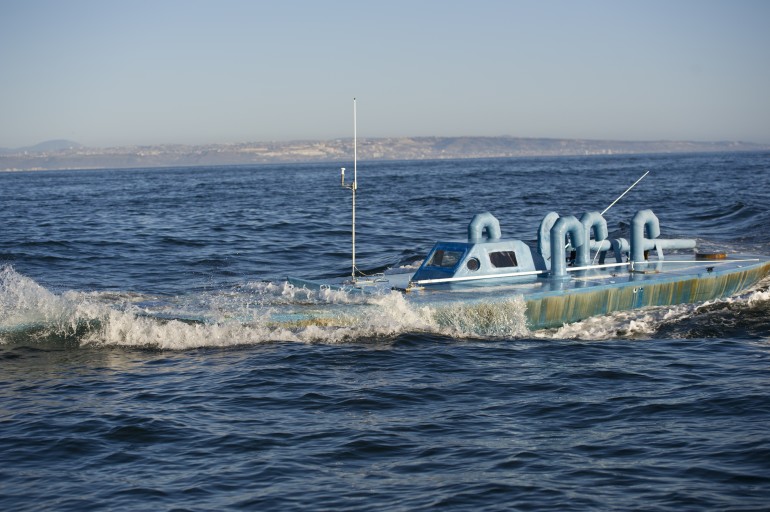
PLUTO seen during tests in San Diego, CA…..If you live around Destin, you may have bumped into it…

Surrogate semi-submersible engineered to mimic the design of the “dark vessels” being used
to bring narcotics and other illicit cargo into the United States. With low profiles and low radar reflectivity, stealthy, drug-running semi-submersibles, “narco subs,” built in southern jungles cut through the ocean at wave height and are nearly impossible to detect.  DHS’ semi-submersible mimics them so that  a variety of sensors can be tested  in the battle  against illegal drug-running.

The erstwhile planet Pluto (now officially an asteroid) was known for decades as a small, dark planet—hidden, difficult to spot, and on a quiet, determined course all its own.  And so, when the DHS Science and Technology Directorate (S&T) needed a target semi-submersible to detect the hidden but determined maritime smuggling operations of the South American drug cartels, it created its own vessel and called it “PLUTO,” after the planet that is so difficult to spot.  S&T’s PLUTO is a small, semi-submersible that is representative of what are popularly called “narco subs,” and serves as a realistic practice target for the detection systems of DHS and its national security community partners.

In the early 90’s, South American drug cartels came up with a new tactic to transport narcotics destined for the United States: small, radar-dodging, self-propelled, semi-submersibles (SPSSs).  Although clandestine semi-submersibles were rumored to exist in the mid-1990s, many believed them to be a myth, hence their name Bigfoots.  Then in 2006, an actual Colombian semi-submersible was captured by the U.S. Coast Guard in the Eastern Pacific Ocean.  Today, drug cartels continue to build their “narco subs.”  With low profiles and low radar reflectivity, these illegal, stealthy, drug-running semi-submersibles cut through the water at wave height and are nearly impossible to detect.

S&T built PLUTO in 2008 to serve as a surrogate SPSS with many of the same features as the vessels built by the cartels.  It is used as a target by DHS and its national security community partners to help test the performance of detection systems and give operators of those systems real world experience under controlled conditions.  This testing helps develop new concepts of operation for seaborne, airborne, and space-borne technologies to spot illegal vessels.

“Small surface vessels, self-propelled semi-submersibles, and now the most recent innovation of fully submerged vessels (FSVs), pose significant challenges to maritime security,” says Tom Tomaiko of S&T’s Borders and Maritime Security Division.  “While some small boats sitting low in the water have legitimate purposes, there are many that are used for illicit purposes.

Dozens of these boats have been captured by the U.S. and partner nation law enforcement agencies in the last few years, sometimes with their cargo still on board, sometimes after it has been thrown overboard.  “When the crews become aware they’ve been spotted, they will typically scuttle the boat immediately, knowing they’ll be rescued by us anyway,” says Tomaiko.

Meanwhile, cramped living conditions within the illegal SSPSs can be horrendous.  There is generally only 3” of space above the waterline, meaning the ride can be very rough.  The small crews of 3 or 4 have little to eat, poor air quality, no toilet facilities, operate with little rest until they reach their destination, and are sometimes watched over by an armed guard.

If the mission is undetected and the drugs successfully delivered, the vessel is typically scuttled and not reused.  “Drug-running is lucrative.  It is cheaper to simply build another vessel than to run the risk of trying to get a vessel and its crew home,” says Tomaiko.

In a typical operation, PLUTO will operate at SPSS cruising speeds of 4 to 8 knots while remote sensor platforms from sea to space attempt to detect and track it at various distances and observation angles.

S&T’s PLUTO is home-ported at Eglin Air Force Base, near Fort Walton Beach, Florida, and is maintained by the Air Force’s 46th Test Squadron.  Various civilian and military
agencies, including the U.S. Coast Guard, Customs and Border Protection/Air and Marine (CBP/OAM), U.S. Navy, U.S. Air Force, and other national agencies have tested their remote sensing capabilities against PLUTO in the Gulf of Mexico, the Atlantic, and the Pacific.

In 2009, Customs and Border Protection tested its Dash 8 maritime surveillance aircraft against PLUTO at the Eglin range and near Key West, Florida.These results helped gauge the performance of the Dash 8’s SeaVue radar against PLUTO and helped determine detection distances and aspect angles for optimal mission performance. In addition, the U.S. Navy tested one of its P-3 aircraft equipped with maritime surveillance radar system against PLUTO.All such tests were instrumental in helping to verify the performance of sensor capabilities, and provided operators with real-world training which will help determine future tactics.

PLUTO is just over 45 feet long, can run roughly 10 knots at maximum speed and can hold a crew of 3 to 4, although it usually operates with only one for safety reasons.  It has VHF and HF radios, and the 46th Test Squadron can install other types of radios and maritime automated identification system (AIS) equipment to meet testing or safety requirements.  Conditions onboard, however, were primarily influenced by the need for crew safety, so PLUTO’s design does not exactly mimic that of illegal SSPSs.

Technical capabilities such as PLUTO are necessary to counter and stay ahead of threats to the country.  Admiral James Stavridis, former Joint Commander for all US forces in the Caribbean, Central and South America, wrote, “Criminals are never going to wait for law enforcement to catch up.  They are always extending the boundaries of imagination, and likewise, we must strive to push forward technology and invest in systems designed specifically to counter the semi-submersible.  We need to be able to rapidly detect and interdict this new type of threat, both for its current effects via the drug trade, and – more troublingly – for its potential as a weapon in the hands of terrorists.”

North Sea Boats Launch New 63m Stealth Fast Missile Patrol Vessel for Indonesian Navy

Not much information other than its all carbon fiber, 62.5m (205-feet long) appears to have a heli deck (?), and is minimally manned. Looks like a mini LCS to me. Good luck with that.

http://northseaboats.com/news/wp-content/uploads/2012/08/Press_Invitation_-_KCR_Trimaran_Launching_-_24_Aug_2012.pdf

Royal Navy Looking for a Swan

The Royal Navy, seeing its numbers of surface combatants shrinking every day, has gone looking for a Swan.

During WWII, with hundreds of U-Boats chilling in the Atlantic and North Sea, they ran a series of what they called Sloops (referred to as destroyer escorts/corvettes in the US.) In the vein of quantity has a quality all its own, they operated in squadrons. Even of a wolf pack or surface raider picked off one or two, the other half dozen boats would survive to avenge their death.

These were the Black Swan class

Dimensions: Length – 299.5 feet (91.29m); Width – 37.5 feet (38.5 feet Modified) (11.43m(11,73m); Draught – 12 feet (3.5m); Displacement – 1,300 tons standard, 1770-1945 tons deep load; Modified- 1,350-1,490 tons standard; 1,880-1,950 tons deep load
Armament – Six 4-Inch/45 QF Mk XVI HA DP; Four 2pdr pompoms; Later 4-8 20mm Oerlikon 20mm AA guns; Later four 40mm Bofors AA guns; ASW fit increased during war, including addition to Hedgehogs in certain ships.
Machinery – Two shaft Parsons Geared Turbines; Two Admiralty 3-drum boilers; 4,300 shp; 19.75 knots maximum speed: Complement – 180


The 2012-Black Swan is the same concept.

The new paper that MOD has released is full of information.

They are to be built to commercial standards (SOLAS) which means they can survive minor collisions at sea and soft beach groundings with possible economic repair but not torpedoes, mines, or anti-ship missiles/naval gunfire. The paper mentions that they will have ” survivability through platform numbers” and the concept is that for Sea Control missions they would operate in squadrons of 4-6 ships commanded overall by a O-5 level officer.

Note the huge helicopter deck with a Merlin mock up. It borders on being able to operate a CH53-sized aircraft

Main Dimensions
Length overall 95.00m
Length (WL) 90m
Breadth (WL) 15.50m
Depth moulded 11.60m
Draft 4m

Tank capacities
Fuel oil 390 tonnes
Fresh water 24 tonnes
Additional fuel for Unmanned Systems 94 tonnes

Main Machinery
Speed and Range Generators 2 x Wartsila 8L201
1 x Wartsila 12V26

Top speed 18 knots
Range 10,000nm at 12kts
Propulsion 2 x 2MW disel electric motors
Deadweight and Draught
Deep Displacement 3150 tonne

Weapons (Fixed)
1 x 30mm gun
2 x GPMG2 x miniguns
Possible directed energy weapons/LRADs
Additional weapon systems could be carried in the mission bay, hangar or upper deck module positions. The ship will be able to re-role independently using a logistic supply system involving ISO-containerized mission modules and on board cranage.ISO containerized missile modules could be fitted on the upper deck with long-range land, air and surface capability. ISO containerized sensors such as towed array could also be included.

Basic complement
8 plus 32 mission
planners for total of 40 (HMS ASTUTE
standard) inside the CBRN citadel.

If you can operate 8 large rotary wing UAV’s like Firescout from one of these close to shore, that is littoral warfare!

Helicopter Accommodation
Flight deck Chinook ramp down
Hangar Merlin + 1 rotary wing UAV
Can operate as many as 8 Bell 206/Hughes 500 sized aircraft at once (OH-58/OH-6) if needed. This is thought to include large UAVs such as the USN’s Firescout.

A look at the mission bay

20-foot ISO container accommodation for at least 20 In mission bay
Total mission payload 400 tonnes.

It actually looks interesting and small navies as well as large ones (USN LCS ‘lite’/USCG OPC) may look towards it.

Private Navy Being Built to Take out Pirates

http://www.informationdissemination.net/2012/05/insurance-company-funded-private-navy.html#disqus_thread

Many ships that sail in Pirate waters have been making do with scarecrows to ward off gunmen….maybe a couple hardlegs with battlerifles can do a little more.

Private Navy’s to fight pirates are coming, and we are starting to see more details.

A private navy costing US$70 million (Dh257m) is being set up to escort merchant ships through the pirate-infested Gulf of Aden.

It will comprise a fleet of 18 ships, based in Djibouti, and will offer to convoy merchant vessels along the Internationally Recognised Transit Corridor (IRTC).

This is the world’s most dangerous shipping lane, between the Red Sea and the Arabian Sea. The fleet will be operated by the Convoy Escort Programme (CEP), a British company launched by the international shipping insurers Jardine Lloyd Thompson (JLT) and the Lloyds of London underwriters Ascot.

Full funding will be in place by the end of next month, and the CEP hopes the fleet will be operational by December.

“The shipping industry needs to stand up and be counted,” said Angus Campbell, the CEP’s chief executive and a former director of Overseas Shipholding Group, the world’s second-biggest listed oil tanker company. “The time is now, not in four or five years’ time.”

Piracy in the region is costing the global economy an estimated US$7 billion a year. For the ship owners alone, every vessel sailing through the waters off Somalia is charged additional insurance premiums of between $50,000 and $80,000.

Ships opting to carry their own armed guards can be charged an additional $18,000 and $60,000 per voyage by security companies.

Although the European Union is spending more than €8m (Dh37.94m) a year to maintain a naval force in the waters – EU NavFor – its warships still cannot provide close support to all merchant vessels.

I Dont want to meet what took this bite

This 11-foot long shark was attacked on the line.…look at the bite radius…..Now thats why they make spear guns! (And depth charges…nuclear ones)

Great White Shark attacked

First 154-foot Cutters in service

The first of upto 58 Fast Response Cutters, the USCGC Cutter Bernard C Webber,  for the US Coast Guard was commissioned this week.

The craft, at $88-mill per, will replace the 1980s era 110-foot Island Class cutters from Iraq to Alaska.

Displacement:     353 long tons
Length:     46.8 m (154 ft)
Beam:     8.11 m (26.6 ft)
Depth:     2.9 m (9.5 ft)
Propulsion:     2 x 4,300 kilowatts (5,800 shp)
1 x 75 kilowatts (101 shp) bow thruster
Speed:     28 knots (52 km/h; 32 mph)
Endurance:     5 days, 2,500 nautical miles (4,600 km; 2,900 mi)
Designed to be on patrol 2,500 hours per year
Boats and landing
craft carried:     1 x Short Range Prosecutor RHIB
Complement:     2 officers, 20 crew
Sensors and
processing systems:     L-3 C4ISR suite
Armament:     1 x Mk 38 Mod 2 25 mm automatic gun
4 x crew-served Browning M2 machine guns

It is sure that the Coast Guard ordered these after several years of using loaned 170-foot Cyclone class Patrol Boats from the Navy.

You can expect these to be showing up anywhere the Navy has littoral issues over the next few decades. Of course they will probably be upgunned (110-foot cutters in the Perisan Gulf carried as many as six M2s and a Mk19 Grenade Launcher in addition to their 25mm hood ornament) when on navy duty in brown water.

They could also be used in the waters of East Africa against pirates and the warm Caribbean waters chasing down narcosubs.

PMCs Vs Somali Pirates

http://www.liveleak.com/e/5e2_1333668975


Not a lot of background info here. Is being purported to be a group of Private Military Contractors aboard an unidentified merchant vessel off the Somali Coast. At about 40 seconds into the video you see a small fast boat approach danger close and attempt to board or at least menace the much larger merchie. A team of 2-4 PMCs armed with semi-automatic AR-15 platforms engage the small boat extensively and drive it off. Note the PMC’s sandbagged defensive position, nomex gear, and other interesting pieces of kit. Also it looks like they have a non-lethal LRAD set up, although you cannot tell if it is being used or not.


Bedouins Capture Peacekeepers

The Washington Post reports that in the Sinai Desert, where US and international troops have been hanging out since the 1970s to be aimed at by both Egyptian and Israeli artillery at the same time, that apparently a base has been surrounded by Bedouins.

MONTEVIDEO, Uruguay — An international peacekeeping force remained surrounded by armed Bedouins in the Sinai desert Wednesday, senior Uruguayan officials said. The Bedouins hoped their show of force would lead to the release of five Egyptian terror suspects.

About 300 Bedouins armed with automatic rifles mounted on pickup trucks surrounded the camp, where hundreds of Colombian, U.S. and Uruguayan soldiers are stationed to monitor compliance with an Israeli-Egyptian peace treaty.

An official with the peacekeeping force said there has been no shooting, even as the Bedouins blocked the main road leading up to the camp and tore barbed wire outside. The forces were in a state of alert and had increased their security, the official said on condition of anonymity because he is not authorized to brief reporters….

If you ask me, i think a single run by a A-10 should just about fix that.

« Older Entries Recent Entries »