Members of the Canadian contingent serving with the United Nations Peacekeeping Force in Cyprus (UNFICYP), are seen at an observation post in Trakhomas. 27 March 1964.
UN Photo Archives # 86335
Note the unit patch of the famous Royal 22e Régiment (The Van Doos), as well as the Canadian-made, inch-pattern semi-auto FN FAL dubbed the C1A1 (C1) in Canuck service and a U.S.-supplied M1919 light machine gun. Interestingly enough, the Canadians were the first large military to adopt the FAL, in 1954, to replace the Enfield .303, and only phased it out in the late 1980s with the Diemaco (Colt Canada) C7 (M16A2).
According to the UN: “Canada has a long tradition of supporting peacekeeping missions starting with its contribution in the United Nations Military Observer group in Indian and Pakistan (UNMOGIP) in 1949 and currently have contributes 113 military and police personnel to our peacekeeping missions in Haiti (MINUSTAH) Darfur (UNAMID) Cyprus (UNFICYP) South Sudan (United Nations Mission in South Sudan (UNMISS) and the Middle East (UN Truce Supervision Organisation).”
A behind the scenes look at the U.S. Army’s Small Arms Repair Facility at Anniston Army Depot.
Here, Army experts with the U.S. Army Materiel Command bring small caliber weapons to fully mission capable status, from disassembly, repair, modification, to target accuracy testing. The full overhaul resets US Army equipment and generates readiness. They cover M249 SAWs, conversion of M2 BHMGs to the improved M2A1, M4s, et. al. They show off a Frigidaire-made M2 as well as an example by Kelsey Hayes Wheels
I am kinda disappointed that the M-4 standards for accuracy are 5-inches at 100 meters, seems a bit loose. But meh. Also, they should have mic’d old boy, as its hard to hear him (sorry).
Still, between CMP and Anniston Army Depot, there is probably no better pool of U.S. small arms gunsmiths in any town its size in the world.
As noted by DLA:
“The depot’s Small Arms Repair Facility is the primary Small Arms Rebuild Center for the Department of Defense.
Here, employees overhaul, repair and upgrade small caliber weapons from the M9 pistol to the M2 50-caliber machine gun, grenade launchers, mortars and much more.
The men and women who work in the depot’s Small Arms Repair Facility are able to refurbish many parts, bringing them back to like-new condition.
For example, as much as 60 percent of a M2 weapon can be refurbished and reused as the artisans upgrade it to a M2A1 machine gun. ”
American gunners of B Bty, 6 Bn, 27th Artillery, fire an M110 8-inch howitzer during a fire support mission at LZ Hong, approx. 12 km northeast of Song Be, South Vietnam. 26 March 1970.
Entering service in 1963, the big M110 with its 203mm gun M201A1 howitzer could lob a host of exotic 8-inch shells including the M426 round– full of Sarin nerve gas– and the M422A1 which held a 40-kt W33 nuclear warhead. These big guns were slowly withdrawn after the Cold War with that last seeing service with the Army Reserve as late as 1994. Demilled, their tubes were turned into GBU-28 bunker-buster bombs capable of penetrating thick reinforced concrete several meters underground.
However, some M110s remain in service with about a dozen allies, including Taiwan who use them as long-range artillery against neighboring Chinese batteries.
As for the 27th Artillery, one battalion (4th) is still on active duty and is based at Fort Bliss as part of the 2nd Brigade Combat Team, 1AD, equipped with M109A6 Paladins and towed M777A2 howitzers, both in 155mm.
The social news discussion platform ranked among the most visited websites in the world announced a content policy Wednesday that left many popular gun boards banned.
The San Francisco-based site, which is structured around user-created boards termed “subreddits,” updated their community guidelines to bar the use of Reddit “to solicit or facilitate any transaction or gift” that involves a host of items ranging from firearms to drugs, sex work, and stolen goods.
“Reddit is not intended to be used as a marketplace and takes no responsibility for any transactions individual users might decide to undertake in spite of this,” said the company in a posting that saw nearly 3,000 comments, overwhelmingly negative to the change.
Popular subreddits trading ammunition brass, giving tips for good deals on guns for sale by shops and wholesalers and even airsoft trading boards were turned off.
In April 1964, Allied Air Forces Central Europe, (or AAFCE also AIRCENT), was turning 13 and the NATO/OTAN members behind the group held Operation 7-Up, a tactical weapons meet at RAF Wildenrath, West Germany that cumulated with a breathtaking international formation showcasing some of the best tin of the day.
The Lockheed F-104 Starfighter, the famously dangerous “rocket with a man in it” was obviously the F-16 of its day and the Belgians, Canadians, Dutch, and Germans all showed up with some. Add to this lot the newly-fielded F-105 Thud, RAF Canberras and Gloster Javelins, and French Mirage IIIC’s (the French only withdrew their troops from NATO in 1966), and it is some very sweet period air power. It was an important milestone as, some 19 years after WWII, likely few of the participants had fought in the great conflict and fewer still had cut their teeth in piston-driven fighters, as they were flying what could be considered at least second-generation combat jets.
Early USAF F-105 FH-436; British Gloster Javelin XH771 Netherlands F-104G D-8060 Canadian CF-104 815 Belgian F-104G FX07 German F-104G DA+243 French Mirage IIIC 2-EI Operation Seven-Up an international formation flown to mark the 13th anniversary of Allied Air Forces Central Europe on April 2nd, 1964
The Ilmavoimat, or Finnish Air Force, has its roots in the old Imperial Russian Army’s air corps and sprang to life 100 years ago this month at the country’s independence from the failing old Empire, using both inherited Tsarist and donated Swedish crews and aircraft. The small but hearty force has earned a solid reputation fighting first the Reds in 1918 and later the Soviets in the 1939-40 Winter War (using such quaintly obsolete aircraft as Brewster Buffalos, Bristol Bulldogs, Fokker D.XXIs, and Gloster Gladiators) and WWII, which, as they largely just fought the Soviets again, they termed “The Continuation War.”
The Finns, even with a tiny air corps and beat-up planes chalked up nearly 100 aces in WWII, including “Illu” Ilmari Eino Ilmari Juutilainen, the highest (non-German) ace of the war.
Finnish Brewster-239 BW-354 over Lake Tikshozero 1942
The Cold War saw an uneasy peace between the great neighbor to the East with a shared border that kept Treaty-limited Finn aviators at peak readiness while the country was forced to buy from MiGs from Moscow as an act of good faith (augmented by double-delta Drakens from neutral Sweden) rather than Western fighters.
That changed when the Cold War thawed and Finland promptly purchased 64 F-18C/Ds to replace their dated Soviet and Swedish fast movers in 1995 and haven’t looked back. Today, though their Hornets have 20+ years on their airframes, the 55 F-18s still in service with the Ilmavoimat are being constantly updated and the pilots are, in historic Finn fashion, top notch.
Proof being this week when Ilmavoimat Capt. Juha “Stallion” Jrvinen preformed an arrested landing in a borrowed F-18C on the Nimitz-Class aircraft carrier USS Abraham Lincoln (CVN 72). The Finn is currently attached to Marine Fighter Attack Training Squadron (VMFAT) 101 to become qualified as a pilot instructor. It was the first documented Finnish Air Force carrier trap.
180317-N-FK070-0120 ATLANTIC OCEAN (March 17, 2018) Finnish Air Force Capt. Juha Jarvinen lands an F/A-18C Hornet assigned to the Sharpshooters of Marine Strike Fighter Training Squadron (VMFAT) 101 on the flight deck of the Nimitz-class aircraft carrier USS Abraham Lincoln (CVN 72). This marks the first time a Finnish pilot has performed an arrested landing aboard an aircraft carrier. (U.S. Navy photo by Mass Communication Specialist 1st Class Brian M. Wilbur/Released)
To successfully land an F/A-18C on an aircraft carrier, pilots must hook on to one of four wires located on the flight deck. The goal is to catch the third wire, giving pilots the best and safest chance to land.
When Jrvinen was asked about his landing aboard Abraham Lincoln, his face lit up as he reflected on this once-in-a-lifetime experience.
“It was pretty intense,” said Jrvinen. “I was extremely happy because I knew I actually caught the wire when I felt the sensation of rapidly slowing down, but at the same time I was a little disappointed because I caught the second wire and not the third.”
180317-N-FK070-0221 ATLANTIC OCEAN (March 17, 2018) U.S. Marine Corps. Capt. Michael Humiston congratulates Finnish Air Force Capt. Juha Jarvinen upon completion of an arrested landing of an F/A-18C Hornet assigned to the Sharpshooters of Marine Strike Fighter Training Squadron (VMFAT) 101 on the flight deck of the Nimitz-class aircraft carrier USS Abraham Lincoln (CVN 72). This marks the first time a Finish pilot has performed and arrested gear landing aboard an aircraft carrier. (U.S. Navy photo by Mass Communication Specialist 1st Class Brian M. Wilbur/Released)
Jrvinen is a part of the first pilot exchange between the United States Marine Corps and the Finnish Airforce. He was hand-selected for the program by his superiors for his work ethic. Flying in the Finnish Air Force for 15 years and instructing for the last five, he has earned every qualification available as a Finnish pilot.
For those who wonder about safety issues here, Jrvinen was put through all the same carrier landing practice events that Marine aviators go through and the Finns regularly use tailhooks and arresting gear on their our Hornets– though without a flattop. They have land-based runway fitted with catch wires where pilots practice regularly. Why? Because just in case the balloon goes up and the airstrips are taken out first, the Finns are ready to operate from roadways with a movable container catch wire systems.
Check it out below on an Ilmavoimat F-18D (at about the 1-minute mark)
Others use land arrestors for the F-18 as wel, behold in the Great North:
CF18 Demo Hornet testing out the arrestor cable system at 19 Wing Comox, B.C April 2018
HMNZS Manawanui (A09), a 141-foot diving support/mine countermeasures ship was decommissioned 23 February 2018 after 30 years of service to the Kiwi fleet. Prior to that, she had been built in 1979 for commercial service as Star Perseus by Cochrane Shipbuilders Limited, Selby, for the North Sea oil rig service.
HMNZS Manawanui (A09), (Photo: RNZN)
Needing a canceled $14 million overhaul, the New Zealand Navy has put the nearly 40-year old ship on the block and one publication says she would make the perfect fishing vessel:
“It comes with a triple-lock compression chamber and a wet diving bell if you’re keen to go diving for crays. The 13.6-tonne crane means you’ll be able to pull anything on board – and with a range of 5000 nautical miles, trawling for marlin will be no problem,” says Newshub.
The vessel is up for sale “as a going concern, as-is where-is” alongside Devonport Naval Base, Auckland.
RNZN LCDR Muzz Kenneth told The Stuff there has been some interest:
“We’ve already had a guy from Singapore come and have a look, and he wants to take it up to Malaysia and moor it permanently as an accommodation and dive support vessel for dive training,” said Kenneth. “I also know the Mayor of Thames-Coromandel is very keen to get her hands on the ship and sink it as a dive attraction somewhere out in the Hahei reserve.”
“This drawing gives a splendid idea of the hugeness of the task of keeping a warship fighting trim. It represents the food for the officers and the men only. The food for the guns is, of course, another very big item”
Here we see the Cannon-class destroyer escort USS Atherton (DE 169) in a shot taken from a US Navy Blimp as the two team up to sink U-boats in the Atlantic in 1945.
The class, ordered in 1942 to help stem the tide of the terrible U-boat menace in the Atlantic, was also known as the DET type from their Diesel Electric Tandem drive. The DET’s substitution for a turbo-electric propulsion plant was the primary difference with the predecessor Buckley (“TE”) class. The DET was in turn replaced with a direct drive diesel plant to yield the design of the successor Edsall (“FMR”) class In all, although 116 Cannon-class destroyer escorts were planned, *only* 72 were completed. Some of her more famous sisters included the USS Eldridge, the ship claimed to be a part of the infamous Philadelphia Experiment.
Named for contemporary naval hero Lt (JG) John McDougal Atherton, lost on the destroyer USS Meredith (DD-434) when she was jumped by planes from Zuikaku, our hearty destroyer escort was built at Federal Shipbuilding and Drydock Company, Newark, New Jersey, and commissioned at the height of the battle of the Atlantic on 29 August 1943. This hearty little 1600-ton boat, just a hair over 300-feet long was packed with guns, torpedoes, Hedgehog ASW mortars, depth charge racks, and projectors.
By January 1944, she was prowling the Atlantic as part of TF60, escorting convoys from Norfolk and New York City to various ports in the Mediterranean. As noted by DANFs, these ports included Casablanca, Morocco; Bizerte, Tunisia; and Oran, Algeria.
On 6 May 1945, she counted coup on the German submarine U-853 (Oblt. Helmut Frömsdorf and 54 hands) and was given credit for her sinking. She sent her to the bottom 7 miles east of Block Island, Rhode Island, resulting in the loss of her entire crew.
“After four depth charge attacks, pieces of broken wood, cork, mattresses, and an oil slick broke the surface. Atherton, in conjunction with Moberly (PF-63), was later credited with destroying the German submarine U-853,” said DANFS.
USS Moberly conducts a Hedgehog attack on U-853, USS Atherton in distance. HH-NH48872
The encounter was the day before Generalfeldmarschall Wilhelm Keitel signed the Allied surrender terms, in Berlin, but U-853, a Type IXC/40 submarine, showed no signs of surrendering– she sank the SS Black Point, a small collier out of Boston, just the day before Atherton found her.
According to NHHC, U-853 was one of the final half-dozen German subs sent to the bottom in combat, with three others (U-1008, U-2534, and U-881) being scratched the same day and U-320 meeting Davy Jones on 7 May.
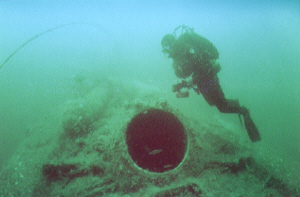
Today the U853 is a popular dive, lying in just 120 feet of water 11 miles off the US East Coast. You can thank the USS Atherton for putting her there.
The action contributed to Atherton winning her sole battlestar for Atlantic Action in WWII.
Post-VE-Day, she immediately sailed for the Pacific and conducted anti-sub patrols there for a few more months before the Japanese surrendered. The plucky destroyer escort was decommissioned 10 December 1945 and placed in reserve status for 10 years before she got on with her life.
On 14 June 1955, Atherton was transferred to the Japan Maritime Self-Defense Force (JMSDF), becoming one of the first ships of the new Japanese Navy, operating as the destroyer escort JDS Hatsuhi (DE-263, later FF-6) though this is sometimes spelled “Atsuhi” is western sources.
She put in a solid 20 years with the Japanese.
Japanese frigate Atsuhi, commissioned as USS ATHERTON (DE-169). Turned over to JMSDF, 14 June 1955. Paid off June 1975. Transferred to the Philippines, 13 September 1976. NH 46122
DE 263 JDS Hatsuhi – Japan Maritime Self defense Force (1955-75)
NH 46123, Japanese frigate Atsuhi, FF-6
The Japanese returned the then 30-plus-year-old Atherton and her sister-ship, the former USS Amick (DE-168), to the US Navy in 1977. Then, the vintage tin cans began a third career as a Barko ng Republika ng Pilipinas (BRP) naval vessel.
Following a refit in South Korea paid for in part by Washington, the two joined the Philippine Navy 27 February 1980. At the time the island nation was already operating another Cannon-class warship– the former USS Booth (DE-170). The deal also saw Manila buy the condemened sister ships former USS Muir (DE-770) and USS Sutton (DE-771) from the Koreans for a token fee. These two ships were so old and worn out that they were acquired simply with the intention to be cannibalized for spare parts to keep the Atherton, Boothe, and Amick running.
Well, in 1981, Booth (as BRP Datu Kalantiaw PS-76) was sunk during a typhoon, leaving just two DEs in the PI.
The former USS Boothe hard aground after a typhoon in 1981. This left the PI Navy with but two destroyer escorts…Atherton and Amick
Then Amick, thoroughly worn-out (as BRP Datu Sikatuna PF-5) was scrapped in 1989.
This left Atherton (as BRP Rajah Humabon PF-11), as the only real blue-water warship left in the Philippine Navy. Other than a three-year local refit/lay-up from 1993-1996, this humble 300-foot ship held the line for over two decades.
SOUTH CHINA SEA (April 21, 2009) – Philippine Navy ship BRP Rajah Humabon (PF 11) steams ahead during an exercise with the forward-deployed amphibious assault ship USS Essex (LHD 2) and the amphibious dock landing ship USS Tortuga (LSD 46), as part of exercise Balikatan 2009 (BK09). (U.S. Navy photo by Mass Communication Specialist 2nd Class Greg Johnson/Released)……..Other than the dazzle paint and some commercial navigational radar, she is the same as pictured above in 1945.
In 2011, the 44-year old USCGC Hamilton (WHEC-715), was transferred to the Philipines by the US State Department and renamed BRP Gregorio del Pilar (PF-15), giving the Atherton her first back up in over 20 years. Another “378” the USCGC Dallas (WHEC-716), was transferred in 2013 as the BRP Ramon Alcaraz (PF-16). A third, ex-USCGC Boutwell (WHEC-719), followed as BRP Andres Bonifacio (FF 17) in 2016.
Today the larger, younger and better equipped Hamilton/Pilar, Dallas/Alcaraz and Boutwell/Bonifacio undertake most blue water missions while the old USS Atherton/JDS Hatsuhi/BRP Rajah Humabon, at a spry 70-years of age, was still considered in active, albeit limited commission, armed, and ready to respond if needed– up until last week.
As such, she was only one of just three ships to still carry working 3-inch Mk22 guns (the other two being a Brazilian river monitor and a Thai sister ship) as well as the last warship in the world to carry the old Oerlikon 20mm in active service. Besides the museum ship USS Slater (DE-766), now sitting dockside in Albany New York, and the pierside training ship USS Hemminger (DE-746) (now HTMS Pin Klao DE-1) in Thailand, Atherton is the last destroyer escort afloat in the world, and the only one since 1992 still in regular naval service.
However, all good things must eventually come to an end, and as noted by the Philippine Navy on 15 March 2018:
“After 38 years of service, the Philippine Navy (PN) has formally retired its oldest warship, the BRP Rajah Humabon (PS-11), one of the last World War II-era warships still in active service, during short ceremonies in Sangley Point, Cavite Thursday morning,” said Philippine Fleet spokesperson Lt. Sahirul Taib in a message Thursday.
The retirement of BRP Rajah Humabon is in-line with the Navy’s Strategic Sail Plan of “moving to legacy vessels to more and capable and modern vessels,” he added.
She will be preserved, turned into one of the exhibits at the Philippine Navy (PN) Museum in Sangley Point, Cavite City. Taib said in a subsequent interview that turning the ship into an exhibit would happen shortly after it is stripped of its navigational equipment and other usable items.
Here in the states, Atherton is remembered by a veterans’ group and has a memorial on display aboard the USS Slater (DE-766) Museum. While a number of scale models are availble to celebrate the class, some of which specifically include Atherton in her Japanese scheme.
Not bad for a ship, class, and type that was considered disposable.
Specs:
Cannon class DE’s via USS Slater.com
Displacement: 1,240 tons standard
1,620 tons full load
Length: 93.3 metres (306.1 ft)
Beam: 11 metres (36.1 ft)
Draft: 3.5 metres (11.5 ft) full load
Propulsion: 4 GM Mod. 16-278A diesel engines with electric drive
4.5 MW (6000 shp), 2 screws
Speed: 21 knots
Range: 10,800 nmi at 12 knots (22 km/h)
Complement: 15 officers 201 enlisted men
Armament: • 3 × single Mk.22 3″/50 caliber guns
• 3 × twin 40 mm Mk.1 AA gun
• 8 × 20 mm Mk.4 AA guns
• 3 × 21 in (533 mm) torpedo tubes
• 1 × Hedgehog Mk.10 anti-submarine mortar (144 rounds)
• 8 × Mk.6 depth charge projectors
• 2 × Mk.9 depth charge tracks
If you liked this column, please consider joining the International Naval Research Organization (INRO), Publishers of Warship International
The International Naval Research Organization is a non-profit corporation dedicated to the encouragement of the study of naval vessels and their histories, principally in the era of iron and steel warships (about 1860 to date). Its purpose is to provide information and a means of contact for those interested in warships.
With more than 50 years of scholarship, Warship International, the written tome of the INRO has published hundreds of articles, most of which are unique in their sweep and subject.
PRINT still has it place. If you LOVE warships you should belong.