Tag Archives: battleship

Warship Wednesday Jan 15, 2014 A Tale of the Unlucky Porter

Here at LSOZI, we are going to take out every Wednesday for a look at the old steam/diesel navies of the 1859-1946 time

period and will profile a different ship each week.

– Christopher Eger

Warship Wednesday Jan 15, 2014 A Tale of the Unlucky Porter

porter1

Here we see the fine lines of the USS Porter as she steams quietly before WWII. This destroyer, DD-356, looked more like a fast cruiser with her high bridge and four twin turrets. Truly a beautiful ship from that enlighten era where warships could be both easy on the eyes and functional.

The first USS Porter almost sent a torpedo into the cruiser New York in 1898

The first USS Porter almost sent a torpedo into the cruiser New York in 1898

The name of the USS Porter is something of an albatross with the navy. Drawn from the famed War of 1812 era Commodore David Porter, and his son, Civil War Admiral David Dixon Porter, the first ship with this name, USS Porter (TB-6), a torpedo boat, launched in 1896, was commissioned five years after the passing of the Admiral. This small green torpedo boat almost sank the cruiser USS New York in a nighttime engagement during the Spanish-American War, and would have if the torpedo she fired didn’t miss.

The second USS Porter (DD-59), a Tucker-class destroyer, commissioned in 1916, had to be stricken to comply with the London Naval Treaty.

USS William D. Porter (DD-579), a Fletcher-class destroyer, was a ship of the United States Navy named for Civil War Commodore William D. Porter, son of Commodore David Porter and brother of Admiral David Dixon Porter, continued the curse of the Porter ship name. She almost sank the battleship USS Iowa during the war when she fired a live torpedo at the battlewagon while practicing torpedo runs. The Iowa at the time was carrying President Franklin D. Roosevelt, along with Secretary of State, Cordell Hull and all of the Country’s WWII military brass. When the Iowa saw and evaded the errant fish, she trained all of her guns on the much smaller Porter who’s crew were arrested and made the subject of an FBI probe to make sure the torp was an accident and not an attempted assassination.

USS William D._Porter (DD-579) sinking after being missed by a kamikaze

She spent the next year on duty in Alaskan waters after everything was cleared up. Then to the Philippines and Okinawa. There, on 10 June 1945 she was attacked by a lone Japanese Val dive bomber who missed the ship but exploded underneath after the craft hit the water. This gave the almost Iowa-killer the dubious distinction of missing a kamikaze but still being sunk by it.

DD-800
DD-800

The Fourth Porter (DD-800), a Fletcher-class sister-ship of the William D Porter above, although modern and low mileage, just spent two years on active duty before she was put into reserve. Called back for Korea, she was a member of the little know “Trainbusters Club”of warships that destroyed locomotives with naval gunfire. Decommissioned again 10 August 1953, she was scrapped in 1973, spending only a total of four and a half years of her thirty year life outside of Red Lead Row gathering rust.
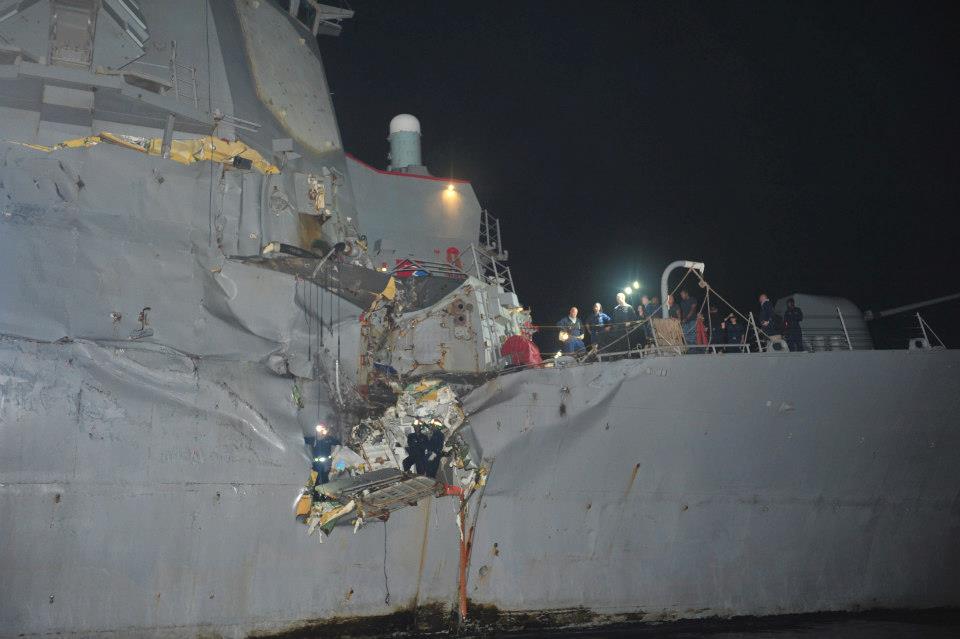
The Fifth USS Porter...

The Fifth USS Porter…

The fifth USS Porter, (DDG-78) is an Arleigh Burke-class destroyer, collided with the MV Otowasan, a Japanese oil tanker, near the Strait of Hormuz in 2012, ripping a huge 10×10 foot hole in the billion dollar Aegis warship that led to the replacement of her skipper.

But we are here to speak of the third Porter, DD-356.

0535613

Head of her class of large ‘destroyer leaders’ she was over 1800-tons and 381-feet long overall. Capable of making 35+ knots and carrying a battery of eight 5-inch/38 caliber naval guns over eight 21-inch torpedo tubes, she would have been considered a scout cruiser if she was commissioned in 1919 rather than in 1936.

She was one of the fastest and largest of US pre-WWII destroyer classes and her seven younger sisters provided yeomen service during the war. Her seven sisters earned a combined total of more than 30 battlestars during the war, fighting U-boats, protecting carriers, escorting convoys, and downing enemy aircraft.

0535611

All seven of her sisters survived the war to be scrapped in the late 1940s and early 1950s.

histor3

This was not to be the luck of the Porter.

Commissioned 25 August 1936 at New York Shipbuilding Corporation, she left immediately for the Pacific Fleet. Leaving Pearl Harbor just two days before the day of infamy, she was at sea off Hawaii when the war started. Joining Task Force 16 after convoy duty off the West Coast, she sailed immediately for the waters off Guadalcanal in 1942.

carrierwarcsg038BattleOfSantaCruzDwightCShepler
There, she found herself neck-deep in the Japanese onslaught that was the Battle of the Santa Cruz Islands. This pitted two US carriers, Enterprise and Hornet against three of Yamamoto’s. This battle, fought on 26 October 1942, started off with the Japanese having more planes (199 vs 136) and more surface combatants (40 vs 23).

Halsey’s fleet lost the Hornet, had the Enterprise badly mauled, and had more than 70% of the fleet’s carrier air-wing destroyed. During the fight, with planes ditching left and right around the USS Enterprise, Porter stood by as a plane guard, firing at Japanese aircraft while picking up pilots lost at sea.

To say the Battle of Santa Cruz was chaotic is an understatement.

To say the Battle of the Santa Cruz Islands was chaotic is an understatement.

One armed US Navy TBF Avenger torpedo bomber crashed near Porter and soon after, as the ship maneuvered to rescue the crew, she was struck by a torpedo of unknown origin. During the war the US blamed it on a Japanese submarine, but post-war study of the Combined Fleet’s records, none of the Emperor’s u-boats claimed the kill.

This had left historians to credit the sinking of the USS Porter, DD-356, to friendly fire.

Her crew was rescued by the nearby USS Shaw (DD-373), whose dramatic Pearl Harbor photographs have immortalized that ship.

The Shaw stood by to sink the stricken Porter in deep water with gunfire.

Her name was stricken a week later from the Naval List where it was given to a new Fletcher class destroyer (DD-800) at her launching on 13 March 1944.

Specs:

uss-dd-356-porter-1940-destroyer
Displacement:     1,850 tons
Length:     381 ft (116 m)
Beam:     36 ft 2 in (11.02 m)
Draft:     10 ft 5 in (3.18 m)
Propulsion:     50,000 shp (37,285 kW);
Geared Turbines,
2 screws
Speed:     35 knots (65 km/h)
Range:     6,500 nmi. at 12 knots
(12,000 km at 22 km/h)
Complement:     194
Armament:

As Built:
1 x Mk33 Gun Fire Control System
8 × 5″(127mm)/38cal SP (4×2),
8 × 1.1″(28mm) AA (2×4),
8 x 21″(533mm) torpedo tubes (2×4)
c1942:
1 x Mk33 Gun Fire Control System
8 × 5″(127mm)/38cal SP guns (4×2),
2 X 40mm AA (1×2),
6 x 20mm AA (6×1),
2 x Depth Charge stern racks

If you liked this column, please consider joining the International Naval Research Organization (INRO), Publishers of Warship
International.

They are possibly one of the best sources of naval study, images, and fellowship you can find http://www.warship.org/

The International Naval Research Organization is a non-profit corporation dedicated to the encouragement of the study of naval
vessels and their histories, principally in the era of iron and steel warships (about 1860 to date). Its purpose is to provide information and a means of contact for those interested in warships.

Nearing their 50th Anniversary, Warship International, the written tome of the INRO has published hundreds of articles, most of
which are unique in their sweep and subject.

I’m a member, so should you be!

Warship Wednesday Jan 8, 2014 The Brave Perth

Here at LSOZI, we are going to take out every Wednesday for a look at the old steam/diesel navies of the 1859-1946 time period and will profile a different ship each week.

– Christopher Eger

Warship Wednesday Jan 8, 2014 The Brave Perth

fot-percolor41
Happy new year and thanks for dropping by. Here we see HMAS Perth (D29) of the Royal Australian Navy (RAN) in a beautiful camouflage pattern sometime around 1941.

Perth in 1940, Sydney

Perth in 1940, Sydney

Perth was a modified Leander-class light cruiser. At 6800-tons with a 31-knot speed, her armament of  eight 6-inch Mk XXIII naval guns and another eight 4-inch guns along with eight 21-inch torpedo tubes was packed into her 565-foot long hull. They were based on the York-class heavy cruiser, but with smaller guns. Smaller than the destroyers of today, the Leander-class were some of the finest light cruisers in the Commonwealth. Her seven sisters included the illustrious cruisers Ajax and Achilles (of Graf Spee fame) as well as the famous HMAS Sydney, killer of both the German cruiser Kormoran and  Italian cruiser Bartolomeo Colleoni.

The Perth was brought into the world as the HMS Amphion of the Royal Navy,  15 June 1936, after spending three years under construction at  Portsmouth Naval Dockyard. Transferred to the RAN officially on 29 June 1939, she was given the name HMAS Perth. As such, she was the last cruiser ever commissioned in the Australian Navy.

HMAS-Perth-1941

When WWII broke out she was visiting South America and spent 1939-41 in hard service in the Med. She saw hot action off Syria, fought hard at the  Battle of Cape Matapan, helped evac Crete, and ran the Malta gauntlet. When war came to the Pacific she sailed back home, joining the ill-fated  ABDA fleet under Dutch Rear-Admiral Doorman. Running headlong into the Japanese Navy, she became involved in the Battle of Sunda Strait on the night of Feb28-Mar1 1942.

AWM_ART24483_HMAS_Perth
Perth, along with the 9200-ton Northampton-class heavy cruiser USS Houston and the Dutch destroyer HNLMS Evertsen, stumbled across 58 Japanese transports crammed with troops. Normally this would have been a field day for the small Allied force, but the troop carriers were escorted by the Imperial Japanese Navy’s 7th Cruiser Division, under Vice Admiral Takeo Kurita. This force included five modern cruisers including the giant twin 14,000-ton supercruisers Mogami and Mikuma and a dozen destroyers.

The force was doomed but still fought it out, blocked at both sides of the straits by the huge Japanese force. Over 90 Long Lance torpedoes fired at the two ABDA cruisers by Japanese destroyers while the cruisers slugged it out at long-range. Four Japanese torpedoes hit the Perth near simultaneously, dooming her.

During the abandon ship operation Perth was under fire from several destroyers at close range and many hits were scored and casualties caused. Many were killed or wounded in the water by the explosion of the last two torpedoes and by shells exploding in the water. Of the Perth’s crew of 681, only 218 were repatriated. Many became prisoners of war and were incarcerated in camps near Batavia, Java.

The Perth, Houston, and Evertsen all went to the bottom of the strait that night but were joined by a number of Japanese troopships, themselves victim of friendly fire Long Lances. Apparently once a torpedo hits the water, it has no friends.

Perth‘s wreck lies in approximately 35 meters of water and unfortunately is very heavily visited not only by recreational divers but by salvors.

5156380-3x2-700x467
Recently, illegal salvage operations have attacked the Perth, now considered a war memorial. These buzzards of the sea have completely removed the “mid section above deck, where the bridge was, has been completely removed, the bow guns have been damaged by what appears to be explosives with the barrels missing and the tops peeled of [sic], the bow has collapsed completely.”

“Although it is hard to be certain, but as the metal that was the superstructure is all missing and is not lying around as debris it looks although we could be wrong like purposeful attempt to salvage the steel. She has been hammered and the once impressive six-inch A1 and A2 turrets are gone, the bow is flat and… the wreck is more hazardous than before – even for general swimming around, with lots of live ordinance, wire and overhanging metal.”

Perth1-bell
Gratefully, in 1967 her binnacle, bridge voice pipe and ship’s bell were retrieved by divers. They are currently on display in the Australian War Memorial in Canberra.

Specs

hmas-perth-1942-light-cruiser
Displacement:     6,830 tons (standard)
Length:     562 ft 3.875 in (171.39603 m) overall
530 ft (160 m) between perpendiculars
Beam:     56 ft 8 in (17.27 m)
Draught:     19 ft 7 in (5.97 m)
Installed power:     72,000 shaft horsepower (54,000 kW)
Propulsion:     4 x Parsons geared turbines
4 x Admiralty 3-drum boilers
4 shafts
Speed:     31.7 knots (58.7 km/h; 36.5 mph)
Range:     6,060 nautical miles (11,220 km; 6,970 mi) at 22.7 knots (42.0 km/h; 26.1 mph)
1,780 nautical miles (3,300 km; 2,050 mi) at 31.7 knots (58.7 km/h; 36.5 mph)
Complement:     646 (35 officers, 611 ratings) standard
681 at time of loss (includes six RAAF and four civilians)
Armament:

8 × BL 6-inch Mk XXIII naval guns (4 × 2)
8 × 4-inch Mk XVI guns (4 × 2)
12 x 0.5-inch machine guns (3 × 4)
10 x 0.303-inch machine guns (10 × 1)
8 × 21-inch torpedo tubes (2 × 4)
Aircraft carried:     1 × seaplane (a Supermarine Walrus)

If you liked this column, please consider joining the International Naval Research Organization (INRO)

They are possibly one of the best sources of naval lore http://www.warship.org/naval.htm

The International Naval Research Organization is a non-profit corporation dedicated to the encouragement of the study of naval vessels and their histories, principally in the era of iron and steel warships (about 1860 to date). Its purpose is to provide information and a means of contact for those interested in warships.

Nearing their 50th Anniversary, Warship International, the written tome of the INRO has published hundreds of articles, most of which are unique in their sweep and subject.

I’m a member, so should you be!

Warship Wednesday January 1, 2014 : The Baron Pirate, His UBoat, and the Sea Serpent

Here at LSOZI, we are going to take out every Wednesday for a look at the old steam/diesel navies of the 1859-1946 time period and will profile a different ship each week.

– Christopher Eger

Warship Wednesday January 1, 2014 The Baron The U Boat and the Sea Serpent

sub_silhouetteu28

Here we see SM U-28, a Type 27 U-Boat of Kaiser Wilhem’s Kaiserlachemarine during World War One. For such a diminutive ship, she has a fascinating service record to say the least.

Ordered 19 February 1912 from Kaiserliche Werft, Danzig (now Gdansk, Poland), she was built to the doppelganger design of her sister boat, U-27 (who was later the first submarine to ever sink another in warfare when she sent the British submarine HMS E3 to the bottom of the North Sea in October 1914). The U-28 was large for her time but still very small by today’s standards– what would be called a ‘Baltic Boat’ similar to those built and operated by the Swedish Navy these days. She was but 213 feet long and weighed 878 when ballasted submerged. Her mild steel hull was tested to 50 meters (164 feet). She had very long legs for a small boat, capable of traveling nearly 10,000 miles on her efficient diesel-electric suite. When commissioned 26 June 1914 (two days before the Archduke Franz Ferdinand was assassinated in Sarajevo, lighting the fuse to the First World War) her first captain was (Baron) Freiherr Georg-Günther von Forstner.

willy stower painting
A propaganda post card which was given as a token of appreciation to participants in the fund-raising campaign for supporting  the submarine warfare of the First World War. Painted by seascape artist Willy Stöwer (1864-1931), a personal artist friend of Kaiser Wilhelm II, it depicts a scene from the so-called “traders warfare”  (Handelskrieg). A submarine very much like a U27 type sinks a British merchant ship, while her crew has boarded the life boats and are rowing away. (KFB Collection).

U28, as part of IV Underseebotte Flotilla took to the war with earnest. Between 1914-1917 she completed  four patrols, sinking 39 ships totaling 93,782 tons. She further damaged another 2 ships damaged totaling 11,188 tons, and took two ships prize totaling 3,226 tons for a total of 104,589 tons of shipping. Almost all 43 of these vessels were small merchant ships under 5,000-tons of British, Belgian, Dutch and Norwegian flags.

Note we said he captured two ships as prizes. Like a pirate. Just sailed out of port, grabbed a pair of steamers, and sailed back in with them one spring day in 1915.

U-28.lib of congressjpg

Here we see U28 coming heading out from Zeebrugbee with the tender W2.  Even though the tender is a small ship, she still dwarfs the U28. The below series of pictures, taken by a neutral Dutch photographer, were published by the British paper Graphic on March 27, 1915, show the sequence of events of the U28 capturing both the Batavia and the 1657ton Zaanstroom just an hour later.

imagep078a
imagep078b

While under the Baron’s command, U28 sighted the British steamer SS Iberian, 5223-tons , on 30 July 1915. After sending her to the bottom, the captain and crew observed the wreckage, seeing what can only be termed as a 65-foot long crocodile-like sea serpent.

Tylosaurus_large
According to the Baron’s own statement archived here :

the description of an animal estimated at 20 meters in length, seen by me and some of the crew of the submarine U28 on 30 July 1915 in the Atlantic Ocean; [it] was sighted on the starboard side, about 60 nautical miles south of Fastnet Rock, off the southwest corner of Ireland, after the sinking of the British steamer Iberian. This animal was hurled some 20 or 30m into the air by an underwater explosion about 25 seconds after the sinking of that vessel, thrown full length from the water. It is possible that this was caused by the detonation of an explosive device on board, the existence of which we assumed was  concealed in the ship’s papers, or from a small boiler explosion… This explosion certainly could have been the result of a detonation, but in my opinion only the bursting of the spaces deep inside the ship could have produced such air pressure.

    The animal was about 20 meters long and crocodile-like in shape, with pairs of strong front and hind legs adapted for swimming, and a long head that tapered towards the nose… Our senior engineering officer, marine engineer Romeihs, watched the animal for 10 to 15 seconds at a distance of about 150 to 100m in bright sunshine with the aid of powerful glasses.

We aren’t making this up.

The description is believed by many to mirror that of the (believed extinct) Tylosaurus  a large, predatory marine lizard of the  Late Cretaceous period closely related to modern monitor lizards and to snakes. Too bad the term ‘pictures or it didnt happen’ wasn’t popular then.

Officers taking bearings with sextant

The Good Baron von Forstner completed his war service in apparently a desk-bound training capacity, no longer at the helm of
a U-boat. That’s what you get when you spy a sea sepent and put it in the ship’s log.  He had his journal detailing his wartime experience published logically enough as, “The Journal of Submarine Commander Von Forstner” ( free Libravox audio book here) (Gutenburg Text version here for free ) which has been in the public domain for decades.

(Read it, its pretty good stuff)

(Read it, its pretty good stuff)

The Baron did, however, live to a ripe old age of 58 dying in 1940. His nephew was none other than Korvettenkapitän Siegfried Freiherr von Forstner, winner of the Ritterkreuz des Eisernen Kreuzes for his 70,000-tons of shipping sunk in WWII while skipper of  U-402 (which included the armed yacht Cythera, a past Warship Wednesday ship). Small world.

Well, back to the story of the U28.

She went back out to sea under a series of three more captains until her final skipper, Georg Schmidt, assumed command on 15 January, 1917. On her last patrol she found herself face to face on 2 Sep 1917 with the 4649-ton British steamer SS Olive Branch 85 miles north-by-northeast of North Cape, Norway in the Arctic Sea. The Olive Branch, most unlike her name, was loaded to the gills with munitions, lorries, and artillery shells for the Russian military machine. After sending a torpedo into her, U28 closed in to assess the damage to the stricken ship. It was then that the steamer’s hold detonated, sending deck cargo– including a number of vehicles– skyward. One of these flying trucks landed square on U28 and holed her, sending the boat and all 39 of her men to the bottom.

Her final location is unknown.

So there you have the true story of the pirate German submarine that tangled with a sea serpent and, in turn, was sunk by a truck.

Specs

u27Displacement:     685 tons surfaced
878 tons submerged
Length:     64.7 m (212.3 ft)
Beam:     6.32 m (20.7 ft)
Draught:     3.48 m (11.4 ft)
Speed:     16.4 knots (30.4 km/h) surfaced
9.8 knots (18.1 km/h) submerged
Range:     9,770 nautical miles (18,090 km) at 8 knots (15 km/h) surfaced
85 nautical miles (157 km) at 5 knots (9.3 km/h) submerged
Test depth:     50 m (164.0 ft)
Armament:
4 x 50 cm (19.7 in) torpedo tubes
1 x 8.8 cm (3.46 in) deck gun (listed as 105mm in some sources), note line drawing shows two deck guns as fitted  to the later U29 and U30.

If you liked this column, please consider joining the International Naval Research Organization (INRO)

They are possibly one of the best sources of naval warship research and has since 1964 publishes Warship International

http://www.warship.org/wi.htm

The International Naval Research Organization is a non-profit corporation dedicated to the encouragement of the study of naval
vessels and their histories, principally in the era of iron and steel warships (about 1860 to date). Its purpose is to provide information and a means of contact for those interested in warships.

Nearing their 50th Anniversary, Warship International, the written tome of the INRO has published hundreds of articles, most of
which are unique in their sweep and subject.

I’m a member, so should you be!

Warship Wednesday December 25th The Christmas Ship of the Fleet

Here at LSOZI, we are going to take out every Wednesday for a look at the old steam/diesel navies of the 1859-1946 time period and will profile a different ship each week.

– Christopher Eger

Warship Wednesday December 25th The Christmas Ship of the Fleet

09031602

Commissioned 12 March 1943, the USS Cascade was an unsung hero of the fleet. With the destroyers of the time very minimally equipped, they needed a floating hotel/storeship/repair shop to tie up to from time to time and give the crew some rest, some better food, restock the groceries on the destroyer, and fix what was broken. With just this task in mind, the Cascade was dubbed Destroyer Tender Number 16 (AD-16).

09031617

She followed the fleet from Kwajalein, to Eniwetok, to Ulithi. Holding true to her motto ‘We Serve’ USS Cascade in her three years of war serviced more than a thousand ships.  Most of these, as the ship’s name would imply, were destroyers, patrol frigates, and destroyer escorts which often saw the Cascade 4-5 times in that three-year period. In addition, the ship tended “175 landing craft (LST, LCI, LCM, LSD, and LCS), almost 100 sub-chasers, 60 transports, 32 cargo ships, 56 tankers, 37 mine sweepers, 10 cruisers, 7 aircraft carriers, and a miscellaneous group of other types neighboring around one hundred in number.”

09031609

“Due to the long supply line which commenced to make itself felt in November 1943, the USS Cascade was dovetailed into another assignment in addition to her original assignment. While machine shops hummed the new job added to the increasing tempo of the ship’s activity. During the two years of this duty, ten thousand tons of fresh and dry provisions were received and issued. Five hundred and fifty-one tons of clothing were issued and an equal number of tons of ship’s store stock was sold by the ship. The combined value of these issues amounted to more than five million 1944 dollars. ”

When you were close to the Cascade, everyday was Christmas. While at Ulithi she stored a library of nearly a thousand movies that were passed around the fleet at anchorage. It also didn’t hurt that the ice-cream barge capable of making thousands of gallons of sweet geedunk a day was nearby. She was effectively the Blockbuster of the atoll. It was the service and support of the unseen tenders like Cascade that helped keep the fleet forward deployed and not tied to logistics harbors and shipyards in California. Had there been no Cascades, there could have been no victory in the naval war in the far-flung Pacific. The base was far from the ‘rear’ though as one of her anchorage mates, the fleet oiler Mississinewa (AO-59), while at anchor in the harbor next to Cascade, was struck and sunk by Japanese torpedoes in 1944.

USS_Zane (DD-337)

USS_Zane (DD-337)

While at Ulithi the next month, Cascade served as a floating courtroom for the inquiry into Halsey’s Typhoon (Typhoon Cobra) with no less than Admiral Nimitz himself in attendance. In the audience was one LT(JG) Herman Wouk, who was at the time a junior officer of the old Clemson-class four piper minesweeper destroyer USS Zane (DD-337/DMS-14/AG-109). The Zane was one of Cascades baby ducklings and Wouk, as you may know, went on to write The Caine Mutiny which has a strong element of UCMJ/Naval CIS to its tale. As far as the inquiry on the Cascade went, the inquiry found that though Halsey had committed an error of judgement in sailing the Third Fleet into the heart of the typhoon that cost the lives of 790 men and three ship, it stopped short of unambiguously recommending sanction.

Cascade saw active combat in 1945, moving to a small cove of Kerama Retto on Okinawa where she repaired and patched up beaten ships that had survived kamikaze attacks just miles from her. While there, her crew endured their own share of plane and suicide boat attacks without damage.

The Christmas of 1945

Just a few months after the end of the War, the Cascade came to rest in Wakeyama, Japan, where she served as the floating storehouse for the fleet in the Japanese home waters. There her Christmas was special.

The following brief history of the USS Cascade from her commissioning until the end of the war was included in the Christmas 1945 menu. At the time the Commanding officer was Captain Louis T. Young, USN and the Executive Officer was Comdr. T.W. Hardisty, USN. Captain Young’s Christmas message was as follows:

“To all Officers and the Crew: It is my pleasure and privilege to wish you all, individually and collectively, the best of Merry Christmas and the happiest of New Years. May the following ones be even better.”

Lt-Comdr. Hardisty’s Christmas message was as follows: “The Christmas season is one when our thoughts are drawn to happy memories of the past and of happier things to come. It is my sincere wish for you all that this Christmas season be a very happy one and that the New Year will be filled with many blessings.”

The Christmas menu included: Cream of Tomato Soup, Ripe Olives, Sweet Pickles, Roast Tom Turkey, Giblet Gravy, Sage Dressing, Cranberry Sauce, Mashed Potatoes, Buttered Peas, Parker House Rolls, Fruit Cake, Mince Pie, Ice Cream, Cigars, Cigarettes, Coffee.

09031630

The Cascade still had a lot of life left in her. Spending 1947-51 in the Reserve fleet at Philadelphia, she was recommissioned and spent twenty years forward deployed across the Atlantic and Med as a tender and flagship. She was decommissioned on 22 November 1974, stricken, and sold for her value as scrap metal the next fall. Her role in the fleet was assumed by the much larger (20263 tons) destroyer tender USS Yellowstone which was laid down the following year.

09031626

Specs
Displacement: 9,250 long tons (9,398 t)
Length:     492 ft (150 m)
Beam:     69 ft 9 in (21.26 m)
Draft:     27 ft 6 in (8.38 m)
Fuel Capacity
NSFO 17,360 Bbls
Propulsion
one General Electric turbine
two Foster & Wheeler D-type boilers 460psi, 765°
double Westinghouse Main Reduction Gear
three 100Kw 450V. A. C. Ship’s Service Generators
single propeller, 8,500shp
Speed:     18 knots (33 km/h; 21 mph)
Complement:  600 original, over 1200 by 1944
Armament:     • 2 × 5″/38 caliber guns (reduced to single mount 1951)
4 × quad 1.1″/75 caliber guns (removed 1944)
three twin 40mm AA gun mounts (1944-47)
two quad 20mm AA gun mounts (1944-47)
12 × single 20 mm AA guns (removed 1951)
4x 12.7mm M2 guns (mounted 1950s)

If you liked this column, please consider joining the International Naval Research Organization (INRO)

They are possibly one of the best sources of naval lore http://www.warship.org/naval.htm

The International Naval Research Organization is a non-profit corporation dedicated to the encouragement of the study of naval vessels and their histories, principally in the era of iron and steel warships (about 1860 to date). Its purpose is to provide information and a means of contact for those interested in warships.

Nearing their 50th Anniversary, Warship International, the written tome of the INRO has published hundreds of articles, most of which are unique in their sweep and subject.

I’m a member, so should you be!

Warship Wednesday December 18th The Big WY

Here at LSOZI, we are going to take out every Wednesday for a look at the old steam/diesel navies of the 1859-1946 time period and will profile a different ship each week.– Christopher Eger

Warship Wednesday, December 18th The Big WY

Wyomingabout to sail in under the manhattan-bridge, New York City, 1912.
Here we see one of the best of Uncle Sam’s early dreadnought-style battleships at play. We present to you the USS Wyoming BB-32.

The ship was named not only for the State, but for two previous USS Wyoming, the first a screw sloop of war that fought in the Civil War, the second for an Arkansas-class monitor turned submarine tender (BM-10) that was renamed USS Cheyenne, 8 October 1908 so that the battleship could assume the more regal state name.

uss_wyoming_2lo

Laid down at William Cramp and Sons in Philadelphia in February 1910, Wyoming was just the 7th American Dreadnought, but when compared to the previous Florida-, Delaware-, and South Carolina-class ships built between 1906-1911, she was far superior. With a full load of 27,243 long tons and a 562-foot overall length, she could make an impressive 21-knots on her 12 coal-fired boilers pushed by a quartet of direct-drive steam turbines. Capable of steaming 8000 miles without refueling, she had long legs for the time. A dozen 12″/50 caliber Mark 7 guns (305 mm) in six twin turrets coupled with a secondary battery of no less than 21 5-inchers gave her a punch that rivaled any battleship afloat in Europe while her 9-12 inches of armor plate in important areas meant she could take the punishment if needed. Overall, Wyoming, when completed in 1912 she was the best ship in the Navy and comparable to any battlewagon in the world.

us battleships firing 1913 wyoming

Built in just 16-months, Wyoming immediately became the flagship of the US Atlantic Fleet. As such she spent several years steaming in the Gulf of Mexico, Caribbean, and Mexican waters. She intervened in Mexico in 1914 and in Haiti in 1916 exercising the best in gunboat diplomacy.

signal turret wyoming

When WWI came to the US, she spent several months training new gunners mates and sailors in the comparatively safe waters of Chesapeake Bay before heading to Europe. Since the British could not support the newer oil-fueled US ships like the USS Pennsylvania, Wyoming, since she was one of the last coal-fired battleships in the Navy appealed the British. In November 1917, Battleship Division 9 (BatDiv 9), made up of the Wyoming, USS New York, USS Delaware, and USS Florida, departed the U.S., bound for Europe. BatDiv 9 was to reinforce the British Grand Fleet at its base in Scapa Flow, becoming the 6th Battle Squadron of the RN’s Grand Fleet. It seemed the King forgave the colonials for that whole 1776 thing.

Note the early model WWI era lattice masts and clock

Note the early model WWI era lattice masts and clock

Wyoming escorted convoys and attended to the surrender of the Kaiser’s High Seas Fleet at Scapa before serving as the flagship for Admiral Sims. She returned home after the war and spent the next decade in routine fleet operations.

This rare oil painting by American artist Burnell Poole, “The 6th Battle Squadron of the Grand Fleet Leaving the Firth of Forth”, is one of less than two dozen paintings owned by the Navy that depicts U.S. naval operations in World War One (WWI). After years of being considered a total loss by Navy Art Gallery curators, it has been restored to near perfect condition. The entire process took several months, but the result is the total recovery of a painting that is sure to establish Burnell Poole’s name among the best marine painters of the early 20th century. The composition of the ships of the 6th Battle Squadron during their operational history, appearing in the painting in no particular order were: Delaware (BB-28), Florida (BB-30),Wyoming (BB-32), Arkansas (BB-33), New York (BB-34), Texas (BB-35), & Arizona (BB-39).

By 1931, the ship was on the chopping block. The Navy had newer and more modern vessels than the old, coal-fired Wyoming. With the limitations of the looming London Naval Treaty and all the allowed battleships spaced being taken by newer ships made after Wyoming, the ship’s days were numbered. Instead of being scrapped, she was allowed to be retained as a disarmed training ship.
Half her 12-inch turrets were removed as well as most of her 5-inch guns (they were often too wet to work anyway) and she was reclassified as Auxiliary Gunnery Training Ship #17 (AG-17) in August 1931. For the next decade, she spent most of her time conducting Annapolis Midshipman cruises, NROTC cruises and other training evolutions around the world. She showed the flag from Germany to Panama to Gibraltar and Egypt.

wyo1919
When World War Two started, the ship was thirty years old, had a cranky engineering suite rated for 16-knots, and only half the armament of any other battleship in the world. Not being able to fight toe to toe in a modern naval engagement, she continued to serve as a gunnery training ship. Bristling with AAA guns ranging from 5″/38s to 40mm to 20mm OKs to 12.7mm M2’s, she wandered around the live fire areas off Norfolk throughout WWII.

There is a battleship under there somewhere

There is a battleship under there somewhere. Note all but two 12-inch turrets have been removed and the rear mast completely altered. Her second funnel has been removed.

This earned her the nickname of the “Chesapeake Raider” while she trained over 35,000 new gunners and consumed more ammunition than any other ship in the fleet during WWII– although none of it at enemy targets. However, if it wasn’t for the old Wyoming, there would have been more lives lost to kamikazes in the Pacific without a doubt. To help pull this off, her remaining 12-inch guns were removed in 1944, going to replace elements on battleships serving in the fleet.

Note by this time the last two of her 12-inch mounts had been removed

Note by this time the last two of her 12-inch mounts had been removed, but the old WWI lattice mast is still seen forward. At just 560-odd feet, by 1940s standards she was the size of a very large cruiser rather than a battleship of the time.

USS Wyoming clearly showing her conversion to an AA training ship. Over 35,000 men trained on her.

One of the last officers assigned to the ship at the tail end of the war was Ensign Jimmy Carter, who later transferred to subs and ran for President. Finally, just shy of 35 years of continuous service, the USS Wyoming (BB-32/AG-17) was decommissioned 1 August 1947. Like so many historic ships of her era, she was sold for scrap shortly after. Her only sister ship, USS Arkansas (BB-33), did not outlive her, being crushed in the underwater nuclear test BAKER at Bikini Atoll in June 1946.

Steaming proud on her direct-drive steam plant, at the time the last in the navy. Of course, loosing 7,000 tons in armor, 12-inch guns, and shells can do that for a lady

Steaming proud on her direct-drive steam plant, at the time the last in the navy. Of course, losing 7,000 tons in armor, 12-inch guns, and shells can do that for a lady. By this time her masts had been totally stepped.

The US Naval Museum stores the original BB-32’s Bell and her silver service was presented back to the State of Wyoming in 1978.

013222

She is also remembered in maritime art.

Dreadnought Battleship U.S.S. Wyoming of 1911 – Anton Otto Fischer

The legacy of the USS Wyoming was picked up by the Ohio-class ballistic missile submarine USS Wyoming (SSBN-742) in 1996 after spending nearly fifty years absent from the Naval List.

Specs

bb-32-uss-wyoming-1912

Note the clean lines as commissioned in 1912.

After 1944 refit, she was a completely different ship.

After 1944 refit, she was a completely different ship.

Displacement:

Design: 26,000 long tons (26,420 t)
Full load: 27,243 long tons (27,680 t)
WWII- 20,000-tons due to reduced armor

Length:     562 ft (171 m)
Beam:     93 ft 2 in (28.40 m)
Draft:     28 ft 7 in (8.71 m)
Propulsion:     12 Babcock and Wilcox coal-fired boilers with oil spray, 4-shaft direct-drive steam turbines, 28,000 shp
Speed:     21 knots (39 km/h)
Range:     5,190 nautical miles (9,610 km) at 12 knots (22 km/h) and 2,760 nautical miles (5,110 km) at 20 knots (37 km/h), 8,000 nmi (15,000 km; 9,200 mi) at 10 kn (19 km/h; 12 mph)
Coal: 1,667 tons Oil: 266 tons
Complement:     1,063 officers and men
Armament:

As built:
12 × 12 inch/50 caliber (305 mm) guns (reduced to 6 by 1931, removed by 1944)
21 × 5 inch/51 caliber guns (127 mm) (reduced to 16 in 1919, all but 4 later removed by 1940)
2 × 21 inch (533 mm) torpedo tubes (decommissioned 1931)

After 1940 she carried an increasingly varied and constantly changing series of AAA weapons ranging from 5″ to .12.7mm were fitted to the ship as her role in gunnery training. After 1944 refit her last armament of 40+ weapons was truly bizarre for a 1912-designed battleship. It consisted of eight 5″/38 caliber guns, six of which are in twin mountings such as found on cruisers, carriers, and battleships, and two in Mk30 single enclosed base ring mounts common to destroyers and tenders. Then there were four older (original issue) single-mounted 5″/51 caliber guns of the type found on armed merchants and naval auxiliaries mounted on the ship’s port side. A quartet of 3″ deck guns of the type used by submarines and small frigates graced her starboard. For 40mm Bofors, the ship had a dozen in one quad, three twins, and two single mounts. Then came no less than a dozen 20mm Oerlikons (in some 8 double and some in single) mounts as well as fifty cal and thirty cal Brownings, small arms, etc.

Armor:

Belt: 9–11 in (229–279 mm)
Lower casemate: 9–11 in (229–279 mm)
Upper casemate: 6.5 in (165 mm)
Barbettes:11 in (279 mm)
Turret face: 12 in (305 mm)
Conning tower: 11.5 in (292 mm)
(Note, torpedo blisters and side armor removed after 1931)

If you liked this column, please consider joining the International Naval Research Organization (INRO)

They are possibly one of the best sources of naval lore http://www.warship.org/naval.htm

The International Naval Research Organization is a non-profit corporation dedicated to the encouragement of the study of naval vessels and their histories, principally in the era of iron and steel warships (about 1860 to date). Its purpose is to provide information and a means of contact for those interested in warships.

Nearing their 50th Anniversary, Warship International, the written tome of the INRO has published hundreds of articles, most of which are unique in their sweep and subject.

I’m a member, so should you be!

Warship Wednesday December 11, 2013 The Indian Step Ahead

Here at LSOZI, we are going to take out every Wednesday for a look at the old steam/diesel navies of the 1859-1946 time period and will profile a different ship each week.

– Christopher Eger

Warship Wednesday December 11, 2013 The Indian Step Ahead

Historic-37

Here we see the neatly arranged Indian Navy carrier INS Vikrant (R11) at sea in the 1960s.  She was one of 16 planned 1942 Design Light Fleet Carriers for the British Royal Navy. This class, broken up into Colossus and Majestic-class sub-variants, were pretty nifty 19,500-ton, 695-foot long carriers that the US Navy would have classified at the time as a CVL or ‘light carrier’. They were slower than the fast carriers at just 25-knots with all four 3-drum Admiralty boilers were lit and glowing red, but they had long legs (over 14,000 miles at cruising speed) which allowed them to cross the Atlantic escorting convoys, travel to the Pacific to retake lost colonies, or remain on station in the South Atlantic (Falklands anyone?) or Indian Ocean for weeks.

Historic-13

Capable of carrying up to 52 aircraft of the time, these carriers had enough punch to make it count. The thing is, only seven of these carriers were completed before the end of World War Two and even those came in during the last months and weeks. They effectively saw no service. With the 1945-Post WWII Royal Navy not having a need for 16 flash new oceangoing landing strips, they started laying them up and selling them off. Three went to Canada, three to Australia, one to france, one to Holland and others were mothballed. Two ships, HMS Hercules and HMS Leviathan sat on the builders ways, never completed.

578919_1000_570

Laid down in 1943, the ships were launched but when the war ended, construction was canceled. Then in 1957 the Indian government, newly independent and needing to police a huge coastline, bought the HMS Hercules for a song. She was towed from the original yard at Vickers-Armstrong to Holland-Wolfe in Ireland (the same yard that built the Titantic) and finished as the Indian Naval Ship Vikrant with pennant number R11. Vikrant was taken from Sanskrit “vikranta” meaning “stepping beyond”, and its a good choice as it was the first aircraft carrier operational that was not from one of the more established naval powers (i.e Britain, France, US, Japan).

Vikrant2

Her sistership, the HMS Leviathan sat at Swan, Hunter & Wigham until 1968. She would have been finished like Vikrant and commissioned as R13 but the money to do so never materialised and she was scrapped.

Vikrant joined the Indian Navy officially on 4 March 1961, giving her a construction period that lasted 18 years. She was to serve for the next four decades and was seen as the Indian Navy’s USS Langley, serving as the test bed and training hive for the first generations of India’s naval aviators.  It should be taken as a direct inspiration that after the Indian Navy commissioned Vikrant, the navies of Argentina and Brazil embarked on flat top programs (also with surplus British 1942 Design Light Fleet Carriers).

Sea_hawk_2

Flying obsolete British Hawker Sea Hawks, the Vikrant sailed into history during the Indo-Pakistani War of 1971. Her Hawks scored nearly a dozen “kills”, mainly of Pakistan Navy gunboats and Merchant navy ships and cargo ships in East Pakistan (present day Bangladesh) without losing an aircraft in the war. Aided by French-made Breguet Alize aircraft, the Sea Hawks of Vikrant emerged unscathed, achieving the highest kill ratio for any aircraft in the entire war.

According  to a Indian historical website, “After the sinking of the Ghazi, the Vikrant then cordoned off and every port in the erstwhile East Pakistan — Cox’s Bazar, Chittagong, and Khulna — was pounded by the Sea Hawks based on the Vikrant. Such was the impact of the air attack from Sea Hawks, that the Pakistani Naval commander in the then East Pakistan remarked, “Indian naval aircraft were hitting us day and night. We could not run.” On one occasion, with aircraft airborne and no wind conditions, the ship had to take a chance with her cracked boilers to land the returning flights. This was easily the carrier’s best of the finest hour. Such was the performance of the ship in the liberation of Bangladesh that it earned two Maha Vir Chakras and 12 Vir Chakras.”

Vikrant in 1984 after many years of hard service. You can note the Sea Harriers, Sea King helicopters, Sea Hawks and Alize aircraft on deck

Vikrant in 1984 after many years of hard service. You can note the Sea Harriers, Sea King helicopters, Sea Hawks and Alize aircraft on deck

578922_612_420

She later flew the first Indian Sea Harriers and after 1989 gained a ski-jump for these VSTOL aircraft. Showing her age, she was decommed 31 January 1997. She has since served as a museum ship of sorts in Mumbai harbor. It was announced this week that
the old girl is to be auctioned off to the highest bidder, most likely for scrap. Since a lot of ship-breaking is done in Bangladesh, her last voyage could be to the country she helped to free.

Vikrant, ave atque vale.

800px-Vikrant_Museum_Ship

Specs:

Vikrant1
Displacement:     15,700 tons standard, 19,500 tons full load
Length:     192 m (630 ft) waterline, 213.3 metres (700 ft) extreme
Beam:     24.4 m (80 ft) waterline, 39 metres (128 ft) extreme
Draught:     7.3 m (24 ft)
Propulsion:     2 Parsons geared steam turbines 40,000 hp (30 MW), 4 Admiralty three-drum boilers
Speed:     23 knots (43 km/h)
Range:     12,000 nautical miles (22,000 km) at 14 knots (26 km/h)
Complement:     1,075 usual,
1,340 wartime
Armament:     16 × 40 mm Bofors anti-aircraft guns (later reduced to 8)
Armor:     none
Aircraft carried:
Hawker Sea Hawk
Westland Sea King
HAL Chetak
Sea Harrier
Breguet Alizé Br.1050

If you liked this column, please consider joining the International Naval Research Organization (INRO)
They are possibly one of the best sources of naval lore http://www.warship.org/naval.htm The International Naval Research Organization is a non-profit corporation dedicated to the encouragement of the study of naval vessels and their histories, principally in the era of iron and steel warships (about 1860 to date). Its purpose is to provide information and a means of contact for those interested in warships.

Nearing their 50th Anniversary, Warship International, the written tome of the INRO has published hundreds of articles, most of
which are unique in their sweep and subject.

I’m a member, so should you be!

Warship Wednesday December 4, 2013 The Ice Cold S-13

Here at LSOZI, we are going to take out every Wednesday for a look at the old steam/diesel navies of the 1859-1946 time period and will profile a different ship each week. – Christopher Eger

Warship Wednesday, December 4, 2013, The Ice Cold S-13

S-13
Here we see Red Submarine S-13 of the Baltic Submarine Brigade of the Red Banner Fleet as she would have appeared in WWII.

The S-13 was an S-class Stalinents submarine. This class was a turning point for Soviet submersible development. Designed in the 1930s with help from the Germans, who were forbidden to work on U-boats by the Versailles Treaty, these boats were some of the most modern in the world at the time. Diesel-electric with a pair of engines and motors tied to their own independent propeller shafts, these boats could make nearly 20-knots on the surface and 10 submerged. Capable of depths of over 300-feet, they could submerge their 1000-ton 240-foot hull in just 30-feet of water. A dozen torpedoes in six bow and stern tubes gave the boat an impressive set of teeth. For surface action, a 100mm deck gun along with smaller AAA pieces were mounted. In all, some 56 S-class submarines were completed between 1939-1947.

color1_1

They formed the backbone of the Red Navy for two decades and at least four went on to serve the Chinese as their first submarines. These boats saw hard service in the Baltic and the Black Sea during World War Two with only S-13 surviving of the first 13 ships of the class built.

The S-13 went on to become the most famous (infamous?) of all Soviet submarines

The S-13 went on to become the most famous (infamous?) of all Soviet submarines

The S-13 herself was commissioned on 31 July 1941, six weeks after the Soviet Union was invaded by Hitler’s Axis forces.  Her keel had been laid down by Krasnoye Sormovo in Gorky on 19 October 1938, during much happier times. Homeported at Baltic Fleet anchorage at Kronstadt, her first captain was the unremarkable Pavel Malantyenk.  Captain Malantyenk sank a pair of Finnish merchant ships before the S-13 was damaged by a depth charge attack from Finn subchasers. This led to his replacement by a hard-drinking skipper by the name of Alexander Ivanovich Marinesko.

Stamp_of_Moldova_md102cvs
Born the son of a Rumanian sailor in Odessa, Marinesko had long been a naval maverick. Although a good skipper, he was known to be somewhat flamboyant, hard on the vodka, and with a questionable eye to the ladies, (even once facing desertion charges after disappearing with a Swedish woman for several days during the war).  As commander of the M-class submarine M96, he had sunk a German Artillery Barge and landed commandos behind the lines, earning an Order of Lenin and promotion to captain third rank. Taking over the newly repaired S-13 in 1943, he found her unlucky and was unable to sink any German ships on patrol.

Lazarettschiff

Finally, on January 30, 1945, he saw a huge German ship in his periscope. Nearly 700-feet long and over 25,000-tons, this proved to be the MV Wilhelm Gustloff. An ocean liner taken up by the Kreigsmarine at the beginning of the war, the Gustloff had spent most of the war in Danzig, serving as a floating headquarters and training ship for the German U-boat service. But that night, the Wilhelm Gustloff was evacuating Danzig ahead of the approaching Red Army. She was carrying a crew of 173 (naval armed forces auxiliaries), 918 officers, NCOs, and men of the 2 Unterseeboot-Lehrdivision (the best of the U-boat brain trust), 373 female naval auxiliary helpers, 162 wounded soldiers, and 8,956 civilians, among them an estimated 4,000 children, for a total of 10,582 passengers and crew.

Her only escort was the torpedo boat Lowe (the captured Norwegian destroyer HNoMS Gyller). Although the Gustloff was full of civilians she was painted as a military ship, not marked or declared as a hospital ship, armed with visible guns (3x105mm, 8x20mm cannon), and running dark in a combat zone– all of which made her a legitimate target.

The S-13 launched three torpedoes at the Wilhelm Gustloff′s port side while it was 16 miles offshore soon after 21:00,  hitting it with all three. The first torpedo (marked by the crew “For Motherland”) struck near the port bow. The second torpedo (“For Soviet people”) hit just ahead of midships. The third torpedo (“For Leningrad”) struck the engine room in the area below the ship’s funnel, cutting off electrical power to the ship. The Gustloff took a light list to port and settled rapidly by the head.

s13

In the panic that followed, many of the passengers were trampled in the rush to the lifeboats and life jackets. Some equipment was lost as a result of the panic. The water temperature in the Baltic Sea at this time of year is usually around 39 °F; however, this was a particularly cold night, with an air temperature of -0 to 14 °F and ice floes.

Soviet submarine S-13 shells the transatlantic Wilhelm Gustloff 13 of January 1945.

Soviet submarine S-13 attacks the transatlantic Wilhelm Gustloff 13 of January 1945.

Many deaths were caused either directly by the torpedoes or by drowning in the onrushing water. Others were crushed in the initial panic on the stairs and decks, and many jumped into the icy Baltic. The majority of those who perished succumbed to exposure in the freezing water. Less than 40 minutes after being struck, the Wilhelm Gustloff was lying on her side and sank bow-first,  in 144 ft of water. Thousands of people were trapped inside on the promenade deck. When she went down, more than 9,000 people went with her and is the largest maritime disaster in human history.

Polarfahrt mit Dampfer

SS General von Steuben was the S-13s next victim

This crippled the German U-boat arm for the rest of the war. On the way back to Krondstadt, S-13 sank the SS General von Steuben.  This 14,660-ton liner was also performing similar work as the Gustloff. Onboard were 2,800 wounded German soldiers; 800 civilians; 100 returning soldiers; 270 navy medical personnel (including doctors, nurses, and auxiliaries); 12 nurses from Pillau; 64 crew for the ship’s anti-aircraft guns, 61 naval personnel, radio operators, signalmen, machine operators, and administrators, and 160 merchant navy crewmen: a total of 4,267 people. The S-13 fired two fish into her side and she sank in 20-minutes with only 300 survivors ever found.

Russian_stamp_304_S-13_1996

In the span of a single war cruise, the S-13 sent over 40,000 tons of shipping to the bottom along with 13,000 souls for the cost of just five 21-inch torpedoes. However, returning to port the Soviet high command doubted Marinesko’s claims. Here they had a drunk who had only sunk a barge in four years of combat coming in with his scratch and dent submarine saying he sank two huge naval vessels. The fact that the Germans were silent on their losses also played into this.

Still, the subs political officer did in fact vouch that two attacks had been made, which earned Marinesko an Order of the Red Banner (instead of the more appropriate Hero of the Soviet Union award). When the brass came by to decorate Marinesko, he submerged his sub and left the dignitaries on the dock. On the next war patrol, the submarine did not make a single attack, even though it was in a target-rich environment.

esmarinesko3904_1

Marinesko was drummed out of the service in 1946, “For neglect of duty, regular heavy drinking and domestic immorality, the Commander of the Red Submarine S-13, Red Submarine Brigade of the Baltic Fleet, Captain 3rd Rank Marinesco, Alexander Ivanovich, to be dismissed, downgraded in military rank to lieutenant and placed at the disposal of the military council of the same fleet.”

He died in 1963 forgotten and marginalized, living on a small pension. However, today he is seen as a Soviet hero and the Submarine Museum in St Petersburg is named after him.  He is after-all the highest-scoring Russian Submarine Ace by tonnage in history.

The S-13 was decommissioned on 7 September 1954, stricken two years later, and scrapped.

Stalinets-class S-13 submarine in 1951, the most successful soviet submarine in history

Her sister ship, the S-56, the only known S-class still in existence, is on display as a museum ship in Vladivostok.

799px-S-56_from_sea

Specs

Type:     Diesel attack submarine
Displacement:     840 tonnes (surfaced)
1050 tonnes (submerged)
Length:     77.8 m
Beam:     6.4 m
Draught:     4.4 m
Propulsion:     2 x diesels (2000 hp)
2 x electric motors (550 hp)
2 x propeller shafts.
Speed:     19.5 knots (36 km/h) surfaced
9 knots (16.7 km/h) submerged
Range:     9800 miles (10.4 knots) surfaced
148 miles (3 knots) submerged
Test depth:     100 m
Complement:     8 officers
16 non-coms and
21 ratings
Sensors and
processing systems:
2 x periscopes
Mars-12 microphone system
Sirius communication system
ASDIC (on some boats)
Armament:     6 x 533 mm (21 in) torpedo tubes
(4 forward, 2 aft, 12 torpedoes)
1 x 100 mm B-24-2 gun
1 x 45 mm 21-K gun
mines

If you liked this column, please consider joining the International Naval Research Organization (INRO)

They are possibly one of the best sources of naval lore http://www.warship.org/naval.htm

The International Naval Research Organization is a non-profit corporation dedicated to the encouragement of the study of naval vessels and their histories, principally in the era of iron and steel warships (about 1860 to date). Its purpose is to provide information and a means of contact for those interested in warships.

Nearing their 50th Anniversary, Warship International, the written tome of the INRO has published hundreds of articles, most of which are unique in their sweep and subject.

I’m a member, so should you be!

Warship Wednesday November 27th 2013, One of the Best Tin Cans

Here at LSOZI, we are going to take out every Wednesday for a look at the old steam/diesel navies of the 1859-1946 time
period and will profile a different ship each week.

– Christopher Eger

Warship Wednesday November 27th 2013 One of the Best Tin Cans

law

On June 4, 1942, the pivotal day of the Battle of Midway, a group of  new TBM Avenger torpedo bombers headed to the isolated atoll to improve the base’s security. These six planes from VT-8 included one 32-year old AM3 William Clare Lawe, who, along with
the crews of five other planes never reached Midway, jumped on the way by Japanese zeroes. Lawe received the posthumous
Distinguished Flying Cross and was set to have a new destroyer escort named after him. This ship, DE-313 was canceled before it could be commissioned so his name was given to another ship (DE-373) which was also canceled. Then it was finally bestowed to the new Gearing class destroyer DD-763, which you see above.

The Gearing class was the Cadillac of US Navy WWII-era destroyers. What was not to like? I mean they could steam at almost 37-knots, carried six rapid-fire 5-inch/38 caliber guns, 23 anti-aircraft guns, depth charges, and ten beautiful 21-inch torpedo tubes. Further, they had long legs, capable of steaming over 4500 miles between fill ups. The Navy asked for 156 of them and Congress paid for 99, of which the new USS William C Lawe was one.

Note, this is pre-Fram, as you can see her with two 5-inch turrets forward as commissioned.

Note, this is pre-Fram, as you can see her with two 5-inch turrets forward as commissioned.

She was laid down at Bethlehem Steel Co., San Francisco, California on 12 March 1944. When the war ended the next year, her completion was delayed and she did not get to see service until December 1946. This was baby may have been conceived during the Big One, but she didn’t get delivered until it was all over. Nevertheless, she had a very active life, and did a little bit of everything for nearly forty years.

After 1960 the Lawe was 'FRAM'd' which removed much of her WWII armament and added, among other things, ASROC rockets and a  Gyrodyne QH-50 DASH (Drone Anti-Submarine Helicopter) remote control drone that could drop nuclear depth charge or torpedoes on submarines upto 22-miles away or help direct naval gunfire via a video link. The drones were unsuccessful and the Navy pulled them by the early 1970s.

After 1960 the Lawe was ‘FRAM’d’ which removed much of her WWII armament and added, among other things, ASROC rockets and a Gyrodyne QH-50 DASH (Drone Anti-Submarine Helicopter) remote control drone that could drop nuclear depth charge or torpedoes on submarines upto 22-miles away or help direct naval gunfire via a video link. The drones were unsuccessful and the Navy pulled them by the early 1970s.

The Lawe escorted President Harry S. Truman, joined a Deep Freeze task force to the polar regions, exercised often with NATO ships at sea, conducted midshipmen cruises, walked the picket line around Cuba during the Missile Crisis, and supported the invasion of the Dominican Republic in 1965. She also stood by in the very tense waters off Israel during the 1967 Six Day War and helped recover NASA’s Gemini IX and X space capsules.

The ship between the carrier and the Soviet destroyer? Lawe

The ship between the carrier and the Soviet destroyer? Lawe

The picture above shows a U.S. Navy McDonnell F-4B Phantom II armed with an AIM-7 Sparrow missile from Fighter Squadron VF-33 “Tarsiers” on the catapult of the aircraft carrier USS America (CVA-66). VF-33 was assigned to Carrier Air Wing 6 aboard the America for a deployment to the Mediterranean Sea from 10 January to 20 September 1967. In the background are the U.S. Navy Gearing-class destroyer USS William C. Lawe (DD-763), screening the carrier from the Soviet Kashin-class guided missile destroyer 381. This was during the tense standoff of the Arab-Israeli War.

30796-USS-Bordelon-DD-881-Vietnam
By 1972 she was part of the gunline that floated just off the coast of North Vietnam, conducting hot and heavy naval gunfire support that included exchanging shots with NVA shore batteries and point-blank range. She received two battle stars for her Vietnam War service.

lawe

In 1978, as one of the smallest ships in the navy, she toured the Great Lakes, making stops in Ohio, Canada, and Michigan, in some places being the first US Navy warship to make port since WWII. US Navy recruiting posters of the time featured the ship and promised adventures.

The Lawe, along with her sister-ship USS Harold J. Ellison  DD-864 (which was also named after a naval aviator who died during the Battle of Midway) were the last WWII-era destroyers of the Gearing class in US Naval service. They both were decommissioned 1 October 1983, replaced by much larger Spruance-class destroyers. While many of the Gearings went on to serve in other navies, (both Mexico and Taiwan still have a few that are nominally operational), the 37-year old Lawe never again left the US.

The ex-USS William C Lawe in mothballs, prepared to become a target ship. Picture from Navsource

The ex-USS William C Lawe in mothballs, prepared to become a target ship to test weapons systems. If only they could give them a final cigarette before they send them to the bottom….(Picture from Navsource)

She sat in mothballs with the James River reserve fleet for sixteen more years until she was sunk as a target at sea 14 July 1999. Two of her sisters,  USS Joseph P. Kennedy, Jr. (DD-850) in Fall River, MA; and USS Orleck (DD-886) in Lake Charles, LA are maintained as museum ships.

Specs
Displacement:     2,616 tons standard; 3,460 tons full load
Length:     390.5 ft (119.0 m)
Beam:     40.9 ft (12.5 m)
Draft:     14.3 ft (4.4 m)
Propulsion:     2 shaft; General Electric steam turbines; 4 boilers; 60,000 shp
Speed:     36.8 knots (68.2 km/h)
Range:     4,500 nmi at 20 knots
(8,300 km at 37 km/h)
Complement:     350 as designed
Armament:

   As built:
6 × 5 in /38 cal guns (127 mm) (3×2)
12 × 40 mm Bofors AA guns (2×4 & 2×2)
11 × 20 mm Oerlikon cannons
2 × depth charge racks
6 x K-gun depth charge throwers
10 × 21 in (533 mm) torpedo tubes

By 1950:
6 × 5 in/38 cal guns (127 mm) (in 3×2 Mk 38 DP mounts)
6 × 3 in/50 cal guns (76 mm) (2 x 2, 2 x 1)
2 x Hedgehog ASW weapons
1 × depth charge rack
6 x K-gun depth charge throwers

After FRAM
4 × 5 in/38 cal guns (127 mm) (in 2×2 Mk 38 DP mounts)
1 x ASROC 8-cell launcher
2 x triple Mark 32 torpedo tubes for Mark 44 torpedoes
1 x Drone Anti-Submarine Helicopter (DASH), removed by 1970
Variable Depth Sonar (VDS)

If you liked this column, please consider joining the International Naval Research Organization (INRO)

They are possibly one of the best sources of naval lore http://www.warship.org/naval.htm

The International Naval Research Organization is a non-profit corporation dedicated to the encouragement of the study of naval
vessels and their histories, principally in the era of iron and steel warships (about 1860 to date). Its purpose is to provide information and a means of contact for those interested in warships.

Nearing their 50th Anniversary, Warship International, the written tome of the INRO has published hundreds of articles, most of
which are unique in their sweep and subject.

I’m a member, so should you be!

Warship Wednesday November 20, 2013 The Last Dreadnought

Here at LSOZI, we are going to take out every Wednesday for a look at the old steam/diesel navies of the 1859-1946 time period and will profile a different ship each week. – Christopher Eger

Warship Wednesday, November 20, 2013, The Last Dreadnought

In_Drydock_byCharles_E_Turner

Here we see the 10th HMS Vanguard that sailed in the Royal Navy. Coming from a long maritime tradition, she was the third battleship to carry that name. As a twist of fate would have it, she was also the last of Her Majesty’s battleships and the above image is how she spent most of her life.

Ordered under the Emergency War Program of 1940 she was laid down on 2 October 1941 at  John Brown and Company, Clydebank, Scotland with Winston Churchill taking a keen interest in her.  The largest and fastest warship in the Royal Navy, the 47,000-ton HMS Hood, had been sunk by Hitler’s Bismarck on 24 May 1941 with a profound effect on the British nation. Vanguard would be larger, and better.

vanguard

Displacing over 50,000-tons, she would be heavier than any German battleship ever built. Capable of over 30-knots, she could outrun all but the U.S. Navy’s new Iowa-class fast battleships. Her armor, except for the Iowas and Japan’s Yamato-class, was the heaviest installed on the world’s oceans with improved splinter protection. She did, however, have a throw back to the Hood and the battleships of the rest of the British fleet in the fact that she was designed to carry the same 1915-era BL 15 inch Mk I naval gun as her main armament. This same gun was fitted to Queen Elizabeth, Revenge, and Renown class battlewagons (as well as the Hood herself). With these HMS Vanguard could range to 33,550 yards (30,680 m) (1900-pound Mk XVIIB or Mk XXII streamlined shell at 30 degrees.

With air attack an ever-increasing concern, she was fitted with over 70 40mm Bofors cannons.

i03737

The thing is, building a 50,000-ton warship while your country is fighting for its life against U-boats, buzzbombs, the Blitz and threatened landings across the English Channel was not the most urgent of matters. In that type of warfare, destroyers were needed, not battleships. Since Hitler never was able to get more than a half-dozen large armored ships operational at any time, and the Royal Navy outnumbered these by a factor of 2:1 with their WWI-era battleships alone, Vanguard never had much emphasis put upon her.

By the time she was launched on 30 November 1944, the war in Europe was already a forgone conclusion and the German navy had sidelined their last few armored warships to provide crews for U-boats which were being sunk as soon as they were commissioned.

vanguard19

This left Vanguard to enter service on 12 May 1946, some eight months after the Japanese surrender. She was the last battleship completed by any navy on earth.

vanguard 3

As such, the Royal Navy came full circle as they had commissioned the HMS Dreadnought in 1906, exactly forty years before, starting the period of all-big-gun Dreadnoughts.

i03681

Vanguard had a happy and peaceful, if boring life. She was the fleet flagship and as such was one of the best accommodations in the fleet, being both air-conditioned and heated. She was very connected to the royal family with then-Princess Elizabeth having christened her and King George VI almost having died upon her.

Princess Elizabeth playing tag with midshipmen on board HMS Vanguard during the Royal Tour of South Africa. 1947.

Princess Elizabeth played tag with midshipmen on board HMS Vanguard during the Royal Tour of South Africa. 1947.

However the days of battleships were waning and in 1955, after just nine years with the fleet, she was placed into reserve, though still in commission. There she served as flagship of the reserve fleet.

Sailors employed in the very peacetime job of polishing HMS Vanguard's gun caps. [1600x1265]

Sailors employed in the very peacetime job of polishing HMS Vanguard’s gun caps. [1600×1265]

At the time, besides the old WWI-era Turkish battlecruiser Yavuz Sultan Selim which had struck in 1954, and the collection of US battleships in mothballs, she was the last battleship in the world in any type of military service. As such, she had almost all of the scenes involving battleships for the 1960 film “Sink the Bismarck!” filmed aboard her. Thus she had the distinction of playing both the Hood and the Bismarck in movies.

vanguard at night

Two of John Brown’s finest; HMS Vanguard and RMS Queen Elizabeth. Absolute stunners both.

She was decommissioned on 7 June 1960 and sold to the Iron and Steel Corporation of Great Britain for £560,000, scrapping in 1962.

Vanguard hard aground on way to breakers

Vanguard hard aground on way to breakers

IMG_0048

The 11th ship with this name in the Royal Navy is the HMS Vanguard (S28) is a Vanguard-class ballistic missile submarine launched in 1992 and currently in service.

Specs:

vanguardschem
Displacement:     44,500 long tons (45,200 t) (standard)
51,420 long tons (52,250 t) (deep load)
Length:     814 ft 4 in (248.2 m)
Beam:     108 ft (32.9 m)
Draught:     36 ft (11.0 m) (deep load)
Installed power:     130,000 shp (97,000 kW)
Propulsion:     4 shafts
4 Parsons steam turbine sets
8 Admiralty 3-drum water-tube boilers
Speed:     30 knots (56 km/h; 35 mph)
Range:     8,250-nautical-mile (15,280 km; 9,490 mi) at 15 knots (28 km/h; 17 mph)
Complement:     1,975
Sensors and
processing systems:     1 × Type 960 air-warning radar
1 × Type 293 target-indication radar
1 × Type 277 height-finding radar
2 × Type 274 15-inch fire-control radar
4 × Type 275 5.25-inch fire-control radar
11 × Type 262 40 mm fire-control radar
Armament:     4 × 2 – BL 15-inch Mk I guns
8 × 2 – QF 5.25-inch Mk I dual-purpose guns
10 × 6 – 40 mm Bofors AA guns
1 × 2 – 40 mm Bofors AA guns
11 × 1 – 40 mm Bofors AA guns
Armor: Belt: 4.5–14 in (114–356 mm)
Deck: 2.5–6 in (64–152 mm)
Barbettes: 11–13 in (279–330 mm)
Gun turrets: 7–13 in (178–330 mm)
Conning tower: 2–3 in (51–76 mm)
Bulkheads: 4–12 in (102–305 mm)

If you liked this column, please consider joining the International Naval Research Organization (INRO)

They are possibly one of the best sources of naval lore http://www.warship.org/naval.htm

The International Naval Research Organization is a non-profit corporation dedicated to the encouragement of the study of naval vessels and their histories, principally in the era of iron and steel warships (about 1860 to date). Its purpose is to provide information and a means of contact for those interested in warships.

Nearing their 50th Anniversary, Warship International, the written tome of the INRO has published hundreds of articles, most of which are unique in their sweep and subject.

I’m a member, so should you be!

Warship Wednesday November November 13th Of Irish Clippers and Russian Comrades

Here at LSOZI, we are going to take off every Wednesday for a look at the old steam/diesel navies of the 1859-1946 time period and will profile a different ship each week. – Christopher Eger

Warship Wednesday, November 13th Of Irish Clippers and Russian Comrades

Tovaris-1-001

Here we see the four-masted barque rigged clipper ship Tovarish (also spelled Tovarisch, and Товарищ meaning “comrade”), the pride and joy of the Pre-WWII Soviet Red Banner Fleet, Military Maritime Fleet of the USSR in full sail. She served under no less than four flags and fought in three wars– often on both sides.

as laurinston

Launched at the Irish-based shipyard of Workman, Clark & Co., Belfast, for Galbraith & Moorhead, London, and delivered in December 1892, her original name was the clipper Lauriston. She was a four-masted windjammer built for blue-water cross-ocean trading service. There was nothing about her that was modern even at the time of her birth. She had no electric lights, no engine of any sort, no mechanical ventilation, no refrigeration, bathing facilities, watertight bulkheads, or water distillation devices. There was a single steam boiler, but it was just for powering the cargo boom to load and unload her four holds. She was one of the last of the old-school clipper ships. Her crew did everything manually from turning capstans on up. Their only comfort was salted pork and stored water. Their only light was by the flicker of kerosene wicks.  While the ship would sail for over 50 years, this was never improved upon.

Tovaris-1-002

Nevertheless, what she lacked in comfort she made up for in speed, without any coal or oil to store, freed up most of her below-deck areas for cargo. She raced the oceans from one continent to another for twenty years. She completed the Liverpool – Rangoon run in just 95 days once and the Holyhead – Calcutta one in 96. When it was considered that these trips normally took even steam-assisted ships 107 and 116 days respectively, you can see just how fast the ship was. This shouldn’t surprise you when you realize that her sail plan was for nearly 10,000-square feet of canvas aloft on 30 sheets.

Sketch_barque_Tovarich

She hauled silks, sheep, dry goods, jute, teak wood, wool, and just about anything else that paid. First for Galbraight, then after 1905 for G. Duncan & Co, then after 1910 for Cook & Dundas, London (sold for £ 4,000), and finally to Cherey, Eggar & Forrester of  London in 1913.

On to Russia!

It was Eggar (no relation) who sold the ship to an agent of the Tsar in 1914 to work the convoy route from Aberdeen to Murmansk during World War One, carrying railroad ties and equipment. A large quantity of the Murmansk-St Petersburg Railway, which was completed in 1917, came from the UK on the Russian-owned, Finnish/British-crewed His Russian Majesty’s Ship Lauriston. After the line was finished, she became a coal lighter/mothership for the flotilla of Russian navy minesweepers there. (She would be used for this in another war too, but more on that later.)

645796

When the Tsar was kicked out in 1917 and the now-Soviet Russians sued for peace in March 1918, the Brits accompanied by other allied forces (including US doughboys) seized Murmansk. It was then the Lauriston was seized by the Brits and placed at the disposal of the Hudson Bay Co., London, moving cargo back and forth from the UK to Murmansk as needed and serving as a floating base of operations for these “Interventionist” forces in the Russian Civil War. When the Brits evacuated Murmansk to the Soviets in 1920, they towed the Lauriston back with them of course.

I mean, she may have been a 28-year old scratch and dent windjammer from another era, but she was free, right?

627980

Well, not quite. It seems the Soviets believed that what the Tsar once owned, the State now did and by 1921 they had pitched enough of a fit to get her back. After having a refit for her (new sails, rigging, etc) at bargain prices in Germany, she was renamed Tovarish (Comrade) in 1923 and made a training ship for the Soviet navy and merchant marine, officially assigned to the Leningrad Maritime College. In her new service, she had a 32-man crew of professional officers and NCOs who oversaw 120 cadets.

813

She also had female crew, with the ladies being seen as equals under the new Communist utopia.

Moreover, she was one of the first operational Soviet-flagged merchant ships. This meant she could move across Europe in the 1920s, bringing back to the Soviet Union much-needed flour (the country was beset by famine throughout the 20s).

It was also theorized that she dropped of Soviet agents, and picked up Communist political prisoners. In one mission six Communist party members in Estonia were quietly bundled out to the Tovarish and away from local authorities, escaping a death sentence passed upon them.

648925
She was the first Soviet-flag ship to enter and receive honors in many foreign ports from Europe to the Americas. For instance, she completed a run from Leningrad to Rosario, Argentina in 1926 in just 74 days by sail alone. Although with no watertight bulkheads and a riveted iron-hull, she was very strong. So much so that in a collision in the English Channel in 1928 with the Italian cargo ship “Alcantara“, it was the newer Italian steamer that went to the bottom while the Tovarish picked up survivors. Two years later an English Admiralty Court ruled that the Italian steamer was at fault, not the Soviet school ship.

It was during these salad-days of the pre-WWII Red Navy that the Tovarish proved a happy and successful ship. Her cadets included many men who would go on to become admirals of the Red Navy during and after the war.

One of the heroes that walked her deck was the infamous Alexander Marineseko, the highest scoring submarine ace in Russian history. While aboard Tovarish at age 17, Marinesko stood on his hands high up the tallest mast of the ship. Seeing the young man teetering precariously 20 meters above the deck, the ship’s longtime captain, Ivan Freiman prophesied: “You will go through a whole lotta pain, young man, if you do not learn to tame your desires and your nature!”

The cadet should have listened because even though he sank two huge German naval troopships in the Baltic (Wilhelm Gustloff and General Von Steuben) taking more than 15,000 souls down in the process, he was cashiered from the Navy for drinking and chasing tail.

Товарищ-2

When World War Two broke out, the Tovarish was sitting at Novorossisk in the Black Sea. As the Germans approached the port in 1941, the Soviets abandoned the school ship, opening her to the sea. The Germans were able to raise her and tow her to Mariupol where she sat as a floating barracks ship for the Croatian Naval Legion (Hrvatska Pomorska Legija).

The Croatian Naval Legion wore German Kreigsmarine uniforms with a Croat checkerboard emblem on the sleeve. These Adriatic sailors lived and fought from the Tovarish for nearly two years

The Croatian Naval Legion wore German Kreigsmarine uniforms with a Croat checkerboard emblem on the sleeve. These Adriatic sailors lived and fought from the Tovarish for nearly two years

This group of 340 ethnic-Croat sailors was formed by the Nazi-puppet Croatian Government and sent to the Black Sea to man minesweepers and patrol boats for the Germans. The Croatian government hoped that the German Kriegsmarine would use their valiant countrymen on the Eastern Front to gain valuable experience and form the core of future free Croatian Navy. Active throughout 1942, the Croatian Legion owned 31 small sailing-craft and 35 motorboats, which they operated from the mother-ship Tovarish.

In August 1943, with the Soviets closing on  Mariupol, the Germans/Croats sank the ship for the second time, with Soviet aircraft finishing the job. There she sat on the harbor floor until 1959 when she was raised and scrapped. Her anchor was retained In the Town Square near the port gate, where it remains to this day, a 4-ton 1890s Irish anchor in a Ukrainian port.

Tovaris anchor

She was also remembered with a special gold coin for the 300th Anniversary of the Russian Navy in 2000, as well as a postage stamp by the Soviet Union in 1981.

RR5512-0002R

1981._Четырехмачтовый_барк_Товарищ

*(As a side note, when the Soviet Navy seized the scuttled German training ship SMS Gorch Fock at the end of the war, she was soon salvaged and repaired as a replacement for the lost Torvarich. Fittingly, that replacement ship carried the name Tovarisch in the Soviet Navy from 1951-90 and then in the Ukrainian Navy until 1999. This kept a legacy of nearly 75 years of naval training on a sailing ship named Comrade, flying the red banner fleet’s ensign. )

Specs:

Tovaris-1-004
The length of the upper deck (register), m 86.73(284.56-feet)
LWL, m     84.00
Beam at the middle, m 12,80, m (41.99-feet)
Depth, m     7.93
The height of the outer bar keel, mm 254
Maximum draft with the keel, m 6.60 (21.65-feet)
Full-load displacement, t 4750
Lightship, t     1150
Deadweight, t 3600
Capacity Gross, Reg. t     2472
Capacity clean, reg. t     2118
By Bruce     3.3
Crew     32
Number of trainees 120
Armament (small arms)

Sail plan:
(Sail area, m2, four-masted barque)
Flying jib –     57.9
Cleaver –     66.3
Midship jib – 62.8
Fore topmast staysail –     68.6
Fok – 226.0
The lower form Marseille – 127.0
The top form Marseille – 142.0
The lower form bramsails – 76.4
The top form bramsails – 92.8
Four-bom-bramsails –     70.0
Main-topmast staysail 1st grotto –     66.6
Main-topgallant staysail 1st grotto – 58.0
The first cave – 243.0
The lower topsail 1st grotto – 127.0
The upper topsail 1st grotto – 142.0
Lower bramsails 1st grotto – 76.4
Upper bramsails 1st grotto – 92.8
Groth-bom-bramsails 1st grotto –     70.0
Main-topmast staysail 2nd grotto –     66.6
Main-topgallant staysail 2nd grotto – 58.0
The second cave – 231.0
The lower topsail 2nd grotto – 127.0
The upper topsail 2nd grotto – 142.0
Lower bramsails 2nd grotto – 76.4
Upper bramsails 2nd grotto – 92.8
Groth-bom-bramsails 2nd grotto –     70.0
Apsel – 68.6
Cruys-topmast staysail – 53.6
Mizzen –    105.0
Mizzen topsail hafnium – 48.4
Total – 3005.0m2

If you liked this column, please consider joining the International Naval Research Organization (INRO)
They are possibly one of the best sources of naval lore http://www.warship.org/naval.htm

The International Naval Research Organization is a non-profit corporation dedicated to the encouragement of the study of naval vessels and their histories, principally in the era of iron and steel warships (about 1860 to date). Its purpose is to provide information and a means of contact for those interested in warships.

Nearing their 50th Anniversary, Warship International, the written tome of the INRO has published hundreds of articles, most of which are unique in their sweep and subject.

I’m a member, so should you be!

« Older Entries Recent Entries »