Tag Archives: battleship

Warship Wednesday, November 14

Here at LSOZI, we are going to take out every Wednesday for a look at the old steampunk/dieselpunk navies of the 1866-1946 time period and will profile a different ship each week.

– Christopher Eger

Warship Wednesday,  November 14

Here we see a painting depicting the beautiful 198-foot United States Revenue Cutter Service Cutter Bear as she appeared around the 1890s. Built as a ocean-going sealing ship by Alexander Stephen & Son, Dundee, Scotland in 1874 (for which she was used for a decade as the SS Bear), she was bought by the US government in 1884 for use in the Arctic. Her Scottish builders had always meant for her to work in thick ocean ice chasing seals and as such she had a 6-inch thick oaken hull, sailing barquentine rig and steam auxiliary engines. Under the USRCS, and then after 1916 the USCG, the Bear served for 40 years as virtually the sole US government ship of any kind along the lawless 20,000 miles of Alaskan Territory coastline. Every year she would sail the Alaskan coastline during the spring and summer, returning to the piers of San Fransisco in the winter, refitting, and doing the same thing the next year.

She found the remnants of the Greely Expedition, helped assist the people of San Fransisco after the 1906 Earthquake, ran down poachers and smugglers, waved the flag in every inlet of the territory, protected the Gold Rush prospectors, and saved countless lives. In 1926 the Coast Guard laid her up but she was she spent the next 15 years used as a museum ship, a prop in movies, and by Admiral Byrd in one of his arctic expeditions.

On 11 September 1939, (ten days after Hitler marched into Poland) she was called back to service and, with a Navy crew (as the USS Bear, AG-28), sailed Greenland/Iceland waters in search of German weather stations and raiders during World War Two. She even captured an armed German auxiliary trawler at gunpoint. Not bad for a then-68 year old ship. She was decommissioned, 17 May 1944, and placed in mothballs. The Navy sold her in 1948 and she was used again as a sealer for another decade (as the FV Arctic Bear) then laid up once more.

Seen in WWII in USN service, note the J2F Duck Seaplane on her stern and stepped masts. Disregard the Norwegian armed trawler in the front. In her 89-year life, she served five in the Navy (including WWII), 42 in the Coast Guard (including WWI), and almost 30 years as a sealer, tramp cargo ship, floating museum, and relic.

In 1960 a Philadelphia businessman bought her to use as a restaurant, moored alongside the venerable ex-USS Olympia in downtown Philly. However, the old girl wasn’t putting up with that shit and on the tow down from Canada, she slipped her towline and took a plunge  to the bottom of the Atlantic ocean off  Sable Island, the Graveyard of the Atlantic in 1963 where she remains today.

Her captain in the old days, Michael “Hell Roaring Mike” Healy, is remembered in the name of the USCGs newest cutter, and the Bear herself is the name of the lead ship of the 270-foot Medium Endurance Cutters commissioned in the 1980s.

Specs:
Displacement: 703 tons
Length:     198.5 ft (60.5 m)
Beam:     30 ft (9.1 m)
Draft:     18.8 ft (5.7 m)
Propulsion:     300 ihp compound steam engine, 1 screw
Range:     Limited only by water and provisions
Complement:  51
Aircraft carried: Carried Barkley-Grow seaplane on Byrd Expedition III, 1942-44 one  J2F-1 seaplane
Armarment (1885-1926) 3 x 6-pound rapid-fire guns, (1941-44) Unknown but photos show covered machine guns and/or cannon, probably 12.7mm or 20mm.

Warship Wednesday, November 7

Here at LSOZI, we are going to take out every Wednesday for a look at the old steampunk/dieselpunk navies of the 1866-1946 time period and will profile a different ship each week.

– Christopher Eger

Warship Wednesday,  November 7


Here we see the beautiful new battlecruiser SMS Goeben of the Kasierliche Marine. She was the second of two Moltke-class battlecruisers of the Imperial German Navy, launched in 1911 and named after the German Franco-Prussian War hero General August Karl von Goeben.


SMS Goeben with torpedo nets rolled up pre1914

SMS Goeben with torpedo nets rolled up pre1914, Click to big up

She served only two years in the Kaiser’s navy officially before causing havoc and frustration in the Med while running from British and French warships on the outbreak of World War I. Her Admiral, William Souchon, made for Turkey where the ship was interned and then officially turned over to the Turkish Navy 16 August 1914, just over two weeks into the War. However, renamed the  Yavuz Sultan Selim after Ottoman sultan Selim I, and with her German crew wearing Turkish fez, she became the flagship of the Ottoman Navy.

As such she pulled Turkey into the War when Souchon sailed across the Black Sea to bombard Russian ports. For the rest of the war she traded shots with the occasional Russian battleship, avoiding lurking British subs, and generally trying to just stay one step ahead of the Turks themselves.

Goeben and Breslau

Goeben and Breslau. Click to bigup

The Germans left in 1918 but the Selim remained. In 1936 she was renamed once again as the TCG Yavuz (“Ship of the Turkish Republic Yavuz“) since the old Ottoman name was passe.

Battlecruiser Yavuz (Yavuz Selim) in Bosporus ,1931

Battlecruiser Yavuz (Yavuz Selim) in Bosporus ,1931. Click to bigup


Yavuz remained the flagship of the Turkish Navy until she was decommissioned in 1950. She was scrapped in 1973, after the West German government declined an invitation to buy her back from Turkey as a museum. She was the last surviving ship built by the Imperial German Navy, and the longest-serving battlecruiser or dreadnought-type ship in any navy, with some .


Specs:
Displacement:

Design: 22,979 t (22,616 long tons)
Full load: 25,400 t (25,000 long tons)

Length:     186.6 m (612 ft 2 in)
Beam:     30 m (98 ft 5 in)
Draft:     9.2 m (30 ft 2 in)
Installed power:

Design: 52,000 hp (39,000 kW)
Maximum: 85,782 hp (63,968 kW)

Propulsion:     4 screws, Parsons steam turbines
Speed:

Design: 25.5 kn (47.2 km/h; 29.3 mph)
Maximum: 28.4 kn (52.6 km/h; 32.7 mph)

Range:     4,120 nmi (7,630 km; 4,740 mi) at 14 kn (26 km/h; 16 mph)
Complement: 43 officers
1,010 men

Armament:

10 × 28 cm (11 in) SK L/50 guns (5 × 2)
12 × 15 cm (5.9 in) guns
12 × 8.8 cm (3.5 in) guns

Armor:

Belt: 280–100 mm (11–3.9 in)
Barbettes: 230 mm (9.1 in)
Turrets: 230 mm
Deck: 76.2–25.4 mm (3–1 in)
Conning tower: 350 mm (14 in)

Warship Wednesday October 31st (Happy Halloween Edition)

Here at LSOZI, we are going to take out every Wednesday for a look at the old steampunk/dieselpunk navies of the 1866-1946 time period and will profile a different ship each week.

– Christopher Eger

Warship Wednesday,  October 31

Here we see the Japanese ironclad Kōtetsu in Japan in the 1870s. She had a very interesting history and often masqueraded under several flags and names (hence the Halloween edition!).

Built in secret for the Confederate Navy to be used as the ironclad Stonewall (but dubbed the Sphinx) by  the L’Arman Yard, Bordeaux, France 1863-64, she was ‘officially’ for the Egyptian Navy (hence the original name). Her and her sister-ship were  built to break the Union blockade of the South. The sale was found out and blocked, forcing the Sphinx/Stonewall to be sold to Denmark and a Danish Navy crew took her over in the fall of 1864.

Her sister ship Cheops was sold to the Prussian Navy, becoming the SMS Prinz Adalbert.

Well, to further complicate things, the Sphinx/Stonewall/Copenhagen was turned over to the Confederate Navy, its original owner in January 1865 after Denmark lost a short war with Prussia. The ship took to sea in an epic voyage across the Atlantic shadowed by US Navy ships the whole way. She arrived in Havana Cuba  just as the war ended and the captain promptly sold her to Spain (Cuba was a Spanish territory then). Spain, turned around and sold her, unused by the Spanish navy, to the United States in July 1865 for $16,000. The US Navy sailed to to the east coast, kept her in storage for three years, often inspecting her to see how the French built ironclads.

In 1868 she was sold for $30k (almost twice what the navy paid for her) to the shogun of Japan. Delivered the next year to the Meji government (who deposed the shoguns– talk about a cursed and unlucky ship!) and named the Kōtetsu, she immediately put her ultra-modern Gatling guns and rifled cannon in action at the Battle of Miyako Bay (where she was helmed by, wait for it, French naval experts). The Japanese ultimately renamed her Azuma, kept her on the payroll for twenty years (although her internal wooden construction was rotten) and she was finally decommissioned and scrapped in 1888.

So to recap, she was built in France for Egypt with English guns (but secretly for the CSA), sold to Denmark, resold to the CSA, who sold her to Spain, who sold her to the USA, who sold her to the shogun but gave her to the Meji government to use against the shogun (under French mercenaries).

Wow, I need a drink now. Everyone, raise your Halloween punch to the Sphinx/CSS Stonewall/Copenhagen/CSS Stonewall/USS Stonewall/Kōtetsu,/IJNS Azuma!

Her specs:


Class & type:     Ironclad Ram Warship
Displacement:     1,358 t
Length:     193.5 ft (59.0 m) oa
Beam:     31.5 ft (9.6 m)
Draught:     14 ft 3 in (4.34 m)
Propulsion:     1,200 hp (890 kW) double reciprocating engine, 95 tons coal.
Speed:     10.5 kn (19.4 km/h)
Complement:     135
Armament:     1 × 300 pdr (136 kg) Armstrong
2 × 70 pdr (32 kg) Armstrong
2 x Gatling guns
Armor:     main belt, 89 to 124 mm (3.5 to 4.9 in)
turrets, 124 mm (4.9 in)

Her propulsion system was provided by Mazeline, based in Le Havre. The ship was powered by a pair of 2-cylinder single expansion engines, each of which drove a four-bladed screw that was 3.6 m (11 ft 10 in) in diameter. The engines were placed in a single engine room. Two trunk boilers, also in a single boiler room, supplied steam to the engines at 1.5 standard atmospheres (150 kPa). Two rudders were fitted side by side to control the vessel. The ship was initially fitted with a 740 square meter (2,428 sq ft) brig rig, though this was subsequently replaced with a 677 square meter topsail schooner rig.

Warship Wednesday, October 24

Here at LSOZI, we are going to take out every Wednesday for a look at the old steampunk navies of the 1866-1946 time period and will profile a different ship each week.

– Christopher Eger

Warship Wednesday,  October 24

Here we see a mock up of the 1912 type US Navy battle cruiser CC-1 as mocked up by Robert Pawling.  In 1911, battlecruisers were the rage in the modern navies of the world. Great Britain had the Invincible class and was designing the HMS Hood. Japan was looking at the Kongo class. The Kaiser of Imperial Germany had the Moltke-class and looking to build the Derrflinger class.

With all of the peer pressure, the United States decided they needed a half-dozen of  their own. Original designs included ships with as many as 24 boilers to keep them fast enough (35-knots) to outrun battleships, and a heavy armament up to 10 14-inch guns to destroy anything too fast to outrun. By 1916 it had been decided to fit these monsters with powerful diesel-electric power-plants that created an amazing 130,000 kW of power. This is impressive when you consider today that the 1000+ foot USS Nimitz class super carriers of today only generate 64,000 kW of power and have to use two nuclear reactors to accomplish that feat. Eight 16-inch/50cal guns, just one fewer than those carried by the Iowa class battleships, was the final armament chosen. They would have been the most impressive six warships of their era.

World War One ended before the battle-cruisers were laid down and only two hulls, Lexington and Saratoga, were finally started in 1921. While under construction the two were a victim of the 1922 Naval Treaty. Battle cruisers were limited but aircraft carriers were allowed. This led the two huge batttlecruisers to be redesigned as large carriers. At over 800-feet long, they were only surpassed in size by the 1945-era Midway supercarriers more than two decades later. They also carried some of the largest guns of any aircraft carrier: eight 203mm (8-inch) naval rifles…making the pair every bit as powerful as a heavy cruiser. In many ways they were ahead of their time.

Saratoga after her 1944 refit, wearing camouflage measure 32 design 11A. Her 8 8-inch guns had been replaced by 16 5-inch guns and 60 40mm Bofors and– giving her the same equivalent AAA firepower of almost five destroyers.

The Lexington and Saratoga were commissioned in 1927 and for most of the pre-WWII era were the primary training and development carriers of the US fleet (the Yorktown class didn’t appear until 1937). During WWII the Lexington was lost in the Battle of the Coral Sea. The Sara won seven battle-stars, had a lifetime total of 98,549 aircraft landings in 17 years and was finally sunk in 1946 as a target for the Atom bomb tests at Bikini Atoll, where she is a popular dive destination.

Specs (as 1922 aircraft carrier)
Displacement:     36,000 long tons (37,000 t) (standard)
47,700 long tons (48,500 t) (deep load)
Length:     888 ft (270.7 m)
Beam:     107 ft 6 in (32.8 m)
Draft:     32 ft 6 in (9.9 m) (deep load)
Installed power:     180,000 shp (130,000 kW)
Propulsion:     4 shafts, 4 sets turbo-electric drive
16 water-tube boilers
Speed:     33.25 knots (61.58 km/h; 38.26 mph) (made 34 on trials, not broken by another US carrier till 1955)
Range:     10,000 nmi (19,000 km; 12,000 mi) at 10 kn (19 km/h; 12 mph)
Complement:     2,791 (including aviation personnel) in 1942
Armament:     4 × 2 – 8-inch guns
12 × 1 – 5-inch anti-aircraft guns
Armor:     Belt: 5–7 in (127–178 mm)
Deck: .75–2 in (19–51 mm)
Gun turrets: .75 in (19 mm)
Bulkheads: 5–7 in (127–178 mm)
Aircraft carried:     78+
Aviation facilities:     1 Aircraft catapult

Warship Wednesday, October 18

Here at LSOZI, we are going to take out every Wednesday for a look at the old navies of the 1866-1948 time period and will profile a different ship each week.

– Christopher Eger

Warship Wednesday,  October 18

Here we see the WWII Minesweeper USS Inaugural (AM-242/MSF-242) during the closing days of WWII. A 184-foot ship midway between the size of a PT-boat and a destroyer, her job was to clear mines but they were usually pressed into work as gunboats, inshore gunfire support, escorts, supply boats and any number of misc jobs around the fleet and anchorage.

Built in less than six months in 1944, the Inaugural joined the Pacific Fleet in time for the bloody push for Okinawa where she cleared eighty-two mines and was awarded two battle stars for service during World War II. In 1947, she was transferred  to the Atlantic Fleet Reserve mothballs where she waited quietly to be recalled to service for twenty years. She was stricken 1 March 1967 and sold the next year for $1 to become a museum ship in St Louis, Missouri, docked under the famous St Louis Arch. She continued to serve in that capacity for 25 years.

In 1993 the Inagural broke lose from her moorings in the great flood of the Mississippi River and crashed into the Poplar street bridge. Eventually the ship sank South of the MacArther Bridge. About 700 ships that have been recorded as shipwrecked on the stretch of the Missisppi  between Cairo and Hannibal in the past century so she has plenty of company.

Over the past couple decades apparently her 5-ton 40mm Bofors L60 AAA gun has been stolen and restolen no less than three times.  And her forward 3″/50 has vanished.

After 19 years the old minesweeper just recently and literally popped back up and her exposed wreckage has been local news in St Louis.

Specs;
Displacement:     530 tons
Length:     184 ft 6 in (56.24 m)
Beam:     33 ft (10 m)
Draft:     9 ft 9 in (2.97 m)
Speed:     15 knots (27.8 km/h)
Complement:     104
Armament:     1 × 3″/50 caliber gun
6 × Oerlikon 20 mm cannon
4 × Bofors 40 mm guns (2×2)
2 × Depth charge projectors (K-guns)
2 × Depth charge tracks

Warship Wednesday Oct 10

Here at LSOZI, we are going to take out every Wednesday for a look at the old steampunk navies of the 1866-1938 time period and will profile a different ship each week.

– Christopher Eger

Warship Wednesday,  October 10th


Here we see the Second Class Battleship/Armored Cruiser USS Maine sailing past the Brooklyn Bridge around 1895.

This beautiful ship was the start of the US Navy’s Great Battleship race that ran from about 1886 to the Post-WWI Washington Naval Treaty. Although she was the most advanced ship in the world when laid down in 1886, by the time she was commissioned 9 years later she was already obsolete. At only 6,000-tons she was too small for a battleship, and at 16-knots too slow for a cruiser. Although she had up to 12-inches of  nickel steel armor, by 1900 new Harvey and later Krupp armor made it look like cardboard. Likewise her mixed armament of 25 guns of 6 different calibers from .45-70 to 254mm, would be made totally obsolete by 1905. However she would not be around by then….


At 21:40 on 15 February, 1898 an explosion of unknown origin on board Maine occurred in the Havana Harbor. Later investigations revealed that more than 5 long tons (5.1 t) of powder charges for the vessel’s six and ten-inch guns had detonated, obliterating the forward third of the ship. The remaining wreckage rapidly settled to the bottom of the harbor.  Even though she was  divided into 214 watertight compartments, she sank in less than five minutes. The ship’s crew consisted of 355: 26 officers, 290 sailors, and 39 marines. Of these, there were 261 fatalities:

2 officers and 251 sailors/marines either killed by the explosion or drowned
7 others were rescued but soon died of their injuries
1 officer later died of “cerebral affection” (shock)

Of the 94 survivors, only 16 were uninjured.

The Maine became a rallying cry for revenge and the Spanish-American War was a direct result of the sinking. Teddy Roosevelt himself, the Asst Secretary of the Navy when the Maine was sunk, carried a salvaged Navy 38 revolver from the ship up San Juan Hill.

After the war, the crippled ship was raised and towed to sea, where she was interred in the Florida Straits in over 600 fathoms of water. Parts of her including the main mast, anchors, brass torpedo tube hatches, the conning tower, artillery shells, and the capstan are on public display in more than twenty states from coast to coast, making her the one of the best remembered battleships….that really wasnt a battleship…

Specs:
Displacement:     6,682 long tons (6,789 t)
Length:     324 ft 4 in (98.9 m)
Beam:     57 ft (17.4 m)
Draft:     22 ft 6 in (6.9 m)
Installed power:     9,293 ihp (6,930 kW)
Propulsion:

2 × shafts
2 × vertical triple expansion steam engines
8 × boilers

Speed:     16.45 kn (30.47 km/h; 18.93 mph)
Range:     6670km (3600nm) at 10 knots
Complement:     374 officers and men
Armament:

2 × 2 – 10 in (254 mm) guns
6 × 1 – 6 in (152 mm) guns
7 × 1 – Driggs-Schroeder 6-pounder (57 mm (2.2 in)) guns
4 × 1 – 1-pounder (37 mm (1.5 in)) Hotchkiss guns
4 × 1 – Driggs-Schroeder 1-pounder (37 mm (1.5 in)) guns
4 x 1 – Gatling guns .45-70 caliber
4 × 18 in (457 mm) torpedo tubes

Armor:

Belt: 12 in (305 mm)
Deck: 2–3 in (51–76 mm)
Turrets: 8 in (203 mm)
Conning tower: 10 in (254 mm)
Bulkheads: 6 in (152 mm)

Warship Wednesday October 3

Here at LSOZI, we are going to take out every Wednesday for a look at the old steampunk navies of the 1866-1938 time period and will profile a different ship each week.

– Christopher Eger

Warship Wednesday,  October 3

Here we have the Russian naval auxillary Standart as she would have looked in her heyday, around 1906.

The Imperial Yacht Standart (Штандартъ) was built by order of Emperor Alexander III of Russia, and constructed at the Danish shipyard of Burmeister & Wain, beginning in 1893. She was launched on 21 March 1895 and came into service early September 1896. For twenty years she served Tsar Nicholas and his family as they motored around the Baltic for two or three weeks at a time during the summer. Remember, before 1917, what is now Finland, Latvia, Lithuania, and Estonia was all Russian and belonged to the Tsar.


To protect the ship from attack it carried  8  hard chromed 47mm Hotchkiss guns, and a platoon of heavily armed Imperial Marines of the Guarde Equipage. Two marines attached to the ship served as the personal bodyguard/nannies of the young Tsarvitch Alexei and followed the boy ashore 365 days a year.

two sailors from the Standart, Nagorny and Derevenko, followed the young Alexei for 14 years everywhere he went. One even went into exile in Sibera with the boy who would never be king.

During WWI the ship served as a naval auxiliary cruiser protecting the approaches  to St Petersburg/Petrograd. In the revolution her marines were some of the last guardians of the imperial palace at Tsarskoe Selo.

The Marti was credited with shooting down several German Stukas during the 900-day siege of Leningrad.

Renamed Marti, after a revolutionary French sailor, she served as a minelayer, was damaged during the epic siege of Leningrad, and continued  to serve the Soviet navy after the war as a training ship, only retiring from service in 1963.

Specs:
Displacement:     5557 tons standard
Length:     128 m (420 feet)
Beam:     15.8 m (52 feet)
Draught:     6.00 m (19′ 8)
Propulsion:     2 Triple Expansion Steam Engines
Speed:     21.18 knots (by 1930, 14-knots)
Complement:     355-400

Armament (after 1920)
4 – 130mm guns (4×1)
7 – 76.2 mm guns (7×1)
3 – 45mm guns (3×1)
3 -12.7mm machine guns (3×1)
320 mines

Warship Wednesday, Sept 26

Here at LSOZI, we are going to take out every Wednesday for a look at the old steampunk navies of the 1866-1938 time period and will profile a different ship each week.

– Christopher Eger

Warship Wednesday,  Sept 26

Here we have the classic and hard-serving US Coast Guard Cutter George M. Bibb around 1970. Named after an 1840s Treasury Secretary, she only carried the last name of the cabinet member and was known simply as Bibb for her nearly 50-years of service.


One of the class of six 327-foot large coast guard cutters built during the Great Depression by the Charleston Navy Yard, she was commissioned 10 March 1937. She fought German U-Boats in the Atlantic during World War Two, escorting over 20-convoys to Iceland. During one of these, her Captain ignored the order to leave the survivors of a torpedoed troopship, went back and rescued 202 men from the icy waters. In 1944 she served in the Med and ended the war in the Pacific where she shot down at least one kamikaze.


CGC Bibb Rescues Bermuda Sky Queen, Artist Dean Mosher, Fairhope, Alabama

In 1947 she saved 69 passengers and crew from the crashed airliner Bermuda Sky who certainly would have been lost at sea otherwise.

Again working for the Navy she spent several years off the coast of South Vietnam providing fire missions ashore from her 5″ gun while supporting Swift boats and Point-class Coast Guard cutters in Operation Market Garden.

The old vet was decommissioned in 1985 after 48-years of service and then slipped into a watery grave off the Florida Keys on 28 November 1987, where she now serves as a reef.

Specs: Displacement:     2,350 (1936)
Length:     327′ 0″
Beam:     41′ 0″
Draft:     12′ 6″ (max.)
Propulsion:     2 x Westinghouse double-reduction geared turbines; 2 x Babcock & Wilcox sectional express, air-encased, 400 psi, 200° superheat 5,250 (total shaft horse power)
Speed:     19.5 knots (36.1 km/h)
Range:     13.0 knots, 7,000 mi (11,000 km) range
Complement:     1937: 12 officers, 4 warrants, 107 enlisted
1941: 16 officers, 5 warrants, 202 enlisted
1966: 10 officers, 3 warrants, 133 enlisted.
Sensors and
processing systems:     Radar: (1945) SK, SG-1; (1966) AN/SPS-29D, AN/SPA-52.
Fire Control Radar: (1945) Mk-26; (1966) Mk-26 MOD 4
Sonar: (1945) QC series; (1966) SQS-11
Electronic warfare
& decoys:     HF/DF: (1943)
Armament:
1936: 3 x 5″/51 (single); 2 x 6-pounders.; 1 x 1-pounder.

1944: 2 x 5″/38 (single, DP), 6x 40mm/60 Bofors AAA, 4x20mm Oeirkilon cannon.

1966: 1 x 5″/38 (single); MK 52 MOD 3 director; 1 x 10⁻¹ Hedgehog; 2 x (P&S) Mk 32 MOD 5 TT, 4 x MK 44 MOD 1 torpedoes; 2 x .50 cal. MK-2 Browning MG, 2 x MK-13 high altitude parachute flare mortars.

1980: 1 x 5″/38 (single); MK 52 MOD 3 director;  2 x .50 cal. MK-2 Browning MG,

Aircraft carried:     Curtiss SOC-4, USCG No. V172 (1937-1938)
Grumman JF-2, USCG No. V146 (1939-44)

Warship Wednesday, Sept 19

Here at LSOZI, we are going to take out every Wednesday for a look at the old steampunk navies of the 1866-1938 time period and will profile a different ship each week.

– Christopher Eger

Warship Wednesday,  Sept 19

Here we have the experimental torpedo boat USS Alarm chilling out where she spent most of her time– at dock.
Built by the New York Naval Yard 1873-1874, she was one of the few warships commissioned into the very small US Navy in the post-bellum period after the Civil War. She was a short boat at just 158-feet overall. Her main armament was a very long 24-foot ram bow, drawing from the lessons of the Italian Navy at the 1866 Battle of Lissa. She also carried three spar torpedoes that hung over the side like medieval lances. The forward hatch held a fixed 15-inch smooth-bore Dahlgren gun, the largest ordnance in the Navy at the time. The entire ship had to be aimed to fire the cannon, her only one. Once she was committed to battle she would attack at full speed (10-knots) and drive herself right at her target, firing her 15-inch cannon at point blank range while waiting for her ram and spar torpedoes to finish the job. Marines with musketry and Gatling guns would cover her decks and board her victim once the ram was impaled.

Behind the hatch…this is not a torpedo tube…but a fixed 15-inch artillery piece mounted directly at the front of the USS Alarm’s bow, looking out over her ram.

The USS Alarm from the front. Note the very long ‘nose’ she had in the form of a 24-foot pointed ram that was thought capable of breaking away and still keeping the ship afloat. See the roughly square hatch over the bow ram…behind it is where the 15-inch cannon was mounted for point-blank fire.

She served for ten years, all with the Atlantic Squadron, and was decommissioned in 1885. The Navy held her in mothballs for another decade and sold her for her value in scrap, about $2900 worth, in 1898. She never had a chance to fight.

Specs:
Displacement 800 tons.
Dimensions 158′ 6″ x 28′ 0″ x 10′ 6″.
Armament 1 x 15″ fixed SB gun, small arms
3 x spar torpedo.
Speed 10 Knots on a single steam engine and boiler.

Warship Wednesday, Sept 12

Here at LSOZI, we are going to take out every Wednesday for a look at the old steampunk navies of the 1866-1938 time period and will profile a different ship each week.

– Christopher Eger

Warship Wednesday,  Sept 12


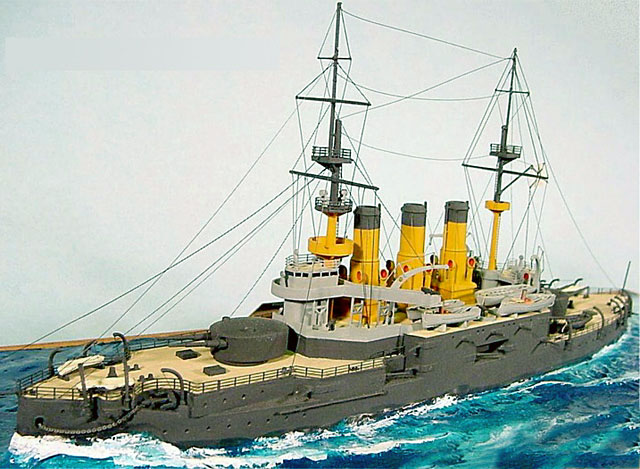
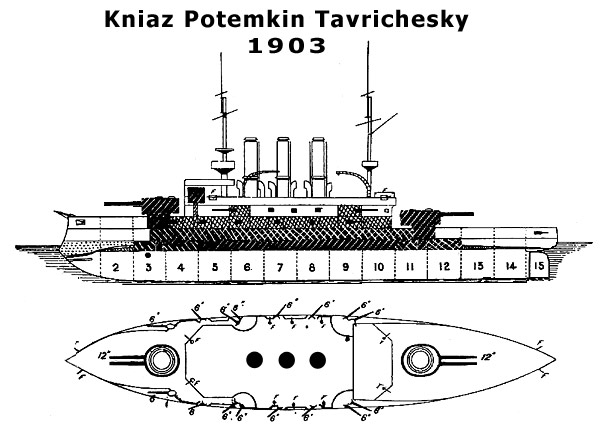
Here we have the Kniaz Potemkine Tavritchesky, ‘Prince Potemkin of Tauris,’ a pre-dreadnought battleship of the Imperial Russian Navy, in model form.

Built at the  Nikolayev shipyard 1898-1904, she was a proud warship and one of the strongest in the Black Sea fleet, — a more modern vessel than any ship the Sultan of the Ottoman Empire could muster. She was thoroughly modern, with much help from French, German, and British engineering firms in her design. She was the first Russian battleship with liquid-fueled boilers and a centralized fire control.

Specs:
Displacement:  13500 tons full load
Length:     115 m (377 ft 4 in)
Beam:     22.3 m (73 ft 2 in)
Draught:     8.2 m (26 ft 11 in)
Propulsion:

2 shaft VTE,
22 Bellville coal-fired boilers,
11,300 hp

Speed:     16 knots (30 km/h)
Complement:     18 officers and 763 men
Armament:

4 × 305 mm (12 in) guns in two turrets,
16 × 152 mm (6 in) guns,
14 × 75 mm (3 in) guns,
various small-calibre guns.
5 × 380 mm (15 in) torpedo tubes

Armour:

Krupp armour
6–9 in (150–230 mm), belt
2.5–3 in (63–76 mm), deck
10 in (250 mm), turrets
5–6 in (130–150 mm), casemates
9 in (230 mm), conning tower

When Russia found herself in the middle of the Russo-Japanese War in 1904, the brand new ship, forbidden from ever leaving the Black Sea by international treaty, lost most of her best and most experienced crew. Only raw recruits and an understrength and untalented NCO and officer corps were detailed to the ship. On June 23, 1905 a group of sailors met to plot a mutiny. The next day some 40 sailors are removed from the ship. The battleship put to sea for gunnery training with her inexperienced crew. On June 27th, all hell broke loose.

At 4 am the ship took on a supply of rotten meat. The Russian tars, already pissed at their life of toil, notice the maggots and the revolutionaries start a boycott of the Borscht made with the meat. The ship’s captain, had the 700-man crew assembled on deck and ordered to eat it, of which only 12 sailors obey. The rest are threatened with 20 armed marines, the sailors dispersed. Second-in-command Gilyarovsky calls for tarpaulin so he can execute 30 sailors who did not flee, and not soil the decks. 30 revolutionaries steal rifles from the armory, and take over the signal and engine rooms. They rush aboard, the marines do not fire. Stoker Nikishkin fires the first shot.The captain flees to his cabin. Gilyarovsky shoots Grigory Vakulinchuk then orders the guards to fire, they flee, he is shot. They stop the torpedo boat Ismail from escaping with officers who jumped overboard. 7 officers are killed, 12 arrested. 25 sailors are elected to a committee with Matyushenko chairing. They make ensign Alekseyev, the only one of the 18 officers to side with the mutineers, captain. They raise the red flag and toss the Tsar’s portrait into the sea. At 10pm they arrive at Odessa.

For three days the Potemkin was a revolutionary battleship in Odessa harbor. On the morning of 30 June the three loyal battleships Tri Sviatitelia, Dvenadsat Apostolov, and Georgii Pobedonosets arrived to take the red flag of the Potemkin down, or sink the ship. The crew of the Apostolov refused to ram the red battleship while the Pobedonosets broke into open mutiny. Over the next two days, the mutiny spreads to a great many ships across the entire Black Sea Fleet. Slowly however the risings on the other ships flare up and die out. The commander of the Apostlov, one Captain Kolands even tried to blow his own ship and drown his crew. By July 8th, the revolutionary battleship sailed to Constanta Rumania, where her sea cocks were opened in the harbor and her crew surrendered.

The Tsar decreed that she was, after the events of 1905, renamed the Panteleimon after the patron saint of accidents. Here she is during that time period, in flat paint scheme. From 1906-1917 she was always left to bring up the rear in any naval parade, never to have a position of honor or carry an admiral’s flag.

In October of that year the ship was re-floated and returned to the Tsar. In shame her name was stricken and once she was repaired she was entitled Saint Pantaleon, the patron saint of accidents and loneliness. With a new crew (more than 600 of her old remained in Rumania or emigrated abroad) she quietly served the Tsar. During World War One she fought unremarkably against the combined German-Ottoman forces and in 1917, after the Tsar was deposed, her old name was restored. During the Russian Civil War she was scuttled for a second time, by the British, in April 1919 when the Interventionists abandoned Odessa. Not worth salvaging, the Soviets scrapped the hulk in the 1920s.

Her story, was immortalized in Sergi Einsteins epic 1925 film, The Battleship Potemkin.

The Potemkin was scrapped before the film was shot, however the Soviets dug up the old battleship “Dvenadtsat Apostolov”, (that had refused to ram Potemkin in 1905) as a stand in. That old beater had been removed from active service in 1911 and served as depot  hulk without engines or armament until mid-1920s, when the film was made. Despite the fact that she was from a similar period (1892) she was only about half the size of Potemkin (at 8,000-tons and with only two stacks instead of three) and had to be heavily modified externally with dummy gun turrets.

However the film lives on….

« Older Entries Recent Entries »