For better or worse, with all the drama over a proposed U.S. purchase of Greenland, the Danish military has gotten aggressive over showing that it is ready to protect the massive frozen landmass.
In recent weeks– and the first such deployment to Greenland since 2014– the Royal Danish Air Force has dispatched a Bombardier CL-604 Challenger (tail C-172) and four F-16AMs (E-007, E-018, E-101, and E-605) under the control of the Arktisk Kommando.
Based at Kangerlussuaq, they were shepherded over the Atlantic, the 2,100 miles from their base at Vojens-Skrydstrup, by a French A330 MRTT tanker, which is sticking around as part of NATO.
They have been patrolling over Nuk and up and down the East Coast.
The Danish Home Guard (Hjemmeværnet), which numbers some 44,000 volunteers in Denmark, has activated small groups to support operations in exercises in Greenland in recent years, but doesn’t have HJV units among Greenland’s cities and towns.
The six-month Arktisk Basisuddannelse course, open only to Greenlanders, mimics the Danish military basic training course and blends field and classroom instruction
The program has been recruiting youth from among 13 towns and settlements across Greenland and graduated its first 19 students in November 2024.
Arktisk basisuddannelse (Arctic Basic Education) students, Greenland’s first “home guard” style class. While many may go on to join the Arktisk Kommando or Greenland police and fire agencies, it isn’t a requirement.
The country has also just entered into an agreement to purchase four MQ-9B SkyGuardians for use in Greenland.
Coming soon: Danish MQ-9B SkyGuardians over Greenland
If you enjoy my always ad-free Warship Wednesday content, you can support it by buying me a cup of joe at https://buymeacoffee.com/lsozi
Warship Wednesday, Jan. 8, 2025: Frozen Comanche
USCG image.
Above we see the 165-foot (A) Algonquin-class U.S. Coast Guard Cutter Comanche (WPG 76) with her warpaint on, circa 1942, while part of the oft-forgotten Greenland Patrol during WWII. With Greenland and its defense in the news right now, it is worth revisiting the ship that started the whole discussion, so to speak.
The Algonquins
In 1934, the Coast Guard moved to construct a half dozen new ice-strengthened patrol gunboats (by Navy standards). These were based on the successful circa 1915 165-foot ice-breaking cutter Ossipee (WPG 50) but constructed with a reinforced belt at the waterline and a cutaway forefoot, features that, combined with their geared turbine drives– the first for the USCG– were thought capable of breaking up to two feet of sea ice.
USCGC Ossipee, view taken circa 1916, shortly after her completion. NH 89751
Coast Guard 165-foot cutter Ossipee, Boston Navy Yard, April 1932. Note her 3-inch guns forward. Boston Public Library, Leslie Jones Collection
The plating doubled around the bow, the cutaway forefoot, short length, and medium draft made these cutters good ice boats. They had a heavy steel belt around the vessel at the waterline and relatively short bilge keels, so in a seaway they had a tendency to roll considerably.
Built for a total of just under $3 million in Public Works Administration construction allotments, three of these new cutters– Algonquin (WPG-75), Comanche, and Mohawk (WPG-78) — were awarded on 14 October 1934 with Pusey & Jones Company of Wilmington, Delaware while a week later on 23 October a second trio– USCGC Escanaba (WPG-77), Onondaga (WPG-79) and Tahoma (WPG-80)-– were contracted with Defoe on the Great Lakes at Bay City, Michigan.
Using a pair of side-by-side Foster-Wheeler high-pressure boilers to feed a centerline 1,500shp Westinghouse double-reduction geared turbine mated to a single screw, the Algonquins could make a paint-peeling 12.8 knots at full RPMs or a more economical 9.4 knots, with the latter allowing a 5,000nm range– long enough legs to wallow across the Atlantic if need be or pull far-off Bering Sea and International Ice Patrols.
Algonquin on trials in the Delaware River, 1934
A peacetime crew of six officers and 56 men could handle the cutter and a main battery of two 3″/50 guns, curiously arranged abreast of each other on the foc’sle, backed up by a pair of two quaint old 6-pounders off the bridge wings, provided a top-side armament. Typical of Coast Guard cutters for the time, the 3-inchers were almost always well greased up and covered, only fired on annual gunnery exercises, while the 6-pounders were used more liberally for law enforcement, saluting, line-throwing, and signaling. Typical peacetime allowances per cutter included 55 service rounds and 110 “Navy” blanks per 6-pounder and 60 service rounds per each 3-incher.
There were also enough small arms to send a light platoon-sized (30-man) landing force ashore, arranged in a six-man HQ team, two eight-man rifle squads, and an eight-man machine gun detachment. The 1938 small arms allowance for cutters of this size was for 40 M1903 Springfield rifles with bayonets and slings, 15 M1911 pistols with two magazines apiece, two M1917 Lewis guns, and at least one Thompson sub gun, all fed by 2,400 rounds of .30 caliber ball for the Lewis guns and rifles and a whopping 6,000 of .45 ACP for the pistols and Tommy guns. A full 38 sets of “landing force gear” including a FAK, mess kit, canteen, web belt with pouches, haversack, and pack carrier was stored for such use.
Coast Guard cutter crew made up in landing force kit. Note the M1903 Springfield rifles. USCG Historian’s Office, CG-09231220211-G-G0000-025
These cutters also had magazines for legacy 238-pound guncotton or smaller new 150-pound TNT electrically detonated “wrecking mines” used in destroying derelicts– or in reducing hazardous icebergs and blasting paths in the ice sheet.
Coast Guard destroying a derelict with TNT mines. March 1927. An explosion on the water throws lumber through the air. In the foreground is the railing of a Coast Guard ship with the American flag flying. The caption reads, “Destroying a derelict with TNT mines. The Coast Guard destroys or removes from the path of navigation hundreds of such derelicts each year.” NARA 26-G-03-21-27(1)
As detailed by a 1935 Yachtsman article, these cutters typically carried a 36-foot motor launch with a 20hp engine, two 26-foot Monomoy type surf boats, and a 19-foot surf boat, the latter three vessels oar-powered.
Electrified, these cutters had an extensive radio suite (three transmitters and four receivers) with the vessel’s radio call letters prominently displayed for overhead aircraft, interior and topside lighting, refrigerators and reefers sufficient for length patrols, and a pair of remote-controlled 12-inch incandescent searchlights on the flying bridge overhead.
Meet Comanche
Our cutter is the second to carry the name of the fierce Native American tribe in the USCG.
The first, a 170-foot vessel which was the service’s first attempt at a “modern” steam cutter in 1897, originally commissioned as the USRC Windom and, after serving during the Spanish-American War and the Great War, policed against rumrunners in the Gulf of Mexico during Prohibition before she was disposed of in 1930.
The original USCGC Comanche, formerly USRC Windom, seen in 1920. CG Historian’s Photo.
Our Comanche, laid down at Pusey & Jones in late 1933, was launched in September 1934 and commissioned in December.
Comanche seen on 26 November 1934, post-delivery but before commissioning in a rare period color photo. Note she does not have her Navy-owned main and secondary batteries fitted yet but does have her gleaming white hull, buff stack and masts, and black cap.
The Coast Guard has never been overstaffed and the plankowners of her first crew were transferred hot from the old cutter Gresham, which was being decommissioned for the first time and was co-located at Wilmington. As Gresham still had stores aboard while Comanche did not, her crew had to walk back to their old cutter for meals for the first several days.
Her 1934 deck log for commissioning, detailing her initial five officers and four men transferred from the USCG inspector office at the builder’s yard while 43 other men came from Gresham:
One of her enlisted inherited from Gresham, 44-year-old S1c Maurice D. Jester, listed above, had volunteered for the service in 1917 as a surfman. A chief boatswain mate by 1941, Jester was given a temporary lieutenant’s commission post-Pearl Harbor and, in command of the 165-foot USCGC Icarus (WPC-110), would sink one of the first U-boats (U-352) by an American ship in WWII, earning a Navy Cross in the process.
But we are getting ahead of ourselves.
Comanche was stationed at Stapleton, New York on Staten Island, and carried out the typical varied missions of the Coast Guard, often deploying to Florida for patrols and naval training exercises in the summer.
CGC Comanche in service, 1930s, note she has her armament installed
A page covering a typical day while on one such stint deployed to the Sunshine State:
Having an ice-cruncher bow, she also pulled down the additional task of light ice-breaking on the Hudson River in winter.
Comanche Hudson River ice patrol, Saugerties, 1938
Comanche Hudson River Ice Patrol, 1939
March 1936. “This image depicts the Coast Guard cutter Comanche, which found the pictured vessels stuck fast in the ice off Poughkeepsie, N.Y., and broke the ice to free them.” NARA 26-G-04-27-36(8)
War! (In Denmark)
Despite being neutral, Denmark was invaded by Germany on 9 April 1940.
German Linienschiff Schleswig-Holstein off Denmark on April 9, 1940, sending landing forces ashore
This led to a tense occupation that, for the first three years or so, still “allowed” the Danes to keep their military, so long as it remained in skeletal format hiding in its garrisons and ports.
The majority of the ships of the Royal Danish Navy would be immolated or drowned by their faithful crews in August 1943 when the Germans moved to capture them once the veil of civility was removed from the occupation. Despite being almost totally disarmed and de-fueled to comply with German armistice requirements, a handful of vessels managed to make it across the Oresund to neutral Sweden or were lost trying.
A few vessels outside of metropolitan Denmark- such as the two armed Icelandic Coast Guard cutters Aegir and Odinn and two smaller vessels in Greenland waters which we will get to- escaped German custody or destruction to prevent such custody. A beautiful 212-foot three-masted schoolship, the Danmark, filled with Danish merchant marine and naval cadets, was on an extended visit to America in 1940 and would end up clocking in after Pearl Harbor, crew included, to train over 5,000 USCG and USMM officer cadets during the war as USCGC Danmark (WIX-283).
Meanwhile, in giant colonial Greenland, the world’s largest island, the entire armed Danish military presence in April 1940 amounted to the Royal Danish Navy inspektionsskip Maagen and opmålingsskib (survey ship) Ternen. Small shallow draft sailing cutters with auxiliary diesels had an 11-member crew, a single ancient low-angle 3-pounder (37mm) M/84 cannon, and some small arms. Four larger corvette/frigate-sized inspection ships existed– Besytteren, Islands Falk, Hvidbjornen, and Ingolf— but were in Denmark getting ready for their summer patrols and thus were trapped there under German occupation.
The Royal Danish Navy’s opmålingsskib (survey ship) Ternen, left, and inspektionsskip Maagen, right, wintered in Greenland waters and thus were there in April 1940, escaping German capture. They were small cutters, at about 70 feet oal and 100 tons displacement, good for about 8 knots on their single diesel engine.
Other than the two cutters, the only other armed body in Greenland were the police under their inspector (Politiinspektør for Østkysten), the multi-hatted Danish polar explorer Ejnar Mikkelsen– who was back in Denmark at the time. The force had two stations (politistationer), at Eskimonæs (to cover the Norddistriktet) and Ella Ø (to cover the Syddistriktet), with just two officers at each location. This was to enforce the law over a territory about three times larger than Texas. Even this token group was only created in 1933 to answer the dispute with Norway over what was called Erik Raudes Land in north-east Greenland, with the League of Nations arbitrating that if Denmark wanted to continue to claim all Greenland as its territory, it had to maintain a permeant presence.
Although Norse settlements went back to the 9th Century, the island’s population in 1940 was still just hovering around 18,000, and the four police officers and 22 navy personnel described above were all that was needed for its constabulary purposes.
Meanwhile, the U.S. military had long bumped along the Greenland coast, including the Navy visiting it during the Polaris expedition of 1871–1873, the Juniata and Jeannette expeditions in 1873 and 1879-81, the Greely Relief Expedition in 1884, and the well-known Peary Arctic Expedition in 1898-1901.
In 1928, the 125-foot USCGC Marion carried out two full months of extensive oceanographic and iceberg studies of the region, fleshing out charts and adding to the general knowledge of the 450,000 sq. miles of the Davis Strait, with copies forwarded to the Danish Hydrographic Office. Her skipper was LT Edward Hanson “Iceberg” Smith, a polar ice nerd who had attended MIT before joining the Revenue Cutter Service in 1910, loved working the International Ice Patrol and went on to attain a Ph.D. in oceanography from Harvard.
USCGC Marion alongside a glacier in Baffin Bay, Canada. August 1928. The Active-class patrol boat, built for the Rum War, would go on to serve through WWII and was only disposed of in 1962. NH 46401
In 1933, the American Geographical Society wrapped up a trip to nearly all the fjords in Greenland between 72°30’ and 74°North latitude including photogrammetric mapping of the valleys, glaciers, and mountains and depth charting the fjords with echo-sounding equipment. Five years later, American meteorologist Clifford MacGregor conducted a groundbreaking study on the formation of polar air masses over Greenland.
To complicate things, the chief industry in Greenland in 1940 was an immense and strategically important cryolite mine at Ivittuut (Invigtut, also seen as Ivigtut)– a vital mineral used at the time to smelt aluminum. The largest known natural deposit of cryolite in the world was at Ivittuut, where about 150 mostly Canadian and Scandinavian miners toiled in the pits for the rare substance under the employ of the Kryolith Mine-og Handelsselskabet A/S.
Kryolitminen, Ivigtut, Greenland, 1937. The ships are the Danish patrol gunboat Hvidbjørnen (right) and the mine’s tender, the 1,200-ton coaster SS Julius Thomsen. Hvidbjørnen, trapped in Denmark in 1940, was scuttled by her crew during the war while Thomsen, taken over by the British, survived and kept up a regular transit between Canada and America and the mine during the war. THM-18645
With all this in mind, the two Danish Landsfogeder (governors) of Greenland, Eske Brun and Aksel Svane, invoked a 1925 emergency clause that allowed the colony to govern itself in the event of war. Moving forward, the Landsfogeder coordinated with the Danish ambassador in Washington, Henrik Kauffmann, to act as a sovereign nation per the Monroe Doctrine for the U.S. to protect Greenland and keep it neutral.
Kauffmann met with his American counterparts in D.C. on 10 April 1940, the day after the Germans rolled into Denmark. The response was warm.
But first, there needed to be a U.S. presence in Greenland.
Comanche to the rescue!
With the State Department in high gear to recognize the new (if temporary) independent government in Greenland and with the blessing of the island’s local administrative councils, Comanche, then in New York City’s Pier 18, made ready to sail in early May 1940. This shortcutted the planned British “Force X” being organized in Canada to seize the island.
Comanche took aboard Consul James K. Penfield and Vice-consul George L. West, on State Department orders. Also sailing on the cutter would be Maurice R. Reddy, the assistant director of the American Red Cross, tasked with assessing Greenland’s need for supplies as the last ship from Denmark had arrived the previous October. She also carried a detachment of five spare Coast Guard radiomen which would be landed to operate the infant consulate’s radio station and provide security.
Every nook and cranny of the 165-foot cutter was packed with extra provisions, heavy on canned goods, salted meats, and tinned fish. The crew was issued heavy sheepskin coats and purchased commercial in the city’s garment district. Also included as cargo, as detailed by the New York Times, was a “complete outfit of office furniture for the consulate,” and a “fairly large quantity of lumber fastened down on the forward deck. It was supplied to the Red Cross and will be used to build sheds to shelter supplies sent later.”
The poor little 165-foot Comanche was so loaded down (thanks largely to the superhuman efforts of the Despatch Agent, Mr. Fyfe) that even the Captain’s shower was stuffed with boxes of books, skis, snowshoes, rubber boots and duffle bags full of parkas, woolen underwear and heavy socks. But in spite of its load it pitched and rolled its way to St. Johns with such gusto that we thought we’d never know the meaning of the word horizontal again, except in the very unsatisfactory relative sense of a body in a bunk (when it wasn’t pitched out onto the deck).
Leaving NYC on the 10 May 1940– the same day Germany invaded neutral Luxembourg, Belgium, and Holland on his sweep through the Lowlands while the British preemptively occupied Iceland for the Allies– the little overseas mission arrived at Godthab (now Nuuk), on Greenland’s west coast, on 20 May.
A thrilled-looking U.S. Consul James K. Penfield (right) and Vice Consul George L. West Jr. (left) arrive in Greenland aboard Cutter Comanche. (Acme News Pictures Inc. 1940).
Discharging her cargo and passengers, Comanche proceeded 200nm down the coast to become a station ship at Arsuk Fjord, directly adjacent to the cryolite mining concern.
Soon, 14 Coastguardsmen recently “discharged” from the service took up newly established positions as uniformed security guards on the staff of the Invigtut cryolite mine, paid a hefty $125 per month (the average non-rate in the USCG made about $50 a month) for the next 12 months with a $225 bonus for completing the contract, all paid by the local Greenland government. The funds to pay these guards, as well as to buy a “surplus” 3″/50 gun, eight Lewis guns, and 55 M1903 rifles landed via USCG cutter, along with shells and bullets for said ordnance, came from a $1 million cash deal from Uncle Sam for local goods negotiated by Brun in a delegation carried back to America by the USCGC Campbell.
This original detachment was soon joined by a 15th man, late from the interned training ship Danmark. A replacement shift of 20 similarly recruited “newly civilianized” USCG men would arrive in July 1941 and guard the mine until May 1942 when the U.S. Army took over the watch.
Comanche at Shipshaven, Ivigtut Greenland 1941
Besides Comanche, two larger cutters soon followed: the 327-foot Treasury class cutters Campbell (June 1940) and Duane (August) with both of the 5-inch gunned twin-screwed cutters suffering issues in the ice. By 10 September both the 327s were sent back to the U.S. The icebreaking USCG Northland also arrived in August and would operate on the wild east coast of Greenland where a plan was made with local officials to clear the remote Northeast coastline of its 20-odd inhabitants with the assistance of the Free Norwegian Navy gunboat Fridtjof Nansen.
Comanche was relieved at Ivittuut on 4 September 1940 by the 250-foot Lake class cutter Cayuga. By January 1941, Northland and Cayuga had returned to the U.S. for the worst of the winter, leaving behind the 15 guards at the mine and five radiomen at the consulate to hold down the island until April 1941 when Cayuga and Northland would return.
Meet the Greenland Patrol
On the first anniversary of Germany’s occupation of Denmark, 9 April 1941, the U.S. and Greenland entered into a formal defense agreement.
With a special U.S. survey team, carried by Cayuga to Greenland, working from Ternen and the local Greenland administration’s motorboat JP Koch, coupled with Northland’s J2F Duck, efforts were made to map the coast. The 240-foot USCGC Modoc (WPG-46) arrived in May and joined the efforts– coming uncomfortably close to the running fight against the German battleship Bismarck and the Royal Navy in the process.
On 1 June 1941, the South Greenland Patrol, under USCG LCDR H.G. Beford, was established around Modoc (flag) Comanche, the 110-foot icebreaking harbor tug USCGC Raritan (WYT-93), and the famed polar schooner Bowdoin (commissioned in the Navy on 16 June as IX-50).
A week later the sister organization, the Northeast Greenland Patrol, was formed in Boston around Northland, USCGC North Star, and the 70-year-old retired cutter Bear, the latter recommissioned in naval service as USS Bear (AG-29). The force would be led by now-LCDR Iceberg Smith, USCG.
With the two patrols consolidating in Greenland waters by mid-July, by early August the first PBY flying boats were arriving, the first maritime aircraft based year-round on the island. The PBYs would eventually be operated by a dedicated unit, Patrol Squadron Six (VP-6 CG) as an all-Coast Guard outfit home based at Narsarssuak (Narsarsuaq), Greenland, a base soon coded as Bluie West One (BW-1).
By early September, Comanche, with an Army survey team aboard, was back in local waters making reconnaissance patrols of the Southeast Greenland fjords. She would later go on to establish the lce Cap Station at Igtip Kangertiva, a bay on Greenland’s southeast coast that went on to be dubbed “Comanche Bay” for obvious reasons as well as Weather Station Able (later Bluie West 7) at Gronne Dal (Grønnedal).
The survey work by these cutters and aircraft resulted in the 178-page volume “Greenland Pilot & Sailing Directions” by 1941.
Quietly, the entire Coast Guard was transferred to the Department of the Navy on 1 November 1941, by Executive Order 8929, although it should be noted that, under E.O. 8767 of June 1941 the USCG was authorized to operate as a part of the Navy.
USN ONI 56 Escanaba class 165As including Comanche and Onondaga
Eventually, there were upwards of 25 Allied– primarily American– bases in Greenland during WWII.
At its height, some 5,500 military personnel were based on the island.
(Note Comanche Bay)
In 1942 alone, 86,000 tons of cryolite were shipped to the U.S. and Canada for use in aluminum production.
Meanwhile, on 26 June 1942, the first large-scale trans-Atlantic ferry flights of Allied military aircraft to Britain using Greenland and Iceland began. Comanche was there, as noted by her XO in a post-war interview, serving as the visual aide and radio beacon at the fjord entrance to the main airbase, Narsarsuak, for the first USAAF trans-Atlantic flight of B-17s. The ship logged the arrival of 26 B-17s on that first day, from 2:40 am to 10:30 pm.
The so-called North Atlantic Route, saw three fields in Greenland– Narsarssuak (BW-1), Angmagssalik (Bluie East 2), and Sondrestrom (BW-8)– used as a stopover between Maine/Newfoundland and Iceland, trans-shipping as many as 300-400 aircraft per month, primarily B-17, B-24 and B-25 bombers, to Europe.
B-17s ferry flight through Greenland Jan 1945 U.S. Air Force Number 122001AC 342-FH_000017
War comes to the Greenland Patrol.
Comanche was tied up at Ivigtut on 7 December 1941, a dry Sunday that saw local temperatures hovering around 34 degrees. By that point, she had spent most of the previous 19 months in the Danish colony’s waters.
While I can’t find that the Germans ever attempted a serious move against the cryolite mine at Invigtut, they did come to Greenland in search of something else.
As early as 11 September 1941, the cutter North Star, visiting Eskimonaes, had a report from local hunters of a flagless two-masted steamer poking around Young Sound. Chased down the next day, the steamer was the 105-foot Norwegian sealer Buskoe who had delivered a German agent– Jacob R. Bradley– and meteorological personnel ashore.
With a need to help forecast the weather in Europe and the Atlantic, and being cut off from meteorological reports from Canada in 1939 and America in 1941, the Germans needed weather stations in the Arctic. This led to somewhat disjointed efforts by the German Army, Luftwaffe, and Kriegsmarine weather services to establish their own. Even the Abwehr got involved with their own hybrid weather/listening stations.
The Kriegsmarine sowed the icy Barents and Greenland Seas with at least 15 unmanned Wetterfunkgerät See (WFS) radio-transmitting weather buoys. While their employment would seem ideal, these 33-foot tall buoys were not well-liked by the U-boat crews tasked with deploying them as they took nearly two hours of assembly on the surface in calm seas with the boat’s torpedo crane as muscle– and that’s if everything went right. Plus they had a planned lifespan of 10 weeks once deployed but most of them went dark well short of that.
Most of the 15 assorted manned stations were established in Svalbard (Spitzbergen) while one (Schatzgräber) was set up off Russia’s arctic coast on Franz Josef Land. An unmanned station was even set up (and only found decades later) on the coast of Labrador!
As part of this, the Kriegsmarine moved to establish no less than four fixed (Edelweiss I and II, Holzauge, and Bassgeiger) as well as one migratory (Zugvogel, on sea ice) weather station in Greenland during the war.
The counter to this was Greenland’s first and only army, the locally-recruited Nordøstgrønlands Slædepatrulje (Northeast Greenland Sledge Patrol), which blended Danish police officers and Danish, Greenlandic and Norwegian fur trappers into an irregular force, almost devoid of military training, that would get into at least two firefights with German weather troops along the 700-mile stretch of Greenland’s most rugged coastline.
The Northeast Greenland Sledge Patrol would grow to 27 members during WWII. Armed with their own hunting rifles and a few short M1889 Danish Krag engineer carbines (ingeniørkarabin) and uniformed only with an armband, one member of the patrol would perish in a fight with weather station Holzauge personnel.
The Germans, for their part, sometimes went on the offensive, with their own patrols burning down half of Greenland’s police stations, when they attacked the Eskimonæs station (BE-5) in March 1943, driving off the two Danes in residence at the time. While destroying radio and weather equipment, they were good enough to leave a storage shed with food largely untouched and the post’s Danish flag unceremoniously stuffed into a box
The station was attacked by a German force on the night of March 23-24, 1943. The Germans burned the main building but first took down the flag and left it in a box. Note the kennels of the sled patrol.
It was in this atmosphere that the Greenland Patrol carried on their war.
Original caption: White Phantoms of the Northern Seas. The breathless beauty of an iceberg floating from the Arctic holds the gaze of Coast Guardsmen, lining the rail of a combat cutter. Frequently, the sturdy Coast Guard Cutters on the Greenland Patrol encounter these floating islands of glistening ice – dazzling to look upon but hazardous to the ships that pass over the northern lanes.
Coast Guard in Greenland: USCG crew on a water-cooled .50 caliber Browning mans their gun on patrol. 17 October 1942. NARA 26-G-10-17-42(2) 205580166
Kungnat Bay, Greenland. Coast Guard sentry keeps watch as the armed trawler USCGC Arundel (WYT-90) lends assistance to a freighter in the middle distance, 1 February 1943. 26-G-3491
The ensuing so-called “Weather War” saw well-armed and J2F-4 amphibian-equipped USCG combat icebreakers round up 60 German POWs, smashing two weather stations in the process while capturing a third that was recently evacuated, and chasing down three armed Kriegsmarine trawlers– Kehdingen, Coburg, and Externsteine, taking the last as a prize.
This image depicts a Coast Guardsman on watch aboard a vessel in Greenland, painted by Coast Guard Combat Artist Norman Millet Thomas, in February 1943. NARA 26-G-02-06-43(1)
This image depicts a USCG landing party from the cutter Northland (WPG-49) gathering captured German remote radio-weather station equipment that had been parachuted in on Northeast Greenland, in September 1943. Note the M1903 Springfields, shaggy dog, and the mixture of blue, grey, and OD Navy and Army gear. NARA 26-G-3501
German POWs on deck of the USCGC Northland (WPG-49) in 1944 as part of the Weather War off Greenland. These may be from the Cape Sussie weather station (Unternehmen Bassgeige), taken down in late July 1944, and landed by the German trawler Coburg.
Comanche at times also served as a floating kennel, running sled dogs from location to location in addition to her work clearing paths through the ice, standing guard at the cryolite mine, and escorting convoys.
From her July 1943 deck log:
Fighting Arctic Wolves
Besides the defense of the cryolite mine and the skirmishes of the Weather War already mentioned, it should be pointed out that the fight against German U-boats, even in these frozen waters off Greenland, was very real.
On 4 September 1941– three full months before Pearl Harbor, the destroyer USS Greer (DD-145) narrowly missed a torpedo fired by U-652 in Greenlandic waters while en route to Iceland.
Comanche served on numerous convoys (SG-19, SG-29, SG-30, SG-37, SG-52, SG-74, GS-27, GS-34, GS-39 et.al.) running ships from Newfoundland to Greenland and back, often tossing ash cans and Mousetrap rockets on suspect underwater contacts.
Comanche, still in her peacetime scheme, escorting SS Munago, 1941, South Greenland, Peary Museum
Comanche in her wartime outfit. She carried a QCL-2 sonar, SF radar, had her 6-pounders replaced with 20mm Orelikons, mounted two depth charge racks, carried four “Y” gun projectors (with allowance for 14 depth charges) had two 7.2-inch Moustrap ASW rocket devices installed.
The report from one such brush with a sonar contact incident:
She also had to pick up the pieces.
Such as in the rescue of freighter USAT Nevada in December 1943. The 950-ton cargo ship, part of Convoy 5G-36, en route from St. John’s to Narsarssuak, became separated in 20-foot high seas and 60-mile-per-hour winds snow squalls that ended with her holds flooded.
Comanche was the closest to her and went to work, catching up to her while still about 200 miles south of Greenland.
From her deck log :
Steamship Nevada (American Freighter, built 1915) photographed from the deck of the USCGC Comanche (WPG-76) as Nevada was foundering in the North Atlantic, circa 15-18 December 1943. Comanche was able to rescue twenty-nine of those on board Nevada, but thirty-four lost their lives during the abandonment of the storm-crippled ship. In 1918-1919 Nevada had briefly served as USS Rogday (ID # 3583). NH 66258
Her most famous rescue came during the sinking of the 5,649-ton USAT Dorchester, a pre-war M&MT cruise ship built for 314 passengers that had been turned into a 750-space troopship. On Dorchester’s fifth convoy run (third to Greenland), leaving outbound on 29 January 1943, she was assigned to SG-19 out of St. Johns bound for Narsarssuak with a complement of seven officers, 123 crewmen, 23 Navy armed guards, 16 USCG, 597 Army personnel and 155 civilian passengers.
M&MT passenger steamer S.S. Dorchester (1926-1943) photographed during 1942 as a USAT SC-290583
Riding shotgun on SG-19 was Comanche and her sister USCGC Escanaba (WPG 77) as well as the larger 240-foot cutter USCGC Tampa (WPG-48). Also in the convoy were the Norwegian steam merchants Biscaya and Lutz, whose holds were full of cargo and building materials to construct bases.
Six days out, in heavy seas and rough weather while 150 miles southwest of Greenland’s Cape Farewell, U-223 (Kptnlt Karl-Jürg Wächter) crept in close enough at 0102 in the predawn of 3 February to fire five torpedoes at the largest vessel in the little arctic convoy– Dorchester— and the transport soon went down. While Tampa moved to shepherd Biscaya and Lutz to nearby Skovfjord (Tunulliarfik) on Greenland’s southern tip, Comanche and Escanaba stood by in the dark and frigid waters to pick up survivors.
Using the “rescue retriever” technique for the first time– which amounted to a rubber-suited volunteer on a line dropping overboard and coming back up with a person– Escabana scooped up 81 survivors from the water and rafts and 51 from one lifeboat. Lacking the same protective suits as used on her sister, nonetheless, three officers and nine enlisted men of Comanche personally picked up 41 survivors from another lifeboat and 57 from rafts and the freezing water.
After the Dorchester slipped beneath the waves on 3 February 1943, the USCGC Comanche and Escanaba rescued dozens of survivors from the doomed Army troopship. (Painting by Robert Lavin, via U.S. Coast Guard History Office)
Dorchester Torpedoed by Perry Stirling, showing Escanaba and Comanche picking up survivors (USCG painting)
Of the more than 900 souls aboard Dorchester, the sea claimed 674, largely due to hyperthermia, with men succumbing to the cold within minutes of hitting the water. The sinking of Dorchester is regarded by the Navy as the “heaviest loss of personnel suffered in any U.S. convoy during the war.”
Among those lost to Poseidon were four Army clergy members, all lieutenants– Methodist minister George L. Fox, Reformed Church in America minister Clark V. Poling, Catholic Church priest John P. Washington, and Rabbi Alexander B. Goode– who voluntarily gave up their own life jackets when the supply ran out then reportedly joined arms, said prayers, and sang hymns as they went down with the transport. They are well-remembered as the “Immortal Chaplains” and were posthumously granted the Chaplain’s Medal for Heroism in 1961.
Speaking of heroism, one of Comanche’s fearless retrievers, STM 1c Charles Walter David, Jr., 25, suffering from hypothermia and pneumonia, died in a hospital ashore in Greenland after the rescue operation and he was interred in the permafrost. In addition to saving Dorchester survivors, he is also credited with bringing Comanche’s XO, a fellow retriever, back after the officer was suffering exposure.
His widow Kathleen W. David, and newborn son, a young son, Neil Adrian David, were presented with his Navy and Marine Corps Medal, posthumously.
Further illustrating the danger of the waters around Greenland during the war, Escanaba was lost on the early morning of 13 June 1943 in an explosion off Ivigtut, with the official conclusion that she was struck by either a torpedo or a mine. Only two of her crew survived. Another smaller cutter, the converted trawler Natsek (WYP-170) would vanish without a trace in December 1942 while out of Narsarssuak bound for Boston. Meanwhile, Northland sighted and attacked a U-boat in the Davis Strait on 18 June 1942 reportedly almost catching a German torpedo for her trouble.
All in all, nearly 50 American warships served on the Greenland Patrol during the conflict, almost all of these Coast Guard assets. Of those cutters, four of Comanche’s five Algonquin class sisters clocked in, with the only exception being USCGC Onondaga (WPG-79) who spent the war fighting the Japanese in Alaskan waters.
Upwards of 300,000 U.S. military aircraft were produced during the war, with the rare mineral harvested from the Greenland shale a big part in making that happen.
Post War service
VE Day found Comanche at the USCG Yard at Curtis Bay, Maryland undergoing a much-needed 30-day overhaul that she entered on 17 March 1945. Once she emerged, she caught orders to proceed to Iceland for air-sea rescue duties from June through September 1945.
Once the Coast Guard transferred back to the Treasury Department from the Navy on New Year’s Day 1946, Comanche had her war-time armament removed, and her homeport shifted to Norfolk. However, the service, flush with very new ships (13 255-foot Owasco class cutters were commissioned in 1945-46) shoehorned into a peacetime budget, soon put all the remaining Algonquins into storage in an “in commission, in reserve” status, with reduced crews.
Comanche decommissioned 29 July 1947. Cleared for disposal, she was sold on 10 November 1948 to the Virginia Pilots Association who used her as a floating office and barracks boat until 1984 when the 50-year-old historical cutter was donated to the Patriot’s Point Museum in Charleston, South Carolina, for use as a floating museum.
The nuclear-powered freighter NS Savannah, the retired 327-foot Treasury-class cutter USCGC Ingham (WPG 35), and the former USCGC Comanche, all the way to the right, almost unrecognizable after 35 years as a pilot boat, at Charleston’s Patriots Point Naval Museum in the late 1980s. Savannah has been in Baltimore since 2008 and Ingham is now at Key West.
Comanche’s career as a museum ship was short-lived, being seriously damaged by Hurricane Hugo in 1989 and closed.
This led to her donation to the South Carolina DNR for use as a reef in 1992.
She is located 22.5 miles North of Charleston Harbor at a depth of 110-120 feet and is a popular wreck dive.
A few stirring interviews with her wartime crew remain. One of these is with EM 2c Richard N. Swanson, one of the volunteer retrievers on the Dorchester rescue who earned his Navy and Marine Corps Medal the hard way.
Patriot’s Park saved some of the relics still aboard Comanche in 1992 and has them at the park. They also donated one of her wartime 2,100-pound anchors to the Florence Veterans Park ashore in SC.
The cutter’s 1934-marked bell has been at the Arlington, Virginia barracks of the Coast Guard Ceremonial Honor Guard since at least 1999, where it is used in annual remembrances and individual “ringing out” ceremonies.
The Honor Guard was established in 1962 and performs an average of 1,200 ceremonies each year across the United States. It is housed in the Coast Guard’s old Washington Radio Station in Alexandria and Comanche’s well-polished bell is on its quarterdeck.
The service recycled the name for a third Comanche.
The Coast Guard acquired the former Navy 142-foot Sotoyomo-class auxiliary ocean tug USS Wampanoag (ATA-202) and placed her in commission as the medium endurance cutter Comanche (WMEC-202) in February 1959. Based in California except for a two-year stint in Corpus Christi, Texas, she was involved in several high-profile blue water rescues across a 21-year second career.
The third Comanche (ex-Wampanoag) is preserved as a floating museum in the Seattle area.
On 16 November 2013, the Coast Guard officially commissioned the USCGC Charles David Jr (WPC 1107) in honor of Comanche’s lost Dorchester retriever. His body had been reinterred at Long Island National Cemetery post-war.
His granddaughter was the ship’s sponsor.
Rear Adm. Jake Korn, Coast Guard Seventh District commander; Sharon David, granddaughter of the cutter’s namesake and sponsor of the Coast Guard Cutter Charles David Jr; and Chris Bollinger, president of Bollinger Shipyards; look at information about Charles W. David Jr. before the commissioning ceremony. Steward’s Mate 1st Class Charles David Jr. was posthumously awarded the Navy and Marine Corps Medal for his part in saving the lives of nearly 100 U.S. Army soldiers and members of his own crew during World War II. U.S. Coast Guard photo by Petty Officer 3rd Class Mark Barney.
Likewise, former Comanche plank owner, the sub-busting LCDR Maurice Jester, has his name on a sistership of David, USCGC Maurice Jester (WPC-1152).
In 1951, the Danish Naval Station Grønnedal was established as a year-round home for Greenland Command, since 2012 the Arktisk Kommando, which has a permanent staff of 36 civilians and military personnel in a big blue building in Nuuk.
Arktisk Kommandos hovedkvarter in Nuuk
In the summer, a force of three modern 1,700-ton Knud Rasmussen class OPVs, augmented by another four 3,500 Thetis-class OPFs, roam the Greenlandic littoral.
Danish patrol vessel HDMS Knud Rasmussen (P570) ice-breaking in Greenland waters, December 2022, around Narsaq, Narsarsuaq, and Qassiarsuk
The Greenland Police is still seen as a district of the Danish state police, numbering 300 members. There is no local territorial defense force.
The Danish Home Guard (Hjemmeværnet), which numbers some 44,000 volunteers in Denmark, has activated small groups to support operations in exercises in Greenland in recent years, but doesn’t have HJV units among Greenland’s cities and towns.
The six-month Arktisk Basisuddannelse course, open to only to Greenlanders, mimics the Danish military basic training course and blends field and classroom instruction
The program has been recruiting youth from among 13 towns and settlements across Greenland and graduated its first 19 students in November 2024.
Arktisk basisuddannelse (Arctic Basic Education) students, Greenland’s first “home guard” style class. While many may go on to join the Arktisk Kommando or Greenland police and fire agencies, it isn’t a requirement.
When it comes to U.S. bases, the Americans pulled out of most of the BW/BE stations by 1947 with a few exceptions: BW-1 (Narsarsuaq) closed in 1958 and Stromfjord (BW-8) in 1992, while Pituffik Space Base (formerly Thule AB, formerly BW-8) is still very much a thing, supported by the USCG, MSC, and Canadian Coast Guard and operated by the Space Force. The Army had Camp Century (including a novel underground nuclear reactor) there in the 1960s. The USAF also had four unmanned DEW stations in Greenland between 1960 and 1990.
The Coast Guard, meanwhile, still frequently gets to Greenland waters where they continue to work with local and Danish forces.
USCGC Campbell transited south along the west coast of Greenland overnight with the Royal Danish Navy vessel HDMS Knud Rasmussen and rendezvoused in a position just offshore of Evighedsfjorden (Eternity Fjord). CGC Campbell received HDMS Knud Rasmussen’s Executive Officer, Commander Bo Ougaard, on board to serve as an ice pilot and provide local knowledge to assist CGC Campbell in safely entering and transiting Evighedsfjorden. Once inside Eternity Fjord, CGC Campbell launched their MH-65 Dolphin aircraft and proceeded up the fjord to the head where the glacier begins. U.S. Coast Guard photo by Seaman Kate Kilroy DVIDS 200907-G-NJ244-002
Meminisse est ad Vivificandum – To Remember is to Keep Alive
Ships are more than steel and wood And heart of burning coal, For those who sail upon them know That some ships have a soul.
If you liked this column, please consider joining the International Naval Research Organization (INRO), Publishers of Warship International.
The International Naval Research Organization is a non-profit corporation dedicated to the encouragement of the study of naval vessels and their histories, principally in the era of iron and steel warships (about 1860 to date). Its purpose is to provide information and a means of contact for those interested in warships.
With more than 50 years of scholarship, Warship International, the written tome of the INRO has published hundreds of articles, most of which are unique in their sweep and subject.
PRINT still has its place. If you LOVE warships you should belong.
U.S. Coast Guard Pacific Southwest recently saluted the 101st birthday of a WWII-era Coastie, Lewis Miskelly Jr.
Born in Pennsylvania in 1922, he studied at the Pennsylvania Academy of Fine Arts prior to the conflict and volunteered for the Coast Guard just after Pearl Harbor. While not an official war artist, he painted what he saw while in Atlantic convoy duty on the Coast Guard Cutter Mojave (WPG-47), a 240-foot Tampa-class cutter.
Shown here is the ‘Tampa’ class gunboat type cutter USCG Mojave (WPG-47), 1942, operating amid ice floes off Greenland.
As noted by the USCG Historian’s Office during that period:
Mojave was assigned to the Greenland patrol in 1942, where she took part in convoy escort and rescue operations. While acting as escort for the slow group of Convoy SG–6 which had departed Sydney, Nova Scotia 25 August, she assisted in the rescue of 570 men from the torpedoed army transport Chatham. The escort and antisubmarine accomplishments of the cutters were truly vital to the winning of the Battle of the Atlantic.
USS General R.L. Howze (AP-134) anchored off Manus Island, Marshall Islands, circa 1944-45.
Commissioned in early 1944, Howze completed 11 voyages to the combat areas of the Pacific, before returning to San Francisco 15 October 1945, carrying troops and supplies to New Guinea, Guadalcanal, Manus, Eniwetok, and “many other islands as the rising tide of the Navy’s amphibious offensive swept toward Japan.”
When he was 52, he learned how to surf. He cruised the waves of Pacifica and Santa Cruz until he was 85. He does tai chi everyday and still loves biking and driving his car.
For most of his life, he worked as a structural engineer and naval architect, which took he, his late wife June and four kids from Marconi to Petaluma in 1963. He worked until he was 75.
Thank you for your service, and your work, Mr. Miskelly.
When talking over the weekend in reference to the 80th anniversary of the lost USCGC Natsek (WYP-170) during WWII’s massively unsung Greenland Patrol, these images from the Danish Arktisk Kommando— their all-services joint Arctic command that interfaces both with NATO and the U.S., Icelandic, Canadian and UK forces in the region stretching across the Faeroes and Greenland– seems timely.
The below shows the new Rasmussen-class patrol vessels HDMS Knud Rasmussen (P570), HDMS Ejnar Mikkelsen (P571), and HDMS Lauge Koch (P572) of 1. Eskadre working the Greenland coastline for the last couple of weeks.
The Danes throughout the Cold War kept a trio of purpose-designed ice-strengthened arctic offshore patrol craft in the region and continue to do so, rotating Royal Danish Navy vessels deployed to Greenland to perform coast-guard duties, while an intrepid 14-man Siriuspatruljen (sled patrol) polices the interior, with the benefit of air-dropped supplies.
The Rasmussens replaced the trio of much smaller (300-ton, 11 knots, 2x.50 cal HMGs) Agdlek-class patrol boats that walked the beat from the 1970s through 2017.
The old Agdlek-class OPVs, exemplified by the HDMS Tulugaq (Y388) seen here, were essentially modified steel-hulled trawler/whaler types, mounting just a pair of .50 cal Brownings
The new 1,700-ton 235-foot vessels are much more capable– not to mention downright naval-looking– with a 76mm M/85 OTO Melera main battery, embarked helicopter/UAV support, and space/weight available for both ASW torpedo tubes and Sea Sparrow missiles.
While low-speed (just 17 knots maximum speed) they are meant to poke around and, with their two large RIBs, send VBSS inspection teams out to check on things both ashore and afloat. Speaking to the latter, they are manned by just an 18-person crew but have accommodations for an embarked helicopter det and a small (16-man) platoon of commando types, of which Denmark has a proficient group.
And, of course, there are some other benefits of walking the Greenland beat, such as plenty of ice for your New Year’s drinks!
Some 80 years ago today, a warship and her entire crew vanished from the waves and not a single confirmed piece of her has ever been seen since.
Constructed in 1941 at Snow Shipyards in Rockland, Maine, the 225-ton, 116-foot wooden-hulled longline trawler F/V Belmont was acquired for $2,122 on 19 June 1942 by the U.S. Coast Guard for use on the newly-formed Greenland Patrol, watching over the Danish possession and fighting the “Weather War,” keeping German radio and meteorological stations out of the frozen land.
Commissioned as USCGC Natsek (WYP-170), named in honor of a geographical feature on Greenland, her armament was slight– an old 6-pounder 57mm gun taken from prewar cutter stocks that was deemed still deadly enough to haul over German weather trawlers in spotted, two 20mm Oerlikons should she encounter a German Condor patrol plane, and two short depth charge racks should she see a U-boat.
Assigned to CINCLANT control out of Boston with the rest of the Greenland Patrol, Natsek could make a stately 11 knots and cruise at 9.5. Her and her Snow-built half-sisters USCGC Nanok (ex-F/V St. George) and USCGC Nogak (ex-F/V North Star), earned the nickname of “wooden shoes” as they looked, well, like large wooden shoes and had about the same characteristics.
Other vessels of the Greenland Patrol converted at the time included seven larger and sturdier steel-hulled trawlers (F/V Helka, Lark, Weymouth, Atlantic, Arlington, Winchester, and Triton) that likewise received similar armament and Greenland geographical monikers but starting with an “A” to set them apart as a class (USCGC Alatok, Amarok, Aklak, Arluk, Aivik, Atak, and Arvek, respectively).
Besides keeping the Germans out of Greenland, the Patrol’s primary task was to establish and supply a series of 14 “Bluie” met and HF/DF stations around the coastline. Airfields would soon be added to these isolated stations to allow them to serve as way stations for the North Atlantic ferry route, running planes from bases in Labrador to Scotland with stops in Greenland and Iceland.
The fact that these converted trawlers could carry 90 tons of cargo below decks and draw but 11 feet of seawater when doing so helped greatly. While it would seem folly to us today to task 10 small vessels (the largest of these, Winchester/Aivik, was only 590 tons and 128 feet overall) with such a mission, keep in mind that the locations chosen for the Bluie stations were often only reachable by snaking through dense fields of icebergs and narrow fjords, so chosen to remain hidden from German surface raiders.
Natsek’s first patrol, began just ten days after she was commissioned, with newly-minted Lt. (jg) Thomas La Farge, USCGR, skipper. La Farge, who had no prior military experience, received his temporary commission as he was “a yachtsman and lover of ships” and noteworthy as a grandson of the late, great, muralist, John La Farge.
She set sail for Greenland waters in company with the minesweeper USS Bluebird (AM-72), and fellow USCG-manned armed trawlers Atak and Aivik, as part of CTG 24.8 on 29 June. Arriving at Bluie West #1 (Narsarssuak) on 20 July, Natsek plied Greenland waters, supplying Bluie stations through the month of August. Beginning on 28 September, she set sail from Narsarssuak to transport supplies, equipment, and personnel to Skoldungen to establish and build a weather station. She arrived there on 12 October. She continued on to help establish another weather station, this time at Torgilsbu and later that month another one at Skjoldungen.
On 9 November she was ordered to assist in looking for a downed plane along the southeast coast of Greenland.
On 15 November she then received orders to escort the Army cargo ship Belle Isle to Torgilsbu from Skjoldungen. She accomplished the escort without incident and arrived at Torgilsbu on 16 November. She departed Torgilsbu on 23 November and arrived at Narsarssuak on 30 November.
On 14 December 1942 Natsek departed Narsarssuak in a convoy with Bluebird and fellow “wooden shoe” USCGC Nanok, to return to Boston via Belle Isle Strait.
Natsek never arrived.
In January, the Navy made it official after she was several weeks overdue.
From the 1/24/43 issue of the NYT:
The detailed story of her disappearance, via the 1947 report, “The Coast Guard at War: Lost Cutters”
Click to make bigger
This, from “Death of a Wooden Shoe :A Sailor’s Diary of Life and Death on the Greenland Patrol, 1942” by Thaddeus D. Nowakowski, a journal kept by a Coast Guardsman during his six crucial months as a seaman on board Natsek’s sister, USCGC Nanok, and digitized by the Coast Guard Historian’s Office in 1994:
Besides LaFarge, Natsek vanished with a crew of 23 including 10 Coast Guard regulars (counting both her chiefs) a Navy radioman, and 12 wartime-era recruits. Considered lost at sea, their names are inscribed on the World War II East Coast Memorial in Manhattan’s Battery Park as well as a marker at Arlington that notes of the Natsek:
The entire crew of 23 men and one commissioned officer are considered to have met death in the line of duty on or after 17 December 1942, as a result of drowning.”
As for the Weather War, the Allies won and today, Bluie West Six is Thule Air Base, still an important enough asset that the Pentagon on Friday awarded a $4 billion civil engineering and maintenance contract to a local firm in Greenland, Inuksuk A/S, running through 2034.
How about these nice balmy pictures from the Royal Danish Navy’s Thetis-class offshore patrol frigate HDMS Triton (F358) off the southwest coast of Greenland, where it is something on the order of 20 degrees below 0C?
Today the USCG has a mandate to secure and protect the coasts of the United States of America. This includes its entire coast.
The US has some 2000-miles of Atlantic coastline, 1600-miles of Gulf of Mexico coastline, and 1300-miles of Pacific Coastline. Hawaii has some 700-miles of Pacific Coast and Puerto Rico has 300-miles in the Atlantic/Caribbean.
Then there is Alaska. Seward’s Folly has approximately 5580 miles of coastline, (6640 miles of coastline including its islands.) If every actual mile of coastline including every cove and beach is counted, there are more than 44,000-miles. If you walked one thousand miles a year, it would take forty-four years to hike Alaska’s coastline!
Most of this is in the Northern Pacific; however 1400-miles of it is the sunny US Arctic Coast. From Kotzebue to Barrow to the Yukon it stretches across the north slope of Alaska.
Moreover, not a single military base exists there.
Current US Polar Bases, Stars are DOD bases (Army and Airforce) circles are USCG bases. Note from the Bering Sea to Greenland, thier are no bases on the US Arctic coast
The missions of U.S. polar ship operations are as follows:
Conducting and supporting scientific research in the Arctic and Antarctic.
Defending U.S. sovereignty in the Arctic by helping to maintain a presence in the region.
Defending other U.S. interests in Polar Regions, including economic interests relating to the U.S. exclusive economic zone (EEZ) north of Alaska.
Monitoring sea traffic in the Arctic, including ships bound for the United States.
Conducting other typical Coast Guard missions (search and rescue, law enforcement, etc.) in Arctic waters, including U.S. territorial waters north of Alaska.
Today the only US icestrengthend ship in service with the Coast Guard is a single medium icebreaker that is overworked. With numerous missions for its single icebreaker, how can the US Arctic Coast be patrolled reasonably?
The Northwest Passage
Legions of explorers looked for the Northwest Passage for hundreds of years; this included the ill-fated Franklin Expedition, which perished virtually to a man in the 1850s. The first man to complete the voyage was Norwegian explorer Roald Amundsen in a small 70-foot long 47-ton herring boat called the Gjoa.
The Northwest Passage has been accomplished 15 times by American vessels, and U.S. Coast Guard icebreakers have been the only American surface combatants to do so, carried out 11 of these voyages. In 1957 the ice-strengthened buoy tenders Storis, Bramble and Spar were the first of these Coast Guard cutters to make the journey through the passage, establishing a tradition that was followed by the Coast Guard icebreakers Northwind and Staten Island (1969), Polar Sea (1985, 1990), Polar Star (1988,1989) and Healy (2000, 2003). The other three American warships to transit fully the Northwest Passage were the submerged nuclear powered submarines USS Nautilus (1958), USS Queenfish (1970) and USS Seadragon (1958). The US-flagged tanker M/V Manhattan was the first commercial vessel to make a full transit (in 1969).
The Northwest Passage is now wide open in some parts during the summer. In 2006, the Hapag-Lloyd cruise ship M/S Bremen sailed through it with passengers. The Bremen, built in 1990, is 6.752 gross tons carries 164 passengers and 100 crewmembers in its non-ice reinforced hull.
On April 9, 2006, Canada’s Joint Task Force North declared that the Canadian military would no longer refer to the region as the Northwest Passage, but as the Canadian Internal Waters. The declaration came after the successful completion of Operation Nunalivut (Inuktitut for “the land is ours”), which was an expedition into the region by five military patrols.
With no US icebreakers to prove otherwise, it looks like Canada is right.
The Schooner fix
In recent years, no less than four privately owned US-flagged yachts have completed the passage in a single season since 1984, showing the feasibility of passing through. This craft were ocean cutter types ranging from 40-60 feet in length and handled the NWP in fine style without an extensive support staff or multi-million dollar budget.
Schooners have long been an excellent source of transportation through the sea ice with minimum support. Remember it was Amundsen himself who used his 70-foot long, 47-ton sailing boat, the Gjoa, to transit the route first.
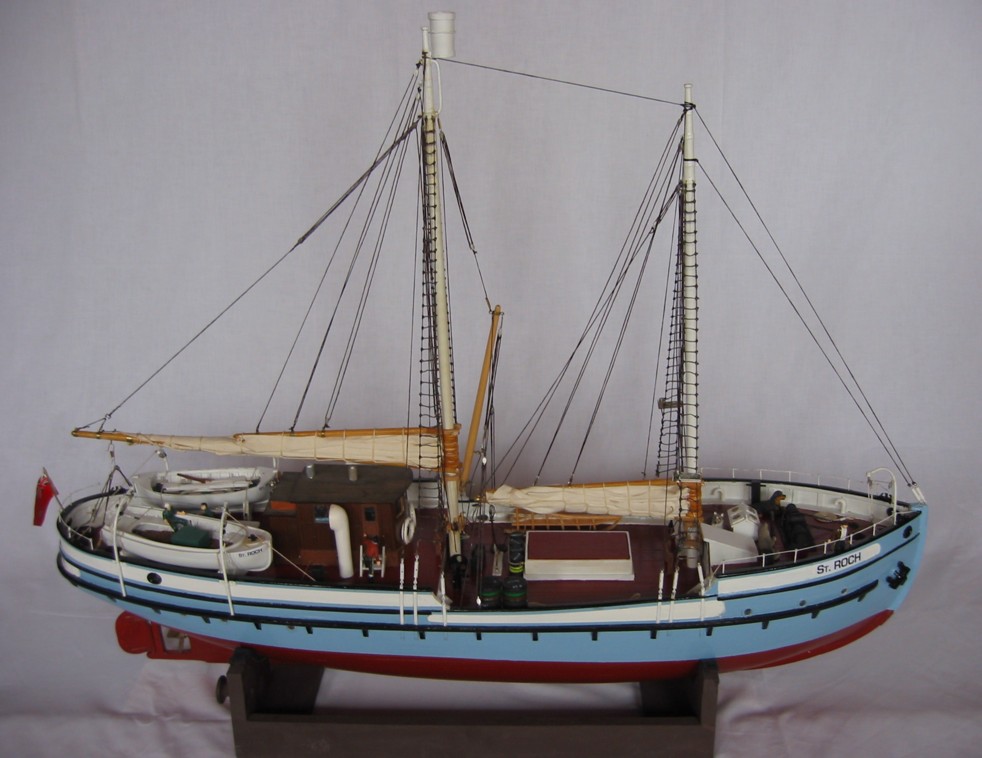
A model of the humble 104-foot St Roch which patroled the NWP for 14-years, including during World War Two
Built in 1928, the Vancouver-built arctic schooner St. Roch was used by the Royal Canadian Mounted Police to patrol the NWP in 1940-54. It was the first ship to completely circumnavigate North America, and the second sailing vessel to complete a voyage through the Northwest Passage. It was the first ship to complete the Northwest Passage in the direction west to east, going the same route that Amundsen on the sailing vessel Gjøa went east to west, 38 years earlier. In 1944, St. Roch returned to Vancouver via the more northerly route of the Northwest Passage, making her run in 86 days. The epic voyages of St. Roch demonstrated Canadian sovereignty in the Arctic during the difficult wartime years, and extended Canadian control over its vast northern territories.
The St Roch was 104-feet long, carried three sails on two masts, weighed 323-tons, and was capable of extended patrols in the arctic. Carrying a number of RCMP Mounties who were given a crash course in sailing, they were equipped to perform dog sled patrols from the ship once it was locked inside polar ice. Preserved as a museum ship since 1954, the St Roch was an excellent design.
The closest thing to the St Roch in the US was the arctic schooner Bowdoin. Built at the specifications of famous polar explorer Donald B. MacMillan, the ship was designed by William H. Hand of New Bedford, Massachusetts and built by the Hodgdon Brothers shipyard of East Boothbay, Maine.
The 88-foot Bowdoin, completed more than 26 arctic expeditions and sailed more than 300,000-miles
The 88-feet long, 60-ton Bowdoin is one of the smallest vessels designed for Arctic work. It is a two-masted, baldheaded auxiliary schooner made from double-planked and double-framed white oak. A five-foot belt, one-and-a-half inches thick, made of tough Australian greenheart, protects against ice, and the rudder is overly large for turning easily and quickly when working through narrow stretches of open water between ice packs. The Bowdoin’s single propeller is deep under water to avoid damage, and the hull is rounded, designed to rise up out of the water when caught between ice pans or to crush ice blocking the way. A nosepiece of steel plate weighing 1800 pounds is bolted to the hull to aid in crushing ice and protect from collisions with heavy ice. Its original engine, built to be able to burn whale blubber if needed, was replaced by a 300-hp diesel.
a mock up of the Bowdoin's hull shape, that allowed her to withstand winters iced-in along Canadas frozen coast without damage
The ship completed more than 26 trips to the Arctic and sailed in excess of 300,000-miles in its service life under MacMillan. During World War II, the Navy from May 1941- December 1945 used the Bowdoin to conduct patrols around Greenland before Macmillan resumed his scholarship on the schooner.
The ship is currently owned and maintained, still in sailing condition and on occasional arctic service at nearly 80-years old by the Maine Maritime Academy in Castine, Maine, for training runs to Labrador and Greenland.
A modern polar patrol schooner
If a modified version of an arctic patrol schooner could be made today, after study of the successful Bowdoin and St Roch, both of which are perfectly preserved, it could be made of more modern materials and with current SOLAS and Lloyds guidelines.
A strongly built modern schooner configuration can be had for a as low as $1.7-million in Europe and half that amount in South America. Even if you double the European amount to take into account US shipyard craft costs, and double it again for the custom nature of the design, it can still be expected to get a new 100-foot arctic schooner built for polar operations in a stateside shipyard for under $7-million per copy. If multiple hulls were ordered, the cost for hulls 2, 3, 4, etc. would be amortised out and acquisition costs further reduced.
Composite materials and hi-tech polymers can take the place of wooden planks and beams in the Bowdoin and St Roch. Carbon-epoxy-aluminum sandwich construction yields amazing results in strength with very low weight and can be molded into exotic hull shapes, such as on the original Bowdoin. A tender issued by the USCG allowing current US yacht makers to participate in submitting bids can lead to very appreciable savings realization.
Green Schooners
In 1999 – 2000, two people sailed the 40-foot yacht Rusalka Mist from the island of Jersey in the English Channel, via Tenerife to the Caribbean and back via the Azores without a generator. Using only solar panels and a small towed waterpower generator, they provided self-sufficiency in electrical energy during this trip, both at sea and at anchor during the year. With technology ten years more advanced, commercial off the shelf, technology can be had that increases this today.
Solar panels and wind turbines are often found in DIY rigs on todays modern sailing yachts
In the past decade, solar panels and wind turbines have appeared across boat docks all over the country. Many live-aboard owners of medium to large sailing craft have installed 300-400 watt wind turbines, each about 24-inches in diameter on their craft to power refrigeration, electronics, laptops etc. while in moored away from shore power. Many other owners have installed PV (solar power) panels on flat areas of their decking and pilothouses to provide the same amount of power. Using both of these technologies, a modern arctic patrol schooner can utilize renewable resources by feeding power into a bank of 12-36 marine batteries (as a substitute for ballast) for use at a constant rate. Coupled with energy saving measures on the craft such as the use of low wattage LEDs instead of traditional bulbs from interior lighting, power saving modes on electronics not in use, and other efficiency ideas, the use of a ships gen set and diesel could be minimized.
For auxiliary propulsion when becalmed as well as exiting and entering port, electric thrusters could be used inside the hull and a single efficient diesel electric motor combination rigged to a central prop or water jet in the rear of the craft.
With efficient food service technology and on board, grey water storage, and trash compactor the ecological footprint of such a vessel could be kept low for transiting sensitive biological areas.
The 189-foot ultra modern Rainbow Warrior III. Lets get a few of these built half the size and paint them icebreaker red with a white coast guard racing stripe.
Greenpeace’s Rainbow Warrior III, a 189-foot steel-hulled, 3 masted ship, classified as a yacht, was built in Bremen for and was billed as being ‘green’. For an estimated 14-million pounds (about $25-million USD), the Germans built a craft that is one of the “greenest” ships afloat. With her sail rigging for propulsion, the engine projected to be needed only for 10% or less of the time. Two 50-metre masts will carry 1,200 square meters of sail and the engine is described as a “state-of-the-art hybrid.” All materials, from the paintwork to the insulation, have been chosen with a view to sustainability, and each component has been supplied with “transparent ethical sourcing.” The 189-footer carries advance communication suites inside an armored citadel safe room, a helipad with support capabilities, RHIB boats, et al.
It is not impossible
Why the USCG?
The USCG has a long and varied sailing history. Founded in 1916 by absorbing the US Revenue Cutter Service with the US Life Saving Service, both of whom had operated sail-powered vessels for nearly 150-years, the USCG is a prime sailor. During World War 2, the Coast Guard maintained a “Corsair Navy” that included hundreds of sail yachts taken up from civilian service. These sail yachts, often classified as WPY’s (Coast Guard-Patrol-Yard) were generally under 100-feet and manned by a 7-man crew. Armed with a couple of machineguns, a depth charge rack and small arms they escorted coastal convoys, conducted harbor patrols, and waved the flag in every small port across the country from 1942-44.
The CG81004, a 81-foot twin masted schooner, one of many that the USCG used during World War Two, heading out on patrol. Armed with a .50 caliber browning on the fordeck over the bowsprit and two short depth charge racks on her stern, the schooner ws a warship that conducted patrols off the US coast from 23 Aug 1942- 19 July 1945 with a crew of coast guard reservists.(from Robert Scienas Coast Guard Cutters of World War Two)
The USCG were very much in the cold-weather schooner biz in the 1940s
The Coast Guard also used many full sized sailing ships 150-300-feet in length including the Sea Cloud, Danmark, Hussar, and Joseph Conrad for officer training throughout the war years. After the war, the USCG acquired the former Nazi sail training vessel SSS Horst Wessel, a 295-foot barque. Recommissioned as the USCGC Eagle in 1946 the ship is well known and sails the world with 19 officers, 56 crew, and 175 USCG Academy cadets and instructors. Eagle has over 6 miles (9.7 km) of running rigging and approximately 22,300 square feet (2,072 m2) of sail area and has broken 19-knots using her sails alone. She is America’s Tall Ship and has represented the country around the world for six decades.
The USCGC Eagle in her training paint. Arctic patrol schooners could be painted the same color as other USCG polar assets- Red with white strips
Besides service on the Eagle, USCGA cadets all undergo the 12-day Coastal Sail Training Program (CSTP) that has been expanded to include 100% of each incoming class. The 12-day program runs all summer long with crews starting each Monday. Cadets sail both the 16 Colgate 26-footers and a fleet of Ludders 44-footers around Connecticut, Rhode Island, and Massachusetts. Plans are afoot to replace the Ludders with modern 44’s of a more up-to-date design.
USCGA cadets start in small 26-footers and work thier way up to the Eagle. USCG officers know sailing firsthand.
The coast guard knows sailing craft, and at any given time during warm months, you can be assured that hundreds of its officers, coasties, and cadets are staring up at canvas blowing in the breeze.
Incumbent enlisted and NCO crew-members assigned to the Arctic Patrol Schooners could cycle through the Coast Guard Academy’s sail program during the off-season to get a feel of life under sail. Its possible that the Bowdoin herself could be leased and used for a year as a workshop vessel to spin up the plankowners of the first schooner crews while their ships are being built.
The Mission
A 100-foot two masted arctic patrol schooner, equipped with renewable energy PVs and wind turbines, could be capable of extended patrols along both the Northwest Passage and the US Arctic Coats during summer months. At least three vessels would be required.
One craft could be detailed to make an eastern pass through the NWP, sailing from Boston to Seattle (both USCG shore bases with support available) on a 60-day timeline from May-June. To satisfy Canadian concerns, a RCMP or Canadian Coast Guard liaison officer, or even a Danish Navy liaison could be embarked, instantly making it a ‘Joint’ NATO patrol. Transient NOAA, USGS, or USF&W researchers could also be carried. Joint operations with Canadian Navy and Army assets, Alaskan National Guard and other DOD assets could be undertaken.
One craft could be detailed to make a western pass through the NWP, sailing from Seattle to Boston on the same timeline. These two vessels could rendezvous along the passage with a small (and photographed) ceremony before breaking off and sailing to their respective destinations.
One craft could undertake an extensive (read- slow) US Arctic coastline survey from May-September from Nome to the Yukon. Along the way, the vessel would stop in coastal towns such as Wales, Kotzebue, Point Hope, Barrow, and Prudhoe Bay for port calls. At each portcall an embarked US Public Health Service healthcare professional could set up one-day clinics to the public, tours could be given of the ship, reports taken from concerned locals etc. Another possibility would be to embark an Alaska State Police members or conservation officers to augment the coasties. This craft would be available for local SAR on the Arctic coast if needed during the summer months, provided it was within range.
During the winter months where the Arctic coast and NWP is iced in, the patrol cutters could tour the US East and West coasts as low-cost public relations exercises with reduced crews. The coastal sailing would keep the ships and crew sharp and spread the information about their mission. The platforms could also be utilized to provide sail training workshops to non-USCGA assets such as cadets of the US Merchant Marine Academy, USCG OCS, and CPO program schools etc. while iced out of the Polar Regions.
Being of an ice-strengthened design, it is possible for the crew; if provision was made for resupply, to remain locked in the NWP, or US Arctic Coast during the winter months should the needed mission arise.
Further vessels could be built and forward deployed to Antarctica to assist National Science Foundation assets there if deemed desirable.
The craft ideally could be operated with the same crew as a current USCG patrol boat. The 87-foot Marine Protector WPBs carry a nine-person crew consisting of a commander (MCPO/O2-3), chief petty officer, engineer, FS, Ops petty officer, two seaman strikers, and two fireman strikers. A similar sized crew with sailing experience could operate a patrol cutter. The Bowdoin had berthing for 14, which included the explorer who built her and his guests. The St Roch sailed with a 10-man crew of RCMP constables but held 19 berths and room for sled dogs. A similarly sized USCG patrol schooner could embark its 9-man crew as well as have a few additional berths for liaison officers, scientists, public affairs people, USPHS doctors etc., as the mission requires.
For SAR and use as a utility boat a short-range prosecutor 17-foot RIB could be carried by the patrol schooner, launched via davit. A small UAV aircraft could be embarked for ice surveys, wildlife spotting, oil spill reporting and so forth. Similarly, a small ROV submersible could be carried
For defense operations, including possibly escorting tankers from Prudhoe Bay if needed, M2 12.7mm heavy machineguns could be mounted. This, coupled with the small arms locker onboard, reproduces the armament carried either by the current 420-foot USCG icebreaker Healy, or by its fleet of 87-foot patrol boats. For National Science Foundation missions carrying research scientists, the armament can be secured below decks or disembarked completely.
The total tasking of three patrol schooners, even assuming one Coastie on shore for each embarked, would require less than 60-personnel. With the back-of-an-envelope estimated cost of each schooner to be in the realm of $7-million apiece, the fleet would cost somewhere in the region of $21-$30 million for acquisition when support equipment is accounted for. With a new USCG full-sized heavy icebreaker estimated at costing $925-million per hull, the program would be a drop in the bucket comparatively.
The USCG still needs a few more large seagoing icebreakers, but a few ice strengthened arctic patrol schooners can help bridge the gap that we have today from almost no dedicated coverage to reliable yearly tasked ships.
What could three 100-foot schooners accomplish?
The bottom line is, they can accomplish more than what is there now. It has been 9-years since the last US warship passed through the NWP (the Healy in 2003.) A yearly patrol by two schooners, one from each direction, coupled with a Joint interaction with NATO allies in the region already, establishes a precedent. With energy resources at a premium and potential non-NATO powers looking to the Arctic, this is important.
The US Arctic Coast is often forgotten. With each of the NWP patrol schooners passing through each year, and the third schooner dedicated to spending its summer poking along the coastline from Nome to the Yukon, a message is sent. A 225 or 175-foot buoy tender from the 13th CG District making aids to navigation repairs or possibly a 110-foot WPB sent from southern Alaska in the summer months could augment this patrol. If those platforms are not available, it is the schooner’s bread and butter.
Lets compare the missons again of the USCG polar forces and see how a trio of arctic patrol schooners could manage:
The missions of U.S. polar ship operations are as follows:
Conducting and supporting scientific research in the Arctic and Antarctic (yes).
Defending U.S. sovereignty in the Arctic by helping to maintain a presence in the region.(yes)
Defending other U.S. interests in Polar Regions, including economic interests relating to the U.S. exclusive economic zone (EEZ) north of Alaska.(yes, while its not realistic for a schooner to chase down a third nation fishing trawler or rouge whaler, its UAV and RIB can provided the ship was in range)
Monitoring sea traffic in the Arctic, including ships bound for the United States.(yes, with three schooners passing through the arctic every season, it is reasonable that third country ships passing through the NWP may see all 3 of them)
Conducting other typical Coast Guard missions (search and rescue, law enforcement, etc.) in Arctic waters, including U.S. territorial waters north of Alaska. (yes, to a limited degree. With thousands of miles of water to cover the schooners would be spread very thin, however it is still an increase over what is there now)