Tag Archives: old warships

Warship Wednesday Feb 19, The Wandering Island of Luzon

Here at LSOZI, we are going to take out every Wednesday for a look at the old steam/diesel navies of the 1859-1946 time period and will profile a different ship each week. – Christopher Eger

Warship Wednesday, Feb 19, The Wandering Island of Luzon

(click to embiggen)

(click to embiggen)

Here we see the spic and span US gunboat USS Isla de Luzon resting quietly at anchor with her 1900s issue white and buff paint scheme. Her life before this moment was a little different. Ordered by the Spanish government for the Armada Española, she was billed as a second-class “protected cruiser” by her government. In actuality, she was, even when new, considered smaller than most other cruisers, not to mention slow and ineffective.

In Spanish service the cruiser had a green and black paint scheme with buff to white superstructures

In Spanish service, the cruiser had a green and black paint scheme with buff-to-white superstructures

Laid down on 25 February 1886 in the UK, she was built by Elswick (Armstrong, Whitworth)  at  Newcastle upon Tyne. She was completed and commissioned in late 1887. Just over 1000-tons, she was 184-feet in length. Beamy at nearly 30 feet, she had a length-to-beam ratio of 1:6 and tended to wallow in heavy seas. She also didn’t have enough ass to push her through the waves, her 2-shaft horizontal triple-expansion engines fed by 2 cylindrical boilers could generate about 14 knots, 15 if she was light. Very lightly armored, she was also lightly armed with a half-dozen 4.7-inch guns as well as some smaller QFs and MGs but her deadliest weapon was a triple set of 14-inch torpedo tubes.

Delivered to the Armada in 1887, she served first in Europe and even dropped some shells on the Rif in Morocco from time to time, practicing true gunboat diplomacy.

Today her size and armament would make her a corvette or offshore patrol vessel. In her time, cruisers were meant to be the fast eyes of the fleet, able to reach out over the horizon, find targets, and alert the main fleet of other vessels. The Isla de Luzon was too slow for that, and she soon found herself in colonial service in the Philippines. There she could visit far-flung Pacific islands and enforce the crown’s law against the locals without too much problem. She was part of the Spanish Pacific Squadron under Admiral Patricio Montojo, which consisted of seven cruisers (of which Isla de Luzon was one of the best) and a few gunboats.

Then came the Spanish-American War.

Dewey in the USS Olympia dropping it like its hot on the moored Spanish fleet

Dewey in the USS Olympia drops it like it’s hot on the moored Spanish fleet. Isla de Luzon would be in the background closer to the shore

On 1 May 1898, Commodore Dewey steamed his Asiatic Squadron into Cañacao Bay under the lee of the Cavite Peninsula east of Sangley Point, Luzon– coincidentally the island she was named after. The resulting Battle of Manila Bay, the first major engagement of the Spanish-American War, left most Spanish ships sunk while Dewey suffered less than forty casualties by the worst estimate.

57447_isla_de_luzo_md wreck

isla de luzon
Isla de Luzon was hit three times by US shells, then was scuttled in shallow water by her crew when the battle was in its final stages. She only had a half-dozen casualties. Bluejackets from the gunboat Petrel swarmed over her stricken hull, looted what they could, and set her alight.

isladeluzonwreck

Raised after the war, she was rebuilt, rearmed with US-pattern guns, painted white, and commissioned USS Isla de Luzon on 11 April 1900.

Former Spanish cruiser Isla de Luzon soon after capture, seen in Pensacola, FL. Note she is wearing an American shield on her bow

USS Isla de Cuba 4

Note twin stacks in US service after 1911

She then served as a gunboat, sailing through the Indian and Atlantic oceans to reach her new homeland in 1903, serving as a station ship in Pensacola until 1907 when she was loaned to the Louisiana Naval Militia on 6 December 1907 and later to the Illinois Naval Militia on the Great Lakes as a training ship. She spent WWI as a torpedo tender in Narragansett Bay, instructing new gunners mates and TMs.

In 1911 she was given a new power plant and two skinny funnels. Here she is as a training ship after that date in haze grey scheme

In 1911 she was given a new power plant and two skinny funnels. Here she is as a training ship after that date in a hazed grey scheme

Decommed and truck 23 July 1919, she was sold the next year to the Bahama & West Indies Trading Co to work as a coastal trading ship in the shallow waters there under the name SS Reviver. Her 1911-installed Babcocks boilers couldn’t handle the strain and she was soon sold to Bahama Salvors, Ltd. of Nassau and scrapped in 1931 at age 44.

The only remnant of her that remains today dates back to 1902. “Following long custom, when she visited Muscat’s picturesque harbor, members of her crew painted “Isla de Luzon” on the steep entrance cliff; in later years this was periodically refurbished by visiting ships of the U.S. Navy Middle East Force Command.”

isla de luzon muscat

Her name can still be seen there today.

Her only sistership, the cruiser Isla de Cuba, was also sunk at the Battle of Manila Bay, also salvaged and commissioned into the US Navy with the unimaginative name of USS Isla de Cuba, paid off in 1912, then picked up by the Venezuelans who used her as the training ship  Mariscal Sucre until 1940.

Specs:
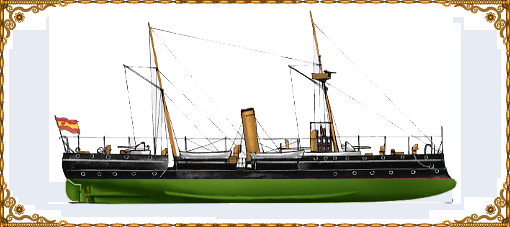
You can best see her Spanish scheme in this line drawing

You can best see her Spanish scheme in this line drawing

(As-built)

Displacement:     1,030 tons
Length:     184 ft 10 in (56.34 m)
Beam:     29 ft 11 in (9.12 m)
Draft:     12 ft 6 in (3.81 m) maximum
Installed power:     1,897 hp (natural draft)
2,627 hp (forced draft)
Propulsion:     2-shaft horizontal triple-expansion, 2 cylindrical boilers
Speed:     14.2 knots (natural draft)
15.9 knots (forced draft)
Complement:     164 officers and enlisted
Armament:     6 × 4.7 in (120 mm) guns
8 × 6 pdr quick-firing guns
4 × machine guns
3 × 14 in (356 mm) torpedo tubes
Armor:     Deck 2.5 in (64 mm)-1 in (25 mm); conning tower 2 in (51 mm)

(1900)
Displacement:     950 long tons (965 t)
Length:     195 ft (59 m)
Beam:     30 ft (9.1 m)
Draft:     11 ft 4.75 in (3.4735 m) (mean)
Propulsion:     2-shaft horizontal triple expansion engine, 535 hp (399 kW)
2-cylinder boilers
160 tons coal
Speed:     11.2 knots (20.7 km/h; 12.9 mph)
Complement: 137 officers and enlisted (1900-07), after 1907 just a small cadre of regular officers and CPOs backed by up to 200 naval militia and trainees.
Armament: Four 4″ mounts and three torpedo tubes
1905 – Four 4″ mounts, four 6-pounder,s and four .30 cal. machine guns
1911 – Four 4″/40 rapid fire mounts, four 6-pounder rapid fire mounts, two 1-pounder rapid fire mounts, and added two temporary 3-pounder rapid fire mounts
Armor:     Deck: 1–2.5 in (25–64 mm), scortched

If you liked this column, please consider joining the International Naval Research Organization (INRO), Publishers of Warship International

They are possibly one of the best sources of naval study, images, and fellowship you can find http://www.warship.org/

The International Naval Research Organization is a non-profit corporation dedicated to encouraging the study of naval vessels and their histories, principally in the era of iron and steel warships (about 1860 to date). Its purpose is to provide information and a means of contact for those interested in warships.

Nearing their 50th Anniversary, Warship International, the written tome of the INRO has published hundreds of articles, most of which are unique in their sweep and subject.

I’m a member, so should you be!

Warship Wednesday Feb 12, the Big Mass

Here at LSOZI, we are going to take out every Wednesday for a look at the old steam/diesel navies of the 1859-1946 time period and will profile a different ship each week.

– Christopher Eger

Warship Wednesday Feb 12, the Big Mass

(click to embiggen)

(click to embiggen)

Here we see the war veteran USS Massachusetts fitting out at the New York Navy Yard, 1904, USS Indiana (BB-01), her sister, is in the background. The second official US battleship, the Massachusetts had an interesting life including service against the Spanish, Germans, and a few stops in between before finally taking a beating from the Army.

Note the LOW freeboard...

Note the LOW freeboard…

Built by William Cramp & Sons Ship & Engine Building Co. in Philadelphia at a cost of $3-million, she and her sisters Indiana and Oregon were the young nations first all-steel seagoing battleships. Of course this term was relative as the ships could hardly take to sea due an extremely low free-board that threatened to swap them in heavy sea states.

span am

Ordered in 1890, she was laid down on 25 June 1891 and commissioned 10 June 1896, her construction drawn out almost six years which is evident to the new type of ship that she was. Just 350-feet long, she would be considered a small frigate today except for the fact that she was a massive 11,500-tons when fully loaded. This was because the ship was crammed with 4 double ended Scotch boilers,  two vertical inverted triple expansion reciprocating steam engines, a dozen 13-inch and 8-inch guns, forty smaller cannon and five torpedo tubes.

This was all clad in a total of up-to 18-inches of  Harveyized steel and conventional nickel-steel armor, she was crewed by some 400+ officers and men.

The men in the late 1890s, were darlings of the media and some of their pictures remain in the Library of Congress, showing an interesting aspect of the ordinary lives of bluejackets more than a century ago.

bluejackets on BB-2 getting some officially sanctioned boxing in

bluejackets on BB-2 getting some officially sanctioned boxing in

According to the history of the ship, “To the men who served on her she was more than just a battleship. The men polished her brass fittings and cleaned her wooden deck because she was their home and their protector. They proudly sailed the seas knowing that they were aboard one of the most powerful and beautiful ships on Earth. But these men did not always have it easy, they had to constantly feed the coal burners to keep the ship powered, clean the guns and ammunition and then check and recheck them to maintain battle-readiness.

U.S.S. Massachusetts, fire room 1897 note the chalk on the boiler hatches

U.S.S. Massachusetts, fire room 1897 note the chalk on the boiler hatches

“They lived in small quarters, sailed through rough seas and were away from daily comforts. Yet throughout these difficult tasks and times, recreation was encouraged. The Navy learned long ago that it was important to keep up the men’s spirits in the face of such demanding times. Before retiring to their hammocks for the evening, the men were sometimes allowed to purchase small amounts of beer. They also formed a football team and held boxing matches to help relieve tensions aboard, and on holidays special dinners were cooked for those not lucky enough to be at home with family. Overall, those who lived, worked and died in her service know that Massachusetts was a fine ship”

Marine guards c1897

Marine guards c1897. White gloves and spiked Prussian style helmets were standard for the Army too in many units at this time. 

BB-2 sailors in summer whites

BB-2 sailors in summer whites

Inside one of her turrets

Inside one of her turrets. Note the old school Donald Ducks

Capable of steaming at up-to 16-knots, she was fast for her time.

off tow ar
When war broke out in 1898 with Spain, her beautiful white and buff paint scheme switched to haze grey and she went off to the beat of the drums, joining the Flying Squadron under Commodore Winfield Scott Schley for the blockade of Cuba. Missing the main fleet battles due to having to be coaled, she did cause the old Spanish cruiser Reina Mercedes to scuttle and assisted with the occupation of both Puerto Rico and Cuba.

The 3000-ton largely disarmed Spanish cruiser Reina Mercedes, sunk in Santiago, Cuba 1898 after scuttling following an engagement with the USS Massachusetts

The 3000-ton largely disarmed Spanish cruiser Reina Mercedes, sunk in Santiago, Cuba 1898 after scuttling following an engagement with the USS Massachusetts. She cruiser suffered no less than three direct hits from her 13-inch shells.

Over the next several years she was something of a cursed ship, grounding herself on no less than three occasions as well as suffering explosions in her turret and boiler rooms.

By 1910 she was used only for gunnery training and annual summer midshipmen s cruises around the Eastern seaboard and Caribbean. In 1917 when WWI became very real for the US, she was pressed into service to train naval gun-crews which she did admirably. With the end of the war came the end of her usefulness and in 1919 she was simply renamed the very awe-inspiring and creative  ‘Coastal Battleship No.2′ before being struck on 22 November 1920. The next year she was turned over to the Army, who desperately wanted a battleship to poke holes in

Her guns and coal stores were removed as was anything that was useful. But thats ok, as the Army just wanted her armor intact anyway.

Her guns and coal stores were removed as was anything that was useful. But that’s OK, as the Army just wanted her armor intact anyway.

Scuttled in shallow water near Pensacola, she was within range of the US Army Coastal Artillery positions at Forts Pickens and Fort Barrancas as well as by mobile railway artillery and tons of ordnance were fired at the old ship through 1925 when the Army offered her back to the Navy. The Navy said thanks but no thanks and instead used her for occasional bombing runs by pilots flying out of NAS Pensacola  as late as the 1950s when she finally slipped under the waves for good.

She is now owned by the state of Florida who maintains her as an artificial reef.

As such she is a very popular dive.

Specs:

Displacement: 10,288 long tons (10,453 t; 11,523 short tons)
Length:     350 ft 11 in (106.96 m)
Beam:     69 ft 3 in (21.11 m)
Draft:     27 ft (8.2 m)
Propulsion:

Two vertical inverted triple expansion reciprocating steam engines
4 double ended Scotch boilers later replaced by 8 Babcock & Wilcox boilers
9,000 ihp (6.7 MW) (design)
10,400 ihp (7.8 MW) (trial)

Speed:

15 kn (28 km/h; 17 mph) (design)
16.2 kn (30.0 km/h; 18.6 mph) (trial)

Range:     4,900 nmi (9,100 km; 5,600 mi)
Complement:     473 officers and men
Armament:

4 × 13″/35 gun (2×2)
8 × 8″/35 gun (4×2)
4 × 6″/40 gun removed 1908
12 × 3″/50 gun added 1910
20 × 6-pounders
6 × 1 pounder guns
5 × Whitehead torpedo tubes

Armor:     Harveyized steel

Belt: 18–8.5 in (460–220 mm)
13″ turrets: 15 in (380 mm)
Hull: 5 in (130 mm)

Conventional nickel-steel

Tower: 10 in (250 mm)
8″ turrets: 6 in (150 mm)
Deck: 3 in (76 mm)

If you liked this column, please consider joining the International Naval Research Organization (INRO), Publishers of Warship International

They are possibly one of the best sources of naval study, images, and fellowship you can find http://www.warship.org/

The International Naval Research Organization is a non-profit corporation dedicated to the encouragement of the study of naval vessels and their histories, principally in the era of iron and steel warships (about 1860 to date). Its purpose is to provide information and a means of contact for those interested in warships.

Nearing their 50th Anniversary, Warship International, the written tome of the INRO has published hundreds of articles, most of which are unique in their sweep and subject.

I’m a member, so should you be!

Warship Wednesday Feb 5: Russian Thunder

Here at LSOZI, we are going to take out every Wednesday for a look at the old steam/diesel navies of the 1859-1946 time period and will profile a different ship each week. – Christopher Eger

Warship Wednesday, Feb 5:  Russian Thunder

click to embiggen

click to embiggen

Here we see the Tsar’s armored cruiser Gromoboi (Thunderbolt) as she looked when visiting Australia in 1901. Built as a large warship capable of independent operations in far-flung seas, her primary role was to be that of a commerce raider against the British merchant fleet. You see when she was laid down 14 June 1897, it was Edwardian England that was seen as the greatest threat to Holy Russia, and not the Kaiser’s Germany.

The Russian cruiser Gromoboi shortly before its launch note imperial footman leaning over to get a better view.

The Russian cruiser Gromoboi shortly before its launch note imperial footman leaning over to get a better view.

An improvement on the earlier Rossia and Rurik class armored cruisers that came just before her, she was 481-feet long and tipped the scales at some 12,500 tons with a full load. This made her roughly the same size (and even larger in some cases) than the Pre-Dreadnought battleships of her age.

Oddly, her steel hull was sheathed in arsenic treated wood, to prevent fouling in distant harbors where drydocks were not available

Oddly, her steel hull was sheathed in arsenic-treated wood, to prevent fouling in distant harbors where drydocks were not available

Her battery of 20 eight and six-inch guns made sure she could slaughter any merchant ship, gunboat, or cruiser while her 19-knot speed enabled her to outrun the lumbering turn of the century battleships of the 1890s. The only ships fast enough to catch her were small scout cruisers and torpedo boats which her fifty small-caliber rapid fire guns and six inches of Krupp cemented armor belt could shrug off.

A handsome sight with her four funnels venting her 32 boilers

A handsome sight with her four funnels venting her 32 boilers

Capable of cruising over 8000-miles on a single load of coal, she could cross the Atlantic or sail to the far-flung Pacific with ease.

And she did.

Ordered from the Baltic Works, Saint Petersburg, she was commissioned November 1899, firmly a 19th-century ship in a 20th-century world. To keep her hull from fouling in tropical waters, it was sheathed with wood. Her three shafts were turned by amazingly and over complex series of 32 Belleville water-tube boilers with thousands of tubes that needed constant attention.

Note the Romanov eagle on her bow and the Imperial Russian Naval ensign fluttering. This ship was made to show the flag around the world

Note the Romanov eagle on her bow and the Imperial Russian Naval ensign fluttering. This ship was made to show the flag around the world. You have to dig the 3-inch gun as a hood ornament too. 

Her crew numbered nearly a thousand men to feed and care for these boilers, shovel 2400-tons of coal, and man her incredibly varied suite of weaponry.

Besides her twenty 8 and 6 inch guns in casemates, the cruiser had more than fifty of these smaller canet style guns to ward off torpedo boats. They offered little protection for their crews from splinters.

Besides her twenty 8 and 6 inch guns in casemates, the cruiser had more than fifty of these smaller canet style guns to ward off torpedo boats. They offered little protection for their crews from splinters.

She left the Baltic the spring after her commissioning and the gleaming white cruiser made appearances in Germany, Britain, and Australia on her way to the Tsar’s new colony of Port Arthur, recently garnered from ailing Manchu-controlled China by a lease.

Vladivostok cruisers in 1903. From left to right you have the Rossia, Bogatyr, Gromboi and Rurik ("Russia", "Hercules", "Thunderbolt", "Rurik") by Valery Shilyaeva

Vladivostok cruisers in 1903. From left to right you have the Rossia, Bogatyr, Gromboi, and Rurik (“Russia”, “Hercules”, “Thunderbolt”, “Rurik”) by Valery Shilyaeva. Click to embiggen.

Stationed in Vladivostok by 1903 along with the cruisers Rossia, Rurik and Bogatyr and the auxiliary cruiser Lena, their enemy changed from the planned British merchant fleet to that of the Japanese merchant fleet by a twist of fate in 1904 when the Russo-Japanese war started. The enemy soon bottled up most of the Russian Pacific Squadron inside Port Arthur but neglected to do so for the cruiser squadron at Vlad.

The last thing you wanted to see if you were a Japanese merchant ship in the North Pacific in 1904...

The last thing you wanted to see if you were a Japanese merchant ship in the North Pacific in 1904…

Painted a thick grey coat and made ready for war, the four cruisers formed a raider group that haunted the Northern Pacific Ocean, sinking the occasional Japanese ship. Led by the Baltic German commander Vice Admiral Karl Petrovich Jessen, they were a force to be reckoned with and almost drove the Japanese to drink.

Rossiya and Gromoboi sinking the unarmed wallowing 1,000-ton freighter, the Nakanoura Maru, built in 1865, just days after the war started in Feb 1904.

Rossiya and Gromoboi sinking the unarmed wallowing 1,000-ton freighter, the Nakamura Maru, built in 1865, just days after the war started in Feb 1904.

Their most important victory was against the Hitachi Maru, a 6,172 gross ton combined passenger-cargo ship built by Mitsubishi Shipbuilding in Nagasaki, for NYK Lines.

While transporting 1238 people, including 727 men of the 1st Reserve Regiment of the Imperial Guard of Japan and 359 men from the IJA 10th Division and 18 Krupp 11-inch (280 mm) siege howitzers desperately wanted for the siege at Port Arthur, the Hitachi Maru was found by  the Gromoboi in the southern Korean Strait between the Japanese mainland and Tsushima on June 15, 1904. The Tsar’s cruiser shelled and sank same which led to the resulting “Hitachi Maru Incident,” which ignited both British (the ship had a British captain) and Japanese anger (due to the loss of the politically important Imperial Guard regiment which included several officers from the Japanese petit nobility).

In all the cruiser force made six sorties from Vladivostok and sank 15 Japanese ships and captured two (British) merchant vessels.

The Japanese sent a fleet to Vladivostok to blockade the port and shelled the cruisers at anchorage. When the Russians did manage to emerge again in August, the fleet of six cruisers of Japanese Admiral Kamimura Hikonojō’s fast fleet caught up with the Rossia, Rurik, and Gromoboi off of Ulsan, Korea.

Japanese postcard with their version of how the Battle of Ulsan played out

Japanese postcard with their version of how the Battle of Ulsan played out

The resulting battle was a tactical Japanese victory fought over the morning of 14 August 1904.  Improved Japanese fire-control as well as a 2:1 ratio in hulls and guns won the day.

The Rurik was hit by a shell in her unarmored stern and the steering mechanism was destroyed, immobilizing her rudder in an elevated position, resulting in her being the target of intense bombardment by the Japanese cruisers. The stricken Russian ship was scuttled while Gromoboi and Rossia were able to slip their attackers and make it back to Vladivostok.

Gromoboi riddled with shrapnel after the battle. Dont worry though, its just a flesh wound

Gromoboi riddled with shrapnel after the battle. Don’t worry though, it’s just a flesh wound

All six of the Japanese cruisers received damage as did the two remaining Russian ones. The Gromoboi was riddled with shell fragments from 22 direct hits, severely damaged and had 91 dead and 182 wounded during the battle. Most of these deaths came from gunners manning the unprotected light canet guns on her decks.

Whereas the Japanese ships were able to return to the shipyard for repair, the two Russian ones could only retire to the primitive port facilities at their Siberian port. Unable to be repaired, they sat out the rest of the war and did not sortie again.

Iced in 1904-1905

Iced in 1904-1905

After spending the winter of 1904-1905 iced in, she emerged in the spring and hit a mine on 24 May, the war ended without her sailing from port again.

Following the end of the war, she was sent to the Baltic again to reinforce the fleet there. Rode hard and put up wet, she spent six years in the shipyard and emerged in 1911 with a refurbished engineering suite and upgraded fire control. Her armament was modified after experiences in the war, receiving 18-inch torpedo tubes and reducing the number of unprotected guns, and several searchlights were added.

When WWI started in 1914, she was still in the Baltic. Modified as a fast minelayer (18-knots was fast in 1914), she sortied from Krondstadt to German-frequented waters several times, sewing 200 mines per trip. Her armament was changed once more during the war and her displacement went to almost 14,000-tons.

On August 10, 1915, she tangled with the much larger and stronger German battlecruiser SMS Von Der Tann (23,000-tons, 8×11-inch guns, 9.8-inches of armor), in the waters around the Gulf of Finland. Both ships sailed away afterward, with the Gromoboi weaving her way back home safely.

Becoming part of the Red Banner Fleet by default in 1918, she survived both British and White Russian efforts to sink her during the Russian Civil War as well as the Bolshevik siege of Krondstat in 1921 only to be scrapped by a German company in 1922. No monument or memorial exists to her and her three unusual wars.

Hard aground in the port of Libau, she was scrapped in place in 1922 by the breaker who lost her there while under tow.

Hard aground in the port of Libau, she was scrapped in place in 1922 by the breaker who lost her there while under tow.

There is though, a memorial to her most famous opponent, the Hitachi-Maru Memorial Stele. It is located at the Yasukuni Shrine, Chiyoda, Tokyo, Japan.

800px-Yasukuni_Hitachi-Maru_Memorial_Stele

Specs:

click to embiggen

click to embiggen

Displacement:     12,455 long tons (12,655 t)
Length:     481 ft (146.6 m)
Beam:     68.6 ft (20.9 m)
Draught:     26 ft (7.9 m)
Installed power:     14,500 ihp (10,800 kW)
Propulsion:     3 shafts, 3 vertical triple expansion steam engines, 32 Belleville water-tube boilers
Speed:     19 knots (35 km/h; 22 mph)
Range:     8,100 nautical miles (15,000 km; 9,320 mi) at 10 knots (19 km/h; 12 mph)
Complement: 874 officers and crewmen
Armament:

(as built)
4 × 1 – 8-inch (203 mm)/45 guns
16 × 1 – 6-inch (152 mm)/45 guns
24 × 1 – 75-millimetre (3.0 in)/50 guns
12 × 1 – 47-millimetre (1.9 in)/43 guns
18 × 1 – 37-millimetre (1.5 in)/23 Hotchkiss Gatling guns
4 × 15-inch (381 mm) torpedo tubes

(after 1911)
4 × 1 – 8-inch (203 mm)/45 guns
22 × 1 – 6-inch (152 mm)/45 guns
4 × 1 – 75-millimetre (3.0 in)/50 guns
4 × 1 – 47-millimetre (1.9 in)/43 guns
2 × 18-inch torpedo tubes

(after 1915)
6 × 1 – 8-inch (203 mm)/45 guns
22 × 1 – 6-inch (152 mm)/45 guns
2x57mm guns
2 × 1 – 47mm high angle AAA guns
2 × 18-inch torpedo tubes
200 mines

Armor:     Krupp cemented armor
Belt: 6 in (152 mm)
Deck: 1.5–3 in (38–76 mm)
Conning tower: 12 in (305 mm)

If you liked this column, please consider joining the International Naval Research Organization (INRO), Publishers of Warship International

They are possibly one of the best sources of naval study, images, and fellowship you can find http://www.warship.org/

The International Naval Research Organization is a non-profit corporation dedicated to the encouragement of the study of naval vessels and their histories, principally in the era of iron and steel warships (about 1860 to date). Its purpose is to provide information and a means of contact for those interested in warships.

Nearing their 50th Anniversary, Warship International, the written tome of the INRO has published hundreds of articles, most of which are unique in their sweep and subject.

I’m a member, so should you be!

Warship Wednesday Jan 29. U427 : Survived 678 depth charges but never sank a ship

Here at LSOZI, we are going to take out every Wednesday for a look at the old steam/diesel navies of the 1859-1946 time period and will profile a different ship each week.

– Christopher Eger

Warship Wednesday Jan 29, 2014 U427 : survived 678 depth charges but never sank a ship

U427 decorated for commissioning

U427 decorated for commissioning

Here we see a Type VII submarine of the WWII Kreigsmarine. Her name was the U-427 and she was both the luckiest and the most unlucky ship in Hitler’s navy. Ordered  two weeks before the invasion of the Soviet Union in 1941 from Danziger Werft, Danzig, she was commissioned 2 June 1943.

u427lekiosque
This class was the largest single class of submarines ever built, with some 703 units completed. Designed in 1933-34 as the first series of a new generation of attack U-boats, these hardy 220-foot craft could sail nearly 10,000 miles, making them capable of crossing the Atlantic and coming back unescorted.

Famous picture of U-427 crashing the surface. Emergency ascent, the so-called "killer whales jump" ("whale jump"), of German submarine U-427. The picture was taken through the periscope of a submarine

Famous picture of U-427 crashing the surface. “Emergency ascent, the so-called “killer whales jump” (“whale jump”), of German submarine U-427. The picture was taken through the periscope of a submarine” (Click larger)

U-427 entered service as the Battle of the Atlantic was being lost by the German navy. Throughout 1939-42 the tide was high for Admiral Donitz’s unterseebottes. U-boat skippers looked back at those years as ‘the happy time’. By 1943, with increasing numbers of US escort carriers armed with Avenger torpedo planes, British intelligence reading Donitz’s letters to the fleet, and hundreds of Allied escort ships coming out of the builder’s yards, life for the U-boat arm sucked.

u427armesaa

Used for a year as a training craft, U-427 only ventured out to the North Atlantic for the first time on 20 June 1944, two weeks after D-Day. She survived an amazing 678 depth charges dropped on her from Allied ships and craft over the course of the next eleven months. Her war patrol record reads like monotony and included Convoy escort operations along the Norwegian coast December 4, 1944 to February 23, 1945 followed by Arctic operations against Russian convoys April 21, 1945 to 2 May, 1945. She conducted five patrols with five different Flottes and as part of Wolfpack Faust.

u427

She never managed to sink or damage an Allied ship, be it merchant or naval. Just days before the end of the war, U-427 saw a chance to pop its cherry when it found a pair of 2800-ton Tribal class destroyers of the Royal Canadian Navy loafing about waiting for the war to end. These two ships,  HMCS Haida and HMCS Iroquois, were on the receiving end of two live torpedoes fired from the U-427 that both missed.

The submarine retired to her base at Kilbotn, Norway, where it remained until Germany’s surrender on 8 May, in a heavily damaged state. In December of that year, along with 116 other surrendered German U-boats, she was sunk in deep water by the Royal Navy 100 miles northwest of Ireland  as part of Operation Deadlight.

HMCS Haida today

HMCS Haida today

HMCS Haida, near-victim of U-427, survived the war as well and after retiring from the fleet in 1963 is now a museum ship and National Historic Site of Canada displayed at Hamilton, Ontario.

Specs:

type viic

Displacement:     769 tonnes (757 long tons) surfaced
871 t (857 long tons) submerged
Length:     67.1 m (220 ft 2 in) o/a
50.5 m (165 ft 8 in) pressure hull
Beam:     6.2 m (20 ft 4 in) (o/a)
4.7 m (15 ft 5 in) (pressure hull)
Height:     9.60 m (31 ft 6 in)
Draft:     4.74 m (15 ft 7 in)
Propulsion:     2 × supercharged 6-cylinder 4-stroke diesel engines totalling 2,800–3,200 hp (2,100–2,400 kW). Max rpm: 470-490
Speed:     17.7 knots (32.8 km/h; 20.4 mph) surfaced
7.6 knots (14.1 km/h; 8.7 mph) submerged
Range:     8,500 nautical miles (15,700 km; 9,800 mi) at 10 kn (19 km/h) surfaced
80 nautical miles (150 km; 92 mi) at 4 knots (7.4 km/h; 4.6 mph) submerged
Test depth:     230 m (750 ft)
Calculated crush depth: 250–295 m (820–968 ft)
Complement:     44-52 officers & ratings
Armament:     5 × 53.3 cm (21 in) torpedo tubes (4 bow, 1 stern)
14 × torpedoes or 26 TMA or 39 TMB mines
1 × 8.8 cm SK C/35 naval gun with 220 rounds
Various antiaircraft weaponry

If you liked this column, please consider joining the International Naval Research Organization (INRO), Publishers of Warship International

They are possibly one of the best sources of naval study, images, and fellowship you can find http://www.warship.org/

The International Naval Research Organization is a non-profit corporation dedicated to the encouragement of the study of naval vessels and their histories, principally in the era of iron and steel warships (about 1860 to date). Its purpose is to provide information and a means of contact for those interested in warships.

Nearing their 50th Anniversary, Warship International, the written tome of the INRO has published hundreds of articles, most of which are unique in their sweep and subject.

I’m a member, so should you be!

Warship Wednesday Jan 22, 2014 The Most Famous Dutch Pantserschip

Here at LSOZI, we are going to take out every Wednesday for a look at the old steam/diesel navies of the 1859-1946 time period and will profile a different ship each week. – Christopher Eger

Warship Wednesday Jan 22, 2014 The Most Famous Dutch Pantserschip

Via Postales Navales, colorised by Diego Mar

Here we see the very interesting Hr. Ms. De Zeven Provinciën of the Royal Dutch Navy. Designed before World War One as a ship to protect far-flung colonies from trespassers and show the flag in native ports, she was a product of the steam age.

The new gleaming 333-foot, 6300-ton battleship at her commisoning

The new gleaming 333-foot, 6300-ton battleship at her commissioning. Note the size of the large 11-inch single turret on her stern.

The De Zeven Provinciën was designed specifically to protect the country’s largest overseas colony, the Dutch East Indies (now Indonesia). This vital possession was a source of oil, rubber, and other treasures for the Netherlands for decades.

Envisioned in the early 1900s, she was to be a poor-mans battleship. She was more than capable of sinking smaller ships than her (cruisers and destroyers) with her pair of large 11-inch guns while up to 8-inches of armor kept her safe. Carrying some 200 600-pound shells for her main battery, her guns could fire to over 8km and still punch through 15-inches of good steel armor at ranges half that. These guns were very similar to those used by the German Navy on the Nassau and Von der Tann battlewagons of the same time period, just in single mounts.

Note guns of her secondary battery amidships. These include two 150mm (5.9 in) guns in protected by very low-angle turrets and 10x75mm (3.0 in) (10 × 1)

Note guns of her secondary battery amidships. These include two visible 150mm (5.9 in) guns in protected by very low-angle turrets and two visible 75mm (3.0 in) guns in open mounts.

She could hide in littoral spaces from larger true battleships due to her ability to float in 21-feet of seawater. The ship type was known as the pantserschip (or “coastal defense ship”) and was popular with countries like Sweden, Denmark, and others who had a legitimate coastal defense need but could not afford large battlewagons.

A more bow-on view, again, the size of her single 11-inch mount forward would seem impressive to both subjects in far off lands and potential enemy cruisers and raiders

A more bow-on view, again, the size of her single 11-inch mount forward would seem impressive to both subjects in far off lands and potential enemy cruisers and raiders

Completed 6 October 1910, she sailed immediately for the Dutch East Indies, where she was arguably the most capable ship there at any time (except when passing the US, Japanese or British battleships sailed through the area) for the next quarter-century. For over two decades she quietly patrolled the thousands of islands in the Netherlands crown colony, showing the flag to locals and foreign interests alike. During WWI she helped ensure Dutch neutrality was strictly adhered to.

Within a few years, she had a mixed Dutch and Indonesian crew, which may have been the cause of problems later in her life.

In 1933, De Zeven Provinciën was involved in a naval mutiny.  Her crew ceased to listen to the Dutch high command after news of a 7% pay cut was made public (this was the Depression folks). The pocket battleship went rogue on February 5th while the ship’s captain was ashore. Her complement at the time consisted of  16 European officers, 34 European NCOs and ratings, and some 140 Indonesian crew-members. This is notably less than her designed complement of 450 men, barely half as much in fact. This is a testament of 1930s naval manning in colonial waters.

Wearing a more modern battleship grey scheme in the 1930s, the DZP is seen here with a Dutch Navy Fokker floatplane overhead

Wearing a more modern battleship grey scheme in the 1930s, the DZP is seen here with a Dutch Navy Fokker C.VII-W float-plane overhead. The little 30-foot/3000-lb two-place recon plane had a range of 600 miles and the Dutch Navy had a dozen of them in the Pacific. The DZP often carried one (as seen in the opening article image) on her cruises in the late 1920s and early 1930s.

For a week they sailed off the Sumatran coast headed towards the port of Soerabaja, to release other sailors that had been thrown in the brig for protesting the pay cuts. On February 10th, the combined fleet including the cruiser Java (8000-tons, 10 x Bofors 150 mm guns), two destroyers, and two submarines intercepted the mutinous vessel.

The Dutch defense minister ordered the ship stopped and when she refused to heave to and surrender, a shore-based Fokker T.IV bomber dropped a bomb on her deck that caused more than 30 casualties.

Pantserschip Hr.Ms. De Zeven Provinciën on fire after a direct hit near her bridge which killed 19 people outright and 11 wounded of which four later died. On the bottom is Hr.Ms. Java the flagship of Admiral Van Dulm with on the top the Destroyer Hr.Ms. Piet Hein or Hr.Ms. Evertsen. The mutiny would soon after end and the culprits arrested. 10 February 1933.

damage to her amidships from the bomb dropped by her own navy

Damage to her amidships from the bomb dropped by her own navy

After the loss of life, the crew of the De Zeven Provinciën surrendered was disciplined, and the ship was renamed HNLMS Soerabaja (Surabaya) to erase the stain on her.

(Some 30 Fokker T.IV floatplanes were used by the Marine-Luchtvaartdienst; the naval aviation branch of the Royal Netherlands Navy to defend the Dutch East Indies. These lumbering beasts with thier two open-air cockpits could carry a single torpedo or upto 1,700lbs of bombs. Built in the late 1920s, they were all based at Soerabaja. The only succesful use of these planes in combat was ironically in bombing the De Zeven Provinciën) Painting by Segie Stone

(Some 20 Fokker T.IV float-planes were used by the Marine-Luchtvaartdienst; the naval aviation branch of the Royal Netherlands Navy to defend the Dutch East Indies. These lumbering twin-engined beasts, with their two open-air cockpits, could carry a single torpedo or up-to 1,700lbs of bombs. Built-in the late 1920s, they were all based at Soerabaja. The only successful use of these planes in combat was ironically in bombing the De Zeven Provinciën) Painting by Sergie Stone

The new 6,500-ton light cruiser HNLMS De Ruyter, armed with 7x150mm guns and capable of making 32-knots, replaced the aging De Zeven Provinciën/Soerabaja in 1936 as a combat ship. Coupled with the light cruiser Java, she was much more capable than the WWI-era Pantserschip.

As the Soerabaia after 1936. Note her secondary armarment is gone, her second funnel is gone (as 5 out of 8 boilers were removed) and her main battery is covered by tarpaulins. Its questionable if by this stage of her life her 11-inch Krupp guns were even still supportable.

As the Soerabaia after 1936. Note her secondary armament is gone, as is her aft mast. Her No.1 funnel is gone (as 5 out of 8 boilers were removed) and her main battery both fore and aft is covered by extensive tarpaulins. Its questionable if by this stage of her life her 11-inch Krupp guns were even still supportable as the company wasn’t doing much with pre-WWI ordnance. In the heat of pre-airconditioned Indonesia, the awnings were probably more welcome anyway.

This left the 26-year-old coastal defense ship with her unmentionable past largely relegated to training for the rest of her career. She was extensively reworked for this new role. Her boilers were reduced from 8 to 3, her armament reduced, and she was largely used as a static harbor defense ship, capable of just 8-knots with everything lit.

When World War Two broke out in the Pacific, she was assigned to the ABDA fleet of Dutch Rear-Admiral Karel Doorman, but her usefulness in fleet combat was limited.  Her only action during the war was to land mobilized troops on various islands during December 1941.

On February 18, 1942, just over two months into the war, she was attacked by Japanese planes in Surabaya harbor and sunk at her moorings with a loss of 13 of her crew. She sank upright, leaving the machine guns operable, and she continued to serve as an anti-aircraft battery in being for several more days until finally abandoned.

Admiral Doorman, along with his flagship De Ruyter and the old cruiser HNLMS Java were lost at the battle of the Java Sea 28 February 1942, ending the era of a strong Dutch fleet in Indonesian waters. All of the Marine-Luchtvaartdienst‘s Fokker floatplanes were all destroyed by the Japanese or burned on the ground by their crews before the Islands fell, not taking any effective part in the war.

When the Japanese captured Surabaya later that year, they raised the old De Zeven Provinciën/Soerabaja and used her as a floating anti-aircraft battery for the rest of the war. In late 1943, Allied airstrikes sank her for a second time five miles North of Djamoengan Reef where her hulked remains are today.

Her name was recycled as that of a 12,000-ton light cruiser in 1950 that was sold to Peru in 1976.

HNLMS De Zeven Provinciën in 1967 operating with HS-5 SH-3 Sea Kings and USS Essex

She is further remembered today in the modern HNLMS De Zeven Provinciën (F802), a frigate, in commission with the Royal Netherlands navy since 2002.

Part of the old DZP is ashore and remembered in Indonesia:

De Zeven Provinsein warship cannon at museum in indonesia

One of De Zeven Provinsein’s massive 11-inchers at the Museum TNI AL Loka Jala Crana in Surabaya It was salvaged and placed there in 1969.

Specs:

HNLMS de zeven provincien 1
Displacement:     6,530 tons
Length:     101.5 m (333 ft 0 in)
Beam:     17.1 m (56 ft 1 in)
Draught:     6.15 m (20 ft 2 in)
Propulsion:     8,000 hp (6,000 kW), two shafts powered by 8 Werkspoor -Yarrow boilers
Speed:     16 knots (30 km/h), 5000nm range @8kts with 800 tons of coal bunkered. Less than 8kts after 1936.
Complement: 452 as-built

Armament:     2×11.1 in Krupp L/42,5 guns (28 cm) (2 × 1), 100 rounds per gun carried.
4x150mm (5.9 in) (4 × 1)
10x75mm (3.0 in) (10 × 1)
4x1pdr (4 × 1)

After 1936:
2×11.1 in (28 cm) (2 × 1), possibly inoperable.
6x40mm AAA (deck)
2x.50 caliber HMG (focsle)

After 1942: Various Japanese MGs and AAA cannon

Armour:     2 in (5.1 cm) deck
5.9 in (15 cm) belt
7.75 in (19.7 cm) barbette
8 in (20 cm) conning Tower
9.8 in (25 cm) turret

If you liked this column, please consider joining the International Naval Research Organization (INRO), Publishers of Warship

International

They are possibly one of the best sources of naval study, images, and fellowship you can find http://www.warship.org/

The International Naval Research Organization is a non-profit corporation dedicated to the encouragement of the study of naval
vessels and their histories, principally in the era of iron and steel warships (about 1860 to date). Its purpose is to provide information and a means of contact for those interested in warships.

Nearing their 50th Anniversary, Warship International, the written tome of the INRO has published hundreds of articles, most of which are unique in their sweep and subject.

I’m a member, so should you be!

Warship Wednesday Jan 15, 2014 A Tale of the Unlucky Porter

Here at LSOZI, we are going to take out every Wednesday for a look at the old steam/diesel navies of the 1859-1946 time

period and will profile a different ship each week.

– Christopher Eger

Warship Wednesday Jan 15, 2014 A Tale of the Unlucky Porter

porter1

Here we see the fine lines of the USS Porter as she steams quietly before WWII. This destroyer, DD-356, looked more like a fast cruiser with her high bridge and four twin turrets. Truly a beautiful ship from that enlighten era where warships could be both easy on the eyes and functional.

The first USS Porter almost sent a torpedo into the cruiser New York in 1898

The first USS Porter almost sent a torpedo into the cruiser New York in 1898

The name of the USS Porter is something of an albatross with the navy. Drawn from the famed War of 1812 era Commodore David Porter, and his son, Civil War Admiral David Dixon Porter, the first ship with this name, USS Porter (TB-6), a torpedo boat, launched in 1896, was commissioned five years after the passing of the Admiral. This small green torpedo boat almost sank the cruiser USS New York in a nighttime engagement during the Spanish-American War, and would have if the torpedo she fired didn’t miss.

The second USS Porter (DD-59), a Tucker-class destroyer, commissioned in 1916, had to be stricken to comply with the London Naval Treaty.

USS William D. Porter (DD-579), a Fletcher-class destroyer, was a ship of the United States Navy named for Civil War Commodore William D. Porter, son of Commodore David Porter and brother of Admiral David Dixon Porter, continued the curse of the Porter ship name. She almost sank the battleship USS Iowa during the war when she fired a live torpedo at the battlewagon while practicing torpedo runs. The Iowa at the time was carrying President Franklin D. Roosevelt, along with Secretary of State, Cordell Hull and all of the Country’s WWII military brass. When the Iowa saw and evaded the errant fish, she trained all of her guns on the much smaller Porter who’s crew were arrested and made the subject of an FBI probe to make sure the torp was an accident and not an attempted assassination.

USS William D._Porter (DD-579) sinking after being missed by a kamikaze

She spent the next year on duty in Alaskan waters after everything was cleared up. Then to the Philippines and Okinawa. There, on 10 June 1945 she was attacked by a lone Japanese Val dive bomber who missed the ship but exploded underneath after the craft hit the water. This gave the almost Iowa-killer the dubious distinction of missing a kamikaze but still being sunk by it.

DD-800
DD-800

The Fourth Porter (DD-800), a Fletcher-class sister-ship of the William D Porter above, although modern and low mileage, just spent two years on active duty before she was put into reserve. Called back for Korea, she was a member of the little know “Trainbusters Club”of warships that destroyed locomotives with naval gunfire. Decommissioned again 10 August 1953, she was scrapped in 1973, spending only a total of four and a half years of her thirty year life outside of Red Lead Row gathering rust.

The Fifth USS Porter...

The Fifth USS Porter…

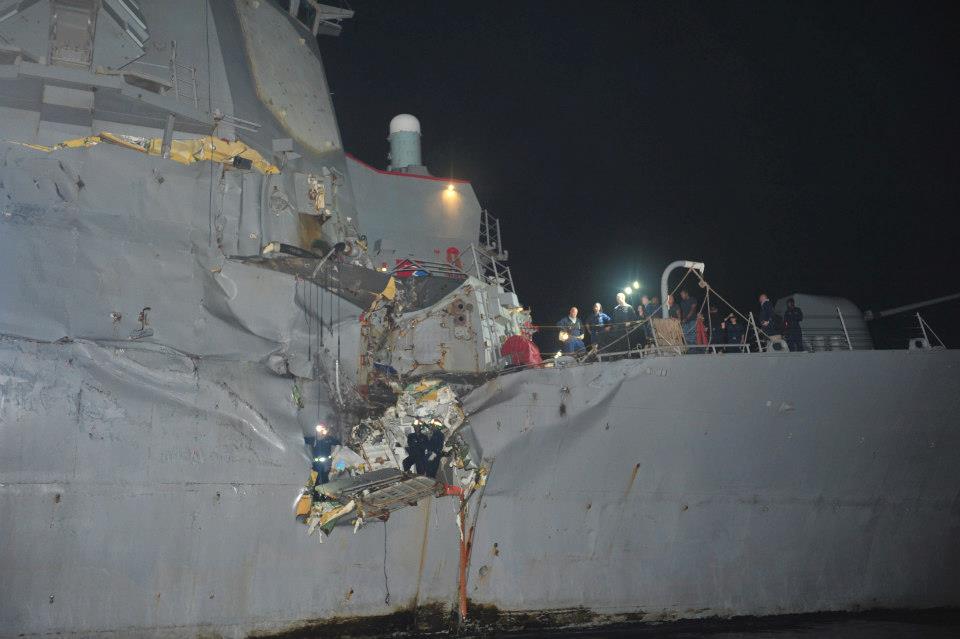
The fifth USS Porter, (DDG-78) is an Arleigh Burke-class destroyer, collided with the MV Otowasan, a Japanese oil tanker, near the Strait of Hormuz in 2012, ripping a huge 10×10 foot hole in the billion dollar Aegis warship that led to the replacement of her skipper.

But we are here to speak of the third Porter, DD-356.

0535613

Head of her class of large ‘destroyer leaders’ she was over 1800-tons and 381-feet long overall. Capable of making 35+ knots and carrying a battery of eight 5-inch/38 caliber naval guns over eight 21-inch torpedo tubes, she would have been considered a scout cruiser if she was commissioned in 1919 rather than in 1936.

She was one of the fastest and largest of US pre-WWII destroyer classes and her seven younger sisters provided yeomen service during the war. Her seven sisters earned a combined total of more than 30 battlestars during the war, fighting U-boats, protecting carriers, escorting convoys, and downing enemy aircraft.

0535611

All seven of her sisters survived the war to be scrapped in the late 1940s and early 1950s.

histor3

This was not to be the luck of the Porter.

Commissioned 25 August 1936 at New York Shipbuilding Corporation, she left immediately for the Pacific Fleet. Leaving Pearl Harbor just two days before the day of infamy, she was at sea off Hawaii when the war started. Joining Task Force 16 after convoy duty off the West Coast, she sailed immediately for the waters off Guadalcanal in 1942.

carrierwarcsg038BattleOfSantaCruzDwightCShepler
There, she found herself neck-deep in the Japanese onslaught that was the Battle of the Santa Cruz Islands. This pitted two US carriers, Enterprise and Hornet against three of Yamamoto’s. This battle, fought on 26 October 1942, started off with the Japanese having more planes (199 vs 136) and more surface combatants (40 vs 23).

Halsey’s fleet lost the Hornet, had the Enterprise badly mauled, and had more than 70% of the fleet’s carrier air-wing destroyed. During the fight, with planes ditching left and right around the USS Enterprise, Porter stood by as a plane guard, firing at Japanese aircraft while picking up pilots lost at sea.

To say the Battle of Santa Cruz was chaotic is an understatement.

To say the Battle of the Santa Cruz Islands was chaotic is an understatement.

One armed US Navy TBF Avenger torpedo bomber crashed near Porter and soon after, as the ship maneuvered to rescue the crew, she was struck by a torpedo of unknown origin. During the war the US blamed it on a Japanese submarine, but post-war study of the Combined Fleet’s records, none of the Emperor’s u-boats claimed the kill.

This had left historians to credit the sinking of the USS Porter, DD-356, to friendly fire.

Her crew was rescued by the nearby USS Shaw (DD-373), whose dramatic Pearl Harbor photographs have immortalized that ship.

The Shaw stood by to sink the stricken Porter in deep water with gunfire.

Her name was stricken a week later from the Naval List where it was given to a new Fletcher class destroyer (DD-800) at her launching on 13 March 1944.

Specs:

uss-dd-356-porter-1940-destroyer
Displacement:     1,850 tons
Length:     381 ft (116 m)
Beam:     36 ft 2 in (11.02 m)
Draft:     10 ft 5 in (3.18 m)
Propulsion:     50,000 shp (37,285 kW);
Geared Turbines,
2 screws
Speed:     35 knots (65 km/h)
Range:     6,500 nmi. at 12 knots
(12,000 km at 22 km/h)
Complement:     194
Armament:

As Built:
1 x Mk33 Gun Fire Control System
8 × 5″(127mm)/38cal SP (4×2),
8 × 1.1″(28mm) AA (2×4),
8 x 21″(533mm) torpedo tubes (2×4)
c1942:
1 x Mk33 Gun Fire Control System
8 × 5″(127mm)/38cal SP guns (4×2),
2 X 40mm AA (1×2),
6 x 20mm AA (6×1),
2 x Depth Charge stern racks

If you liked this column, please consider joining the International Naval Research Organization (INRO), Publishers of Warship
International.

They are possibly one of the best sources of naval study, images, and fellowship you can find http://www.warship.org/

The International Naval Research Organization is a non-profit corporation dedicated to the encouragement of the study of naval
vessels and their histories, principally in the era of iron and steel warships (about 1860 to date). Its purpose is to provide information and a means of contact for those interested in warships.

Nearing their 50th Anniversary, Warship International, the written tome of the INRO has published hundreds of articles, most of
which are unique in their sweep and subject.

I’m a member, so should you be!

Warship Wednesday Jan 8, 2014 The Brave Perth

Here at LSOZI, we are going to take out every Wednesday for a look at the old steam/diesel navies of the 1859-1946 time period and will profile a different ship each week.

– Christopher Eger

Warship Wednesday Jan 8, 2014 The Brave Perth

fot-percolor41
Happy new year and thanks for dropping by. Here we see HMAS Perth (D29) of the Royal Australian Navy (RAN) in a beautiful camouflage pattern sometime around 1941.

Perth in 1940, Sydney

Perth in 1940, Sydney

Perth was a modified Leander-class light cruiser. At 6800-tons with a 31-knot speed, her armament of  eight 6-inch Mk XXIII naval guns and another eight 4-inch guns along with eight 21-inch torpedo tubes was packed into her 565-foot long hull. They were based on the York-class heavy cruiser, but with smaller guns. Smaller than the destroyers of today, the Leander-class were some of the finest light cruisers in the Commonwealth. Her seven sisters included the illustrious cruisers Ajax and Achilles (of Graf Spee fame) as well as the famous HMAS Sydney, killer of both the German cruiser Kormoran and  Italian cruiser Bartolomeo Colleoni.

The Perth was brought into the world as the HMS Amphion of the Royal Navy,  15 June 1936, after spending three years under construction at  Portsmouth Naval Dockyard. Transferred to the RAN officially on 29 June 1939, she was given the name HMAS Perth. As such, she was the last cruiser ever commissioned in the Australian Navy.

HMAS-Perth-1941

When WWII broke out she was visiting South America and spent 1939-41 in hard service in the Med. She saw hot action off Syria, fought hard at the  Battle of Cape Matapan, helped evac Crete, and ran the Malta gauntlet. When war came to the Pacific she sailed back home, joining the ill-fated  ABDA fleet under Dutch Rear-Admiral Doorman. Running headlong into the Japanese Navy, she became involved in the Battle of Sunda Strait on the night of Feb28-Mar1 1942.

AWM_ART24483_HMAS_Perth
Perth, along with the 9200-ton Northampton-class heavy cruiser USS Houston and the Dutch destroyer HNLMS Evertsen, stumbled across 58 Japanese transports crammed with troops. Normally this would have been a field day for the small Allied force, but the troop carriers were escorted by the Imperial Japanese Navy’s 7th Cruiser Division, under Vice Admiral Takeo Kurita. This force included five modern cruisers including the giant twin 14,000-ton supercruisers Mogami and Mikuma and a dozen destroyers.

The force was doomed but still fought it out, blocked at both sides of the straits by the huge Japanese force. Over 90 Long Lance torpedoes fired at the two ABDA cruisers by Japanese destroyers while the cruisers slugged it out at long-range. Four Japanese torpedoes hit the Perth near simultaneously, dooming her.

During the abandon ship operation Perth was under fire from several destroyers at close range and many hits were scored and casualties caused. Many were killed or wounded in the water by the explosion of the last two torpedoes and by shells exploding in the water. Of the Perth’s crew of 681, only 218 were repatriated. Many became prisoners of war and were incarcerated in camps near Batavia, Java.

The Perth, Houston, and Evertsen all went to the bottom of the strait that night but were joined by a number of Japanese troopships, themselves victim of friendly fire Long Lances. Apparently once a torpedo hits the water, it has no friends.

Perth‘s wreck lies in approximately 35 meters of water and unfortunately is very heavily visited not only by recreational divers but by salvors.

5156380-3x2-700x467
Recently, illegal salvage operations have attacked the Perth, now considered a war memorial. These buzzards of the sea have completely removed the “mid section above deck, where the bridge was, has been completely removed, the bow guns have been damaged by what appears to be explosives with the barrels missing and the tops peeled of [sic], the bow has collapsed completely.”

“Although it is hard to be certain, but as the metal that was the superstructure is all missing and is not lying around as debris it looks although we could be wrong like purposeful attempt to salvage the steel. She has been hammered and the once impressive six-inch A1 and A2 turrets are gone, the bow is flat and… the wreck is more hazardous than before – even for general swimming around, with lots of live ordinance, wire and overhanging metal.”

Perth1-bell
Gratefully, in 1967 her binnacle, bridge voice pipe and ship’s bell were retrieved by divers. They are currently on display in the Australian War Memorial in Canberra.

Specs

hmas-perth-1942-light-cruiser
Displacement:     6,830 tons (standard)
Length:     562 ft 3.875 in (171.39603 m) overall
530 ft (160 m) between perpendiculars
Beam:     56 ft 8 in (17.27 m)
Draught:     19 ft 7 in (5.97 m)
Installed power:     72,000 shaft horsepower (54,000 kW)
Propulsion:     4 x Parsons geared turbines
4 x Admiralty 3-drum boilers
4 shafts
Speed:     31.7 knots (58.7 km/h; 36.5 mph)
Range:     6,060 nautical miles (11,220 km; 6,970 mi) at 22.7 knots (42.0 km/h; 26.1 mph)
1,780 nautical miles (3,300 km; 2,050 mi) at 31.7 knots (58.7 km/h; 36.5 mph)
Complement:     646 (35 officers, 611 ratings) standard
681 at time of loss (includes six RAAF and four civilians)
Armament:

8 × BL 6-inch Mk XXIII naval guns (4 × 2)
8 × 4-inch Mk XVI guns (4 × 2)
12 x 0.5-inch machine guns (3 × 4)
10 x 0.303-inch machine guns (10 × 1)
8 × 21-inch torpedo tubes (2 × 4)
Aircraft carried:     1 × seaplane (a Supermarine Walrus)

If you liked this column, please consider joining the International Naval Research Organization (INRO)

They are possibly one of the best sources of naval lore http://www.warship.org/naval.htm

The International Naval Research Organization is a non-profit corporation dedicated to the encouragement of the study of naval vessels and their histories, principally in the era of iron and steel warships (about 1860 to date). Its purpose is to provide information and a means of contact for those interested in warships.

Nearing their 50th Anniversary, Warship International, the written tome of the INRO has published hundreds of articles, most of which are unique in their sweep and subject.

I’m a member, so should you be!

Warship Wednesday January 1, 2014 : The Baron Pirate, His UBoat, and the Sea Serpent

Here at LSOZI, we are going to take out every Wednesday for a look at the old steam/diesel navies of the 1859-1946 time period and will profile a different ship each week.

– Christopher Eger

Warship Wednesday January 1, 2014 The Baron The U Boat and the Sea Serpent

sub_silhouetteu28

Here we see SM U-28, a Type 27 U-Boat of Kaiser Wilhem’s Kaiserlachemarine during World War One. For such a diminutive ship, she has a fascinating service record to say the least.

Ordered 19 February 1912 from Kaiserliche Werft, Danzig (now Gdansk, Poland), she was built to the doppelganger design of her sister boat, U-27 (who was later the first submarine to ever sink another in warfare when she sent the British submarine HMS E3 to the bottom of the North Sea in October 1914). The U-28 was large for her time but still very small by today’s standards– what would be called a ‘Baltic Boat’ similar to those built and operated by the Swedish Navy these days. She was but 213 feet long and weighed 878 when ballasted submerged. Her mild steel hull was tested to 50 meters (164 feet). She had very long legs for a small boat, capable of traveling nearly 10,000 miles on her efficient diesel-electric suite. When commissioned 26 June 1914 (two days before the Archduke Franz Ferdinand was assassinated in Sarajevo, lighting the fuse to the First World War) her first captain was (Baron) Freiherr Georg-Günther von Forstner.

willy stower painting
A propaganda post card which was given as a token of appreciation to participants in the fund-raising campaign for supporting  the submarine warfare of the First World War. Painted by seascape artist Willy Stöwer (1864-1931), a personal artist friend of Kaiser Wilhelm II, it depicts a scene from the so-called “traders warfare”  (Handelskrieg). A submarine very much like a U27 type sinks a British merchant ship, while her crew has boarded the life boats and are rowing away. (KFB Collection).

U28, as part of IV Underseebotte Flotilla took to the war with earnest. Between 1914-1917 she completed  four patrols, sinking 39 ships totaling 93,782 tons. She further damaged another 2 ships damaged totaling 11,188 tons, and took two ships prize totaling 3,226 tons for a total of 104,589 tons of shipping. Almost all 43 of these vessels were small merchant ships under 5,000-tons of British, Belgian, Dutch and Norwegian flags.

Note we said he captured two ships as prizes. Like a pirate. Just sailed out of port, grabbed a pair of steamers, and sailed back in with them one spring day in 1915.

U-28.lib of congressjpg

Here we see U28 coming heading out from Zeebrugbee with the tender W2.  Even though the tender is a small ship, she still dwarfs the U28. The below series of pictures, taken by a neutral Dutch photographer, were published by the British paper Graphic on March 27, 1915, show the sequence of events of the U28 capturing both the Batavia and the 1657ton Zaanstroom just an hour later.

imagep078a
imagep078b

While under the Baron’s command, U28 sighted the British steamer SS Iberian, 5223-tons , on 30 July 1915. After sending her to the bottom, the captain and crew observed the wreckage, seeing what can only be termed as a 65-foot long crocodile-like sea serpent.

Tylosaurus_large
According to the Baron’s own statement archived here :

the description of an animal estimated at 20 meters in length, seen by me and some of the crew of the submarine U28 on 30 July 1915 in the Atlantic Ocean; [it] was sighted on the starboard side, about 60 nautical miles south of Fastnet Rock, off the southwest corner of Ireland, after the sinking of the British steamer Iberian. This animal was hurled some 20 or 30m into the air by an underwater explosion about 25 seconds after the sinking of that vessel, thrown full length from the water. It is possible that this was caused by the detonation of an explosive device on board, the existence of which we assumed was  concealed in the ship’s papers, or from a small boiler explosion… This explosion certainly could have been the result of a detonation, but in my opinion only the bursting of the spaces deep inside the ship could have produced such air pressure.

    The animal was about 20 meters long and crocodile-like in shape, with pairs of strong front and hind legs adapted for swimming, and a long head that tapered towards the nose… Our senior engineering officer, marine engineer Romeihs, watched the animal for 10 to 15 seconds at a distance of about 150 to 100m in bright sunshine with the aid of powerful glasses.

We aren’t making this up.

The description is believed by many to mirror that of the (believed extinct) Tylosaurus  a large, predatory marine lizard of the  Late Cretaceous period closely related to modern monitor lizards and to snakes. Too bad the term ‘pictures or it didnt happen’ wasn’t popular then.

Officers taking bearings with sextant

The Good Baron von Forstner completed his war service in apparently a desk-bound training capacity, no longer at the helm of
a U-boat. That’s what you get when you spy a sea sepent and put it in the ship’s log.  He had his journal detailing his wartime experience published logically enough as, “The Journal of Submarine Commander Von Forstner” ( free Libravox audio book here) (Gutenburg Text version here for free ) which has been in the public domain for decades.

(Read it, its pretty good stuff)

(Read it, its pretty good stuff)

The Baron did, however, live to a ripe old age of 58 dying in 1940. His nephew was none other than Korvettenkapitän Siegfried Freiherr von Forstner, winner of the Ritterkreuz des Eisernen Kreuzes for his 70,000-tons of shipping sunk in WWII while skipper of  U-402 (which included the armed yacht Cythera, a past Warship Wednesday ship). Small world.

Well, back to the story of the U28.

She went back out to sea under a series of three more captains until her final skipper, Georg Schmidt, assumed command on 15 January, 1917. On her last patrol she found herself face to face on 2 Sep 1917 with the 4649-ton British steamer SS Olive Branch 85 miles north-by-northeast of North Cape, Norway in the Arctic Sea. The Olive Branch, most unlike her name, was loaded to the gills with munitions, lorries, and artillery shells for the Russian military machine. After sending a torpedo into her, U28 closed in to assess the damage to the stricken ship. It was then that the steamer’s hold detonated, sending deck cargo– including a number of vehicles– skyward. One of these flying trucks landed square on U28 and holed her, sending the boat and all 39 of her men to the bottom.

Her final location is unknown.

So there you have the true story of the pirate German submarine that tangled with a sea serpent and, in turn, was sunk by a truck.

Specs

u27Displacement:     685 tons surfaced
878 tons submerged
Length:     64.7 m (212.3 ft)
Beam:     6.32 m (20.7 ft)
Draught:     3.48 m (11.4 ft)
Speed:     16.4 knots (30.4 km/h) surfaced
9.8 knots (18.1 km/h) submerged
Range:     9,770 nautical miles (18,090 km) at 8 knots (15 km/h) surfaced
85 nautical miles (157 km) at 5 knots (9.3 km/h) submerged
Test depth:     50 m (164.0 ft)
Armament:
4 x 50 cm (19.7 in) torpedo tubes
1 x 8.8 cm (3.46 in) deck gun (listed as 105mm in some sources), note line drawing shows two deck guns as fitted  to the later U29 and U30.

If you liked this column, please consider joining the International Naval Research Organization (INRO)

They are possibly one of the best sources of naval warship research and has since 1964 publishes Warship International

http://www.warship.org/wi.htm

The International Naval Research Organization is a non-profit corporation dedicated to the encouragement of the study of naval
vessels and their histories, principally in the era of iron and steel warships (about 1860 to date). Its purpose is to provide information and a means of contact for those interested in warships.

Nearing their 50th Anniversary, Warship International, the written tome of the INRO has published hundreds of articles, most of
which are unique in their sweep and subject.

I’m a member, so should you be!

Warship Wednesday December 25th The Christmas Ship of the Fleet

Here at LSOZI, we are going to take out every Wednesday for a look at the old steam/diesel navies of the 1859-1946 time period and will profile a different ship each week.

– Christopher Eger

Warship Wednesday December 25th The Christmas Ship of the Fleet

09031602

Commissioned 12 March 1943, the USS Cascade was an unsung hero of the fleet. With the destroyers of the time very minimally equipped, they needed a floating hotel/storeship/repair shop to tie up to from time to time and give the crew some rest, some better food, restock the groceries on the destroyer, and fix what was broken. With just this task in mind, the Cascade was dubbed Destroyer Tender Number 16 (AD-16).

09031617

She followed the fleet from Kwajalein, to Eniwetok, to Ulithi. Holding true to her motto ‘We Serve’ USS Cascade in her three years of war serviced more than a thousand ships.  Most of these, as the ship’s name would imply, were destroyers, patrol frigates, and destroyer escorts which often saw the Cascade 4-5 times in that three-year period. In addition, the ship tended “175 landing craft (LST, LCI, LCM, LSD, and LCS), almost 100 sub-chasers, 60 transports, 32 cargo ships, 56 tankers, 37 mine sweepers, 10 cruisers, 7 aircraft carriers, and a miscellaneous group of other types neighboring around one hundred in number.”

09031609

“Due to the long supply line which commenced to make itself felt in November 1943, the USS Cascade was dovetailed into another assignment in addition to her original assignment. While machine shops hummed the new job added to the increasing tempo of the ship’s activity. During the two years of this duty, ten thousand tons of fresh and dry provisions were received and issued. Five hundred and fifty-one tons of clothing were issued and an equal number of tons of ship’s store stock was sold by the ship. The combined value of these issues amounted to more than five million 1944 dollars. ”

When you were close to the Cascade, everyday was Christmas. While at Ulithi she stored a library of nearly a thousand movies that were passed around the fleet at anchorage. It also didn’t hurt that the ice-cream barge capable of making thousands of gallons of sweet geedunk a day was nearby. She was effectively the Blockbuster of the atoll. It was the service and support of the unseen tenders like Cascade that helped keep the fleet forward deployed and not tied to logistics harbors and shipyards in California. Had there been no Cascades, there could have been no victory in the naval war in the far-flung Pacific. The base was far from the ‘rear’ though as one of her anchorage mates, the fleet oiler Mississinewa (AO-59), while at anchor in the harbor next to Cascade, was struck and sunk by Japanese torpedoes in 1944.

USS_Zane (DD-337)

USS_Zane (DD-337)

While at Ulithi the next month, Cascade served as a floating courtroom for the inquiry into Halsey’s Typhoon (Typhoon Cobra) with no less than Admiral Nimitz himself in attendance. In the audience was one LT(JG) Herman Wouk, who was at the time a junior officer of the old Clemson-class four piper minesweeper destroyer USS Zane (DD-337/DMS-14/AG-109). The Zane was one of Cascades baby ducklings and Wouk, as you may know, went on to write The Caine Mutiny which has a strong element of UCMJ/Naval CIS to its tale. As far as the inquiry on the Cascade went, the inquiry found that though Halsey had committed an error of judgement in sailing the Third Fleet into the heart of the typhoon that cost the lives of 790 men and three ship, it stopped short of unambiguously recommending sanction.

Cascade saw active combat in 1945, moving to a small cove of Kerama Retto on Okinawa where she repaired and patched up beaten ships that had survived kamikaze attacks just miles from her. While there, her crew endured their own share of plane and suicide boat attacks without damage.

The Christmas of 1945

Just a few months after the end of the War, the Cascade came to rest in Wakeyama, Japan, where she served as the floating storehouse for the fleet in the Japanese home waters. There her Christmas was special.

The following brief history of the USS Cascade from her commissioning until the end of the war was included in the Christmas 1945 menu. At the time the Commanding officer was Captain Louis T. Young, USN and the Executive Officer was Comdr. T.W. Hardisty, USN. Captain Young’s Christmas message was as follows:

“To all Officers and the Crew: It is my pleasure and privilege to wish you all, individually and collectively, the best of Merry Christmas and the happiest of New Years. May the following ones be even better.”

Lt-Comdr. Hardisty’s Christmas message was as follows: “The Christmas season is one when our thoughts are drawn to happy memories of the past and of happier things to come. It is my sincere wish for you all that this Christmas season be a very happy one and that the New Year will be filled with many blessings.”

The Christmas menu included: Cream of Tomato Soup, Ripe Olives, Sweet Pickles, Roast Tom Turkey, Giblet Gravy, Sage Dressing, Cranberry Sauce, Mashed Potatoes, Buttered Peas, Parker House Rolls, Fruit Cake, Mince Pie, Ice Cream, Cigars, Cigarettes, Coffee.

09031630

The Cascade still had a lot of life left in her. Spending 1947-51 in the Reserve fleet at Philadelphia, she was recommissioned and spent twenty years forward deployed across the Atlantic and Med as a tender and flagship. She was decommissioned on 22 November 1974, stricken, and sold for her value as scrap metal the next fall. Her role in the fleet was assumed by the much larger (20263 tons) destroyer tender USS Yellowstone which was laid down the following year.

09031626

Specs
Displacement: 9,250 long tons (9,398 t)
Length:     492 ft (150 m)
Beam:     69 ft 9 in (21.26 m)
Draft:     27 ft 6 in (8.38 m)
Fuel Capacity
NSFO 17,360 Bbls
Propulsion
one General Electric turbine
two Foster & Wheeler D-type boilers 460psi, 765°
double Westinghouse Main Reduction Gear
three 100Kw 450V. A. C. Ship’s Service Generators
single propeller, 8,500shp
Speed:     18 knots (33 km/h; 21 mph)
Complement:  600 original, over 1200 by 1944
Armament:     • 2 × 5″/38 caliber guns (reduced to single mount 1951)
4 × quad 1.1″/75 caliber guns (removed 1944)
three twin 40mm AA gun mounts (1944-47)
two quad 20mm AA gun mounts (1944-47)
12 × single 20 mm AA guns (removed 1951)
4x 12.7mm M2 guns (mounted 1950s)

If you liked this column, please consider joining the International Naval Research Organization (INRO)

They are possibly one of the best sources of naval lore http://www.warship.org/naval.htm

The International Naval Research Organization is a non-profit corporation dedicated to the encouragement of the study of naval vessels and their histories, principally in the era of iron and steel warships (about 1860 to date). Its purpose is to provide information and a means of contact for those interested in warships.

Nearing their 50th Anniversary, Warship International, the written tome of the INRO has published hundreds of articles, most of which are unique in their sweep and subject.

I’m a member, so should you be!

Warship Wednesday December 18th The Big WY

Here at LSOZI, we are going to take out every Wednesday for a look at the old steam/diesel navies of the 1859-1946 time period and will profile a different ship each week.– Christopher Eger

Warship Wednesday, December 18th The Big WY

Wyomingabout to sail in under the manhattan-bridge, New York City, 1912.
Here we see one of the best of Uncle Sam’s early dreadnought-style battleships at play. We present to you the USS Wyoming BB-32.

The ship was named not only for the State, but for two previous USS Wyoming, the first a screw sloop of war that fought in the Civil War, the second for an Arkansas-class monitor turned submarine tender (BM-10) that was renamed USS Cheyenne, 8 October 1908 so that the battleship could assume the more regal state name.

uss_wyoming_2lo

Laid down at William Cramp and Sons in Philadelphia in February 1910, Wyoming was just the 7th American Dreadnought, but when compared to the previous Florida-, Delaware-, and South Carolina-class ships built between 1906-1911, she was far superior. With a full load of 27,243 long tons and a 562-foot overall length, she could make an impressive 21-knots on her 12 coal-fired boilers pushed by a quartet of direct-drive steam turbines. Capable of steaming 8000 miles without refueling, she had long legs for the time. A dozen 12″/50 caliber Mark 7 guns (305 mm) in six twin turrets coupled with a secondary battery of no less than 21 5-inchers gave her a punch that rivaled any battleship afloat in Europe while her 9-12 inches of armor plate in important areas meant she could take the punishment if needed. Overall, Wyoming, when completed in 1912 she was the best ship in the Navy and comparable to any battlewagon in the world.

us battleships firing 1913 wyoming

Built in just 16-months, Wyoming immediately became the flagship of the US Atlantic Fleet. As such she spent several years steaming in the Gulf of Mexico, Caribbean, and Mexican waters. She intervened in Mexico in 1914 and in Haiti in 1916 exercising the best in gunboat diplomacy.

signal turret wyoming

When WWI came to the US, she spent several months training new gunners mates and sailors in the comparatively safe waters of Chesapeake Bay before heading to Europe. Since the British could not support the newer oil-fueled US ships like the USS Pennsylvania, Wyoming, since she was one of the last coal-fired battleships in the Navy appealed the British. In November 1917, Battleship Division 9 (BatDiv 9), made up of the Wyoming, USS New York, USS Delaware, and USS Florida, departed the U.S., bound for Europe. BatDiv 9 was to reinforce the British Grand Fleet at its base in Scapa Flow, becoming the 6th Battle Squadron of the RN’s Grand Fleet. It seemed the King forgave the colonials for that whole 1776 thing.

Note the early model WWI era lattice masts and clock

Note the early model WWI era lattice masts and clock

Wyoming escorted convoys and attended to the surrender of the Kaiser’s High Seas Fleet at Scapa before serving as the flagship for Admiral Sims. She returned home after the war and spent the next decade in routine fleet operations.

This rare oil painting by American artist Burnell Poole, “The 6th Battle Squadron of the Grand Fleet Leaving the Firth of Forth”, is one of less than two dozen paintings owned by the Navy that depicts U.S. naval operations in World War One (WWI). After years of being considered a total loss by Navy Art Gallery curators, it has been restored to near perfect condition. The entire process took several months, but the result is the total recovery of a painting that is sure to establish Burnell Poole’s name among the best marine painters of the early 20th century. The composition of the ships of the 6th Battle Squadron during their operational history, appearing in the painting in no particular order were: Delaware (BB-28), Florida (BB-30),Wyoming (BB-32), Arkansas (BB-33), New York (BB-34), Texas (BB-35), & Arizona (BB-39).

By 1931, the ship was on the chopping block. The Navy had newer and more modern vessels than the old, coal-fired Wyoming. With the limitations of the looming London Naval Treaty and all the allowed battleships spaced being taken by newer ships made after Wyoming, the ship’s days were numbered. Instead of being scrapped, she was allowed to be retained as a disarmed training ship.
Half her 12-inch turrets were removed as well as most of her 5-inch guns (they were often too wet to work anyway) and she was reclassified as Auxiliary Gunnery Training Ship #17 (AG-17) in August 1931. For the next decade, she spent most of her time conducting Annapolis Midshipman cruises, NROTC cruises and other training evolutions around the world. She showed the flag from Germany to Panama to Gibraltar and Egypt.

wyo1919
When World War Two started, the ship was thirty years old, had a cranky engineering suite rated for 16-knots, and only half the armament of any other battleship in the world. Not being able to fight toe to toe in a modern naval engagement, she continued to serve as a gunnery training ship. Bristling with AAA guns ranging from 5″/38s to 40mm to 20mm OKs to 12.7mm M2’s, she wandered around the live fire areas off Norfolk throughout WWII.

There is a battleship under there somewhere

There is a battleship under there somewhere. Note all but two 12-inch turrets have been removed and the rear mast completely altered. Her second funnel has been removed.

This earned her the nickname of the “Chesapeake Raider” while she trained over 35,000 new gunners and consumed more ammunition than any other ship in the fleet during WWII– although none of it at enemy targets. However, if it wasn’t for the old Wyoming, there would have been more lives lost to kamikazes in the Pacific without a doubt. To help pull this off, her remaining 12-inch guns were removed in 1944, going to replace elements on battleships serving in the fleet.

Note by this time the last two of her 12-inch mounts had been removed

Note by this time the last two of her 12-inch mounts had been removed, but the old WWI lattice mast is still seen forward. At just 560-odd feet, by 1940s standards she was the size of a very large cruiser rather than a battleship of the time.

USS Wyoming clearly showing her conversion to an AA training ship. Over 35,000 men trained on her.

One of the last officers assigned to the ship at the tail end of the war was Ensign Jimmy Carter, who later transferred to subs and ran for President. Finally, just shy of 35 years of continuous service, the USS Wyoming (BB-32/AG-17) was decommissioned 1 August 1947. Like so many historic ships of her era, she was sold for scrap shortly after. Her only sister ship, USS Arkansas (BB-33), did not outlive her, being crushed in the underwater nuclear test BAKER at Bikini Atoll in June 1946.

Steaming proud on her direct-drive steam plant, at the time the last in the navy. Of course, loosing 7,000 tons in armor, 12-inch guns, and shells can do that for a lady

Steaming proud on her direct-drive steam plant, at the time the last in the navy. Of course, losing 7,000 tons in armor, 12-inch guns, and shells can do that for a lady. By this time her masts had been totally stepped.

The US Naval Museum stores the original BB-32’s Bell and her silver service was presented back to the State of Wyoming in 1978.

013222

She is also remembered in maritime art.

Dreadnought Battleship U.S.S. Wyoming of 1911 – Anton Otto Fischer

The legacy of the USS Wyoming was picked up by the Ohio-class ballistic missile submarine USS Wyoming (SSBN-742) in 1996 after spending nearly fifty years absent from the Naval List.

Specs

bb-32-uss-wyoming-1912

Note the clean lines as commissioned in 1912.

After 1944 refit, she was a completely different ship.

After 1944 refit, she was a completely different ship.

Displacement:

Design: 26,000 long tons (26,420 t)
Full load: 27,243 long tons (27,680 t)
WWII- 20,000-tons due to reduced armor

Length:     562 ft (171 m)
Beam:     93 ft 2 in (28.40 m)
Draft:     28 ft 7 in (8.71 m)
Propulsion:     12 Babcock and Wilcox coal-fired boilers with oil spray, 4-shaft direct-drive steam turbines, 28,000 shp
Speed:     21 knots (39 km/h)
Range:     5,190 nautical miles (9,610 km) at 12 knots (22 km/h) and 2,760 nautical miles (5,110 km) at 20 knots (37 km/h), 8,000 nmi (15,000 km; 9,200 mi) at 10 kn (19 km/h; 12 mph)
Coal: 1,667 tons Oil: 266 tons
Complement:     1,063 officers and men
Armament:

As built:
12 × 12 inch/50 caliber (305 mm) guns (reduced to 6 by 1931, removed by 1944)
21 × 5 inch/51 caliber guns (127 mm) (reduced to 16 in 1919, all but 4 later removed by 1940)
2 × 21 inch (533 mm) torpedo tubes (decommissioned 1931)

After 1940 she carried an increasingly varied and constantly changing series of AAA weapons ranging from 5″ to .12.7mm were fitted to the ship as her role in gunnery training. After 1944 refit her last armament of 40+ weapons was truly bizarre for a 1912-designed battleship. It consisted of eight 5″/38 caliber guns, six of which are in twin mountings such as found on cruisers, carriers, and battleships, and two in Mk30 single enclosed base ring mounts common to destroyers and tenders. Then there were four older (original issue) single-mounted 5″/51 caliber guns of the type found on armed merchants and naval auxiliaries mounted on the ship’s port side. A quartet of 3″ deck guns of the type used by submarines and small frigates graced her starboard. For 40mm Bofors, the ship had a dozen in one quad, three twins, and two single mounts. Then came no less than a dozen 20mm Oerlikons (in some 8 double and some in single) mounts as well as fifty cal and thirty cal Brownings, small arms, etc.

Armor:

Belt: 9–11 in (229–279 mm)
Lower casemate: 9–11 in (229–279 mm)
Upper casemate: 6.5 in (165 mm)
Barbettes:11 in (279 mm)
Turret face: 12 in (305 mm)
Conning tower: 11.5 in (292 mm)
(Note, torpedo blisters and side armor removed after 1931)

If you liked this column, please consider joining the International Naval Research Organization (INRO)

They are possibly one of the best sources of naval lore http://www.warship.org/naval.htm

The International Naval Research Organization is a non-profit corporation dedicated to the encouragement of the study of naval vessels and their histories, principally in the era of iron and steel warships (about 1860 to date). Its purpose is to provide information and a means of contact for those interested in warships.

Nearing their 50th Anniversary, Warship International, the written tome of the INRO has published hundreds of articles, most of which are unique in their sweep and subject.

I’m a member, so should you be!

« Older Entries Recent Entries »