Monthly Archives: February 2014

Inside the Army’s hidden archives

The Center for Military History (CMH) maintains perhaps the best archive of the American war machine for the past three hundred years. Everything from Grant’s hat to Revolutionary war saddlebags, to Queen Ann’s war muskets to souvenirs from Helmland province and Saddam’s palaces.

grid-cell-6117-1392867359-1

But its locked away in archival storage and may very well continue to be so for years, with no one allowed access as the Army struggles to build a museum to house it all.

original-2328-1392839696-11

Pop quiz: how many of these can you name?

Buzzfeed took an amazing tour lately.

grid-cell-31195-1392912665-2 grid-cell-19057-1392911105-2

grid-cell-18574-1392911387-11
Tom Lea’s famous 2000-yard stare is one of more than 16,000 pieces of art that rest quietly waiting for a spot to be displayed. These range from Norman Rockwell’s work to Hitler’s watercolors made between the wars. Every piece is military art in one way or another.

enhanced-buzz-wide-7025-1392843719-21

“The story goes that Norman Rockwell, seeking authenticity, wanted to rip holes in the soldiers’s shirt. The GI said fine. Rockwell asked to smear mud on his face and hands. Not a problem. But when the artist asked to rub dirt on his machine gun, the soldier refused: No proper gunner could tolerate that. So Rockwell portrayed the GI as tattered and begrimed, but with his big gray Browning machine gun sleek and clean.”

I can buy that, 110%

grid-cell-13584-1392843447-5 grid-cell-13017-1392843975-11 grid-cell-18696-1392910779-7 grid-cell-22321-1392910793-14 grid-cell-30580-1392912786-3 grid-cell-26454-1392912778-14

The Army Historical Foundation is in charge of raising the funds for the museum. However, there are major fundraising hurdles to jump before the museum can be built. The foundation’s president recently told the Washington Post that they have raised $76 million of the $175 million required for the museum and predicts the museum could open in 2018. The plan is to build the museum at Fort Belvoir.

But until the Army can get a museum built this massive collection will remained locked away, in the dark.

Please click here for the restof the pictures and amazing story

US Paratrooper Loadout WWII

(click to embiggen)

(click to embiggen)

Found this out there on the interwebs and thought you guys would dig it.It purports to show a pre-D-Day paratrooper’s loadout. You can see at the top of the gear pile the main and backup chutes, then moving down into the weapons there is quite a bit of interesting gear. Note the 16-inch M1905/M1942 bayonet, the machete in the canvas cover, and the M1918 trench knife knuckle duster (co-located in the 1911 holster), along with a basic penknife in the bottom corner. This guy was into blades.

His 1911 with two spare mags, and 25 8-round enbloc clips in field-made pouches for the M1 Garand give him over 250-rounds of 30.06 and 21 of .45ACP. Then of course there are four pineapple grenades for when the going gets tough.

The SCR-536 handie-talkie radio (remember it from the green plastic army men days?) was a neat little 5-pound radio made by Motorola that operated in AM voice mode between 3.5 and 6.0 MHz frequency range. Range in built up areas or hilly terrain was line-of-sight while at sea or in the open flat desert at night was as much as 3-miles. Every rifle company of the U.S. 29th Infantry division on D-Day had six; one for each of three rifle platoons, two for the weapons platoon, and one for the company CO, which makes me think the owner of the loadout was a young LT or Captain, or possibly an artillery forward observer, hence the two packs of signal flares to the left. That would make the compass, flash-lite, notebooks, and pencils seem all the more important.

The radio was issued first in 1941-42, while the  M1905 bayonet was being withdrawn from service after 1943, which could place this picture between that time, rather than D-Day of 1944.

If you ask me, the machete looks as well as the coil of rope, often used by paratroopers who are caught up in trees, an leather gloves more useful in the Pacific and the time frame would fit better for the 503rd PRCT.

What, you haven’t heard of the 503rd?

The 503rd Parachute Regimental Combat Team wasn’t part of one of the huge and celebrated airborne divisions that jumped into Europe like the 82nd and 101st, it fought independently– in the jungles of the Pacific.

During its more than three years service in the Southwest Pacific Theater, the 503d served in five major combat operations. A number of other missions were planned but called off by higher headquarters.

The Regiment jumped in the Markham Valley, New Guinea, on 5 September 1943, in the first successful Airborne Combat Jump in the Pacific Theatre of Operations. The Regiment forced the Japanese evacuation of a major base at Lae to take a route which proved to be disastrous for them. The third Battalion of the 503d had a major skirmish with the rear guard of this exodus. The successful employment of Parachute troops, in the Markham Valley, has been credited with saving the concept of vertical envelopment from being abandoned following several less than successful engagements in Europe.

Two rifle Battalions of the 503d Regiment jumped Noemfoor off the coast of Dutch, New Guinea early in July 1944, followed by an amphibious landing by the other rifle Battalion a few days later. The Regiment was employed in the elimination of the Japanese garrison on that Island. Airfields constructed on Noemfoor after its capture played a significant role in supporting the advance of Allied troops from New Guinea to the Philippines. Sergeant Ray E. Eubanks was awarded the Congressional Medal of Honor, posthumously, for his actions on Noemfoor.

A good overview is here

503rdpir01


Dwarfed by and silhouetted against clouds of smoke (created to provide cover), C-47 transport planes from the US Army Air Forces drop a battalion of the U.S. 503rd Parachute Regiment at Nadzab. A battalion dropped minutes earlier is landing in the foreground. General Vasey was in the plane from which the photograph was taken

Still, that’s a whole lot of stuff to jump out of a perfectly good plane with.

Into the jungle…

The new CZ 805 BREN Gun, oh how sweet it is

After World War One the country of Czechoslovakia emerged from the ashes of the former Austro-Hungarian Empire. The new nation had to build everything up from scratch. Her army, made up of men who had fought for the Russians, Austrians, and French, had an amalgam of arms and munitions that was as varied as the colors of the rainbow. The first thing the new country did was seek its own armament.

In 1926 this led to a new light machine gun known in Czechoslovakia as the Zb.v 26. With its plans escaping from the country after it was taken over by Hitler in 1938, the gun went into production in Britain as the BREN gun. The name Bren was derived from Brno, Moravia, the Czechoslovak city where the Zb vz. 26 was originally designed (in the Zbrojovka Brno Factory), and Enfield, site of the British Royal Small Arms Factory.

(The WWII Bren gun was about as old-school sexy as you could get)

(The WWII Bren gun was about as old-school sexy as you could get)

This gun went on to be possibly one of the best light machine guns in history, seeing service around the world as late as the 1982 Falklands War and the 1991 Gulf War.

Still following along?

Well fast forward to the 1950s. The Soviets had come in after 1945 and ran Hitler out but decided to stick around for the next four decades, placing the country on the front lines of the Cold War. Not wanting to arm their forces with the AK-47, the Czechs designed the Vz.58 rifle, considered by many to be the best 7.62x39mm assault rifle ever made, and issued it for generations.

When the Soviets moved to the 5.45x45mm caliber in the late 1970s, the CZ factory started a redesign of the Vz.58 to accept this new caliber. This led to the LADA project in 1986. By the 1990s the Soviets themselves had left and the now Czech Republic was looking to join NATO.

Which in a round about way led to this bad boy:

And no, its not airsoft...

And no, its not airsoft…

Read the rest in my column at CZTalk.com

Dont be that guy, and by that guy, we mean Carl. Everyone knows Carl

He’s kind of a phuckwaffle

carl8 carl7 carl6 carl5 carl3 carl2 carl

Paint that AR for cheap

Ron Larimer has a great tutorial on painting an AR over at When the Balloon Goes Up.

“There are plenty of reasons you might want to paint an AR-15.  Like camouflage from enemy soldiers or prey animals, to refurbish rifle that is really banged up and protect it from future abuse, or to show people at the range that you are higher speed and lower drag then they are.  I did be cause it looks cool and that is really a good enough reason.”

camo ar 2

camo ar
The rest here

Hiding your guns in plain sight

There are an estimated 140 million guns in the US and it’s important for each of these to stay secure. Sure there are traditional gun safes, cabinets and racks, but many of these are obvious and easy to defeat by a skilled burglar. That’s why you can add an extra layer of protection to your gun collection by hiding them– often in plain sight.

We’ve all walked past those displays of refrigerator sized gun safes and marveled at the thickness of the walls, how heavy the doors are, and how many huge moving deadbolts the door secures with. The problem is, most of these safes are meant to protect the insides from fire and casual theft, not to stop an all-out assault on your firearm collection by someone who knows what they are doing.

In fact, most of your basic safes are so simple that a kid can pick them with household items in just a few minutes.

Beautiful glass gun cabinets are even easier to penetrate as most use only a simple cam-lock to close the doors and, of course, have large panels of very breakable glass.

The solution could be in some cover and concealment

behind painting

Read the rest in my column at Firearms Talk.com

His Majesty’s victorious revolver team

Found this image on the interwebs and was kind of fond of it, so I thought I would share.

(click to embiggen) and for the record, I am upset that there are no monocles visible.

(click to embiggen) and for the record, I am upset that there are no monocles visible..but their are swagger sticks aplenty.

The officer bottom left front, sports the badge of the 21st (Empress of India’s) Lancers (1901 – 1922) in his pith helmet. However this photo is of the 12th Royal Lancers (Prince of Wales own) Pistol Team in Cairo, Egypt, with the Duke of Connaught’s Cup in the 1930s. Revolvers of course are .455 caliber Webley MKVI’s. The cup was for a series of revolver matches run by the British army in Egypt and India from 1920 to 1939.

Founded in 1715, the 12th RL has an impressive lineage. The  Duke of Wellington served with the regiment as a young subaltern before his rendezvous with Napoleon. In 1928, the 12th Lancers gave up their horses and were equipped with armoured cars (as the Brits say, rather than “armored cars”), taking over vehicles left in Egypt by two Royal Tank Corps armoured car units, so these very dashing cavalrymen pictured above were mounted on tin horses. They went on to fight in Europe in 1940 from inside hopelessly outgunned Morris CS9 armored cars, shielding the withdrawal at Dunkirk. They later fought at El Alamein with Montgomery and were amalgamated with the  9th Queen’s Royal Lancers to form the 9th/12th Royal Lancers in 1960. This unit still exists attached to the 7th Armoured Brigade, the Desert Rats.

As far as the Cup itself goes, Connaught was fond of promoting pistolcraft. As the Governor General of Canada in the 1912 he started an earlier revolver competition there, with the passing of a cup to the winner each year. This event remains today.

Somali Pirates video (VICE)

The guys over at Vice put this up about skinny pirates in the HOA. Entitled Fishing Without Nets, it follows the touching coming of age story of a young Somali fisherman in his struggle to find peace, love and an AK that doesn’t jam.

But seriously guys, its not a bad way to spend 17 minutes at work.

Warship Wednesday Feb 19, The Wandering Island of Luzon

Here at LSOZI, we are going to take out every Wednesday for a look at the old steam/diesel navies of the 1859-1946 time period and will profile a different ship each week. – Christopher Eger

Warship Wednesday, Feb 19, The Wandering Island of Luzon

(click to embiggen)

(click to embiggen)

Here we see the spic and span US gunboat USS Isla de Luzon resting quietly at anchor with her 1900s issue white and buff paint scheme. Her life before this moment was a little different. Ordered by the Spanish government for the Armada Española, she was billed as a second-class “protected cruiser” by her government. In actuality, she was, even when new, considered smaller than most other cruisers, not to mention slow and ineffective.

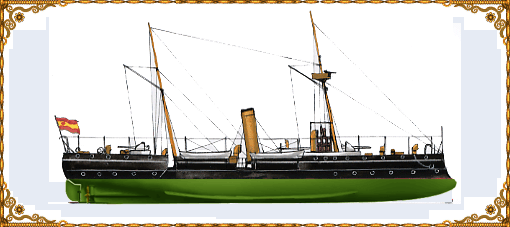
In Spanish service the cruiser had a green and black paint scheme with buff to white superstructures

In Spanish service, the cruiser had a green and black paint scheme with buff-to-white superstructures

Laid down on 25 February 1886 in the UK, she was built by Elswick (Armstrong, Whitworth)  at  Newcastle upon Tyne. She was completed and commissioned in late 1887. Just over 1000-tons, she was 184-feet in length. Beamy at nearly 30 feet, she had a length-to-beam ratio of 1:6 and tended to wallow in heavy seas. She also didn’t have enough ass to push her through the waves, her 2-shaft horizontal triple-expansion engines fed by 2 cylindrical boilers could generate about 14 knots, 15 if she was light. Very lightly armored, she was also lightly armed with a half-dozen 4.7-inch guns as well as some smaller QFs and MGs but her deadliest weapon was a triple set of 14-inch torpedo tubes.

Delivered to the Armada in 1887, she served first in Europe and even dropped some shells on the Rif in Morocco from time to time, practicing true gunboat diplomacy.

Today her size and armament would make her a corvette or offshore patrol vessel. In her time, cruisers were meant to be the fast eyes of the fleet, able to reach out over the horizon, find targets, and alert the main fleet of other vessels. The Isla de Luzon was too slow for that, and she soon found herself in colonial service in the Philippines. There she could visit far-flung Pacific islands and enforce the crown’s law against the locals without too much problem. She was part of the Spanish Pacific Squadron under Admiral Patricio Montojo, which consisted of seven cruisers (of which Isla de Luzon was one of the best) and a few gunboats.

Then came the Spanish-American War.

Dewey in the USS Olympia dropping it like its hot on the moored Spanish fleet

Dewey in the USS Olympia drops it like it’s hot on the moored Spanish fleet. Isla de Luzon would be in the background closer to the shore

On 1 May 1898, Commodore Dewey steamed his Asiatic Squadron into Cañacao Bay under the lee of the Cavite Peninsula east of Sangley Point, Luzon– coincidentally the island she was named after. The resulting Battle of Manila Bay, the first major engagement of the Spanish-American War, left most Spanish ships sunk while Dewey suffered less than forty casualties by the worst estimate.

57447_isla_de_luzo_md wreck

isla de luzon
Isla de Luzon was hit three times by US shells, then was scuttled in shallow water by her crew when the battle was in its final stages. She only had a half-dozen casualties. Bluejackets from the gunboat Petrel swarmed over her stricken hull, looted what they could, and set her alight.

isladeluzonwreck

Raised after the war, she was rebuilt, rearmed with US-pattern guns, painted white, and commissioned USS Isla de Luzon on 11 April 1900.

Former Spanish cruiser Isla de Luzon soon after capture, seen in Pensacola, FL. Note she is wearing an American shield on her bow

USS Isla de Cuba 4

Note twin stacks in US service after 1911

She then served as a gunboat, sailing through the Indian and Atlantic oceans to reach her new homeland in 1903, serving as a station ship in Pensacola until 1907 when she was loaned to the Louisiana Naval Militia on 6 December 1907 and later to the Illinois Naval Militia on the Great Lakes as a training ship. She spent WWI as a torpedo tender in Narragansett Bay, instructing new gunners mates and TMs.

In 1911 she was given a new power plant and two skinny funnels. Here she is as a training ship after that date in haze grey scheme

In 1911 she was given a new power plant and two skinny funnels. Here she is as a training ship after that date in a hazed grey scheme

Decommed and truck 23 July 1919, she was sold the next year to the Bahama & West Indies Trading Co to work as a coastal trading ship in the shallow waters there under the name SS Reviver. Her 1911-installed Babcocks boilers couldn’t handle the strain and she was soon sold to Bahama Salvors, Ltd. of Nassau and scrapped in 1931 at age 44.

The only remnant of her that remains today dates back to 1902. “Following long custom, when she visited Muscat’s picturesque harbor, members of her crew painted “Isla de Luzon” on the steep entrance cliff; in later years this was periodically refurbished by visiting ships of the U.S. Navy Middle East Force Command.”

isla de luzon muscat

Her name can still be seen there today.

Her only sistership, the cruiser Isla de Cuba, was also sunk at the Battle of Manila Bay, also salvaged and commissioned into the US Navy with the unimaginative name of USS Isla de Cuba, paid off in 1912, then picked up by the Venezuelans who used her as the training ship  Mariscal Sucre until 1940.

Specs:

You can best see her Spanish scheme in this line drawing

You can best see her Spanish scheme in this line drawing

(As-built)

Displacement:     1,030 tons
Length:     184 ft 10 in (56.34 m)
Beam:     29 ft 11 in (9.12 m)
Draft:     12 ft 6 in (3.81 m) maximum
Installed power:     1,897 hp (natural draft)
2,627 hp (forced draft)
Propulsion:     2-shaft horizontal triple-expansion, 2 cylindrical boilers
Speed:     14.2 knots (natural draft)
15.9 knots (forced draft)
Complement:     164 officers and enlisted
Armament:     6 × 4.7 in (120 mm) guns
8 × 6 pdr quick-firing guns
4 × machine guns
3 × 14 in (356 mm) torpedo tubes
Armor:     Deck 2.5 in (64 mm)-1 in (25 mm); conning tower 2 in (51 mm)

(1900)
Displacement:     950 long tons (965 t)
Length:     195 ft (59 m)
Beam:     30 ft (9.1 m)
Draft:     11 ft 4.75 in (3.4735 m) (mean)
Propulsion:     2-shaft horizontal triple expansion engine, 535 hp (399 kW)
2-cylinder boilers
160 tons coal
Speed:     11.2 knots (20.7 km/h; 12.9 mph)
Complement: 137 officers and enlisted (1900-07), after 1907 just a small cadre of regular officers and CPOs backed by up to 200 naval militia and trainees.
Armament: Four 4″ mounts and three torpedo tubes
1905 – Four 4″ mounts, four 6-pounder,s and four .30 cal. machine guns
1911 – Four 4″/40 rapid fire mounts, four 6-pounder rapid fire mounts, two 1-pounder rapid fire mounts, and added two temporary 3-pounder rapid fire mounts
Armor:     Deck: 1–2.5 in (25–64 mm), scortched

If you liked this column, please consider joining the International Naval Research Organization (INRO), Publishers of Warship International

They are possibly one of the best sources of naval study, images, and fellowship you can find http://www.warship.org/

The International Naval Research Organization is a non-profit corporation dedicated to encouraging the study of naval vessels and their histories, principally in the era of iron and steel warships (about 1860 to date). Its purpose is to provide information and a means of contact for those interested in warships.

Nearing their 50th Anniversary, Warship International, the written tome of the INRO has published hundreds of articles, most of which are unique in their sweep and subject.

I’m a member, so should you be!

The Dutch like to watch…through a periscope.

Odds are, if you are a sneaky non-nation party rogue state operator and NATO wants to keep ears on you, that cigarette
burning in the corner just offshore may be that of a Dutch submarine skipper.

Commissioned 25 April 1990, the Zeeleeuw (Dutch for Seal) is over twenty years old but is a master of littoral combat. The Dutch have used their quartet of 222-foot long Walrus-class subs, capable of floating in as little as 20-feet of water and submerging in as little as 60, to lie just offshore the bad-guy’s coastline listening for intel while on NATO missions.

These boats have done yeoman’s service off the former Yugoslavia in the 1990s, followed by Iraq, then off Libya a couple years ago, and, as shown in the video, off Somalia and the Horn of Africa. Its rumored that when Hugo Chavez started talking smack about invading the Dutch Antilles in the Caribbean, a Walrus-class sub wandered around the Venezuelan coastline making notes and taking names.

They are well suited for hanging out in shallow waters and soaking up radio intercepts while their radar and sonar get a fix on just what is moving around and where it is going to and from. They have a specialized L-3 KEO mast that is optimized to capture HD footage both day and night– so that beautiful bean footage can be shown round the world if needed.

zeeluew with diffuser

The Zeeleeuw (center) was fitted with an extended mounting on her sail to diffuse her signature and diesel exhaust while near
surface/snorting. All the better to be on the low low with.

Specs

Displacement:     2,350 t surfaced,
2,650 t submerged,
1,900 t standard
Length:     67.73 m
Beam:       8.4 m
Draft:       6.6 m
Propulsion:     3 diesels, diesel-electric, 5,430 shp (4 MW), 1 shaft, 5 blades
Speed:     13 knots (24 km/h) surfaced,
20 knots (37 km/h) submerged
Range:     18,500 km at 9 knot
Test depth:     >300 m
Complement:     50 to 55
Sensors and processing systems:     • Surface Search Radar: Signaal/Racal ZW 07
• Sonar Systems: Thomson Sintra TSM 2272 Eledone Octopus, GEC Avionics Type 2026 towed array, Thomson Sintra DUUX 5 passive ranging and intercept
Armament:     4 × 21 inch (533 mm) torpedo tubes (20 × Honeywell Mk 48 or Honeywell NT 37 torpedoes, mines,
SubHarpoon SSM)

« Older Entries Recent Entries »