Category Archives: mine warfare

The Ponce Still Serves

The USS Ponce, now over forty years old and officially Afloat Force Service Base (Interim) AFSB(I), still serves as a floating base for NSW, MCM, and other activities in the very warm standoff between the West and Iran in the Persian Gulf.


From a recent article about the old girl, ” Although it is under the command of a Navy captain, most of the Ponce‘s  crew are civilians. It has more than 155 civilian crew members from the Military Sealift Command and 55 Navy sailors, according to the ship’s commanding officer, Capt. Jon Rodgers. The number of civilian crew can fluctuate depending on who is onboard.

The MSC is normally responsible for running about 110 supply ships and other non-combat vessels for the Navy, but the Ponce‘s hybrid crew is unusual.

Visitors arriving by helicopter are met on the flight deck by some crew in uniform and others in civilian coveralls. Civilian employees keep the floors and toilets clean, and dish out corned beef hash and French toast on the mess deck. Some of the MSC crew members have dreadlocks — a no-no for enlisted sailors — and many are in their 40s or beyond. A handful are older than 60.

It’s not just the civilian crew that’s showing its age. The Ponce is among the Navy’s oldest ships. Construction began in 1966, and it was commissioned during the Nixon administration in 1971.

Rust is prevalent throughout the ship, and many of the fittings retain a Cold War feel.”

Read more here

Warship Wednesday October 3

Here at LSOZI, we are going to take out every Wednesday for a look at the old steampunk navies of the 1866-1938 time period and will profile a different ship each week.

– Christopher Eger

Warship Wednesday,  October 3

Here we have the Russian naval auxillary Standart as she would have looked in her heyday, around 1906.

The Imperial Yacht Standart (Штандартъ) was built by order of Emperor Alexander III of Russia, and constructed at the Danish shipyard of Burmeister & Wain, beginning in 1893. She was launched on 21 March 1895 and came into service early September 1896. For twenty years she served Tsar Nicholas and his family as they motored around the Baltic for two or three weeks at a time during the summer. Remember, before 1917, what is now Finland, Latvia, Lithuania, and Estonia was all Russian and belonged to the Tsar.


To protect the ship from attack it carried  8  hard chromed 47mm Hotchkiss guns, and a platoon of heavily armed Imperial Marines of the Guarde Equipage. Two marines attached to the ship served as the personal bodyguard/nannies of the young Tsarvitch Alexei and followed the boy ashore 365 days a year.

two sailors from the Standart, Nagorny and Derevenko, followed the young Alexei for 14 years everywhere he went. One even went into exile in Sibera with the boy who would never be king.

During WWI the ship served as a naval auxiliary cruiser protecting the approaches  to St Petersburg/Petrograd. In the revolution her marines were some of the last guardians of the imperial palace at Tsarskoe Selo.

The Marti was credited with shooting down several German Stukas during the 900-day siege of Leningrad.

Renamed Marti, after a revolutionary French sailor, she served as a minelayer, was damaged during the epic siege of Leningrad, and continued  to serve the Soviet navy after the war as a training ship, only retiring from service in 1963.

Specs:
Displacement:     5557 tons standard
Length:     128 m (420 feet)
Beam:     15.8 m (52 feet)
Draught:     6.00 m (19′ 8)
Propulsion:     2 Triple Expansion Steam Engines
Speed:     21.18 knots (by 1930, 14-knots)
Complement:     355-400

Armament (after 1920)
4 – 130mm guns (4×1)
7 – 76.2 mm guns (7×1)
3 – 45mm guns (3×1)
3 -12.7mm machine guns (3×1)
320 mines

The DHS Does OPFOR Submarine Ops…

http://www.dhs.gov/st-snapshot-pluto

Ever Heard of Pluto?

Homeland Security’s ‘narco sub’ PLUTO mimics the real thing

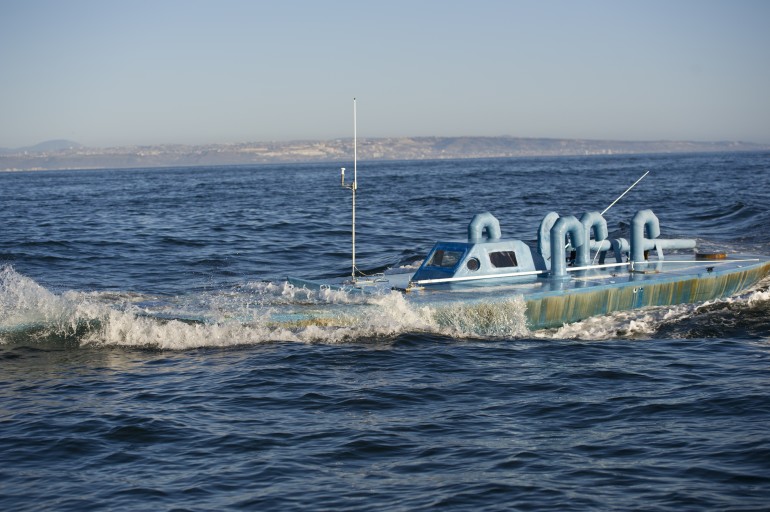
PLUTO seen during tests in San Diego, CA…..If you live around Destin, you may have bumped into it…

Surrogate semi-submersible engineered to mimic the design of the “dark vessels” being used
to bring narcotics and other illicit cargo into the United States. With low profiles and low radar reflectivity, stealthy, drug-running semi-submersibles, “narco subs,” built in southern jungles cut through the ocean at wave height and are nearly impossible to detect.  DHS’ semi-submersible mimics them so that  a variety of sensors can be tested  in the battle  against illegal drug-running.

The erstwhile planet Pluto (now officially an asteroid) was known for decades as a small, dark planet—hidden, difficult to spot, and on a quiet, determined course all its own.  And so, when the DHS Science and Technology Directorate (S&T) needed a target semi-submersible to detect the hidden but determined maritime smuggling operations of the South American drug cartels, it created its own vessel and called it “PLUTO,” after the planet that is so difficult to spot.  S&T’s PLUTO is a small, semi-submersible that is representative of what are popularly called “narco subs,” and serves as a realistic practice target for the detection systems of DHS and its national security community partners.

In the early 90’s, South American drug cartels came up with a new tactic to transport narcotics destined for the United States: small, radar-dodging, self-propelled, semi-submersibles (SPSSs).  Although clandestine semi-submersibles were rumored to exist in the mid-1990s, many believed them to be a myth, hence their name Bigfoots.  Then in 2006, an actual Colombian semi-submersible was captured by the U.S. Coast Guard in the Eastern Pacific Ocean.  Today, drug cartels continue to build their “narco subs.”  With low profiles and low radar reflectivity, these illegal, stealthy, drug-running semi-submersibles cut through the water at wave height and are nearly impossible to detect.

S&T built PLUTO in 2008 to serve as a surrogate SPSS with many of the same features as the vessels built by the cartels.  It is used as a target by DHS and its national security community partners to help test the performance of detection systems and give operators of those systems real world experience under controlled conditions.  This testing helps develop new concepts of operation for seaborne, airborne, and space-borne technologies to spot illegal vessels.

“Small surface vessels, self-propelled semi-submersibles, and now the most recent innovation of fully submerged vessels (FSVs), pose significant challenges to maritime security,” says Tom Tomaiko of S&T’s Borders and Maritime Security Division.  “While some small boats sitting low in the water have legitimate purposes, there are many that are used for illicit purposes.

Dozens of these boats have been captured by the U.S. and partner nation law enforcement agencies in the last few years, sometimes with their cargo still on board, sometimes after it has been thrown overboard.  “When the crews become aware they’ve been spotted, they will typically scuttle the boat immediately, knowing they’ll be rescued by us anyway,” says Tomaiko.

Meanwhile, cramped living conditions within the illegal SSPSs can be horrendous.  There is generally only 3” of space above the waterline, meaning the ride can be very rough.  The small crews of 3 or 4 have little to eat, poor air quality, no toilet facilities, operate with little rest until they reach their destination, and are sometimes watched over by an armed guard.

If the mission is undetected and the drugs successfully delivered, the vessel is typically scuttled and not reused.  “Drug-running is lucrative.  It is cheaper to simply build another vessel than to run the risk of trying to get a vessel and its crew home,” says Tomaiko.

In a typical operation, PLUTO will operate at SPSS cruising speeds of 4 to 8 knots while remote sensor platforms from sea to space attempt to detect and track it at various distances and observation angles.

S&T’s PLUTO is home-ported at Eglin Air Force Base, near Fort Walton Beach, Florida, and is maintained by the Air Force’s 46th Test Squadron.  Various civilian and military
agencies, including the U.S. Coast Guard, Customs and Border Protection/Air and Marine (CBP/OAM), U.S. Navy, U.S. Air Force, and other national agencies have tested their remote sensing capabilities against PLUTO in the Gulf of Mexico, the Atlantic, and the Pacific.

In 2009, Customs and Border Protection tested its Dash 8 maritime surveillance aircraft against PLUTO at the Eglin range and near Key West, Florida.These results helped gauge the performance of the Dash 8’s SeaVue radar against PLUTO and helped determine detection distances and aspect angles for optimal mission performance. In addition, the U.S. Navy tested one of its P-3 aircraft equipped with maritime surveillance radar system against PLUTO.All such tests were instrumental in helping to verify the performance of sensor capabilities, and provided operators with real-world training which will help determine future tactics.

PLUTO is just over 45 feet long, can run roughly 10 knots at maximum speed and can hold a crew of 3 to 4, although it usually operates with only one for safety reasons.  It has VHF and HF radios, and the 46th Test Squadron can install other types of radios and maritime automated identification system (AIS) equipment to meet testing or safety requirements.  Conditions onboard, however, were primarily influenced by the need for crew safety, so PLUTO’s design does not exactly mimic that of illegal SSPSs.

Technical capabilities such as PLUTO are necessary to counter and stay ahead of threats to the country.  Admiral James Stavridis, former Joint Commander for all US forces in the Caribbean, Central and South America, wrote, “Criminals are never going to wait for law enforcement to catch up.  They are always extending the boundaries of imagination, and likewise, we must strive to push forward technology and invest in systems designed specifically to counter the semi-submersible.  We need to be able to rapidly detect and interdict this new type of threat, both for its current effects via the drug trade, and – more troublingly – for its potential as a weapon in the hands of terrorists.”

Giant Mine Ex by Iran has Nothing to Do With Iran…..We promise

Officially, despite rising tensions with Tehran, the enemy in in the international naval wargames that kicked off in the Gulf this week is not, repeat not, Iran: It’s radical environmentalists. Very, very well-armed environmentalists.

Against this fictional Greenpeace gone rogue are set the ships, aircraft, and divers from more than 20 nations, including an unprecedented concentration of Navy minesweepers, eight of which are now in the Gulf — a surge the Navy told AOL Defense it cannot sustain long into 2013.

Navy Diver 2nd Class Devon Headley, assigned to Mobile Diving Salvage Unit TWO (MDSU-2), removes the transducer head from a sonar buoy during dive operations. MDSU-2 is deployed with CTG 56.1, which provides mine counter-measure, explosive ordnance disposal, salvage-diving, counter-terrorism, and force protection for the U.S. 5th Fleet. (U.S. Navy photo by Mass Communication Specialist 1st Class Shane Tuck/Released)

“The scenario is that it’s an environmentally focused group that has been known to employ violence,” said Rear Adm. Kenneth Perry, the vice-chief of the Naval Mine & Anti-Submarine Warfare Command (NMAWC), who’s come out to Bahrain to oversee the International Mine Counter-Measures Exercise (IMCMEX), “and they have the resourcing, the visibility, the access to procure either on the grey market or the black market ‘improvised underwater explosives,’ or mines.”

“It’s not about Iran,” said a somewhat weary Navy spokesman in a follow-up call.

The simulated mines will include not just home-made devices but some of the “more advanced types” on the global market, Perry explained, similar to the Italian MANTA mines featured, incidentally, in the Iranian arsenal. The goal is to test the participating forces to the fullest, rather than be limited by what a non-state organization might realistically be expected to acquire.

‘Greenpeace terrorists mining the Gulf’. Uh-huh. Somebody at the Pentagon has a sense of humor

Damn treehuggers!

North Sea Boats Launch New 63m Stealth Fast Missile Patrol Vessel for Indonesian Navy

Not much information other than its all carbon fiber, 62.5m (205-feet long) appears to have a heli deck (?), and is minimally manned. Looks like a mini LCS to me. Good luck with that.

http://northseaboats.com/news/wp-content/uploads/2012/08/Press_Invitation_-_KCR_Trimaran_Launching_-_24_Aug_2012.pdf

How the SBS Does Things

A Fascinating insight of the mission by 12 men who would later become known as the “Cockleshell Heroes ” Presented by Paddy Ashdown former SBS man himself . Also highlights how SOE also conducted an operation against the same target but never  telling once of there objective to Combined Operations .

n 1942, Britain was struggling to fight back against Nazi Germany. Lacking the resources for a second front, Churchill encouraged innovative and daring new methods of combat. Enter stage left, Blondie Hasler. With a unit of twelve Royal Marine commandos, Major Blondie Hasler believed his ‘cockleshell’ canoe could be effectively used in clandestine attacks on the enemy. Their brief was to navigate the most heavily defended estuary in Europe, to dodge searchlights, machine-gun posts and armed river-patrol craft 70 miles downriver, and then to blow up enemy shipping in Bordeaux harbour. Lord Ashdown recreates parts of the raid and explains how this experience was used in preparing for one of the greatest land invasions in history, D-day.

“…..It is a tale of massive Whitehall cock-up”


The Russkis Were Chillin on the Gulf Coast….Bet you didnt know that

Did You see one of these poking around the Gulf Coast lately?

An Free Beacon article (found here ) recently advised that a Russian Navy Akula-class submarine was just in the Gulf of Mexico. No big deal. Its a big place. However, the Akula was there for a long time apparently (weeks not days) and (wait for it)….nobody but the Russians knew that it had even shown up.

You see back in the 1980s and 90s we had a SOSSUS net that tracked everything in the Atlantic, keepiing an eye on every Soviet boat. We had SSN’s off Murmansk watching for when they left and came back. We had a line of sonobouys, P-3 Orions, Nimrods, and frigates watching the GIUK gap.

That’s all gone now. The Navy and NATO doesn’t have to worry about all that these days.

Background on the Akula-class:

Project 971 ????-? (Shchuka-B, ‘Shchuka’ meaning pike, NATO reporting name “Akula“), is a nuclear-powered attack submarine (SSN) first deployed by the Soviet Navy in 1986. There are four sub-classes or flights of Shchuka, totaling some 15 submarines built between 1984 and 2001. The Russians still maintain 9 of them while India is playing with a single boat.

The 13,800-ton (submerged), 370-foot long Akula is a very large attack submarine. For reference that is about the size of a WWII heavy cruiser or a 1900-era battleship. They are twice the size of the US 1970s era Sturgeon SSN class submarines. They carry upto 40-torpedoes in eight tubes, 4 × 533mm torpedo tubes (28 torpedoes) and 4 × 650mm torpedo tubes (12 torpedoes). With advanced sonars and a high speed they can speed at over 35-knots, remain submerged until they run out of groceries (about 100 days) and dive  to over 1800-feet deep.

They are killers. Akula means shark. With 40 advanced torps even one of these boats could (if things ever went bad) cause a panic in the Gulf, close down the Panama Canal, the mouth of the Mississippi River, strike at vulnerable LNG or Oil platforms, sink newly built LHA, LPD, DDG and NSCs on sea trials from Huntington Ingalls in Pascagoula, trail US SSBNs leaving Kings Bay, or lie in wait for a nice big carrier calling at Mayport, or Jacksonville.

Of course, I am just paranoid.

None of that would ever happen, right?

By the way, Hugo Chavez wants an Akula of his own..(Link here)

And the US Navy just commissioned the newest Virgina class SSN in……Pascagoula…

The T-Hawk Flying Roomba

When i was a kid i was in love with the movie 1979 The Black Hole ( I was five, thank you). It was an otherwise forgettable sci-fi flick that featured a pair of what today would be classified as Self-Aware AI-outfitted UAVs named V.I.N.CENT and B.O.B. ( Roddy McDowall and Slim Pickens did the voices for them!):

In 1979, these were total fantasy……and I was hooked

Now Honeywell has made a dead ringer: the T-Hawk

The T- Hawk is a pretty Groovy little thing that is of course a much less intelligent RC/ROV- UAV that the Army, Navy and UK are using. Four of these guys sniffed out the melted nuke plant at Fukisihima. So who knows, maybe Black Holes are in their future.

The T-Hawk is powered by a 3W-56 56cc Boxer Twin piston, two stroke gas-powered engine. Each engine produces an output of 4hp. It can fly at speeds of up to 46 miles an hour (mph) at wind speeds of about 17mph. The MAV can reach altitudes of up to 10,000ft and has an endurance of about 46 minutes. Its flight routes can be pre-programmed or controlled manually.

……Now, its routine….coming soon to an EOD/UXO team near you….

The US Army awarded a $61m contract to Honeywell in May 2006 to develop an advanced version of the drone with a heavy fuel engine and long endurance. The US Navy ordered 20 gasoline engine MAVs (GMAV) for deployment with the US Multi-Service Explosive Ordnance Disposal Group in Iraq. The $7.5m worth contract was awarded in 2007. Another order for 372 more MAVs was placed in January 2008.

The US Navy designated the T-Hawk MAVs as the RQ-16A T-Hawk. The navy received the first MAV in August 2009. Six T-Hawk MAVs were ordered by the UK Ministry of Defense in February 2009. The Miami-Dade Police Department has also purchased two of the T-Hawk drones

More here at ArmyTechnology.com

Trawlers with a Surprise

Saw pictures of this floating around out there and decided to bring it up. For as long as thier has been trawlers, Navies have pressed them into service. In both World Wars, some of the best and most effective erstaz ASW boats were fishing boats that the navy would throw some depth charges and old ‘good enough’ popguns on deck.

Norwegian fishing schooner taken up by the German Navy in 1940 for use as a patrol boat. Note the machine gun on the front of the bow. These craft have often been used during war.

However these the boats below were purpose built by the Soviet Navy to look like Naval trawlers (they are painted haze gray and have pennant numbers in most cases) but are sometimes very un-trawler like under the surface.

Between 1960-1988 the Soviet Union built some 37 project 1824/1823 NATO code name “Muna” class modified trawlers.

More than 20 were simply used as seagoing armement transports in the thousands of craggy rocky inlets along the Baltic (due to thier 10-foot draft), one was completes as a Seagoing reefer transports, a few were small signals intelligence ships, four were completed for the KGB as border patrol ships, some did survey work, and this one, coded OS-57  offically ‘supported torpedo research’. It leads to wonder why a trawler would have a set of two underwater torpedo tubes along with an active sonar. It would appear that as mant as four of these torpedo carriers were produced. With two different sized tubes, one on each side.

My grandma, what big teeth you have under your bow….

Displacement (tons):
Standard:     441-455
Full load:     686-912 depending on type
Dimensions (m):
Length:     51,45m (178 feet)
Beam:     8,42m (27 feet)
Draft:     3,22m (10.52 feet)
Speed (kts):     11,5
Range:     4950 nm (9,3 kts), 2240 nm (11,4 kts) (Project 1824B – 8600 nm (9 kts), 6000

nm (11 kts))
Autonomy (days):     15 (Project 1824B – 16)
Propulsion:     1×600 h.p., diesel 6LH-30.50-3 (Project 1824B – 1×800 h.p., diesel), 2

diesel-generators x50 kW
Armament:
1×2 25 mm 2M-3M – Reya cannons
1×1 650 mm torpedo tube – (torpedo trials ships only)
1×1 533 mm torpedo tube – (torpedo trials ships only)
2×4 launchers MTU-4 SAM – Project 1824B

A pair of tubes and an active forward looking sonar, just what every fisherman needs.

Electronics:     Navigation radar “Don”
Capacity (tons):     180
Crew:     22 (Project 1824B – 30, Project 18236 – 23)

US Army Wants Rats for EOD

http://www.army.mil/article/84554/R_A_T_S__research_may_teach_rodents_to_detect_explosives/

WASHINGTON (July 30, 2012) — A rat may never be man’s best friend, but the Rugged Automated Training System research sponsored by scientists with the U.S. Army Research Laboratory, in collaboration with engineers at West Point and the Counter Explosives Hazards Center, will determine if and how these animals can be trained to save Soldiers’ lives.

In July, Barron Associates Inc., Charlottesville, Va. was selected for an award under the Small Business Technology Transfer, or STTR, program to develop and test a rugged, automated and low-cost system for training rats to detect improvised explosive devices and mines, said Micheline Strand, chief of the Army Research Office’s Life Sciences Division, which manages the program.

“The automated system we’re developing is designed to inexpensively train rats to detect buried explosives to solve an immediate Army need for safer and lower-cost mine removal,” said William Gressick, senior research engineer and the project’s principal investigator at Barron Associates. “Beyond this application, the system will facilitate the use of rats in other search tasks such as homeland security and search-and-rescue operations. In the long-term, the system is likely to benefit both official and humanitarian organizations.”

“If we can demonstrate that rats can be trained inexpensively to be reliable detectors, then this method would not only lower costs for the Army but would also create new opportunities for using animals to detect anything from mines to humans buried in earthquake rubble,” Strand said.

It is well established that animals are capable of identifying explosives at lower concentrations than abiotic systems. The Department of Defense currently relies on dogs as the animal of choice for explosives detection. The goal of this STTR program is not to replace the use of dogs, but to expand the Army’s detection capabilities.

“Training dogs is very expensive. If we can significantly reduce the cost of a trained animal, then we could provide more animals to protect soldiers.” Strand explained.

Trained rats would also create new opportunities; rats can search smaller spaces than a dog can, and are easier to transport.

Landmines kill between 15,000 and 20,000 people a year, and continue to kill adults and children decades after a conflict ends. An automated system to train rats to find mines could accelerate worldwide efforts to clear mined areas and return mined land to farming or other productive uses.

« Older Entries Recent Entries »