Category Archives: warship wednesday

Efim Nikonov’s Secret Vessel (AKA the 1721 Barrel Sub)

In 1718, Russian subject Efim Nikonov, a carpenter from a village Pokrovskoye near Moscow, submitted a petition addressed to Peter the Great where he suggested building a “secret vessel” that “would sail the seas and destroy all enemy ships with cannons secretly”. Curious and interested, the Russian tsar ordered to bring this talented self-taught man to Saint-Petersburg and immediately get down to her construction.

plnikon1

It is also known that in 1721 this vessel was put to the tests in Peter’s presence after which the author was proposed to start construction of a “bigger secret vessel”. In August, 1724, Nikonov asked to provide him with armoury for his underwater ship which he described as “fire tubes”. Apparently, these were the primitive gun-powder flame-throwers. After Peter’s death, however, further development of this “secret vessel” was terminated while the submarine built by this talented and skilled craftsman went completely rotten and decayed in a deserted wood-shed.  –(extracted from “The Fleet of the State of Russia: The Roots and Origin of the Russian Navy” written by V.Dygalo.)

This of course, is a replica.


click to embiggen

click to embiggen. Note the weights that could be jettisoned in an emergency by screws if needed.

Still, although it was not used, it predated David Bushnell’s Turtle made during the War for Independence by some fifty years.

And now you know why those darned Russians love those subs. They always have. They always will.

French privateers and Yank flattops

140313-N-ZZ999-004 MEDITERRANEAN SEA (March 13, 2014) The French navy frigate FS Cassard (D614) breaks away from passing alongside the aircraft carrier USS George H.W. Bush (CVN 77) during a scheduled exercise. George H.W. Bush is on a scheduled deployment supporting maritime security operations and theater security cooperation efforts in the U.S. 6th Fleet area of responsibility. (US Navy Photo by Cmdr. Tom Winkler/Released)

140313-N-ZZ999-004 MEDITERRANEAN SEA (March 13, 2014) The French navy frigate FS Cassard (D614) breaks away from passing alongside the aircraft carrier USS George H.W. Bush (CVN 77) during a scheduled exercise. George H.W. Bush is on a scheduled deployment supporting maritime security operations and theater security cooperation efforts in the U.S. 6th Fleet area of responsibility. (US Navy Photo by Cmdr. Tom Winkler/Released). Click to embiggen.


Named after the famous 17th century French naval officer and privateer Jacques Cassard, the French ship shown here was the lead craft of her two-vessel class of DCNS SA-built “AA (air defense) destroyers.” Basically an improved version of the 1970’s designed Georges Leygues class of ASW frigates, she is more rightly classified at 4500-tons as a guided missile frigate. With her single Mk13 one armed bandit (with elderly 40 SM-1MR missiles), 8 Exocet MM40 antiship missiles, Creusot- Loire Compact 100mm/55 Mod 68 DP gun (seen on foredeck) and suite of ASW torpedoes and small guns, she is comparable to the US Navy’s Oliver Hazzard Perry class of FFGs, which are now rapidly retiring. Commissioned in 1988, the French Navy is intending to pay off Cassard in 2020.

Such is the way of the warship.

Warship Wednesday April 2, The Lost Dorado

Here at LSOZI, we are going to take out every Wednesday for a look at the old steam/diesel navies of the 1859-1946 time period and will profile a different ship each week.

– Christopher Eger

Warship Wednesday April 2, The Lost Dorado

USS_Dorado_(SS-248)

Here we see the Gato-class fleet submarine USS Dorado (SS-248) fitting out just before commissioning–note the Rosie the Riveter types on deck.  Named after the mahi mahi fish, the Dorado had a very short life, but one that will live on forever in what she left behind.

A member of the famous Gato-class of fleet submarines, Dorado was but one of 77 of that extended family commissioned between 1943-44. These 311-foot long boats could make 21-knots on the surface, which meant they could chase down just about any Japanese Maru that was on the ocean. Her 11,000-mile range and 24 torpedo magazine allowed her to stay at sea, taking the war to the Japanese home islands, for upto 75 days at a time.

The Gatos were some of the most famous of US fleet boats in WWII, and they suffered for it, with 20 being lost at sea. Ships of this class included USS Wahoo who, under Mush Morton, slaughtered an entire Japanese convoy off New Guinea all by her self. USS Cavalla, assassin of the Japanese aircraft carrier (and Pearl Harbor veteran) Shokaku. USS Albacore, who took the carrier Taiho, the flagship of Vice-Admiral Jisaburo Ozawa’s fleet– was a Gato. The USS Flasher, the most successful US sub of the war, with over 100,000-tons to her credit, was also Gato.

All of these 77 Gatos, save the Dorado, would fight in the Pacific, but the ill-fated submarine would never make it that far.

Laid down 27 August 1942 at the famous General Dynamics Electric Boat yard, Groton, Connecticut, Dorado was completed just one year and one day later, and commissioned 28 August 1943.

In September, she took aboard two artists employed by the US War Department, Thomas Hart Benton  and Georges Schreiber to document the ship’s cruise and preserve the images of a fleet boat at sea during wartime operations (although safely in US waters most of the time).

Schreiber and Benton along with the Dorado's skipper, Sept 1943

Schreiber and Benton along with the Dorado’s skipper, Sept 1943

While underway  Schreiber and Benton sketched, painted and interacted with the crew. They even got some excitement when the ship encountered a derelict vessel in the sea-lanes that Dorado dispatched with her deck guns.

The art from that cruise lives on for eternity.

Going Home by Georges Schreiber

Going Home by Georges Schreiber

Up Periscope by Thomas Hart Benton,

Up Periscope by Thomas Hart Benton,

Score Another One, Thomas Hart Benton

Score Another One, Thomas Hart Benton


Dorado‘s sea trials proved the readiness of the crew, and she sailed from New London, Connecticut, on 6 October 1943 for the Panama Canal Zone.

She did not arrive.

It is thought that she was sent to the bottom by a friendly fire attack of the US Mariner aircraft (of VP-210 USN/P-9, pilot Lt(jg) Daniel T. Felix, Jr.) stationed on NAS Guantanamo Bay, Cuba on 12 Oct, 1943. The aircraft was patrolling around the convoy GAT-92 and dropped three depth charges and one bomb on a surfaced U-boat at 20.51 hours on 12 October.

Another theory is that she ran into a minefield set by German U-214. Between 15.51 hours on 19.02 hours on 8 Oct, 1943, U-214 had laid a mine field of 15 mines off Colon. It is possible that USS Dorado (SS 248) was lost on one of these mines when she passed the area on her way to Colon on 14 October. The mine field was detected on 16 October and ten mines swept.

Overdue at Colon, Dorado is still considered on eternal patrol.

2085352_med

A memorial to Dorado has been constructed in the Veterans Memorial Park in Wichita, Kansas while the USS Dorado Assoc still keeps watch that some day she will be found. In 2007 a remote sensing survey was conducted to try and find her resting place.

To visit a sister-ship of the lost Dorado, Six retired Gatos are on display in the United States:

USS Cavalla is at Seawolf Park near Galveston, Texas (in SSK configuration).
USS Cobia is at the Wisconsin Maritime Museum.
USS Drum is at Battleship Memorial Park in Mobile, Alabama.
USS Cod is on display in Cleveland. It does not have doors cut through its pressure hull nor stairwells added.
USS Croaker is on display in Buffalo, New York (in SSK configuration).
USS Silversides is on display in Muskegon, Michigan.

Go aboard and pay your respects.

Specs:

Click to embiggen

Click to embiggen

Displacement:     1,525 long tons (1,549 t) surfaced, 2,424 long tons (2,463 t) submerged
Length:     311 ft 9 in (95.02 m)
Beam:     27 ft 3 in (8.31 m)
Draft:     17 ft (5.2 m) maximum
Propulsion:     4 × General Motors Model 16-248 V16 diesel engines driving electrical generators
2 × 126-cell Sargo batteries
4 × high-speed General Electric electric motors with reduction gears
two propellers
5,400 shp (4.0 MW) surfaced
2,740 shp (2.0 MW) submerged
Speed:     21 kn (39 km/h) surfaced,[4] 9 kn (17 km/h) submerged
Range:     11,000 nmi (20,000 km) surfaced @ 10 kn (19 km/h)
Endurance:     48 hours @ 2 kn (3.7 km/h) submerged, 75 days on patrol
Test depth:     300 ft (91 m)
Complement:     6 officers, 54 enlisted
Armament:     10 × 21-inch (533 mm) torpedo tubes  (six forward, four aft) with 24 torpedoes
1 × 3-inch (76 mm) / 50 caliber deck gun
Bofors 40 mm and Oerlikon 20 mm cannon

If you liked this column, please consider joining the International Naval Research Organization (INRO), Publishers of Warship International

They are possibly one of the best sources of naval study, images, and fellowship you can find http://www.warship.org/

The International Naval Research Organization is a non-profit corporation dedicated to the encouragement of the study of naval vessels and their histories, principally in the era of iron and steel warships (about 1860 to date). Its purpose is to provide information and a means of contact for those interested in warships.

Nearing their 50th Anniversary, Warship International, the written tome of the INRO has published hundreds of articles, most of which are unique in their sweep and subject.

I’m a member, so should you be!

Warship Wednesday March 26, The Church-house Rattler

Here at LSOZI, we are going to take out every Wednesday for a look at the old steam/diesel navies of the 1859-1946 time period and will profile a different ship each week.

– Christopher Eger

Warship Wednesday March 26, The Church-house Rattler

Note the big red "1" on the wheelhouse and the folding smokestacks, to allow movement through densely forested bayou

Note the big red “1” on the wheelhouse and the folding smokestacks, to allow movement through densely forested bayou. This paining by Herb Mott is at the Depot Museum in Vicksburg.

Here we see “Tinclad Gunboat #1”, the USS Rattler, as she moves into the Yazoo River in Mississippi in Feb 1863, leading nine ships in an ill-fated attempt to navigate the narrow swamp to reach Vicksburg by surprise. The Rattler has one of the weirdest tales of naval lore in the world– and it includes a very spicy church service.

Built as the 165-ton, stern-wheel flat-bottom steamboat Florence Miller in Ohio, she was purchased in 1862 by the Navy and rapidly converted to a warship for river combat. Her important sections (paddlewheel, boiler, etc) were armored by lumber planks and two sheets of half-inch iron to protect the ship from shore fire. As such she was called a tinclad, and officially named as such, Tinclad Gunboat #1, the USS Rattler. Her armament was a pair of 30-pounder Parrott rifles and quartet of 24-pounder smoothbore Dahlgren Napoleon guns, plus small arms.

rattler

Under command of Master Amos Longthorne, she was commissioned 19 Dec 1862 at Cairo, ILL. With Rattler in the lead to the fleet of David Dixon Porter’s Mississippi Squadron, she was instrumental in the capture of Fort Hindman at Arkansas Point in January 1863, closing so close to the fort that she took the rebel rifle pits in enfilade. Following this, she served as the flagship of a force of nine tinclads and Army transports carrying some 6000 men of Sherman’s division in an effort to slip through the Yazoo River north of Vicksburg during that siege (in the painting above). Battling tangles, impassable bayou, and logjams, they were forced to turn around.

rattler 24

After this date, Longthorne left the Rattler for service on the ironclad USS Mound City before commanding the USS Alabama at Fort Fisher.

Her next three skippers all had a harder experience on her decks.

Rattler briefly raided up the Black, Red, Tensa and Ouachita rivers following the fall of Vicksburg before being assigned to patrol the crossings near Rodney to watch for Confederate troops. To keep the threat to his ships at a minimum while all along the still very wild Mississippi, Adm. Porter’s General Order No. 4 (18-Oct-1862) required that gunboats “must not lie tied up to a bank at any time,” when south of St. Louis and north of New Orleans, except for where Federal troops held garrison.

While stationed near the important (but ungarrisoned) river town of Rodney, Mississippi in Jefferson County, between Vicksburg and Natchez, USS Rattler had its crew invited to church. It seemed a passing Presbyterian minister, with Union sympathies, was going to run the services the coming Sunday and asked the captain to attend.

Rattler’s Master Walter E. H. Fentress (today considered a LT or LT(JG)), took the ships XO and Engineer, navigator, and 19 enlisted ashore “dressed in their best toggery” on Sunday Sept 13, 1863, just two months after Vicksburg and nearby Port Gibson, to attend church service at the First Presbyterian Church. The group was unarmed except for a revolver concealed by the engineer. Fentress even wore a civilian suit!

Well all went well for a minute but sometime between the first and second hymn, a Confederate cavalry officer, most likely one Lt. Allen of the 4th Mississippi Cavalry Regiment, which was largely a group of small mounted partisan and ranger type units drawn from across South Mississippi, walked in and placed the group under arrest.

Apologizing to the minister, he turned and announced that his men had surrounded the church and demanded that the Union sailors surrender. Allen had some 15-20 troopers lined up outside the church windows who were well armed. The most common Mississippi cavalry weapons being shotguns and revolvers, although the size in forces was comparable, the rebels had the drop on the bluejackets.

One of the very few pictures of Mississippi cavalry, this one of the 1st MS. These Gray Ghosts were not photographed very often and wandered across the state in small bands throughout the war.

One of the very few pictures of Mississippi cavalry, this one of the 1st MS. These Gray Ghosts were not photographed very often and wandered across the state in small bands throughout the war.

Well according to most accounts, the Yanks fired first, with the Engineer standing and firing a shot ‘through the hat’ of the Confederate cavalry officer (maybe it was a big hat, they did like to be flamboyant). This resulted in much confusion, yelling, and gunplay with the troopers firing through the windows, Allen firing a shot into the ceiling, and a good bit of fisticuffs. In the end, 17 Yanks ended up as prisoners of war (including Master Fentresss) while six (including the pistoero ship’s Engineer) made it back to the boat.

The Rattler, in an effort to get their captain and crew back from the scoundrels who seized them in God’s house, bombarded the town with at least 20 rounds of 24-pdr shrapnel, and 5 of 30-pdr Parrott shells that were aimed both into the town and the roads leading into and away from. These hit the church and damaged at least four homes. One of these rounds is still rumored embedded in the church at Rodney today.

Click to embiggen. The 'cannonball' (most likely a fragment from a 24-pdr shell if its the real deal) is seen embedded in the wall of the church between the center second-story window and the bell free/steeple

Click to embiggen. The ‘cannonball’ (most likely a fragment from a 24-pdr shell if its the real deal) is seen embedded in the wall of the church between the center second-story window and the bell free/steeple

The Confederates in fact did not give their prisoners back and shipped many of them to POW camps around the south. At least three (Thomas Brown, Frederick Plump, and Oloff Nelson,) died at Danville, Virginia of disease before the end of the war. A petition signed by Rodney residents and presented to the Navy after the incident plead that they had no involvement in the action .

This was not to be the end of the Rattlers troubles.

From Sept 7-10, 1864, the captain of the Rattler quietly left to boat and proceeded to occupied Vicksburg without orders on his own on personal business. He instructed his crew to “fire a shell every 15 minutes” and avoid any contact with rebels in the area. Upon arriving back, his absence had been noted and led to something of a controversy, that included speculation that the rebels were going to capture the ship.

Captian Pennock, of the Mississippi Blockading Squadron sent the Secretary of the Navy, Mr. Gideon Wells, a letter that said in part that Acting Master D. W. Glenney, late commanding U. S. S. Rattler, “In direct violation of General Orders Nos. 4 and 24, issued by Admiral Porter, he directed his boats to land and the crew to proceed beyond the distance wherein he could protect or afford them assistance, thereby losing his men by deaths, capture, and showing his want of judgment and capacity.”

Glenney was dismissed.

Just three months later, Rattler met her end in a storm at Grand Gulf. From the ill-fated skipper:

Sir: I have the honor to submit the following report of the loss of the USS Rattler while nt anchor off the bar opposite Grand Gulf, Miss., on the evening of Dec 30. A heavy storm of wind and rain arose about 0 o’clock from the southward and eastward. In a few minutes the wind shifted suddenly to the northward and blew very strong, so that we commenced dragging one anchor, although we were working ahead on the engines with all the steam we had. We dragged down afoul of the supply steamer Magnet, which was lving a short distance astern of us, she having cast off when the storm first struck us. Our starboard quarter striking her on the port bow. we swung around to starboard, head across the stream and broadside to the wind. At this time the Magnet parted her chains and went ashore on the Mississippi side. The wind was now blowing very hard, and it was so dark that an object could not be distinguished at 10 feet. Before we could get the vessel’s head to the wind we parted our chain, and swinging around stern to the wind, went ashore (on the Mississippi side), striking a snag, which stove in the port side amidships. In about five minutes she filled with water and sunk, so that the starboard side was under about 2 feet, with the exception of some 15 feet forward. The steamer Magnet lay within a short distance of us. We commenced saving everything we could get at. transferring them to the May net. I succeeded in saving all the howitzers, but had to leave two 30-pounder Parrotts, which I had spiked. I then took all the officers and men on board the Magnet and proceeded down the river to report to you for further orders. On my way down communicated with the U. S. S. Forest Roue, informing her commanding officer of the condition of the Rattler. The Forest Roue Proceeded immediately up the river to save whatever they could that ad been left. We arrived at Natchez at about 3.30 p. m. The Magnet and her officers rendered me every possible assistance. Please find enclosed a list of stores and equipments saved.

I am. sir. verv respectfully, vour obedient servant,

N. B. Wiluets. Acting Master, Late Commander U. S. S. Rattler.

Four captains in two years, three cashiered or blighted due to incidents. It seems that the Rattler could bite both the enemy and ally alike.

The Confederates in the area found the wreck of the Rattler, and burned what was left. Her spiked 30-pounder Parrotts, boiler and engine are likely buried under twenty or more feet of thick Mississippi River sediment now. With her 24-pounders salvaged towards the end of the war it is doubtful they were used elsewhere and most likely ended their life as so much iron in the scrap heap.

It would seem the only relic left from this ship not buried under the river is the cannonball at the church in Rodney.

Although there has been at least some speculation that his shell was lost to time and replaced, it’s still a good story and there is still a church in a forgotten river ghost town in Mississippi that has a cannonball stuck in it, as well as lead musket balls buried in its walls.

As for the church, in 1870 the river shifted two miles to the west, leaving Rodney in the middle of the woods. It dwindled and died, having its status as a city canceled by the Governor in 1930. Today, other than a few resolute residents, the city is a ghost town of abandoned buildings. The Presbyterian church was deeded to the Daughters of the Confederacy in 1960 and largely restored but has fallen into disrepair since then.

But it still has the cannonball and the bell-tower which houses the “buckey Bell,” which was purportedly cast with the inclusion of 1000 Silver dollars that had been donated by church members.

Another story of silver, steel and lead you are unlikely to find in another building.

Specs:
Displacement:     165 tons
Length:     ~170 feet[1]
Beam:     not known
Draught:     4-feet
Propulsion:     steam engine
side-wheel propelled
Speed:     not known
Complement: typically 40-50
Armament:     two 30-pounder Parrott rifles
4 24-pounder Napoleon guns
Armour: tinclad

If you liked this column, please consider joining the International Naval Research Organization (INRO), Publishers of Warship International.

They are possibly one of the best sources of naval study, images, and fellowship you can find http://www.warship.org/

The International Naval Research Organization is a non-profit corporation dedicated to the encouragement of the study of naval vessels and their histories, principally in the era of iron and steel warships (about 1860 to date). Its purpose is to provide information and a means of contact for those interested in warships.

Nearing their 50th Anniversary, Warship International, the written tome of the INRO has published hundreds of articles, most of which are unique in their sweep and subject.

I’m a member, so should you be!

Warship Wednesday March 12, 100 years of Texas

Here at LSOZI, we are going to take out every Wednesday for a look at the old steam/diesel navies of the 1859-1946 time period and will profile a different ship each week.

– Christopher Eger

Warship Wednesday March 12, 100 years of Texas

BB-35 Texas, 24 March 1914, 100 years ago this month, just two weeks after commissioning (click bigger)

BB-35 Texas, 24 March 1914, 100 years ago this month, just two weeks after commissioning (click bigger)

Here we see the classic US naval dreadnought, USS Texas (BB-35), today is her 100th birthday and she is the oldest US battleship afloat.

Awarded 17 December 1910 to the Newport News Shipbuilding Company, she was commissioned on 12 March 1914 for a cost of $5.83 million. Decommissioned 21 April 1948, she served through both World Wars and over the course of her 34-years of service she received five battle stars.

texas 1919

A New York class battleship, Texas was some 27,000 tons. Her 14 Babcock and Wilcox coal-fired boilers with oil spray could push that leviathan at over 21-knots and her 10×14-inch (356mm) guns gave her an impressive arsenal.

After service in Mexico in 1914, World War One saw  her conduct naval gunnery training before she sailed to join the British Fleet. She departed New York on 30 January 1918, arrived at Scapa Flow in the Orkney Islands off the coast of Scotland on 11 February, and rejoined BatDiv 9, by then known as the 6th Battle Squadron of Britain’s Grand Fleet. Texas’s service with the Grand Fleet consisted entirely of convoy missions and occasional forays to reinforce the British squadron on blockade duty in the North Sea whenever German heavy units threatened. She was present at the surrender of the German High Seas Fleet, returning home at Christmas 1918.

Idaho (BB-42) (foreground) and Texas (BB-35), circa 1930.

Idaho (BB-42) (foreground) and Texas (BB-35), circa 1930.

After an extensive overhaul in the 1920s, Texas was shuttled back and forth from Atlantic to Pacific, serving as a flagship more often than not.

On December 7, 1941, she luckily was on Neutrality Patrol on the East Coast and escaped the nightmare that was Battleship Row. She spent 1942 in convoy duty, dodging German U-boats, and stood off of Casablanca for the Torch Landings, with a young war correspondent named Walter Cronkite on board while she provided naval gunfire support ashore.

On D-Day, Texas was the star of the Naval show off Omaha Beach. Her firing area of Omaha was the western half, supporting the US 29th Infantry Division and the US 2nd Ranger Battalion at Pointe du Hoc, and the US 5th Ranger Battalion, which had been diverted to Western Omaha to support the troops at Pointe du Hoc. Closing to within 3000-yards of the beach, she fired all along Dog One, the route made famous in the first ten minutes of Saving Private Ryan. She continued her bombardment as the troops moved inland over the next two weeks, even having her starboard torpedo blister flooded with water to provide a list of two degrees to increase her guns elevation.

USS Texas BB-35 by Ruutiukko

USS Texas BB-35 by Ruutiukko

She later silenced the Germans at Cherbourg, supported the Dragoon landings in the South of France from the Mediterranean.

Dodging German coastal artillery off Cherbourg

Dodging German coastal artillery off Cherbourg

With the war in Europe winding down, she sailed for the Pacific in 1945, moving in close to bombard Okinawa. When the war ended she was in the Ryukyus, preparing to bombard coastal Japan itself in the upcoming big invasions of the main islands.

Her wars finished, the old battle-wagon was obsolete. While the Navy kept the newer 1940s era SoDak and Iowa class ships as well as the Alaska type battle-cruisers, the old WWI era dreadnoughts like Texas were soon to be discarded. Most tragically went to the scrappers. Some, like the Mississippi lived on a few more years as test ships, others, like her sister ship USS New York, Employed as a target ship in the atomic bomb tests at Bikini Atoll, were sunk as targets.

Texas, as she avoided Uboats and kamikazes, dodged this fate as well.

After she was stricken in 1948, she was presented to the state of Texas who made her flagship of the Texas Navy and put her on display at San Jacinto military park. Texas was the first battleship memorial museum in the US.

bangstead-uss-texas-(measure-12-modified)

However, she is threatened by age and decay, on her 100th birthday, will you please visit the Battleship Texas Foundation and do your part for the ship that steamed over 700,000 miles for her nation?

Specs:

(1914)

(1914)

(As built)
Displacement:     27,000 long tons (27,000 t) (design)
Length:     573 ft (175 m)
Beam:     95 ft 3 in (29.03 m)
Draft:     27 ft 10.5 in (8.496 m) (normal)
29 ft 3.25 in (8.9218 m)(full)
Propulsion:    14 Babcock and Wilcox coal-fired boilers with oil spray (replaced by 6 Bureau Express oil-fired boilers in 1925-26); vertical triple-expansion steam engines; 2 shafts; 28,100 ihp
Speed:     21 kn (24 mph; 39 km/h)
Range:     As built: 7,060 nautical miles (13,080 km) at 10 knots
Coal: 1,900 tons
Oil: 267 tons
Complement:     1,042
Armament:

    As built:
10 × 14 inch/45 caliber guns (356 mm) (5×2)
21 × 5 inch/51 caliber guns (127 mm)
(reduced to 16 guns in 1918)
2 x 3 inch/50 caliber AA guns (76 mm) added 1916
4 × 3-pounder (1.4 kg) guns[2]
4 × 21 inch torpedo tubes (533 mm) (submerged)

  After 1925-6 refit:
10 × 14 inch/45 caliber guns (356 mm) (5×2)
16 × 5 inch/51 caliber guns (127 mm)
8 x 3 inch/50 caliber AA guns (76 mm)
torpedo tubes removed
8 x 1.1 inch (28 mm) AA guns (2 x 4) added 1937

After 1942 refit:
10 × 14 inch/45 caliber guns (356 mm) (5×2)
6 × 5 inch/51 caliber guns (127 mm)
10 x 3 inch/50 caliber AA guns (76 mm)
24 × 40 mm Bofors AA guns (6 × 4)
(later increased to 40 guns (10 x 4))
44 × 20 mm Oerlikon cannons
Armor:
Belt: 10 to 12 in (250 to 300 mm) (midships)
6 in (150 mm) (aft)
Bulkheads:
10 in (250 mm) and 11 in (280 mm)
9 in (230 mm) (lower belt aft)
Barbettes:
5 to 12 in (130 to 300 mm)
Turrets:
14 in (360 mm) (face)
4 in (100 mm) (top)
8 in (200 mm) – 9 in (230 mm) (sides)
8 in (200 mm) (rear)
Decks:
1.5 to 3 in (38 to 76 mm)

texas cross section

General characteristics (by 1945)
Displacement:     32,000 long tons (33,000 t) (full load)
Length:     573 ft (175
Beam:     106 ft 0 in (32.31 m)
Draft:     31 ft 6 in (9.60 m)
Propulsion:     2 × dual-acting triple expansion reciprocating steam engines
Speed:     19.72 kn (22.69 mph; 36.52 km/h)
Endurance:     15,400 nmi (17,722 mi; 28,521 km) at 10 kn (12 mph; 19 km/h)
Complement:     1810 officers and men
Sensors and processing systems:
2 × SG surface search radars
1 × SK air search radar
2 × Mk 3 fire control radar
2 × Mk 10 fire control radar

Armament:
10 × 14 in (360 mm)/45 cal guns (5 × 2)
6 × 5 in (130 mm)/51 cal guns
10 × 3 in (76 mm)/50 cal guns
10 × quad 40 mm (1.6 in) mounts
44 × 20 mm (0.79 in) guns

Armor:     Same as 1914 characteristics except:
Turrets:        1.75 in (44 mm) added to turret tops
Aircraft carried:     2 × OS2U Kingfisher

If you liked this column, please consider joining the International Naval Research Organization (INRO), Publishers of Warship International

They are possibly one of the best sources of naval study, images, and fellowship you can find http://www.warship.org/

The International Naval Research Organization is a non-profit corporation dedicated to the encouragement of the study of naval vessels and their histories, principally in the era of iron and steel warships (about 1860 to date). Its purpose is to provide information and a means of contact for those interested in warships.

Nearing their 50th Anniversary, Warship International, the written tome of the INRO has published hundreds of articles, most of which are unique in their sweep and subject.

I’m a member, so should you be!

Warship Wednesday March 5, The Japanese Auspicious Phoenix

Here at LSOZI, we are going to take out every Wednesday for a look at the old steam/diesel navies of the 1859-1946 time period and will profile a different ship each week.

– Christopher Eger

Warship Wednesday March 5, The Japanese Auspicious Phoenix

Click to embiggen

Click to embiggen

Here we see the aircraft carrier Zuiho (meaning “Auspicious Phoenix” or “Fortunate Phoenix”) making a run for it during the Battle of Cape Engaño, 25 October 1944. She is painted to mimic a cruiser if seen from the air, to include a false bow wave running over the front of her decking. This was in hopes of high altitude bombers aiming for the ‘center’ of the cruiser, which would be in the carrier’s wake.

Note the very 'oiler' like bow

Note the very ‘oiler’ like bow

Originally laid down as the diesel-engined submarine support ship Takasaki at Yokosuka Naval Arsenal in 1935, she was converted to a light aircraft carrier. After launching, she was completed as a flat top (and with the Japanese navy we do mean flat-top– the ship was characteristically without above deck superstructure.) Re-engined with the same steam turbines found in the IJN’s fast destroyers, she was commissioned as the Zuiho 27 Dec. 1940. Her sister ship, the torpedo support ship Tsurugizaki, was likewise also converted and commissioned as the carrier Shoho (Happy Phoenix) the same year.

She was unattractive but very lucky, covering the evacuation of Guadalcanal and the reinforcement of Rabal without a scratch.

She was unattractive but very lucky, covering the evacuation of Guadalcanal and the reinforcement of Rabal without a scratch.

The 11.500-ton, 646-foot long light carrier had a 590-foot flight deck, two elevators, and could accommodate up to 30 single-engined aircraft. This made her one of the smallest aircraft carriers in the world at the time. Even the US Navy’s diminutive USS Ranger (17,800-tons) and USS Wasp (19,200-tons) were giants compared to Zuiho, and could carry twice the aircraft.

Attached to the 3rd Carrier Div of the 1st Air Fleet, she mainly saw screening operations in the first part of WWII, not participating in any of the opening battles. At the time of the Battle of Midway, she was with the Japanese fleet, but did not take part in that battle, protecting the support units of Yamamoto ‘s task force instead. Her air group consisted of six Mitsubishi A5M “Claude” and six Mitsubishi A6M2 “Zero” fighters, and twelve Nakajima B5N2 “Kate” torpedo bombers.

zuiho color

In the Battle of the Santa Cruz Islands, her air group passed that of the USS Enterprise and Zuiho came out of the engagement with a couple of bombs in deck. Throughout 1943 and 1944 she dodged US submarines (including a close attack from USS Skate) and aircraft, always coming out smelling like roses, surviving the catastrophic Battle of the Philippine Sea by a combination of luck. Her sister lost her life early, Shōhō was the first Japanese aircraft carrier to be sunk during World War II when aircraft from the USS Lexington (“Scratch one flat top!”) sent her to the bottom in four minutes during the Battle of the Coral Sea.

Then came 25 October 1944. Zuiho was then given the task of attacking the US forces in the Leyte Gulf. She, along with the Chiyoda, Chitose and Zuikaku, was to serve as decoys to attract attention away from the two other, better prepared forces approaching from the south and west. The carrier was largely stripped of aircraft and going for her certain doom.

Spotted, the US fleet flew hundreds of aircraft against the ill-fated force. In a running battle Zuiho was struck by no less than three bombs, a torpedo, and 77 near misses (proving the camo may have worked!) in four terrific waves.

Finally, taking on water and listing,  Zuihō sank at 1526 at position 19°20′N 125°15′E with the loss of 7 officers and 208 men. The destroyer Kuwa and the battleship Ise rescued 58 officers and 701 men between them.

Specs:

Zuiho1944
Displacement: 11,262 tons (standard); 14,200 tuns (full)
Complement: 785
Length: 674.3′
Beam: 59.9 feet
Draught: 21.7 feet
Aircraft: 30
Speed: 28 kts
Guns:
8 x 5″/40 cal in 4 twin mounts 2 sets removed .1934
8 x 25mm
56 x 25mm by .1944
8 x 28 barrell rocket launchers .1943
12 x 13.2mm
Machinery: Geared turbines. S.H.P. 52,000 = 28.2 kts, 2 shafts.

If you liked this column, please consider joining the International Naval Research Organization (INRO), Publishers of Warship International

They are possibly one of the best sources of naval study, images, and fellowship you can find http://www.warship.org/

The International Naval Research Organization is a non-profit corporation dedicated to the encouragement of the study of naval vessels and their histories, principally in the era of iron and steel warships (about 1860 to date). Its purpose is to provide information and a means of contact for those interested in warships.

Nearing their 50th Anniversary, Warship International, the written tome of the INRO has published hundreds of articles, most of which are unique in their sweep and subject.

I’m a member, so should you be!

Warship Wednesday Feb 26, Mr. Hunley’s invention after 150 years

Here at LSOZI, we are going to take out every Wednesday for a look at the old steam/diesel navies of the 1859-1946 time period and will profile a different ship each week.

– Christopher Eger

Warship Wednesday Feb 26, Mr. Hunley’s invention after 150 years.

(click to embiggen)

(click to embiggen)

Here we see in a beautiful work by Mort Kuntsler, the Confederate submarine HL Hunley as she sits preparing to sail out to sea and strike at the US Navy blockade. The Hunley was the first operational submarine of any navy to sink an enemy warship in combat and she did so 150-years ago this month.

With the Confederacy surrounded by US Navy blockade at sea and the US Army on land, she desperately needed a way to poke holes to breathe. One of these plans involved early, and very primitive submarines.

DSCN6111

The Hunley and two earlier prototype submarines were privately developed and paid for by one Horace Lawson Hunley and his associates. Hunley was a Tennessee-born engineer by training who was practicing law in New Orleans when the war broke out in 1861. There he funded his early subs before having to relocate to Mobile once the Crescent City fell to the US fleet in 1862.

The craft was born in Mobile, Alabama, one of the last Confederate ports to fall.

h53543
Park and Lyons machine shop building, Mobile, Alabama, Where the Confederate submarine H.L. Hunley was constructed in 1863. Located at the corner of Water and State Streets, in Mobile, this old building housed the Gill Welding and Boiler Works when photographed in about 1960.

Hunley’s craft was simple. Manned by a captain who would steer and command the vessel, it was powered by a hand cranked turned by 4-7 men. This made the 40-foot long submersible capable of about 4-knots for as long as the crew could hold out. It was submerged and raised by hand pumped ballast tanks. Armed with a copper cylinder containing 90 pounds of black powder on a 22-foot spar ,she would attach the charge to the enemy ship, back away, and then detonate the bomb against the hull of the Yankee blockader.

While testing in Mobile Bay, the boat was able to simulate an attack on a moored coal boat in the summer of 1863. This led the craft to be transferred by rail to besieged Charleston, SC.

There she sank twice in testing, the first time taking five of her crew with her, the second time, on October 15, 1863, taking Mr. Hunley himself to the bottom of Charleston harbor.

DSCN6112
Finally on the cold night of February 17, 1864, she sailed with her third unfortunate volunteer crew under the command of Lieutenant George E. Dixon, himself a well-known Mobile area steamboat engineer before the war and late of the 21st Alabama Infantry Regiment. The Hunley cranked to the location of the 1240-ton screw sloop USS Housatonic, swaying 3.5 nautical miles from Sullivan’s Island outside of the entrance to Charleston Harbor.

civil-war-submarine-revealed-hunley-weapon_48009_600x450

Housatonic‘s officer of the deck sighted an object in the water 100 yards off, approaching the ship. “It had the appearance of a plank moving in the water,” he later reported. Although the chain was slipped, the engine backed, and all hands were called to quarters, it was too late. Within two minutes of the first sighting, the Hunley rammed her spar torpedo into Housatonic‘s starboard side, forward of the mizzenmast. The resulting explosion sank both the sloop, with a loss of five men.

It was the first occasion in history that a submarine sank another warship in action and would be far from the last.

hunley

Hunley, however, was mortally stricken and her hulk, still with Dixon and the crew inside, was raised by author Clive Cussler and his NUMA crew in 2000, found in 1970 just twenty feet from where the Housatnonic sank in 1864. Remember, Hunley‘s spar was but 22-feet long.

hunleygrave

Dixon and the bodies of the crew, namely Frank Collins, Joseph F. Ridgaway, James A. Wicks, Arnold Becker, Corporal C. F. Carlsen, C. Lumpkin, and Augustus Miller, were recovered and buried with military honors.

The crew was postumously awarded the Confederate Medal of Honor by the Sons of the Confederate Veterans in 1991.

The crew was posthumously awarded the Confederate Medal of Honor by the Sons of the Confederate Veterans in 1991.

The Hunley remains in preservation process and you can visit the Friends of the Hunley  website for more information and how to help with its preservation.

hunley 2


Specs

hunley2
Displacement:     7.5 short tons (6.8 metric tons)
Length:     39.5 feet (12.0 meters) Unconfirmed.
Beam:     3.83 feet (1.17 meters)
Propulsion:     Hand-cranked propeller
Speed:     4 knots (7.4 kilometers/hour) (surface)
Complement: 1 officer, 7 enlisted
Armament:     1 spar torpedo

If you liked this column, please consider joining the International Naval Research Organization (INRO), Publishers of Warship International.

They are possibly one of the best sources of naval study, images, and fellowship you can find http://www.warship.org/

The International Naval Research Organization is a non-profit corporation dedicated to the encouragement of the study of naval vessels and their histories, principally in the era of iron and steel warships (about 1860 to date). Its purpose is to provide information and a means of contact for those interested in warships.

Nearing their 50th Anniversary, Warship International, the written tome of the INRO has published hundreds of articles, most of which are unique in their sweep and subject.

I’m a member, so should you be!

Warship Wednesday Feb 19, The Wandering Island of Luzon

Here at LSOZI, we are going to take out every Wednesday for a look at the old steam/diesel navies of the 1859-1946 time period and will profile a different ship each week. – Christopher Eger

Warship Wednesday, Feb 19, The Wandering Island of Luzon

(click to embiggen)

(click to embiggen)

Here we see the spic and span US gunboat USS Isla de Luzon resting quietly at anchor with her 1900s issue white and buff paint scheme. Her life before this moment was a little different. Ordered by the Spanish government for the Armada Española, she was billed as a second-class “protected cruiser” by her government. In actuality, she was, even when new, considered smaller than most other cruisers, not to mention slow and ineffective.

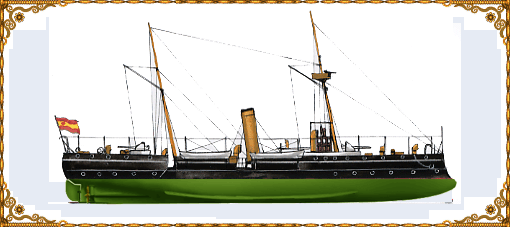
In Spanish service the cruiser had a green and black paint scheme with buff to white superstructures

In Spanish service, the cruiser had a green and black paint scheme with buff-to-white superstructures

Laid down on 25 February 1886 in the UK, she was built by Elswick (Armstrong, Whitworth)  at  Newcastle upon Tyne. She was completed and commissioned in late 1887. Just over 1000-tons, she was 184-feet in length. Beamy at nearly 30 feet, she had a length-to-beam ratio of 1:6 and tended to wallow in heavy seas. She also didn’t have enough ass to push her through the waves, her 2-shaft horizontal triple-expansion engines fed by 2 cylindrical boilers could generate about 14 knots, 15 if she was light. Very lightly armored, she was also lightly armed with a half-dozen 4.7-inch guns as well as some smaller QFs and MGs but her deadliest weapon was a triple set of 14-inch torpedo tubes.

Delivered to the Armada in 1887, she served first in Europe and even dropped some shells on the Rif in Morocco from time to time, practicing true gunboat diplomacy.

Today her size and armament would make her a corvette or offshore patrol vessel. In her time, cruisers were meant to be the fast eyes of the fleet, able to reach out over the horizon, find targets, and alert the main fleet of other vessels. The Isla de Luzon was too slow for that, and she soon found herself in colonial service in the Philippines. There she could visit far-flung Pacific islands and enforce the crown’s law against the locals without too much problem. She was part of the Spanish Pacific Squadron under Admiral Patricio Montojo, which consisted of seven cruisers (of which Isla de Luzon was one of the best) and a few gunboats.

Then came the Spanish-American War.

Dewey in the USS Olympia dropping it like its hot on the moored Spanish fleet

Dewey in the USS Olympia drops it like it’s hot on the moored Spanish fleet. Isla de Luzon would be in the background closer to the shore

On 1 May 1898, Commodore Dewey steamed his Asiatic Squadron into Cañacao Bay under the lee of the Cavite Peninsula east of Sangley Point, Luzon– coincidentally the island she was named after. The resulting Battle of Manila Bay, the first major engagement of the Spanish-American War, left most Spanish ships sunk while Dewey suffered less than forty casualties by the worst estimate.

57447_isla_de_luzo_md wreck

isla de luzon
Isla de Luzon was hit three times by US shells, then was scuttled in shallow water by her crew when the battle was in its final stages. She only had a half-dozen casualties. Bluejackets from the gunboat Petrel swarmed over her stricken hull, looted what they could, and set her alight.

isladeluzonwreck

Raised after the war, she was rebuilt, rearmed with US-pattern guns, painted white, and commissioned USS Isla de Luzon on 11 April 1900.

Former Spanish cruiser Isla de Luzon soon after capture, seen in Pensacola, FL. Note she is wearing an American shield on her bow

USS Isla de Cuba 4

Note twin stacks in US service after 1911

She then served as a gunboat, sailing through the Indian and Atlantic oceans to reach her new homeland in 1903, serving as a station ship in Pensacola until 1907 when she was loaned to the Louisiana Naval Militia on 6 December 1907 and later to the Illinois Naval Militia on the Great Lakes as a training ship. She spent WWI as a torpedo tender in Narragansett Bay, instructing new gunners mates and TMs.

In 1911 she was given a new power plant and two skinny funnels. Here she is as a training ship after that date in haze grey scheme

In 1911 she was given a new power plant and two skinny funnels. Here she is as a training ship after that date in a hazed grey scheme

Decommed and truck 23 July 1919, she was sold the next year to the Bahama & West Indies Trading Co to work as a coastal trading ship in the shallow waters there under the name SS Reviver. Her 1911-installed Babcocks boilers couldn’t handle the strain and she was soon sold to Bahama Salvors, Ltd. of Nassau and scrapped in 1931 at age 44.

The only remnant of her that remains today dates back to 1902. “Following long custom, when she visited Muscat’s picturesque harbor, members of her crew painted “Isla de Luzon” on the steep entrance cliff; in later years this was periodically refurbished by visiting ships of the U.S. Navy Middle East Force Command.”

isla de luzon muscat

Her name can still be seen there today.

Her only sistership, the cruiser Isla de Cuba, was also sunk at the Battle of Manila Bay, also salvaged and commissioned into the US Navy with the unimaginative name of USS Isla de Cuba, paid off in 1912, then picked up by the Venezuelans who used her as the training ship  Mariscal Sucre until 1940.

Specs:

You can best see her Spanish scheme in this line drawing

You can best see her Spanish scheme in this line drawing

(As-built)

Displacement:     1,030 tons
Length:     184 ft 10 in (56.34 m)
Beam:     29 ft 11 in (9.12 m)
Draft:     12 ft 6 in (3.81 m) maximum
Installed power:     1,897 hp (natural draft)
2,627 hp (forced draft)
Propulsion:     2-shaft horizontal triple-expansion, 2 cylindrical boilers
Speed:     14.2 knots (natural draft)
15.9 knots (forced draft)
Complement:     164 officers and enlisted
Armament:     6 × 4.7 in (120 mm) guns
8 × 6 pdr quick-firing guns
4 × machine guns
3 × 14 in (356 mm) torpedo tubes
Armor:     Deck 2.5 in (64 mm)-1 in (25 mm); conning tower 2 in (51 mm)

(1900)
Displacement:     950 long tons (965 t)
Length:     195 ft (59 m)
Beam:     30 ft (9.1 m)
Draft:     11 ft 4.75 in (3.4735 m) (mean)
Propulsion:     2-shaft horizontal triple expansion engine, 535 hp (399 kW)
2-cylinder boilers
160 tons coal
Speed:     11.2 knots (20.7 km/h; 12.9 mph)
Complement: 137 officers and enlisted (1900-07), after 1907 just a small cadre of regular officers and CPOs backed by up to 200 naval militia and trainees.
Armament: Four 4″ mounts and three torpedo tubes
1905 – Four 4″ mounts, four 6-pounder,s and four .30 cal. machine guns
1911 – Four 4″/40 rapid fire mounts, four 6-pounder rapid fire mounts, two 1-pounder rapid fire mounts, and added two temporary 3-pounder rapid fire mounts
Armor:     Deck: 1–2.5 in (25–64 mm), scortched

If you liked this column, please consider joining the International Naval Research Organization (INRO), Publishers of Warship International

They are possibly one of the best sources of naval study, images, and fellowship you can find http://www.warship.org/

The International Naval Research Organization is a non-profit corporation dedicated to encouraging the study of naval vessels and their histories, principally in the era of iron and steel warships (about 1860 to date). Its purpose is to provide information and a means of contact for those interested in warships.

Nearing their 50th Anniversary, Warship International, the written tome of the INRO has published hundreds of articles, most of which are unique in their sweep and subject.

I’m a member, so should you be!

Warship Wednesday Feb 12, the Big Mass

Here at LSOZI, we are going to take out every Wednesday for a look at the old steam/diesel navies of the 1859-1946 time period and will profile a different ship each week.

– Christopher Eger

Warship Wednesday Feb 12, the Big Mass

(click to embiggen)

(click to embiggen)

Here we see the war veteran USS Massachusetts fitting out at the New York Navy Yard, 1904, USS Indiana (BB-01), her sister, is in the background. The second official US battleship, the Massachusetts had an interesting life including service against the Spanish, Germans, and a few stops in between before finally taking a beating from the Army.

Note the LOW freeboard...

Note the LOW freeboard…

Built by William Cramp & Sons Ship & Engine Building Co. in Philadelphia at a cost of $3-million, she and her sisters Indiana and Oregon were the young nations first all-steel seagoing battleships. Of course this term was relative as the ships could hardly take to sea due an extremely low free-board that threatened to swap them in heavy sea states.

span am

Ordered in 1890, she was laid down on 25 June 1891 and commissioned 10 June 1896, her construction drawn out almost six years which is evident to the new type of ship that she was. Just 350-feet long, she would be considered a small frigate today except for the fact that she was a massive 11,500-tons when fully loaded. This was because the ship was crammed with 4 double ended Scotch boilers,  two vertical inverted triple expansion reciprocating steam engines, a dozen 13-inch and 8-inch guns, forty smaller cannon and five torpedo tubes.

This was all clad in a total of up-to 18-inches of  Harveyized steel and conventional nickel-steel armor, she was crewed by some 400+ officers and men.

The men in the late 1890s, were darlings of the media and some of their pictures remain in the Library of Congress, showing an interesting aspect of the ordinary lives of bluejackets more than a century ago.

bluejackets on BB-2 getting some officially sanctioned boxing in

bluejackets on BB-2 getting some officially sanctioned boxing in

According to the history of the ship, “To the men who served on her she was more than just a battleship. The men polished her brass fittings and cleaned her wooden deck because she was their home and their protector. They proudly sailed the seas knowing that they were aboard one of the most powerful and beautiful ships on Earth. But these men did not always have it easy, they had to constantly feed the coal burners to keep the ship powered, clean the guns and ammunition and then check and recheck them to maintain battle-readiness.

U.S.S. Massachusetts, fire room 1897 note the chalk on the boiler hatches

U.S.S. Massachusetts, fire room 1897 note the chalk on the boiler hatches

“They lived in small quarters, sailed through rough seas and were away from daily comforts. Yet throughout these difficult tasks and times, recreation was encouraged. The Navy learned long ago that it was important to keep up the men’s spirits in the face of such demanding times. Before retiring to their hammocks for the evening, the men were sometimes allowed to purchase small amounts of beer. They also formed a football team and held boxing matches to help relieve tensions aboard, and on holidays special dinners were cooked for those not lucky enough to be at home with family. Overall, those who lived, worked and died in her service know that Massachusetts was a fine ship”

Marine guards c1897

Marine guards c1897. White gloves and spiked Prussian style helmets were standard for the Army too in many units at this time. 

BB-2 sailors in summer whites

BB-2 sailors in summer whites

Inside one of her turrets

Inside one of her turrets. Note the old school Donald Ducks

Capable of steaming at up-to 16-knots, she was fast for her time.

off tow ar
When war broke out in 1898 with Spain, her beautiful white and buff paint scheme switched to haze grey and she went off to the beat of the drums, joining the Flying Squadron under Commodore Winfield Scott Schley for the blockade of Cuba. Missing the main fleet battles due to having to be coaled, she did cause the old Spanish cruiser Reina Mercedes to scuttle and assisted with the occupation of both Puerto Rico and Cuba.

The 3000-ton largely disarmed Spanish cruiser Reina Mercedes, sunk in Santiago, Cuba 1898 after scuttling following an engagement with the USS Massachusetts

The 3000-ton largely disarmed Spanish cruiser Reina Mercedes, sunk in Santiago, Cuba 1898 after scuttling following an engagement with the USS Massachusetts. She cruiser suffered no less than three direct hits from her 13-inch shells.

Over the next several years she was something of a cursed ship, grounding herself on no less than three occasions as well as suffering explosions in her turret and boiler rooms.

By 1910 she was used only for gunnery training and annual summer midshipmen s cruises around the Eastern seaboard and Caribbean. In 1917 when WWI became very real for the US, she was pressed into service to train naval gun-crews which she did admirably. With the end of the war came the end of her usefulness and in 1919 she was simply renamed the very awe-inspiring and creative  ‘Coastal Battleship No.2′ before being struck on 22 November 1920. The next year she was turned over to the Army, who desperately wanted a battleship to poke holes in

Her guns and coal stores were removed as was anything that was useful. But thats ok, as the Army just wanted her armor intact anyway.

Her guns and coal stores were removed as was anything that was useful. But that’s OK, as the Army just wanted her armor intact anyway.

Scuttled in shallow water near Pensacola, she was within range of the US Army Coastal Artillery positions at Forts Pickens and Fort Barrancas as well as by mobile railway artillery and tons of ordnance were fired at the old ship through 1925 when the Army offered her back to the Navy. The Navy said thanks but no thanks and instead used her for occasional bombing runs by pilots flying out of NAS Pensacola  as late as the 1950s when she finally slipped under the waves for good.

She is now owned by the state of Florida who maintains her as an artificial reef.

As such she is a very popular dive.

Specs:

Displacement: 10,288 long tons (10,453 t; 11,523 short tons)
Length:     350 ft 11 in (106.96 m)
Beam:     69 ft 3 in (21.11 m)
Draft:     27 ft (8.2 m)
Propulsion:

Two vertical inverted triple expansion reciprocating steam engines
4 double ended Scotch boilers later replaced by 8 Babcock & Wilcox boilers
9,000 ihp (6.7 MW) (design)
10,400 ihp (7.8 MW) (trial)

Speed:

15 kn (28 km/h; 17 mph) (design)
16.2 kn (30.0 km/h; 18.6 mph) (trial)

Range:     4,900 nmi (9,100 km; 5,600 mi)
Complement:     473 officers and men
Armament:

4 × 13″/35 gun (2×2)
8 × 8″/35 gun (4×2)
4 × 6″/40 gun removed 1908
12 × 3″/50 gun added 1910
20 × 6-pounders
6 × 1 pounder guns
5 × Whitehead torpedo tubes

Armor:     Harveyized steel

Belt: 18–8.5 in (460–220 mm)
13″ turrets: 15 in (380 mm)
Hull: 5 in (130 mm)

Conventional nickel-steel

Tower: 10 in (250 mm)
8″ turrets: 6 in (150 mm)
Deck: 3 in (76 mm)

If you liked this column, please consider joining the International Naval Research Organization (INRO), Publishers of Warship International

They are possibly one of the best sources of naval study, images, and fellowship you can find http://www.warship.org/

The International Naval Research Organization is a non-profit corporation dedicated to the encouragement of the study of naval vessels and their histories, principally in the era of iron and steel warships (about 1860 to date). Its purpose is to provide information and a means of contact for those interested in warships.

Nearing their 50th Anniversary, Warship International, the written tome of the INRO has published hundreds of articles, most of which are unique in their sweep and subject.

I’m a member, so should you be!

Warship Wednesday Feb 5: Russian Thunder

Here at LSOZI, we are going to take out every Wednesday for a look at the old steam/diesel navies of the 1859-1946 time period and will profile a different ship each week. – Christopher Eger

Warship Wednesday, Feb 5:  Russian Thunder

click to embiggen

click to embiggen

Here we see the Tsar’s armored cruiser Gromoboi (Thunderbolt) as she looked when visiting Australia in 1901. Built as a large warship capable of independent operations in far-flung seas, her primary role was to be that of a commerce raider against the British merchant fleet. You see when she was laid down 14 June 1897, it was Edwardian England that was seen as the greatest threat to Holy Russia, and not the Kaiser’s Germany.

The Russian cruiser Gromoboi shortly before its launch note imperial footman leaning over to get a better view.

The Russian cruiser Gromoboi shortly before its launch note imperial footman leaning over to get a better view.

An improvement on the earlier Rossia and Rurik class armored cruisers that came just before her, she was 481-feet long and tipped the scales at some 12,500 tons with a full load. This made her roughly the same size (and even larger in some cases) than the Pre-Dreadnought battleships of her age.

Oddly, her steel hull was sheathed in arsenic treated wood, to prevent fouling in distant harbors where drydocks were not available

Oddly, her steel hull was sheathed in arsenic-treated wood, to prevent fouling in distant harbors where drydocks were not available

Her battery of 20 eight and six-inch guns made sure she could slaughter any merchant ship, gunboat, or cruiser while her 19-knot speed enabled her to outrun the lumbering turn of the century battleships of the 1890s. The only ships fast enough to catch her were small scout cruisers and torpedo boats which her fifty small-caliber rapid fire guns and six inches of Krupp cemented armor belt could shrug off.

A handsome sight with her four funnels venting her 32 boilers

A handsome sight with her four funnels venting her 32 boilers

Capable of cruising over 8000-miles on a single load of coal, she could cross the Atlantic or sail to the far-flung Pacific with ease.

And she did.

Ordered from the Baltic Works, Saint Petersburg, she was commissioned November 1899, firmly a 19th-century ship in a 20th-century world. To keep her hull from fouling in tropical waters, it was sheathed with wood. Her three shafts were turned by amazingly and over complex series of 32 Belleville water-tube boilers with thousands of tubes that needed constant attention.

Note the Romanov eagle on her bow and the Imperial Russian Naval ensign fluttering. This ship was made to show the flag around the world

Note the Romanov eagle on her bow and the Imperial Russian Naval ensign fluttering. This ship was made to show the flag around the world. You have to dig the 3-inch gun as a hood ornament too. 

Her crew numbered nearly a thousand men to feed and care for these boilers, shovel 2400-tons of coal, and man her incredibly varied suite of weaponry.

Besides her twenty 8 and 6 inch guns in casemates, the cruiser had more than fifty of these smaller canet style guns to ward off torpedo boats. They offered little protection for their crews from splinters.

Besides her twenty 8 and 6 inch guns in casemates, the cruiser had more than fifty of these smaller canet style guns to ward off torpedo boats. They offered little protection for their crews from splinters.

She left the Baltic the spring after her commissioning and the gleaming white cruiser made appearances in Germany, Britain, and Australia on her way to the Tsar’s new colony of Port Arthur, recently garnered from ailing Manchu-controlled China by a lease.

Vladivostok cruisers in 1903. From left to right you have the Rossia, Bogatyr, Gromboi and Rurik ("Russia", "Hercules", "Thunderbolt", "Rurik") by Valery Shilyaeva

Vladivostok cruisers in 1903. From left to right you have the Rossia, Bogatyr, Gromboi, and Rurik (“Russia”, “Hercules”, “Thunderbolt”, “Rurik”) by Valery Shilyaeva. Click to embiggen.

Stationed in Vladivostok by 1903 along with the cruisers Rossia, Rurik and Bogatyr and the auxiliary cruiser Lena, their enemy changed from the planned British merchant fleet to that of the Japanese merchant fleet by a twist of fate in 1904 when the Russo-Japanese war started. The enemy soon bottled up most of the Russian Pacific Squadron inside Port Arthur but neglected to do so for the cruiser squadron at Vlad.

The last thing you wanted to see if you were a Japanese merchant ship in the North Pacific in 1904...

The last thing you wanted to see if you were a Japanese merchant ship in the North Pacific in 1904…

Painted a thick grey coat and made ready for war, the four cruisers formed a raider group that haunted the Northern Pacific Ocean, sinking the occasional Japanese ship. Led by the Baltic German commander Vice Admiral Karl Petrovich Jessen, they were a force to be reckoned with and almost drove the Japanese to drink.

Rossiya and Gromoboi sinking the unarmed wallowing 1,000-ton freighter, the Nakanoura Maru, built in 1865, just days after the war started in Feb 1904.

Rossiya and Gromoboi sinking the unarmed wallowing 1,000-ton freighter, the Nakamura Maru, built in 1865, just days after the war started in Feb 1904.

Their most important victory was against the Hitachi Maru, a 6,172 gross ton combined passenger-cargo ship built by Mitsubishi Shipbuilding in Nagasaki, for NYK Lines.

While transporting 1238 people, including 727 men of the 1st Reserve Regiment of the Imperial Guard of Japan and 359 men from the IJA 10th Division and 18 Krupp 11-inch (280 mm) siege howitzers desperately wanted for the siege at Port Arthur, the Hitachi Maru was found by  the Gromoboi in the southern Korean Strait between the Japanese mainland and Tsushima on June 15, 1904. The Tsar’s cruiser shelled and sank same which led to the resulting “Hitachi Maru Incident,” which ignited both British (the ship had a British captain) and Japanese anger (due to the loss of the politically important Imperial Guard regiment which included several officers from the Japanese petit nobility).

In all the cruiser force made six sorties from Vladivostok and sank 15 Japanese ships and captured two (British) merchant vessels.

The Japanese sent a fleet to Vladivostok to blockade the port and shelled the cruisers at anchorage. When the Russians did manage to emerge again in August, the fleet of six cruisers of Japanese Admiral Kamimura Hikonojō’s fast fleet caught up with the Rossia, Rurik, and Gromoboi off of Ulsan, Korea.

Japanese postcard with their version of how the Battle of Ulsan played out

Japanese postcard with their version of how the Battle of Ulsan played out

The resulting battle was a tactical Japanese victory fought over the morning of 14 August 1904.  Improved Japanese fire-control as well as a 2:1 ratio in hulls and guns won the day.

The Rurik was hit by a shell in her unarmored stern and the steering mechanism was destroyed, immobilizing her rudder in an elevated position, resulting in her being the target of intense bombardment by the Japanese cruisers. The stricken Russian ship was scuttled while Gromoboi and Rossia were able to slip their attackers and make it back to Vladivostok.

Gromoboi riddled with shrapnel after the battle. Dont worry though, its just a flesh wound

Gromoboi riddled with shrapnel after the battle. Don’t worry though, it’s just a flesh wound

All six of the Japanese cruisers received damage as did the two remaining Russian ones. The Gromoboi was riddled with shell fragments from 22 direct hits, severely damaged and had 91 dead and 182 wounded during the battle. Most of these deaths came from gunners manning the unprotected light canet guns on her decks.

Whereas the Japanese ships were able to return to the shipyard for repair, the two Russian ones could only retire to the primitive port facilities at their Siberian port. Unable to be repaired, they sat out the rest of the war and did not sortie again.

Iced in 1904-1905

Iced in 1904-1905

After spending the winter of 1904-1905 iced in, she emerged in the spring and hit a mine on 24 May, the war ended without her sailing from port again.

Following the end of the war, she was sent to the Baltic again to reinforce the fleet there. Rode hard and put up wet, she spent six years in the shipyard and emerged in 1911 with a refurbished engineering suite and upgraded fire control. Her armament was modified after experiences in the war, receiving 18-inch torpedo tubes and reducing the number of unprotected guns, and several searchlights were added.

When WWI started in 1914, she was still in the Baltic. Modified as a fast minelayer (18-knots was fast in 1914), she sortied from Krondstadt to German-frequented waters several times, sewing 200 mines per trip. Her armament was changed once more during the war and her displacement went to almost 14,000-tons.

On August 10, 1915, she tangled with the much larger and stronger German battlecruiser SMS Von Der Tann (23,000-tons, 8×11-inch guns, 9.8-inches of armor), in the waters around the Gulf of Finland. Both ships sailed away afterward, with the Gromoboi weaving her way back home safely.

Becoming part of the Red Banner Fleet by default in 1918, she survived both British and White Russian efforts to sink her during the Russian Civil War as well as the Bolshevik siege of Krondstat in 1921 only to be scrapped by a German company in 1922. No monument or memorial exists to her and her three unusual wars.

Hard aground in the port of Libau, she was scrapped in place in 1922 by the breaker who lost her there while under tow.

Hard aground in the port of Libau, she was scrapped in place in 1922 by the breaker who lost her there while under tow.

There is though, a memorial to her most famous opponent, the Hitachi-Maru Memorial Stele. It is located at the Yasukuni Shrine, Chiyoda, Tokyo, Japan.

800px-Yasukuni_Hitachi-Maru_Memorial_Stele

Specs:

click to embiggen

click to embiggen

Displacement:     12,455 long tons (12,655 t)
Length:     481 ft (146.6 m)
Beam:     68.6 ft (20.9 m)
Draught:     26 ft (7.9 m)
Installed power:     14,500 ihp (10,800 kW)
Propulsion:     3 shafts, 3 vertical triple expansion steam engines, 32 Belleville water-tube boilers
Speed:     19 knots (35 km/h; 22 mph)
Range:     8,100 nautical miles (15,000 km; 9,320 mi) at 10 knots (19 km/h; 12 mph)
Complement: 874 officers and crewmen
Armament:

(as built)
4 × 1 – 8-inch (203 mm)/45 guns
16 × 1 – 6-inch (152 mm)/45 guns
24 × 1 – 75-millimetre (3.0 in)/50 guns
12 × 1 – 47-millimetre (1.9 in)/43 guns
18 × 1 – 37-millimetre (1.5 in)/23 Hotchkiss Gatling guns
4 × 15-inch (381 mm) torpedo tubes

(after 1911)
4 × 1 – 8-inch (203 mm)/45 guns
22 × 1 – 6-inch (152 mm)/45 guns
4 × 1 – 75-millimetre (3.0 in)/50 guns
4 × 1 – 47-millimetre (1.9 in)/43 guns
2 × 18-inch torpedo tubes

(after 1915)
6 × 1 – 8-inch (203 mm)/45 guns
22 × 1 – 6-inch (152 mm)/45 guns
2x57mm guns
2 × 1 – 47mm high angle AAA guns
2 × 18-inch torpedo tubes
200 mines

Armor:     Krupp cemented armor
Belt: 6 in (152 mm)
Deck: 1.5–3 in (38–76 mm)
Conning tower: 12 in (305 mm)

If you liked this column, please consider joining the International Naval Research Organization (INRO), Publishers of Warship International

They are possibly one of the best sources of naval study, images, and fellowship you can find http://www.warship.org/

The International Naval Research Organization is a non-profit corporation dedicated to the encouragement of the study of naval vessels and their histories, principally in the era of iron and steel warships (about 1860 to date). Its purpose is to provide information and a means of contact for those interested in warships.

Nearing their 50th Anniversary, Warship International, the written tome of the INRO has published hundreds of articles, most of which are unique in their sweep and subject.

I’m a member, so should you be!

« Older Entries Recent Entries »