Tag Archives: four piper

Warship Wednesday, Nov. 29, 2023: As Easy as 123

Here at LSOZI, we take off every Wednesday for a look at the old steam/diesel navies of the 1833-1954 period and will profile a different ship each week. These ships have a life, a tale all their own, which sometimes takes them to the strangest places. – Christopher Eger

Warship Wednesday, Nov. 29, 2023: As Easy As 123

Naval History and Heritage Command Photograph NH 109514

Above we see Wickes-class tin can USS Gamble (Destroyer No. 123) steaming into after the review of Pacific Fleet, 13 September 1919, with her sister USS Radford (DD-120) trailing behind.

Brand new and beautiful in this image, she was commissioned 105 years ago today. Gamble would give her last full measure off Iwo Jima and be deep-sixed a month before the end of World War II but don’t worry, she rolled the dice and took a few of the Emperor’s ships with her.

The Wickes

Gamble was one of the iconic first flights of “Four Piper” destroyers that were designed in 1915-16 with input from no less an authority as Captain (later Admiral) W.S. Sims. Beamy ships with a flush deck and a quartet of boilers (with a smokestack for each) were coupled to a pair of Parsons geared turbines to provide 35.3 knots designed speed– which is still considered fast today, more than a century later.

The teeth of these 314-foot, 1,250-ton greyhounds were four 4-inch/50 cal MK 9 guns and a full dozen 21-inch torpedo tubes.

They reportedly had short legs and were very wet, which made long-range operations a problem, but they gave a good account of themselves. Originally a class of 50 was authorized in 1916, but once the U.S. entered WWI in April 1917, this was soon increased and increased again to some 111 ships built by 1920.


Wickes class USS Yarnall (DD-143): Booklet of General Plans – Inboard Profile / Outboard Profile, June 10, 1918, NARA NAID: 158704871


Wickes class USS Yarnall (DD-143): Booklet of General Plans – Main Deck / 1st Platform Deck / S’ch L’t P’f’m, S’ch L’t Control P’f’m, Fire Control P’f’m Bridge, Galley Top, After Dk. House and 2nd Platform Deck. / June 10, 1918, Hold NARA NAID: 158704873

Wickes class. A close-up of her stern top-down view of plans shows the Wickes class’s primary armament– a dozen torpedo tubes in four turnstiles and stern depth charges.

Meet Gamble

Our subject is the first Navy ship to be named in honor of at least two of the quartet of Gamble brothers who served in the War of 1812. The four brothers including Capt. Thomas Gamble (USN) who served aboard USS Onedia during the war and perished while in command of the sloop USS Erie of the Navy’s Mediterranean Squadron in 1818; 1st Lt. Peter Gamble (USN) killed on the USS Saratoga during the Battle of Lake Champlain in 1814; Lt. Francis B. Gamble (USN) who died of yellow fever in 1824 while in command of the USS Decoy of the navy’s West Indies Squadron; and U.S. Marine hero Lt. Col. (Brvt) John Marshall Gamble, the only member of the Corps to command an American warship in battle– the prize ship USS Greenwich in her combat with the British armed whaler Seringapatam in 1813. Only John lived into the 1830s, passing at age 44, still on active duty.

Two of the four brothers Gamble. Midshipman Thomas Gamble, USN (L) via Analectic magazine. Painted by Waldo, and engraved by J.B. Longacre. NH 49483 and Lt. John M. Gamble, USMC (R). Photo from a portrait in possession of his grandson. (Naval History and Heritage Command Photograph NH 49482)

Gamble (Destroyer No. 123) was laid down on 12 November 1917 at Newport News, launched on 11 May 1918 sponsored by a dour relative of SECNAV Josephus “Cup of Joe” Daniels; and commissioned at Norfolk 18 days after the Armistice on 29 November 1918.

Wickes class sisters USS Breese (DD-122) and USS Gamble (DD-123) on the ways at Newport News between November 1917 and May 1918. NH 43018

USS Gamble (DD-123) launched at Newport News, Virginia, on 11 May 1918. Her sistership USS Breese (DD-122) is next to her and launched the same day in a dual ceremony. NH 53813

Same as above, NH 53812

Entering a crowded and rapidly demobilizing fleet that was just coming off the Great War, Gamble would spend the next several months in a series of shakedowns and trials up and down the East Coast from Maine to Cuba but notably was one of the ships escorting the troop transport George Washington, which was carrying President Woodrow Wilson back to the U.S. from peace negotiations in Paris to Boston in February 1919 and again in July.

In May 1919, she was one of the support ships for the legendary first transatlantic flight by the Navy’s Curtiss NC flying boats, helping spot NC-4 through the Azores.

In mid-July 1919, Gamble, along with sisters Breese, Lamberton (Destroyer No. 119), and Montgomery (Destroyer No. 121), were shifted to the Pacific Fleet to join Destroyer Division 12 and made their way to San Diego via the Panama Canal.

USS Gamble (DD-123) and USS Breese (DD-122) photographed circa 1919, probably at Balboa, Panama, Canal zone. Courtesy of Jack Howland, 1983. NH 94956

Once on the West Coast, she would spend most of the next three years haze gray and underway, so to speak, steaming from up and down the West Coast from San Diego to Seattle and out to Pearl and back in a series of tests, maneuvers, and reviews.

Gamble photographed about 1919. NH 53815

Gamble at San Diego, California, circa 1919. NH 53816

USS Gamble (DD-123) photographed on 23 April 1919 with extensive tropical awnings covering her decks. Sister USS Breese (DD-122) is in the background. NH 53814

Gamble with her original DD-123 hull numbers. NH 67684

Destroyers at the Mare Island Navy Yard, 1919 (from left to right): USS Tarbell (Destroyer # 142); USS Thatcher (Destroyer # 162); USS Rizal (Destroyer # 174); USS Hart (Destroyer # 110); USS Hogan (Destroyer # 178); USS Gamble (Destroyer # 123); USS Ramsay (Destroyer # 124); and USS Williams (Destroyer # 108). Donation of Rear Admiral Ammen Farenholt, USN (Medical Corps). NH 42537

USS Gamble (DD-123) at anchor and dressed with flags, circa 1921, following the relocation of her after 4″/50 cal gun to the top of the after deckhouse. NH 59648

Battleship USS Mississippi (BB-41) at sea for maneuvers, during the early 1920s. Wickes class destroyers in the background include USS Radford (DD-120) and USS Gamble (DD-123). NH 46051

Destroyer tender USS Prairie (AD-5) in San Diego Harbor, California, with USS Gamble (DD-123) alongside, circa 1920-1922. NH 105775

U.S. fleet in Balboa, Panama, early 1920s. The center of the photo is the battleship USS New Mexico BB-40, then a cluster of flush deck destroyers including USS Ramsey DD-124, USS Montgomery DD-121, USS Breese DD-122, USS Lamberton DD-119, and USS Gamble DD-123. In the background are the battleship USS Mississippi BB-41, the tin cans USS O’Bannon DD-177, USS MacKenzie DD-175, USS Hugan DD-178, USS Anthony DD-172, and several other destroyers and another battleship in the far distance.

With budget cuts, Gamble was tapped to begin inactivation procedures and was decommissioned on 17 June 1922 and was held in reserve at San Diego.

Recall, and a job change

After nearly a decade on red lead row, Gamble was taken out of mothballs and redesignated a fast destroyer minelayer (DM-15) on 24 May 1930. This saw her head to Mare Island for a general overhaul and conversion.

The Navy had previously converted 14 Wickes and Clemson class ships to this designation in 1920, with the simple swap out of having their torpedo tubes replaced with a set of two 140-foot tracks that could carry approximately 85 1,400-pound Mark VI moored antenna mines (of which the Navy had 50,000 left over from the Great War) to drop over the stern.

The Navy ordered 100,000 Mark VI (MK 6) mines in 1917, carrying a 300-pound charge, and had so many left that even after using thousands during WWII they remained in U.S. service into the 1980s. Gamble and her sisters could carry as many as 85 of these on a pair of rails that ran, port and starboard, down the aft half of the ship.

As noted by Destroyer History.org:

Among the lessons World War I offered the US Navy was the possibility that fast ships could be effective in laying minefields to disrupt enemy operations. The surplus of flush-deckers at the end of the war provided an opportunity to experiment.

The original 14 circa 1920 rated destroyer-minelayers were slowly replaced throughout the 1930s by a smaller group of eight converted flush-deckers taken from mothballs– USS Gamble (DM-15)(DD-123), USS Ramsey (DM-16)(DD-124), USS Montgomery (DM-17)(DD-121), USS Breese (DM-18)(DD-122), USS Tracy (DM-19)(DD-214), USS Preble (DM-20)(DD-345), USS Sicard (DM-21)(DD-346) and USS Pruitt (DM-22)(DD-347).

Jane’s 1931 entry on the type. Note Breese is misspelled as “Breeze.”

Curiously, these ships would retain their white DD-hull numbers but wore Mine Force insignia on their bow, outwardly looking much more destroyer than minelayer.

Wickes-class destroyer USS Ramsey (DM-16)(DD-124) view was taken by Tai Sing Loo, at Pearl Harbor, T. H., circa 1930. Note that she is fitted out as a minelayer (DM) and retains her DD-hull number while wearing a mine-force insignia on her bow. NH 49953

In addition to these minelayers, several Wickes/Clemson class flush deckers were converted during the WWII era to other tasks including eighteen fast minesweepers (DMS), fourteen seaplane tenders (AVD), and six fast “Green Dragon” transports (APD) plus test ship Semmes (AG 24, ex-DD 189) at the Key West Sound School and damage control hulk Walker (DCH 1, ex-YW 57, ex-DD 163) which was reclaimed from commercial service as a dockside restaurant at San Diego.

All eight of the active destroyer-minelayers were formed into Mine Squadron 1 headed up by the old minelayer USS Oglala (CM 4), flagship of Rear Admiral William R. Furlong, commander of Minecraft for the Battle Force of the Pacific Fleet, and forward-based with “The Pineapple Fleet” at Pearl Harbor, where a new conflict would soon find them.

USS Oglala (CM-4); USS Gamble (DD-123/DM-15); USS Ramsay (DD-124/DM-16). (listed L-R) anchored off Cocoanut Island, Hilo Harbor, Hawaii, T.H., 12 December 1931. Mauna Kea Volcano is in the distance. Note that the DMs are still wearing their destroyer hull numbers but with Mine Force insignias. 80-G-409991

Gamble and her crew were busy while in Hawaiian waters in the 1930s, and often helped in search and rescue cases including that of the missing aircraft Stella Australis, the disabled steamer President Lincoln, and the yacht Lanikai.

She was also something of a public relations boat and was tapped to carry Territorial Governor Lawrence M. Judd from Honolulu to Hilo in 1931 then hosted the six-year-old singing and dancing wonder, Ms. Shirley Temple, in 1935.

Besides spending the day on Gamble, Temple was declared a Colonel of the Hawaiian National Guard, inducted as a Waikiki Beach lifeguard, and given a surfboard by Duke Kahanamoku during her 1935 Hawaiian trip.

Gamble (DM-15) dressed with flags while tied up in port, circa 1940 at the Golden Gate International Exposition (World’s Fair) in San Francisco. Note the circular Mine Force insignia, red/blue/white with a black center and outline, on her bow. In the distance is a USCG 240-foot Lake class cutter. Courtesy of the Mariners Museum, Newport News, Virginia. Ted Stone Collection. NH 66812

War!

All MineRon1’s ships were swaying at their berths at Pearl’s Middle Loch on 7 December 1941 when the Japanese attack came in. The squadron was divided into two divisions, with MinDiv2 consisting of Gamble, Montgomery, Breese, and Ramsay.

The response by Gamble, among others, was immediate, opening fire just two minutes after her lookouts saw enemy planes.

From her after-action report:

0745 Heard explosions on Ford Island.
0756 Wave of about 50 Japanese planes attacked battleships and Naval Air Station, Ford Island, planes flying at low altitudes about 500 feet over battleships from the direction of Diamond Head, about 700 feet over Ford Island. Five successive waves of the attack of about 10 planes each.
0758 Went to General Quarters, opened fire with .50 cal. machine guns on planes passing over nest at about 800 feet altitude. Set material condition afirm except for certain protected ammunition passages.
0759 Opened fire with 3″/23 cal. AA guns, firing as planes came within range, fuses set 3 to 8 secs.
0805 Mounted and commenced firing with .30 cal. machine guns on galley deck house.
0810 Commenced making preparations to get underway. Lighted off four boilers.
0925 One Japanese plane shot down by A.A. fire, falling in water on port beam about 1000 yards away from ship. Believed shot down by ROBERTS, W.L., BM2c, U.S.S. Gamble, port machine gunner (#2 machine gun) .50 cal., and JOOS, H.W., GM3c, U.S.S. Gamble (#1 machine gun) starboard.
0930 Division commenced getting underway. U.S.S. Breese underway.
0930 U.S.S. Gamble got underway and cleared mooring buoy.
0937 Japanese planes attacked near main channel entrance.
0955 Temporarily anchored, astern of U.S.S. Medusa.
1005 Underway proceeding out of channel.
1015 Shifted .30 cal. A.A. machine guns to top of pilot house on fire control platform.
1021 Cleared channel entrance. Eight depth charges were armed and the ship commenced off-shore anti-submarine patrol off Pearl Harbor entrance.
1204 Established sound contact with submarine and dropped three depth charges. Position bearing 162° T from Diamond Head Light, distant 2.5 miles.
1255 Proceeded on course 270° T at 20 knots to join friendly forces upon receipt of orders from CinCPac.
1412 Sighted sampan bearing 320° T.
1435 Slowed to investigate but did not search. Sampan position approximately 4 miles south of Barbers point.
1628 Sighted smoke bomb off port bow.
1631 Submarine surfaced.*
1632 Fired one shot 4″ gun and missed, short and to the left. Submarine displayed U.S. colors, and ceased firing. Submarine submerged and fired recognition red smoke bomb.
1647 Proceeded west.
1732 Sighted Enterprise and exchanged calls. Instructed by Commander Aircraft, Battle Force to join Enterprise.
1744 Joined Enterprise and took station as third ship with two other plane guard destroyers.

*The friendly submarine turned out to be the Tambor class boat USS Thresher (SS-200), which was unharmed although a critically ill member of her crew– the reason for her surfacing and heading to port– passed. She again tried to enter the harbor on 8 December but was driven off by depth bombs from a patrol plane and only made it into Pearl under escort from a seaplane tender. Thresher went on to become the most decorated submarine of the war with 15 battle stars and a Navy Unit Commendation.

Gamble would remain off Pearl for the rest of the month, dropping depth charges on at least two further underwater sound contacts, and continue her ASW mission into 1942 when she expanded her operations to Samoa and Fiji, sowing defensive minefields in the waters of both. She also picked up some much-needed extra AAA in the form of a couple of 20mm Oerlikons.

Escorting a convoy to Midway in June, Gamble returned with a high-profile enemy POW, CDR Kunizo Aiso, the former chief engineering officer of the Japanese carrier Hiryu which had been sunk in the pivotal battle.

Carrier flagship Hiryu: Last Moments of Admiral Yamaguchi at the Battle of Midway. oil painting by Renzo Kita, 1943. Most of the ship’s officers chose to ride her to the bottom or were evacuated. Aiso, forgotten in the engineering spaces with a small group of snipes, surfaced after the ship had been left to the sea and managed to take to lifeboats. 

Aiso was the senior Japanese naval officer imprisoned in the U.S. at the time and would be until 1944. Picked up at sea in a crowded lifeboat with 34 other survivors of his carrier after 12 days bobbing around the Pacific some 250 miles west of Midway, the English-speaking officer reportedly did not wish to return to Japan, nor wish his government be informed of his capture, preferring to be recorded as lost with his ship. For the trip to Hawaii, CDR Aiso was issued USN officer khakis and barricaded inside Gamble’s captain’s cabin with the wings cut off the wingnuts of the battle ports.

Finally, picking up 85 Mark VI mines at Pearl for points West, Gamble set off for Espíritu Santo in August 1942 and, from there, Guadalcanal.

DD-123, meet I-123

When it comes to pennant numbers, the meeting that Gamble had on the morning of 29 August some 60 miles east of Savo Island was curious. She came across I-123, a big Japanese I-121-class minelaying submarine, operating on the surface. On her fifth war patrol, she had left Rabaul two weeks prior under the command of LCDR Nakai Makoto and had already given the Marines on Lungga Point heartburn with her deck gun.

Type I-121 Submarine I-23 pictured at Kobe Naval Arsenal on April 28th, 1928

The rolling ship vs submarine combat between DM-15 (formerly DD-123) and I-123 over the course of four hours ended with Makoto and his 71 crewmembers receiving a promotion, posthumously.

Gamble’s report:

While the Japanese lost 131 seagoing Ro- and I-class submarines during World War II (100 by Allied action including mines, 3 in accidents, and 28 by unknown causes) I-123 was only the 12th boat sent to the bottom in the conflict and was one of the Empire’s first early losses.

Gamble was soon back to work.

The very afternoon after she sank I-123, she sped to Nura Island to pick up four shot-down TBF-1 Avenger (Bu. No. 00396) aviators of Torpedo 8 from the Saratoga (LT JG EL Fayle, ARM3c W Velogquz, S1C RL Minning and ARM3c JR Moncarrow), retrieved via her whaleboat from the surf line. She would rescue two more lost Airedales from Palikulo Bay two weeks later, picking up 2nd LT EN Railsbach, USMC, and Ens. EF Grant, USNR, after their SBD burned in.

Gamble was pressed into service at Guadalcanal as a fast troop transport, on the morning of 31 August carrying 158 Marines from Guadalcanal to Tulagi in company with sisters USS Gregory and USS Little, who were equally loaded down with Devil Dogs.

Gamble also was soon performing her primary role once again, that of sowing minefields around the area, planting 42 in a defensive belt in Segond Channel in December 1942.

Speaking of which…

Stopping the “Tokyo Express”

On 7 May 1943, Gamble and sisters Breese and Preble laid mines in the Ferguson Passage/Blackett Strait between Gizo and Wanawana Islands in the Solomons southwest of Rendova. Hidden by a rain squall and with enemy attention diverted by a supporting cruiser-destroyer group, the old four pipers were able to sow 250 sea mines in three rough lines across the strait in just 17 minutes.

Hours later, these mines were stumbled upon by a passing column of first-class Japanese tin cans of DesDiv 15 on an overnight fast troop transport run and sank the Kagero-class destroyer Kuroshio, with 83 lives, and crippled two sisterships– Oyashio and Kagero– which, barely able to maneuver and full of seawater, would be sunk the next day after being spotted by Navy dive bombers from Guadalcanal.

IJN First-class destroyer Hamakaze of the Kagerō-class. Three of her sisters were killed due to mines laid by Gamble and company. 

As noted by Allyn D. Nevitt over at Combined Fleet, “The loss of even one such modern destroyer was fast becoming intolerable to the Japanese; having a crack unit of three erased in one blow was pure catastrophe. American daring and ingenuity in the Blackett Strait had reaped a substantial reward indeed.”

After further service– including supporting the invasion of New Georgia and planting more mines– Gamble was sent to San Francisco in July 1943 for a three-month overhaul at Hunter’s Point Navy Yard. Arriving back in the South Pacific, Gamble spent November 1943 conducting several mining runs off Bougainville in the Solomon Islands in support of the Allied offensive there.

Then, as noted by DANFS:

Through late 1943 and much of 1944, Gamble generally served as convoy escort ship screening for enemy submarines while operating between Guadalcanal and Florida Island in the Solomons; Espíritu Santo; and Noumea, with additional runs to Suva, Fiji; Finschhaven and New Britain Island, New Guinea; Sydney; and Tarawa Atoll in the Gilbert Islands.

Overhaul

In September 1944, Gamble was sent back to the West Coast for four months at the Bethlehem Steel Repair Yard at Alameda. This led to a serious overhaul of her guns, landing all her old 3″/23s and 4-inchers in favor of a homogenized set of 3″/50s and 20mm Oerlikons.

According to her December 1944 plans, her WWII topside armament was mostly emplaced on a series of superstructure platforms except for a forward 3″/50 DP above the CPO quarters just 20 feet from the bow and a 20mm Oerlikon directly behind it in front of the wheelhouse. The ammo magazine was three decks down on the keel amidships and another on astern near the shafts, meaning a chain gang had to be established to hump it up top. The main gun platform was over the galley between the three remaining funnels and held two 3″/50 DPs (port and starboard) with hinged sponsons for the gun crew and two Oerlikons. A small gun tub with two single 20mm Oerlikons (port and starboard) was above Radio 3 next to the stub mast. The stern superstructure gun platform was built atop the crew’s washhouse and armory and held a single 3″/50 DP installed just 22 feet from the stern. Two portable .50 cals were set up midship atop the pilot house and on the main deck at frame 117 (of 177 frames).

She also only had three stacks by this point. 

All told, this fit gave her four 3″/50 DPs, five 20mm Oerlikons, and two .50 cals. She would also be fitted with a twin 40mm Bofors gun, although I am not sure of its placement. Not a lot of throw weight there, but then of course her main armament was in her mine rails and projectors for Mark VI depth charges.

Eight breakaway Carely float-type life rafts were installed to augment the ship’s 26-foot whaleboat and punt. The crew at this time was a skipper (LCDR/CDR) and 8 wardroom officers along with a mix of 132 rates and enlisted (62 Seamans branch, 57 Artificer branch, 4 Special branch, 4 Commissary branch, 5 Messman branch). By this time, she carried SF and SC radar sets and QCL sonar.

She also picked up a new camo scheme.

Camouflage Measure 32, Design 7D drawings prepared by the Bureau of Ships for a camouflage scheme intended for light minelayers of the DM-15 (Gamble) class. This plan, approved by Captain Torvald A. Solberg, USN, is dated 14 June 1944. 80-G-173486 and 80-G-173487.

This readied her for the “Big Show,” the push to Iwo Jima, Operation Detachment, in February 1945.

Back in the thick of it

On D+3, 17 February, Gamble closed into the beach close enough to cover the small minesweepers (YMS) and UDT teams of Sweep 5 and 6 clearing a path in the shoaling waters, shelling Japanese coastal emplacements and positions with her 3-inch and 40mm guns to silence them from harassing the cleaners via the application of 204 rounds of 3-inch AA Common and 254 of 40mm HETSD over seven hours. There, roughly six miles off Mt. Suribachi, she scored a hit on a large ammo dump with secondary explosions as well as silencing several enemy guns and bird-dogging other emplacements for the battlewagons.

Her NGFS report: 

Taking position off the old battlewagon Nevada the next night, she was hit by two small 250-pound bombs dropped by a  Japanese Kawasaki Ki-45 Toryu (Nick) twin-engine bomber that came in low and fast while she was silhouetted by star shells ashore. The bombs effectively wrecked our Gamble.

From her report:

Her crew was removed, and the shattered Gamble was towed to Saipan where she was decommissioned on 1 June 1945, and her name was stricken from the Navy Register three weeks later.

Stripped of anything thought useful, a series of images and videos were captured of her scuttling process, which took place off Guam on 16 July.


“Down Went the Gamble (DM 15).” Gamble was scuttled in June 1945. She was previously hit by Japanese enemy bombs in Feb 1945. Artist: Standish Backus, No.9. U.S. Navy photograph, now in the collections of the National Archives. 428-GX-KN 18978

Gamble received seven battle stars for service in World War II.

Epilogue

As Gamble was scuttled off Guam in deep water, few relics of her remain topside.

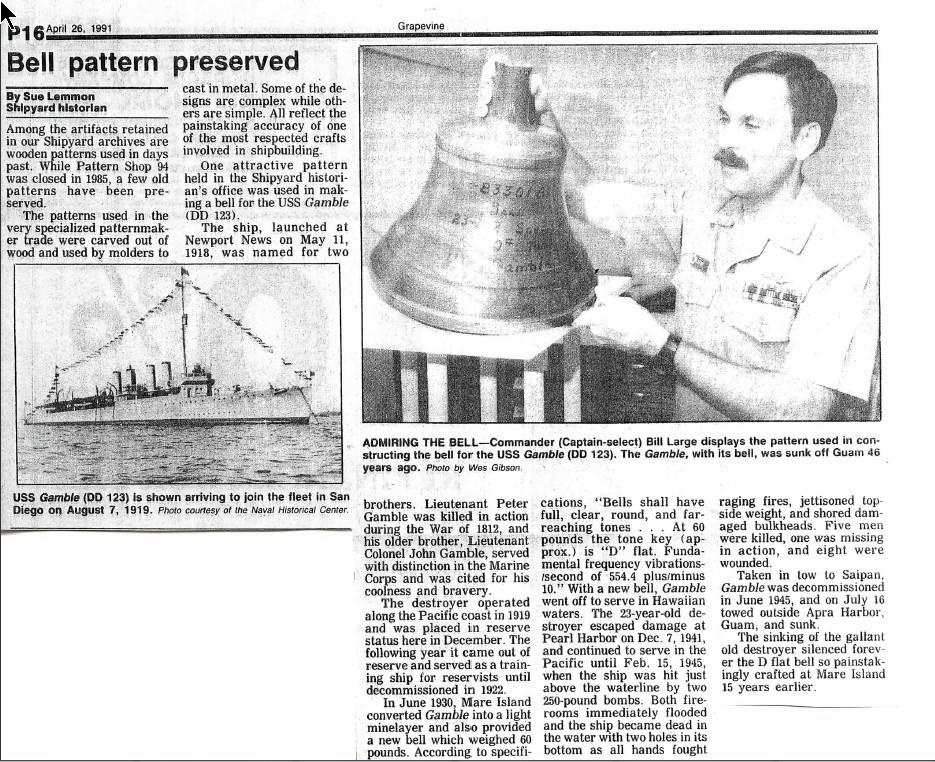
The wooden mold for her D Sharp ship’s bell, cast at Mare Island, resurfaced in 1991.

Her plans, drawings, deck logs, and war history are online in the National Archives. 

As for Shirley Temple, a bosun whistle presented to her by Gamble’s crew in 1935 remained a treasured possession for years. After all, she would meet her future husband, Charles Alden Black, a former Naval intelligence officer, in Hawaii in 1950 so perhaps those long-ago Pearl Harbor USN memories were prized. The whistle remained part of Ms. Temple’s estate and archives until it was sold at a 2015 auction by Theriault’s in New York.

It is undoubtedly in some collector’s display as this is written and perhaps will resurface one day.

Thus far, the Navy has chosen to not reissue the name “Gamble” to a second ship, which is a pity.


Ships are more than steel
and wood
And heart of burning coal,
For those who sail upon
them know
That some ships have a
soul.


If you liked this column, please consider joining the International Naval Research Organization (INRO), Publishers of Warship International

They are possibly one of the best sources of naval study, images, and fellowship you can find. http://www.warship.org/membership.htm

The International Naval Research Organization is a non-profit corporation dedicated to the encouragement of the study of naval vessels and their histories, principally in the era of iron and steel warships (about 1860 to date). Its purpose is to provide information and a means of contact for those interested in warships.

With more than 50 years of scholarship, Warship International, the written tome of the INRO, has published hundreds of articles, most of which are unique in their sweep and subject.

PRINT still has its place. If you LOVE warships you should belong.

I’m a member, so should you be!

Warship Wednesday, May 10, 2023: The Sleazy B

Here at LSOZI, we take off every Wednesday for a look at the old steam/diesel navies of the 1833-1954 period and will profile a different ship each week. These ships have a life, a tale all their own, which sometimes takes them to the strangest places.- Christopher Eger

Warship Wednesday, May 10, 2023: The Sleazy B

Naval History and Heritage Command NH 56568

Above we see a view of the slipway at the Newport News Shipbuilding and Drydock Co., some 105 years ago this week, of the Wickes-class four-piper USS Breese (Destroyer No. 122) just after she was launched on Saturday 11 May 1918. Completed too late for the war she was intended for; our humble little tin can would be very busy in the next one.

The Wickes

Breese was one of the iconic first flight of “Four Piper” destroyers that were designed in 1915-16 with input from no less an authority as Captain (later Admiral) W.S. Sims. Beamy ships with a flush deck and a quartet of boilers (with a smokestack for each) were coupled to a pair of Parsons geared turbines to provide 35.3 knots designed speed– which is still considered fast today, more than a century later.

The teeth of these 314-foot, 1,250-ton greyhounds were four 4-inch/50 cal MK 9 guns and a full dozen 21-inch torpedo tubes.

They reportedly had short legs and were very wet, which made long-range operations a problem, but they gave a good account of themselves. Originally a class of 50 was authorized in 1916, but once the U.S. entered WWI in April 1917, this was soon increased and increased again to some 111 ships built by 1920.

Wickes class USS Yarnall (DD-143): Booklet of General Plans – Inboard Profile / Outboard Profile, June 10, 1918, NARA NAID: 158704871

Wickes class USS Yarnall (DD-143): Booklet of General Plans – Main Deck / 1st Platform Deck / S’ch L’t P’f’m, S’ch L’t Control P’f’m, Fire Control P’f’m Bridge, Galley Top, After Dk. House and 2nd Platform Deck. / June 10, 1918, Hold NARA NAID: 158704873

Wickes class. A close-up of her stern top-down view of plans shows the Wickes class’s primary armament– a dozen torpedo tubes in four turnstiles and stern depth charges.

Meet USS Breese

Our warship is the only one named in honor of Kidder Randolph Breese.

Mr. Breese, a Philadelphian, was appointed a Navy midshipman at the age of 15 and saw wartime service on the sloop USS Saratoga off Mexico before his appointment to Annapolis. He later went on to join Commodore Perry’s Japan voyage and in the Paraguay Expedition in the antebellum period of the young republic. Civil War service included serving on the USS San Jacinto during the Trent affair, then with RADM David Dixon Porter for Vicksburg and Fort Fisher. Post-war assignments were varied and included inspecting the battle-damaged ironclad Huascar and command of the Torpedo Station at Newport, where he passed in 1881 at the rank of captain, aged a well-traveled 50.

Laid down on 10 November 1917 at Newport News, she was launched on 11 May 1918 with Mrs. Gilbert McIlvaine, the late Capt. Breese’s daughter, as sponsor, and commissioned on 23 October 1918, just three weeks before the Great War ended.

Notably, she was built side-by-side with her sister USS Gamble (DD-123) and the two were launched on the same day.

Newport News Ship Building Company, Newport News, Virginia. Caption: USS Breese (DD-122) and USS Gamble (DD-123) on the ways between November 1917 and May 1918. Description: NH 43018

USS Breese (DD-122), double launching with USS Gamble (DD-123) at Newport News Shipbuilding and Drydock Co., Newport News, Virginia on 11 May 1918. NH 56567

With the line still hot, just five minutes after she was launched, workmen began putting down the keel plates for sistership USS Bagley (DD-185) on the ways that Breese had just vacated while USS Clemson (DD-186) had her plates installed on Gamble’s freshly vacant berth.

Still, our brand new destroyer was able to get some wartime service in, effectively spending her shakedown on convoy escort duty with the Atlantic Fleet Cruiser Force.

USS Breese (DD-122) photographed circa November 1918, dressed in flags. Note her dazzle camouflage, which she would shed within a year. NH 42836

Immediately after the war wound down, Breese along with Gamble and several of their sisters Destroyer Division 12, would deploy to Cuban waters for most of 1919.

USS Gamble (DD-123) and USS Breese (DD-122) photographed circa 1919, probably at Balboa, Panama, Canal zone. Courtesy of Jack Howland, 1983 NH 94956

USS Breese (Destroyer # 122). Photographed circa 1919. Note that she still wears a small hull number (“122”) in its World War I position below the bridge, as well as a large number in the post-war location on the bow. Courtesy of Jim Kazalis, 1981. NH 92527

Div 12, with Breese along with it, then set out for the Pacific Fleet, where they would be active out of San Diego for the next two years.

USS Breese (DD-122) moored to a buoy circa 1920. NH 56572

USS Breese (DD-122) in San Diego, California, circa 1920. Note her single 3″/23 “anti balloon gun” behind her forward 4-incher. Courtesy of Mr. Donald M. McPherson, Corte Madera, California NH 56573

USS Breese (DD-122) photographed circa 1920. NH 61910

Destroyers nested at San Diego, CA circa 1920; from L-R: USS Radford (Destroyer No. 120), USS Sproston (Destroyer No. 173), USS Breese (Destroyer No. 122), USS Badger (Destroyer No. 126) and USS Montgomery (Destroyer No. 121). NH 50241

Destroyer Divisions 13, 15, 14, 11, and 10 moored in nests, off San Diego, California, circa 1922. Ships in the left foreground nest include (from left to right): USS Breese (DD-122); USS Radford (DD-120); USS Gamble (DD-123); USS Farquhar (DD-304); USS Robert Smith (DD-324); USS Montgomery (DD-121); and USS Lamberton (DD-119). The leftmost ship in the nest at right is USS Kennison (DD-138). Courtesy of ESKC Joseph L. Aguillard, USNR, 1969 NH 69514

Three Wickes (Lamberton) Class Destroyers during a public event at an unknown west coast port, maybe San Diago Ca in the early 1920s. From the left is USS Lamberton DD-119 (lead ship of the modified Wickes Destroyers), USS Breese DD-122, and USS Radford DD-120. Ships were part of Destroyer Force Division 12, Pacific Fleet

U.S. fleet in Balboa, Panama, early 1920s. The center of the photo is the battleship USS New Mexico BB-40, then a cluster of flush deck destroyers including USS Ramsey DD-124, USS Montgomery DD-121, USS Breese DD-122, USS Lamberton DD-119, and USS Gamble DD-123. In the background are the battleship USS Mississippi BB-41, the tin cans USS O’Bannon DD-177, USS MacKenzie DD-175, USS Hugan DD-178, USS Anthony DD-172, and several other destroyers and another battleship in the far distance.

With the Navy flush with destroyers and few destroyermen billets to go around, Breese was decommissioned on 17 June 1922 after just short of four years of service and laid up.

Destroyers refitting at Mare Island. View taken circa 1921-22. Many of these ships are being modified to place the after 4/50 gun atop an enlarged after-deckhouse. Ships present include (listed from the foreground): USS Lamberton (DD-119); unidentified destroyer; USS Breese (DD-122); USS Radford (DD-120); unidentified destroyer; USS Elliot (DD-146); USS Tarbell (DD-142); USS Yarnall (DD-143); USS Delphy (DD-261); USS McFarland (DD-237); USS Litchfield (DD-336); USS Kennison (DD-138); USS Lea (DD-118); and two unidentified destroyers. Collection of Rear Admiral Ammen Farenthold, USN (MC), 1932. NH 50325

Welcome to the Mine Forces

After nearly a decade on red lead row, Breese was taken out of mothballs and redesignated a fast destroyer minelayer (DM-18) on 5 January 1931. This saw her head to Mare Island for a general overhaul and conversion.

The Navy had previously converted 14 Wickes and Clemson class ships to this designation in 1920, with the simple swap out of having their torpedo tubes replaced with tracks that could carry approximately 80 1,400-pound Mark VI moored antenna mines (of which the Navy had 50,000 left over from the Great War) to drop over the side.

As noted by Destroyer History.org:

Among the lessons World War I offered the US Navy was the possibility that fast ships could be effective in laying minefields to disrupt enemy operations. The surplus of flush-deckers at the end of the war provided an opportunity to experiment.

The original 14 circa 1920 rated destroyer-minelayers were slowly replaced throughout the 1930s by a smaller group of eight converted flush-deckers taken from mothballs– USS Gamble (DM-15)(DD-123), USS Ramsey (DM-16)(DD-124), USS Montgomery (DM-17)(DD-121), USS Breese (DM-18)(DD-122), USS Tracy (DM-19)(DD-214), USS Preble (DM-20)(DD-345), USS Sicard (DM-21)(DD-346) and USS Pruitt (DM-22)(DD-347).

Jane’s 1931 entry on the type. Note Breese is misspelled as “Breeze.”

Curiously, these ships would retain their white DD-hull numbers but wear mine-force insignia on their bow, outwardly looking much more destroyer than minelayer.

Wickes-class destroyer USS Ramsey (DM-16)(DD-124) view was taken by Tai Sing Loo, at Pearl Harbor, T. H., circa 1930. Note that she is fitted out as a minelayer (DM) and retains her DD-hull number while wearing mine-force insignia on her bow. NH 49953

In addition to these minelayers, a number of Wickes/Clemson class flush deckers were converted during the WWII era to other tasks including eighteen fast minesweepers (DMS), fourteen seaplane tenders (AVD), and six fast “Green Dragon” transports (APD) plus test ship Semmes (AG 24, ex-DD 189) at the Key West Sound School and damage control hulk Walker (DCH 1, ex-YW 57, ex-DD 163) which was reclaimed from commercial service as a dockside restaurant at San Diego.

All eight of the active destroyer-minelayers were formed into Mine Squadron 1 headed up by the old minelayer USS Oglala (CM 4), flagship of Rear Admiral William R. Furlong, commander of Minecraft for the Battle Force of the Pacific Fleet, and forward-based with “The Pineapple Fleet” at Pearl Harbor, where a new conflict would soon find them.

War!

All MineRon1’s ships were swaying at their berths at Pearl’s Middle Loch on 7 December 1941 when the Japanese attack came in. The squadron was divided into two divisions, with MinDiv2 consisting of Gamble, Montgomery, Breese, and Ramsay.

The response by Breese, among others, was immediate. From her after-action report:

At 0755 two dive bombing planes approached Ford Island from the west at an altitude of 200 ft., in horizontal flight and bombed the sea plane hangar and adjacent gasoline tanks on the west end of Ford Island. The general alarm was sounded, and the anti-aircraft battery manned. This ship opened fire with 50 cal. machine guns at 0757, the first ship to open fire in the Middle Loch area.

In all, Breese got off 1,700 rounds .50 cal. AP/tracer and 45 rounds from her single 3″/23 cal. AAA gun which had been designed primarily to shoot down balloons. Her crew also broke out the light machine guns reserved for use by the landing force– three 30 cal. Lewis machine guns and three M1918 Browning Automatic Rifles. The ship claimed one “kill.”

Four planes were observed by this officer as they were shot down in the Middle Loch area. One of these was hit by a 3″ projectile from this ship, which blew the after part of the fuselage away the remainder of the plane crashed into the west bank of the channel in flames.

By 0917, with an unidentified submarine sighted in the middle of the channel northwest of Ford Island, Breese got underway towards where a periscope had been sighted. She spent the rest of the morning hunting down sound bearings and dropped 11 depth charges on what were thought to be contacts, and Breese may have had a hand in accounting for one of the five Japanese Type A kō-hyōteki midget subs lost in the attack.

Her casualties that day included two gunners suffering minor injuries while working the 3″/23 and minor splinter damage to the ship’s rigging. Likewise, all seven of her DM sisters came through the Japanese strike’s fury and were ready for service. However, Oglala capsized through a series of strange events but would be quickly raised and returned to service as an engine repair ship.

DANFS is almost criminally short on Breese’s subsequent wartime service, summing it up as :

Breese operated in the Central Pacific from 7 December 1941 until 10 October 1944. She then extended her sphere of duty westward to include various islands in the Marianas-Philippine area and continued to serve as a minelayer and patrol ship until 7 November 1945.

Her nine-page War History, in the National Archives, shed much more light on the service.

She would lay one of the first American offensive minefields of the Pacific War, in French Frigate Shoals, and spend much of 1942 on ASW patrol around Hawaii. This would include a sortie to Midway along with USS Allen and USS Fulton, where the three ships picked up 81 men and three officers from the lost carrier USS Yorktown.

Then came some real excitement, detailed via some excerpts from her War History:

The U.S. Navy destroyer USS Tucker (DD-374) sinking on 4 August 1942. Tucker had struck a mine in the area on 3 August 1942, breaking her keel. She was being towed by a motor launch from Espiritu Santo to beach her before she sank when she jack-knifed amidships about 3 1/2 hours later and sank off the northwest corner of Malo Island. The destroyer minelayer USS Breese (DM-18) is standing by, in the foreground. Photographed from a seaplane based on USS Curtiss (AV-4). NH 77031.

Breese (DM-18) underway on 11 December 1943. Note by this point in the war she had three stacks rather than four. NH 107270

Her 7 May offensive mine efforts are detailed by Destroyer History.org:

On 7 May, Radford led GamblePreble and Breese in an offensive operation to the New Georgia Group. Approaching Kolombangara from the south through Ferguson Passage, the three laid 250 mines in 17 minutes across narrow Blackett Strait, a well-known route of the Tokyo Express to Vila. The following night, three unsuspecting destroyers of veteran Japanese Destroyer Division 15—which had conducted more Tokyo Express operations to Guadalcanal than any other division—ran into it from the east at 18 knots enroute home from their advance base at nearby Vila plantation. Kuroshio sank immediately; class leader Kagero and division flagship Oyashio were disabled. Despite rescue barges sent out from Vila, they remained exposed to attacks by American aircraft, which found and bombed them the following day. Both eventually sank.

Then came a very busy string of island-hopping campaigns. 

Breese (DM-18) 22 April 1944 off Aitape, New Guinea. Note her small “18” hull number, reduced stacks (three rather than four), and green camouflage, much like that seen on the APD fast transports of the time. National Archives photo SC259984

Among the eight flush-deck destroyer minelayers, the class earned 44 Pacific battle stars. Breese accounted for 10 of these by herself, including:

  • 7 Dec 41 Pearl Harbor–Midway
  • 12 May 43 – 13 May 43 Consolidation of Southern Solomons
  • 29 Jun 43 – 25 Aug 43 New Georgia-Rendova-Vanunu occupation
  • 1 Nov 43 – 8 Nov 43 Occupation and defense of Cape Torokina
  • 12 Oct 44 – 20 Oct 44 Leyte landings
  • 4 Jan 45 – 18 Jan 45 Lingayen Gulf landing
  • 16 Feb 45 – 7 Mar 45 Assault and occupation of Iwo Jima
  • 25 Mar 45 – 30 Jun 45 Assault and occupation of Okinawa Gunto
  • 5 Jul 45 – 31 Jul 45 3d Fleet operations against Japan

In August and September 1945 Breese swept mines in the East China Sea “Klondike” areas and Van Dieman Straits in the Kyushu-Korean area.

Then, she headed home for good.

She transited the Panama Canal and put into New York on 13 December 1945. She was decommissioned on 15 January 1946 and sold on 16 May 1946.

Epilogue

Breese’s war diaries, plans, and war history are preserved in the National Archives.

Meanwhile, the Hampton Roads Naval Museum’s gallery contains her ship’s bell.

(US Navy Photo by Max Lonzanida/Released)

Breese’s Pearl Harbor skipper, LCDR Herald Franklin Stout (USNA 1926) would go on to earn two Navy Crosses in the Solomon Islands with the “Little Beavers” of DESRON 23 ( Squadron) as skipper of the new Fletcher-class tin can USS Claxton (DD-571). He retired in 1956 as a rear admiral and passed away in 1987, aged 83. The Pascagoula-built destroyer USS Stout (DDG-55) is named after him and has been in service since 1994.

Of the eight flush-deck destroyer minelayers, two were lost during the war, including Breese’s twin, USS Gamble, who was so severely damaged off Iwo Jima while screening the old battleship Nevada that she was towed to the Marianas and scuttled off Guam. The other loss was Navy Unit Commendation recipient USS Montgomery (DM-17)(DD-121), who fouled a drifting mine in Palau in late 1944 and was decommissioned shortly after limping back home.

Besides Gamble and Montgomery, at least 11 other Wickes class destroyers were lost during World War II in U.S. service. The remainder were scrapped between 1945 and 1947.

Today no Wickes-class tin cans survive. The last one afloat, USS Maddox (DD–168), was scrapped in late 1952 after serving in the US, then RN, then Canadian, then Soviet navies.

However, one of the class, USS Walker (DD-163), has been given new life in the excellent alternate history series Destroyermen written by Taylor Anderson.

There has never been another USS Breese.


Ships are more than steel
and wood
And heart of burning coal,
For those who sail upon
them know
That some ships have a
soul.


If you liked this column, please consider joining the International Naval Research Organization (INRO), Publishers of Warship International

They are possibly one of the best sources of naval study, images, and fellowship you can find. http://www.warship.org/membership.htm

The International Naval Research Organization is a non-profit corporation dedicated to the encouragement of the study of naval vessels and their histories, principally in the era of iron and steel warships (about 1860 to date). Its purpose is to provide information and a means of contact for those interested in warships.

With more than 50 years of scholarship, Warship International, the written tome of the INRO has published hundreds of articles, most of which are unique in their sweep and subject.

PRINT still has its place. If you LOVE warships, you should belong.

I’m a member, so should you be!

Warship Wednesday, July 8, 2020: Service Guarantees Citizenship

Here at LSOZI, we take off every Wednesday for a look at the old steam/diesel navies of the 1833-1946 time period and will profile a different ship each week. These ships have a life, a tale all their own, which sometimes takes them to the strangest places. – Christopher Eger

Warship Wednesday, July 8, 2020: Service Guarantees Citizenship

Naval History and Heritage Command NH 108363

Here we see the Wickes-class tin can USS Roper (Destroyer No. 147) in an undated overhead bow-on shot early in her career. As yesterday was the 113th birthday of her most famous crewmember, it only seemed important to shine some light on this often-overlooked but well-traveled warship.

Roper was one of the iconic first flight of “Four Piper” destroyers that were designed in 1915-16 with input from no less an authority as Captain (later Admiral) W.S. Sims. Beamy ships with a flush-deck, a quartet of boilers (with a smokestack for each) were coupled to a pair of Parsons geared turbines to provide 35.3-knots designed speed– which is still considered fast today, more than a century later. The teeth of these 314-foot, 1250-ton greyhounds were four 4-inch/50 cal MK 9 guns and a full dozen 21-inch torpedo tubes.

They reportedly had short legs and were very wet, which made long-range operations a problem, but they gave a good account of themselves. Originally a class of 50 was authorized in 1916, but once the U.S entered WWI in April 1917, this was soon increased and increased again to some 111 ships built by 1920.

Roper was laid down on 19 March 1918, at the height of the German’s Michel Offensive in France, at the William Cramp & Sons yard in Philadelphia. She was the first ship to carry the name of LCDR Jesse M. Roper (USNA 1872) who, as skipper of the gunboat USS Petrel in 1901, lost his life in a fire attempting to rescue a trapped seaman.

However, USS Roper came too late to join the Great War, commissioned on 15 February 1919. Nonetheless, after shakedown, she crossed the Atlantic and served in the Med and the Black Sea during the tumultuous period that included the breakup of the old Ottoman and Austro-Hungarian Empire coupled with the heartbreak of the Russian Civil War.

Roper, pre-1922. NH 108361

Transferring to the Pacific Fleet, Roper would be placed decommissioned in 1922 and rest in mothballs until 1930 when she was refit and reactivated. In contrast to her quiet time during the 20s, the 1930s would be a time of active participation in a series of fleet problems and maneuvers that ranged from the Eastern seaboard to the Caribbean and Alaska.

An undated overhead image of Roper underway, likely early in her career and after her 1930 reactivation. Note her stern depth charge racks. NH 108364

From the same set, with a good overview of her guns and profile. NH 108362

Enter Mr. Heinlein

With a tradition that his family fought in every American war going back to the days of Bunker Hill, Robert Anson Heinlein, born in Missouri in 1907, entered the U.S. Naval Academy as a Mid in 1925. He had a bit of family support on campus, as his brother Rex had been admitted the previous year, a factor that led Robert to have to pester U.S. Sen. Jimmy Reed to burn another service academy appointment on a Heinlein, reportedly hitting the senator with over 50 letters.

The younger Heinlein, “Bob” to his classmates, was an expert rifleman and a member of the fencing team, winner of the 1927 Epee medal.

Academically 5th in his class of 243, he graduated 20th due to demerits with the 1929 class– one that included the future RADM Edward J. O’Donnell, RADM Warner S. Rodimon and VADM James H. Flatley– and has a very entertaining page in that year’s Lucky Bag. Headed to the fleet, the newly minted ensign shipped out for one of the choicest assignments, the brand-new carrier USS Lexington (CV-2).

LEXINGTON at the fleet concentration, Lahaina, Maui, Hawaiian Islands, 16 February 1932. Heinlein would have been aboard her at the time. NH 67634

Lex’s skipper, while Ensign Heinlein was aboard, was the taciturn Ernest J. King, future WWII CNO. This cheerful guy:

Captain Ernest J. King, USN, Commanding officer of USS LEXINGTON (CV-2), is shown the Olympic Cup by Chief Gunner Campbell, on 5 September 1931. The cup had recently been won by LEXINGTON’s runabout crew. 80-G-462576

In 1933, Heinlein left the mighty turbo-electric carrier for the much smaller and almost in comparison “retro” tin can, Roper, where he would serve as gunnery officer until he left the Navy on a medical discharge due to a case of TB.

Over the course of 46 novels and dozens of short stories, Robert Heinlein was always flanked by what he learned and remembered from his days as an Annapolis Mid and as a young line officer in the fleet.

Of course, Bob would settle for a career as a renowned science fiction author; winner of several Hugo Award prizes for groundbreaking science fiction.

Requesting immediate assignment, he was able to loop back around during WWII as an aeronautical engineer at the Navy Aircraft Materials Center at PNSY, bringing fellow sci-fi legends Isaac Asimov and L. Sprague de Camp with him to do their part.

Meanwhile, Roper had a war of her own to fight

Off Cape Cod on 7 December 1941, the Great War-era destroyer was soon on convoy duty during the height of what the German U-boat skippers deemed “The Happy Time” of Operation Drumbeat (Paukenschlag) due to the widespread availability of targets in American waters. As such, this included several instances of picking her way through floating wreckage and rescuing lifeboats crammed with U-boat survivors.

USS Roper (DD-147) Escorting a convoy, out of Hampton Roads, Virginia in 1942. Ships of the convoy are visible on the horizon. Roper is wearing Measure 12 (Modified) camouflage. NARA 80-G-K-580

USS ROPER (DD-147) View taken while underway in Hampton Roads, on convoy escort duty, circa 1942. Note camouflage. 80-G-K-467

On the night of 13-14 April 1942, Roper made a weak sonar contact in shallow water off North Carolina’s Bodie Island lighthouse, inside an area dubbed “Torpedo Junction” due to the high rate of submarine actions in the region and began prosecuting it. The contact turned out to be the Type VIIB German U-boat U-85 of 3. Flottille. Realizing he was caught in the shallows with no room to move, the sub’s skipper, Oblt. Eberhard Greger, made for the surface to fight it out, making turns for 17 knots while snapping a torpedo from its aft tube at his pursuer– from just 700 yards away- which only narrowly missed, running down the port side of the oncoming tin can’s hull.

The engagement went down to deck guns at a range of 2,100 yards, with Roper’s forward 3-incher busting the sub’s pressure hull just aft of the conning tower on her third round as one of her .50-caliber Brownings, manned by a Chief Boatswains Mate, kept the Germans from their own guns. The U-boat disappeared below the waves, stern first, before Roper’s torpedo tubes could be brought to bear.

A painting of the destroyer USS Roper (DD-147) engaging the German Type VII submarine U-85, during the night of 13/14 April 1942, near Cape Hatteras, North Carolina. Artist unknown. Image from the 1967/68 Edition of Jane’s Fighting Ships via Navsource. http://www.navsource.org/archives/05/147.htm

Greger and crew apparently attempted to abandon ship as it was going down but, in a sad fog of war incident, all perished as Roper’s crew, in the dark and fearing another U-boat was in the area due to another, albeit unrelated sonar contact, continued depth charging the area after the sub submerged for the final time. When dawn broke, Roper’s crew recovered 29 bodies, which were later interred at Hampton National Cemetery.

Roper’s attack report is in the National Archives and makes for interesting reading. https://catalog.archives.gov/id/133887377

The wreck and war grave that is U-85 is now listed on the National Register of Historic Places and protected as part of NOAA’s Monitor National Marine Sanctuary. In just 100 feet of water, she is a popular dive site.

With her “kill” Roper became an inaugural member of the U.S. Navy’s sub-busting club in the Atlantic War, although the milestone of the lonely battle was kept secret until after the war. She was in good company, as her sister ship, USS Ward (DD-139), fired the first U.S. shots of the Pacific War, sinking a Japanese midget submarine outside of Pearl Harbor just before the attack there.

The rest of Roper’s 1942 was spent in less eventful coastal patrol and escort service, shifting to riding shotgun on Caribbean-to-Mediterranean convoys building up Allied forces in North Africa and the 1943 push to Sicily and Italy.

In October, entered Charleston Navy Yard for conversion to her next role, that of a WWII littoral combat ship.

Green Dragon Days

With the changing pace of the new naval war, the Roper, as with most of her class, was converted to other uses, being too small for fleet work. She lost her 4-inch guns, which went on to equip armed merchant ships, as well as her torpedo tubes. Also leaving were half of her boilers, which dropped her speed down to 25-knots. She was given a trio of newer high-angle 3-inch/50 guns, one 40 mm AA gun, and five 20 mm AA guns, and the capability to carry up to 300 Marines or soldiers for a brief period. In this new role, she was re-designated as a high-speed amphibious transport (APD-20). Where her torpedo tubes once were, she now carried four 36-foot LCP landing craft on davits.

Such converted, these ships, usually painted in an all-over alligator green scheme, became known as “Green Dragons.”

US Navy Yard, SC, November 21, 1943. USS Roper, (APD-20) Starboard Quarter. File 11-21-43-4.” Patriots Point Naval and Maritime Museum

US Navy Yard, SC, November 21, 1943. USS Roper, (APD-20) Bow, Down View. File 11-21-43-6. Patriots Point Naval and Maritime Museum

US Navy Yard, SC, November 21, 1943. USS Roper, (APD-20) Starboard Bow. File 11-21-43-2. Patriots Point Naval and Maritime Museum

US Navy Yard, SC, November 21, 1943. USS Roper, (APD-20) Starboard Bow. File 11-21-43-7. Patriots Point Naval and Maritime Museum

US Navy Yard, SC, November 21, 1943. USS Roper, (APD-20) Stern View. File 11-21-43-5. Patriots Point Naval and Maritime Museum

These conversions had a hard war. They transported troops to beachheads, served as escorts for transports and supply vessels, conducted anti-submarine patrols and survey duties, operated with Underwater Demolition Teams and commando units, performed messenger and transport duties, conveyed passengers and mail to and from forward units, and were involved in minesweeping operations.

On 13 April 1944, Roper steamed across the Atlantic to join the massing 8th Fleet at Oran and subsequently landed units of the reformed French Army on the Italian coast at Pianosa on 17 June. By August, she was part of the Dragoon Landings in southern France, landing troops on Levant Island with TF 86/Sitka Force. Her charges were 14 officers and 269 men of the elite “Black Devil” commandos of the 1st Battalion, 2nd Regiment, 1st Special Service Force who landed, and subsequently fought the small Battle of Port Cros in which they captured the five forts on the islands from the German Army.

Roper’s report of landing operations on the Ile du Levant with Sitka Force is digitized and in the National Archives. 

Reaping the Devine Wind

With the days of amphibious landings in Europe at an end in 1945, Roper sailed for the Pacific for the first time in WWII. Just three days after arriving at Nakagusuku Bay on the southern coast of Okinawa, she was hit by a Japanese kamikaze, a Zeke that was being pursued by three F4U Corsairs, the latter being a factor that prevented AAA fire from being directed at the incoming suicide plane. The Zeke hit Roper’s forecastle at 0922 on 25 May, starting fires in the CPO and Wardroom country which were extinguished in about an hour but left her forward magazines flooded. Her First Lieutenant, Lt. (JG) Thomas Walsh, was killed on deck via flying debris. Ten of her crew were lightly wounded with seven being evacuated to the hospital ship USS Relief. 

USS ROPER (APD-20) as damaged by a suicide plane attack, 26 May 1945. The plane’s port wing had sheared off and entered the ship’s starboard side, making a 6-foot hole about f-feet above the waterline. The fuselage of the Zeke glanced off the ship’s forecastle and exploded 30 feet off her beam. The plane’s propeller chewed several 3-foot-long gashes in the forecastle’s deck. The pilot’s helmet, jacket, and “pieces of his anatomy” were found hanging from Gun. No. 1. Courtesy of Admiral H.W. Hill. NH 66192

Roper’s kamikaze report is digitized and available in the National Archives. 

Of her class, 13 of her sisters were sunk in WWII, most early in the war while trying to stem the Japanese tide off Guadalcanal or, in the case of two, due to German U-boats in the Atlantic. The famous Ward, similarly, converted to an APD, was sunk off Ormoc in the Philippines on 7 December 1944 by a kamikaze. A similar fate befell sister USS Palmer (DD-161/DMS-5) in the Lingayen Gulf. Likewise, sister USS Dickerson (DD-157/APD-21) was so badly hit by a kamikaze in April 1945 off Iwo Jima that she was scuttled.

As for Roper, ordered back to the States to complete her own kamikaze repairs, she departed the Ryukyus on 6 June and reached San Pedro a month later. With the end of the war, her those repairs were not undertaken, and she was instead decommissioned on 15 September 1945 and scrapped the following year.

Roper earned four battle stars during World War II and the largest part of her currently in existence is an anchor that is on display at an entrance to the Massachusetts Institute of Technology (MIT). There has not been a second USS Roper on the Navy List.

Most of Roper’s WWII war diaries, as well as a set of her plans, are in the National Archives. 

Today no Wickes-class tin can survive. The last one afloat, USS Maddox (DD–168), was scrapped in 1952 after serving in the US, then RN, then Canadian, then Soviet navies.

However, one of the class, USS Walker (DD-163), has been given new life in the excellent alternate history series Destroyermen written by Taylor Anderson. It is, um, science-fiction. Go figure.

As for Heinlein, whose wartime work for the Navy ironically included kamikaze detection and defense, died in 1988, aged 80. His body was eventually cremated, and his ashes scattered over the Pacific from the deck of a warship. Before that, he addressed the Mids in 1973 during which he noted:

What you do have here is a tradition of service. Your most important classroom is Memorial Hall. Your most important lesson is the way you feel inside when you walk up those steps and see that shot-torn flag framed in the arch of the door: ‘Don’t Give Up the Ship.’ If you feel nothing, you don’t belong here. But if it gives you goose flesh just to see that old battle flag, then you are going to find that feeling increasing every time you return here over the years… until it reaches a crescendo the day you return and read the list of your own honored dead – classmates, shipmates, friends – read them with grief and pride while you try to keep your tears silent.

In 2001, Virginia Heinlein, who had a long naval history herself and was the prototype of the strong female characters in many of her husband’s novels, endowed the Robert Anson Heinlein Chair in Aerospace Engineering at Annapolis.

Specs:

USS Roper (DD-147): Booklet of General Plans – Inboard Profile / Outboard Profile. National Archives Identifier: 109188795 https://catalog.archives.gov/id/109188795

(As completed)
Displacement: 1,247 long tons (1,267 t)
Length: 314 ft 4 in
Beam: 30 ft 11 in
Draft: 9 ft 10 in
Propulsion: 2 × geared steam turbines, 2 × shafts
Speed: 35 kn
Complement: 231 officers and enlisted
Armament:
4 × 4 in /50 cal guns
2 × 3 in /50 cal anti-aircraft guns
12 × 21 in torpedo tubes (4×3)

(1943, APD conversion)
Speed: 25kn
Complement: 180 officers and enlisted, up to 300 troops for short periods
Armament:
3 x 3inch/50
1 x 40mm Bofors
5 x 20mm Oerlikons

If you liked this column, please consider joining the International Naval Research Organization (INRO), Publishers of Warship International

They are possibly one of the best sources of naval study, images, and fellowship you can find. http://www.warship.org/membership.htm

The International Naval Research Organization is a non-profit corporation dedicated to the encouragement of the study of naval vessels and their histories, principally in the era of iron and steel warships (about 1860 to date). Its purpose is to provide information and a means of contact for those interested in warships.

With more than 50 years of scholarship, Warship International, the written tome of the INRO has published hundreds of articles, most of which are unique in their sweep and subject.

PRINT still has its place. If you LOVE warships you should belong.

I’m a member, so should you be!

Warship Wednesday, Dec. 4, 2019: The Other Tora of Pearl Harbor

Here at LSOZI, we are going to take off every Wednesday for a look at the old steam/diesel navies of the 1833-1946 period and will profile a different ship each week. These ships have a life, a tale all their own, which sometimes takes them to the strangest places. – Christopher Eger

Warship Wednesday, Dec. 4, 2019: The Other Tora of Pearl Harbor

U.S. Coast Guard Historian’s Office

Here we see the 125-foot Active-class patrol craft USCGC Tiger (WPC-152) in 1928 during Prohibition. One of a class of 35 so-called “Buck and a Quarter” cutters rushed into completion to deal with rumrunners, these choppy little gunboats were designed to serve as subchasers in time of war and Tiger would be there the moment the balloon went up over Pearl Harbor.

These cutters were intended for trailing the slow, booze-hauling mother ship steamers of “Rum Row” along the outer line of patrol during Prohibition. Constructed for $63,173 each, they originally had a pair of 6-cylinder 150hp Superior or Winton diesel engines that allowed them a stately speed of 10 knots, max, but allowed a 4,000nm, theoretically Atlantic-crossing range– an outstanding benefit for such a small craft.

For armament, they carried a single 3″/23 cal deck gun for warning shots– dated even for the 1920s– as well as a small arms locker that included everything from Tommy guns to .38s. In a time of conflict, they could tote listening gear and depth charge racks left over from the Great War, but we’ll get to that later.

Taking advantage of one big contract issued on 26 May 1926, they were all built within 12 months by the New York Shipbuilding Corporation in Camden, New Jersey (although often listed as “American Brown Boveri” due to their owners at the time, the Swiss Brown Boveri corporation).

Named like the rest of the class in honor of former historic cutters, our craft recycled the moniker only used previously by the Civil War-era 100-foot steam tug Tiger which had been bought in 1861 for $9,000 from the Patapsco Steam Co. by the Revenue Marine Service– the forerunner of the Coast Guard– and used to patrol Chesapeake Bay and the approaches to New York City alternatively during the conflict, boarding “with revolvers” as many as 20 craft a day in search of contraband and rebel blockade runners.

The brand-new USCGC Tiger was NYSB Hull No. 346 and was completed on 29 April 1927. Placed in commission on 3 May, she operated out of Coast Guard Base Two at Stapleton, New York, hitting Rum Row with a vengeance in the closing days of the war on illegal liquor. As the Volstead Act was repealed, she transferred to Norfolk, Virginia, for more traditional coastal SAR and fisheries patrol work, arriving there on 6 June 1933.

Durable for their size, Tiger and her sisters were well-liked by their crews and would go on to soldier on for several more decades. Constructed with 3×3 Douglas fir frames on a steel hull, they gained a reputation for being solid ships but were considered too slow (go figure) and were subsequently re-engined in the late 1930s with their original 6-cylinder diesels replaced by more powerful 8-cylinder units on the same beds that gave the vessels three additional knots or so. This left them with a changed profile, as they picked up a large (for their size) stack just behind the wheelhouse.

The 125-foot cutter Dexter, post-conversion. Note the stack.

By 1940, Tiger was assigned to the Hawaii Territory along with her sister Reliance (WPC-150), where they soon picked up depth charges, Lewis guns, and grey paint from the Navy. Such equipped, the class was redesignated as Coast Guard submarine chasers (WSC). The Coast Guard was transferred from the Treasury Department to the Navy Department on 1 November 1941, making the lead-up to WWII official.

Speaking of lead up, both Tiger and Reliance, along with the 327-foot cutter Taney (WPG-37) were assigned to the Navy’s Inshore Patrol Command under CDR John Wooley along with four old destroyers and four minesweepers. This group was tasked by Pacific Fleet boss ADM Husband E. Kimmel to patrol the shoreline around Pearl Harbor and keep an eye peeled for both spies and saboteurs as well as strange periscopes.

That brings us to the morning of 7 December 1941.

On patrol off Oahu that morning, Tiger, under the command of CWO William J. Mazzoni, received a flash from the destroyer USS Ward, a fellow member of the Inshore Patrol Command, around 0645 claiming destruction of an unidentified submarine trying to come through the nets into Pearl– one it had been searching for since 0357 after it had been reportedly spotted by the minesweeper Condor. Said periscope turned out to be one of the series of Japanese midget subs sent to attack Battleship Row at the beginning of the air assault.

USS Ward, The First Shot, by Tom Freeman

The Japanese Striking Force had five Type A midget submarines for the attack, which was transported on larger Type I submarines. These submarines were launched the night before the attack. USS Ward (DD-139) spotted one of the submarines trying to enter the harbor before dawn and was sunk.

This put Tiger on alert and she soon made ready for a real-live shooting war.

At 0720, just after passing the Barber’s Point buoy, Tiger’s WWI-era listening gear picked up a contact now believed by some to be Japanese midget submarine HA-19, a two-man Type A boat that was bumping around off reefs with a broken compass.

At 0753, as the first wave of 183 armed Japanese carrier planes swung around Barber’s Point, allowing a view into Pearl Harbor and the seven slumbering dreadnoughts below, CDR Mitsuo Fuchida ordered the radioman in his Kate torpedo bomber to tap out the later-infamous “Tora, Tora, Tora” (tiger, tiger, tiger) signal, the code words back to the Japanese fleet that the inbound airstrike had caught the Americans unaware.

While still looking unsuccessfully for subs, right around 0800, Tiger started receiving fire that fell within 100 yards of her, with Mazzoni radioing Pearl that he saw Japanese warplanes inbound overhead.

Author James C. Bunch, in his 1994 work Coast Guard Combat Veterans: Semper Paratus, says that “USCGC Tiger (WSC-152) was, by a few seconds, the first U.S. vessel to be fired upon in Pearl Harbor.”

Suffering no casualties from their early interactions with the Emperor’s submariners or aircrew, Tiger also inflicted no damage on the Japanese that day, being out of range of the carnage going on the harbor. Nonetheless, she did come under ineffective fire later that day from U.S. Army shore batteries that were amped up and loaded for bear.

The next day, HA-19 was recovered, aground on Waimanalo Beach in eastern Oahu. Manned by ENS Kazuo Sakamaki and CWO Kiyoshi Inagaki, the midget submarine had depleted its batteries on the evening of 7 December and was abandoned. Its scuttling charge failed, Sakamaki became the only Japanese serviceman captured in the attack on Pearl Harbor. Inagaki’s body was recovered later.

(Japanese Type A midget submarine) Beached in eastern Oahu, after it unsuccessfully attempted to enter Pearl Harbor during the 7 December 1941 Japanese attack. The photograph was taken on or shortly after 8 December 1941. Official U.S. Navy Photograph, now in the collections of the National Archives. : 80-G-32680

Surviving her baptism of fire, Tiger would still be very busy throughout December on the search for Japanese submarines off Hawaii, which at the time were running wild in the area. Sadly, this meant picking up the pieces left in their wake.

On 21 December, Tiger arrived at Kahului, Maui, with the 30 survivors of the sunken Matson Navigation Co. steamer SS Lahaina (5645grt). The waterlogged mariners had nine days earlier fallen prey to the Japanese submarine I-9 under CDR Akiyoshi Fujii, who had sunk her in a prolonged surface action 700 miles NE of Oahu. During their wait for rescue two of the crew had committed suicide by jumping from their overcrowded lifeboat while another two died of exposure.

It would not be the only time Tiger performed such a vital mission.

On 28 December, Tiger rescued one of the two lifeboats of the Matson steamer SS Manini (3545grt) which had been torpedoed and sunk 11 days prior by I-75/I-175 (CDR Inoue) while en route from Hawaii to San Francisco. The previous day, the cutter had picked up 13 men and the first officer of the Lykes steamer SS Prusa (5113grt) which had been torpedoed and sent to the bottom by I-172 (CDR Togami) on 16 December.

Tiger remained based out of Honolulu for the duration of the war on local patrol and antisubmarine duties in the Hawaiian Sea Frontier.

Tiger received one battle star for her wartime service.

By the end of the war, Tiger, like her sisters, had been fitted with both radar and sonar as well as upgrading their 3″/23 hood ornament for a more functional 40mm/60 Bofors single, their Lewis guns for 20mm/80s, and augmenting their depth charges with Mouse Trap ASW rocket devices.

The somewhat incorrect Jane’s listing for the class in 1946, showing a prewar image and listing their 1939 armament.

Decommissioned 12 November 1947, Tiger was sold 14 June 1948.

As for the rest of the Active-class cutters, they served during the war, and two, Jackson (WSC-142) and Bedloe (WSC-128), were heroically lost in the 14 September 1944 hurricane off Cape Hatteras while aiding a torpedoed tanker.

These pint-sized warships were regular players on the frozen Greenland Patrol fighting the Germans in the “Weather War,” served as guard ships in places as diverse as Curacao and the Aleutians, were credited with at least one submarine kill, and performed air-sea rescue duties. Ten were refitted as buoy/net tenders during the war and reverted to patrol work afterward while two served as training ships.

Coast Guard Cutter Cuyahoga ready to depart from the Coast Guard Yard in Curtis Bay, Md., Feb. 11, 1945. U.S. Coast Guard photo. Note her 40mm Bofors crowding her bow.

While some, like Tiger, were disposed of in the late 1940s, others remained in USCG service into the 1960s and 1970s.

Boston: “125 ft CGC cutter LEGARE (WSC-144) which fought 20-40 foot waves to take a 79-foot fishing vessel MARMAX in tow, is now proceeding to her home port, New Bedford”

The last example in commission, USCGC Cuyahoga (WPC/WSC/WIX-157), was tragically lost in 1978 in a collision while working as the OCS training ship at Yorktown.

Photo of Cuyahoga in the 1970s in its role as an Officer Candidate School training vessel, in white livery with the now-traditional racing stripe. U.S. Coast Guard photo

Epilogue

With her service to the country over with, Tiger later made the Pacific Northwest in her civilian life and by the 1960s was a coastal tug with Northland Marine Lines of Seattle, under the name Cherokee and later Polar Merchant. Her sister USCGC Bonham (WPC/WSC-129) worked alongside her as Polar Star.

Previously USCGC Bonham (WSC-129) as tug Polar Star

Remaining active until at least 2012, Tiger/Polar Merchant was sold in poor condition to the Tyee Marina in Tacoma Washington where she was stripped, stuffed with styrofoam, and installed as a breakwater.

Still located at Tyree with everything above the deck removed, Tiger remains afloat and is one of the few surviving warships that was present at Pearl Harbor on that Infamous Day. Her hulk is moored next to the museum ship USS Wampanoag/USCGC Comanche (ATA/WMEC-202).

There has not been another USCGC Tiger.

Specs

(1927)
Displacement: 232 tons
Length: 125 ft (o.a) 120 ft. (w.l.)
Beam: 23.5 ft.
Draft: 7.5 ft.
Propulsion: Two 6-cylinder, 150 hp Winton diesels (300hp total), twin screws
Speed: 10 knots, max
Range: 4,000 nm at 7 knots, cruise, with 6,800 gal of 95% fuel oil.
Complement: 2 officers, 20 men
Armament:
1 × 3″/23 caliber gun forward, small arms

(1945)
Displacement: 320 tons (full load)
Length: 125 ft (o.a) 120 ft. (w.l.)
Beam: 23.5 ft.
Draft: 9 ft
Propulsion: Two 8-cylinder, 300 hp Cooper-Bessemer EN-9 diesels (600hp total), twin screws
Speed: 12 knots, max
Range: 3,500 nm at 7 knots, cruise with 6,800 gal of 95% fuel oil.
Complement: 5 officers, 41 men
Sensors: QCN-2 sonar, SO-9 radar
Armament:
1 × 40 mm/60 (single), forward
2 × 20 mm/70 (single), wings
2 × depth charge tracks, stern
2 × Mousetrap ASW, forward

If you liked this column, please consider joining the International Naval Research Organization (INRO), Publishers of Warship International

They are possibly one of the best sources of naval study, images, and fellowship you can find. http://www.warship.org/membership.htm

The International Naval Research Organization is a non-profit corporation dedicated to the encouragement of the study of naval vessels and their histories, principally in the era of iron and steel warships (about 1860 to date). Its purpose is to provide information and a means of contact for those interested in warships.

With more than 50 years of scholarship, Warship International, the written tome of the INRO has published hundreds of articles, most of which are unique in their sweep and subject.

PRINT still has its place. If you LOVE warships you should belong.

I’m a member, so should you be!

Warship Wednesday, Sep 25, 2019: The Unsung Hero of Dutch Harbor at 100

Here at LSOZI, we are going to take off every Wednesday for a look at the old steam/diesel navies of the 1833-1946 period and will profile a different ship each week. These ships have a life, a tale all their own, which sometimes takes them to the strangest places. – Christopher Eger

Warship Wednesday, Sep 25, 2019: The Unsung Hero of Dutch Harbor at 100

3 US Navy PT-boats Aleutians in June 1943 eaplane tender GILLIS AVD12 PBY Catalina Higgins boats Mk 19 torpedo tubes.

Official USN Photographs (National Archives) 80-G-K-9454 (Color).

Here we see three, in a beautiful original color photograph, a trio of Higgins-type PT-boats belonging to Motor Torpedo Squadron 13, moored alongside the old seaplane tender destroyer, USS Gillis (AVD12, ex-DD260) in Casco Cove, Massacre Bay, Attu Island, Aleutians, 21  June 1943. Note the PBY-5 Catalina flying-boat astern of our aging tin can.

One of the massive fleets of Clemson-class flush decker destroyers, like most of her sisters, Gillis came too late for the Great War. An expansion of the almost identical Wickes-class destroyers with a third more fuel capacity to enable them to escort a convoy across the Atlantic without refueling, the Clemsons were sorely needed to combat the pressing German submarine threat of the Great War. At 1,200-tons and with a top speed of 35 knots, they were brisk vessels ready for the task.

USS Gillis is the only ship named for Commodore John P. Gillis and RADM James Henry Gillis.

Commodore John P. Gillis was a native of Wilmington, Delaware. He fought in the Mexican-American War where he was captured at Tuxpan. Subsequently, between 1853 and 1854, he sailed with Perry to open Japan to the West. Gilles later served in the Civil War by providing support to the Union blockade effort, commanding the warships Seminole, Monticello, and Ossipee, in turn.

RADM James Henry Gillis (USMA 1854), a Pennsylvania native, during the Civil War, commanded Michigan, Franklin, the flagship of the European Squadron, Lackawanna, Minnesota, and Hartford, the flagship of the Pacific Squadron before retiring from the Navy in 1893 “having never lost a man at sea.”

USS Gillis was built by the Bethlehem Shipbuilding Corp., Quincy, Mass. and commissioned 3 September 1919, LCDR Webb Trammell in command– some 100 years ago this month.

Destroyer USS Gillis (DD-260), 29 May 1919, Fore River Shipyard, Quincy, Massachusetts.

Her peacetime service was brief. Gillis sailed from Newport, R.I., 17 December 1919 and moored at San Diego 20 January 1920. She joined the Pacific Fleet Destroyer Force in tactics and maneuvers along the West Coast until decommissioned at San Diego 26 May 1922.

NH 53731

In all, Gillis spent just under two years with the fleet in her first stint on active duty.

Gillis (DD-260) Laid up at San Diego, California, circa 1929 in rusty and crusty condition. Photographed by Lieutenant Commander Don P. Moon, USN. Note the ship’s rusty condition. Courtesy of Donald M. McPherson, 1973. NH 78286

When the drums of war started beating in Europe and Asia in the late 1930s, Gillis was recommissioned in ordinary 28 June 1940, then soon reclassified as seaplane tender destroyer AVD-12, a mission that importantly saw her fitted with an early radar set. Following conversion, which included swapping out her torpedo tubes for aviation store space and some extra AAA guns and depth charges, she was placed in full commission at San Francisco, 25 March 1941.

USS Gillis (AVD-12) Photograph dated 14 February 1941. The ship appears to be painted in Camouflage Measure One. Catalog #: 80-G-13141

As noted by DANFS:

Gillis was assigned as tender to Patrol Wing 4, Aircraft Scouting Force, U.S. Pacific Fleet. In the following months she performed plane guard patrol between San Diego and Seattle with time out for aircraft tending duties at Sitka, Alaska (14-17 June); Dutch Harbor and Kodiak (15-31 July). After overhaul in the Puget Sound Naval Shipyard she returned to Kodiak 16 October 1941 to resume tending of amphibious patrol planes in Alaskan waters. She was serving at Kodiak when the Japanese attacked Pearl Harbor.

Just six months later, she was at rest in Dutch Harbor on the morning of 3 June 1942. Almost simultaneously with their attack on Midway, a strong task force under Japanese RADM Kakuji Kakuta, comprising the carriers Ryujo (10,000 tons) and Jun’yo (25,000 tons) as well as their escorts and a naval landing force, attacked the Aleutians in Alaska.

But Gillis had the upper hand.

In the harbor that morning with the two old flush-deck destroyers King and Talbot, the submarine S-27, Coast Guard cutter Onondaga, and the U.S. Army transports President Fillmore and Morlen, Gillis had the advantage of radar and her operator picked up the incoming Japanese airstrike at 0540. With that, she and the other ships weighed anchor and stood out with all hands at battle stations. Likewise, the Army detachment at nearby Fort Mears was alerted.

Had they been sunk at their moorings and Dutch Harbor more badly damaged, the effort to keep/hold/retake the Aleutians would have surely been a tougher task, diverting key U.S. assets from other theaters– such as Guadalcanal.

Further, the Japanese, in turn, got a bloody nose that morning from the old school 3-inch M1918 AAA guns and .50 cal water-cooled Browning of Arkansas National Guard’s 206th Coast Artillery (Anti-Aircraft), which splashed a few Japanese planes. Meanwhile, a PBY that Gillis was tending stitched up 19-year-old PO Tadayoshi Koga’s Zero (which crashed and was recovered in remarkable condition– an intelligence coup) and a group of Army Col. John Chennault’s P-40s out of Unamak accounted for a few more. The Gillis claimed two planes shot down. No ship was damaged.

Koga’s Zero

Not a bad day’s work for an isolated outpost.

Three days later, while on air-sea rescue patrol, Gillis made three depth charge runs on an underwater sound contact.

DANFS= “A Japanese submarine violently broached the surface revealing its conning tower and propeller, then disappeared. Gillis was unable to regain contact. She was credited with damaging this underseas raider in the combat area off Umak Island.”

Starting on June 9, PBYs of VP-41, operating from Dutch Harbor, initiated what became known as the “Kiska Blitz,” a series of extreme long-range shuttle attack bombing missions by the flying boats of PatWing Four to plaster the Japanese ships at that occupied Aleutian island, using Gillis, which had forward-deployed closer to the action, at Nazan Bay off Atka island. This took amazing 48-hour sorties with the old tender providing fuel, hot meals and extra 250-pound bombs to the Catalinas until she was out of bombs to give. This lasted for several days, with Catalinas of VPB-42 and 43, until a Japanese scout plane discovered the seaplane tender and her position was compromised.

At least one PBY of VB-135 on occasion dropped 92 empty beer bottles on the Japanese at Kiska. The aircrew had discovered the bottles made a disconcerting whistling noise as they fell through the air.

This drawing was made by the intelligence units of the U.S. 11th Air Force, showing a dual Imperial Japanese Navy Type 11 Early Warning Radar site on the captured Alaskan island of Kiska in Oct 1942. It was built by the Japanese in response to the PBY blitz.

On June 13, before retiring from Atka, Gillis was ordered to carry out a “scorched earth” policy, setting fire to all buildings and a local Aleut village to leave nothing of use to the Japanese. She later fought off a sortie from three four-engine Mavis bombers from Kiska while in Kuluk Bay, Adak. To her brood, she added the plywood PT-boats of MTBRon 13.

Higgins 78-foot torpedo boats of Motor Torpedo Boat Squadron 13 (MTBRon 13) moored in Attu, Alaska, Jul 1943. Note PT-75 and PT-78 nested outboard of their squadron-mate and a PBY Catalina patrol plane taking off. 80-G-475727

After that, joined by four other tenders, Gillis formed the mothership backbone of Patrol Squadrons 41, 43, 51, 62; consisting of 11 PBY flying boats and 20 PBY-5As. By October 1943, however, the other tenders were withdrawn, and she was the only one in operative condition forward deployed to the Aleutians.

USS Gillis (AVD-12) leaving ARD-6 Dutch Harbor, Alaska 80-G-386650

With the theatre dying down, by April 1944 Gillis departed Dutch Harbor for the West Coast where she was given an overhaul and served as a plane guard off San Diego. She was then ordered forward into the Pacific to rejoin the shooting war.

She then sailed with RADM M. L. Deyo’s Gunfire and Covering Force, en route via the Marshalls, Marianas, and Ulithi for the Invasion of Okinawa, arriving off Kerama Retto 25 March 1945. There, Gillis guarded minesweepers and stood by UDT teams clearing approaches to the western beaches of Okinawa. After invasion forces stormed ashore 1 April, she tended observation and patrol planes at Kerama Retto and performed air-sea rescue patrol.

USS Relief -AH-1 In a Western Pacific Harbor, probably at the time of the Okinawa Campaign, circa April 1945. USS Gillis -AVD-12- is in the left background Catalog #: 80-G-K-3707

On 28 April, Gillis departed Okinawa in the screen of USS Makassar Strait, bound via Guam to San Pedro Bay, Philippine Islands. She returned by the same route in the escort screen of Wake Island (CVE-65). That carrier-launched planes 29 June to land bases on Okinawa and Gillis helped escort her back to Guam 3 July 1945.

Gillis won two battle stars, for escort and antisubmarine operations in the American area (1941-44) and Okinawa.

Gillis departed Guam for home 8 July 1945. She arrived at San Pedro, Calif., 28 July and decommissioned there 15 October 1945. Her name was struck from the Navy List 1 November 1945. She was sold to NASSCO, Treasure Island, CA, for scrapping 29 January 1946.

As for her sisters, seven Clemsons were lost at the disaster at Honda Point in 1923, and 18 (including six used by the British) were lost in WWII including one, USS Stewart (DD-224), which was famously raised by the Japanese and used in their Navy only to be recaptured by the USN and given a watery grave after the war. Those four-pipers not sold off in the 1930s or otherwise sent to Davy Jones were scrapped wholesale in the months immediately after WWII. Sister USS Hatfield (DD-231) decommissioned 13 December 1946 and was sold for scrap 9 May 1947 to NASSCO, the last of her kind in the Navy.

The final Clemson afloat, USS Aulick (DD-258), joined the Royal Navy as HMS Burnham (H82) in 1940 as part of the “Destroyers for Bases” deal. Laid up in 1944, she was allocated for scrapping on 3 December 1948.

None are preserved and only the scattered wrecks in the Western Pacific, Honda Point, the Med and Atlantic endure.

Specs:

USS Gillis (DD-260/AVD-12): Outboard profile from Booklet of General Plans (NARA) 117877196

Displacement:
1,215 tons (normal)
1,308 tons (full load)
Length: 314 ft. 4.5 in
Beam: 30 ft. 11.5 in
Draft: 9 ft. 4 in
Propulsion:
4 × boilers, 300 psi (2,100 kPa) saturated steam
2 geared steam turbines
27,600 hp (20,600 kW)
2 shafts
Speed: 35.5 knots (65.7 km/h)
Range: 4,900 nmi (9,100 km) @ 15 kn (28 km/h)
Crew: (USN as commissioned)
8 officers
8 chief petty officers
106 enlisted
Armament:
(1920)
4 x 4?/50cal guns
1 x 3″/23AA
12 × 21-inch torpedo tubes (4 × 3) (533 mm)

If you liked this column, please consider joining the International Naval Research Organization (INRO), Publishers of Warship International

They are possibly one of the best sources of naval study, images, and fellowship you can find. http://www.warship.org/membership.htm

The International Naval Research Organization is a non-profit corporation dedicated to the encouragement of the study of naval vessels and their histories, principally in the era of iron and steel warships (about 1860 to date). Its purpose is to provide information and a means of contact for those interested in warships.

With more than 50 years of scholarship, Warship International, the written tome of the INRO has published hundreds of articles, most of which are unique in their sweep and subject.

PRINT still has its place. If you LOVE warships you should belong.

I’m a member, so should you be!

Warship Wednesday, Feb. 6, 2019: The final Four-Piper

Here at LSOZI, we are going to take off every Wednesday for a look at the old steam/diesel navies of the 1833-1946 time period and will profile a different ship each week. These ships have a life, a tale all their own, which sometimes takes them to the strangest places.- Christopher Eger

Warship Wednesday, Feb. 6, 2019: The final Four-Piper

NH 64543

Here we see the Clemson-class “four-piper” flush-decker torpedo boat destroyer USS Hatfield (DD-231) in dry dock at the Philadelphia Navy Yard on May 23, 1932, with a newly-fitted bow. One of a tremendous class of vessels some 156-strong, she had a long and varied career, ending it as the very last of her type in U.S. service.

An expansion of the almost identical Wickes-class destroyers with a third more fuel capacity to enable them to escort a convoy across the Atlantic without refueling, the Clemson’s were sorely needed to combat the pressing German submarine threat of the Great War. At 1,200-tons and with a top speed of 35 knots, they were brisk vessels ready for the task.

“They kept the sea lanes open” – Invest in the Victory Liberty Loan WWI, poster from 1918 by LA Shafer, Niagara Litho Co. Buffalo, NY, showing a four-piper destroyer armed with 5-inch guns dressed in dazzleflauge jumping between a merchantman and a dastardly German U-boat, the latter sent by the Kaiser to send passenger liners to the bottom.

However, they were was built too late for the war.

The hero of our story was named after naval hero John Hatfield, a young man who volunteered for service and, appointed Midshipman 18 June 1812, served on the small armed schooner USS Lady of the Lake as part of the force commanded by Lt. Isaac Chauncey on Lake Ontario. During the assault on York (now Toronto) in April 1813, Hatfield was killed while leading his ships small boats in a combined arms attack that netted the giant British Royal Standard taken from the Parliament House (and currently in the USNA collection).

Laid down 10 June 1918 at New York Shipbuilding Corp., Camden, N.J, Hatfield just missed her Great War and commissioned 16 April 1920. Her early career included a fleet review by President Harding at Hampton Roads and training cruises in the Caribbean. Interestingly, although almost every four-piper carried a battery of five 4″/50 cal singles, she was one of a handful (DD-231 through DD-235) that were commissioned instead with four 5″/51 cal guns. Due to the extra weight, no depth charge racks were installed on these more heavily gunned sisters

Hatfield Launching at The New York Shipbuilding Corporation, Camden, New Jersey. NH 53688

With the Allied High Commission in the former Ottoman Empire needing muscle, on 2 October 1922, Destroyer Division 40, composed of the destroyers Bainbridge (DD-246), Fox (DD-234), Gilmer (DD-233), Hatfield (DD-231), Hopkins (DD-249), and Kane (DD-235), and Destroyer Division 41, composed of the destroyers Barry (DD-248), Goff (DD-247), King (DD-242), McFarland (DD-237), Overton (DD-239), and Sturtevant (DD-240), sailed from Hampton Roads, Virginia, for Constantinople.

The destroyers arrived there on 22 October, under the command of RADM Mark Lambert Bristol, who had his flag on the humble station ship USS Scorpion, a Warship Wednesday alum, who spent years in the Bosporus moored to the quay and connected by telephone with the Embassy. Hatfield remained in the region until 31 July 1923, when she was given orders to proceed back to the West Coast.

In the early 1920s, the Black Sea was an American lake, as the Russian, Bulgarian, Romanian and Ottoman fleets had largely ceased to exist while the British and French fleets, facing near bankruptcy and mutinous crews, respectively, were keen to send only a few vessels to Constantinople and Odesa and withdraw them as soon as possible. At its height, the U.S. fleet in Constantinople included over 26 warships including the battleships Arizona and Utah, a dozen destroyers, heavy and light cruisers, floating repair shops, and transport ships.

NH 803

Assigned to the U.S. Scouting Fleet, her stomping ground ranged from New York to Panama including a tour of gunboat diplomacy off the coast of Nicaragua throughout February and March 1927, during the civil war in that country in which the U.S. backed the conservative Solórzano government. For this, Hatfield picked up the Second Nicaraguan Campaign Medal.

The next year, Hatfield was part of the squadron that carried President Coolidge to Cuba and Haiti for the Pan-American Conference.

U.S. Navy destroyers moored side-by-side after a day’s maneuvers in Haitian Waters, circa the later 1920s or the 1930s. These ships are (from front to rear): USS Kane (DD-235); USS Hatfield (DD-231); USS Brooks (DD-232); and USS Lawrence (DD-250). The first three destroyers carry 5″/51 cal guns mounted on their sterns, while Lawrence has the more typical four-piper popgun, a 4″/50 cal, mounted atop her after deckhouse, with a 3″/23 anti-aircraft gun on her stern. Note bedding airing on the ships’ lifelines. NH 52227

USS Hatfield (DD-231) In San Diego Harbor, California, during the early 1930s. She was one of only five flush-deck destroyers to carry 5/51 guns. Donation of Franklin Moran, 1967. U.S. Naval History and Heritage Command Photograph. NH 64542

USS Hatfield (DD-231) and sister USS Humphreys (DD-236) circa 1928

Hatfield had a crack up with the USS Sands (DD-243), a sistership, during maneuvers 40 miles off Newport, Rhode Island, 13 September 1930. Damage control was quick and she was towed to Brooklyn Navy Yard by tugs Sagamore (AT-20) and Penobscot (YT-42) for repairs.

Photo via Boston Public Library, Leslie Jones Collection. 08_06_006245

Transferred to San Diego in 1932 after a brief stint in ordinary, by April 1936 she was deployed to friction points once again, serving off Spain in the neutrality patrol during the Spanish Civil War as part of Squadron Forty-T commanded by RADM Arthur P. Fairfield. This special task force, initially comprising the old cruiser Raleigh, fellow four-piper USS Kane, Hatfield, and the Coast Guard cutter USCGC Cayuga, saved hundreds of U.S. and foreign nationals during the conflict. In all, she would spend 19 months there, returning to the U.S. at the tail end of 1937, returning to mothballs for a few months.

USS HATFIELD (DD-231). (1920-1947). Collection of Gustave Maurer. NH 2216

When WWII erupted in Europe, Hatfield was dusted off once more and recommissioned 25 September 1939 for assignment to FDR’s East Coast Neutrality Patrol looking for U-Boats, a mission she would continue through August 1940 when she was sent to the West Coast, arriving at Bremerton for operations in the Northern Pacific as part of the rusty old tin cans of DESDIV 82.

In the days immediately after Pearl Harbor, the obsolete flush decker was sent to sparsely defended Alaska, where she spent her “shooting days” of WWII. Even equipped with sonar, radar, and a smattering of machine guns for AAA use, destroyer technology had passed her by.

Destroyer evolution, 1920-1944: USS HATFIELD (DD-231), USS MAHAN (DD-364), USS FLETCHER (DD-445). NH 109593

Hatfield 26 May 1942, at Puget Sound, Navy Yard, Bremerton, Washington. Note rafts, torpedo tubes, boat, radar at mainmast. Also, note barrage balloons 19-N-30086

Hatfield on 26 May 1942, at Puget Sound, Washington 19-N-30085

As noted by DANFS: “In the uncertain early months of the Pacific war, Hatfield convoyed merchant ships to Alaskan ports, helping to carry the supplies necessary to establish bases in the North. She continued this vital duty in the bleak and dangerous northern waters until 13 March 1944, when she returned to Seattle.”

Relegated to work as an auxiliary (AG-84) in October 1944, she finished her military service towing targets and assisting with underway training. Hatfield decommissioned 13 December 1946 and was sold for scrap 9 May 1947 to National Metal & Steel Corp., Terminal Island, Calif, the last of her kind in the Navy. Only spending about 36 months of her 26 years out of commission — a rarity for her class– Hatfield had some 22 skippers in her long career.

Some of her original builder’s plaques are on display at the Los Angeles Maritime Museum.

And of course, there are a number of postal cancelations from this far-traveled greyhound.

Destroyer USS HATFIELD DD-231 Villefranche France Naval Cover MhCachets 1 MADE

As for her sisters, seven Clemson’s were lost at the disaster at Honda Point in 1923, and 18 (including six used by the British) were lost in WWII including one, USS Stewart (DD-224), which was famously raised by the Japanese and used in their Navy only to be recaptured by the USN and given a watery grave after the war. Those four-pipers not sold off in the 1930s or otherwise sent to Davy Jones were scrapped wholesale in the months immediately after WWII. Besides Hatfield, the penultimate Clemson in US service was USS Williamson (DD-244) which was decommissioned 8 November 1945 and sold to the breakers on 4 November 1948.

The final Clemson afloat, USS Aulick (DD-258), joined the Royal Navy as HMS Burnham (H82) in 1940 as part of the “Destroyers for Bases” deal. Laid up in 1944, she was allocated for scrapping on 3 December 1948.

None are preserved and only the scattered wrecks in the Western Pacific, Honda Point, the Med and Atlantic endure.

Specs:


Displacement:
1,215 tons (normal)
1,308 tons (full load)
Length: 314 ft. 4.5 in
Beam: 30 ft. 11.5 in
Draft: 9 ft. 4 in
Propulsion:
4 × boilers, 300 psi (2,100 kPa) saturated steam
2 geared steam turbines
27,600 hp (20,600 kW)
2 shafts
Speed: 35.5 knots (65.7 km/h)
Range: 4,900 nmi (9,100 km) @ 15 kn (28 km/h)
Crew: (USN as commissioned)
8 officers
8 chief petty officers
106 enlisted
Armament:
(1920)
4- 5″/51cal guns
12 × 21 inch torpedo tubes (4 × 3) (533 mm)

If you liked this column, please consider joining the International Naval Research Organization (INRO), Publishers of Warship International

They are possibly one of the best sources of naval study, images, and fellowship you can find. http://www.warship.org/membership.htm

The International Naval Research Organization is a non-profit corporation dedicated to the encouragement of the study of naval vessels and their histories, principally in the era of iron and steel warships (about 1860 to date). Its purpose is to provide information and a means of contact for those interested in warships.

With more than 50 years of scholarship, Warship International, the written tome of the INRO has published hundreds of articles, most of which are unique in their sweep and subject.

PRINT still has its place. If you LOVE warships you should belong. I’m a member, so should you be!

Ward, who fired Pearl Harbor’s first shot, located after 73 years

New video in from the Philippines of Paul Allen’s RV Petrel exploring and documenting the remains of the Wickes-class destroyer, USS Ward (DD-139/APD-16).

USS Ward fired the first American shot in World War II on December 7, 1941, and of course is a past Warship Wednesday alumnus.

In a twist of fate, she was lost December 7, 1944, in Ormoc Bay and is now found and announced to the world again on that, now hallowed, date.

Warship Wednesday June 18, The Opening shot of the old subkiller

Here at LSOZI, we are going to take off every Wednesday for a look at the old steam/diesel navies of the 1859-1946 time period and will profile a different ship each week. These ships have a life, a tale all of their own, which sometimes takes them to the strangest places.- Christopher Eger

Warship Wednesday June 18, The Opening shot of the old subkiller

click to bigup

click to bigup

Here we see the old Wickes-class destroyer, USS Ward (DD-139/APD-16), with her No.3 4-inch MK9 gun dropping it like its hot on an unidentified submarine contact trailing the 11450-ton auxiliary USS Antares (AG-10/AKS-3) into Pearl Harbor on the early morning of December 7, 1941.

Ward had an eventful life to say the least.

Built as one of the 111-ship Wickes-class, she was one of the iconic ‘Four Piper” destroyers that were designed in 1915-16 with input from no less an authority as Captain (later Admiral) WS Sims. Beamy ships with a flush-deck, a quartet of boilers (with a smokestack for each) were coupled to a pair of Parsons geared turbines to provide a blistering 35.3-knots designed speed, which is still considered fast today, nearly 100 years later. The teeth of these 314-foot, 1250-ton greyhounds were four 4-inch/50 cal MK9 naval rifles and a full dozen 21-inch torpedo tubes.

ward note torpedo tubes

They had short legs and were very wet, which made long-range operations a problem, but they gave a good account of themselves. Originally a class of 50 was authorized in 1916, but once the U.S entered WWI in April 1917, this was soon increased and increased again to some 111 ships built by 1920.

109 day plate from wardWard was a warbaby. Laid down at Mare Island Navy Yard in San Fransisco on 15 May 1918, she was commissioned just 109 days later on 24 July.

USS WARD NH-50261 Mare Island 1918

Her service in World War One was brief, the war basically ending just weeks after she was transferred to the Atlantic. She did, however, help escort the four NC flying boats that crossed the Atlantic the following year.

ward 1920

Like most of the Wickes-class boats, she was soon laid up due to the shortage of real live shooting wars in the 1920s. By July 1921 Ward was on read-lead row.

During this time, the 111-ship class was reduced with several ships being lost in accidents, scrapped, or sunk as targets. In 1940, 27 of the class were transferred to Britain and Canada as part of the famous “Bases for Destroyers” deal. Then in 1941, with the new war coming, Uncle Sam started knocking the rust off his old four-pipers and bringing them back into service.

With that, Ward was recommissioned 15 January 1941. Since the Navy was short on man-power, the ship was crewed in large part by citizen sailors of the St Paul Division of the Minnesota Naval Militia.

As part of the increasing naval presence in Hawaii, the 23-year old, low mileage destroyer with her now active-reserve crew was sent to Pearl Harbor to patrol the coastline for unauthorized intruders. Her skipper was Lt.Cmdr. William Woodward Outerbridge (USNA 1927), on his first command.

It was then at 03:57 on Sunday Morning, 7 December 1941, that the Ward, on patrol outside of the peaceful harbor at Pearl, was alerted to a periscope sighting from the 85-foot long Coast Guard manned converted wooden-hulled purse seiner USS Condor. After going to battle stations and alerting Pearl, Ward spotted a periscope of unknown origin trying to sneak in past the harbor nets at about 0630. Her No.3 gun crew opened fire on the intruder, which later turned out to be Type A Ko-hyoteki-class submarine No.20 of the Imperial Japanese Navy.

Several of the 4-inch shells from the gun penetrated the conning tower of the midget sub, while depth charges lifted the tiny craft out of the water before she plummeted to a depth of 1200-feet where she lay on the seafloor and was found 3-miles from Pearl Harbor by a University of Hawaii research submersible on 28 August 2002.

Pearlminisub

For more than 50-years, it was claimed by many naysayers that Ward sank nothing on Dec 7th, then when the University of Hawaii found Midget Submarine No.20 with Ward‘s shell holes through her in 2002, they could naysay-nolonger.

The Ward had fired the first U.S. shots of World War Two and tragically, although they were an hour and a half before waves of Japanese carrier planes came in low over Battleship Row, the fleet was not properly alerted.

 “A Shot for Posterity — The USS Ward’s number three gun and its crew-cited for firing the first shot the day of Japan’s raid on Hawaii. Operating as part of the inshore patrol early in the morning of December 7, 1941, this destroyer group spotted a submarine outside Pearl Harbor, opened fire and sank her. Crew members are R.H. Knapp - BM2c - Gun Captain, C.W. Fenton - Sea1c - Pointer, R.B. Nolde - Sea1c - Trainer, A.A. De Demagall - Sea1c - No. 1 Loader, D.W. Gruening - Sea1c - No. 2 Loader, J.A. Paick - Sea1c - No. 3 Loader, H.P. Flanagan - Sea1c - No. 4 Loader, E.J. Bakret - GM3c - Gunners Mate, K.C.J. Lasch - Cox - Sightsetter.”


“A Shot for Posterity — The USS Ward’s number three gun and its crew-cited for firing the first shot the day of Japan’s raid on Hawaii. Operating as part of the inshore patrol early in the morning of December 7, 1941, this destroyer group spotted a submarine outside Pearl Harbor, opened fire and sank her. Crew members are R.H. Knapp – BM2c – Gun Captain, C.W. Fenton – Sea1c – Pointer, R.B. Nolde – Sea1c – Trainer, A.A. De Demagall – Sea1c – No. 1 Loader, D.W. Gruening – Sea1c – No. 2 Loader, J.A. Paick – Sea1c – No. 3 Loader, H.P. Flanagan – Sea1c – No. 4 Loader, E.J. Bakret – GM3c – Gunners Mate, K.C.J. Lasch – Cox – Sightsetter.”

Shell hole in conning tower of Japanese Type A Ko-Hyoteki two-man submarine, raised after the sub had been shelled and sunk during the Japanese raid on Pearl Harbor.

With the changing pace of the new naval war, the Ward, as was most of her class, was converted to other uses, being too small for fleet work. She lost her 4-inch guns, which went on to equip armed merchant ships, as well as her torpedo tubes. Also leaving were half of her boilers, which dropped her speed down to 25-knots. She was given a trio of newer high-angle 3-inch/50 guns, one 40 mm AA gun, and five 20 mm AA guns, and the capability to carry up to 300 marines or soldiers for a brief period of time. In this new role, she was re-designated as a high-speed amphibious transport (APD-16). Where her torpedo tubes once were, she now carried four 36foot LCP landing craft on davits.

100401605

Note just two funnels now, and with huge LCP’s amidships. The 3-inch gun forward looks tiny compared to the old 4-inch MK9s.

These conversions had a hard war. They transported troops to beachheads, served as escorts for transports and supply vessels, conducted anti-submarine patrols and survey duties, operated with Underwater Demolition Teams and commando units, performed messenger and transport duties, conveyed passengers and mail to and from forward units, and were involved in mine sweeping operations. Ward landed troops at Saidor, Nissan Island, Emirau, Aitape, Biak, Cape Sansapor, Morotai,  Dinagat Island, Ormac Bay, and others.

"Sansapor, Dutch New Guinea, falls to the Allied Forces, July 30, 1944. One might almost say - Sansapor falls to the boys from St. Paul, Minn. - as all but two of these men come from that city and the entire group has shipped together since Pearl Harbor, with the actions and results shown on their banner. As a matter of fact, they are believed to have fired the first offensive shot of the war in the Pacific, while on patrol against Japanese subs." Note the more than a dozen landings credited on the scoreboard on the left side as well as two subs and several planes. They are L/R: (bottom row) J.L. Spratt, MM2/c; A.J. Fink, CM2/c; O.S. Ethier, MM1/c; C.W. Fenton, BM1/c; D.R. Pepin, SM1/c; J.G. LeClair; SOM2/c; F.V. Huges, SOM2/c. (Top Row) R.B. Nolde, SF1c; W.G. Grip, BM2c; H.F. Germarin, S1c; H.J. Harris, MM1c; H.K. Paynter, CMoMM; J.K. Lovsted, CMMM; W.H. Duval, CCS, (of San Diego); I.E. Holley, CSK (of Los Angeles); W.S. Lehner, SC1c; F.J. Bukrey, CM1c; and F.L. Fratta, MM1c."

“Sansapor, Dutch New Guinea, falls to the Allied Forces, July 30, 1944. One might almost say – Sansapor falls to the boys from St. Paul, Minn. – as all but two of these men come from that city and the entire group has shipped together since Pearl Harbor, with the actions and results shown on their banner. As a matter of fact, they are believed to have fired the first offensive shot of the war in the Pacific, while on patrol against Japanese subs.” Note the more than a dozen landings credited on the scoreboard on the left side as well as two subs and several planes. They are L/R: (bottom row) J.L. Spratt, MM2/c; A.J. Fink, CM2/c; O.S. Ethier, MM1/c; C.W. Fenton, BM1/c; D.R. Pepin, SM1/c; J.G. LeClair; SOM2/c; F.V. Huges, SOM2/c. (Top Row) R.B. Nolde, SF1c; W.G. Grip, BM2c; H.F. Germarin, S1c; H.J. Harris, MM1c; H.K. Paynter, CMoMM; J.K. Lovsted, CMMM; W.H. Duval, CCS, (of San Diego); I.E. Holley, CSK (of Los Angeles); W.S. Lehner, SC1c; F.J. Bukrey, CM1c; and F.L. Fratta, MM1c.”

It was off of Ormac in the Philippines that the Ward, with only her naval crew aboard, was attacked by a kamikaze.

Ward (APD-16, ex-DD-139) on fire after she was hit by a “Kamikaze” in Ormoc Bay, Leyte, 7 December 1944

Ward (APD-16, ex-DD-139) on fire after she was hit by a “Kamikaze” in Ormoc Bay, Leyte, 7 December 1944

On December 7th, 1944. Three years exactly from Pearl Harbor day.

A 314-foot ship is not designed to withstand a direct impact from a loaded fighter-bomber, and soon she was fully involved. Her crew abandoned ship and the newly built Allen Sumner-class destroyer USS O’Brien (DD-725), recently transferred to the Pacific after dropping it while it was hot on the Germans on Normandy on D-Day, administered the coup de grace.

ward
Another amazing coincidence, O’Brien‘s skipper on that day was now-Commander William Woodward Outerbridge, who helmed Ward three years before.

In another turn, O’Brien herself would later be sunk as a target by U.S ships off California on 13 July 1972 at the end of her service life. Outerbrigde retired from the Navy in 1957 as a Rear Admiral after thirty years of service, taking his last breath on September 20, 1986.

Today no Wickes-class tin can survives. The last one afloat, USS Maddox (DD–168), was scrapped in 1952 after serving in the US, then RN, then Canadian, then Soviet navies.

One of the class, the USS Walker (DD-163), has been given new life in the excellent alternate history series Destroyermen written by Taylor Anderson.

However, it should be noted that Ward‘s famous gun No.3 still exists, saved from going down with the ship by virtue of it being replaced during the war with more modern ordnance.

4inch from ward

Preserved in the Twin Cities area, it was presented to the state in 1958 by the Navy in honor of her Minnesota reservist guncrew on Dec.7, 1941.  It is located on the grounds of the Veterans Service Building in St. Paul.

Specs:

uss-dd-139-ward-1941-destroyer
(As built)
Displacement: 1,247 long tons (1,267 t)
Length:     314 ft 4 in (95.81 m)
Beam:     30 ft 11 in (9.42 m)
Draft:     9 ft 10 in (3.00 m)
Propulsion:     2 × geared steam turbines, 2 × shafts
Speed:     35 kn (65 km/h; 40 mph)
Complement:     231 officers and enlisted
Armament:     4 × 4 in (100 mm)/50 cal guns
2 × 3 in (76 mm)/50 cal anti-aircraft guns
12 × 21 in (530 mm) torpedo tubes (4×3)

(1942)
Displacement: 1,247 long tons (1,267 t)
Length:     314 ft 4 in (95.81 m)
Beam:     30 ft 11 in (9.42 m)
Draft:     9 ft 10 in (3.00 m)
Propulsion:     2 × geared steam turbines, 2 × shafts
Speed:     25kn
Complement: 180 officers and enlisted, upto 300 troops for short periods
Armament:     3x3inch/50
One 40mm bofors
Five 20mm OK

If you liked this column, please consider joining the International Naval Research Organization (INRO), Publishers of Warship International

They are possibly one of the best sources of naval study, images, and fellowship you can find http://www.warship.org/

The International Naval Research Organization is a non-profit corporation dedicated to the encouragement of the study of naval vessels
and their histories, principally in the era of iron and steel warships (about 1860 to date). Its purpose is to provide information and a means
of contact for those interested in warships.

Nearing their 50th Anniversary, Warship International, the written tome of the INRO has published hundreds of articles, most of which are
unique in their sweep and subject.

I’m a member, so should you be!