On April 30, 1981, Gaston Glock filed for his 17th patent, a forward-looking pistol with a host of innovations. The gun at its heart is today’s Glock 17.
While Mr. Glock has over 50 patents to his name, with some filed as far back as 1953, he was 51 years old when he filed the original patent in Austria for his G17 handgun, which would be adopted first by his country’s Army before going on to what could best be described as a wild global success across the consumer, law enforcement and military markets.
Filed from a Vienna address, (Siebenbürgerstraße 16-12, A-1220) the final patent application included almost 40 drawings, making nearly a dozen separate claims.
The new handgun had largely been designed and prototyped by Glock, working out of his workshop next to his home garage in the small town of Deutsch-Wagram, just North of Vienna, where he first founded his company in 1963.
Before his handgun, the engineer had patented and sold an entrenching tool and field knife to the Austrian Army as well as lending his talent to design grenade casings and machine-gun belt links.
Mr. Glock was building the pistol for the Austrian military and law enforcement, which meant it had to be ready to fire at a moment’s notice in life-threatening situations. To address this critical need, Mr. Glock designed his pistol with three internal safeties – the trigger, firing pin and drop safeties – to ensure that the pistol would perform consistently while providing the best protection against accidental discharge.
Mr. Glock met additional requirements of the Austrian government by including a high-capacity magazine, lightweight materials, consistent trigger pull, and a hammer-forged barrel. Mr. Glock understood that reliability resides in simplicity, and therefore, he designed his pistol with as few parts as possible, minimizing its complexity. Today, the GLOCK pistol is made from an average of only 35 parts, which is significantly fewer than any other pistol on the market and makes it more durable, reliable, and easier to maintain.
On this side of the pond, the original G17 patent was approved on Sept. 10, 1985, and issued Patent Number 4,539,889.
In 1986, GLOCK opened its U.S. headquarters in Smyrna, Georgia, with what we would call today 1st Generation G17s showing up in ads in national gun magazines that July with the tagline, “Put the Future in the Palm of Your Hand.”
Today, the G17 Gen 5 is the current version of the gun in production. They come standard with a Marksman Barrel, recessed barrel crown, nDLC finish on the barrel and slide, an ambidextrous slide stop, and the same 17+1 capacity that the original did. Moreover, the profile is unmistakable from the original guns.
Today’s Gen 5 Glock 17 MOS, now optics-ready, because this is the 2020s
If you ask me, 40 years from now it will probably still look the same.
The Queen Elizabeth carrier task force is set to leave on its first operational deployment on Sunday, May 2nd.
HMS Queen Elizabeth (R08) has spent the past 40 months in a series of workups, trials, and visits to the yard to correct issues and is ready to head out on an Indo-Pacific cruise on what has been termed “the UK’s largest deployment of sea and air power for a generation.”
Besides the 65,000-ton carrier, the task force will be protected by six escorts to include a Dutch frigate and the Burke-class destroyer USS The Sullivans (DDG-68) as well as an Astute-class SSN and two auxiliaries. Although she could theoretically carry as many as 40 aircraft, Queen Elizabeth will be carrying 18 F-35Bs (10 of which are from the USMC’s VMFA-211 “Wake Island Avengers” with the balance from the joint RN FAA/RAF-manned 617 Squadron), and, counting those of her escorts, 14 helicopters. Of note, this is the largest F-35 deployment for the type as a whole so far.
Marine Wake Island Avenger F-35B BuNo 169610 of the British Carrier Strike Group, with HMS Queen Elizabeth markings
The Joint British force stacks up nicely compared to a traditional American CSG, although with much fewer aircraft and more escorts.
However, it is impressive for the RN in the respect that the country retired their last flattop, the Harrier carrierHMS Illustrious (R06), in early 2014 and the final British GR9/A Harriers themselves were withdrawn in 2010 with the disbanding of the Naval Strike Wing. Even so, the Invincible-class “carriers” were actually designed in the 1970s as something of a through-deck destroyer with limited aviation capacity and rarely deployed with more than eight Harriers (with a few notable exceptions such as the Falklands.)
With that, Queen Elizabeth is really replacing the capability lost to the Admiralty when the 53,000-ton Audacious-class carrier HMS Ark Royal (R09) flew off the last of her 892 NAS McDonnell Douglas Phantom FG.1s in November 1978. For those wondering, Ark’s “warload” was two squadrons of Phantoms and one of Buccaneers at the time, which would put her with 36~ combat aircraft.
Physical size comparison between HMS Queen Elizabeth (R08), of today, and the old HMS Ark Royal R09, on the right
“Medcap”, June 1969, showing Marines smoking and joking atop lumbering a 37-ton LVTP-5 (Landing Vehicle, Tracked, Personnel) amphibious armored fighting vehicle “somewhere in Vietnam.”
Note the sandbagged fighting position, complete with an M2 .50 cal HMG and an M1919 .30 cal LMG, and tarp sunshade.
From the Kenneth W. Koldys Collection (COLL/5791) at the Marine Corps History Division
Powered by a Continental V12, the LVTP-5 was good for about 20 mph on roads and a wallowing 4 knots on the water but could carry a platoon of Marines over the beach from as far as 30 miles offshore and withstand (some) small arms fire. Replaced in the 1970s by the AAVP-7A1, which itself has been the subject of various replacement programs for decades, the big amtrac is still reportedly in use in the Philipines.
Raytheon just released a Navy-credited image of the Navy-Marine Expeditionary Ship Interdiction System, or NMESIS, at work at Point Magu Mugu. The vehicle, which looks to be Oshkosh’s unmanned variant of the Joint Light Tactical Vehicle (JLTV) known as “ROGUE Fires,” is loaded with a containerized module that includes a Norwegian Kongsberg-developed Naval Strike Missile, which is dramatically taking flight.
U.S. Navy photo via Raytheon
The planned successor to the 1970s-developed Harpoon as the Navy’s dedicated OTH anti-ship weapon, NSM has a greater range as well as a laundry list of attack profile updates. JLTV, meanwhile, is amphibious, helicopter, and fixed-wing transportable.
With the assumption that at least two, if not four, of the 900-pound NSMs could be carried on each of the ROGUE Fires trucks, a battery of six vehicles could carry up to 24 missiles linked to a central CCV truck with a platoon-sized crew (or smaller). That’s a small footprint for two dozen AShMs. Like atoll-sized or even oil platform-sized small.
Worst case scenario on a “shoot and scoot” after the missiles are expended from such pieces of tiny real estate: blow the vehicles with WP grenades and evac the battery crew by fastest means possible, e.g. MV-22, or provide them with rubber raiders to fall back just offshore for a submarine recovery– something the Marines have been revisiting lately.
Of course, the scale is the key to something like this. If you only have a couple of these batteries the whole concept is academic. However, if you could sow, say, 50 batteries around a battlespace on every strip of sandy beach, hidden in every mangrove thicket, and hiding under netting on every coral reef, that is a serious distruptor. Like a “don’t bother going to battle” type of disruptor, which is the point of peace through superior firepower, right?
The current buy is set to field 14 new Marine expeditionary precision strike units with 252 launchers.
However, these units could also be of use afloat.
The Marines are already theorizing using their NMESIS batteries while underway on amphibious support ships if needed. The same concept could quickly arm ships taken from trade, such as old RO/ROs and tankers, giving the 1990’s Arsenal Ship theory an ersatz rebirth, at least for anti-ship purposes.
“Going back to uncoiling the lethality of the MAGTF, I see containerized weapon systems that the Marine Corps is using: when we jump onboard a ship, that becomes available to the ship’s captain. So maybe we don’t need to install launchers and NSM; maybe the Marine Corps [expeditionary advance base operations] forces serve as the main battery when we’re moving out,” Maj. Gen. Tracy King, who until recently served as the expeditionary warfare director on the chief of naval operations’ staff (OPNAV N95), said.
“To me, that just makes sense. We give the latitude and the flexibility to that ship’s captain to use those assets when he needs to. There’s been some naysayers to that, mostly in my tribe, because if you use all my missile before I get there, I don’t have my missiles. But I’m a little bit dismissive of that complaint because the ship’s got to get there first. So I think you’re going to see us employing containerized weapon systems that we can use wherever we want to use them.”
Beretta has quietly added two French-made Manurhin MR73 series revolvers to their U.S. offerings, available now through Beretta dealers.
Introduced in the early 1970s– hence the MR73 designation– the full-sized wheel gun is about the same size as a Colt Python or S&W K-frame and has a reputation for being beautifully made with a brilliant polished blue finish, and extremely rugged.
Speaking to the latter, the guns are favored for use by French counter-terror units, which meant frequent practice with full-house magnum loads.
All jokes about recent French martial ability aside, their Gendarmerie and special service units have done lots of heavy lifting in recent years, and their preferred handgun, MR73, is a unicorn on American shores.
The c.1760 Nicholson of London “banana lock” .58-caliber flintlocks, were presented to Hamilton following the historic Battle of Saratoga by General Philip Schuyler, Hamilton’s father-in-law, who had carried the guns in the French and Indian War.
He continued to use them while in the Continental Army as Lt. Colonel of Artillery and were likely at Yorktown where he helped run the siege guns and break the back of the British lines.
Headed to auction with a set of Hamilton’s epaulets, it is thought the auction could top $3.5 million.
The War Pistols of Alexander Hamilton are the most historically significant item ever offered by Rock Island Auction Company. Used in the combat that gave birth to the United States, the pistols were then presented to the man who would help shape its destiny for centuries to come.
Hamilton forever changed the timeline of the United States and these pistols provide an apt metaphor for his life at that time. Presented to the Founding Father by his father-in-law General Philip Schuyler, they are a giant in the field of American history collecting.
Items from the era rarely survive, let alone those of Founding Fathers. Given these pistols’ rarity, significance, and provenance, they may very well set the world record price for a firearm offered at auction.
Not to insert an Indiana Jones meme, but these guns “belong in a museum.” Hopefully, one with deep pockets can win the auction and institutionalize these artifacts.
Warship Wednesday, April 28, 2021: Kan-do Kangaroo
Official U.S. Navy Photographs NH 98383 and NH 98391, from the Naval History and Heritage Command collections. (Click to big up)
Here we see what a difference 19 years make! The brand-new Baltimore-class heavy cruiser USS Canberra (CA-70) underway in Boston harbor, 14 October 1943, clean and ready for WWII; compared to the Boston-class guided-missile cruiser USS Canberra (CAG-2) underway at sea during the Cuban Missile Crisis, 28 October 1962.
When the early shitstorm of 1939 World War II broke out, the U.S. Navy, realized that in the likely coming involvement with Germany in said war– and that country’s huge new 18,000-ton, 8x8inch gunned, 4.1-inches of armor Hipper-class super cruisers– it was outclassed in the big assed heavy cruiser department. When you add to the fire the fact that the Japanese had left all of the Washington and London Naval treaties behind and were building giant Mogami-class vessels (15,000 tons, 3.9-inches of armor), the writing was on the wall.
That’s where the Baltimore class came in.
These 24 envisioned ships of the class looked like an Iowa-class battleship in miniature with three triple turrets, twin stacks, a high central bridge, and two masts– and they were (almost) as powerful. Sheathed in a hefty 6 inches of armor belt (and 3 inches of deck armor), they could take a beating if they had to. They were fast, capable of over 30 knots, which meant they could keep pace with the fast new battlewagons they looked so much like as well as the new fleet carriers that were on the drawing board as well.
While they were more heavily armored than Hipper and Mogami, they also had an extra 8-inch tube, mounting nine new model 8-inch/55 caliber guns whereas the German and Japanese only had 155mm guns (though the Mogamis later picked up 10×8-inchers). A larger suite of AAA guns that included a dozen 5-inch/38 caliber guns in twin mounts and 70+ 40mm and 20mm guns rounded this out.
In short, these ships were deadly to incoming aircraft, could close to the shore as long as there were at least 27 feet of seawater for them to float in and hammer coastal beaches and emplacements for amphibious landings, then take out any enemy surface combatant short of a modern battleship in a one-on-one fight.
Originally laid down on 3 September 1941 by Bethlehem Steel Corp of Quincy, Mass., as the third USS Pittsburgh, the subject of our tale was renamed USS Canberra on 16 October 1942 in honor of the Kent-class heavy cruiser HMAS Canberra (D33) of the Royal Australian Navy (while CA-72 would go on to be named Pittsburgh until stricken in 1973).
The move was to pay respect to the cruiser which– struck by two Japanese torpedoes and 20 8-inch salvos of gunfire while fighting alongside American ships and under the tactical command of RADM Richmond K. Turner– was lost at the Battle of Savo Island off the Solomon Islands two months prior and was the first time that a U.S. naval vessel was named for a foreign capital city.
The Australian Minister to Washington, Sir Owen Dixon, somberly presented the American ship with a special plaque to represent its RAN namesake (which had itself been the first to carry the name “Canberra”) and his handsome wife dutifully performed the christening ceremony in 1943.
USS Canberra was commissioned on 14 October 1943, CPT Alexander R. Early (USNA 1914) in command. After completing her wartime shakedown in the Caribbean (90 percent of her crew had never been to sea and were fresh “off the farm”) and a yard period in Boston afterward, she was on the way to the Pacific.
USS Canberra (CA-70) underway, circa late 1943. NH 45505
USS Canberra (CA-70) underway in Boston harbor, Massachusetts, 14 October 1943. Note the ship’s two aircraft cranes, stern 40mm quad gun mount offset somewhat to port, and arrangement of 8/55, 5/38, and 40mm guns aft and amidships. NH 98386
Her war got real when she escorted the carrier USS Saratoga (CV-3) to plaster the Japanese stronghold at Eniwetok in February 1944 then proceeded to protect the amphibious landings there.
After a pollywog party while crossing into the South Pacific, she worked interchangeably with the legendary USS Enterprise (CV-6) and the newer Essex-class USS Lexington (CV-16) for attacks on the islands of Palau, Truk, and Yap as well as supporting the troop landings at Tanahmerah Bay on New Guinea. Then came more “softening up” raids on Marcus Island, Wake, Guam, and Iwo Jima.
During the Battle of the Philippine Sea, she was one of the units that used searchlights and star shells to guide American carrier air wings back to the fleet from the “Marianas Turkey Shoot.” Afterward, Canberra and her OS2N Kingfisher floatplanes performed extensive lifeguard duties for aircrews of ditched and lost planes, rescuing young aviators who had started the battle on squadrons from Yorktown, Lexington, Wasp, and Belleau Wood but ended it in life rafts.
Then came more work in the Carolines before shifting back to the PI, where she accompanied her carrier task force to Samar, Leyte, Cebu, Negros, and Bohol Islands.
USS Canberra (CA-70) operating with Task Force 38 in the Western Pacific, on 10 October 1944, three days before she was torpedoed off Formosa. Her camouflage is Design 18a in the Measure 31-32-33 series. 80-G-284472
It was while on station roughly equidistant from Okinawa, Formosa, and Northern Luzon– within easy flight range of all three, on Friday the 13th, October 1944, her crew spied a late afternoon/early evening attack at approximately 1833 by a group of Japanese torpedo bombers. Although her AAA crews splashed three of the incoming planes, one was able to drop a fish that contacted our cruiser.
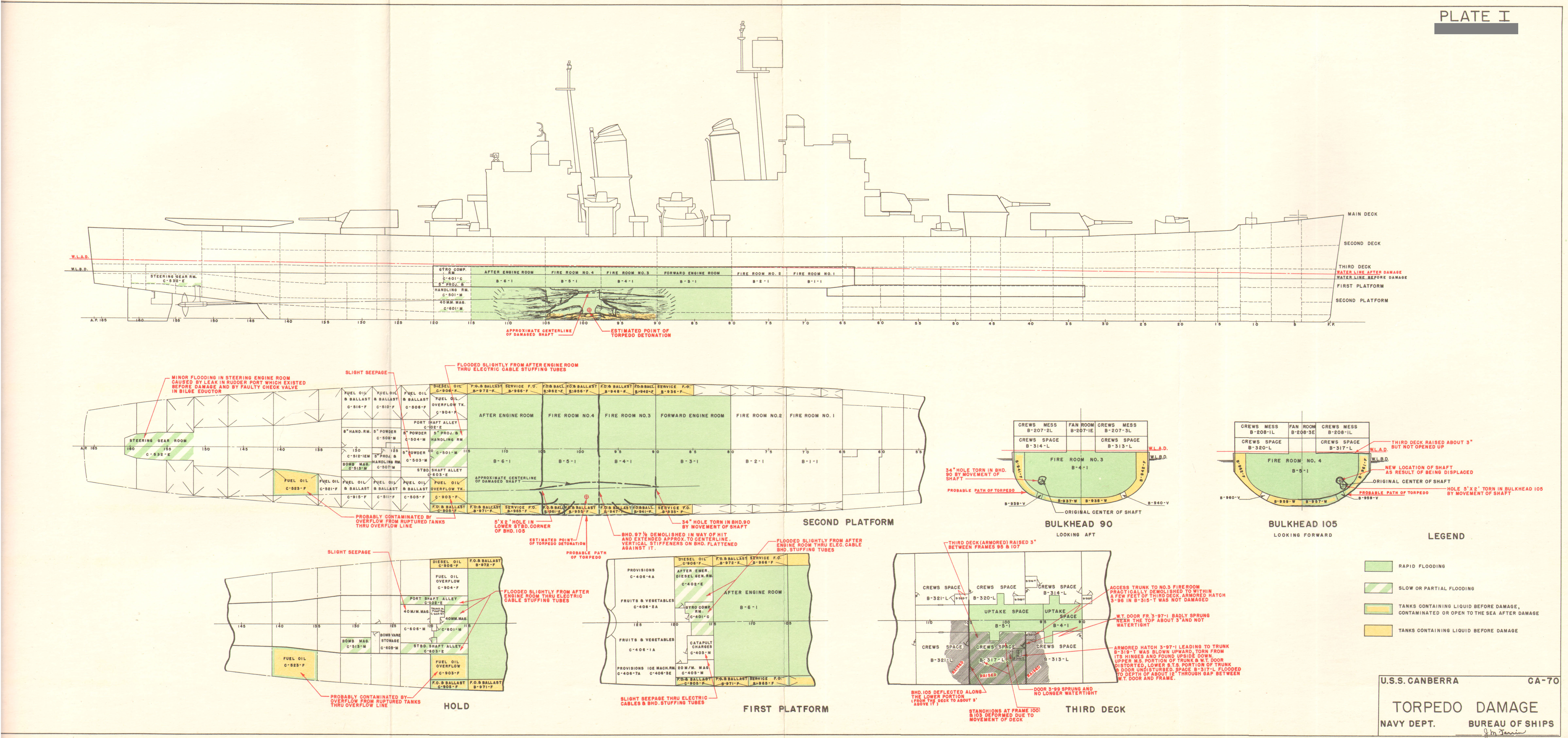
Believed to be a Type 91, Mod. 3 torpedo, it hit below her armor belt at the engineering spaces and blew a jagged hole in her side, killing 23 men outright. Due to the location of the wound, a whopping 4,500 tons of water flooded her after fireroom and both engine rooms, leaving the cruiser dead in the water. (Read the extensive damage report, here)
Saved by heroic DC efforts, Canberra, along with the likewise torpedoed light cruiser USS Houston (CL-81), was towed to safety over the next several days under a CAP flown by the aircraft of the carriers Cabot and Cowpens. Nonetheless, during the initial retirement to Ulithi, the crippled cruisers were subjected to repeated Japanese air attacks, with Houston suffering another torpedo hit before it was over.
USS Canberra (CA-70) under tow toward Ulithi Atoll after she was torpedoed while operating off Okinawa. USS Houston (CL-81), also torpedoed and under tow, is in the right background. Canberra was hit amidships on 13 October 1944. Houston was torpedoed twice, amidships on 14 October and aft on 16 October. The tugs may be the USS Munsee (ATF-107), which towed Canberra, and the USS Pawnee (ATF-74). NH 98343
USS Canberra dry-dock ABSD-2 at Manus after the Japanese torpedo attack.
In the end, Canberra would remain under repair in forward bases and then at Boston Naval Yard until after VJ Day. Ordered back to the post-war Pacific Fleet, a refreshed Canberra arrived at San Francisco on 9 January 1946 then was placed out of commission at Bremerton on 7 March 1947 and mothballed.
She earned seven battle stars for her WWII service. Captain Early, her wartime skipper, would earn a Naval Cross and retire as a rear admiral in 1949, a veteran of both world wars in big-gunned ships.
USS Canberra (CA-70), a chart of the ship’s operations in the Pacific Ocean with the Fifth and Third Fleet, from 14 February to 19 November 1944. Drawn by Quartermaster J.L. Whitmeyer, USNR. NH 78680
The Missile Age
The Baltimore class cost Uncle Sam an estimated $39.3 million per hull in 1940s War Bond-backed dollars. It made sense in the 1950s to try and get some more use out of these all-gun cruisers in an increasingly Atomic world. With that, Canberra and her sister ship USS Boston (CA-69) were tapped in 1951 to become the U.S. Navy’s first guided-missile warships in fleet service, dubbed CAG-1 (Boston) and CAG-2, respectively.
The conversion radically changed the aft of the vessels, deleting their 143-ton No. 3 8-inch turret and after twin 5-inch DP mount. Also stripped off were all the 40mm and 20mm AAA guns, replaced by six (later reduced to four) of the new 3″/50 twin Mk. 22s. Also deleted were the seaplane provisions and accompanying hangar, catapults, and crane.
Aerial photographs of USS Canberra in 1943, top, and 1967, bottom. Note her helicopter platform, angled to the starboard to provide for boat storage space. Immediate CAG sistership Boston did not have such an arrangement.
The superstructure was modified with their twin funnel arrangement morphed into a single stack and their pole mast was replaced with a radar mast topped with a powerful air search radar.
Two giant Terrier missile systems–capable of firing two missiles every 30 seconds– were installed over the stern along with two giant AN/SPQ5 radar directors for them. Below deck, a massive rotating magazine/workroom, capable of holding 144 missiles, was created. Keep in mind that the VLS-equipped Ticonderoga-class cruisers of today only have 122 cells.
USS Canberra (CAG-2) fires a Terrier guided missile during First Fleet demonstrations for Secretary of the Navy Paul H. Nitze, off the U.S. West Coast in December 1963. KN-8743
USS Canberra fires a Terrier guided missile, in February 1957. Photo NH 98398
Official period caption: “Super radars (AN/SPQ5) for guidance on terrier missiles installed onboard USS Canberra (CAG-2). The radars have massive, turret-like antennae and resemble giant searchlights. Developed for the U.S. Navy by the Sperry Gyroscope Company, the long-range, high-altitude missile guidance systems are a part of the U.S. Navy’s program directed toward the fleet with highly reliable missiles to combat supersonic jet aircraft. The super radar is giving an exceptionally high performance for tenacious stable guidance of supersonic missiles whether fired singly or in salvoes at individual or multiple enemy attackers. The systems combine many automatic radar functions in each unit and either system can control the missiles from a single launcher or battery, which fires the terrier missile or both radars can track different target groups simultaneously. It also includes flexible modes of scanning the air space many miles beyond the horizon, providing the advantage of early warning. Thus, individual targets can be selected from close flying groups and tracked with great distances while the missiles are launched and guided with extreme accuracy.” USN Photograph 670326 was released May 3, 1957.
The two-stage missile weighed 1.5 tons and was 27 feet long over the booster but had a speed of Mach 3 and a range of over 17 miles. Besides the 218-pound warhead, it could carry a W45 tactical nuke in the 1KT range. Not bad for just a decade off WWII.
Terriers were huge!
Seen here aboard the USS Providence (CLG-6) in 1962.
The conversions cost $15 million per hull or about half their original cost. Canberra was re-commissioned on 15 June 1956 at Philadelphia and looked quite different from when she was last with the fleet.
USS CANBERRA (CAG-2) entering Hampton Roads, Virginia, 1950s. K-20598.
The Kangaroo opened her pouch for the brass as needed, hosting Ike for his 1957 Bermuda conference with British Prime Minister Harold Macmillan.
President Dwight D. Eisenhower with his Naval Aide, Captain Evan P. Aurand, USN, onboard a launch taking them to USS Canberra (CAG-2), 12 March 1957. NH 68550
USS Canberra CAG-2 carrying President Eisenhower on a trip to Bermuda – March 1957 LIFE Magazine – Hank Walker Photographer
President Dwight D. Eisenhower practicing his golf game, while onboard USS Canberra (CAG 2) en route to Bermuda for a conference, 14 March 1957. The driving target and protective netting have been rigged on the main deck, just to starboard the ship’s Number Two eight-inch gun turret. NH 68555.
After a mid-cruise in the Caribbean and an extended deployment to the Mediterranean, she served as the ceremonial flagship for the selection of the Unknown Serviceman of World War II and Korea in 1958.
USS Boston sailors render honors as the casket is transferred to USS Canberra before ceremonies on board Canberra to select the Unknown Serviceman of World War II. Virginia Capes on 26 May 1958. NH 54117
Hospitalman William R. Charette selects the Unknown Serviceman of World War II, during ceremonies on board USS Canberra, 26 May 1958
Then came another mid-cruise, and stints in the Med, where she was often used as a flagship. A 1960 circumnavigation saw her visit her “home” in Australia for the first time and the next year she was on the line off Cuba, where she hosted RADM John W. Ailes, head of the blockade err quarantine task force.
A beautiful Kodachrome of USS Canberra (CAG-2) was underway on 9 January 1961. KN-1526
Then came her second shooting war, and she did lots of shooting.
Southeast Asia
Off Vietnam in February 1965 screening carriers of TF77, Canberra became the first U.S. Navy vessel to relay an operational message via communication satellite via the Syncom 3 system and prototype Hughes Aircraft terminals to reach the Naval Communications Station in Honolulu, 4,000 miles away. She followed it up with a confirmed xmit to USS Midway (CVA-43), which at the time was some 6,000 miles away.
By March 1965, she shifted away from Yankee Station to take up a spot on the evolving gun line just off the coast of Vietnam during Operation Market Time. This included providing overwatch for air raids into the country and Sea Dragon naval gunfire support, a mission the Navy had thought for sure was dead.
As noted by DANFS, “While supporting these operations Canberra carried out six fire support missions making her the first U.S. Navy cruiser to use her guns in warfare since the Korean War.”
In this role, the old WWII bruiser and others of her kind and vintage found steady employment. Between February 1965 and December 1968, Canberra shipped out for Vietnam’s littoral waters on five deployments, with her guns heavily in demand.
Off the coast of North Vietnam, the eight-inch guns of the USS CANBERRA (CAG-2) frame the “Terrier” missile launchers of the USS LONG BEACH (CGN-9). Photographed by Chief Journalist R.D. Moeser, USN. USN 1121640
USS Canberra (CAG-2) Eight-inch guns of Turret # 2 firing, during a Vietnam War gunfire support mission, March 1967. Note the two outgoing projectiles in the upper right corner. Photographed by Chief Journalist R.D. Moeser, USN. USN 1142159
USS Canberra (CAG-2) crewmen sponge out an 8/55 gun of Turret # 2, following Vietnam War bombardment operations, March 1967. USN 1122618
USS Canberra (CAG-2): A ball of fire lights up USS Canberra (CAG-2) as a three-gun salvo is fired toward North Vietnamese targets, in March 1967. Accession #: L45-42
The POW Savant
One of Canberra’s bluejackets had the misfortune of falling into the hands of the North Vietnamese through a freak accident and became a POW in the Hanoi Hilton.
Seaman Apprentice Douglas Hegdahl spent two years in a hell hole but was released earlier than a lot of other prisoners– as he wasn’t seen as being much of a threat and was one of the few conscripts in NVA hands–and carried irreplaceable intel back home. You see, as an EM in a prison camp full of 256 officers, he was given nearly free rein of the place and could interact with the other Americans. As such he (amazingly) memorized their names, capture dates, method of capture, and personal information despite feigning illiteracy during his captivity.
Petty Officer Second Class Douglas Hegdahl was quiet and self-effacing. Unlike most American prisoners, who had been shot from the sky, he had been rescued from the sea. Serving aboard the USS Canberra, he had disobeyed orders and crept up on deck to watch a night bombardment. As he stepped past a five-inch gun, it discharged. He lost his footing and fell into the Gulf of Tonkin. The warship steamed away into the darkness.
Vietnamese fishermen picked him up and turned him over to the authorities, who thought him so clueless that his North Vietnamese guards called him “the incredibly stupid one.” But once released, he turned out to be a gold mine of information. To the tune of “Old McDonald Had a Farm,” he had memorized the names of more than two hundred prisoners. Thanks to him, scores of American families would find out for the first time that their sons and husbands and fathers were still alive. Within a few days of the press conference, Hanoi’s treatment of the prisoners began to improve— “a lot less brutality,” one captive remembered, “and larger bowls of rice.”
From Piloten im Pyjama, an East German propaganda film shot in the glorious Democratic Republic of Vietnam:
“Douglas Brent Hegdahl maintaining the cleanliness of the camp. Hegdahl is the only American draftee in custody in the DRV. The sailor fell overboard from a warship where he was serving as a draftee and was fished out of the water a short time later by Vietnamese fishermen. Now Hegdahl is sharing the life of the captured air pirates.”
The End
By July 1969, Canberra had been redesignated as an all-gun cruiser, picking up her old hull number (CA-70) and her Terrier missile systems and related equipment were removed. Although she was found to still be in good condition, she was instead pulled from service as part of a big pull-down by the Navy to liquidate older vessels.
On 2 February 1970, Canberra was decommissioned at San Francisco, was stricken from the Naval Vessel Register on 31 July 1978, and sold for scrap two years later.
Epilogue
Doug Hegdahl is still alive, aged 74. He left the Navy in the 1970s after working as a SERE instructor, a job he had particular knowledge.
One of the USS Canberra’s screws was saved and is on display at the Los Angeles Maritime Museum in San Pedro.
Her ship’s bell was presented to the Government and Commonwealth of Australia the day before September 11 to mark the 50th anniversary of the ANZUS Treaty Alliance in a ceremony between President George W. Bush and Australian Prime Minister John Howard. It is now on display at the Australian Maritime Museum in Sydney, where Bush visited the bell in 2007.
White House photo by Tina Hager.
Further, in 2000, a plaque commemorating USS Canberra was installed at the Australian War Memorial.
She is also remembered in maritime art.
Painting of USS Canberra (CAG-2) departing San Diego Bay, in 1963 by artist Wayne Scarpaci titled Silvergate Departure
When it comes to such artwork, a 1928 watercolor of HMAS Canberra, which was presented to USS Canberra and carried aboard until she was decommissioned, is now in the custody of the NHHC.
NH 86171-KN HMAS Canberra (Australian heavy cruiser, 1928) Watercolor by F. Elliott. This painting was received from USS Canberra (CA-70) in 1970.
While the Royal Australian Navy is currently on its third HMAS Canberra, a 28,000-ton LHD, the U.S. Navy is set to soon receive its second. PCS USS Canberra (LCS-30), an Independence-class littoral combat ship, recently took to the water of Mobile Bay and is set to commission in 2023. Her name was announced at a Feb. 2018 meeting between President Donald Trump and Australian Prime Minister Malcolm Turnbull.
Specs:
(1946 Jane’s)
(As-built) Displacement: 14,500 long tons (14,733 t) standard; 16,000 tons full load Length: 673 ft. 5 in Beam: 70 ft. 10 in Height: 112 ft. 10 in (mast) Draft: 26 ft. 10 in Propulsion: 8 Babcock & Wilcox boilers, four GE geared steam turbines with four screws = 120,000 shp Speed: 33 knots Fuel: 2,500 tons Complement: 61 officers and 1,085 sailors Armor: Belt Armor: 6 in Deck: 3 in Turrets: 3–6 inches Conning Tower: 8 in Aircraft: 4 floatplanes (Kingfishers) 2 catapults, one crane over the stern, below deck hangar for two aircraft Armament: 9 × 8″/55 (20.3 cm) Marks 12s (3 x 3) 12 × 5″/38 (12.7 cm) Mark 12s (6 x 2) 48 × 40 mm Bofors guns 28 × 20 mm Oerlikon cannons
(As CAG) Displacement: 17,500 full load Length: 673 ft. 5 in Beam: 70 ft. 10 in Height: 112 ft. 10 in (mast) Draft: 26 ft. 10 in Propulsion: 8 Babcock & Wilcox boilers, four GE geared steam turbines with four screws = 120,000 shp Speed: 33 knots Fuel: 2,500 tons Complement: 73 officers, 1,200 enlisted Armor: Belt Armor: 6 in Deck: 3 in Turrets: 3–6 inches Conning Tower: 8 in Aircraft: Deck space for helicopter Radar: SPS-43 forward, SPS-30 aft pole mast Armament: 6 × 8″/55 (20.3 cm) Marks 12s (2 x 3) 10 × 5″/38 (12.7 cm) Mark 12 (2 x 2) 8 × 3″/50 (7.62 cm) Mark 22 AAAs (4 x 2) 2 x Terrier twin rail SAM launchers (144 missile magazine)
If you liked this column, please consider joining the International Naval Research Organization (INRO), Publishers of Warship International
The International Naval Research Organization is a non-profit corporation dedicated to the encouragement of the study of naval vessels and their histories, principally in the era of iron and steel warships (about 1860 to date). Its purpose is to provide information and a means of contact for those interested in warships.
With more than 50 years of scholarship, Warship International, the written tome of the INRO has published hundreds of articles, most of which are unique in their sweep and subject.
PRINT still has its place. If you LOVE warships you should belong.
The Chadian government last week reported that recently reelected six-time president (!) Idriss Déby, 68, died of injuries following clashes with rebels in the north of the country at the weekend. Deby’s son, leader of the Presidental Guard, has been installed as the country’s leader.
The Deby government came to power in 1990 as part of a military coup while he was head of the military. Although we aren’t in the habit of celebrating African authoritarian strongmen, it should be noted that Deby was a legend of asymmetric warfare.
He was the head of the Chadian National Armed Forces (FANT) during the Toyota Wars of the 1980s.
Trained in a series of French officer schools to include the prestigious École de Guerre, Deby’s Mad Max-style troopers pulled off a French-funded Deserts Rats-esque campaign against Gaddafi’s set-piece Libyan armored columns in Chad’s northern deserts, pitting 400 Milan- and machine gun-armed technicals against T-54s– and coming out on top.
Since literally taking office 30 years ago, Deby has remained a big friend to Paris in backing up the old colonizer’s fight against Islamists on the Continent and setting up Chad as the model of stability in the region.
With that, there should be no surprise that France– who has long looked the other way on Chad’s intermittent border clashes with Nigeria– is supporting the Chadian military’s seizure of power following Deby’s death on the battlefield.
Speaking of which…
Chad and France have a unique bond that goes back to WWII.
On 26 August 1940, just two months after the fall of metropolitan France to the Axis, Chad was the first French territory in Africa to break with the Vichy government and join De Gaulle’s Free French movement.
With the blessing of colonial governor Felix Ebouse and Lt. Col Pierre Marchand, commander of the Senegalese infantry regiment of Chad (Régiment de Tirailleurs Sénégalais du Tchad, RTST), the local unit, DeGaulle sent a young Major Philippe Hauteclocque (under the nom de guerre, Leclerc) who handpicked a column of 400 to strike out from the colony against the key oasis of Koufra in Italian Libya in January 1941 to aid the British push in the Western Desert.
1940 uniform of Régiment de Tirailleurs Sénégalais du Tchad, via the Musee d’la Armee
Free French infantryman, a native of the Chad colony, who was awarded the Croix de Guerre, 1942 for combat in North Africa. Note the tribal face scars, British helmet, and fouled anchor insignia common to French colonial troops (NARA)
Leclerc’s truck-borne unit, augmented by some old armored cars and a couple of 75mm guns, kicked the Italian Sahariana di Cufra around the desert for two months and, upon victory, which was hugely symbolic to the Free French, Leclerc and his men (some 3/4ths were Africans from Chad), took the so-called “Koufra Oath,” promising not to lay down their arms until the Free French flag flew from the Strasbourg Cathedral.
Fast forward to 23 November 1944 and Leclerc, then general in charge of his own armored division of Sherman tanks and on his way to becoming a Marshal of France, liberated Strasbourg.
The Régiment de Marche du Tchad still exists in the modern French Army today, based in Meyenheim in Alsace, as a mechanized infantry unit of some 1,200 soldiers.
Keeping that in mind, the odds of the French ever quitting Chad are somewhat lower than zero.
Porto Tramazzu, Sardinia: The first assault wave hits Blue Beach, landing the Teufelhunden of the Third Battalion, Sixth Marines (3/6) for an exercise, on April 27, 1961. The assorted LCVPs are from the Bayfield-class attack transport USS Fremont (APA-44) and the Andromeda-class attack cargo ship USS Muliphen (AKA-61/LKA-61).
The 3rd Battalion had just three years prior taken part in the landings in Lebanon and, four years after this image, would go on to take part in the wildly confusing intervention in the Dominican Republic. (National Archives KN-2431 via NHHC)
Besides the easy propaganda purpose that such shots sent to Moscow during the Cold War, ops like this were also good fodder for camera crews to shoot high-quality B-roll for Hollywood movies on the war, which always helped as recruiting tools. Sure, the Devils are wearing ODs instead of HBTs or frogskins, but Tinsel Town wouldn’t care.
While the concept of such “wet” landings fell rapidly out of popularity with the USMC in favor of vertical envelopment via helicopter during the 1960s and the following on air-cushioned landings by LCAC, the use of landing craft never fully went away and, in the near future, Marines could once again be getting their feet wet more often.