Category Archives: rants

Wyoming Prepares for End of the World

Wyoming House Bill 85 passed on first reading by a voice vote. It would create a state-run government continuity task force, which would study and prepare Wyoming for potential catastrophes, from disruptions in food and energy supplies to a complete meltdown of the federal government.

The task force would look at the feasibility of Wyoming issuing its own alternative currency, if needed. And House members approved an amendment Friday by state Rep. Kermit Brown, R-Laramie, to have the task force also examine conditions under which Wyoming would need to implement its own military draft, raise a standing army, and acquire strike aircraft


http://usnews.msnbc.msn.com/_news/2012/02/27/10520804-wyoming-lawmaker-introduces-doomsday-bill

I wonder if the Cheyenne Army will need firearms instructors. If so, give me a call…

Little Girl Fights Off Would-Be Abductor In Walmart

Pretty heddy stuff boys and girls, keep an eye on your kids. Most of these slime-bags work on opportunity. Take that opportunity away. (What was a 25 year old convicted murderer going to do with a kidnapped 7 year old girl?)

“FOX4.COM/BREMEN, Ga. – Seven-year-old Brittney Baxter was looking at princess toys at a Walmart in Bremen, Georgia, when a man grabbed her and tried to carry her away.
But Baxter fought back.
“I was kicking and screaming, and then he put his hand over my mouth, but I kept kicking,” she said.
The man is seen on store surveillance footage carrying Baxter as she thrashes around, trying to get away. Once she starts kicking the man puts her down and takes off running.
Bremen police later arrested 25-year-old Thomas Andrew Woods. He was later charged with attempted kidnapping. Other charges are pending.
Police said Woods was out on parole after being convicted of voluntary manslaughter.”

Link here-

Stop giving Marines Cameras

Marines are devil dogs….killers…when it just has to be torn to pieces send in the marines……However, every time they are stabbed in the back they find out that the knife has their own fingerprints on it…..

This isn’t going to go over well…

http://www.bbc.co.uk/news/world-us-canada-16973868 US Marine sniper unit photographed with ‘Nazi SS’ flag

Zombies Vs Humans all fun and games till the cops show up

Humans vs. Zombies game sparks N.C. State gun alerts

Ron Gallagher – rgallagher@newsobserver.com

RALEIGH — Two reports this week of possible men with concealed guns on the campus of N.C. State University stemmed from students playing a game called Humans vs. Zombies that has become a phenomenon on U.S. college campuses in recent years, university police said today.

“… Police have determined that both reports of individuals on campus who might be carrying handguns were related to the Humans vs. Zombies game, and that there was no threat to campus,” according to a N.C. State campus police department news release. “Both incidents were related to the same individual, who contacted police after hearing the descriptions and locations,” police said in a statement.

They did not identify the student. Though it was a game, police said they “thank those individuals who witnessed suspicious behavior and contacted authorities.”

The game has become so popular that it has its own website, humansvszombies.org, describing the game as “Humans vs. Zombies (HvZ) is a game of moderated tag played at schools, camps, neighborhoods, military bases, and conventions across the world. Human players must remain vigilant and defend themselves with socks and dart blasters to avoid being tagged by a growing zombie horde.”

Training Sources for TEOTWAWKI that are Available Today

 Training Sources for TEOTWAWKI that are Available Today

Christopher Eger

Egerwriter@gmail.com

The reality of the situation is that tactical combat, survival and self defense training is not something that can be mastered in a week or a month.  Training needs to be consistent to the point where the drills become as a reaction that you don’t even have to think about it…. The point is that terrorists and threats to you have been in serious training for a long period of time while many of us still see the concept of learning the inner workings of firearms as being premature.

Failure to practise is failure to prepare

Private survival training in the present day has often been seen as an invitation to police repression.  Examples such as the Black Panthers in the 1960’s and the Militia movement of the 1990’s are often sighted.  For the most part these organizations stayed within the law and were mainly small groups of private citizens trying to exercise the same Rights as the founding fathers did at Lexington and Concord.  The focus of these organizations was to make an expression through show of force.

Private firearms ownership in America for anything other than target shooting and hunting has been made to appear unwise and even illegal.  For that reason people have become more dependent on the government for their defense than ever before. The reality is that in every one of the 50 states in the Union it is Legal to own and use a firearm in defense of life.   What happens when the National Guard is called up and sent overseas?  Do you know 30% of most local law enforcement are members of the Guard and reserve.  We are becoming more and more dependent on Federal Law Enforcement… and a dependant, defenseless people is an enslaved people.

So you have a desire to train, to become confident in what you carry, how you carry it and what to do with it but you are not a member of the law enforcement community or the federal military. What can you do? How can you train?

Unregulated Live Fire Self-training

“Grab some rounds and head to the local dump or the woods and Go shoot”- NO

This is the worst thing you can do. Worse even than not training. If you go to the local shooting pit and blast a box or two of shells out all you are doing is shortening the life of your weapon and reinforcing bad habits. If you typically are doing something incorrect, odds are- without the proper practice to correct that bad habit- all you accomplish is building the wrong muscle memory. Guess what you are going to do when the SHTF? You will fall back on your worst training which is this.

Avoid this!

Regulated Self Training of Firearms

Research your courses of fire that are available. Go online and Google ‘course of fire” and you will find any number of courses plainly outlined. These include Cooper Drills, Shoot and Move drills, Dozier Drills, the El Presidente, various courses used by law enforcement agencies such as the NYPD and LAPD, military courses of fire for rifles, pistols and shotguns. Go to an actual range (or build your own safe one using established range safety guidelines) and run these drills until you can do them correctly. Exercise your fundamentals of Sight picture, trigger control, good solid position, and breathing. Use actual targets instead of beer cans, washing machines and the like. Paper plates can be substituted.

Inquire around at local gun shops and sporting goods stores for local rifle and pistol clubs who offer regulated ranges and competition shoots in exchange for nominal fees. Many State Departments of Wildlife have free ranges that are open to the public at no fee. This will also introduce you to the best part of training which is networking. Make contacts with like-minded individuals that can help point you in the right direction for your goals.

Live Fire is only a small part of firearms training. You need to spend hours training with an unloaded and safe weapon for every minute you spend sending brass downrange. Again, exercise your fundamentals of sight picture, trigger control, good solid position, and breathing. Practice tactical reloads, administrative reloads, one-handed reloads (for if injured), drawing from cover, firing positions etc.

The Boy scouts

Yes I am speaking of the ubiquitous organization that is the BSA. They are faith based and are represented in every community large and small. They also are a cornerstone of one of the few organizations that still attempt to provide firearms training without profit. Get with your local troops and find out the contact for the Shooting Sports Council for your area. Volunteer your services as a Range officer for the Marksmanship classes they have during semi-annual jamborees. Many councils offer full fledged certified NRA Firearms Instructor certification classes at reduced cost (sometimes as low as $25) to volunteers willing to give up a few weekends of their time to help local scouts learn to shoot.

You can learn valuable skills, gain an expanded knowledge base and provide a legacy for our youth in the process. Again, you see the chance to network your training opportunities by making more contacts and sharing information.

Appleseed Groups

Appleseed Groups (RWVA) are a great way to learn and practise valuable long arm skills

The non-profit Revolutionary War Veterans Association (RWVA) offers nationwide Appleseed Clinics that generally cost $70 for two days however, it is free for active military/guard/reserve, people who are under 21 years of age, and currently for 2010, women are also free. These provide training in long arms to a ‘rifleman’ qualification. They also offer longer week long courses and 30-hour instructor courses for much less than what you would get from the custom for-profit training academies.

Bring a rifle and a few hundred rounds of ammunition and put in some legitimate training. Spend your down time networking and making contacts to further your training.

PoliceOne Training Articleshttp://www.policeone.com/training/articles/ with hundreds of free articles such as “Training Police Recruits to Think”, Relevant and Realistic Firearms Training on a Tight Budget” and “Watch Behavior Indicators for Potential Violence” this resource is vital to anyone who is looking for training needs. While these are written by law enforcement and security professionals for use by law enforcement and security professionals many of the same concepts hold true for a TEOTWAWKI situation, CCW holders, and anyone who just wants to gain the upper hand in a bad life or death situation when the zombies come.

Emergency Management Institutes

Government and National organizations in partnership with colleges such as the University of Alabama- Birmingham Texas A&M and Tulane University officer online web interfaces such as the South Southern Public Health Partnership, FEMA’s Emergency Management Institute, and the National Emergency Response and Rescue Training Center

These institutes lean mainly towards Health and Safety aspects of Homeland Security and Counter Terrorism with dozens of amazing free courses such as “Food as an Effective Weapon of Terrorism”, “Preparedness: Factors for the Emergence/Reemergence of Infectious DiseasesApplied Epidemiology of Terrorist Events”, “Agro-terrorism”, and “Medical Effects of Primary Blast Injury” while they are dry are some of the best online training available from accredited sources.

Spend one night a week and devote four hours to one of these free classes. In a single year that is 52 classes under your belt. Take extensive notes that you can understand and create a chapbook with lessons you learned from each class. When the lights go out and the phones die the notebook can be your reference back to those night classes you took.

State Defense Forces

About half of the States in the Union offer a State Defense Force. These range from small relatively top heavy cadre groups such as the Mississippi State Guard to the large and very well organized 1000-manVirgina State Defense Force. Some 23 of these organizations are chartered by the state military department and work hand in hand with the local National Guard AG to perform “State’s only” service as directed by the governor.

Many of these organizations offer membership regardless of physical conditions to residents with clean criminal records. They typically have monthly drills and an annual summer camp much like the regular National Guard. While some offer limited weapons training most are good for at least an introduction into basic military courtesy, field craft, land navigation, communications and other tasks that will come in handy post- TEOTWAWKI without being in danger of a federal call-up or the unfortunate stigma of ‘militia groups’.

Georgia State Defense Force training in Search and Rescue.

The Red Cross

Well known for more than a century of community outreach the American Red Cross is in every community. Contact your local chapter and inquire about joining their Disaster Action Team (DAT). In exchange for agreeing to help with local disaster response inside your own county the Red Cross will provide all the necessary training. A DAT team member is required to have the following training, at no charge to the volunteer: Orientation to Red Cross, Introduction to Disaster, Disaster Team Training, Standard First Aid, Cardiopulmonary Resuscitation (CPR), Mass Care, Shelter Operations, Damage Assessment, Family Service and Providing Emergency Service.

Some of these courses will be more involved than others and each will have its own opportunity to learn lessons and new skills. Networking with individuals on your team can pay great dividends.

Conclusion

So what are we looking at for training as far as an outlay in money?

You can join your local State Defense Force for free, take classes online from the EMI, NEERTC and other agencies for free, catch the nearest Appleseed shoot for free (in some circumstances), help with the Boy scouts, browse online courses of fire and read your Police training articles all for free.

How about time?

Set up a schedule. Allocate one (four hour) night a week for online classes and articles. Schedule one full day a month (eight hours) to drill with your State Defense Force. Set aside one (four hour) night a week for regulated unloaded training with a safe weapon. Spend one (sight hour) full day a month on the range following a course of fire. Attend an Appleseed or Boy scout range when they come up to help brush up your skills and pass the knowledge along to others. Go to your Red Cross DAT team training dates.

This totals some 48-hours per month on average. This is a part-time job to learn the skill-set now that will be literally invaluable if the worst case scenario evolves and you have to utilize it.

As the old saying goes- it’s better to have it and not need it, then to need it and not have it.

(Originally published at Survivalblog.)

Coast Guard Schooners for Arctic Missions

Today the USCG has a mandate to secure and protect the coasts of the United States of America. This includes its entire coast.

The US has some 2000-miles of Atlantic coastline, 1600-miles of Gulf of Mexico coastline, and 1300-miles of Pacific Coastline. Hawaii has some 700-miles of Pacific Coast and Puerto Rico has 300-miles in the Atlantic/Caribbean.

Then there is Alaska. Seward’s Folly has approximately 5580 miles of coastline, (6640 miles of coastline including its islands.) If every actual mile of coastline including every cove and beach is counted, there are more than 44,000-miles. If you walked one thousand miles a year, it would take forty-four years to hike Alaska’s coastline!

Most of this is in the Northern Pacific; however 1400-miles of it is the sunny US Arctic Coast. From Kotzebue to Barrow to the Yukon it stretches across the north slope of Alaska.

Moreover, not a single military base exists there.

Current US Polar Bases, Stars are DOD bases (Army and Airforce) circles are USCG bases. Note from the Bering Sea to Greenland, thier are no bases on the US Arctic coast

The missions of U.S. polar ship operations are as follows:

  • Conducting and supporting scientific research in the Arctic and Antarctic.
  • Defending U.S. sovereignty in the Arctic by helping to maintain a presence in the region.
  • Defending other U.S. interests in Polar Regions, including economic interests relating to the U.S. exclusive economic zone (EEZ) north of Alaska.
  • Monitoring sea traffic in the Arctic, including ships bound for the United States.
  • Conducting other typical Coast Guard missions (search and rescue, law enforcement, etc.) in Arctic waters, including U.S. territorial waters north of Alaska.

Today the only US icestrengthend ship in service with the Coast Guard is a single medium icebreaker that is overworked. With numerous missions for its single icebreaker, how can the US Arctic Coast be patrolled reasonably?

The Northwest Passage

Legions of explorers looked for the Northwest Passage for hundreds of years; this included the ill-fated Franklin Expedition, which perished virtually to a man in the 1850s. The first man to complete the voyage was Norwegian explorer Roald Amundsen in a small 70-foot long 47-ton herring boat called the Gjoa.

The Northwest Passage has been accomplished 15 times by American vessels, and U.S. Coast Guard icebreakers have been the only American surface combatants to do so, carried out 11 of these voyages. In 1957 the ice-strengthened buoy tenders Storis, Bramble and Spar were the first of these Coast Guard cutters to make the journey through the passage, establishing a tradition that was followed by the Coast Guard icebreakers Northwind and Staten Island (1969), Polar Sea (1985, 1990), Polar Star (1988,1989) and Healy (2000, 2003). The other three American warships to transit fully the Northwest Passage were the submerged nuclear powered submarines USS Nautilus (1958), USS Queenfish (1970) and USS Seadragon (1958). The US-flagged tanker M/V Manhattan was the first commercial vessel to make a full transit (in 1969).

The Northwest Passage is now wide open in some parts during the summer. In 2006, the Hapag-Lloyd cruise ship M/S Bremen sailed through it with passengers. The Bremen, built in 1990, is 6.752 gross tons carries 164 passengers and 100 crewmembers in its non-ice reinforced hull.

On April 9, 2006, Canada’s Joint Task Force North declared that the Canadian military would no longer refer to the region as the Northwest Passage, but as the Canadian Internal Waters. The declaration came after the successful completion of Operation Nunalivut (Inuktitut for “the land is ours”), which was an expedition into the region by five military patrols.

With no US icebreakers to prove otherwise, it looks like Canada is right.

The Schooner fix

In recent years, no less than four privately owned US-flagged yachts have completed the passage in a single season since 1984, showing the feasibility of passing through. This craft were ocean cutter types ranging from 40-60 feet in length and handled the NWP in fine style without an extensive support staff or multi-million dollar budget.

Schooners have long been an excellent source of transportation through the sea ice with minimum support. Remember it was Amundsen himself who used his 70-foot long, 47-ton sailing boat, the Gjoa, to transit the route first.

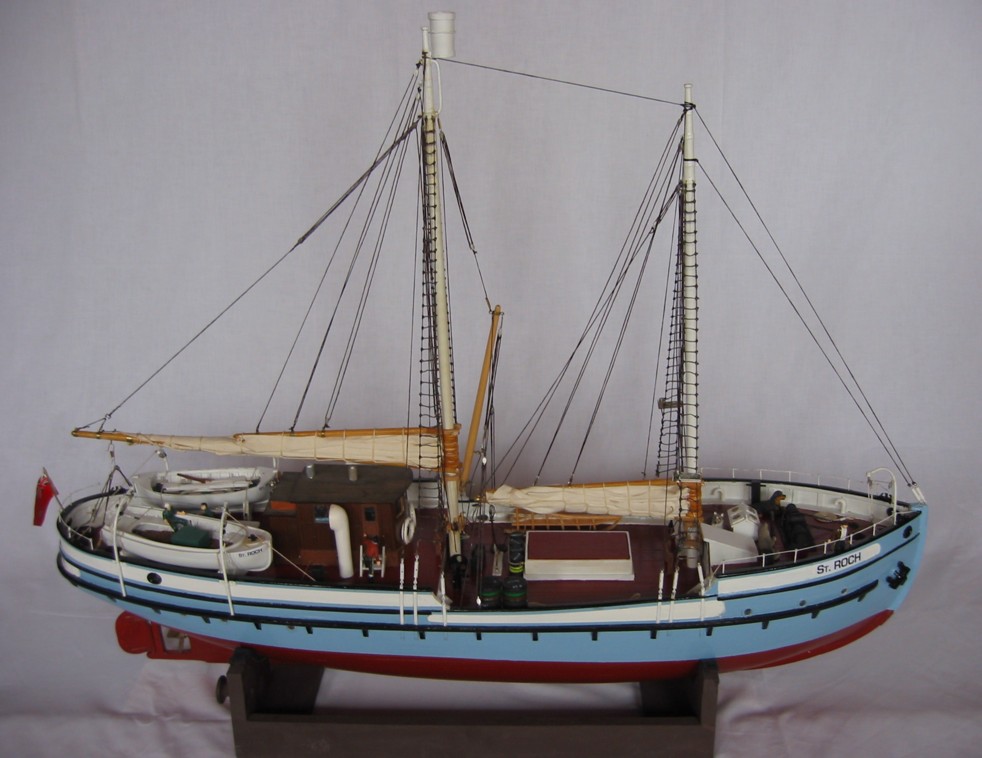
A model of the humble 104-foot St Roch which patroled the NWP for 14-years, including during World War Two

Built in 1928, the Vancouver-built arctic schooner St. Roch was used by the Royal Canadian Mounted Police to patrol the NWP in 1940-54. It was the first ship to completely circumnavigate North America, and the second sailing vessel to complete a voyage through the Northwest Passage. It was the first ship to complete the Northwest Passage in the direction west to east, going the same route that Amundsen on the sailing vessel Gjøa went east to west, 38 years earlier. In 1944, St. Roch returned to Vancouver via the more northerly route of the Northwest Passage, making her run in 86 days. The epic voyages of St. Roch demonstrated Canadian sovereignty in the Arctic during the difficult wartime years, and extended Canadian control over its vast northern territories.

The St Roch was 104-feet long, carried three sails on two masts, weighed 323-tons, and was capable of extended patrols in the arctic. Carrying a number of RCMP Mounties who were given a crash course in sailing, they were equipped to perform dog sled patrols from the ship once it was locked inside polar ice. Preserved as a museum ship since 1954, the St Roch was an excellent design.

The closest thing to the St Roch in the US was the arctic schooner Bowdoin. Built at the specifications of famous polar explorer Donald B. MacMillan, the ship was designed by William H. Hand of New Bedford, Massachusetts and built by the Hodgdon Brothers shipyard of East Boothbay, Maine.

The 88-foot Bowdoin, completed more than 26 arctic expeditions and sailed more than 300,000-miles

The 88-feet long, 60-ton Bowdoin is one of the smallest vessels designed for Arctic work. It is a two-masted, baldheaded auxiliary schooner made from double-planked and double-framed white oak. A five-foot belt, one-and-a-half inches thick, made of tough Australian greenheart, protects against ice, and the rudder is overly large for turning easily and quickly when working through narrow stretches of open water between ice packs. The Bowdoin’s single propeller is deep under water to avoid damage, and the hull is rounded, designed to rise up out of the water when caught between ice pans or to crush ice blocking the way. A nosepiece of steel plate weighing 1800 pounds is bolted to the hull to aid in crushing ice and protect from collisions with heavy ice. Its original engine, built to be able to burn whale blubber if needed, was replaced by a 300-hp diesel.

a mock up of the Bowdoin's hull shape, that allowed her to withstand winters iced-in along Canadas frozen coast without damage

The ship completed more than 26 trips to the Arctic and sailed in excess of 300,000-miles in its service life under MacMillan. During World War II, the Navy from May 1941- December 1945 used the Bowdoin to conduct patrols around Greenland before Macmillan resumed his scholarship on the schooner.

The ship is currently owned and maintained, still in sailing condition and on occasional arctic service at nearly 80-years old by the Maine Maritime Academy in Castine, Maine, for training runs to Labrador and Greenland.

A modern polar patrol schooner

If a modified version of an arctic patrol schooner could be made today, after study of the successful Bowdoin and St Roch, both of which are perfectly preserved, it could be made of more modern materials and with current SOLAS and Lloyds guidelines.

A strongly built modern schooner configuration can be had for a as low as $1.7-million in Europe  and half that amount in South America. Even if you double the European amount to take into account US shipyard craft costs, and double it again for the custom nature of the design, it can still be expected to get a new 100-foot arctic schooner built for polar operations in a stateside shipyard for under $7-million per copy. If multiple hulls were ordered, the cost for hulls 2, 3, 4, etc. would be amortised out and acquisition costs further reduced.

Composite materials and hi-tech polymers can take the place of wooden planks and beams in the Bowdoin and St Roch. Carbon-epoxy-aluminum sandwich construction yields amazing results in strength with very low weight and can be molded into exotic hull shapes, such as on the original Bowdoin. A tender issued by the USCG allowing current US yacht makers to participate in submitting bids can lead to very appreciable savings realization.

Green Schooners

In 1999 – 2000, two people sailed the 40-foot yacht Rusalka Mist from the island of Jersey in the English Channel, via Tenerife to the Caribbean and back via the Azores without a generator. Using only solar panels and a small towed waterpower generator, they provided self-sufficiency in electrical energy during this trip, both at sea and at anchor during the year. With technology ten years more advanced, commercial off the shelf, technology can be had that increases this today.

Solar panels and wind turbines are often found in DIY rigs on todays modern sailing yachts

In the past decade, solar panels and wind turbines have appeared across boat docks all over the country. Many live-aboard owners of medium to large sailing craft have installed 300-400 watt wind turbines, each about 24-inches in diameter on their craft to power refrigeration, electronics, laptops etc. while in moored away from shore power. Many other owners have installed PV (solar power) panels on flat areas of their decking and pilothouses to provide the same amount of power. Using both of these technologies, a modern arctic patrol schooner can utilize renewable resources by feeding power into a bank of 12-36 marine batteries (as a substitute for ballast) for use at a constant rate. Coupled with energy saving measures on the craft such as the use of low wattage LEDs instead of traditional bulbs from interior lighting, power saving modes on electronics not in use, and other efficiency ideas, the use of a ships gen set and diesel could be minimized.

For auxiliary propulsion when becalmed as well as exiting and entering port, electric thrusters could be used inside the hull and a single efficient diesel electric motor combination rigged to a central prop or water jet in the rear of the craft.

With efficient food service technology and on board, grey water storage, and trash compactor the ecological footprint of such a vessel could be kept low for transiting sensitive biological areas.

The 189-foot ultra modern Rainbow Warrior III. Lets get a few of these built half the size and paint them icebreaker red with a white coast guard racing stripe.

Greenpeace’s Rainbow Warrior III, a 189-foot steel-hulled, 3 masted ship, classified as a yacht, was built in Bremen for and was billed as being ‘green’. For an estimated 14-million pounds (about $25-million USD), the Germans built a craft that is one of the “greenest” ships afloat. With her sail rigging for propulsion, the engine projected to be needed only for 10% or less of the time. Two 50-metre masts will carry 1,200 square meters of sail and the engine is described as a “state-of-the-art hybrid.” All materials, from the paintwork to the insulation, have been chosen with a view to sustainability, and each component has been supplied with “transparent ethical sourcing.” The 189-footer carries advance communication suites inside an armored citadel safe room, a helipad with support capabilities, RHIB boats, et al.

It is not impossible

Why the USCG?

The USCG has a long and varied sailing history. Founded in 1916 by absorbing the US Revenue Cutter Service with the US Life Saving Service, both of whom had operated sail-powered vessels for nearly 150-years, the USCG is a prime sailor. During World War 2, the Coast Guard maintained a “Corsair Navy” that included hundreds of sail yachts taken up from civilian service. These sail yachts, often classified as WPY’s (Coast Guard-Patrol-Yard) were generally under 100-feet and manned by a 7-man crew. Armed with a couple of machineguns, a depth charge rack and small arms they escorted coastal convoys, conducted harbor patrols, and waved the flag in every small port across the country from 1942-44.

The CG81004, a 81-foot twin masted schooner, one of many that the USCG used during World War Two, heading out on patrol. Armed with a .50 caliber browning on the fordeck over the bowsprit and two short depth charge racks on her stern, the schooner ws a warship that conducted patrols off the US coast from 23 Aug 1942- 19 July 1945 with a crew of coast guard reservists.(from Robert Scienas Coast Guard Cutters of World War Two)

The USCG were very much in the cold-weather schooner biz in the 1940s


The Coast Guard also used many full sized sailing ships 150-300-feet in length including the Sea Cloud, Danmark, Hussar, and Joseph Conrad for officer training throughout the war years.  After the war, the USCG acquired the former Nazi sail training vessel SSS Horst Wessel, a 295-foot barque. Recommissioned as the USCGC Eagle in 1946 the ship is well known and sails the world with 19 officers, 56 crew, and 175 USCG Academy cadets and instructors. Eagle has over 6 miles (9.7 km) of running rigging and approximately 22,300 square feet (2,072 m2) of sail area and has broken 19-knots using her sails alone. She is America’s Tall Ship and has represented the country around the world for six decades.

The USCGC Eagle in her training paint. Arctic patrol schooners could be painted the same color as other USCG polar assets- Red with white strips

Besides service on the Eagle, USCGA cadets all undergo the 12-day Coastal Sail Training Program (CSTP) that has been expanded to include 100% of each incoming class. The 12-day program runs all summer long with crews starting each Monday. Cadets sail both the 16 Colgate 26-footers and a fleet of Ludders 44-footers around Connecticut, Rhode Island, and Massachusetts. Plans are afoot to replace the Ludders with modern 44’s of a more up-to-date design.

USCGA cadets start in small 26-footers and work thier way up to the Eagle. USCG officers know sailing firsthand.

The coast guard knows sailing craft, and at any given time during warm months, you can be assured that hundreds of its officers, coasties, and cadets are staring up at canvas blowing in the breeze.

Incumbent  enlisted and NCO crew-members assigned to the Arctic Patrol Schooners could cycle through the Coast Guard Academy’s sail program during the off-season to get a feel of life under sail. Its possible that the Bowdoin herself could be leased and used for a year as a workshop vessel to spin up the plankowners of the first schooner crews while their ships are being built.

The Mission

A 100-foot two masted arctic patrol schooner, equipped with renewable energy PVs and wind turbines, could be capable of extended patrols along both the Northwest Passage and the US Arctic Coats during summer months. At least three vessels would be required.

  1. One craft could be detailed to make an eastern pass through the NWP, sailing from Boston to Seattle (both USCG shore bases with support available) on a 60-day timeline from May-June. To satisfy Canadian concerns, a RCMP or Canadian Coast Guard liaison officer, or even a Danish Navy liaison could be embarked, instantly making it a ‘Joint’ NATO patrol. Transient NOAA, USGS, or USF&W researchers could also be carried. Joint operations with Canadian Navy and Army assets, Alaskan National Guard and other DOD assets could be undertaken.
  2. One craft could be detailed to make a western pass through the NWP, sailing from Seattle to Boston on the same timeline. These two vessels could rendezvous along the passage with a small (and photographed) ceremony before breaking off and sailing to their respective destinations.
  3. One craft could undertake an extensive (read- slow) US Arctic coastline survey from May-September from Nome to the Yukon. Along the way, the vessel would stop in coastal towns such as Wales, Kotzebue, Point Hope, Barrow, and Prudhoe Bay for port calls. At each portcall an embarked US Public Health Service healthcare professional could set up one-day clinics to the public, tours could be given of the ship, reports taken from concerned locals etc. Another possibility would be to embark an Alaska State Police members or conservation officers to augment the coasties. This craft would be available for local SAR on the Arctic coast if needed during the summer months, provided it was within range.

During the winter months where the Arctic coast and NWP is iced in, the patrol cutters could tour the US East and West coasts as low-cost public relations exercises with reduced crews. The coastal sailing would keep the ships and crew sharp and spread the information about their mission. The platforms could also be utilized to provide sail training workshops to non-USCGA assets such as cadets of the US Merchant Marine Academy, USCG OCS, and CPO program schools etc. while iced out of the Polar Regions.

Being of an ice-strengthened design, it is possible for the crew; if provision was made for resupply, to remain locked in the NWP, or US Arctic Coast during the winter months should the needed mission arise.

Further vessels could be built and forward deployed to Antarctica to assist National Science Foundation assets there if deemed desirable.

The craft ideally could be operated with the same crew as a current USCG patrol boat. The 87-foot Marine Protector WPBs carry a nine-person crew consisting of a commander (MCPO/O2-3), chief petty officer, engineer, FS, Ops petty officer, two seaman strikers, and two fireman strikers. A similar sized crew with sailing experience could operate a patrol cutter. The Bowdoin had berthing for 14, which included the explorer who built her and his guests. The St Roch sailed with a 10-man crew of RCMP constables but held 19 berths and room for sled dogs.  A similarly sized USCG patrol schooner could embark its 9-man crew as well as have a few additional berths for liaison officers, scientists, public affairs people, USPHS doctors etc., as the mission requires.

For SAR and use as a utility boat a short-range prosecutor 17-foot RIB could be carried by the patrol schooner, launched via davit. A small UAV aircraft could be embarked for ice surveys, wildlife spotting, oil spill reporting and so forth. Similarly, a small ROV submersible could be carried

For defense operations, including possibly escorting tankers from Prudhoe Bay if needed, M2 12.7mm heavy machineguns could be mounted. This, coupled with the small arms locker onboard, reproduces the armament carried either by the current 420-foot USCG icebreaker Healy, or by its fleet of 87-foot patrol boats.  For National Science Foundation missions carrying research scientists, the armament can be secured below decks or disembarked completely.

The total tasking of three patrol schooners, even assuming one Coastie on shore for each embarked, would require less than 60-personnel. With the back-of-an-envelope estimated cost of each schooner to be in the realm of $7-million apiece, the fleet would cost somewhere in the region of $21-$30 million for acquisition when support equipment is accounted for.  With a new USCG full-sized heavy icebreaker estimated at costing $925-million per hull, the program would be a drop in the bucket comparatively.

The USCG still needs a few more large seagoing icebreakers, but a few ice strengthened arctic patrol schooners can help bridge the gap that we have today from almost no dedicated coverage to reliable yearly tasked ships.

What could three 100-foot schooners accomplish?

The bottom line is, they can accomplish more than what is there now. It has been 9-years since the last US warship passed through the NWP (the Healy in 2003.) A yearly patrol by two schooners, one from each direction, coupled with a Joint interaction with NATO allies in the region already, establishes a precedent. With energy resources at a premium and potential non-NATO powers looking to the Arctic, this is important.

The US Arctic Coast is often forgotten. With each of the NWP patrol schooners passing through each year, and the third schooner dedicated to spending its summer poking along the coastline from Nome to the Yukon, a message is sent. A 225 or 175-foot buoy tender from the 13th CG District making aids to navigation repairs or possibly a 110-foot WPB sent from southern Alaska in the summer months could augment this patrol. If those platforms are not available, it is the schooner’s bread and butter.

Lets compare the missons again of the USCG polar forces and see how a trio of arctic patrol schooners could manage:

The missions of U.S. polar ship operations are as follows:

  • Conducting and supporting scientific research in the Arctic and Antarctic (yes).
  • Defending U.S. sovereignty in the Arctic by helping to maintain a presence in the region.(yes)
  • Defending other U.S. interests in Polar Regions, including economic interests relating to the U.S. exclusive economic zone (EEZ) north of Alaska.(yes, while its not realistic for a schooner to chase down a third nation fishing trawler or rouge whaler, its UAV and RIB can provided the ship was in range)
  • Monitoring sea traffic in the Arctic, including ships bound for the United States.(yes, with three schooners passing through the arctic every season, it is reasonable that third country ships passing through the NWP may see all 3 of them)
  • Conducting other typical Coast Guard missions (search and rescue, law enforcement, etc.) in Arctic waters, including U.S. territorial waters north of Alaska. (yes, to a limited degree. With thousands of miles of water to cover the schooners would be spread very thin, however it is still an increase over what is there now)

Something to think about anyway.

The Candidate in support of Zombie Energy….and Free Ponies

International Business Times is covering presidential candidate Vermin Supreme

He wants to be your next President.....Mr. Vermin Supreme...

Wearing a lime green sweater, several ties around his neck and his signature black rubber-boot hat, Supreme started his speech in an unlikely fashion.

“Gingivitis has been eroding the gum line of this great nation long enough and must be stopped,” he began. “For too long this country has been suffering a great moral and oral decay in spirit and incisors.”

In his speech, Supreme discussed a number of key mandates he would promote as president, most importantly a mandatory tooth-brushing law.

“America, my name is Vermin Supreme, I am a friendly fascist,” he told the audience. “I am a tyrant that you should trust, and you should let me run your life because I do know what is best for you.”

He also expressed support for a free-pony-for-every-American entitlement program to create “lots and lots of jobs,” which would “lower our dependence on foreign oil” and help enrich the soil by turning “pony poop into methane gas and a wonderful compost.”

Supreme further discussed a plan in the New Hampshire forum for zombies to turn “giant turbines” filled with dangling brains in an effort to “harness the awesome power of zombies for energy sources” and “lessen America’s dependence on foreign oil.”

Supreme’s closing statement, like much of his campaign, was weird to say the least. The satirist sang a plea for votes to the tune of the Chicken Dance and then glitter-bombed the notoriously homophobic lesser-known Democratic candidate, Randall Terry, claiming “Jesus told me to make Randall Terry gay.

The Icebreaker Crisis in the USCG as of 2012

During World War 2, the US Navy and Coast Guard fought what is known as “The Weather War” in which small ice-strengthened US ships searched for German Weather installations in Greenland, Iceland, Canada, and other frozen points above the Arctic Circle. On the opposite side of the world, the same types of ships were needed to patrol the northern pacific to maintain defense over Alaska. Most Americans forget (if they ever knew) that the Alaskan islands of Attu and Kiska were invaded by the Japanese military in 1942 and retained for almost two years. After WWII, the US military found itself still very much in need of an arctic and Antarctic presence, now that the USSR was only a skip and a jump away over the North Pole.

Today, with the Northwest Passage increasingly viable and fuel resources in the Arctic more approachable, the need is still as strong as ever to have a robust Polar capability for the US Military.

The Northwest Passage

The missions of U.S. polar icebreakers are as follows:

  • Conducting and supporting scientific research in the Arctic and Antarctic.
  • Defending U.S. sovereignty in the Arctic by helping to maintain a presence in the region.
  • Defending other U.S. interests in Polar Regions, including economic interests relating to the U.S. exclusive economic zone (EEZ) north of Alaska.
  • Monitoring sea traffic in the Arctic, including ships bound for the United States.
  • Conducting other typical Coast Guard missions (search and rescue, law enforcement, etc) in Arctic waters, including U.S. territorial waters north of Alaska.

The height of the US seagoing icebreaker fleet was 1955-1972. In that golden age, the US Navy and the USCG combined maintained 8 heavily armed large icebreakers and 40 ships that could be classified as medium icebreakers. This included:

  • 1×309 foot heavy icebreaker (Glacier) that could break up to 20-feet of sea ice, armed with 5″ guns and capable of carrying two helicopters.
  • 7×269-foot heavy (Wind-class) icebreakers that could break up to 13-feet of sea ice, armed with 5″ guns and capable of carrying a helicopter.
  • 1x 230-foot medium icebreaker (Storis) that could break up to 6-feet of sea ice, armed with 3-inch guns.
  • 39x 180-foot (Balsam Class) buoy tenders with icebreaking bows that could break up to 3-feet of sea ice, armed with a 3-inch gun.
  • Also on the drawing board were as many as 4 mega 399-foot Polar Class heavy Icebreakers and a dozen 140-foot icebreaking tugs, projected for delivery as beginning as early as 1976.

By 1989 the USCG-only (the USN got out of the icebreaking biz in 1966) seagoing icebreaking fleet had largely been disarmed and had shrunk to :


The 399-foot Polar Star. Top of the line in icebreakers 1977-2010. However, note no visible weapons. For scientific missions, these are not needed. However, for sovereignty missions, are a must.

  • 2×399-foot, 13,000-ton Polar class icebreakers. These ships were commissioned in 1976 and 1978, painted red, and armed with two 12.7mm machineguns, small arms. They are capable of breaking up to 21-feet of sea ice and carrying two helicopters.
  • 31x remaining 180-foot aging Balsam class buoy tenders, most of which had been disarmed and delisted as being capable of icebreaking.
  • 9x 140-foot Bay Class icebreaking tugboats, armed with two 12.7mm machineguns and capable of breaking up to 3-feet of freshwater ice. These craft are all used on the US East Coast and Great Lakes to keep local waterways open and are therefore unavailable for polar operations.
  • (the 230-foot WWII-era medium icebreaker, Storis, had been retasked as a white-hulled cutter and was no longer used as an icebreaker)

Today, 2012 the USCG is in a pickle barrel full of ice. The 2011 USCG The “High Latitude Region Mission Analysis,”–a summary of which the Coast Guard’s current and future polar missions, stated that the USCG will need at least 3 heavy and 3 medium icebreakers to fulfill its requirements. Today it currently has…one of the above (a medium).

The current (Jan 2012) fleet consists of:


The USCGC Healy. One of the largest medium icebreakers in the world. The ship has fantastic labs and support facilities, but can only break 4.5 feet of ice. Compare this to the smaller Polar Star above that can shatter up to 21-feet of ice.

  • The 13-year old 420-foot, 16,000-ton USCGC Healy.  Commissioned in 1999, the ultra-modern red-hulled beast only has 30,000 shp maximum thrust to her shafts, whereas the smaller Polar-class icebreakers had a maximum of 75,000-shp. This means the largest US icebreaker ever commissioned can only break 4.5 feet of sea ice continuously at three knots, classifying her as a medium icebreaker. In 2011, the ship performed a seven-month science cruise in the Arctic Ocean conducting scientific operations. Due to the other large U.S. icebreakers, being either in repair (Polar Star) or in the process of being decommissioned (Polar Sea), the Healy is the only active large icebreaker in the Coast Guard’s fleet. Under the current arrangement, NSF is responsible for funding the Healy’s operations and maintenance while the Coast Guard is responsible for operating the ship and carrying out its maintenance program. Total Healy costs are approximately $24 million annually or about $130,000 per each of the 185 days she at sea. As a research ship, she is largely unarmed except the ship’s small arms locker.
  • The two 399-foot Polar Star-class heavy icebreakers have been used hard and put up wet. At some 30+ years old, they are well past their prime and due for a replacement that never came. Known as “Buildings 10 and 11” because they rarely move from their docks, both ships have been mission in-capable for several years although they are still on the USCG list as active ships. Since April 2010, neither has been deployable and will continue to be in such a condition for the next few years.

WAGB-10, the Polar Star on June 30, 2006, Polar Star was placed in a “Commission-Special” status in Seattle, WA with a reduced 34-man crew. The Coast Guard plans to reactivate her by 2013 after a $6-million refit, at which point she will 37-years old.  As it stands today, she has not been deployed in 7-years. It is expected that she will be deployable again in 2013 after the refit.

WAGB-11, the Polar Sea, is suffering from severe engine issues that could cost more than $400-million to refit the ship. On June 25, 2010, the Coast Guard announced that Polar Sea had suffered an unexpected engine casualty and consequently will likely be unavailable for operation. The report said, “…inspections of the Polar Sea’s main diesel engines revealed excessive wear in 33 cylinder assemblies.” Moreover, that, “…five of [the ship’s] six mighty engines are stilled, some with worn pistons essentially welded to their sleeves.” Unmoving since April 2010, it has been used for parts to assist the Polar Star in her rebuild and is slated for decommissioning. The most recent USCG report on her is concerning whether she should be awarded National Historic Places statuses upon her decommission.

On March 25, 2008, the Navy Times described options for the refit or replacement of the         Polar Star-class vessels. The four options laid out were either:

  1. Replacement at $925 million each
  2. Full refit at $400 million each that would make the vessel good for another 25 years.
  3. Minor refit $56 million each that would make the vessel good for another seven to ten years.
  4. One season refit at $8 million that would enable the ship to be patched together for one more season’s deployment.

Nov. 3, 2011, Congressional Research Service report estimates a new polar-class sized icebreaker would require 8 to 10 years before entering service. If requested in FY 2012, it is unlikely that a new heavy icebreaker will join the fleet before 2022.

The Coast Guard’s own proposed FY2011 budget does not request any funding in the service’s Acquisition, Construction, and Improvements (AC&I) account for polar icebreaker sustainment or for the acquisition of new polar icebreakers.

The Rest of the World’s Polar Fleet Countries with interests in the Polar Regions have differing requirements for polar icebreakers, depending on the nature and extent of their polar activities. According to one source, as of January 2009, Russia had a fleet of 25 polar icebreakers (including six active heavy icebreakers, two heavy icebreakers in caretaker status, 15 other icebreakers, and two additional icebreakers leased from the Netherlands. 7 of these ships are nuclear powered); Finland and Sweden each had seven heavy polar icebreakers, and Canada had 6.

The NSF and leased scientific ships.

 Supporting National Science Foundation (NSF) research activities in the Arctic and Antarctic have accounted for in the past for a significant portion of U.S. polar icebreaker operations. Supporting NSF research in the Antarctic has included performing—or, in more recent years, standing ready to assist in—an annual mission, called Operation Deep Freeze, to break through the Antarctic ice to resupply McMurdo Station, the large U.S. Antarctic research station located on the shore of McMurdo Sound, near the Ross Ice Shelf. The NSF pays for most USCG icebreaking efforts.

Laurence M. Gould at Palmer Station, contractor-operated 300+ days per year for the NSF

Nathaniel B. Palmer, contractor-operated by the NSF 300+ days per year for less than the cost of funding a USCG icebreaker for 185-days per year. Certain members of Congress are very interested in that concept.

Even with the USCG assets, the U.S. Antarctic Program Palmer Station resupply depends primarily on two privately owned vessels, the Laurence M. Gould (LMG) and the Nathaniel B. Palmer (NBP). Both were designed and built based on input from the science community. As leased vessels, the NSF gets a great deal of bang for the buck. Annual costs for the NPB and LMG in 2007 were $16.3M and $7.5M, respectively, resulting in respective day costs of $54.3K and $23.4K for these ships, or less than half what the NSF spends on the Healy.

The NBP is an ABS A2 icebreaker capable of breaking 3 feet of level ice continuously at 3 knots, with 13,000 shaft horsepower and a displacement of 6,800 long tons. It is outfitted with all of the winches and A-frames necessary for deploying and retrieving oceanographic instrumentation. The vessel is outfitted with onboard oceanographic instrumentation and a networked computer suite, including multi-beam sonar, and has 5,900 ft2 of lab space and 4,076 ft2 of open deck space for oceanographic work and staging and a helicopter pad and hanger. The NBP averages 300 days a year underway in support of science.

The LMG was is smaller than the NBP and has less icebreaking capability, as it was designed to operate in the more benign ice regions surrounding the Antarctic Peninsula. The ship is an ABS A1 ice-strengthened vessel with 4,600 shaft horsepower and a displacement of 3,400 long tons and can break one foot of level ice at a continuous 3 knots. It is fully instrumented with onboard oceanographic instruments and a networked computer suite. The LMG has the dual purpose of supporting oceanographic science and providing re-supply to Palmer Station, located on the Antarctic Peninsula. The LMG averages 320 days a year underway in support of scientific research and associated logistics.

The 20,000-ton, 9-engined Russian icebreaker Krasin, chartered by the US NSF with tax dollars to get the job done

In FY 2005 and FY 2006, the NSF chartered the Russian government-owned, contractor-operated, icebreaker Krasin as no the USCG fleet was unable to meet commitments. In FY 2007 and FY 2008, they chartered the Swedish government-owned, contractor-operated, icebreaker Oden at $7.5 million per year, as the icebreakers that the USCG was provided $54-million by the NSF were insufficient. Furthermore, NOAA charters the Russian flagged R/V Yuzhmorgeologiya approximately 100 sea days per year in support of its Antarctic program.

Small Icebreakers

Besides, several smaller platforms were marginally Polar-capable. The 39 180-foot long Balsam-class buoy tenders were built with a notched forefoot, ice-belt at the waterline, reinforced bow, and stern. Capable of clearing through up to 20-inches of sea ice at a steady pace, the 180s could break through harbors and light pack ice.

In 1957, two of these 180-footers, Bramble and Spar with their larger half-sister the 230-foot Storis, circumnavigated the North American continent through hundreds of miles of sea ice. The Coast Guard convoy, known as Task Force 5, sailed to 4500-miles from Seattle to Point Barrow Alaska, then through the Northwest Passage to the East Coast. The three cutters were the first U.S. vessels to complete a circumnavigation of the continent, icebreaking all the way. With a combined crew of more than two hundred and carrying no less than four dual-purpose 3-inch naval guns as well as several 20mm cannons, this was a fairly well-armed force for 1957.

The unit patch of the Bramble, a 180-foot buoy tender. Can you guess what one of her main jobs was? She and her 39 sisters have all been retired and replaced by tenders that, while nicer and more modern, cant crush as much ice.

In the past two decades, the 230-foot medium icebreaking cutter Storis and all 39 of the 180-foot tenders, joined the six ice-strengthened 165-foot ice-strengthened cutters, and the 216-foot long Northland, in retirement.

Minor icebreaking is now the realm of the 19 new 225-foot Juniper class buoy tenders. The 225’s have a limited icebreaking capability of 14-inches of freshwater ice at 3 knots, or 3 feet of ice backing and ramming.  However, this figure is for Great Lakes use and is of very little use in polar ice. The 14 Keeper-class of 175-foot tenders can break 9-inches of freshwater ice at 3-knots and 18 inches by ramming. This is less than the 180-foot Balsam class buoy tenders that they replaced. Nine excellent 140-foot Bay class tugs have been introduced that can break freshwater ice up to 20 inches (51 cm) thick, and break ice up to 3 feet by ramming, but even this is still slightly less than the 180s.

Therefore, in terms of medium icebreaking the 1950s USCG had 47 vessels that could break up to 20-inches of sea ice that have now been replaced by 39 that can break a lesser amount of freshwater ice. These 39 assets are needed vitally along the East Coast and Great Lakes to the extent that it is unlikely that anything other than an occasionally detached 225-foot buoy tender could be detailed to Polar Region operations. Moreover, these craft are armed with only token crew-served low-angle gun mounts, leaving them incapable of projecting sovereignty in any but the most benign of environments.

The Northwest Passage

Legions of explorers looked for the Northwest Passage for hundreds of years, this included the ill-fated Franklin Expedition, which perished virtually to a man in the 1850s. The first man to complete the voyage was Norwegian explorer Roald Amundsen in a small 70-foot long 47-ton herring boat called the Gjoa.

Amundsen’s 70-foot long Gjoa in 1906. Even with a class of modern sailing yachts and a handful of sailors, the USCG could provide some sort of flag-waving patrol in the Northwest Passage. The route has been covered by no less than 4 US-flagged yachts since 1984.

The Northwest Passage has been accomplished 15 times by American vessels, and U.S. Coast Guard icebreakers have been the only American surface combatants to do so, carried out 11 of these voyages. In 1957 Storis, Bramble and Spar were the first of these Coast Guard cutters to make the journey through the passage, establishing a tradition that was followed by the Coast Guard cutters Northwind and Staten Island (1969), Polar Sea (1985, 1990), Polar Star (1988,1989) and Healy (2000, 2003). The other three American warships to transit fully the Northwest Passage were the submerged nuclear-powered submarines USS Nautilus (1958), USS Queenfish (1970), and USS Seadragon (1958). The US-flagged tanker M/V Manhattan was the first commercial vessel to make a full transit (in 1969).

The Northwest Passage is now wide open in some parts during the summer. In 2006, the Hapag-Lloyd cruise ship M/S Bremen sailed through it with passengers. The Bremen, built in 1990, is 6.752 gross tons carries 164 passengers and 100 crewmembers in its non-ice reinforced hull. No less than four privately owned US-flagged yachts have completed the passage in a single season since 1984, showing the feasibility of passing through.

On April 9, 2006, Canada’s Joint Task Force North declared that the Canadian military would no longer refer to the region as the Northwest Passage, but as the Canadian Internal Waters. The declaration came after the successful completion of Operation Nunavut (Inuktitut for “the land is ours”), which was an expedition into the region by five military patrols.

With no US icebreakers to prove otherwise, it looks like Canada is right.

A look at the Legacy fleet of USN/USCG Icebreakers, from the 1944-1989 Glory days or armed, destroyer-sized, capable, heavy cutters.

USS Glacier (AGB-4) 1955-1966 /USCGC Glacier (WAGB-4) 1966-1987

The proud (and heavily armed) USCGC Glacier. Built in Pascagoula MS, in the same yard as most of the modern US Navy’s destroyers and cruisers. Go figure

Displacement:             8,449 long tons (8,585 t) full load

Length:            309 ft. 6 in (94.34 m)

Complement:   14 officers, 2 warrant officers, 225 enlisted

Armament:      • 1 × twin 5 in (130 mm) guns (removed in 1966 when sent to USCG)

• 3 × twin 3 in (76 mm) guns

• 4 × 20 mm guns

Aircraft carried           2 helicopters. Air detachment: 14 officers and 10 enlisted.

Glacier was capable of breaking ice up to 20 feet (6.1 m) thick, and of continuous breaking of 4-foot (1.2 m) thick ice at 3 knots (5.6 km/h; 3.5 mph). Following 29 Antarctic and 10 Arctic deployments, Glacier was decommissioned in 1987

Seven Wind-class Heavy Icebreakers built for the US Navy and US Coast Guard

Northwind, circa 1955, a good example of the Wind class before they were painted red and had their teeth removed

Displacement: 6,500 short tons (5,900 metric tons) full load

Length:            269 ft (82 m)

Complement:   219 officers and men

Armament: Four 5-inch/38 (127 mm) dual-purpose guns (2 twin turrets). Twelve 40 mm/60 AA guns (3 quadruple turrets). Six 20 mm/80 AA; Y-guns. Two depth charge racks. One Hedgehog (weapon) launcher. M2 Browning machine guns and small arms. Reduced to just the M2s and small arms by 1970.  Originally carried a 1 Grumman J2F Duck seaplane, replaced by helicopter in the 1960s. Capable of breaking 13-foot sea ice.

USCGC Staten Island (WAGB-278), Commissioned 1944. Decommissioned 15 November 1974 and scrapped.

USCGC Eastwind (WAGB-279) Commissioned 1944. Decommissioned in 1968, sold in 1972, and scrapped.

USCGC Southwind (WAGB-280) Commissioned 1944. Decommissioned 1974, sold for scrap 1976.

USS Westwind (AGB-6) renamed USCGC Westwind (WAGB-281) in USCG service. Commissioned into USN in 1944. Transferred to USCG 1951. Decommissioned 29 February 1988, sold and scrapped.

USCGC Northwind  (WAGB-282). Commissioned in 1945. Decommissioned 1989 and scrapped.

USS Burton Island (AGB-88) Commissioned into USN in 1947. Transferred to USCG 1966, renamed USCGC Burton Island (WAGB-283) in USCG service. Decommissioned 1978, sold for scrap 1980.

USS Edisto (AGB-89) Commissioned into USN in 1947. Transferred to USCG 1966 and renamed USCGC Edisto (WAGB-284) in USCG service. Decommissioned 1977 and scrapped 1980.

“Less Than Lethal Force…is not always Less”

According to reports 62-year old Nick Christie was tortured and pepper-sprayed to death by police at the Lee County Jail. Although the medical examiner ruled his death a homicide, the law enforcement officers who kept him strapped naked to a chair and then pepper sprayed him until he died have not been charged in his death.

On January 20, 2010, the Injury Board’s National News Desk reported that Nick Christie’s wife, Joyce Christie, and her son, were planning to file a federal lawsuit because the police violated her husband’s constitutional rights. The article describes what allegedly happened when Christie was arrested for trespassing:

Christie, 62, was arrested last March after traveling from Ohio to Fort Myers while suffering, what his widow describes as a mental breakdown. Arrested twice for disorderly conduct and trespassing, Nick Christie was pepper sprayed ten times over the course of his 43-hour custody.

Suffering from emphysema, COPD, back and heart problems, the jail staff said his medical files were not available or immediately sought at the time of his arrest. But DiCello says Christie gave his medical history and list of medications to the jail days earlier during his first encounter with law enforcement.

His medication list was found in the back pocket of his pants when Christie’s personal effects were returned to his widow.

Sometime between the time he was arrested on March 27, 2009 around 2:00 p.m., and March 31 at1:23 p.m. when he was pronounced dead, Christie had been sprayed with ten blasts of pepper spray, also known as OC (Oleo-resin Capsicum), which is a derivative of cayenne pepper.

Read more: http://www.care2.com/causes/florida-man-tortured-and-pepper-sprayed-to-death-by-police.html#ixzz1heFtbTre

« Older Entries Recent Entries »