Category Archives: vietnam

Wombat Gun

Private Peter Fyfe of Midway Point, Tasmania (pop. 2,000), assigned to the 3rd Battalion, Royal Australia Regiment (3RAR) refilling his canteen in a local waterway during operations in Phouc Tuy Province, Republic of Vietnam in April 1971.

Photographer: Philip John Errington. Accession number: AWM PJE/71/0234/VN

Note Fyfe’s camouflaged weapon, the ubiquitous Springfield Armory-designed 40mm M79 grenade launcher. The single-shot break-action breechloader could be fired at ranges anywhere from 30 meters (the minimum distance to arm the grenade) out to 400 meters for indirect fire. It could be surprisingly accurate against bunker/vehicle-sized objectives.

Known by a host of nicknames among American troops in Vietnam including the “Thumper” and the “Blooper” (read “The Phantom Blooper” by Gustav Hasford), Ozzies tended to label it the “Wombat gun” for their own regional reasons.

From 1962 to 1973, more than 60,000 Australians served in the Vietnam War. Some 523 died as a result of the war (including no less than 28 men of 3RAR) and almost 2,400 were wounded

The World’s Leading Distributor of MiG Parts

While Naval Aviators– Phantom drivers of VF-21 from the carrier USS Midway— shot down the first MiGs in air-to-air combat over Southeast Asia when they splashed a pair of two North Vietnamese MiG-17s on 17 June 1965, the USAF soon got in the game as well.

Of the 196 MiGs zapped in air-to-air combat over Vietnam, 59 were by a mix of Navy/Marine Corps A1-Hs, F-8C/E/Hs, F-4B/D/Js, and an A-4C (which flamed a MiG-17 with a Zuni rocket!), it was the Air Force that managed the lion’s share, mostly MiG-21s via F-4s.

The below chart via the USAF:

Of course, keep in mind that the USAF’s F-86s shot down an amazing 792 MiG-15s in Korea while the USAAF had over 15,000 aerial victories in WWII– almost exclusively up-close gun actions.

Morphing from PTs to PTFs (and a visit with PTF-26)

The Navy went big on Motor Torpedo Boat (PT) models in World War II, producing an amazing 690 PT boats between 7 December 1941, and 1 October 1945— and that’s not counting the early PT-1 through PT-9 prototype boats, the 10 Elco 70s (PT-10-19), 48 early Elco 77s (PT-20 through 68), two prototype 72-foot Huckins boats (PT-69 and 70), and 69 reverse Lend-Lease 70 foot Vospers.

PT 76, a 78-foot Higgins-made boat in Womens Bay, Kodiak Island, Alaska circa 1943. NARA

The thing is, while these mosquito boats covered themselves in glory during their very up-close and personal war in the Med, Pacific, and English Channel, they very rarely got in solid torpedo attacks on enemy vessels. Their best employment came as fast scouts, lifeguard boats for downed aviators, running agents and commandos in the bad guy’s littoral, and in (typically nighttime) surface gun actions against enemy barges and coastal craft.

With that, the Navy got (almost) entirely out of the PT boat biz after 1945, torching or otherwise disposing of hundreds of boats overseas in the PTO and ETO and only keeping a few around for auxiliary purposes.

Then in the 1960s, with the Navy involved in littoral operations in Vietnam and not having anything smaller than 164-foot Asheville-class gunboats and leftover WWII 180-foot PCE-842-class patrol craft that needed 10 feet of water under their hulls to operate, the call went out for Fast Patrol Craft (PTF) which were basically nothing but PT boats sans their torpedoes.

At first the last remaining 1940s PT-boats were simply converted: the 89-foot Bath-built aluminum hulled PT-810 was pulled out of mothballs on 21 December 1962 and reclassified as PTF-1 while the Trumpy-built aluminum hulled 94-foot PT-811 became PTF-2 on the same date.

These were soon augmented by 14 Norwegian-built 80-foot Nasty boats (PTF-3 through PTF-16) ordered between 1962 and 1965.

Bow shot of Norwegian built, (left) and a U.S.-built PTF boat running at high speed together during trials off Virginia Capes, Early May 1963. “First Action Photographs of U.S. Navy PTFs. The U.S. Navy recently placed into service four patrol torpedo boats. The four boats, PTF-1 through PTF-4, are the only PT Boats in active service with the Navy. Assigned to Commander, Amphibious Force, U.S. Atlantic Fleet, the four boats are based at Little Creek, Virginia, and are used in amphibious support and coastal operations, and with the Navy’s SEAL (Sea-Air-Land) teams. SEAL Teams are units specifically trained to conduct unconventional and paramilitary operations and to train personnel of allied nations in these techniques. PTF-1 and PTF-2 are reactivated U.S. Navy PT Boats with torpedo tubes removed, their armament consists of 20-millimeter and 40-millimeter guns for surface and anti-aircraft action. The top speed is more than 45 knots. PTF-3 and PTF-4 were purchased from Norway to fulfill an immediate requirement by the Navy.” Photograph released May 13, 1963. 330-PSA-101-63 (USN 711287)

Following the success of these new mosquito boats in the coastal waters of Southeast Asia, the Navy ordered six Trumpy-built Nasty boats (PTF-17 through PTF-22), which were delivered by 1970.

Then came an updated design, the four-strong (PTF-23 through PTF-26) 95-foot aluminum hulled Osprey class, built by Sewart Seacraft of Berwick, Louisiana.

PTF-23 class fast patrol boat Under construction at Stewart Seacraft, Inc., Berwick, Louisiana, 24 October 1967. Note engines on the floor at right and PCF in the right background. NH 95839

Entering service in 1968, PTF-26 spent three years in Vietnamese water with her sisters then was retrograded to the West Coast where she was assigned to Coastal River Squadron One at Coronado, then later used as a range control boat at the Pacific Missile Test Center. Finally retired from the Navy in 1990, she then spent most of the next 30 years as a school ship first for the Boys & Girls Clubs of San Francisco and then for the non-profit as T/V Liberty.

More recently acquired by the Maritime Pastoral Training Foundation Ltd, PTF-26 has returned to its camouflage livery and is on her way to becoming an inland waterways training boat located in Golconda, Illinois where she will be offered to cadets from 164 different NJROTC and Sea Scout units across the Midwest.

The last of this line of more than 800 PT boats and follow-on PTFs, PTF-26, recently appeared in Mobile opposite Austal and I was able to grab a few snapshots of her.

The deck gun is fake, btw. Chris Eger photo

Chris Eger photo

Note her stern still has the T/V Liberty name. Also, that is the PCU USS Pierre (LCS-38) fitting out across the river at Austal, the last of the Independence-class littoral combat ships. Kind of a nice bookend with the last Indy LCS and last PTF in the same frame. Chris Eger photo

“Each weekend, 12-15 cadets or scouts will do more than take a tour of a U.S. Navy PT boat,” said Rev. Kempton Baldridge, MPTF’s managing director and a retired Navy chaplain, in a January interview. “They will eat, sleep, and train aboard as crew trainees. With a USCG licensed captain in command, PTF-26 will get underway with cadets or scouts as crew, guided by adult officers of their own unit. In port, cadets will learn everything there is to know about PTF-26. When ‘visit ship’ is held on Saturdays and Sundays for members of the public, qualified uniformed cadets and scouts of the crew will conduct tours, just as on board Navy and Coast Guard vessels.”

Fair winds and good luck, Two-Six Boat, there aren’t that many mosquitos left.

Tiger Stripe Redux

Spotted in the PI recently, 1st Group guys are channeling a very 1969 Southeast Asia vibe with Tiger Stripe pattern cammies to include boonie hats and full-color patches. I think it is a great look for a peacetime training deployment, especially because Apocalypse Now was filmed in the Philippines and the obvious Vietnam-era tie-in to the pattern in that region.

A U.S. Army Green Beret from 1st Special Forces Group (Airborne) overlooks movement on an objective alongside a service member with the Philippine National Police Special Action Force the, during Balikatan 24 in Rizal, Palawan, Philippines, April 27, 2024. BK 24 is an annual exercise between the Armed Forces of the Philippines and U.S. military designed to strengthen bilateral interoperability, capabilities, trust, and cooperation built over decades of shared experiences. (U.S. Army photo by Staff Sgt. Asa Bingham)

U.S. Army Green Berets from 1st Special Forces Group (Airborne) meet with service members from the Armed Forces of the Philippines Special Operations Command with 5th Scout Ranger Company, 5th Scout Ranger Battalion, 1st Scout Ranger Regiment-1st Light Reaction Company, 1st Light Reaction Battalion, Light Reaction Regiment, and the Philippine National Police Special Action Force to discuss training in Rizal, Palawan, Philippines, during Balikatan 24, April 27, 2024. (U.S. Army photo by Staff Sgt. Asa Bingham) (Portions of this image have been blurred for security reasons.)

A U.S. Army Green Beret from 1st Special Forces Group (Airborne) conducts an after-action review with service members from the Armed Forces of the Philippines Special Operations Command during Balikatan 24 in Rizal, Palawan, Philippines, April 27, 2024. (U.S. Army photo by Staff Sgt. Asa Bingham) (Portions of this image have been blurred for security reasons.)

A U.S. Army Green Beret from 1st Special Forces Group (Airborne) practices military movement techniques alongside service members from the Armed Forces of the Philippines Special Operations Command 5th Scout Ranger Company, 5th Scout Ranger Battalion, 1st Scout Ranger Regiment during Balikatan 24 in Rizal, Palawan, Philippines, April 27, 2024.  (U.S. Army photo by Staff Sgt. Asa Bingham) (Portions of this image have been blurred for security reasons.)

For reference, check out this below shot of an ERDL-clad SGT Curtis E. Hester firing his M-16 rifle, while Tiger-striped SGT Billy H. Faulks calls for air support, Co D, 151st (Ranger) Inf., Vietnam, 1969.

For those curious about Tiger Stripe and its effectiveness, check the below.

Aeronautique navale at Dien Bien Phu

Some 70 years ago this week, the pivotal 1954 Battle of Diên Biên Phu ended after a 57-day siege, an event that set the stage for the French withdrawal from Indochina and the American entrance into the region for two decades, for better or worse.

13-17 mars 1954 – Indochine française. Un parachutiste blessé est soutenu par deux de ses camarades qui l’évacuent vers l’antenne chirurgicale du camp retranché de Diên Biên Phu. Réf. : NVN 54-40 R79. © Jean Péraud ; Daniel Camus/ECPAD/Défense

While the siege was supported on the French side by over 10,000 sorties– most of which (6,700) were by a host of C-47 transports including 678 sorties from C-119s flown operated by Civil Air Transport (which became Air America)– just four haggard French Navy (Aeronnautique Naval) squadrons accounted for a whopping 1,019 sorties during this period. Compare this to the Armee de l’Air’s 2,650 sorties from two squadrons of F8F Bearcats (2/22 Languedoc and 1/22 Saintonge), two of B-26 Invaders (1/19 Gascogne and 1/25 Tunisie), three observation/recon squadrons, and two helicopter squadrons.

Arromanches

Built as HMS Colossus, the light carrier Arromanches (R95)— so named to honor the memory of the Allied landing on the Normandy coast– was leased to the French in 1946 and finally sold outright in 1951. During the Dien Bien Phu siege, her SB2C-5 Helldivers of Flottille 3F and F6F-5 Hellcats of Flottille 11F lost two aircraft from the former and three from the latter to Viet flak between 15 March and 26 April 1954.

Bois Belleau

Built as the Independence-class light aircraft carrier USS Belleau Wood (CVL-24)— a ship that earned a Presidential Unit Citation as well as a full dozen battle stars in the Pacific in WWII– Bois Belleau (R97) was loaned to the French Navy in late 1953 and rushed to Indochina where her F4U-7/AU-1 Corsairs of Flottille 14F got into the fight in close air support.

French Carrier Bois Belleau, formerly USS Belleau Wood (CVL-24), at Saigon. Note the Corsairs on her deck

César

One of the French Navy units that was there until the end was the unlikely Flottille 28F, which flew land-based Consolidated PB4Y Privateer maritime patrol bombers from Tan-Son-Nhut. Formed in July 1944 at Norfolk to fly lumbering PBY Catalinas in the Med from bases in North Africa, “The Wolves” of 28F had moved to Indochina in October 1945 and transitioned to the bruising Privateer in 1951.

However, spare parts and general unavailability of maintenance and replacement aviators had, by the time of Dien Bien Phu, trimmed the squadron to just 6 operational crews and 7 to 8 aircraft.

Note the Wolf insignia. These bombers dropped not only 500, 1000, and 2000-pound bombs, but often got low enough to Viet positions to open up with their .50 cals as well

Nonetheless, lemons into lemonade, the high-mileage 28F Privateers would make regular nighttime interdiction missions followed up by daytime bombing runs against Viet Mihn artillery and AAA assets, directed by Major Jacques Guerin’s Dien Bien Phu Airfield Control Post (call sign Torri Rouge), with the patrol bombers call sign being César.

Yup, basically flying day and night, with many crews typically running 2-3 sorties per day so long as they had a bird to do it in. One pilot, the famed Éric Tabarly, logged over 1,000 hours in his 11 months with the squadron– an average of three hours every single day, with most of that weight being during the siege.

On the last morning that Dien Bien Phu stood, Torri Rouge made contact with an inbound 28F Privateer, radioing:

“A 17 heures 30 nous faisons tout sauter. les Viets sont à côté. Au revoir à nos familles … …. Adieu César….” (“At 5:30 p.m. we blow up everything. The Viets are nearby. Goodbye to our families… …. Farewell Caesar…. “)

The Men with Green Faces

55 years ago today, 7 May 1969, in Norfolk, Virginia: “Members of SEAL Team TWO participate in a ceremony to award them nearly 60 medals, most of which were earned in combat in the Mekong Delta, Vietnam.”

Remember that the awards are likely just for a platoon or two (12-24 men) returning from a rotation. 

Note at least three silver stars, five Vietnam Gallantry Crosses, and a sea of Bronze stars, many with combat “Vs” or stars for multiple awards. National Archives K-82040

The Brown Water Navy, including the rotating SEAL Platoons, in 1968 alone earned an impressive “one Medal of Honor, six Navy Crosses, four Legions of Merit, 24 Silver Stars, 290 Bronze Stars, 363 Navy Commendation Medals, and more than 500 Purple Hearts, with one out of every three Sailors being wounded,” as noted by the NHHC. Of note, the MOH was earned by LTjg Joseph Robert (Bob) Kerry, USNR, of Team ONE.

“Mekong Delta, Vietnam – SEAL team members move in on their target, an enemy bunker complex on Tan Dinh Island, during Operation Bold Dragon III. March 26, 1968.” Note the tiger stripes, short boonie, camo beret, Stoner 63 in the lead frogman’s hands, slung early M16 complete with “jungle mags” carried by the center man, and the early Colt XM148 40mm grenade launcher on the M16 in the rear. NHHC Accession #: K-46398

Seals on Ambush Painting, Acrylic on Canvas, by Marbury Brown; Framed Dimensions 38H X 50 1/2W Accession #: 88-161-EU Established to carry out guerrilla and anti-guerrilla operations in harbors, inland waters, and their adjacent land areas, SEAL (Sea, Air, Land) teams usually operated in 6 man units to gather intelligence and conduct raids, reconnaissance patrols, salvage dives, and, as depicted here, ambushes of enemy forces.

First heading to Vietnam in 1962 in small groups to help train the locals in the ways of the frogman, by 1968 all-up 12-man SEAL platoons, rotating from both Coronado-based Team ONE and Little Creek’s Team TWO, had switched to full-scale direct action in the Vietnamese marsh and littoral, supported by mobile support team (MST) boat elements (the forerunners of today’s SWCC guys) as well as the Seawolves of HAL-3.

As noted by the UDT SEAL Museum:

SEAL platoons carried out day and night ambushes (but much preferred night operations), hit-and-run raids, reconnaissance patrols, and special intelligence collection operations. Calling them the “men with green faces” because of the face camouflage they used, the VC feared SEALs and often put bounties on their heads.

The last SEAL platoon departed Vietnam on 7 December 1971. The last SEAL advisors left Vietnam in March 1973. Between 1965 and 1972 there were 46 SEALs killed in Vietnam. They are forever remembered on the Navy SEAL Memorial at the Museum.

The First American Goulash Kalash at 55

Republic of Vietnam, 3 May 1969: “Offical caption: Historical Arsenal– Captain Anthony F. Milavic (Miami, Fla.) examines the first Hungarian AKM rifle to be captured in Vietnam. The weapon is the latest development in the AK-47 rifle used by the North Vietnamese Army. Also displayed are 20 different enemy weapons captured by Leathernecks of the 4th Marine Regiment, 3rd Marine Division. The long-barreled rifle (center) is an enemy sniper rifle that was manufactured in 1953, but it is of the Mosin Nagant design that dates back to the 1890s.”

U.S. Marine Photo A193022 by CPL. Dennis Randolph.

Manufactured by the Fegyver- és Gépgyár (FÉG) state arms plant in Hungary, the central European People’s Republic got in the Kalashnikov game around 1963 with the AKM-63, followed by the AMD-65, and after 1977, by the AK-63 (AMM/AMMS) and AMP-69.

The AMD-65. Notably, the Hungarians were one of the first AK makers to go with plastic furniture rather than wood. 

Of course, many Americans outside of AK nerds know FEG better for their excellent PJK Hi-Power copies that flooded the market in the 1990s.

One interesting thing to note about the Marine officer in the top image, Anthony F. Milavic (born 1936) enlisted in the Marine Corps in 1953 and, by 1966 was a warrant officer, then shortly after earned his O-1 commission. He earned the Legion of Merit for his 1968-69 Vietnam tour working in the 3rd MARDIV’s G-2 shop. Retiring from the Marine Corps in 1978 as a major, he was a very prolific writer for several years on military intelligence and firearms subjects, founding the old MILINET bulletin board. 

Speaking of ANZAC

With ANZAC Day upon up– the national day of remembrance in Australia and New Zealand that broadly commemorates all Diggers and Kiwis “who served and died in all wars, conflicts, and peacekeeping operations” and “the contribution and suffering of all those who have served,”– for those in that region keep in mind the rule of thumb when it comes to wearing medals and Rosemary in civilian attire (coats, please) for the occasion.

Remember, one’s own medals are on the left, and family medals are on the right.

ODA Then and Now

The structure of the 12-man Special Forces Operational Detachment – Alpha has remained the same almost since its inception– and echoed the old 15-man OSS Detachments of 1944.

Contrast the look of the early Vietnam-era  “A-Team” in 1965, in the below period recruiting poster, to what it looks like now in a modern recreation.

The 12-man ODA from 1963-1970 had a commander (O-3), an XO (Lieutenant), an Operations Sergeant (E-8), a Heavy Weapons Leader (E-7), an Intelligence Sergeant (E-7), a Light Weapons Leader (E-7), a Medical Specialist (E-7), and Radio Operator Supervisor (E-7), an Assistant Medical Specialist (E-6) and Demolitions Sergeant (E-6), and a Chief Radio Operator (E-5) and Combat Demolition Specialist (E-5).

Today you have a detachment commander (18A), detachment warrant/XO (180A), Ops SGT (18Z), Intel SGT (18F), two Weapons SGTs (18B), two Engineer/Demo SGTs (18C), two Medical SGTs (18G), and two Commo SGTs (18E).

More here.

Welcome, Hannah!

80 years ago today:

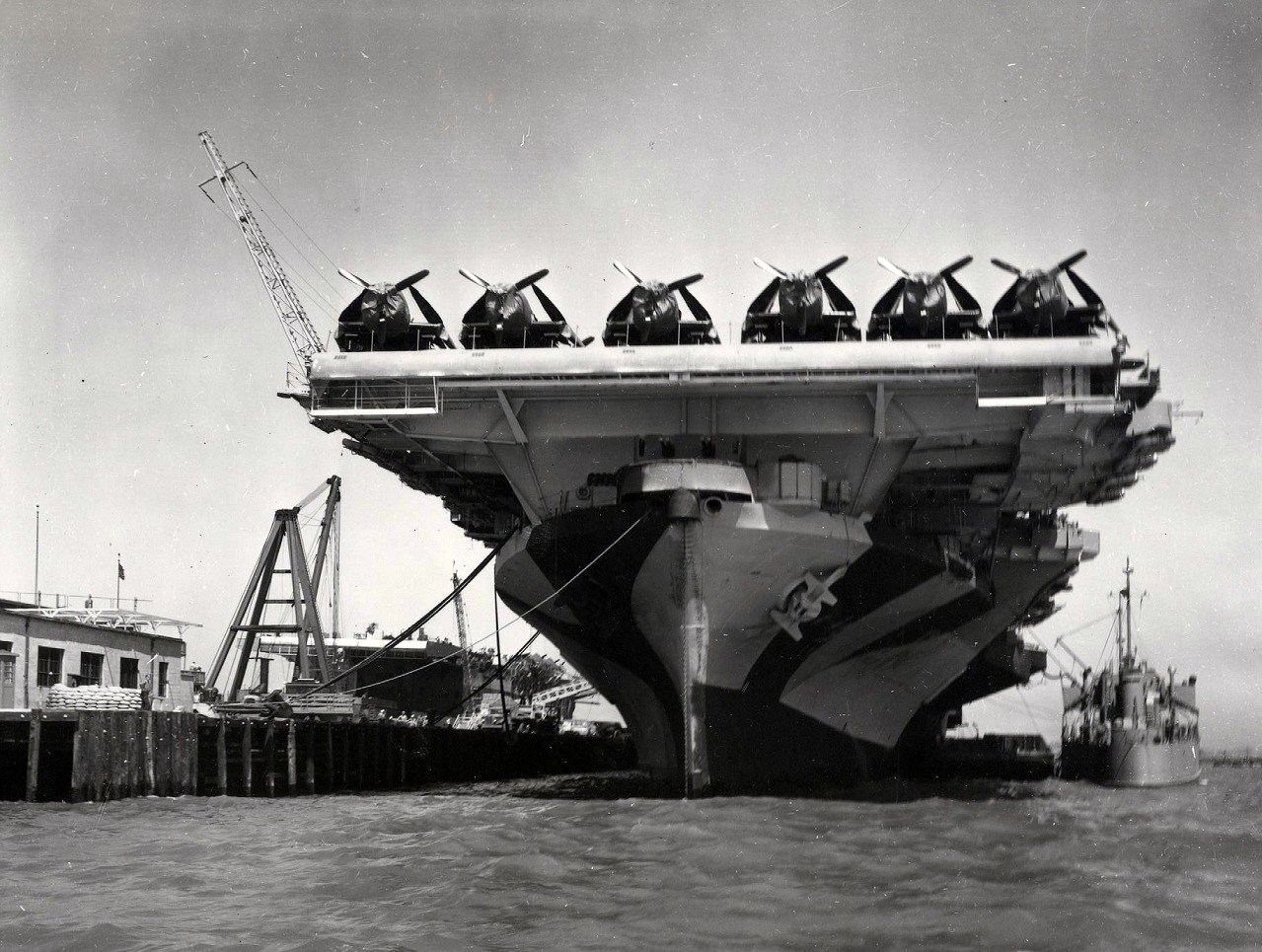
A great shot of the brand new Essex-class fleet carrier USS Hancock (CV-19) underway in Boston harbor on 15 April 1944, the day of her commissioning from the Fore River Shipyard at Quincy, Massachusetts. The paint scheme is Measure 32, Design 3A; note the small hull number on the Dull Black bow area.

Official US Navy photograph from the collections of the Naval History and Heritage Command (NH&HC), # NH 91546.

As noted of this image by Wolfgang Hechler at Navsource:

Hancock was the only “long bow” Essex to wear Design 3A. Since all the Pattern Design Sheets had been prepared for “short bow” Essexes, there were several noticeable differences in the bow area for Intrepid (CV-11), Hornet (CV-12), and Franklin (CV-13)—compare, for example, to this photo of Intrepid. Two 40-mm quad AA mounts were fitted on the extended forecastle of the “long hull” ships. Hancock had two more 40-mm mounts on the fantail but none on the starboard side, amidships. There were four deck-edge masts.

Just six months after the above image was snapped, the new carrier had completed shakedowns and air group quals then joined the Pacific Third Fleet in time for the brutal Philippines Campaign in October 1944.

Hannah earned four battle stars in her short but hectic WWII service. Reconstructed twice during the Cold War (SCB-27C then later SCB-125), she was dubbed an attack carrier (CVA-19) and went on to complete nine deployments to Vietnam– eight with Carrier Air Wing 21 (CVG/CVW-21), and one with CVW-5.

She would earn 13 Vietnam battle stars along with five Navy Unit Commendations and was present for the endgame in April 1975 when Saigon fell, saving 2,500 souls.

USS HANCOCK (CVA-19) With men of VA-55 and crew members information of “44-74” in honor of the ship’s thirty years of service. Photo taken 3 January 1974 by PH1 Cook. NH 84727

Of her sisters, the wooden-decked Hancock outlived all in the fleet except the training carrier USS Lexington and 1950s latecomer USS Oriskany. Even with that, the newer (and steel-decked!) Oriskany was laid up just eight months after Hannah.

Decommissioned for the last time on 30 January 1976 and struck from the Navy list the following day, Hannah was sold for scrap that same September.

« Older Entries Recent Entries »