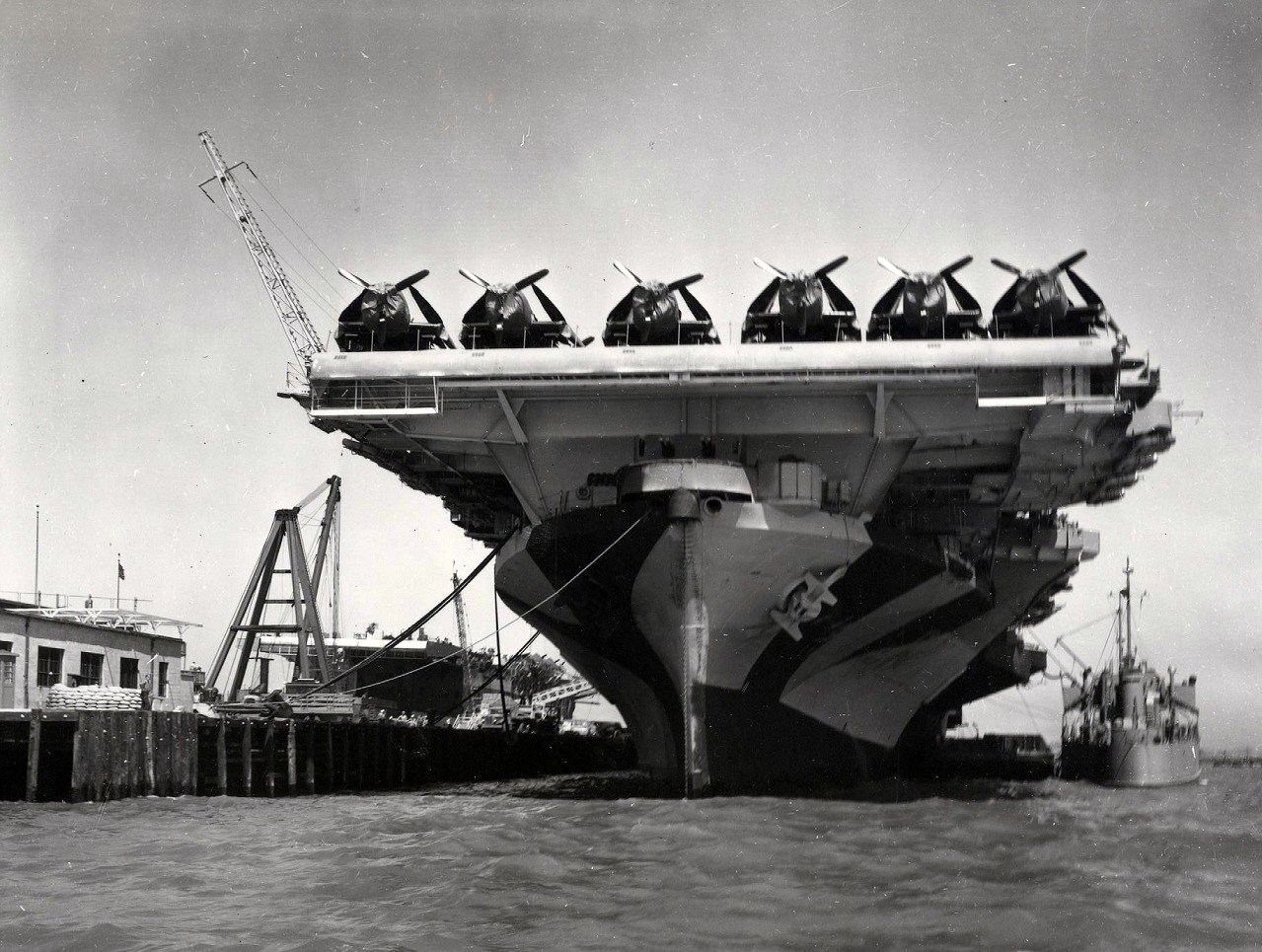
A great shot of the brand new Essex-class fleet carrier USS Hancock (CV-19) underway in Boston harbor on 15 April 1944, the day of her commissioning from the Fore River Shipyard at Quincy, Massachusetts. The paint scheme is Measure 32, Design 3A; note the small hull number on the Dull Black bow area.
Official US Navy photograph from the collections of the Naval History and Heritage Command (NH&HC), # NH 91546.
As noted of this image by Wolfgang Hechler at Navsource:
Hancock was the only “long bow” Essex to wear Design 3A. Since all the Pattern Design Sheets had been prepared for “short bow” Essexes, there were several noticeable differences in the bow area for Intrepid (CV-11), Hornet (CV-12), and Franklin (CV-13)—compare, for example, to this photo of Intrepid. Two 40-mm quad AA mounts were fitted on the extended forecastle of the “long hull” ships. Hancock had two more 40-mm mounts on the fantail but none on the starboard side, amidships. There were four deck-edge masts.
Just six months after the above image was snapped, the new carrier had completed shakedowns and air group quals then joined the Pacific Third Fleet in time for the brutal Philippines Campaign in October 1944.
Hannah earned four battle stars in her short but hectic WWII service. Reconstructed twice during the Cold War (SCB-27C then later SCB-125), she was dubbed an attack carrier (CVA-19) and went on to complete nine deployments to Vietnam– eight with Carrier Air Wing 21 (CVG/CVW-21), and one with CVW-5.
She would earn 13 Vietnam battle stars along with five Navy Unit Commendations and was present for the endgame in April 1975 when Saigon fell, saving 2,500 souls.
USS HANCOCK (CVA-19) With men of VA-55 and crew members information of “44-74” in honor of the ship’s thirty years of service. Photo taken 3 January 1974 by PH1 Cook. NH 84727
Of her sisters, the wooden-decked Hancock outlived all in the fleet except the training carrier USS Lexington and 1950s latecomer USS Oriskany. Even with that, the newer (and steel-decked!) Oriskany was laid up just eight months after Hannah.
Decommissioned for the last time on 30 January 1976 and struck from the Navy list the following day, Hannah was sold for scrap that same September.
Saw this great image passed around the interwebs without much detailed explanation and had to nerd out on it.
After some digging, I am fairly certain it is a USAF F-4E-44-M Phantom II, SN 69-7298, with its nose cone pivoted and Westinghouse AN/APQ-120 X-band fire control radar showing. The Phantom’s “ZF” tail flash would put it as the 31st TFW (307th and 308th TFS) out of Udorn AB, Thailand, circa April 1972 to June 1973.
Note the full-color 31st TFW’s flying sea horse shield on her intake.
Founded in 1940 as the old 31st Pursuit Group– which, flying Spitfires, had been the first American unit to engage in combat in Europe– when it came to Vietnam the 31st TFW more than paid their dues, earning the Presidential Unit Citation and ten campaign streamers flying over 100,000 close air support sorties between 1965 and 1970 out of Bien Hoa and Tuy Hoa in the venerable F-100 Super Sabre.
Finally rotated back home to Homestead AFB, Florida in 1970, where they transitioned to new 1969-model 44/45 block F-4Es, they were tapped to return to Southeast Asia two years later, hence the above image.
From April to 13 August 1972, the 308 TFS deployed to Udorn Royal Thai Air Base, Thailand to augment tactical air forces already deployed to that country. It was followed in July by the 307 TFS. In June 1972, Captains John Cerak and David B. Dingee of the 308 TFS were shot down and captured by the North Vietnamese and confirmed as prisoners of war. In March 1973 both were released and returned to the United States. On 15 October 1972, Captains James L. Hendrickson and Gary M. Rubus of the 307 TFS, who replaced the 308 TFS at Udorn, Thailand, shot down a MiG-21 northeast of Hanoi. This marked the first and only aerial victory for the 31 TFW. The 308 TFS completed the wing’s final deployment to Southeast Asia from December 1972 to June 1973.
The particular bird shown above, as detailed by Baugher, originally flew with the 4th TFW before switching to the 31st TFW. By 1977 it was with the 68th TFS (347th TFW).
F-4G SN 69-7298 was then sent to the boneyard at AMARC as FP1004 in December 1995, converted by Tracor Flight Systems to QF-4G drone AF183 three years later, and expended in missile test in 2002.
As for the 31st TFW? They transitioned from F-4s to F-16s in the 1980s and moved out of Homestead after it was all but destroyed by Hurricane Andrew in 1992.
Since then, they have been pushing their Vipers out of Aviano, which is surely an upgrade. Over the past two decades, they have been the “tip of the spear,” so to speak, in operations in the Balkans, Iraq, Afghanistan, and Libya.
A U.S. Air Force F-16CM Fighting Falcon (SN 89-2047, Block 40E) from the 31st TFW’s 510th Fighter Squadron soars above Aviano Air Base, Italy, March 16, 2020. “The 31st Fighter Wing is dedicated to remaining lethal and rapidly ready” (U.S. Air Force photo 200316-F-ZX177-1037 by Airman 1st Class Ericka A. Woolever)
When bopping around the West Florida panhandle and looking to scratch a military history stuff itch, besides the extensive coastal fortifications around Pensacola (Forts Pickens and Barrancas along with their nearby Advanced Redoubt and WWII beach batteries) and the National Naval Aviation Museum, closer to Eglin AFB there is the excellent Air Force Armament Museum.
There is also a great aviation park that has been off limits to the public since 9/11– the Hurlburt Field Memorial Air Park.
Dedicated to the USAAF’s and USAF’s Air Commandos and maintained by the secret squirrels of the Air Force Special Operations Command, it has several rare COIN and SOF aircraft on display as well as numerous memorial markers spanning from WWII through more recent adventures in the sandbox.
They have a C-46 Commando and C-47, MH-53M and MH-60 Pave Lows, a Psy-Op Huey, A-1G Skyraider, an A-26K Counter Invader, O1s and O2s, an RF-4C, AC-119G Shadow gunship, AC-130A Spectre gunship “Ultimate End,” an OV-10 Bronco, and CH-3 Jolly Green, among some 20 types on display. (U.S. Air Force photo/Senior Airman Christopher Callaway)
Warship Wednesday, March 13, 2024: SEAL Time Capsule
Sorry about the short WW this week. I’m currently in the midst of a 17-day work trip to Europe visiting iconic old-world gunmakers for factory tours. We’ll be back to our regular format next week!
330-PSA-61-63 (USN 1066434)
Official caption for the above photograph, released 61 years ago today, 13 March 1963
U.S. Navy frogmen have the capability of being air-dropped into coastal waters, fully equipped to perform any of their various missions. After landing in the water, they abandon their parachutes, take to the underwater environment, and upon completion of their tasks are picked up by anyone of a variety of methods including aerial, high-speed surface, or submarine retrieval.
The first two U.S. Navy Sea, Air, and Land Teams, commonly known as SEALs, were stood up under orders from JFK– himself a WWII Navy man– in January 1962, with one based on the West Coast at Naval Amphibious Base Coronado, California, and another on the East Coast at Naval Amphibious Base Little Creek, Virginia. Drawn from the Navy’s preexisting underwater demolition teams dating back to WWII, the plankowners of SEAL Team ONE and TWO only numbered 60 frogmen each.
While they would soon face their first test in Vietnam, they got to show off for the cameras in the Virgin Islands in March 1963 for this set of interesting photos showing off a lot of classic gear including what look to be Sportsways Hydro Twin regulators long before Draeger units were a thing, round facemasks, and slab-sided early XM16s complete with waffle mags.
The sub used in the exercise was the old USS Sealion (APSS-315), which earned five battle stars during World War II and then spent almost the entire period from 1954 to 1967 in a series of such exercises with Marines, Underwater Demolition Teams, SEALs, Beachjumper units; and, on occasion, Army units ranging from the Virginia coasts to the Caribbean.
U.S. Navy Frogmen on training exercises at St. Thomas, Virgin Islands, leave the submerged submarine USS Sealion through the forward escape trunk carrying their demolition equipment, proceed to the beach as the spearhead forces of an amphibious assault, and after their mission is accomplished, rendezvous with the submarine and reenter through the escape trunk. 330-PSA-61-63 (USN 1066438)
U.S. Navy Frogmen on training exercises at St. Thomas, Virgin Islands, leave the submerged submarine USS Sealion through the forward escape trunk carrying their demolition equipment, proceed to the beach as the spearhead forces of an amphibious assault, and after their mission is accomplished, rendezvous with the submarine and reenter through the escape trunk. 330-PSA-61-63 (USN 1066431)
“US Navy SEAL holding a rifle near a shack, during a military demonstration at St. Thomas, Virgin Islands,” by Marion S Trikosko. U.S. News & World Report Magazine Photograph Collection (Library of Congress). LC-U9-9190- 21
“US Navy SEALs wearing and holding aquatic equipment during a demonstration at St. Thomas, Virgin Islands” by Marion S Trikosko. U.S. News & World Report Magazine Photograph Collection (Library of Congress). LC-U9-9194- 29
“US Navy SEALs training on a boat and rubber raft at St. Thomas, Virgin Islands,” by Marion S Trikosko. U.S. News & World Report Magazine Photograph Collection (Library of Congress). LC-U9-9194- 29
Catch you guys next week!
Ships are more than steel and wood And the heart of burning coal, For those who sail upon they know That some ships have a soul.
If you liked this column, please consider joining the International Naval Research Organization (INRO), Publishers of Warship International
The International Naval Research Organization is a non-profit corporation dedicated to the encouragement of the study of naval vessels and their histories, principally in the era of iron and steel warships (about 1860 to date). Its purpose is to provide information and a means of contact for those interested in warships.
With more than 50 years of scholarship, Warship International, the written tome of the INRO has published hundreds of articles, most of which are unique in their sweep and subject.
PRINT still has its place. If you LOVE warships you should belong.
Marine Sgt. Charles “Chuck” Mawhinney in Vietnam, left, and in 2013 while at Marine Corps Logistics Base, Barstow, California. (Photos: USMC)
Charles Benjamin “Chuck” Mawhinney was born in Lakeview, Oregon in February 1949, and, the son of a Marine Corps WWII vet, volunteered for service in October 1967 during the height of the Vietnam War. Assigned as a rifleman in the 5th Marine Regiment in Vietnam, he was later reassigned to the regiment’s scout sniper section and, in 16 months while working with not only his Regiment but also in support of ROK Marines and U.S. Army units, was credited with 103 confirmed NVA-VC kills and 216 “probable.”
This left him with the legacy of being the most successful sniper in the service’s history.
After rotating back CONUS and serving as a marksmanship instructor at Camp Pendleton, Mawhinney left the Corps in 1970 as a sergeant and returned home to Oregon. There, he worked for the U.S. Forest Service until he retired in the 1990s.
Mawhinney, as reported by local media in Oregon, passed in Baker City on Feb. 12, aged 74.
January 1954 – French Indochina. Legionnaires of the recently reformed 1st Foreign Parachute Battalion (1er Bataillon Etranger de Parachutistes) crouching, stationary, during a patrol west of a little hamlet in the heart-shaped Mường Thanh Valley called Diên Biên Phu, long before it was infamous.
Daniel Camus/ECPAD/Defense Ref. : NVN 54-9 R43
Note the floppy chapeau de brousse bush hats, TAP 47 “lizard” camo, and hallmark MAT-49 SMGs: the French Indochina experience at its peak.
Formed at Khamisis, Algeria on 1 July 1948, 1er BEP shipped out to Indochina just four months later and would remain in the embattled colony during its entire existence. It was reportedly full of hard cases with prior combat jumps, including several former SOE/OSS types, Sky Soldiers, Paras, Paracadutisti, and Fallschirmjäger who has served under a half dozen flags in the Big Show.
They would make a series of spectacular airborne raids and jumps that have been all but lost to history including dropping 580 men into Haiphong on 18 March 1949, landing two companies at Phu Doan and another at Tuyen Quang during Operation Pomone I in April 1949 to destroy Viet Minh depots, 412 men at Phu Lo Xoc at the end of that month, a full battalion-sized raid on Phu Doan on 7 May 1949, captured Tinh Luyen in an 18 August 1949 airdrop, dropped a company to reinforce Hoa Binh in November 1949, raided Quang Nguyen on 20 April 1950, was involved in the brigade-sized mass drop (along with 2d BEP and 3d BPC) on Phu Doan during Operation Marion on 11 September 1950, and dropped in the tragic rescue at That Khe in October where an entire company was annihilated and its others decimated, leading the battalion to be disbanded on December 31, 1950.
Reformed, they lept into Cho Ben in November 1951 in Operation Tulipe.
Bled out, they had to be reformed extensively over the next two years.
They were only at full strength and para-qualified in November 1953 when they were pinned to Operation Castor– seizing the Mường Thanh Valley and fortifying Diên Biên Phu near the border of present-day Laos, essentially Giap’s backyard.
On D-Day on Castor, 20 November 1953, 2,650 men of GAP; 2/1 RCP, 1 & 6 BPChoc parachuted into the valley, meeting up with 25 pathfinders of GCMA who had landed the night prior. On D+1, 1,400 men of our 1er BEP, along with 2 GAP, and 8 BPChoc parachuted in. D+2 saw 485 Vietnamese paras of 5 BPVN leap in followed by a mortar company and light artillery battalion.
Castor was carried out with five squadrons of WWII-era C-47 Dakotas and one of recently supplied (CIA manned) C-119 Flying Boxcars. In all, just over 5,000 men would be parachuted into the valley in four days– the largest combat airdrop for any country since the Varsity jumps over the Rhine in March 1945.
It would be 1er BEP’s final jump.
Dien Bien Phu, René Pleven, Minister National Defense, presents decoration to fanion 1st BEP Feb 1954. Three months later the unit would no longer exist and the pennant was destroyed rather than be captured
Captain Cabiro, commander of the 4th company of 1st BEP (Bataillon Etranger de Parachutistes) is smoking a Gauloises cigarette. Note the Luger P08 he picked up in 1944 and the American handie-talkie radio
Indochina 1954, Officers newly reformed 1er BEP. TAP 47 lizard camo, Mauser bayonet, US M1 helmets, and handie-talkie
Indochina War, Dien Bien Phu, January 1954. A lieutenant of French 1er BEP recon unit.
With every member of the battalion either killed, wounded, or captured at Diên Biên Phu during the later 54-day siege of the outpost in 1954, 1er BEP would be reconstituted in name only on 18 May 1954– two weeks after the battle.
Following a shift to Algeria during the French withdrawal from Indochina it would be redesignated the 1st Foreign Parachute Regiment (1er Régiment Etranger de Parachutistes, 1er REP) in September 1955, a unit that earned further glory in the Suez and fighting in North Africa only for that unit to be dissolved for good for its part in the 1961 Algiers putsch against De Gaulle.
The regiment’s parade song was “Non, je ne regrette rien” (“No, I regret nothing”), by Edith Piaf.
Courtesy of William H. Davis, 1976. Naval History and Heritage Command Catalog #: NH 84879
Above we see the 542-class tank landing ship USS Meeker County (LST-980) arriving at San Diego, California, on 6 September 1970, capping a four-year stint in Vietnam where she, just a few months before, had survived an attempted mining by a VC dive team. Note that her guns– including WWII-era Bofors– are covered and she is carrying much topside cargo to include vehicles and cranes.
The Normandy veteran was laid down 80 years ago this month, saw lots of service in a few different wars, and was among the very last of her class in U.S. Naval service.
The 542s
A revolutionary concept that, by and large, went a long way to win WWII (and later turn the tables in Korea) was the LST. Designed to beach their bows at the surf line and pull themselves back off via a combination of rear anchor winching and reverse prop work, they were big and slow, earning them the invariable nicknames of “Large Slow Target” or “Last Ship (to) Tokyo.”
While a few early designs were built by the British (the Maracaibo and Boxer classes) it wasn’t until the Royal Navy placed a wish list with the U.S. for 200 LST (2) type vessels that the Americans got into the landing tank ship design in a big way.
This general 1,800-ton, 327-foot vessel, powered (eventually) by two easily maintained GM EMD locomotive diesels, was ultimately built in a whopping 1,052 examples between 1942 and 1945. They could carry around 120 troops, which could be landed by as many as a half-dozen davit-carried Higgins boats, but their main claim to fame was in being able to tote almost 1,500 tons of cargo and vehicles on their tank deck for landing ashore.
Built across three different subclasses (390 LST-1 type, 51 LST-491 type, and 611 LST-542) in nine different yards spread across the country– including five “cornfield shipyards” in the Midwest, then shipped via river to the coast– our humble “gator” was of the latter type.
The 542s, while using the same general hull and engineering plant, were equipped with an enclosed navigation bridge, a large 4,000 gal per day saltwater distilling plant, and a heavier armament (1 3″/50 DP open mount, 2 twin 40mm Bofors w/Mk.51 directors, 4 single Bofors, and 12 20mm Oerlikon) than previous members of the class. This, however, dropped their maximum cargo load from 2,100 tons as carried by previous sisters, down to “only” 1,900.
LST-542 type, cutaway model. Note the extensive 40mm and 20mm gun tubs, six LCVPs in davits, and tank deck. The 542s and some late 491s used a simple ramp rather than an elevator to move vehicles from the topside to the tank deck and vice versa. NMUSN-4950
The first to enter service, LST-542, was commissioned on 29 February 1944, while the last completed was LST-1152, commissioned on 30 June 1945. Now that is production, baby!
Meet LST-980
Laid down on 9 December 1943, at Boston Navy Yard, LST-980 was constructed in just 79 days to be commissioned on 26 February 1944. T
hen came two months of shakedown and post-delivery refits before she left, packed with equipment, bound for England where “the big show” was soon to start.
Touring Beachside France
After leaving Southend on the afternoon of 5 June, on D-Day, LST-980, along with sisters LST-543, 981, 982, and 983, made up Flotilla 17, Group 52, Division 103, under CDR William J. Whiteside as commodore.
The group brought their loads, elements of the British Army, successfully to Juno Beach in the afternoon of the 6th.
Part of L Force, they carried the British 7 Armoured Division and 51 Division along with parts of both I Corps and XXX Corps.
Mitchell Jamieson, “Morning of D-Day from LST” NHHC 88-193-hi
LST in Channel Convoy June 1944 Drawing, Ink and Wash on Paper; by Mitchell Jamieson; 1944; Framed Dimensions 30H X 25W Accession #88-193-HK
After reloading, on 7 June, while carrying elements of the 1st British Army Corps to the No. 102 Beach area on Sword Beach, LST-980 was the subject of several low-level German air attacks, one of which hit the gator with two small (125 pound) (SC50?) bombs, neither of which seemed to have had enough time/distance to arm. The second passed through the main deck and continued into the water. The first, however, likewise passed through the main deck but came to rest in a truck parked on the tank deck.
This problem was carefully addressed by four engineers (LT JHB Monday, SGT H. Charnley, CPL J. McAninly, LCPL F. Crick) of 1 Electrical & Mechanical Section, 282 General Transport Company, who gingerly picked it up, placed it on a field stretcher, carried it to the opened bow doors, and deep-sixed it. While DANFS reports one killed in this incident, other sources note there were no personnel casualties and only minor damage.
Several of her sisters would not be as lucky.
LST-376 was sunk by German E-boats off Normandy on 9 June 1944, LST-499, LST-496, and LST-523 were lost to German mines between 8 June and 19 June; and LST-921 was torpedoed by U-764 on 14 August.
Speaking of August, look at this report from LST-980 filed in September, covering her continued operations on the England to France cross-channel run. Among the more interesting spots are narrowly avoiding German coastal batteries on occupied Gurnsey Island while loaded with artillery shells, shipping 167 U.S. Army vehicles (including 25 tanks and two batteries of field artillery) and 521 soldiers to the Continent while returning to England with 1,106 captured German personnel (guarded at a ratio of 200 EPOWs to 9 MPs) including 30 female nurses.
By February 1945, with the prospect of further amphibious landings in the European Theatre unlikely, LST-980 was sent back to the East Coast to serve as a training ship at Little Creek for troops headed to the Pacific for the ongoing push on Tokyo and the Navy/Coast Guardsmen that would carry them. Our gator was there on VE-Day and VJ-Day.
Naval Gun Factory, Navy Day, October 27 October 1945. Visitors are shown to the U.S. Navy ships at the waterfront. Shown right to left: USS Meeker County (LST 980); USS Dyson (DD 572); USS Claxton (DD 571); USS Converse (DD 509); and USS Charles Ausburne (DD 570). Naval History and Heritage Command Photograph, Navy Subject Files, WNY Box 7, Folder 1.
In April 1949, just three weeks after NATO was formed, LST-980 sailed for a six-month stint with the 6th Fleet in the Med at a time when Europe was still very much in a post-war recovery, with the Cold War dawning.
Records indicate her crew was eligible for a battle star for the Invasion of Normandy from 6 June to 25 June 1944 and later a Navy Occupation Medal for service in Europe from 19 May to 19 September 1949.
When it came to her sisters, no less than 41 were lost during the conflict including six in the so-called West Loch Disaster, two at Slapton Sands to German E-boats during Exercise Tiger, seven to Japanese aircraft and kamikaze, six to Japanese and German submarines, and one (LST-282) to a German glider bomb
Post-war service
In the period immediately following VJ-Day, the Navy rapidly shed their huge LST fleet, giving ships away to allies, selling others on the commercial market (they proved a hit for ferry conversions, as coasters in remote areas, and use in the logging industry), and laying up most of the remainder. More than 100 vessels that were still under contract but not completed were canceled.
By August 1946, only 480 of the 1,011 survivors were still in some sort of active U.S. Navy service with many of those slated for conversion, mothballs, or disposal.
Many had been reclassified to auxiliary roles as diverse as PT-boat tenders (AGP), repair ships (ARL), battle damage repair ships (ARB), self-propelled barracks ships (APB), cargo ships (AKS), electronic parts supply ships (AG), and salvage craft tenders (ARST). Others, like LST-822, were transferred to the civilian mariner-run Military Sea Transportation Service and traded their USS for USNS. Heck, some had even served during the war as mini-aircraft carriers, toting Army Grasshoppers.
Jane’s 1946 listing, covering a thumbnail of the U.S. Navy’s LST classes.
However, LST-980 remained on active service through the Korean conflict, where she was semi-exiled to support the Army and Air Force’s polar basing efforts in Greenland, carrying supplies through the barely thawed Baffin Bay in the summers of 1951, 1952, and 1953, earning a trifecta of Blue Noses for her crew.
USS LST-980 working her way through the Baffin Bay icepack en route to U.S. Air Force Base Thule, Greenland in the summer of 1953. USS LST-980 sailed in August from NAB Little Creek, VA. to Thule Air Force Base, Greenland. LST-980’s load was construction equipment. The ship moved through the icepack behind the Icebreaker USS Northwind (AGB-5). Despite careful sounding of the landing route to the beach at Thule, LST-980 settled on a huge underwater boulder puncturing two of the ship’s fuel tanks and disabling two of the three ship’s generators. After unloading, divers from the seagoing tug in our company patched the punctures and LST-980 proceeded back to Portsmouth, VA. at reduced speed, in the company of the tug. At Portsmouth, the ship was hauled out onto a marine railway for repairs. LST-980 was not able to pump out the damaged fuel tanks, consequently, thousands of gallons of diesel fuel drained into the James River. Repairs were made and LST-980 was back in the fleet in a couple of months. Photo from Alvin Taub, Engineering Officer USS LST-980, via Navsource.
As something of a reward, LST-980 would spend the winters during the same period schlepping Marines around the sunny Caribbean on exercises, typically out of Gtmo and Vieques/Rosy Roads.
LST-980 photographed circa 1950s. Courtesy of William H. Davis, 1976 NH 84878
In July 1955, the 158 LSTs remaining on the Naval List (including the two post-WWII era LST-1153 class and the 54 Korean War-era LST 1156 class vessels) were given county names to go with the hull numbers. Thus, our LST-980 became USS Meeker County, the only ship named in honor of the rural south-central Minnesota county with Litchfield as its seat.
By this time, with over a decade of good service on her hull and most of her class either under a different flag or rusting away in mothballs, the ax came for our girl.
On 16 December 1955, the newly named Meeker County was decommissioned and placed in reserve status, first in Green Cove Springs, Florida, and then in Philly.
Reactivation, and headed to China Beach
With the problems in Southeast Asia suddenly coming to a head in 1965, and the Marines of Battalion Landing Team 3/9 wading ashore at Red Beach Two, north of Da Nang, on 8 March, the Navy suddenly found itself needing more gators.
“Coming Ashore: Marines of the 3rd Battalion, 9th Marines [BLT 3/9] wade ashore from landing craft at Red Beach 2, just north of Da Nang on March 8, 1965.” From the Jonathan F. Abel Collection (COLL/3611) at the Archives Branch, Marine Corps History Division
Several mothballed LSTs were inspected and those found to be in better condition were modernized and reactivated for West Pac service.
The retrofit saw modern (ish) radars and commo gear installed on a new mast to the rear of the wheelhouse, the four forward Higgins boat davits removed while two aft were retained for 36-foot LCVPs, the armament reduced, and a helicopter deck installed on the top deck between Frames 16 and 26.
Observed the changes as shown on sister USS Hamilton County (LST-802) click to big up:
Meeker County was towed to Baltimore, modernized, and recommissioned on 23 September 1966.
A much cleaner Meeker County. Note the helicopter pad and large rear mast but retained 40mm and 20mm guns
Four months later she shipped out for Guam, her official “home port” although she would be bound for semi-permanent service with Landing Ship Squadron Three in Danang. LSRON3 was composed of a dozen modernized WWII LSTs (LST-344, 509, 525, 603, 819, 839, 901, 980, 1077, 1082, 1123, and 1150).
Meeker County, nicknamed at this point “Old Lovely” by her crew, would spend most of the next four years deployed to the South Vietnam littoral, with the gaps between the below periods generally seeing the LST in Subic Bay, Guam, Hong Kong, or Pearl Harbor undergoing maintenance, rotating crewmembers, or getting some much-needed R&R.
In country:
April-June; September-December 1967
February-May; June-October, and December 1968 (including the Tet Offensive)
January; March-April 1969
January-March, June-July 1970
Beautiful color footage exists from this period.
Check out this great two-pager, “Shuttle Run,” covering Meeker County‘s role in moving the Army’s 5th Cavalry Division from Danang to Cua Viet in the I Corps area of Vietnam, just a hair south of the DMZ, by JOC Dick Benjamin in the July 1968 issue of All Hands.
Two snippets:
These are not milk runs. Meeker County and her sister LSTs are often shelled by enemy mortar and artillery fire.
And, as the LST was almost done unloading:
Just a few trailers were left to unload when mortar rounds started coming in, hitting 200 yards from the ship. Before the enemy could correct their range, the unloading was completed and LT [Frank Elwood] Clark backed the ship away. As Meeker County started toward the narrow inlet, heavier artillery rounds began hitting the ramp. More rounds followed the ship as she made her way to the open sea; each succeeding round hit where the ship had been only a few seconds before.
Besides shells and mortar bombs, American ships were subject to repeated attacks by swimmers carrying improvised limpet mines.
At a camp in the jungle, Viet Cong (VC) swimmer sappers raise their right arms in salute at the completion of a briefing for a demolition attack on a bridge in the province. The original photograph was captured from the VC. AWM P01003.010
To counter such attacks, ships inshore would mount extensive topside sentries with grenades and rifles and occasionally spin up their props to scare away sneaky swimmers.
Note this passage from Meeker’s deck log:
Meeker, in a repeat of her Normandy bombing, was once again lucky when the sappers came paddling through.
At 0220 on 28 June 1970, while berthed at the De Long Pier in Vung Tau with 14 feet of muddy water under her keel, a sentry on Meeker Countyspotted a nylon line secured to the pier, and soon after a swimmer was spotted in the area.
Coming to her assistance were EOD divers of the Royal Australian Navy’s Clearance Diving Team 3. LT Ross Blue, Petty Officer John Kershler, and Able Seaman Gerald Kingston.
As described by the Australian War Memorial:
Kershler dove into the water to discover explosives wrapped in black plastic, and four fishing floats secured to the nylon line.
The bundle was drawn clear of the ship and Blue towed it away using a small craft, so it didn’t touch the bottom of the harbour. It was secured to an empty barge a kilometer from the Meeker County and away from the main shipping channel. The plan was to move it to a nearby mud bank at high tide to inspect it more closely.
A few hours before that could occur, the package exploded, shooting water ten metres into the air. Fortunately, no one was near the package at the time, and there were no injuries or damage from the blast.
Meeker County’s deck log for the day:
CDT 3 7th Team 1970: Rear: ABCD Jock Kingston, LSCD John Aldenhoven, (Inset ABCD Bob Wojcik, Killed 21 June 1970). Front: CPOCD Dollar, LT Ross Blue, and POCD John Kershler. Photo via the Military Operations Analysis Team (MOAT) at the University of New South Wales (Canberra)/AWM P01620.003
All told, Meeker County would earn 10 battle stars, the Meritorious Unit Commendation, and the Navy Unit Commendation for Vietnam service, adding to her WWII battle star from Normandy and her Occupation Medal.
Meeker County was decommissioned, in December 1970, at Bremerton and laid up there. She joined 15 remaining WWII LSTs in U.S. service in mothballs while the last of the type on active duty, USS Pitkin County (LST-1082), was decommissioned the following September.
The 1973 Jane’s listing for what was left of the class, all of which were laid up.
By 1975, with Saigon fallen, the Navy moved to dispose of the last of its WWII LSTs, and they were stricken from the Naval Register. The hulls would be transferred overseas, some scrapped, and others sold on the commercial market. The last to go was USS Duval County (LST-758), sold by MARAD in 1981.
Our Meeker County struck on April Fool’s Day 1975, was sold that December to Max Rouse & Sons, Beverly Hills, and soon was resold to fly a Singapore flag as MV LST 3. By 1978, she was operated by a Panama-owned Greek-flagged firm as MV Petrola 143 (IMO 7629893). Out of service by 1996, she was sold to a breaker in Turkey.
Epilogue
When it comes to enduring relics of our humble LST, little remains.
One curious relic, the simple handmade snorkel that was left behind by Viet Cong saboteurs who tried to blow up Meeker County in 1970 was recovered by the Australian divers of CDT3 and is cataloged as part of the AWM’s collection.
“Improvised snorkel with plastic tube connected to a rubber mouthpiece, made from a tyre. Tied around the tube is a piece of khaki green lanyard, to be worn around the neck. A piece of roughly woven string is also attached to the snorkel. It divides at the other end into two piece of string, to which are attached two small balls for insertion in the nose while in use.” AWM RELAWM40821
As for the Ozzies of CDT 3, in the four years (February 1967 – May 1971) they were in Vietnam, they performed over 7,000 ship inspections and safely removed no less than 78 devices from allied hulls.
When it comes to Meeker County’s vast collection of over 1,000 sisters and near-sisters, 11 remain in some sort of service including Mexico, Taiwan, Vietnam, and the Philippines– where one, BRP Sierra Madre (LT-57), ex USS Harnett County (LST-821/AGP-281)/RVNS My Tho (HQ-800,) is famously grounded as an outpost on Second Thomas Shoal in the Spratly Islands.
Meanwhile, two WWII LSTs, none 542 types, are preserved as museum ships in the States. They are USS LST-325 in Evansville, Indiana, and LST-393 in Muskegon, Michigan. Please visit them if you have a chance.
The International Naval Research Organization is a non-profit corporation dedicated to the encouragement of the study of naval vessels and their histories, principally in the era of iron and steel warships (about 1860 to date). Its purpose is to provide information and a means of contact for those interested in warships.
With more than 50 years of scholarship, Warship International, the written tome of the INRO, has published hundreds of articles, most of which are unique in their sweep and subject.
PRINT still has its place. If you LOVE warships you should belong.
“December 1967. Nui Dat, South Vietnam. 15233 Sergeant Reg Matheson of Hammondville, NSW, a member of 103 Field Battery, 1st Field Regiment, Royal Australian Artillery (RAA), with his gun near a sandbagged area at the 1st Australian Task Force (1ATF) base.”
Photo by Michael Coleridge via the Australian War Memorial COL/66/0959/VN
Designed by 24-year-old Pvt. Evelyn Ernest Owen, with 2/17 Battalion of the Australian Army, the gun can generally be regarded as Australia’s STEN and was placed into wartime production in 1943 with some 40,000 produced.
Production Owen Mk 1 painted in green and yellow camouflage for use in jungle fighting. The pistol grips are black plastic and the butt is wood. The 33 round 9mm magazine didn’t last long at the guns ripping 700 rounds per minute rate of fire — but “Diggers” would carry lots of spare mags to keep it stoked.
Late model Owen Mk 1/43 SMG complete with canvas sling mounted on the left-hand side. The butt is the skeleton frame type with a clip for an oil bottle — similar to the one found on the U.S. M1A1 Carbine.
The WWII era guns were refurbished at the Australian Lithgow Small Arms factory in the 1950s, which included stripping away the camo and giving them new MkIII style barrels and a safety catch. This is a good example of the latter type of “improved” Mk2/3 Owen.
As well documented in images online at the AWM, the 9mm Owen continued to see much front-line use in Korea, augmenting the bolt-action .303 Enfield with the Diggers against the Norks and Chinese “volunteers.”
20 September 1952, Korea. Informal portrait of 2400799 Private Bruce Grattan Horgan, 3rd Battalion, The Royal Australian Regiment (3RAR), standing near a trench on Hill 187. Pte Horgan is armed to go on a summer night fighting patrol, which usually consists of 15 men. His armament consists of a 9mm Owen sub-machine gun, seven magazines each holding 33 bullets, and four M36 Mills bomb hand grenades. AWM P06251.002
Owens remained in service with the Australians well into the 1960s– with Vietnam being its last hurrah, serving alongside M16s and inch-pattern semi-auto FALs– then they were replaced by the very Owen-like F1 submachine gun, which was in turn replaced by the Steyr F88 in the 1990s.
AWM caption: “Nui Dat, South Vietnam. 1966. A Signal Corps linesman with a 9mm Owen Machine Carbine (Owen Gun) on his back, climbing a rubber tree at 1st Australian Task Force (1ATF) Base.”
“1st Marine Division, Vietnam, December 1969: NVA Chi Goms, M-16 rounds, grenades found in the hooches.”
Photo by LCpl R.L. Pearson, Marine Corps photo A372861, NARA 127-GVB-Vietnam-Marine 002035
Note the improvised shrapnel sleeves on the Chinese Type 67 grenades— minus their “potato masher” wooden handles ala the old German Stielhandgranate— via the use of empty cans of Ace of Diamonds A1 mackerel, likely crammed with rocks, dust, and screws.
The use of the fragmentation jacket sleeve dates back to the old Russian RDG-33 of Stalingrad fame, albeit with a fishier aftertaste.
The Dissipator concept came about briefly during America’s involvement in Vietnam. Early slab-sided Colt 601 AR-15s, Colt 602 XM-16s, Colt 604 M16s, and forward-assist equipped Colt 603 M16A1s all had full-length 20-inch barrels with a good portion of that being past the gas block/forward sight assembly.
A circa-1962 layout from the U.S. Army’s Springfield Armory showing an early Colt 601. Note that the last 6 inches of its 20-inch barrel are past the forward sight assembly, with overall length hitting just shy of 39 inches.
Troops in tight situations, such as crammed into helicopters and pushing through triple canopy jungle, found themselves wanting something handier. This led to a “field modification,” which saw some simply hacksaw a few inches off the barrel to make the rifle shorter. This mod even became semi-official, with in-country workshops whittling down the barrel a couple of inches and then threading the muzzle to attach the flash hider.
The hacked Dissipator was born – although there is no evidence that it was ever called this in military service. The mod made the 6.5-pound early M16 more compatible in overall length to the 35-inch long M1 Carbines which, while not in U.S. frontline service at the time, were often “acquired” from local South Vietnamese troops due to their ease of carry.
The unwelcome news was that the Dissipator mod killed the rifle’s dwell time and made a gun that was already of questionable reliability at the time even more prone to fail. Doh.
Left is a workshop wall at the U.S. Army’s Springfield Armory with a Dissipator M16 second from the top. Its formal industry replacement, the Colt 610/XM177, can be seen above the Dissipator on the wall. Right is a Fleet Marine Force M16 workshop in South Vietnam apparently reworking guns to make them shorter ala Dissipator style, in April 1968. (Photos: Springfield Armory National Historic Site/National Archives.)
Colt even made the Dissipator concept refined with the Model 605, which included a bayonet-lug-less 15-inch barrel whose flash hider started right where the front sight assembly ended and a full-sized fixed buttstock and a rifle-length gas system. However, it was very soon superseded by the Colt 610/XM177/GAU-5A, which entered service by the late 1960s. With its adjustable two-position buttstock and a 10-inch barrel with a carbine-length gas system, it only took up about 28 inches of real estate and would go on to be the go-to shorty M16 for generations.
While the military walked away from the Model 605, it turned out the concept of an AR-15 platform with a full-length fixed buttstock and handguards with a rifle-length gas system on a trimmed-down barrel made for a smooth-shooting rifle while still coming in (a little) shorter than a traditional 20-inch full-length rifle.
A niche for sure, but one that black rifle makers took a chance on over the years with Adams Arms, ASA, Bushmaster, Delton, Doublestar, KAK, PSA, and Windham Weaponry all selling their own assorted takes on a Dissipator for the commercial market. The thing is, most of these are “mock” Dissipators, as they actually used carbine or mid-length gas systems with a low-profile gas block under the handguard. The A2 sight was pushed out as far as possible to give the short look of the Dissy while getting away from the old dwell time issue the Vietnam-era guns suffered from.
Faux Dissipator: top mid length 16inch, 2nd is a standard 20-inch rifle length pencil, bottom is a true dissipator with a rifle length system on a 16in HBAR
The latest Dissipator comes from Anderson, of all people, and they got the dwell time right without resorting to faux-ing it up.
I’ve got 500 rounds through it thus far and I think I am falling in love.
The recoil impulse on this thing is smooth. I just wish it had a carry handle upper