Checkerboard Fury: 110,743 rounds on Deployment

From the February 1959 issue of Navy Aviation News comes this article about the month-long deployment of the “Checkerboards” of Marine Fighter Squadron (VMF) 312 to Cuba.

Sent “down south” during the height of the Cuban Revolution, their 24 FJ-2 Furies flew 1,300 flight hours of diplomacy and fired over 110,743 rounds in air-to-air target quals from their Colt Mk 12 cannons– that’s a lot of 20 Mike Mike!

VMF-312 hung up their FJ-2/3s for the F8U-1 Crusader in 1959, then became VMFA-312 when they moved to the monstrous F-4B Phantom in 1966, which they took to Vietnam.

In 1987, they became F-18C/Ds drivers, which they took to Bosnia and Iraq.

A U.S. Marine Corps F/A-18C Hornet aircraft with Marine Fighter Attack Squadron (VMFA) 312 flies loaded with six AIM-120D advanced medium-range air-to-air missiles and two AIM-9X Sidewinder missiles over the Pacific Ocean Oct. 27, 2022. (U.S. Marine Corps courtesy photo by Capt. Ryan Fronczek).

Currently, they are set to transition to the STOVL F-35B.

Word is, they are still a whizz with the 20mm. Some things never change.

VMF-312 Insignia, circa 1943

EOTECH, B.E. Meyers seen in more NGSW Spaces

While the Vortex M1157 Fire Control System is the electro-optic of record for the Army’s 250,000 Next Generation Squad Weapons in rifle (M7), carbine (XM8), and LMG (M250) variants to the tune of a fantastical $2.7 billion, Big Green is also looking at other, more modular, options under what is being termed the “M7 Surrogate Fire Control Program.”

The Vortex NGSW-FC has a direct view 1-8×30 magnification and combines a laser rangefinder and ballistic computer in an overlaid display for increased first-round hit probability. Even if the high-tech add-ons take a dirt nap, the backup etched reticle should still allow the sight to work as akin to an LPVO. (Graphic: PEO Soldier)

EOTECH just picked up an award for 14,000 sets of OGL (On-Gun Laser) systems, HWS (Holographic Weapon Sights), and compatible magnifiers.

The EOTECH OGL (On-Gun Laser) aiming and illumination system mounted on a rifle rail, as part of recent U.S. Army modernization and surrogate optics evaluations

The moto video on the OGL:

Plus, and this may or may not be folded into the contract, EOTECH just introduced a CUAS (Counter Unmanned Aircraft Sight) reticle to its existing EXPS3 and XPS3 HWS models, which you could see being deployed downrange very rapidly.

Similarly, B.E. Meyers has also been awarded a contract for 8,936 DAGIR‑V1 systems. The DAGIR is an infrared and visible aiming and illumination laser system designed for multi-platform applications.

Sure, they look more 2026 than 2036, but it seems like they may have a shorter road to realization.

Sea Control Ship, is that you?

On the road in Utah for an industry event this week, so I didn’t have the 10-20 hours needed to pull off a Warship Wednesday.

In its place, let us talk about one of Uncle Elmo’s pet projects.

Back in the 1970s, CNO Elmo Zumwalt’s “Sea Control Ship” concept that would provide a Cold War-era evolution to the escort carrier concept for convoy protection and ASW hunter-killer teams, the basic idea was to turn these small flattops (18,000-tons, 592-feet oal) like the Iwo Jima-class LPH into economical CVEs overnight through the fly-on of a Marine Harrier det for air defense/surface strike and a Navy Sea King SH-3 ASW/SAR element.

The entry for Iwo Jima-class LPH USS Guam as an interim sea control ship in the 1973-74 Jane’s

Of course, Zumwalt wanted some dedicated SCS hulls, but, barring the shipbuilding dollars, the Iwo Jimas could work in a pinch.

Planned Sea Control Ship concept, art

Planned Sea Control Ship concept, model

Sea control ship outline, Janes ’73

Fast forward to earlier this year, and we have seen perhaps the most fleshed-out example to date of Zumwalt’s SCS concept.

The America class amphibious assault ship USS Tripoli (LHA-7) just returned home to Okinawa after six months in CENTCOM.

While she deployed in less than an all-out “Lightning Carrier” configuration which would have allowed for 20 embarked F-35Bs, her MEU’s Aviation Combat Element included at least six F-35Bs of the “Green Knights” of VMFA-121.

USS Tripoli (LHA-7) refuels USS Rafael Peralta (DDG-115) at sea (U.S. Navy Photo)

These F-35Bs, coupled with the rotary-winged assets of Marine Medium Tiltrotor Squadron (VMM) 265 (Rein.), flew 1,600 combat hours with zero mishaps, including 300 aerial refueling evolutions, Sidewinder/AMRAAM-equipped counter-air sorties, and enforcing the naval blockade of Iran, turning back 140 ships.

America-class amphibious assault ship USS Tripoli (LHA 7) sails in the 5th Fleet area of operations to support maritime security and stability in the Middle East, April 24, 2026. (U.S. Navy photo)

An F-35B Lightning II, attached to Marine Fighter Attack Squadron (VMFA) 121, takes off from the flight deck of America-class amphibious assault ship USS Tripoli (LHA 7), April 23, 2026. Tripoli is deployed to the U.S. 5th Fleet area of operations to support maritime security and stability in the Middle East. (U.S. Navy photo)

An F-35B Lightning II, attached to Marine Fighter Attack Squadron (VMFA) 121, takes off from the flight deck of America-class amphibious assault ship USS Tripoli (LHA 7), May 11, 2026. Tripoli is deployed to the U.S. 5th Fleet area of operations to support maritime security and stability in the Middle East. (U.S. Navy photo)

An F-35B Lightning II, attached to Marine Fighter Attack Squadron (VMFA) 121, takes off from the flight deck of America-class amphibious assault ship USS Tripoli (LHA 7), May 13, 2026. Tripoli is deployed to the U.S. 5th Fleet area of operations to support maritime security and stability in the Middle East. (U.S. Navy photo)

An F-35B Lightning II, attached to Marine Fighter Attack Squadron (VMFA) 121, takes off from the flight deck of America-class amphibious assault ship USS Tripoli (LHA 7), May 13, 2026. Tripoli is deployed to the U.S. 5th Fleet area of operations to support maritime security and stability in the Middle East. (U.S. Navy photo)

U.S. Marine Corps F-35B Lightning IIs assigned to Marine Fighter Attack Squadron (VMFA) 121, 31st Marine Expeditionary Unit, land aboard forward-deployed America-class assault ship USS Tripoli (LHA 7), during flight operations in the U.S. Central Command area of responsibility, May 30, 2026. (U.S. Marine Corps photo by Lance Cpl. Victor Gurrola)

Aviation Boatswain’s Mate (Handling) 3rd Class MarkJoshner Dait, launches an F-35B Lightning II jet on the flight deck of forward-deployed America-class amphibious assault ship USS Tripoli (LHA 7), July 20, 2026. Tripoli is currently underway conducting routine operations in the U.S. 7th Fleet area of operations. U.S. 7th Fleet, the U.S. Navy’s largest forward-deployed numbered fleet, routinely interacts and operates with allies and partners in preserving a free and open Indo-Pacific. (U.S. Navy photo by Mass Communication Specialist First Class Danian C. Aiko-Douglas).

Navy MH-60s helped shuttle around VBSS dets from Tripoli’s deck while her embarked UH-1Y Venoms rode shotgun, literally, with Mini Guns, rockets, airborne snipers (w Barrett .50 cals), and EW at the ready.

31st Marine Expeditionary Unit rappels out of an MH-60S Sea Hawk USS Tripoli (LHA 7)

AN/ALQ-231(V)3 Intrepid Tiger II electronic warfare pod on a 31st MEU UH-1Y Venom helicopter aboard USS Tripoli (LHA-7) in the U.S. Central Command area of responsibility, June 11, 2026. Of note, the ALQ-231 is also carried by the F-18. (U.S. Marine Corps Photo by Cpl. Maksim Masloboev)

U.S. Marines with the 31st Marine Expeditionary Unit load onto a UH-1Y Venom assigned to Marine Medium Tiltrotor Squadron (VMM) 265 (Rein.), 31st MEU, during aerial sniper and close air support training in the U.S. Central Command area of responsibility, May 31, 2026. (U.S. Marine Corps photo by Lance Cpl. Victor Gurrola)

Tripoli was relieved on station by USS Boxer (LHD 4) with F-35Bs of VMFA-122 embarked as part of the 11th MEU.

You know…

To control the sea…

As per Zumwalt.

A U.S. Sailor assigned to Wasp-class amphibious assault ship USS Boxer (LHD 4) signals a U.S. Marine Corps F-35B Lightning II assigned to Marine Fighter Attack Squadron (VMFA) 122, 11th Marine Expeditionary Unit, to take off during flight operations aboard in the U.S. Central Command area of responsibility, July 17, 2026. (U.S. Marine Corps photo by Sgt. Trent A. Henry)

KelTec Bullpup Shotguns: Holding the Maritime Line off Korea

Florida-based KelTec announced last week that a major Pacific Rim maritime agency has once again selected the company’s tactical bullpup shotgun for use on patrol.

The South Korean Coast Guard has long used the well-reviewed (once you get used to it) KelTec KSG, with some 200 of the shotguns already in service, dating back to 2015. A new contract, signed in June, will continue that trend with the pump-action shotguns used across its patrol vessels.

The South Korean Coast Guard traces its lineage to 1953 during the Korean War and has some 10,000 personnel. Like the USCG, its Korean counterpart conducts law enforcement missions, polices the country’s maritime borders, and enforces fisheries regulations, among other tasks.

It has several large frigate-sized white-hulled cutters, including the 6,500-ton KCG Sam Bong and KCG Lee Cheong Ho, as well as numerous smaller patrol boats.

The Korean Coast Guard patrol vessel KCG Sam Bong (ARS 5001). She carries a forward 40mm Doosan DST “No Bong” twin DP Gun, a 20mm Sea Vulcan, six GPMGs, and a small arms locker– including KelTec KSGs. (Photo: KCG)

The KSGs are officially for non-lethal use, akin to how the Remington 870P is used for firing LA51 flash-bang warning devices in the USCG, but, you know, some slugs and buck are on the shelf just in case.

Per KelTec:

The KSG Tactical serves in a less-lethal role, firing rubber and impact rounds during maritime interdiction operations, including efforts to deter illegal fishing activity in Korean waters.

The South Korean Coast Guard also has several special response units such as the SSAT (Sea Special Attack Team), and the KSG-12 has been seen with them as well as in the hands of the Black Berets of the South Korean Army’s 707th Special Missions Group, used as a breaching gun with the latter.

The KelTec KSG was officially unveiled at the SHOT Show in 2011 and has undergone several generational changes while the line has simultaneously expanded.

The Harrier Still Serves…

With the sunsetting of the AV-8B in USMC service in May, it is refreshing to see these images from the recently concluded Neptune Strike 26-3 of Spanish AV-8Bs (the world’s youngest Harriers) of Novena Escuadrilla (9th Squadron, the Spanish Navy’s sole fixed-wing fighter aircraft unit), doing their thing in the Atlantic aboard the 26,000-ton carrier SPS Juan Carlos I (L 61).

The last brand-new AV-8B Harrier was constructed for the Spanish Navy (Armada Española), SN VA.1B-39 (military code 01-927, serial # SR5), delivered in December 2003, marking the end of the global AV-8B manufacturing program.

The final Harrier II Plus flying over St.Louis headed out for delivery in 2003.

The country recently acquired five retired USMC Harrier airframes for spare parts cannibalization, and the Spanish intend to be the final user of the type, scheduled to sunset in 2032.

The Italian Navy is set to retire its last Harriers by 2029, and could pass on its final cache of parts to the NATO ally at that point.

The last American Harriers were 68 AV-8B+(R)-25/26/27-MC models which were remanufactured  (“REMAN”) from 74 earlier airframes between 1997 and 2003, with the last delivered being BuNo 166288 (ex-163665). That final airframe, last Modex 18 of VMA-223, completed its final flight in March 2026, a fly-in to the NNAM in Pensacola for preservation two months before U.S. Harrier operations wound down. 

Just 340 precious American-made B-series Harriers were delivered to all countries of all types, including AV-8B attack jets, TAV-8B two-seat trainers, and YAV-8B prototypes.

AV-8B Assembly in St. Louis, circa 1981

Deckies Recalling the old DEMs Gunners

The British Royal Fleet Auxiliary (RFA) is roughly akin to the U.S. Military Sealift Command (MSC) in that they man naval auxiliaries with civilian mariners on contract.

While the MSC’s CIVMARs kinda “go native,” the RFA wears a very RN-like blueberry coverall complete with badges and patches, and they run their own ship’s defense. All RFA ships have a small arms locker, and many also have larger mounts as well.

Take these recent shots of the MNTS Gunnery Teams on RFA Mounts Bay (L3008) conducting quals on mounted FN MAG GPMGs into account.

The ship carries six GPMGs and has the weight and space to carry two CIWS, two 30mm guns, and two M2 50 cals as well.

The RFA’s “trigger pullers” are civilian Able Seamen (Deck), or “Deckies,” who are trained in the use of arms during their 12-month military-style apprenticeships, which include 11 weeks of classroom work ashore at HMS Raleigh in Torpoint.

While the RFA was only established in 1905, British merchantmen carried arms for self-defense going back centuries. During both world wars, the country had full-fledged initiatives to “stiffen up” merchies with the Defensively Armed Merchant Ships (DAMS) program in WWI and the Defensively Equipped Merchant Ship (DEMS) organization run by the Admiralty Trade Division.

DEMS (DEFENSIVELY EQUIPPED MERCHANT SHIPS AND SERVICE), GUNNERS TRAINING. LIVERPOOL, 14-16 OCTOBER 1942 A DEMS seaman-gunner arrives to join his first ship.IWM (A 12370)

The Lewis Gun Mark III DEMS was a specialized World War II British adaptation of the Lewis light machine gun. Allocated to Defensively Equipped Merchant Ships (DEMS), it featured a .303 caliber setup, a crude skeleton stock, a wooden fore-stock, and an added pistol grip to allow free-standing shoulder firing from ship decks

The latter grew quite large, with over 3,400 merchant ships flying the “Red Duster” also festooned with not only small arms but deck guns up to 6 inches of bore, with “the regulars” shipping aboard to control the bigger guns.

DEMS guns were manned by 24,000 Royal Navy personnel and Royal Marines and 14,000 men of the Royal Artillery Maritime Regiment. 150,000 merchant sailors were trained to assist by passing ammunition, loading and replacing casualties. Initially, Royal Artillery personnel provided anti-aircraft protection by bringing their own machine-guns aboard ships operating close to the British Isles.

DEMS gunners were often retired military personnel and young Hostilities Only ratings, commanded by a petty officer or Royal Marine sergeant. Large ships sometimes embarked a junior naval officer to command the DEMS gunners.

Landing Party, 125 Years Ago

We see a great shot of a Montgomery-class cruiser (USS Montgomery C-9, Detroit C-10, or Marblehead C-11) conducting an “arm and away” landing party boat drill in Hampton Roads circa 1901. Note the five whale boats are carrying about 100~ Bluejackets, complete with visible cartridge belts and canteens, which amount to nearly half the authorized complement.

Photo by Edward Hart, Detroit Postcard Collection, Library of Congress, LC-D4-20678. (Incorrectly described as USS Newark on card).

Official caption: “The naval battalion exercised shore landings with rifles, machine guns, and 3-inch field pieces. The landing party also included an ammunition party, pioneers for building fortifications, an ambulance party, a supply detail, a signal gang, buglers, and a color guard.”

Rare German Light Schnellboot Discovered, 96m under the Ionian Sea

While the big S-boots (E boats in Allied parlance) were a crown jewel of the Kriegsmarine during WWII (and with other countries well after), a class that sort of slipped through the historical cracks was the Leichte Schnellboote (LS) boats.

Designed to be carried by cruisers abroad and auxiliary cruisers (HSK), the LS boats were just 41 feet long and made of aluminum and composites. Light enough (11.5 tons) to be winched up and down via davits, they could make 38 knots on two Daimler-Benz MB 507 diesels, and carried a stinger of two rear-dropped 21-inch torpedoes and an MG151 15mm machine cannon.

“LS-Boat” Sideview and Ground Plan Version Torpedo-Boat – Picture from Fock: Schnellboote Bd. 2, via S-boot.net

Just 12 were built, with four (LS 3 to LS 6) intended to be fast stern-launched minelayers rather than TBs. Two of the latter, LS 5 and LS 6, were soon converted to sub chasers with JuMo 205 engines with side-launched depth charge equipment for use on the Black Sea but instead only got as far as Greece, where they worked as “V boat” fast transports moving troops around the coastline of the Aegean and Ionian Seas.

“LS 5” and “LS 6” in the Aegean Sea – Picture from Fock: Schnellboote Vol. 2 via S-boot.net

“LS 5” and “LS 6” in the Aegean Sea – Picture from Fock: Schnellboote Vol. 2 via S-boot.net

There, on 29 September 1943, LS 6 was hit by bombs dropped from a British fighter-bomber during an air raid on Igoumenitsa and sunk while being towed between Lefkada and Preveza for repairs. Two weeks later, her sister LS 5 was grounded off the island of Kos after a similar hit and was written off.

Five other LS boats were lost during the war, with the remainder either being scrapped or kept as trophies post-war. The French finished LS 13 through LS 18 in 1946 for their own use.

Now, the only relic of the design, the long-lost LS 6, has been discovered on the seabed off Preveza in western Greece by the AegeanTec diving team after years of historical research, archival investigations and technical diving expeditions.

And she doesn’t look half bad.

German Leichte Schnellboote LS 6 at Lefkada Island, Greece, where she has been since September 1943.

Seeing the sights along Battleship Row

How about these great RAF images from Ford Island at Pearl during last month’s RIMPAC?

U.S. Navy and partner nation ships dock at Ford Island and Joint Base Pearl Harbor-Hickam, Hawaii, during Exercise Rim of the Pacific 2026, July 3, 2026. Note USS Missouri at dock at the top left of the island and the USS Arizona Memorial just ahead of her. (RAF)

Clockwise from bottom, U.S. Navy Nimitz-class aircraft carrier USS Theodore Roosevelt (CVN 71), Peruvian Navy tank landing ship BAP Pisco (AMP 156) and Royal New Zealand Navy Polar-class auxiliary ship HMNZS Aotearoa (A11) dock at Joint Base Pearl Harbor-Hickam, Hawaii, during Exercise Rim of the Pacific 2026, July 3, 2026. (RAF)

The Nimitz-class aircraft carrier USS Theodore Roosevelt (CVN-71) stands proud in the above image. Other vessels identified alongside include the 11,000-ton Peruvian Navy Makassar-class landing ship BAP Pisco (AMP-156) and the 26,000-ton Polar-class New Zealand Navy tanker HMNZS Aotearoa (A11). The USS Essex (LHD 2), a 40,000-ton Wasp-class amphibious Swiss army knife, is in the top right.

The San Diego-based TR for nearly a decade had an “All-Hornets-All-The-Time” air group, CVW-11,  including four strike squadrons with F-18Es (VFA-154, VFA-211, VFA-34, and VFA-25), as well as the EA-18G Growlers of VAQ-115, fleshed out by MH-60S/Rs of HSC-8 and HSM-75, and a Hawkeye det of VAW-115. Last year this was changed as VFA-34 was replaced by F-35C Lightnings from the “Sidewinders” of Strike Fighter Squadron (VFA) 86. You can spot at least 35 Rhinos on TR’s deck along with 10 F-35Cs, four Hawkeyes, and six MH-60s.

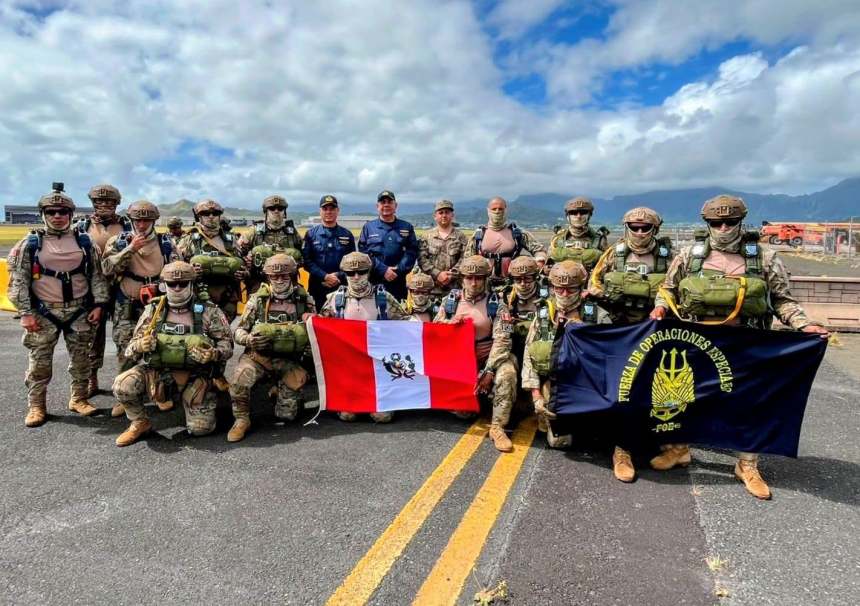
Of interest, the Peruvian Navy assumed command of the Combined Amphibious Task Force 176.1, a first in the 55 years of the exercise, based on Pisco, under Peruvian VADM Gian Marco Chiapperini Faverio.

VADM Favero with Pelotón de Operaciones Especiales commandos

Looking for a Franchi SPAS-15?

Every gun nerd knows about the Franchi SPAS-11, LAW-12, and SPAS-12 SPS autoloading shotguns of the 1980s; I mean, they were something of a pop culture fad if nothing else.

The SPAS-11 was an upgrade of the Franchi 500 meant for mil/LE sales

Meanwhile, the Franchi SPAS-12 SPS is iconic.

What you may not have known was the Franchi SPAS-15, which went box mag instead of tubular and was made (and imported) in much fewer numbers.

If you are curious, Atlantic has some as C&R SBRs, but be warned, they are $15K.

« Older Entries Recent Entries »