We give you, the Rattail One-Nine

Serious former operator turned performance shooter Kyle Defoor once cut down the frame of a full-size Glock 17 to accommodate the shorter 15 round G19 mags. This essentially gave him a G19 with a longer barrel and sight radius.

Now he did the same thing with a G19– chopping the frame down to accept the 10-shot squat G26 mag. He dubs the custom Glock 1926 hybrid the “rattail one nine

glock-19-chopped-down-to-glock-26-magwell-note-streamlite-x01

If you remember your Glocks, the 26 “Baby Glock” subcompact does not have a rail, has a 3.42-inch barrel and a 5.39-inch sight radius, whereas the G19 does have a rail and adds a bit more than a half-inch to both the barrel and SR.

Kind of interesting, especially with the hi-profile night sights, KKM barrel and Surefire XC1 LED attached. In short (see what I did there), you have a G26 that accommodates.

Combat Gallery Sunday: The Martial Art of Don Troiani

Much as once a week I like to take time off to cover warships (Wednesdays), on Sundays (when I feel like working), I like to cover military art and the painters, illustrators, sculptors, photographers and the like that produced them.

Combat Gallery Sunday: The Martial Art of Don Troiani

If you like military art at all, Don Troiani needs no introduction.

Here is a painting he has been working on for the Saratoga National Park that he has chronicled on his social media page from pencil to finished work.

The scene depicts the attack of the 62nd Regiment of Foot on the Connecticut Militia and 3rd New Hampshire Regiment on a wooded slope during the Battle of Freeman’s Farm. Major Harnage of the 62nd is wounded in the left foreground.

Thank you for your work, sir.

Devil Dogs, indeed

Official U.S. Marine Corps Photograph, from the collections of the Naval History and Heritage Command. Catalog #: NH 104294

Official U.S. Marine Corps Photograph, from the collections of the Naval History and Heritage Command. Catalog #: NH 104294

Iwo Jima Operation, 1945.

(Quoted from the original photo caption released on 27 February 1945): “Two Marines – ‘Dutch’, a Doberman Pinscher Marine War Dog stands guard as his partner, Pfc. Reg P. Hester, 7th War Dog Platoon, 25th Regiment, Fifth Marine Division, grabs a little sleep in a volcanic ash foxhole on Iwo Jima. Teams like this eliminated many Jap snipers who played dead inside of blasted pillboxes.”

Note pack and M1 Carbine on the foxhole lip. The original photograph came from Rear Admiral Samuel Eliot Morison’s World War II history project working files. It was provided to Morison by E.J. Long.

The Marines’ love affair with Dobes started when Marine War Dog Training School was stood up 18 January 1943, under the direction of Captain Samuel T. Brick. Some 14 Doberman Pinschers were donated by the Baltimore, Maryland and Canton, Ohio members of the Doberman Pinscher Club of America (though the first war dog sworn in was a Boxer named Fritz).

The War Dog Training Center was quickly established at Camp Knox, site of a former CCC camp aboard Camp Lejeune, eventually setting up 7 War Dog Platoons, each of some 24 military working dogs (later doubled) and about twice that many handlers, instructors and headquarters personnel to include at least one veterinarian.

All went to the Pacific.

According to one site:

The Dobes had to be at least 50 pounds and stand twenty inches high at the withers. Dogs who failed the tests for one reason or another were sent home.

Dobes began their training as Privates. They were promoted on the basis of their length of service. After three months the Dobe became a Private First Class, one year a Corporal, two years a Sergeant, three years a Platoon Sergeant, four years a Gunner Sergeant, and after five years a Master Gunner Sergeant. The Dobes could eventually outrank their handlers.

While towards the end of the war German Shepherds replaced Dobes as the preferred breed, some 892 Marine war dogs processed during the conflict, with a slim majority going overseas being Pinschers. Most were donated directly by dog owners and kennel clubs, while 132 came from the Army Quartermaster Corps.

In Guam, one particularly heavy engagement for the Marine K9s, of the 60 that landed there some 14 dogs were killed in action and 11 others died from exhaustion, tropical illness, heat stroke, accidents, and anemia from hookworm. All were buried in Guam in what is now the first war dog memorial.

The memorial was created by former 1st Lt. William W. Putney, who was the veterinarian for the 3rd Marine War Dog Platoon on Guam. A life-size bronze statue, “Always Faithful” was created by artist, Susan Bahary, in 1994.

It is topped with a Dobe.

war-dog-memorial-guam

At the National Archives at College Park, Maryland, are 11 small boxes containing the individual Dog Record Books of each canine who enrolled in the Marine Corps from December 15, 1942, to August 15, 1945.

That’s one ka-boomish .50 cal rifle you got there

Jake Hamby, who describes himself as a “Former Combat Camera dude/Aspiring Filmmaker/Duel-Sport Enthusiast” recently ran across a whack job of a garage gun in Iraq.

The gun was apparently captured by Peshmerga forces which Hamby is working with near Bashiqa, a town in the Mosul District of northern Iraq and, if a picture says a thousand words, Hamby’s snap shots are profanity at its finest.

“Fanaticism is the mother of invention. This is a DIY .50 ‘sniper’ rifle recovered from an IS position by the Free Burma Ranger team in #bashiqa #iraq #kurdistan #banthoseguns,” noted Hamby on Instagram, going on to explain that the gun “weighed 25-30 lbs so [it’s] certainly not flimsy”

this-captured-isis-homebrew-50-cal-is-a-ka-boom-waiting-to-happen-7 this-captured-isis-homebrew-50-cal-is-a-ka-boom-waiting-to-happen-4 this-captured-isis-homebrew-50-cal-is-a-ka-boom-waiting-to-happen-5 this-captured-isis-homebrew-50-cal-is-a-ka-boom-waiting-to-happen-2


The Jacob Double Rifle

Brig. Gen. John Jacob (CB) was an officer of the British East India Company born in 1812. Reared at the Addiscombe Military Seminary, he completed his formal education at age 16 when he was commissioned in the Bombay Artillery on his 16th birthday, subsequently sailing for India within the same week.

As a young subaltern of artillery he saw steady service on the Afghan frontier, covering himself in glory at the Battle of Meanee in 1843 which resulted in a Brevet Captain honor and his CB.

Sir John then went on to form an irregular cavalry unit which endured under his name as the 36th Jacob’s Horse (which, amalgamated in 1922 to become the 14th Prince of Wales’s Own Scinde Horse, remained until 1947 when it was allotted to the new Indian Army). He also went on to raise both the  130th Baluchis and 26th Jacob’s Mountain Battery.

He also crafted a very interesting rifle.

National Firearms Museum photo

National Firearms Museum photo

Jacob decided that a double barreled rifle with an elaborate sabre bayonet was just the ticket for his troops in India’s Northwest Frontier. His design fired a .52 caliber conical projectile with winged studs that could be modified for explosive impact against ammunition wagons at extreme distances (keep in mind the dum-dum round was born in the same place and time). The folding rear sight leaf was marked to an optimistic 2000 yards.

jacobsrifle7

Some 900 were made by Swinburn & Son in England around 1860, though apparently few were ever issued. You see, the man who had ordered them had already expired of exhuastion. They circled the glob as military surplus for a few generations with the 1907 Bannermans’ catalog listing them as “double barrel elephant rifles.”

Jacob, known locally as Jekum Sahib Bahadur, never returned to England, fought in Perisa, and, buried in what is today Pakistan at Jacobabad (guess who it is named after), is well-remembered and even to a degree, liked.

Balsa wood, is that you? Is this me?

A tank made of wood that was used by Islamic State militants as a diversion tactic is seen in Bawiza, north of Mosul, Iraq November 13, 2016. REUTERS/Ari Jalal

A tank made of wood that was used by Islamic State militants as a diversion tactic is seen in Bawiza, north of Mosul, Iraq November 13, 2016. REUTERS/Ari Jalal

Reports from Iraqi and allied forces advancing around Mosul is that the Islamic State forces are using bearded mannequins, wooden tanks and other props to help draw fire away from their positions.

While easy to discern as fakes up close, from the soda-staw eyes of a drone camera hundreds of feet in the air, or the binos of a commander a half-mile out, they look a lot like the real thing.

The thing is, the U.S. military has done this for 150 years.

tanklift-thumb-570x370-122303

More in my column at Guns.com

Happy Turkey Day

Angela Greene faces her quarry.

Angela Greene faces her quarry thanksgiving

Irish-born Greene was a popular B-movie starlet and WWII pinup and co-starred with Martin and Lewis in At War With the Army (1950).

And with that, enjoy these past menus for unit Thanksgiving dinners as held by the 3rd U.S. Infantry Regiment (The Old Guard).

1930-11-27-Thanksgiving Menu-Company I-1

Warship Wednesday Nov. 23, 2016: A long overdue Salute

Here at LSOZI, we are going to take off every Wednesday for a look at the old steam/diesel navies of the 1859-1946 time period and will profile a different ship each week. These ships have a life, a tale all of their own, which sometimes takes them to the strangest places. – Christopher Eger

Warship Wednesday Nov. 23, 2016: A long overdue Salute

Courtesy of D. M. McPherson, 1974. Catalog #: NH 81370

Courtesy of D. M. McPherson, 1974. Catalog #: NH 81370

Here we see the Admirable-class minesweeper USS Salute (AM-294) photographed sometime in 1944. Although she gave her last measure too soon after, her memory and relics endure.

The U.S. Navy has a long history of minesweeping, having lost the first modem ships to those infernal torpedoes in the Civil War. As a byproduct of Mr. Roosevelt’s Great North Sea Mine Barrage of the Great War, the Navy commissioned their first class of minesweepers, the Lapwing or “Old Bird” type vessels which lingered into WWII, followed by 1930s-era 147-foot three-ship Hawk-class and the much larger 220-foot Raven and Auk-classes early in the first days of that second great international hate.

In early 1941, the Navy set its sights on a hybrid class of new steel-hulled oceangoing sweepers built with lessons learned from their previous designs, that of a 180-foot, 750-ton vessel that could both clear mines and, by nature of their forward and aft 3″/50 guns, provide a modicum of escort support. Since they could float in 9’9″ of water, they were deemed coastal minesweepers at first.

Preliminary design plan, probably prepared during consideration of what became the Admirable (AM-136) class. This drawing, dated 2 May 1941, is for a 750-ton (full load displacement) vessel with a length of 180 feet. Scale of the original drawing is 1/8" = 1'. The original plan is in the 1939-1944 "Spring Styles Book" held by the Naval Historical Center U.S. Navy photo S-511-34

Preliminary design plan, probably prepared during consideration of what became the Admirable (AM-136) class. This drawing, dated 2 May 1941, is for a 750-ton (full load displacement) vessel with a length of 180 feet. Scale of the original drawing is 1/8″ = 1′. The original plan is in the 1939-1944 “Spring Styles Book” held by the Naval Historical Center U.S. Navy photo S-511-34

First of the class of what would eventually turn into orders for 147 ships (of which 123 were completed) was USS Admirable laid down as AMc-113, 8 April 1942 in Tampa, Florida.

Another 68 craft, sans mine gear, were completed as PCE-842-class patrol craft.

The hero of our tale– the first to carry her name– USS Salute (AM-294) was laid down 11 November 1942 at Winslow Marine Railway and Shipbuilding Co, Seattle, WA. Commissioned 4 December 1943 with LT Raymond Henry Nelson, Jr., USNR, in command, the addition of ASW gear and an AAA suite (though one of the original design’s 3-inchers were deleted) raised her displacement to 945 tons fully loaded but gave her some defense against Japanese subs and planes.

On board Salute on her builder's trials, note the Winslow Marine flag from her deckhouse

On board Salute on her builder’s trials, note the Winslow Marine flag from her wheelhouse

Salute on trials from Winslow

Salute on trials from Winslow

uss-salute-am-294-built-in-november-1942-by-winslow-marine-railway-and-shipbuilding-co
According to DANFS, she spent most of 1944 working out of Hawaii escorting convoys between Pearl Harbor, Majuro, Kwajalein, Eniwetok, Guam, and Saipan. It was in this work that she picked up her distinctive camo scheme in March 1944.

uss-salute-puget-sound

With LT Jesse Robert Hodges, USNR, assuming command in June, Salute reported to the 7th Fleet at Manus on 8 October 1944 for the Leyte invasion.

Working with her sisters in Mine Division 34 off the Leyte beaches, she helped clear the landing areas and provide cover fire from Japanese air attacks then combed the waters for survivors of the great Battle off Samar.

Between November 1944 and April 1945, a period of just over six months, Salute conducted dangerous pre-invasion sweeps at Ormoc Bay, Mindoro Island, Subic, the Lingayen Gulf, Zambales, Mariveles and off Corregidor in Manila Bay, the Sulu Sea off Palawan, and off the beaches of Legaspi– often while under fire from shore batteries and dodging kamikazes.

It’s not hard to see how she earned five battle stars for her World War II service. She reportedly cleared 143 Japanese naval mines during the Philippines Campaign.

On 9 May, Salute arrived at Morotai to prepare for operations in the Netherlands East Indies (today’s Indonesia).

It was in that chain that, while sweeping off Brunei Bay, Borneo, on 7 June 1945, she struck a mine, which broke the tiny ship’s back. Landing craft came alongside in an attempt to prop up the rapidly swamping ship, but her hull had taken fatal damage and within minutes, her crew was ordered off the ship. Once clear, the lines holding Salute to the landing craft were cut and she was cast loose into the bay where she quickly swamped, broke in two, and sank, her bow coming to rest over her stern.

salute-wreckFrom a report by Lt. James J. Hughes, an officer aboard Salute who survived the explosion:

“The ship was hit mid-ship, right underneath the belly, and it came right up through all the decks,” said Hughes. “Anybody in that area was killed, especially in the engine room; they didn’t have a chance. We hit it about 4:00 in the afternoon and sunk about midnight. We were making the last run of the day.”

Salute suffered nine crewmembers killed or missing and two officers and eight enlisted wounded with the War Department reporting her loss on June 26. She was struck from the Naval Register 11 July 1945.

Located in 90 feet of water at 5° 08’N, 115° 05’E, over the years she became a popular dive site after the Malaysian navy removed her unexploded depth charges, which brings us to recent developments.

Navy divers from Mobile Diving and Salvage Unit (MDSU) 1 along with Royal Brunei navy personnel dove on Salute from USNS Salvor (T-ARS-52), located in 90 feet of water, over a three-day period earlier this month.

The diving operations were the first by the U.S. Navy on the wreckage of Salute and were conducted as part of Cooperation Afloat Readiness and Training (CARAT) 2016.

“These operations provided U.S. Navy divers a unique opportunity to work alongside our Bruneian counterparts on a very meaningful project,” said Lt. Chris Price, detachment officer-in-charge, MDSU 1. “We are preserving our Navy’s rich history and heritage, and giving a very fitting remembrance to these fallen Sailors.”

USS SALUTE (November 16, 2016) U.S. Navy Divers attached to Mobile Diving & Salvage Company ONE divers serving with the Royal Brunei Armed Forces gather for a group photo at the wreckage site of USS Salute (AM-294), which sank in Brunei waters on June 7, 1945, during Cooperation Afloat Readiness and Training (CARAT) Brunei 2016, Nov. 15. CARAT is a series of annual maritime exercises between the U.S. Navy, U.S. Marine Corps and the armed forces of nine partner nations to include Bangladesh, Brunei, Cambodia, Indonesia, Malaysia, the Philippines, Singapore, Thailand, and Timor-Leste. (U.S. Navy photo by Lt. Chris Price/RELEASED)

USS SALUTE (November 16, 2016) U.S. Navy Divers attached to Mobile Diving & Salvage Company ONE divers serving with the Royal Brunei Armed Forces gather for a group photo at the wreckage site of USS Salute (AM-294), which sank in Brunei waters on June 7, 1945, during Cooperation Afloat Readiness and Training (CARAT) Brunei 2016, Nov. 15. CARAT is a series of annual maritime exercises between the U.S. Navy, U.S. Marine Corps and the armed forces of nine partner nations to include Bangladesh, Brunei, Cambodia, Indonesia, Malaysia, the Philippines, Singapore, Thailand, and Timor-Leste. (U.S. Navy photo by Lt. Chris Price/RELEASED)

USS SALUTE (November 16, 2016) U.S. Navy Divers attached to Mobile Diving and Salve Unit ONE place a memorial plaque at the wreckage site of USS Salute (AM-294) which sank in Brunei waters on June 7, 1945, during Cooperation Afloat Readiness and Training (CARAT) Brunei 2016, Nov. 16. (U.S. Navy photo by Lt. Chris Price/RELEASED)

USS SALUTE (November 16, 2016) U.S. Navy Divers attached to Mobile Diving and Salve Unit ONE place a memorial plaque at the wreckage site of USS Salute (AM-294) which sank in Brunei waters on June 7, 1945, during Cooperation Afloat Readiness and Training (CARAT) Brunei 2016, Nov. 16. (U.S. Navy photo by Lt. Chris Price/RELEASED)

Four artifacts– a gas mask, a glass inkwell, and two pieces of china: a larger plate and a smaller plate– were recovered and are being assessed for preservation.

161109-n-th437-008 161109-n-th437-029-1024x682 161109-n-th437-056-1024x682

From a NHHC Underwater Archaeology Branch release:

However, the four pieces are not all in the greatest of condition—the mask especially—and because of the aquatic environment they spent the last 71 years in, they will all require specialized conservation treatment. Conservation is a main component of any underwater archaeology program since artifacts recovered from submerged archaeological sites require special preservation care.

Besides the recent attention, Salute is remembered by a veteran’s website that hosts crew reunion information. In 1995 the group placed a wreath on her wreck during the 50th anniversary of the liberation of Labuan.

Her name was recycled for an Aggressive-class ocean minesweeper USS Salute (MSO-470) commissioned on 4 May 1955. She famously helped look for a lost H-bomb off Spain in 1966 and continued to serve until 1971 when she was broken up prematurely.

The U.S. Navy minesweeper USS Salute (MSO-470) at Luders Marine Construction Co., Stamford, Connecticut (USA), in January 1955.

The U.S. Navy minesweeper USS Salute (MSO-470) at Luders Marine Construction Co., Stamford, Connecticut (USA), in January 1955.

The latter Salute‘s engineering plans are preserved in the National Archives and she was the last to carry the name on the Navy List.

Speaking of plans, the Admirable-class sweepers have been a very popular model over the years:

lindberg-1-130-uss-sentry-am-299-admirable-class-wwii-us-navy-minesweeper

As for Salute‘s Admirable-class sisters, 24 were given to the Soviets in 1945 and never returned, others remained in use by the Navy through the Korean War era, and some were later passed on to the Taiwan, South Korea, the Republic of Vietnam, and the Dominican, Mexican, Myanmar, and Philippine navies.

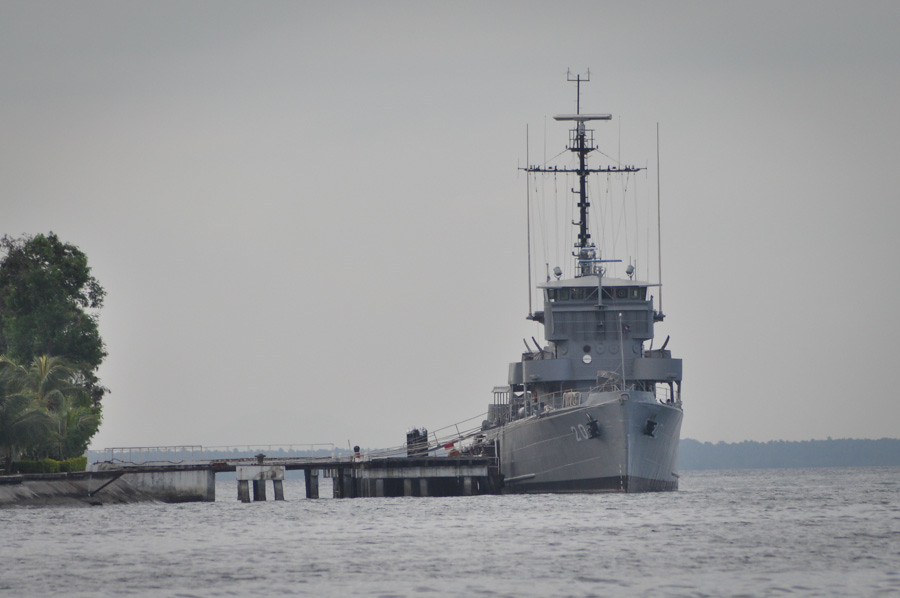
At least five PCE-842/Admirable-class ships remain in nominal service as patrol craft with the Philippines including BRP Magat Salamat (PS-20), formerly USS Gayety (AM-239), shown below.

https://c2.staticflickr.com/4/3746/9469712901_3a0c96497c_b.jpg

Since 1993, the only Admirable-class vessel left above water in the U.S. is USS Hazard (AM-240).

Now a National Historic Landmark, she was retired in 1971 and, put up for sale on the cheap:

1971-newspaper-ad-for-the-disposal-of-uss-hazard-msf-240-an-admirable-class-minesweeper-of-the-wwii-us-navy

Hazard was installed on dry land at Freedom Park on the Missouri River waterfront in East Omaha where she is open to the public.

Please visit her.

hazard-buried-in-freedom-park

According to the NPS:

The ship was transferred to Omaha with all of her spare parts and equipment intact. The only equipment missing from USS Hazard is the minesweeping cable. All equipment (radio, engines, ovens, electrical systems, plumbing) is fully operational. USS Hazard still retains its original dishes, kitchen utensils, and stationery. USS Hazard is one of the best preserved and intact warships remaining from World War II. USS Hazard is a virtual time capsule dating from 1945.

Specs:

Image by shipbucket

Image by shipbucket

Displacement: 945 t (fl)
Length:     184 ft. 6 in (56.24 m)
Beam:     33 ft. (10 m)
Draft:     9 ft. 9 in (2.97 m)
Propulsion:
2 × Cooper Bessemer GSB-8 diesel engines
National Supply Co. single reduction gear
2 shafts
Speed:     14.8 knots
Complement: 104
Armament:
1 × 3″/50 caliber gun
1 × twin Bofors 40 mm guns
6 × Oerlikon 20 mm cannons
1 × Hedgehog anti-submarine mortar
4 × Depth charge projectors (K-guns)
2 × Depth charge tracks

If you liked this column, please consider joining the International Naval Research Organization (INRO), Publishers of Warship International

They are possibly one of the best sources of naval study, images, and fellowship you can find http://www.warship.org/membership.htm

The International Naval Research Organization is a non-profit corporation dedicated to the encouragement of the study of naval vessels and their histories, principally in the era of iron and steel warships (about 1860 to date). Its purpose is to provide information and a means of contact for those interested in warships.

Nearing their 50th Anniversary, Warship International, the written tome of the INRO has published hundreds of articles, most of which are unique in their sweep and subject.

PRINT still has it place. If you LOVE warships you should belong.

I’m a member, so should you be!

Sure, this is just a quiet house, only strategically located and with a good field of fire

Bloke on the Range, an expat living in Switzerland, takes a look at the Berner Oberland Krattigen 105mm “hidden” artillery battery which was housed in steel reinforced concrete bunkers made to look like harmless rural farm homes.

“Lots to interest troglodytes here, and there’s some interesting firearms on display too, including an MP43/44, MG11, several LMG25’s, a fortress-adapted Stgw 57, and some other bangsticks.”

Pretty neat stuff and a good insight into the Alpine fortress mindset.

Get ready for homemade suppressors if HPA passes (but not in every state)

oil-filter-suppressor

With the possible removal of silencers/suppressors from National Firearms Act control, a number of legal questions around the devices emerge.

The current mechanism for change, H.R.3799 — the Hearing Protection Act — is stuck in the U.S. House but would likely see a stronger reboot in the next Congress in 2017. If a new bill gains enough momentum to make it through Capitol Hill and onto the waiting desk of President Trump, it would leave a few things undecided if signed into law with its current language.

I spoke with Adam Kraut, an attorney specializing in Second Amendment rights and NFA issues in particular, about just what could be in store.

More in my column at Guns.com.

« Older Entries Recent Entries »