Tag Archives: vintage warships

Warship Wednesday, Feb. 13, 2019: That time the Japanese (briefly) won a condemned (but free) secondhand battleship

Here at LSOZI, we are going to take off every Wednesday for a look at the old steam/diesel navies of the 1833-1946 time period and will profile a different ship each week. These ships have a life, a tale all their own, which sometimes takes them to the strangest places.- Christopher Eger

Warship Wednesday, Feb. 13, 2019: That time the Japanese (briefly) won a condemned but free battleship

Farenholt Collection. Catalog #: NH 65755

Here we see the Brandenburg-class linienschiff /panzerschiff SMS Weißenburg of the Kaiserliche Marine with a bone in her mouth, likely while on trials in 1893. She would go on to live an interesting life that would leave her one of the last 19th Century battleships still afloat more than a half-century later.

These early German barbette battleships were the Imperial Navy’s first blue water capital ships when they were envisioned in the late 1880s. Stumpy by design, the quartet of Brandenburgers were 379-feet long and weighed 10,000-tons, roughly the same size as a smallish cruiser by the time WWI came around.

The class had an unusual layout for the main armament, mounting two twin 11″/40 cal gun turrets fore and aft with a third twin 11.1″/35 cal turret amidships, which is kinda funky.

The 11-inch guns were good enough to fire a 529-pound shell to 15,000-yards, but the small magazine only carried 60 rounds per gun and the nature of the turret design meant that shells could only be loaded when the gunhouse was trained to 0 degrees. The rate of fire was about 1 shell every 2 minutes. Photo via Navweaps.

However, they could make 17 knots and carried as much as 16-inches of armor, which was decent for their day.

Class leader SMS Brandenburg and our subject Weissenburg were laid down simultaneously at AG Vulcan Stettin in May 1890, followed by SMS Kurfürst Friedrich Wilhelm at Kaiserliche Werft Wilhelmshaven, and SMS Wörth at Germaniawerft, Kiel, which left them all to commission in 1893/94, staggered just months apart.

Differing from their sisters, Weissenburg and Kurfürst Friedrich Wilhelm carried lighter nickel (Harvey) steel plate rather than tougher Krupp-made plate, as the latter was in short supply (this will be important later).

Imperial German Brandenburg class battleships gunnery practice at sea 1900

The German battleship SMS Weißenburg in 1894. Note her peculiar three turret arrangement

WEISSENBURG (German Battleship, 1891-1938) Photographed in British waters, probably during the late 1890s. NH 88653

WEISSENBURG German Battleship, 1891 note her big Reichskriegsflagge on the stern NH 48568

When they joined the fleet, Kaiser Willy II and company loved the new toys, although they were outclassed by the comparable British and French designs of the day– e.g. the Royal Navy’s nine Majestic-class pre-dreadnoughts went over 17,000-tons and carried 12-inch guns, although they had thinner armor than the Brandenburgers while the French Charlemagne-class was marginally faster and also mounted 12-inch guns.

Still, until the Germans ordered their Nassau-class dreadnoughts in 1906, the Brandenburgers carried the largest guns in the fleet, as subsequent linienschiff only toted 9.4-inch or the same 11-inch guns as they did, and in smaller quantities. This left them popular for a decade. During that time, the class of sisters waved the flag as a quartet, forming the 1st Division under Konteradmiral Richard von Geißler, and sailed as a group for China in 1900 to exercise gunboat diplomacy using the Boxer Rebellion as a pretext.

Think of them as Kaiser Willy’s low-budget version of the Great White Fleet.

“Das Linienschiff Weißenburg” passing through the Kaiser-Wilhelm-Kanal in Hochbrücke Levensau, 1900

German battleships SMS Brandenburg (foreground) and SMS Weißenburg (right) in Port Said on the way to China, 1900

The Germans published and widely circulated many very nice period postcards and lithographs on the class which serve as classic maritime art today.

S.M. Linienschiff Weissenburg postcard. Isn’t that beautiful?

The whole class

Although they were substantially modernized after their return from China (a second conning tower added, some torpedo tubes removed, boilers replaced, fire control upgraded etc.) the writing was on the wall for these dated bruisers, especially after the epic slaughter of pre-dreadnoughts observed during the Russo-Japanese War in 1904-05. Shifted to the II Squadron and then the III Squadron, by 1910 they were listed as part of the Reserve Division.

Brandenburg and Worth were then relegated to training duties, passing in and out of ordinary, and later would form part of V Battle Squadron for coastal defense during WWI.

Meanwhile, with Berlin courting the Ottoman Empire, Germany made a deal to sell the two sisters with Harvey armor– Weissenburg and Kurfürst Friedrich Wilhelm— to the Turks in September-October 1910. Payment for the two battleships and four companion German-built destroyers amounted to 25 million marks. As the Germans paid about 10 million marks for each of the Brandenburgers‘ construction when new, they got the better end of the deal.

Fez-equipped crew members of the Ottoman battleship Barbaros Hayreddin or Turgut Reis, sometime between 1910-1914

When compared to the rest of the Sultan’s fleet, whose most impressive vessel was the old (c.1874) 9,000-ton coastal defense battleship Messudiyeh and two Anglo-American protected cruisers– Medjidie (Mecidiye) and Hamidie (Hamidiye) — picked up around the turn of the century, the gently-used German battleships were the best things in the Turkish fleet until German Admiral Wilhelm Souchon showed up in 1914 (more on him later).

Weissenburg /Torgud Reis and Kurfürst Friedrich Wilhelm/Barbaros Hayreddin in the 1914 version of Janes, listed right after the planned British-built modern dreadnoughts which would be seized by Churchill that year and pressed into the Royal Navy, and right before the ancient Messudiyeh, built in 1874.

As the two German battleships required more than 1,800 sailors to crew them– a figure the Turks simply did not have– they were undermanned and filled with often raw recruits from the Empire’s maritime provinces. Within just a few years the lack of trained NCOs and officers meant the two ships had boilers and pipes that were broken, phones that no longer worked, and rangefinders and ammo hoists that could not be operated effectively.

Renamed Torgud Reis and Barbaros Hayreddin, respectively, after famous Ottoman admirals, they sailed for Constantinople just in time to see service against the Italians (then nominal German allies) and against the combined Greek-Bulgarian-Rumanian-Serbo-Montenegrin forces in the series of Balkan Wars, providing artillery support to Ottoman ground forces in Thrace and throwing shells at Greek ships during the ineffective naval skirmishes at Battle of Elli and Lemnos.

Ottoman battleships Barbaros Hayreddin and Turgut Reis, in Thessaloniki, 1911, just after delivery

Unfortunately for the Turks, both of their new-to-them German battleships got the short end of the stick against the Greek’s Italian-built armored cruiser Georgios Averof and her companions and were peppered with shells in each of their meetings with the Hellenic Navy, leaving them in poor shape just two years after delivery. Due to a low number of 280mm shells available, most of the rounds fired by the ships in their career were from 150mm and 120mm secondary guns. At the Battle of Elli on 16 December 1912, Torgut Rus suffered 8 killed and 20 wounded. At the Battle of Lemnos on 18 January 1913, the Greeks inflicted another 9 killed and 49 wounded on our subject’s crew.

Comparison between the Ottoman (left) and Greek (right) fleets during the First Balkan War, 1912-13 L’Illustration, No. 3652, 22 Février 1913 via Wiki. Torgut Ruis is the second from the bottom left.

With little time to lick their wounds, the Ottomans were sucked into World War I on the German side, largely due to the machinations of the aforementioned Adm. Souchon, who showed up with the SMS Goeben and SMS Breslau at Constantinople just after the balloon went up with the British hot on his heels. Donning fez and raising an Ottoman crescent banner, Souchon on his own went on to raid the Russian coast in the Black Sea under the pretext of being in the Sultan’s navy, an act that brought the “Sick Man of Europe” into the hospice care of a conflict it could never hope to survive.

The Ottoman battleship Torgud Reis (ex-SMS Weißenburg) in 1915 during the Gallipoli Campaign. Note her stubby 11″/35s amidships compared to her 11″/40s in the front and rear.

Nonetheless, both Torgud Reis and Barbaros Hayreddin managed to give a good account of themselves in the Dardanelles Campaign, shelling ANZAC troops along Gallipoli and dodging Allied submarines and battleships. Speaking of which, Barbaros Hayreddin was dispatched by a single torpedo from Royal Navy HMS E11, which had penetrated the Sea of Marmara, in August 1915, taking half her crew with her.

Her biggest contribution to the war would seem to come when she tied to Goeben/Yavuz on a rough day for the Turks in January 1918 during the Battle of Imbros and pull the stranded battlecruiser off Nagara Point before the Allies could kill her, as such preserving a fleet in being for the rest of the conflict.

For more on the Ottoman Navy of that period, click here for an excellent essay.

When the war ended, Torgud Reis was in exceptionally poor condition, lacking parts and shells, still suffering from damages inflicted in her wars with the Balkan states as well as a turret explosion in 1915. Following the Armistice of Mudros in October 1918 and the resulting Allied occupation of Constantinople– the first time the city had changed hands since 1453– the Ottoman fleet was disarmed and interned under British guns.

In the controversial Treaty of Sevres, signed on 10 August 1920, the victorious Allies divided the Ottoman fleet among the victors, with Britain to receive the ripest fruit including Yavuz Sultân Selîm (ex-Goeben), Hamidiye, Mecidiye, Muavenet-i, Millet, Numene, Tasoz, Basra, and Samsun. The French, Greeks and others were to split the destroyers Berk-i Efsan, Pelagni Deria, Zuhaf Peyk-i Sevket, and Nusret.

The Japanese, who never fired a shot at the Turks in anger as far as I can tell, was to get Torgud Reis. In fairness to the Emperor, it should be noted that the Japanese sent two squadrons of cruisers and destroyers to the Med in 1917-18 for escort duties for troop transports and anti-submarine operations, which included the destroyer Sakaki getting damaged by a torpedo from the Austro-Hungarian submarine U 27 off Crete.

Needless to say, the Japanese, who picked up the much nicer Jutland-veteran dreadnoughts SMS Nassau and SMS Oldenburg as well as the cruiser Augsburg and five destroyers from the Germans as reparations in the Treaty of Versailles– only to sell them for scrap– never took over the leaky and busted Torgud Reis.

Regardless, the Sevres pact never took effect, as the Greeks and Turks both balked at it although for different reasons, which in turn led to the milder Treaty of Lausanne, signed on 24 July 1923, that allowed the Turks to keep their ancient fleet. The treaty came into force on 6 August 1924 and soon after, Torguid Reis was refitted at the Gölcük Naval Shipyard through 1925 then returned to service as an armed training ship, still with at least two of her 11.1-inch guns working while two of her other turrets were removed and mounted ashore in concrete on the Asian coast of the Dardanelles as a coastal artillery battery.

Meanwhile, her two sisters still in Germany, Brandenburg, and Worth, were scrapped in Danzig just after the war.

The 40-year old battleship Torgud Reis in 1930 in poor shape with only her forward turret remaining. Note the destroyer to the left

Torgud Reis remained on active duty until at least 1933 and endured as an accommodations hulk for another two decades past that date, only being broken in the late 1950s. With that, I believe she was one of the final 19th Century pre-dreadnoughts left, as the USS Kearsarge (BB-5) which was converted to a heavy-crane ship in 1920, had been scrapped in 1955; and the hulk of the ex-USS Oregon (BB-3), which had been used as an ammunition barge at Guam until 1948, was scrapped in 1956. An honorable mention goes to the USS Illinois (BB-7), who was commissioned in 1901, disarmed in 1923, and ultimately sold for scrap in 1956. Only Togo’s Mikasa, which has been preserved as a museum ship at Yokosuka since 1923, remains of the era. Dewey’s 1898-era protected cruiser Olympia, remains as an honorable mention.

Nonetheless, the two turrets removed from Torgud Reis in 1925 and repurposed into coastal artillery, still endure, which counts for something.

Further, the Internationales Maritimes Museum in Hamburg has a set of very well done 1:100/1:250 scale models of the Brandenburgers by master model maker Thomas Klünemann on public display, keeping the memory of the class alive in their former homeland.

Specs:
Displacement:10,670 t (10,500 long tons)
Length: 379 ft 7 in
Beam: 64 ft 0 in
Draft: 24 ft 11 in
Installed power: 10,000 ihp (7,500 kW)
Propulsion: 2-shaft triple expansion engines
Speed: 16.9 knots
Range: 4,300 nautical miles at 10 knots on 1050 tons coal
Complement:
38 officers
530 enlisted men
Armament:
4 × 28 cm (11 in) MRK L/40 caliber guns (two removed 1925)
2 × 28 cm (11 in) MRK L/35 caliber guns (removed 1925)
8 × 10.5 cm (4.1 in) SK L/35 guns
8 × 8.8 cm (3.5 in) SK L/30 guns
5 × 45 cm (18 in) torpedo tubes (1 bow, 4 beam) (removed 1910)
Armor:
Belt: 400 mm (15.7 in)
Barbettes: 300 millimeters (11.8 in)
Deck: 60 millimeters (2.4 in)

If you liked this column, please consider joining the International Naval Research Organization (INRO), Publishers of Warship International

They are possibly one of the best sources of naval study, images, and fellowship you can find. http://www.warship.org/membership.htm

The International Naval Research Organization is a non-profit corporation dedicated to the encouragement of the study of naval vessels and their histories, principally in the era of iron and steel warships (about 1860 to date). Its purpose is to provide information and a means of contact for those interested in warships.

With more than 50 years of scholarship, Warship International, the written tome of the INRO has published hundreds of articles, most of which are unique in their sweep and subject.

PRINT still has its place. If you LOVE warships you should belong.

I’m a member, so should you be!

Warship Wednesday, Feb. 6, 2019: The final Four-Piper

Here at LSOZI, we are going to take off every Wednesday for a look at the old steam/diesel navies of the 1833-1946 time period and will profile a different ship each week. These ships have a life, a tale all their own, which sometimes takes them to the strangest places.- Christopher Eger

Warship Wednesday, Feb. 6, 2019: The final Four-Piper

NH 64543

Here we see the Clemson-class “four-piper” flush-decker torpedo boat destroyer USS Hatfield (DD-231) in dry dock at the Philadelphia Navy Yard on May 23, 1932, with a newly-fitted bow. One of a tremendous class of vessels some 156-strong, she had a long and varied career, ending it as the very last of her type in U.S. service.

An expansion of the almost identical Wickes-class destroyers with a third more fuel capacity to enable them to escort a convoy across the Atlantic without refueling, the Clemson’s were sorely needed to combat the pressing German submarine threat of the Great War. At 1,200-tons and with a top speed of 35 knots, they were brisk vessels ready for the task.

“They kept the sea lanes open” – Invest in the Victory Liberty Loan WWI, poster from 1918 by LA Shafer, Niagara Litho Co. Buffalo, NY, showing a four-piper destroyer armed with 5-inch guns dressed in dazzleflauge jumping between a merchantman and a dastardly German U-boat, the latter sent by the Kaiser to send passenger liners to the bottom.

However, they were was built too late for the war.

The hero of our story was named after naval hero John Hatfield, a young man who volunteered for service and, appointed Midshipman 18 June 1812, served on the small armed schooner USS Lady of the Lake as part of the force commanded by Lt. Isaac Chauncey on Lake Ontario. During the assault on York (now Toronto) in April 1813, Hatfield was killed while leading his ships small boats in a combined arms attack that netted the giant British Royal Standard taken from the Parliament House (and currently in the USNA collection).

Laid down 10 June 1918 at New York Shipbuilding Corp., Camden, N.J, Hatfield just missed her Great War and commissioned 16 April 1920. Her early career included a fleet review by President Harding at Hampton Roads and training cruises in the Caribbean. Interestingly, although almost every four-piper carried a battery of five 4″/50 cal singles, she was one of a handful (DD-231 through DD-235) that were commissioned instead with four 5″/51 cal guns. Due to the extra weight, no depth charge racks were installed on these more heavily gunned sisters

Hatfield Launching at The New York Shipbuilding Corporation, Camden, New Jersey. NH 53688

With the Allied High Commission in the former Ottoman Empire needing muscle, on 2 October 1922, Destroyer Division 40, composed of the destroyers Bainbridge (DD-246), Fox (DD-234), Gilmer (DD-233), Hatfield (DD-231), Hopkins (DD-249), and Kane (DD-235), and Destroyer Division 41, composed of the destroyers Barry (DD-248), Goff (DD-247), King (DD-242), McFarland (DD-237), Overton (DD-239), and Sturtevant (DD-240), sailed from Hampton Roads, Virginia, for Constantinople.

The destroyers arrived there on 22 October, under the command of RADM Mark Lambert Bristol, who had his flag on the humble station ship USS Scorpion, a Warship Wednesday alum, who spent years in the Bosporus moored to the quay and connected by telephone with the Embassy. Hatfield remained in the region until 31 July 1923, when she was given orders to proceed back to the West Coast.

In the early 1920s, the Black Sea was an American lake, as the Russian, Bulgarian, Romanian and Ottoman fleets had largely ceased to exist while the British and French fleets, facing near bankruptcy and mutinous crews, respectively, were keen to send only a few vessels to Constantinople and Odesa and withdraw them as soon as possible. At its height, the U.S. fleet in Constantinople included over 26 warships including the battleships Arizona and Utah, a dozen destroyers, heavy and light cruisers, floating repair shops, and transport ships.

NH 803

Assigned to the U.S. Scouting Fleet, her stomping ground ranged from New York to Panama including a tour of gunboat diplomacy off the coast of Nicaragua throughout February and March 1927, during the civil war in that country in which the U.S. backed the conservative Solórzano government. For this, Hatfield picked up the Second Nicaraguan Campaign Medal.

The next year, Hatfield was part of the squadron that carried President Coolidge to Cuba and Haiti for the Pan-American Conference.

U.S. Navy destroyers moored side-by-side after a day’s maneuvers in Haitian Waters, circa the later 1920s or the 1930s. These ships are (from front to rear): USS Kane (DD-235); USS Hatfield (DD-231); USS Brooks (DD-232); and USS Lawrence (DD-250). The first three destroyers carry 5″/51 cal guns mounted on their sterns, while Lawrence has the more typical four-piper popgun, a 4″/50 cal, mounted atop her after deckhouse, with a 3″/23 anti-aircraft gun on her stern. Note bedding airing on the ships’ lifelines. NH 52227

USS Hatfield (DD-231) In San Diego Harbor, California, during the early 1930s. She was one of only five flush-deck destroyers to carry 5/51 guns. Donation of Franklin Moran, 1967. U.S. Naval History and Heritage Command Photograph. NH 64542

USS Hatfield (DD-231) and sister USS Humphreys (DD-236) circa 1928

Hatfield had a crack up with the USS Sands (DD-243), a sistership, during maneuvers 40 miles off Newport, Rhode Island, 13 September 1930. Damage control was quick and she was towed to Brooklyn Navy Yard by tugs Sagamore (AT-20) and Penobscot (YT-42) for repairs.

Photo via Boston Public Library, Leslie Jones Collection. 08_06_006245

Transferred to San Diego in 1932 after a brief stint in ordinary, by April 1936 she was deployed to friction points once again, serving off Spain in the neutrality patrol during the Spanish Civil War as part of Squadron Forty-T commanded by RADM Arthur P. Fairfield. This special task force, initially comprising the old cruiser Raleigh, fellow four-piper USS Kane, Hatfield, and the Coast Guard cutter USCGC Cayuga, saved hundreds of U.S. and foreign nationals during the conflict. In all, she would spend 19 months there, returning to the U.S. at the tail end of 1937, returning to mothballs for a few months.

USS HATFIELD (DD-231). (1920-1947). Collection of Gustave Maurer. NH 2216

When WWII erupted in Europe, Hatfield was dusted off once more and recommissioned 25 September 1939 for assignment to FDR’s East Coast Neutrality Patrol looking for U-Boats, a mission she would continue through August 1940 when she was sent to the West Coast, arriving at Bremerton for operations in the Northern Pacific as part of the rusty old tin cans of DESDIV 82.

In the days immediately after Pearl Harbor, the obsolete flush decker was sent to sparsely defended Alaska, where she spent her “shooting days” of WWII. Even equipped with sonar, radar, and a smattering of machine guns for AAA use, destroyer technology had passed her by.

Destroyer evolution, 1920-1944: USS HATFIELD (DD-231), USS MAHAN (DD-364), USS FLETCHER (DD-445). NH 109593

Hatfield 26 May 1942, at Puget Sound, Navy Yard, Bremerton, Washington. Note rafts, torpedo tubes, boat, radar at mainmast. Also, note barrage balloons 19-N-30086

Hatfield on 26 May 1942, at Puget Sound, Washington 19-N-30085

As noted by DANFS: “In the uncertain early months of the Pacific war, Hatfield convoyed merchant ships to Alaskan ports, helping to carry the supplies necessary to establish bases in the North. She continued this vital duty in the bleak and dangerous northern waters until 13 March 1944, when she returned to Seattle.”

Relegated to work as an auxiliary (AG-84) in October 1944, she finished her military service towing targets and assisting with underway training. Hatfield decommissioned 13 December 1946 and was sold for scrap 9 May 1947 to National Metal & Steel Corp., Terminal Island, Calif, the last of her kind in the Navy. Only spending about 36 months of her 26 years out of commission — a rarity for her class– Hatfield had some 22 skippers in her long career.

Some of her original builder’s plaques are on display at the Los Angeles Maritime Museum.

And of course, there are a number of postal cancelations from this far-traveled greyhound.

Destroyer USS HATFIELD DD-231 Villefranche France Naval Cover MhCachets 1 MADE

As for her sisters, seven Clemson’s were lost at the disaster at Honda Point in 1923, and 18 (including six used by the British) were lost in WWII including one, USS Stewart (DD-224), which was famously raised by the Japanese and used in their Navy only to be recaptured by the USN and given a watery grave after the war. Those four-pipers not sold off in the 1930s or otherwise sent to Davy Jones were scrapped wholesale in the months immediately after WWII. Besides Hatfield, the penultimate Clemson in US service was USS Williamson (DD-244) which was decommissioned 8 November 1945 and sold to the breakers on 4 November 1948.

The final Clemson afloat, USS Aulick (DD-258), joined the Royal Navy as HMS Burnham (H82) in 1940 as part of the “Destroyers for Bases” deal. Laid up in 1944, she was allocated for scrapping on 3 December 1948.

None are preserved and only the scattered wrecks in the Western Pacific, Honda Point, the Med and Atlantic endure.

Specs:


Displacement:
1,215 tons (normal)
1,308 tons (full load)
Length: 314 ft. 4.5 in
Beam: 30 ft. 11.5 in
Draft: 9 ft. 4 in
Propulsion:
4 × boilers, 300 psi (2,100 kPa) saturated steam
2 geared steam turbines
27,600 hp (20,600 kW)
2 shafts
Speed: 35.5 knots (65.7 km/h)
Range: 4,900 nmi (9,100 km) @ 15 kn (28 km/h)
Crew: (USN as commissioned)
8 officers
8 chief petty officers
106 enlisted
Armament:
(1920)
4- 5″/51cal guns
12 × 21 inch torpedo tubes (4 × 3) (533 mm)

If you liked this column, please consider joining the International Naval Research Organization (INRO), Publishers of Warship International

They are possibly one of the best sources of naval study, images, and fellowship you can find. http://www.warship.org/membership.htm

The International Naval Research Organization is a non-profit corporation dedicated to the encouragement of the study of naval vessels and their histories, principally in the era of iron and steel warships (about 1860 to date). Its purpose is to provide information and a means of contact for those interested in warships.

With more than 50 years of scholarship, Warship International, the written tome of the INRO has published hundreds of articles, most of which are unique in their sweep and subject.

PRINT still has its place. If you LOVE warships you should belong. I’m a member, so should you be!

Warship Wednesday, Jan. 30, 2019: The ‘$2 million Fighting Monster’

Here at LSOZI, we are going to take off every Wednesday for a look at the old steam/diesel navies of the 1833-1946 time period and will profile a different ship each week. These ships have a life, a tale all their own, which sometimes takes them to the strangest places.- Christopher Eger

Warship Wednesday, Jan. 30, 2019: The ‘$2 million Fighting Monster’

NH 108456 (2000×1043)

Here we see the S-class submarine USS S-49 (SS-160), one of the last class of “pig boats” commissioned with letters rather than names, in heavy seas during her brief time in the Navy. Somehow, after a short and unlucky naval career, S-49 was sold to a huckster who turned her into a (sometimes) floating tourist trap that wound up taking his case to the Supreme Court.

True story.

The S-class, or “Sugar” boats, were actually three different variants designed by Simon Lake Co, Electric Boat, and the Bureau of Construction and Repair (BuC&R) in the last days of the Great War in which U.S.-made submarines had a poor record. Looking for a better showing in these new boats, of which 65 were planned, and 51 completed in several subgroups. These small 1,000~ ton diesel-electrics took to the sea in the 1920s and they made up the backbone of the U.S. submarine fleet before the larger “fleet” type boats of the 1930s came online.

The hero of our tale, USS S-49, was 231-feet oal, could dive to 200 feet and travel at a blistering 14.5-knots on the surface on her two 900hp diesel engines and two Westinghouse electric motors for 11-knots submerged. Armament was a quartet of 21-inch bow tubes with a dozen fish and a 4″/50 cal popgun on deck for those special moments. Crew? Just 42 officers and men.

Laid down on 22 October 1920 by the Lake Torpedo Boat Co., Bridgeport, Conn., she commissioned on 5 June 1922 and soon joined New London’s experimental unit, Submarine Division Zero, operating in that role in a series of tests and evaluations into 1926.

U.S. Submarine S-49, during launching NH 108460

This made her one of the most well-photographed of these early submarines.

USS S-49 (SS-160), 1922-1931. NH 108464

USS S-49 (SS-160) NH 108465, on the surface, note her 4″ gun

NH 108462 USS S-49 (SS-160), at periscope depth

NH 108463 USS S-49 (SS-160), with decks awash

NH 108455 USS S-49 (SS-160), looking like she could beat her 14.5-kn max speed

NH 1374 USS S-49 (SS-160). What is the bluejacket on her bow doing?

Then, in early 1926, all hell broke loose.

Per DANFS:

At about 0750 on Tuesday, 20 April, S-49’s engines were started. Seven minutes later, just as a pilot cell cover was removed to test the specific gravity of the electrolyte, the forward battery exploded. The hydrogen gas explosion destroyed the cells in the forward half of the battery and forced up the battery deck. Ten men were injured. Two others were gassed during rescue operations. Four of the twelve died of their injuries.

The battery compartment was sealed and kept shut until mid-afternoon when the outboard battery vent was opened. During the night, the submarine took on a slight list to port and air pressure was used to keep ballast. At about 0515 on the 21st, a second explosion occurred in the battery room when wash from vessels departing for torpedo practice rocked S-49. The compartment was resealed for another few hours, after which the work of clearing the wreckage was begun.

Repaired and operational again by early 1927, S-49 made a cruise to the Florida Keys that Spring for exercises and then, on return to New London, was sent with her twin sister S-50 to red lead row in Philly in March to be placed in mothballs. Decommissioned 2 August 1927, she was stricken in 1931 to help bring down the Navy’s tonnage after the London Naval Conference.

S-49 was subsequently sold to the Boston Iron and Metal Co., Baltimore, Md., on 25 May 1931– but she was not to be scrapped.

You see, a Florida man by the name of “Capt. F.J. Christensen” purchased the gently-used boat as a hulk for a cost of $25,000 (about $400K in today’s dollars) in 1936 and soon put her to work as a privately-owned tourist attraction in the Great Lakes and East Coast, shuffling her between Baltimore, Philadelphia, Newark, Chicago, Cleveland, Buffalo, Boston, and New York, among others.

For this purpose, she was disarmed, her engines disabled, most of her bunks pulled out (the class was notoriously cramped), registered as a “yacht” to comply with Canadian regulations on warships on the Lakes, and billed as “The $2,000,000 Fighting Monster.”

(Archives of the Supreme Court)

Admission to, “See how men live in a Hell Diver!” was 25-cents for adults, 15 for kiddies, with a souvenir book and other trinkets for sale on board for an added fee.

Privately owned sub S-49, open to the public at Point-o-Pines in Revere, near Boston, Aug 1931. Via Leslie Jones: The Cameraman

Ashore at Revere by Leslie Jones. Note that her torpedo door is open

U.S. Submarine S-49, at Great Lakes Exposition- Cleveland. NH 108461

From her souvenir keepsake book:

USS S-49 was only the second U.S. Navy submarine to be privately owned after naval service– with the first being former Warship Wednesday alum, the O-class diesel-electric submarine USS O-12 (SS-73), which was stricken on 29 July 1930 and leased for $1 per year (with a maximum of five years in options) to Simon Lake’s company for use as a private research submarine. Dubbed the Nautilus, O-12 was to explore the Arctic but instead only made it as far as Norway before the venture tanked and she was sunk in deep water on the Navy’s insistence.

As for Christensen, he flew under the radar and continued in his operation for almost four years until he crossed paths with NYPD Police Commissioner Lewis “Nightstick” Valentine who, appointed in 1934 by Mayor Fiorello LaGuardia, ran the agency for over a decade before heading to Post-War Tokyo to take over the Metropolitan Police Department there with MacArthur’s blessing. The fuzz brought the submarine owner’s “sandwich men” on charges in 1940 of distributing illegal handbills (the above advert) in a case that went all the way to the nation’s high court in 1942– with the Supremes backing Valentine.

With a war on and Christensen facing mounting legal bills, after all, you can’t fight city hall, he sold the immobile submarine back to the Navy who dubbed it floating equipment and intended to use it for experimental work at the Naval Mine Warfare Proving Ground, Solomons, Md.

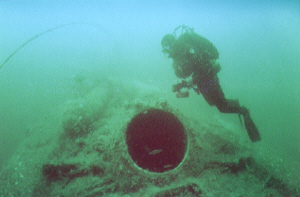
However, she sank on the way in 132-feet of water while under tow off Port Patience in the Patuxent River.

She is an active, though advanced, dive site today.

As for her sisters, though obsolete, several S-boats remained on the Navy List and served the Navy well in both the Atlantic and Pacific (including several lost to accidents) during WWII. A half-dozen were even transferred to the Royal Navy as Lend-Lease including class leader and the former submersible aircraft carrier, USS S-1.

None of these hardy, if somewhat unlucky, craft endure though Pigboats.com keeps their memory alive.

Specs:


Displacement: 876 tons surfaced; 1,092 tons submerged
Length: 231 feet
Beam: 21 feet 9 inches
Draft: 13 feet 4 inches
Propulsion: 2 × MAN diesels, 900 hp each; 2 × Westinghouse electric motors, 447 kW each; 120-cell Exide battery; two shafts.
Speed: 14.5 knots surfaced; 11 knots submerged
Bunkerage: 148 tons oil fuel
Range: 5,000 nautical miles at 10 knots surfaced
Test depth: 200 ft. (61 m)
Armament (as built): 4 × 21 in (533 mm) torpedo tubes (bow, 12 torpedoes)
1 × 4 inch (102 mm)/50 caliber Mark 9 “wet mount” deck gun
Crew: 42 officers and men

If you liked this column, please consider joining the International Naval Research Organization (INRO), Publishers of Warship International

They are possibly one of the best sources of naval study, images, and fellowship you can find. http://www.warship.org/membership.htm

The International Naval Research Organization is a non-profit corporation dedicated to the encouragement of the study of naval vessels and their histories, principally in the era of iron and steel warships (about 1860 to date). Its purpose is to provide information and a means of contact for those interested in warships.

With more than 50 years of scholarship, Warship International, the written tome of the INRO has published hundreds of articles, most of which are unique in their sweep and subject.

PRINT still has its place. If you LOVE warships you should belong.

I’m a member, so should you be!

Bad day for museum ships

A few of the last of their kind, which had been planned to be turned into floating museum ships, will now have another fate.

In Jacksonville, a group has been trying for years to obtain the USS Charles F. Adams (DDG-2) to install downtown as a museum.

(DDG-2) Underway at high speed while running trials, 31 August 1960. Official U.S. Navy Photograph, from the collections of the Naval History and Heritage Command. NH 106724

The first of her extensive class of 23 ships– to include spin-offs for the West German and Royal Australian Navies– Adams was ordered in 1957 and commissioned three years later. Leaving the fleet in 1990, she has been rusting away at the Philadelphia Naval Shipyard ever since.

Adams as she looked in 2008. Remember, this was a decade ago. Imagine what she looks like today! The Navy may have made the right call on this one (Via Wiki)

Now, the ship has moved from museum hold to the scrap list.

From Jax:

“Unfortunately, the United States Navy has reversed course and determined the ex USS Adams will not be donated to the Jacksonville Historic Naval Ship Association (“JHNSA”) as a museum in Jacksonville but instead will be scrapped. This decision is counter to the Navy’s recommendation in 2014 that the ex USS Adams be released to the JHNSA for donation. We wish to thank Congressman Rutherford, Senators Rubio, and Nelson, Governor Scott, and all the City officials for their efforts with the Secretary of the Navy to have the ex USS Adams brought to Jacksonville. Although disappointed by this development, the JHNSA will continue to pursue bringing a Navy warship to downtown Jacksonville.”

The group has been collecting items to display including a not-too-far-from-surplus SPA-25G radar panel and Adams’ bell, but they want a ship to put them on. Perhaps a recently retired FFG-7?

Meanwhile, on the West Coast, the final two members of the USCG’s WWII-era Balsam-class 180-foot buoy tenders have run out of time. USCGS Iris (WLB-395) and Planetree (WLB-307) were decommissioned after helping with the Exxon Valdez oil spill in 1995 and 1999, respectively, and have been sitting in the rusting quiet of the SBRF, Suisun Bay, CA mothballs fleet ever since.

While efforts have been off and on over the past couple decades to save one or both, they have been sold for scrap and are headed to Texas by the same long-distance sea tow.  As such, it will end more than 75 years of service tended by these vessels to Uncle.

Photo: Mike Brook, Tradewinds Towing, via USCGC Storis – Life and Death of a CG Queen

Finally, in a bright sign, the retired U.S. Coast Guard cutter Bramble (WLB-392) could be repeating her historic 1957 voyage through the Northwest Passage. Another of the “180s,” Bramble has been a museum ship in Port Huron for years but was recently sold to a man who wants to repeat the famous five-month trek of the U.S. Coast Guard Cutters Storis, SPAR and Bramble, along with the crew of the Canadian icebreaker HMCS Labrador from May to September of 1957.

Storis, fore, SPAR, and Bramble bringing up the rear. The NWP doesn’t look like this anymore.

Things are easier up there these days, and the crew of the U.S. Coast Guard Cutter Maple, a 225-foot Juniper-class seagoing buoy tender, did the trip in just 47 days last year with no icebreaking involved, so it’s not that hard to fathom.

Either way, you have to love Bramble‘s patch.

Indy (should) get a Gold Medal from Congress, 74 years after the fact

This photo was taken 27 July 1945, the day before she sailed from Guam to her doom, as documented by the ship’s photographer of USS Pandemus (ARL 18), on the back of the photo. This is probably the last photo taken of her. Caption on back of photo: “USS Indianapolis (CA 35) taken: 1530 27, July 1945, Apra Harbor, Guam, from USS Pandemus RL 18 as it passed heading for the sea. The picture was taken by Gus Buono”. U.S. Navy photo from the Collection of David Buell.

The loss of the Portland-class heavy cruiser USS Indianapolis (CA-35) in 1945 is often cited as the worst disaster in U.S. Naval history. Now, Congress had approved a special medal for the ship.

S. 2101: USS Indianapolis Congressional Gold Medal Act, had 70 co-sponsors in the Senate this session Passed by Congress last week, it goes to the President next.

The medal once struck next year, will be presented to the Indiana War Memorial Museum in Indianapolis, Indiana. Hopefully, surviving Indy vets and their survivors can also claim one of their own.

The findings of the bill:

(1) The Portland-class heavy cruiser USS Indianapolis received 10 battle stars between February 1942 and April 1945 while participating in major battles of World War II from the Aleutian Islands to Okinawa.

(2) The USS Indianapolis, commanded by Captain Charles Butler McVay III, carried 1,195 personnel when it set sail for the island of Tinian on July 16, 1945, to deliver components of the atomic bomb “Little Boy”. The USS Indianapolis set a speed record during the portion of the trip from California to Pearl Harbor and successfully delivered the cargo on July 26, 1945. The USS Indianapolis then traveled to Guam and received further orders to join Task Group 95.7 in the Leyte Gulf in the Philippines for training. During the length of the trip, the USS Indianapolis went unescorted.

(3) On July 30, 1945, minutes after midnight, the USS Indianapolis was hit by 2 torpedoes fired by the I–58, a Japanese submarine. The resulting explosions severed the bow of the ship, sinking the ship in about 12 minutes. Of 1,195 personnel, about 900 made it into the water. While a few life rafts were deployed, most men were stranded in the water with only a kapok life jacket.

(4) At 10:25 a.m. on August 2, 1945, 4 days after the sinking of the USS Indianapolis, Lieutenant Wilbur Gwinn was piloting a PV–1 Ventura bomber and accidentally noticed men in the water who were later determined to be survivors of the sinking of the USS Indianapolis. Lieutenant Gwinn alerted a PBY aircraft, under the command of Lieutenant Adrian Marks, about the disaster. Lieutenant Marks made a dangerous open-sea landing to begin rescuing the men before any surface vessels arrived. The USS Cecil J. Doyle was the first surface ship to arrive on the scene and took considerable risk in using a searchlight as a beacon, which gave hope to survivors in the water and encouraged them to make it through another night. The rescue mission continued well into August 3, 1945, and was well-coordinated and responsive once launched. The individuals who participated in the rescue mission conducted a thorough search, saved lives, and undertook the difficult job of identifying the remains of, and providing a proper burial for, those individuals who had died.

(5) Only 316 men survived the ordeal and the survivors had to deal with severe burns, exposure to the elements, extreme dehydration, and shark attacks.

(6) During World War II, the USS Indianapolis frequently served as the flagship for the commander of the Fifth Fleet, Admiral Raymond Spruance, survived a bomb released during a kamikaze attack (which badly damaged the ship and killed 9 members of the crew), earned a total of 10 battle stars, and accomplished a top secret mission that was critical to ending the war. The sacrifice, perseverance, and bravery of the crew of the USS Indianapolis should never be forgotten.

Indianapolis by Michel Guyot

Regardless of the medal. A lasting legacy of Indianapolis is at Great Lakes, and every budding bluejacket learns about her story first hand.

181218-N-BM202-1104 GREAT LAKES, Ill. (Dec. 18, 2018) Recruits receive training at the USS Indianapolis Combat Pool at Recruit Training Command. More than 30,000 recruits graduate annually from the Navy’s only boot camp. (U.S. Navy photo by Mass Communication Specialist 2nd Class Camilo Fernan/Released)

Warship Wednesday, Nov. 28, 2018: The spaghetti boats of Mar del Plata

Here at LSOZI, we are going to take off every Wednesday for a look at the old steam/diesel navies of the 1833-1946 time period and will profile a different ship each week. These ships have a life, a tale all their own, which sometimes takes them to the strangest places.- Christopher Eger

Warship Wednesday, Nov. 28, 2018: The spaghetti boats of Mar del Plata

Colorized by my friend, Diego Mar, of Postales Navales

Here we see the fine Italian-made Santa Fe (Cavallini)-class submarine ARA Santa Fe (S1) of the Argentine Navy sailing past Castello Aragonese in Taranto in 1933. The Argentinians often referred to this class as the “Tarantinos‘ due to their place of birth.

With the recent tragic loss of ARA San Juan, it should be remembered that the blue and white banner of the Armada de la República Argentina has been waving proudly over submarines for almost a century, with the fleet’s Comando de la Fuerza de Submarinos being established some 85 years ago and Santa Fe and her twin sister ships, known in Argentina as the “Tarantinos” due to their origin, started it all.

The Italians had started building submarines as far back as 1892 when the Delfino took to the water. Although they don’t get a lot of press, the Regina Marina put to sea with a formidable submarine force in both World Wars and the Spanish Civil War, which was used to good effect. In WWII, for instance, domestically made Italian subs working briefly in the Atlantic claimed 109 Allied ships, amounting to almost 600,000 tons. Further, Buenos Ares and Rome had a prior relationship stretching back to the 19th Century when it came to ordering naval vessels, so the two were natural partners when the Latin American country wanted in on submersibles.

Contracted with Cantieri navali Tosi on 15 October 1927, the Argentine government arranged for three submarines to be constructed at Taranto to a design of the Cavallini type derived from the Italian Navy’s Settembrini-class boats. At just over 1,100 tons when submerged and some 227 feet long, these were not big boats by any means, but they had a modern and efficient design.

Argentina submarines Sumergibles Salta, Santa Fe y Santiago del Estero. Año under construction in 1929. Astillero Franco Tosti. Tarento. Italia.

Equipped with Tosi diesels and electric motors, they could make 17.5 knots surfaced and about half that while submerged, which was pretty good for a 1920s-era submarine. Using a saddle-tank hull design with five compartments, they could make an impressive 7,100 nm at 8 knots surfaced, allowing them to deploy from Italy to their new homeland non-stop when completed and complete 30-day patrols. With a crush depth of 300~ feet, they mounted a 4-inch gun on deck and eight 21-inch torpedo tubes, making them capable of sinking a battleship with a single salvo. The Italians later developed the design into their Archimedes-class submarines.

ARA Santa Fe (S1) was the class leader followed by ARA Santiago del Estero (S2) and then ARA Salta (S3), all completed by early 1933, all named after Argentine provinces, a tradition in the Armada. After shakedown in the Med with Italian-trained crews and a short work-up cruise to the Canary Islands, they were on their way to Argentina.

Buenos Aires Argentine Italian subs Santa Fe, Santiago del Estero and Salta 7 April 1933

Inspected by national leaders including President Agustín Pedro Justo upon their arrival at their new homeland, they were given their naval ensigns in October 1933, scarcely six years after they were ordered.

Argentine submarine ARA Santa Fé (S-1) alongside battleship ARA Rivadavia and two Almirante Brown-class heavy cruisers, Puerto Belgrano Naval Base, 1937

The submarines were tended by the old (Italian-made) protected cruiser ARA General Belgrano until the latter was stricken in 1947, and then her place was taken by the coastal battleship ARA Independencia.

Argentine Santa Fe class submarines, Mar del Plata, circa 1947. Submarinos Tarantinos with coastal battleship ARA Independencia

Argentinian Cavallini class Submarines S-1 ‘Santa-Fe’, S-3 ‘Salta’, and S-2 ‘Santiago del Estero’ are seen here moored together at Mara del Plata with the Mothership Belgrano in the background.

Argentine Tarantino (Sumergible) Salta ,sala de Torpedos

Argentine Tarantino-Type Submarine Salta, in Mar del Plata

Operating from their base at Mar del Plata, the class would train and exercise regularly, and stand to (uneventful) service in WWII to protect Argentina’s neutrality and later (on paper) join the effort against Germany after the country declared war on 27 March 1945.

Argentine submarine SANTA FE (S-1) underway. She was the class leader of the Tarantinos 1933-1956

Famously, the last two German U-boats to surrender, U-530 and U-977, did so to Argentine military forces on 10 July and 17 August 1945 at Mar del Plata, respectively, and were briefly in the custody of the country’s submarine flotilla until transferred to the U.S. Navy.

U-977 lies in Mar del Plata, Argentina; rusty and weather-beaten after 108 days at sea – Photograph courtesy of Carlos J. Mey – Administrator of the Historia y Arqueologia Marítima website http://www.histarmar.com.ar/ via U-boat Archive

Post-war service continued with more of the same and the Santa Fe-class subs, growing long in the teeth and being hard to repair due to their 1920s Italian parts, often made by companies no longer in business after 1945, meant their timeline was limited. Santa Fe was stricken in Sept. 1956, followed by Santiago del Estero in April 1959.

Salta would outlast them all, making her 1,000th dive in 1960 before striking on 3 August. The last of the Tarantinos was sold for scrap the following April. Salta‘s flag, as well as several artifacts from her days in the Armada, are on display at the Museo de la Fuerza de Submarinos in Mar del Plata but that is not the end of her legacy.

On 1 April 1960, the US and Argentine Navy signed an agreement to transfer two Balao-class submarines, USS Macabi (SS-375) and USS Lamprey (SS-372) who went on to be renamed ARA Santa Fe (S-11) and ARA Santiago del Estero (S-12), respectively, and were manned in large part by veteran submariners who cut their teeth on the Italian-built boats. Serving until 1971, they were in turn replaced by two other GUPPY-modified Balaos, USS Chivo (SS-341) and USS Catfish (SS-339) who served as (wait for it) ARA Santiago del Estero (S-22) and ARA Santa Fe (S-21). The latter, a Warship Wednesday Alumni, had somewhat spectacularly bad luck in the Falklands, becoming the first submarine taken out of service by a helicopter-fired missile.

Speaking of the Falklands, in 1971, Argentina ordered a pair of new Type 209/1200 submarines from Germany, named ARA Salta (S-31) and ARA San Luis (S-32), the latter was more or less active in the Falklands but faced the double-edged sword of not being sunk although an entire British task force (including modern SSNs) were looking for her but, in turn, not being able to make a hit with her malfunctioning torpedoes.

ARA Salta S31, a Type 209 SSK now some 45 years young and still on active duty

Salta is still on active duty although San Luis has since been decommissioned. With the recent loss of San Juan, Salta, and one remaining TR-1700 type U-boat, ARA Santa Cruz (S-41), are the only operational Argentine subs.

Argentine submarine classes in a nutshell from 1933 to the current. Between the 11 boats, only six names were used.

For more information on the boat and her class, see the dedicated memorial group for them at Los Tarantinos Argentina 1933 -1960 (Historia de submarinos) and the articles on the class at ElSnorkel (Spanish) and Histarmar.

Specs:

USN Submarine Sighting Guide ONI 31-2A June 1958 with Salta compared when she was likely one of the last 1920s-ordered submarines on active duty anywhere

Displacement: 755 tons (1155 submerged)
Length: 227 (oa) ft.
Beam: 21.91 ft.
Draft: 16.56 ft.
Diving depth: 80m operational
Engines: 2 Tosi diesels, 3,000hp. One electric motor, 1,043kW
Speed: 17.5 knots on the surface, 9 submerged
Range: 7,100nm at 8 knots surfaced on 90 tons of fuel oil, 80nm at 4kts submerged
Crew: 40
Armament:
1x 4″/40 Odero-Terni deck gun
2x machine guns
8x 21-inch torpedo tubes (4 forward, 4 aft)
1x 40mm/60cal Bofors single added in 1944 for WWII service

If you liked this column, please consider joining the International Naval Research Organization (INRO), Publishers of Warship International

They are possibly one of the best sources of naval study, images, and fellowship you can find. http://www.warship.org/membership.htm

The International Naval Research Organization is a non-profit corporation dedicated to the encouragement of the study of naval vessels and their histories, principally in the era of iron and steel warships (about 1860 to date). Its purpose is to provide information and a means of contact for those interested in warships.

With more than 50 years of scholarship, Warship International, the written tome of the INRO has published hundreds of articles, most of which are unique in their sweep and subject.

PRINT still has its place. If you LOVE warships you should belong.

I’m a member, so should you be!

SBD of Morocco

Yes, a Navy dive bomber on a dirt road in North Africa. It happened.

Below we have a U.S. Navy SBD (Scout Bomber, Douglas) Dauntless dive bomber, likely of Carrier Air Group 4’s VS-41 “Tophatters,” using a road as a makeshift runway, near Safi, Morocco, in November 1942. The historic port, about 140 nautical miles south of Casablanca, had been captured just hours before by three WWI-era U.S. Navy destroyers carrying a raiding force of light infantry in the opening moves of Operation Torch, the invasion of French North Africa.

NHHC 208-N-6070

Note special insignia used during this operation, with a wide white circle around the regular star & circle emblem, predating the Invasion Stripes of D-Day.

Developed by the famous ‎Ed Heinemann (father of the A-20 Havoc, A-26 Invader, A-1 Skyraider, A-4 Skyhawk, et al), the SBD was perhaps the most iconic carrier-borne strike plane of the war, with four squadrons of them responsible for scratching all four Japanese flattops at Midway, disabling three of them in the span of just six minutes. They also proved their mettle at the Coral Sea and in the Guadalcanal campaign with many, as evidenced above, operated from shore.

The SBD was probably from USS Ranger (CV-4) who for the Torch Landings had 18 such aircraft in VS-41. Another 18 SBDs were carried, nine each, on *two escort carriers USS Sangamon (ACV-26) and USS Santee (ACV-29). SBDs from Ranger, besides proving their worth plastering land-based targets, had also socked the French battleship Jean Bart on 10 November 1942 in Casablanca harbor with a pair of 1,000-pound bombs, finishing what the battleship USS Massachusetts had started.

VS-41 lost three aviators in North Africa– ARM George E. Biggs, Ens Charles E. Duffy, and ARM Aubra T. Patterson– and had four others shot down and captured (briefly) by the French. Founded in 1919, VS-41’s lineage is today carried by VFA-14, flying F/A-18Es.

*Two other escort carriers took part in the Torch landings but did not carry SBDs: USS Suwanee (ACV-27) with 29 F4F Wildcats and nine TBFs, and USS Chenango (ACV-28) carrying a load of 76 Army P-40Fs on a one-way trip.

More on Torch’s naval actions here.

Warship Wednesday, Sept, 26, 2018: Sideroxylon lanuginosum, everlasting

Here at LSOZI, we are going to take off every Wednesday for a look at the old steam/diesel navies of the 1859-1946 time period and will profile a different ship each week. These ships have a life, a tale all of their own, which sometimes takes them to the strangest places.- Christopher Eger

Warship Wednesday, Sept. 26, 2018: Sideroxylon lanuginosum, everlasting

USCG photo by MILLER, LAIMAN B. LTJG.

Here we see the Mesquite-class buoy tender USCGC Ironwood (WAGL/WLB-297) in the summer of 1996 in Alaskan waters offloading equipment for maintenance on Eldred Rock Lighthouse. A product of WWII, she would over a half-century in U.S. maritime service and is, remarkably, still ticking in the Pacific Northwest.

In 1916 the Revenue Cutter Service and Lifesaving Service were merged to form the Coast Guard, to which the Bureau of Lighthouses was added on 1 July 1939 and as such all U.S. lighthouses, tenders, and lightships became USCG installations and ships. The thing is, the lighthouse and buoy tender fleet was a hodgepodge of antiquated single-use vessels to which the Bureau had been looking to replace with a new series of 177-foot lighthouse tenders modeled after the USLHT Juniper, the last vessel designed by the Bureau.

Taking these plans, the Coast Guard made some changes and produced a 180-foot/950-ton single-screw steel-hulled ship that incorporated some new features that the USLHS never needed (an ice-strengthened bow, search and rescue equipment and mission, allowance for armament, et.al). The first of these, USCGC Cactus (WAGL-270) was appropriated for $782,381 on 20 Jan 1941 and laid down at Marine Iron & Shipbuilding Corporation, Duluth, MN on 31 March.

Almost all of these hardy ships were built either at Marine or at Zenith Dredge Company very rapidly in three subclasses: the “A” or “Cactus” class, “B” or “Mesquite” class, and “C” or “Iris” class (with all named for trees and bushes). All ships of the three subclasses have the same general characteristics, but with slight differences, (e.g. the “A/Cactus” class tenders may be differentiated from the other two classes of 180-foot tenders by their unique “A” frame main boom support forward and their large 30,000 gal fuel tanks that allowed an economical 17,000nm cruising range on their gentle diesel suite.) The last to come off the ways was USCGC Woodbrush (WAGL-407) which commissioned 22 Sept. 1944. The building process entailed an average of 192,018 hours of labor per vessel.

USCGC Basswood through the Straits of Mackinac- 12 May 1944, a good example of the “180s.” Note the 3″/50 behind her wheelhouse facing over the stern as well as her 20mm mounts. ASW weapons, firefighting gear, and buoy tending equipment were also shoehorned into these ships as well. Further, as shown above, they could break light ice, a feature that was to serve the units headed to the Pacific well!

Unlike the other 38 of the class that was built by contractors, the hero of our story, USCGC Ironwood, was laid down at the Coast Guard Yard at Curtis Bay, Maryland and commissioned 275 days later on 4 August 1943 for a cost of $1,388,227 (note the difference from Cactus, above). She was the only vessel in active U.S. service named for the Sideroxylon lanuginosum, aka gum bully or ironwood, a small tree native to the Sun Belt and Midwest. According to the USCG’s office, in service, her crew nicknamed her “Ironbush” and “Ironweed” for her small size.

The Hughes Co., Photographers, Baltimore, Maryland 4 March 1943 Ironwood under construction at the U.S. Coast Guard shipyard in Curtis Bay, Maryland. Ironwood was the only 180 built by the U.S. Coast Guard. LOC HAER AK-44-1

Ironwood sailed for the War in the Pacific, arriving in Noumea, New Caledonia via Bora Bora and Pago Pago, in March 1944.

Ironwood in all of her WWII glory

She spent the next nine months in a busy but routine operation of keeping the 3rd Fleet’s vast anchorages up to snuff. This meant tending anti-torpedo nets and mooring buoys, establishing the new-fangled LORAN network, carrying cargo, mail, and servicemembers from island to island, and towing barges as needed– all while looking out for the possibility of Japanese mines, periscopes, and floatplanes on the horizon. She even came to the assistance of the stranded Liberty Ship SS John Lind.

Coast Guard Historian’s Office:

On 26 March1944 Ironwood left Noumea to assist SS John Lind grounded on a reef at 22 28 S, 166 36 E. Ironwood’s attempts to pull the vessel off being unsuccessful, she removed 65 Navy and Marine Corps personnel from the vessel on the 28th and transported them to Noumea on the next day. She remained until 2 April 1944 when she proceeded with Navy tugs USS Sioux and YT-463 to remove the reefed ship. In tandem with the tugs they successfully re-floated John Lind on 6 April.

In January 1945, she sailed for Guadalcanal’s Cape Esperance in the Solomons. There, she moved assisted in the recovery of a Japanese midget submarine. The 78-foot, 47-ton, two-man Type A Ko-hyoteki boat, was found in 30 feet of water and the cutter spent two weeks in the recovery operation as detailed by Combined Fleets:

4 January 1945:
US Coast Guard cutter IRONWOOD (W-297) begins operations to raise an unidentified Japanese two-man midget submarine from about 30 feet of water off Cape Esperance. Divers, working from a small boat, use a water pressure hose and crowbars to clear a space under the bow and stern of the submarine. By 9 Jan, a 1.5” chain sling is rigged around the bow of the midget submarine.

19 January 1945:
After retiring to Gavutu for ten days, IRONWOOD again anchors off Cape Esperance. By now, divers have completed rigging the submarine for lifting, connecting the chain around its bow and stern with a chain bridal.

20 January 1945 :
IRONWOOD is positioned alongside the sunken midget submarine. She lowers the main hoist over the starboard side and hooks it to the chain bridal. The cutter then raises the midget submarine to the surface and secures it alongside. IRONWOOD then tows it to Hutchinson’s Creek, Florida Island, Solomons. The next day, IRONWOOD moves to a new anchorage where the midget submarine is transferred to an unidentified USN crane barge.

Ironwood’s crew works to salvage a Japanese midget submarine found off Guadalcanal in 1945 LOC HAER AK-44-2

The identity of this 1945 salvaged midget submarine is unknown but is possibly HA-22 or HA-37. I can’t find out what happened to the craft but it was likely scrapped at some point. It is not one of the five Type A midgets preserved and on display currently (HA-8: Groton, Connecticut; HA-18: JMSDF Etajima Naval Base, Etajima, Japan; HA-19: Nimitz Museum, Fredericksburg, Texas; and HA-14/HA-21 at the Australian War Memorial, Canberra).

Ironwood went on to spend a solid year, from August 1945 to July 1946, in the Philippines reestablishing buoys and lighthouses and looking for pockets of Japanese holdouts.

Following her extended wartime service, she was stationed briefly in Monterey, California then returned to the South Pacific soon enough.

Between 19 November 1951 and 2 May 1954, Ironwood made four deployments to support Korean War operations, supplying and supporting radio stations in the region. As such, she was one of just 24 Coast Guard vessels that qualified for the Korean Service Medal.

Ironwood-1962. Note she still has her 3-inch gun aft. She would pick up her racing stripe a few years later.

In 1963, by that time stationed in Honolulu, she took some of the first scientists to return to the Marshall Islands after U.S. nuclear testing. As related by Capt. LeRoy Reinburg, Jr., U.S. Coast Guard-Retired, her skipper at the time, Ironwood spent almost two weeks inspecting radioactive and poorly charted Rongelap Atoll.

“In the course of our travels, we discovered nine uncharted islands and one large reef that bared at low tide. Dr. Held and I decided to assign names to these geographic features. The reef, appropriately, was named ‘Ironwood Reef,’” he noted.

During the mid-1960s, these boats were designated WLBs (buoy tenders) and saw all fixed armament landed in 1966, leaving them only their small arms lockers. If deployed for law enforcement missions or to war zones, 180s would be equipped with up to four Browning M2 .50-caliber heavy machine guns or a similar number of M60 7.62mm GPMGs. Lacking its naval piece, the 3-inch Gun Tub served as a lookout perch and occasional storage area for small items including crew bicycles when traveling between ports. Lockers for life jackets and exposure survival suits were later located on this deck, which is encircled by a tubular steel railing.

During the Vietnam conflict, four USCG 180s were dispatched to Southeast Asia to perform aids-to-navigation support and assist with harbor defense and maintenance– Basswood (WLB-388), Blackhaw (WLB-390) Planetree (WLB-307, and, of course, Ironwood, the latter of which deployed there in July 1967.

Vietnamese lighthouse service personnel were assigned to temporary duty on board as they worked to reactivate and automate Vietnamese lighthouses and establish new U.S.-sponsored lights. While deploying work crews, machine gun teams would have to stand by in case they came under fire from passing sampans or the shore as VC constantly shot out navigational lights and sank buoys. Her crew also provided services to the local populace such as MEDCAPS.

Sometime around this period she even clocked in on NASA support duties, helping with recovering boilerplate space capsules in the rush to the moon.

She conducted a number of rescues over the years:

*8 January 1959 Ironwood assisted thegrounded sampan Bellatrix at Molokai Beach, HI.

*6 January 1962 Ironwood rescued the crew of FV Hiroshima Maru aground at 21 17 N, 157 51 W.

*23-25 May 1963 the cutter escorted the disabled MV Dianna to Honolulu, HI.

*18 February 1969 Ironwood towed the disabled FV Widgeon from Augustine Island to Homer, AK.

*April 1969 escorted the distressed tanker Yukon, which was holed by a submerged object in Cook Inlet.

*29 April 1969 the crew fought a fire on the Shell Oil drilling platform in Cook Inlet.

*26 December 1969 she hoisted the disabled FV Arctic Fox on board at MacArthur Cove and carried her to Seward, AK

Ironwood was later given a one-year major renovation (MAJREN) in 1974, envisioned at the time to keep her in service for another 15 years. This involved removing her Cooper-Bessemer inline 8-cylinder engines and rebuilding them, new electrical wiring, piping, and sewage handling systems. She picked up a bow thruster, all-new crew spaces, new cranes, ship heaters, reefers, the works.

After her refit, she was put to work on the Alaska beat, stationed at Kodiak, in all spending the last 26 years of her Coast Guard career in Alaskan waters. During this time she escorted Soviet fishing trawlers out of U.S. waters, participated in Naval exercises, towed disabled fishing vessels to port, medevac’d injured mariners, searched for missing planes– you know, typical Coast Guard stuff.

1979

Between 1979 and 1995, she earned six Coast Guard “E” ribbons. In 1981, she received the Coast Guard Unit Commendation. In both 1989 and 1999, she picked up Coast Guard Meritorious Unit Commendations for her duty in the frozen and dangerous Bering Sea, in particular assisting with the cleanup operations in Prince William Sound after the grounding of the Exxon Valdez.

At the time of her decommissioning, Ironwood was the second-oldest cutter in USCG service (only surpassed at the time by the medium endurance cutter Storis) and was the only remaining US vessel in service awarded the Korean Service Medal. Then, of course, there was her WWII service, nuke sniffing, assistance to the Space program and her Vietnam tour. She served 14 Commandants of the Coast Guard, 34 commanding officers and more than 1,200 crew members in the course of her half-million miles traveled.

Kodiak, Alaska (Oct. 6 2000)– The Coast Guard Cutter Ironwood sits alongside the pier in Kodiak on the morning of the ships decommissioning. USCG photo by PA1 Keith Alholm.

But her story doesn’t end there. The old girl, after 57 years of active duty, she was to be transferred to Nigeria but instead, in 2002, was presented to the Tongue Point Seamanship Academy in Oregon which uses her as a floating classroom to train new mariners in an 18-month program to find seagoing careers.

In 2014, the center threw a 70th anniversary for Ironwood.

Turning 75 years young last month, she is still sailing strong and looking good while doing it, regularly showing up in Portland for Fleet Week.

170607-N-ZP059-167 PORTLAND Ore., (June 7, 2017) – ex-USCGC Ironwood (WLB-297) arrives in Portland for Rose Festival Fleet Week. The festival and Portland Fleet Week are a celebration of the sea services with Sailors, Marines, and Coast Guard Members from the U.S. and Canada making the city a port of call. (U.S. Navy photo by Mass Communication Specialist 2nd Class Jacob G. Sisco/Released)

As for her sisterships, many have proven to be very long in the tooth:

*Balsam (WLB-62) was decommissioned 1975 and has been used as an Alaskan crab boat ever since. She is currently the F/V Baranof.

*Cactus (WLB-270) was seized in Kings County Washington as a derelict vessel in 2013 for dismantling.

*Cowslip (WLB-277), Firebush (WLB-393) and Sassafras (WLB-401) were transferred to Nigerian Navy 2002-2003 as NNS Nwamba, NNS Olepu and Obula respectively. All remain in service. Sedge (WLB-402) was also transferred for parts.

*Woodbine (WLB-289) was donated to be a training ship in Cleveland in 1972 and went on to be a fish processing boat in Alaska before being sold for scrap in 2012.

*Gentian (WLB-290) was transferred to Colombia as ARC San Andrés (PO-45) and is still active.

*Laurel (WLB-291) was sold at a GSA auction in 1999, ultimate fate unknown.

*Clover (WLB-292) and Evergreen (WLB-295) were decommissioned 1990 and sunk by the Navy as a targets.

*Sorrel (WLB-296) was decommissioned in 1996 and is used as SS Reliance operated by Sea Scout Ship #13 of Stockton, California, showing up in an episode of Dexter.

*Conifer (WLB-301) and Papaw (WLB-308) were decommissioned 2000 and 1999 respectively and was used for a number of years as F/V Hope and F/V Mersea, part of the disaster relief fleet of Friend Ships, but have since been removed from that organization.

*Madrona (WLB-302) transferred to El Salvador who used her as General Manuel José Arce and subsequently sunk her as a reef.

*Tupelo (WAGL/WLB-303) was decommissioned in 1975 and has spent the past 30 years as a Bering Sea fishing boat, FV Courageous.

*Mesquite (WLB-305) ran aground December 4, 1989 on a reef off the Keweenaw Peninsula in Lake Superior while in Coast Guard service and was scuttled for underwater diving preserve.

*Buttonwood (WLB-306) was decommissioned 2001 and transferred to the Dominican Republic’s Navy as Almirante Didiez Burgos, still active. USCGC Citrus (WMEC-300), also endures there as Almirante Juan Alejandro Acosta (C-456/P301)

*Sweetgum (WLB-309) was transferred in 2002 to Panama as SMN Independencia (P401).

*Basswood (WLB-388), Blackhaw (WLB-390) and Mallow (WLB-396) were scrapped in 2000.

*Bittersweet (WLB-389) was decommissioned and transferred to Estonian Border Guard, 5 September 1997 who used her until 2014– she is retained as a museum ship.

*Blackthorn (WLB-391) sank in 1980 in a collision near the Tampa Bay Sunshine Skyway Bridge, resulting in 23 crewmember fatalities. Raised, she was resunk as a reef.

*Bramble (WLB-392) was decommissioned 2003, and has been retained with a mixed degree of success as a museum ship in the Great Lakes.

*Hornbeam (WLB-394) was decommissioned 1999, and lost near Panama as M/V Rum Cay Grace in 2013.

*Iris (WLB-395) and Planetree (WLB-307) were decommissioned after helping with the Exxon Valdez oil spill in 1995 and 1999, repectviely, and sit in rusting quiet in the SBRF, Suisun Bay, CA mothballs fleet.

*Mariposa (WLB-397) was decommissioned in 2000 but has been retained by the Navy as a hulk until 2009 and has been spotted in the Seattle area since then.

*Redbud (WLB-398) was transferred to the Philippines as Kalinga (AG-89) in 1972.

*Sagebrush (WLB-399) was scuttled off St. Catherine’s Island, Georgia on 28 April 1988.

*Salvia (WLB-400) was decommissioned 1991 and used as a salvage operations training vessel for U.S. Navy at Little Creek.

*Spar (WLB-403) was decommed 1997 and sunk as a reef in 2004.

*Sundew (WLB-404) was decommissioned 2004, used as a museum for a while, then sold to private interests in 2010.

*Acacia (WLB-406), the last 180 in Coast Guard service, was decommissioned 2006 after 63 years of service and is now a museum in Manistee, Michigan.

*Woodrush (WLB-407) and Sweetbrier (WLB-405) were transferred to Ghana in 2001 where she still serves as GNS Anzone (P30) and GNS Bonsu (P31) respectively, which means “shark” and “whale” in the native lingo.

For interior pics, the LOC has a great series of images from the Planetree, a Mesquite subclass sister.

Specs:

Displacement: 935 fl (1944); 1,026 fl (1966); 700 light (1966)
Length: 180-feet oa
Beam: 37 feet mb
Draft: 12 ft. max (1944); 14′ 7″ (1966)
Propulsion: 1 electric motor connected to 2 Westinghouse generators driven by 2 Cooper-Bessemer-type GND-8, 4-cycle diesels; single screw
Top speed: 13.0 kts sustained (1945); 11.9 kts sustained (1966). 28,000 gals diesel
Economic speed: 8.3 kts (1945); 8.5 kts (1966)
Complement:
6 Officers, 74 men (1944);
5 Officers, 2 warrants, 41 men (1966)
Electronics:
Radar: Bk (1943); SLa-1 (1945), SPS-64(V) 1979
Sonar: WEA-2 (1945-66)
Armament:
(1944)
1-3″/50 (single), 4-20mm/80 (single), 2 depth charge tracks, 2 Mousetraps, 4 Y-guns
(1966-2000)
Small arms

If you liked this column, please consider joining the International Naval Research Organization (INRO), Publishers of Warship International

They are possibly one of the best sources of naval study, images, and fellowship you can find. http://www.warship.org/membership.htm

The International Naval Research Organization is a non-profit corporation dedicated to the encouragement of the study of naval vessels and their histories, principally in the era of iron and steel warships (about 1860 to date). Its purpose is to provide information and a means of contact for those interested in warships.

With more than 50 years of scholarship, Warship International, the written tome of the INRO has published hundreds of articles, most of which are unique in their sweep and subject.

PRINT still has its place. If you LOVE warships you should belong.

I’m a member, so should you be!

Warship Wednesday, Sept 5, 2018: Der Piratenjäger

Here at LSOZI, we are going to take off every Wednesday for a look at the old steam/diesel navies of the 1859-1946 period and will profile a different ship each week. These ships have a life, a tale all their own, which sometimes takes them to the strangest places. – Christopher Eger

Warship Wednesday, Sept 5, 2018: Der Piratenjäger

Here we see Kaiserliche Marine’s proud, twin-funneled flusskanonenboot (river gunboat) SMS Otter on the Yangtze River in China sometime between 1910 and 1914. She was one of a kind and had an interesting backstory.

You see, long before the Germans showed up in Kiautschou Bay on 13 November 1897 and the next morning steamed into the inner harbor of Tsingtao to carve out a colony by force, the Imperial German Navy wanted a riverboat to smash roving bands of waterborne Chinese pirates and protect Teutonic interests in the region. While corvettes, sloops, and other traditional bluewater warships could muscle their way into China’s coastal cities and exercise gunboat diplomacy, you needed something much shallower to penetrate the sprawling Yangtze river system and ward off hostile junks filled with sword and musket-armed bandits.

Thus, in 1876, F. Schichau in Elbing was contracted to work up a warship like the Germans had never used before. Displacing just 130-tons (165 max) the 101-foot long gunboat could float in a gentle 5.4-feet of water. Carrying a 120mm rifle forward and an 80mm aft, she could plod along at 8-knots on her coal-fired steam plant (when not using her auxiliary sail rig) and accommodate some 43 officers and men. She was to be a littoral combat ship of the late 19th Century:

The design for the 1877 German pirate buster. She never did get her canvas

The name of this mighty river-going pirate buster? Well, the Germans were fond of animal names for gunboats and Otter just seemed to fit. Commissioned 1 April 1878, everything seemed set.

She even boasted dragons on her prow.

However, the nearly flat-bottomed Otter proved a horrible sea boat, nearly swamping on trials, and the prospect of her sailing from the Baltic to Nanking was thought to be just a drawn-out suicide. This relegated her to a career spent as an artillery tender, compass trials boat and pierside training ship that never left sheltered waters or put to sea on a cloudy day. Decommissioned in 1907, the Navy kept her around as a hulk and test ship until she was scrapped in 1926, never seeing China. Indeed, never even really leaving German coastal waters.

Sadly, this version of Otter never went to China, losing her name in 1907 to a second Otter that did.

Putting their desire for a river gunboat on ice, the Germans eventually acquired the 147-foot Shanghai-built river steamer Woochow locally and, after adding some Germans to her crew as well as a couple of four-pounders, dubbed her SMS Vorwärts (Forward) like her deployment, just in time for the Boxer Rebellion. The same was done with the smaller 120-foot coaster Tong Cheong, which became SMS Schamien. However, they did not prove very well suited to the task and purpose-built craft were urgently requested.

Therefore, two new flat-bottomed gunboats were purpose-built by Schichau on experience learned from Otter— the 157-foot SMS Vaterland and Tsingtau.

Frankes Collection vintage postcard Kaiserliche Marine German river gunboat SMS Tsingtau

Armed with an 88mm gun and a four-pounder, they were built in nine sections and shipped to the region in pieces, solving Otter‘s biggest drawback. Vaterland went via the HAPAG steamer Bisgravia in February 1904, then reassembled in Shanghai and put into service on 28 May 28, 1904. Tsingtau was carried by Prinzzess Marie to Hong Kong the previous September and was in service by Feb. 1904. Once they were operational, they replaced Vorwärts and Schamien, who were sold locally.

However, things were heating up in China. In 1905, no sooner than the two new gunboats entered service, riots broke out in Shanghai that required landing forces. International (read= European) efforts to penetrate and extend influence on the upper reaches of the Yangtze as well as the Min and Pearl river systems taxed the two boats and their crews.

Enter a new and improved Otter!

The boatyard of Joh. C. Tecklenborg, Geestemünde, laid down Germany’s purpose-built fourth (and largest) Chinese river gunboat from a development of the Vaterland/Tsingtau design. Some 177-feet overall (173 at the keel), she could float in just 3.2-feet of water. Equipped with Thornycroft-Schulz steam boilers vented through twin stacks, her two VTE steam engines allowed her to reach a blistering 15.2-knots (faster than Vaterland/Tsingtau‘s 13) despite her flat-hull, or poke around at 5-knots for an impressive 4,300 miles.

Her armament was a pair of fast-firing 5.2-cm SK L/55 Krupp guns— popguns still capable of poking smoking holes in random junks or blowing apart suspect buildings 2,000 yards from the river banks– and three big water-cooled Spandau machine guns.

The 2.05″ 5.2-cm SK L/55 gun was found on German torpedo boats and cruisers of the 1910s. Otter carried two as her main armament, with about 300 shells carried in her magazine.

To protect against small arms fire, she was given 5mm of steel armor plating on her sides and over her vitals.

Completed in 1909, Otter trailed on the Weser before she was disassembled and was shipped overseas in nine sections aboard the Leonhardt & Blumberg GmbH steamer Marie Leonhardt.

German river gunboat SMS Otter, built for China service, round about 1909 on the river Weser under national flag prior to commissioning.

Reassembled and ready for service by April 1910 after inspection by Vice Admiral Friedrich von Ingenohl himself, Otter was the pride of the East Asia Squadron’s riverine operations. Over the next few years she calmly did her job and ranged the rivers of China, the biggest German on the block once you moved inland, and the fastest thing on the brown water.

Otter in China service. Note she has her Reichskriegsflagge flying

Going back to the days of the Woochow, the commander of each German river gunboat was given an operating budget to buy supplies for their ship, as they were not attached to a base. These funds were typically in Mexican silver pesos as they were the easiest to move in China (keep in mind that the famous Tsingtao brewery was started with 400,000 Mexican silver pesos in 1903). The budget also allowed for the hiring of as many as a dozen local Chinese auxiliaries to serve as stokers, pilots, cooks, and stewards besides, of course, doubling as terps. The practice was common on European (and American) river gunboats of the era. It was a quiet life, interrupted by periods of terror. Think The Sand Pebbles but with more sauerkraut and better beer.

A local aboard Otter with the ship’s mascots. via Auktionshaus Christoph Gärtner GmbH & Co. K

Enter the July 1914 crisis that turned into the guns of August.

The German Navy in Asia was far-flung in the late summer of 1914. Under the command of the Vice-Admiral Graf Spee, his East Asia Squadron proper was homeported in Tsingtao. This included the armored cruisers Scharnhorst (his flag) and her sister, Gneisenau, as well as the light cruisers Emden, Leipzig, and Nurnberg; and the four Iltis-class gunboats Iltis, Jaguar, Tiger, and Luchs. Also in the principal German colony in China was the old cruiser Cormoran, which was laid up; a torpedo boat (S90), the tug/minelayer SMS Lauting, and a few steamers quickly converting to auxiliary cruisers.

Out in the German Pacific island colonies– which the Allies would rush to capture, setting the stage for the island-hopping campaigns of 1943– were the old cruiser Geier (Vulture) and the survey ship Planet. Poking around the Pacific coast of Latin America was the cruiser Dresden, complete with a moody junior officer by the name of Wilhelm Canaris.

At Canton on the Pearl River was the flusskanonenboot Tsingtau and on the Yangtze at Nanking with Otter was Tsingtau‘s sister, SMS Vaterland.

The whole of the Kaiser’s military ashore in Asia.

With the likelihood of being able to fight it out with the large Russo-Anglo-French fleets in the Far East when the balloon went up, the good Graf Spee got going. His East Asia Squadron sans the auxiliary cruiser Cormoran and light cruiser Emden beat feat for the Atlantic (which didn’t go well) leaving the aforementioned ships to embark on commerce raiding on their own.

The four Iltis-class gunboats were left at Tsingtao and scuttled before the Japanese could capture them, although their crew and guns were used to arm auxiliary cruisers that largely made it out before the siege. The hardy torpedo boat S90 scuttled after breaking out– as she sank the Japanese mine cruiser Takachiho (3,700-tons) — and had her crew interned by the Chinese in Nanking. By March 1915, the last of von Spee’s squadron, the weathered Dresden, scuttled off windswept and remote Robinson Crusoe Island of southern Chile.

Geier went to Hawaii and was interned. SMS Tsingtau was abandoned on 2 August at Canton with a skeleton crew who later sank her in the river. On 7 October, the crew of Planet scuttled the vessel off the island of Yap to avoid capture by the Japanese.

In Nanking, things went a little differently.

In an effort to have their cake (not be destroyed by the Allies) and eat it too (not lose their ships to the Chinese), the crews of the river gunboats Vaterland and Otter were converted to non-combatants and their ships sold to a private company (although they still apparently kept their armament from what I understand). Vaterland became Landesvater and Otter became München (Munich) on 18 August. The crews, leaving their Chinese auxiliaries behind along with a handful of volunteers to keep the boats afloat, let out for Tsingtao colony as best they could.

This subterfuge of the gunboats-that-weren’t lasted until China, stretching her newfound legs of post-Imperial nationalism, drifted into the Great War on the side of the Allies. In 1917, the German unrestricted U-boat campaign saw the freighter Athos I sunk off Malta with 754 Chinese workers aboard in February (some 200,000 laborers were recruited by French and British agents in the country to work behind the lines on the Western Front.) The next month, China broke off its diplomatic ties with Germany, and on 20 March promptly requisitioned (seized) the two “civilian” gunboats in Nanking although they ran into some trouble as much of the vital equipment on both were wrecked or tossed overboard. Vaterland/Lansesvater subsequently became the Chinese gunboat Li-Sui (also seen as Li Chien) while Otter/München became Li-Tsieh (also seen in Western sources as Li Chieh, Li Jie, Lee Ju, or Lee Jeh, as transliteration is bullshit).

Both ships, reworked and rearmed, went on to serve on the Chinese Sungari flotilla along the Amur river throughout the confusion of the Russian Civil War and Allied Intervention followed by the terrible warlord era in that part of the globe that persisted through the 1920s.

During the 1929 border clash known as the Sino-Russian War, Soviet aircraft from the seaplane-carrier Amur working in tandem with Tayfun-class river monitors of the Red Amur River Flotilla apparently sank Otter/München/Li-Tsieh during this period of undeclared confrontation. Otter‘s fate was sealed in a duel with the monitor Krasnyi Vostok (alternatively credited as killed by Sverdlov on Navypedia) on 12 October at what was termed invariably the Battle of Lahasusu (Sanjiangkou), although the old German ship in Chinese hands reportedly scored hits on two Soviet gunboats. Grounded, she later was scrapped in 1932 or 1942 (again, sources vary).

As for Vaterland/Lansevater/Li-Sui, she was rebuilt several times and, captured by the Japanese in 1932, became part of the puppet Manchukuo Navy until 1945 as the Risui.

A river gunboat from the Manchukuo Navy,on Japanese 1930s

The Soviets then captured her when they swept into Manchuria and she became the gunboat Pekin for a time under the Red banner– which would have been at least her 4th.

To wrap things up:

Many of the 1914 German river gunboat crewmen looking to leave managed to ship out of China on the auxiliary cruiser Cormorman, only to be interned in Guam for the duration. Others, falling in with one Kapitänleutnant Erwin von Möller, formerly the of the SMS Tsingtau, managed to make it to the Dutch East Indies where they fitted out the schooner Marboek and took her 82 days Westward to the Arabian coast, in hopes of making the Ottoman Empire. However, they were reportedly caught by Arabs and killed in the desert in March 1915.

Kapitänleutnant Erwin von Möllers party

Otter‘s prewar skipper, Korvettenkapitän Rudolph Firle, made it to the Ottoman Empire on his own by late 1914 and was put in command of the Turkish torpedo boat flotilla at Constantinople. He went on to win two Iron Crosses and two Ritterkreuz before the Armistice. His most noteworthy action came on a moonless night in 1915 when, at the conn of the Schichau-Werft-built Ottoman destroyer Muavenet-i Milliye (765-tons), he was instrumental in sinking the moored old Canopus-class pre-dreadnought HMS Goliath (14,000-tons) in Morto Bay off Cape Helles with three torpedoes. He later had escapades with the Bulgarians and in the Baltic. Leaving the Navy in 1921, he became a big wheel at Norddeutscher Lloyd and was later instrumental in the design of the 1930’s passenger liners Scharnhorst, Gneisenau, and Potsdam.

A fez and RK/EK-clad Firle, left, among his Ottoman Navy buddies, Yuzbasi Ali Riza (commander of torpedo boat Sultanhisar), and Binbashi Ahmed Saffed (commander of Muavenet-i Milliye) around 1916.

The Tsingtau – historischbiographisches Projekt (in German) has a list of Otter‘s final Kaiserliche Marine crew.

About the biggest reminder of Germany’s past colony in China that endures is the Tsingtao Brewery, which is now publicly traded and is China’s second largest such activity. Further, Oktoberfest is alive and well in the Qingdao region, as it is known today.

https://www.instagram.com/p/BX53yOJhJKA/?taken-by=tsingtao_usa

As far as I can tell, the German Navy never had another warship named Otter but did brush off “Piratenjäger” assignments, contributing ships to anti-piracy operations in the EU’s Operation Atalanta and NATO’s Operation Ocean Shield/CTF-151 in the Gulf of Aden, Guardafui Channel, Arabian Sea, and Indian Ocean over the past decade. In all, at least a dozen frigates and replenishment ships flying the black, red and gold Bundesdienstflagge have been mixing it up in regular deployments off the HofA since 2008.

If only they had dragons on their bows.

Specs:

Otter compared to her predecessors Tsingtau and Vaterland, via the 1914 Janes

Displacement: 280 tons
Length: 177-feet overall
Beam: 28.3-feet
Draft: 3.2-feet
Engineering: 2 Thornycroft-Schulz steam boilers, 2VTE 3cylinder steam engines, 1730hp, twin stacks, twin 1.4m screws
Speed: 15.2 knots designed (listed as 14 in Janes, 13 by Navypedia)
Range: 4350@5kn on 87 tons of coal
Complement: 3 officers, 44 men, + auxiliaries
Armor: 5mm steel sides
Armament:
(As built)
2 x 5.2-cm SK L/55 Krupp rapid-fire four-pdrs with 300 shell magazine
3 x MG08 machine guns
(the 1920s, Chinese service)=?

If you liked this column, please consider joining the International Naval Research Organization (INRO), Publishers of Warship International

They are possibly one of the best sources of naval study, images, and fellowship you can find. http://www.warship.org/membership.htm

The International Naval Research Organization is a non-profit corporation dedicated to the encouragement of the study of naval vessels and their histories, principally in the era of iron and steel warships (about 1860 to date). Its purpose is to provide information and a means of contact for those interested in warships.

With more than 50 years of scholarship, Warship International, the written tome of the INRO has published hundreds of articles, most of which are unique in their sweep and subject.

PRINT still has its place. If you LOVE warships you should belong.

I’m a member, so should you be!

Warship Wednesday, March 21, 2018: After 75 years, take a breather

Here at LSOZI, we are going to take off every Wednesday for a look at the old steam/diesel navies of the 1859-1946 time period and will profile a different ship each week. These ships have a life, a tale all of their own, which sometimes takes them to the strangest places. – Christopher Eger

0616902
Here we see the Cannon-class destroyer escort USS Atherton (DE 169) in a shot taken from a US Navy Blimp as the two team up to sink U-boats in the Atlantic in 1945.

The class, ordered in 1942 to help stem the tide of the terrible U-boat menace in the Atlantic, was also known as the DET type from their Diesel Electric Tandem drive. The DET’s substitution for a turbo-electric propulsion plant was the primary difference with the predecessor Buckley (“TE”) class. The DET was in turn replaced with a direct drive diesel plant to yield the design of the successor Edsall (“FMR”) class In all, although 116 Cannon-class destroyer escorts were planned, *only* 72 were completed. Some of her more famous sisters included the USS Eldridge, the ship claimed to be a part of the infamous Philadelphia Experiment.

Named for contemporary naval hero Lt (JG) John McDougal Atherton, lost on the destroyer USS Meredith (DD-434) when she was jumped by planes from Zuikaku, our hearty destroyer escort was built at Federal Shipbuilding and Drydock Company, Newark, New Jersey, and commissioned at the height of the battle of the Atlantic on 29 August 1943. This hearty little 1600-ton boat, just a hair over 300-feet long was packed with guns, torpedoes, Hedgehog ASW mortars, depth charge racks, and projectors.

By January 1944, she was prowling the Atlantic as part of TF60, escorting convoys from Norfolk and New York City to various ports in the Mediterranean. As noted by DANFs, these ports included Casablanca, Morocco; Bizerte, Tunisia; and Oran, Algeria.

On 6 May 1945, she counted coup on the German submarine U-853 (Oblt. Helmut Frömsdorf and 54 hands) and was given credit for her sinking. She sent her to the bottom 7 miles east of Block Island, Rhode Island, resulting in the loss of her entire crew.

“After four depth charge attacks, pieces of broken wood, cork, mattresses, and an oil slick broke the surface. Atherton, in conjunction with Moberly (PF-63), was later credited with destroying the German submarine U-853,” said DANFS.

USS Moberly conducts a Hedgehog attack on U-853, USS Atherton in distance. HH-NH48872

U-853M-26G2451

The encounter was the day before Generalfeldmarschall Wilhelm Keitel signed the Allied surrender terms, in Berlin, but U-853, a Type IXC/40 submarine, showed no signs of surrendering– she sank the SS Black Point, a small collier out of Boston, just the day before Atherton found her.

According to NHHC, U-853 was one of the final half-dozen German subs sent to the bottom in combat, with three others (U-1008, U-2534, and U-881) being scratched the same day and U-320 meeting Davy Jones on 7 May.

Today the U853 is a popular dive, lying in just 120 feet of water 11 miles off the US East Coast. You can thank the USS Atherton for putting her there.

Today the U853 is a popular dive, lying in just 120 feet of water 11 miles off the US East Coast. You can thank the USS Atherton for putting her there.

The action contributed to Atherton winning her sole battlestar for Atlantic Action in WWII.

Post-VE-Day, she immediately sailed for the Pacific and conducted anti-sub patrols there for a few more months before the Japanese surrendered. The plucky destroyer escort was decommissioned 10 December 1945 and placed in reserve status for 10 years before she got on with her life.

On 14 June 1955, Atherton was transferred to the Japan Maritime Self-Defense Force (JMSDF), becoming one of the first ships of the new Japanese Navy, operating as the destroyer escort JDS Hatsuhi (DE-263, later FF-6) though this is sometimes spelled “Atsuhi” is western sources.

She put in a solid 20 years with the Japanese.

Japanese frigate Atsuhi, commissioned as USS ATHERTON (DE-169). Turned over to JMSDF, 14 June 1955. Paid off June 1975. Transferred to the Philippines, 13 September 1976. NH 46122

DE 263 JDS Hatsuhi – Japan Maritime Self defense Force (1955-75)

NH 46123, Japanese frigate Atsuhi, FF-6

The Japanese returned the then 30-plus-year-old Atherton and her sister-ship, the former USS Amick (DE-168), to the US Navy in 1977. Then, the vintage tin cans began a third career as a Barko ng Republika ng Pilipinas (BRP) naval vessel.

Following a refit in South Korea paid for in part by Washington, the two joined the Philippine Navy 27 February 1980. At the time the island nation was already operating another Cannon-class warship– the former USS Booth (DE-170). The deal also saw Manila buy the condemened sister ships former USS Muir (DE-770) and USS Sutton (DE-771) from the Koreans for a token fee. These two ships were so old and worn out that they were acquired simply with the intention to be cannibalized for spare parts to keep the Atherton, Boothe, and Amick running.

Well, in 1981, Booth (as BRP Datu Kalantiaw PS-76) was sunk during a typhoon, leaving just two DEs in the PI.

The former USS Boothe hard aground after a typhoon in 1981. This left the PI Navy with but two destroyer escorts...

The former USS Boothe hard aground after a typhoon in 1981. This left the PI Navy with but two destroyer escorts…Atherton and Amick

Then Amick, thoroughly worn-out (as BRP Datu Sikatuna PF-5) was scrapped in 1989.

This left Atherton (as BRP Rajah Humabon PF-11), as the only real blue-water warship left in the Philippine Navy. Other than a three-year local refit/lay-up from 1993-1996, this humble 300-foot ship held the line for over two decades.

SOUTH CHINA SEA (April 21, 2009) - Philippine Navy ship BRP Rajah Humabon (PF 11) steams ahead during an exercise with the forward-deployed amphibious assault ship USS Essex (LHD 2) and the amphibious dock landing ship USS Tortuga (LSD 46), as part of exercise Balikatan 2009 (BK09). Essex has been invited by the Republic of the Philippines to participate in BK09, which is an annual combined, joint-bilateral exercise involving U.S. and Armed Forces of the Philippines personnel, as well as subject matter experts from Philippine civil defense agencies. BK09 is the 25th in the series of these exercises, directed by the Joint Chiefs of Staff and requested by the government of the Republic of the Philippines. Essex is commanded by Capt. Brent Canady and is the lead ship of the only forward-deployed U.S. Amphibious Ready Group and serves as the flagship for CTF 76, the Navy's only forward-deployed amphibious force commander. Task Force 76 is headquartered at White Beach Naval Facility, Okinawa, Japan, with a detachment in Sasebo, Japan. (U.S. Navy photo by Mass Communication Specialist 2nd Class Greg Johnson/Released)........Other than the dazzle paint and some commercial navigational radar, she is the same as pictured above in 1945.

SOUTH CHINA SEA (April 21, 2009) – Philippine Navy ship BRP Rajah Humabon (PF 11) steams ahead during an exercise with the forward-deployed amphibious assault ship USS Essex (LHD 2) and the amphibious dock landing ship USS Tortuga (LSD 46), as part of exercise Balikatan 2009 (BK09). (U.S. Navy photo by Mass Communication Specialist 2nd Class Greg Johnson/Released)……..Other than the dazzle paint and some commercial navigational radar, she is the same as pictured above in 1945.

In 2011, the 44-year old USCGC Hamilton (WHEC-715), was transferred to the Philipines by the US State Department and renamed BRP Gregorio del Pilar (PF-15), giving the Atherton her first back up in over 20 years. Another “378” the USCGC Dallas (WHEC-716), was transferred in 2013 as the BRP Ramon Alcaraz (PF-16). A third, ex-USCGC Boutwell (WHEC-719), followed as BRP Andres Bonifacio (FF 17) in 2016.

Today the larger, younger and better equipped Hamilton/Pilar, Dallas/Alcaraz and Boutwell/Bonifacio undertake most blue water missions while the old USS Atherton/JDS Hatsuhi/BRP Rajah Humabon, at a spry 70-years of age, was still considered in active, albeit limited commission, armed, and ready to respond if needed– up until last week.

BRP Rajah Humabon (PS-78)

As such, she was only one of just three ships to still carry working 3-inch Mk22 guns (the other two being a Brazilian river monitor and a Thai sister ship) as well as the last warship in the world to carry the old Oerlikon 20mm in active service. Besides the museum ship USS Slater (DE-766), now sitting dockside in Albany New York, and the pierside training ship USS Hemminger (DE-746) (now HTMS Pin Klao DE-1) in Thailand, Atherton is the last destroyer escort afloat in the world, and the only one since 1992 still in regular naval service.

However, all good things must eventually come to an end, and as noted by the Philippine Navy on 15 March 2018:

“After 38 years of service, the Philippine Navy (PN) has formally retired its oldest warship, the BRP Rajah Humabon (PS-11), one of the last World War II-era warships still in active service, during short ceremonies in Sangley Point, Cavite Thursday morning,” said Philippine Fleet spokesperson Lt. Sahirul Taib in a message Thursday.

The retirement of BRP Rajah Humabon is in-line with the Navy’s Strategic Sail Plan of “moving to legacy vessels to more and capable and modern vessels,” he added.

She will be preserved, turned into one of the exhibits at the Philippine Navy (PN) Museum in Sangley Point, Cavite City. Taib said in a subsequent interview that turning the ship into an exhibit would happen shortly after it is stripped of its navigational equipment and other usable items.

Here in the states, Atherton is remembered by a veterans’ group and has a memorial on display aboard the USS Slater (DE-766) Museum. While a number of scale models are availble to celebrate the class, some of which specifically include Atherton in her Japanese scheme.

Not bad for a ship, class, and type that was considered disposable.

Specs:

Cannon class DE’s via USS Slater.com

Displacement: 1,240 tons standard
1,620 tons full load
Length: 93.3 metres (306.1 ft)
Beam: 11 metres (36.1 ft)
Draft: 3.5 metres (11.5 ft) full load
Propulsion: 4 GM Mod. 16-278A diesel engines with electric drive
4.5 MW (6000 shp), 2 screws
Speed: 21 knots
Range: 10,800 nmi at 12 knots (22 km/h)
Complement: 15 officers 201 enlisted men
Armament: • 3 × single Mk.22 3″/50 caliber guns
• 3 × twin 40 mm Mk.1 AA gun
• 8 × 20 mm Mk.4 AA guns
• 3 × 21 in (533 mm) torpedo tubes
• 1 × Hedgehog Mk.10 anti-submarine mortar (144 rounds)
• 8 × Mk.6 depth charge projectors
• 2 × Mk.9 depth charge tracks

If you liked this column, please consider joining the International Naval Research Organization (INRO), Publishers of Warship International

They are possibly one of the best sources of naval study, images, and fellowship you can find. http://www.warship.org/membership.htm

The International Naval Research Organization is a non-profit corporation dedicated to the encouragement of the study of naval vessels and their histories, principally in the era of iron and steel warships (about 1860 to date). Its purpose is to provide information and a means of contact for those interested in warships.

With more than 50 years of scholarship, Warship International, the written tome of the INRO has published hundreds of articles, most of which are unique in their sweep and subject.

PRINT still has it place. If you LOVE warships you should belong.

I’m a member, so should you be!

« Older Entries Recent Entries »