Tag Archives: warship wednesday

Warship Wednesday, April 11, 2018: Ms. Lane, of Paraguay, Nashville and Galveston fame

Here at LSOZI, we are going to take off every Wednesday for a look at the old steam/diesel navies of the 1859-1946 time period and will profile a different ship each week. These ships have a life, a tale all their own, which sometimes takes them to the strangest places. – Christopher Eger

Warship Wednesday, April 11, 2018: Ms. Lane, of Paraguay, Nashville and Galveston fame

LC-USZ62-48021: United States Revenue Cutter Harriet Lane. Wood engraving, 1858. Courtesy of the Library of Congress

Here we see the classic steam warship, USRC Harriet Lane of the Revenue Marine Service, and 157 years ago this very day she fired the first shot (at sea) in the Civil War, securing her place in history.

A copper plated side-paddle steamer with an auxiliary schooner rig, Lane was built for the US Treasury Department, by William H. Webb at Bell’s shipyard in New York City in 1857 at a cost of $140,000. She was named in honor of Ms. Harriet Rebecca Lane Johnston, the popular niece of lifelong bachelor President James Buchanan, who served as his first lady since he was unmarried at the time.

Her armament, a pair of old 32-pounders and a quartet of 24-pdr brass howitzers, was deemed sufficient for her work in stopping smugglers and destroying derelicts at sea, but she was constructed with three magazines and open deck space for additional guns should they be needed.

USCG Historian’s Office

And soon, she was loaned to the Navy.

Before Lane was even laid down, the gunboat USS Water Witch, who was busy surveying the Río de la Plata basin in South America in 1855, was fired upon as by a Paraguayan battery at Fort Itapirú. Intended as a warning shot (Water Witch had approval from the Argentines but not Paraguay to survey the river), the ball accidentally hit the gunboat and killed the very unfortunate helmsman Samuel Chaney. A resulting fire-fight saw Water Witch hulled 10 times. Fast forward to October 1858 and a punitive expedition was ordered sent to Paraguay to sort things out, even though Water Witch had returned home in 1856.

This expeditionary force, the largest ever assembled by the U.S. Navy until the Civil War, consisted of 19 ships, which seems like a lot but really isn’t when you look at the list of vessels that went. While the Navy had a half-dozen large ships-of-the-line on the Naval List, all were in ordinary at the time. Of the impressive dozen super-sized frigates, just one, the 50-gun USS St. Lawrence, already in Brazil, could be spared. This left the rest of the fleet to be comprised of smaller sloops and brigs, ships taken up from trade and armed with cannon or two, and the brand new and very modern Harriet Lane. The commander of the task force? Flag Officer (there were no admirals at the time) William B. Shubrick, a War of 1812 veteran who was taken from his warm quiet desk at the Lighthouse Bureau in Washington and given his last seagoing command.

Ships of The Paraguay Squadron underway. Ships are from left to right: USS Water Witch next the flag-ship; USS Sabine; next to USS Fulton; behind Fulton is USS Western Port (later USS Wyandotte); next is USS Harriet Lane; behind Harriet Lane is USS Supply; and next to the bow of USS Memphis. Artist unknown. Image from Harper’s Weekly, New York, 16 October 1858. Description from Navsource.

The force was filled with supplies and Marines (Lane herself shipped a 22-man force of Leathernecks) and set off for Latin America with special commissioner James B. Bowlin in tow. Lane at the time was skippered by Captain John Faunce, a skilled USRM officer since 1841, who would later command her at Fort Sumter– but we are ahead of ourselves.

Arriving in January 1859, Paraguay signed a commercial treaty with Brown, apologized for the hit on Water Witch with no more shots fired by either side and agreed to pay an indemnity to the family of the long-dead helmsman and the fleet returned home in February after some literal gunboat diplomacy.

By late 1860, she was back in New York and tapped for another high-profile job. On October 11, the cutter brought 18-year-old Edward, then-Prince of Wales and future King Edward VII of Great Britain and his suite from South Amboy to the waterfront of New York’s Battery Park where he was met by adoring crowds including Gen. Winfield Scott and Mayor Wood and an escort of “two troops of cavalry attached to the Seventh and Eight regiments” of the New York Militia whisked him away from Castle Garden to City Hall and all points Broadway. In her task, she flew the Royal Ensign and received 17-gun salutes up and down the New Jersey coast and Hudson River, surely a first for a Revenue Cutter.

Though Lane resumed her Revenue duties, she was soon again in Naval service.

With states dropping out of the Union left and right from December 1860 onward, she transferred to the Navy 30 March 1861 and was assigned to the Northern Blockading Squadron. Detailed to help supply the Fort Sumter garrison, a small U.S. Army post in rebel-held Charleston Harbor under the guns of coastal defense expert and former U.S. Army Maj (bvt) P. G. T. Beauregard, Lane left New York on 8 April headed to the Palmetto State, arriving three days later. The reason an armed ship was sent was that President Buchannan had detailed the unarmed merchant ship Star of the West to do so earlier in the year, an effort that failed when it was fired upon by Beauregard’s shore batteries made up partially of students from the Citadel.

On the morning of 11 April 1861, Harriet Lane arrived ahead of her task force that was following with supplies and 500 soldiers. Taking up a picket location around the island fort, on the morning of April 13, while the installation was under attack, Faunce order a shot from one of her 32-pounders, commanded by Lt. W. D. Thompson, across the bow of the oncoming steamship SS Nashville (1,241t, 215ft) as that vessel tried to enter Charleston Harbor. The reason for the round was because Nashville was flying no identifying flag, meaning she could possibly be a rebel ship.

The Revenue Cutter Harriet Lane forces the merchant steamer Nashville to show its colors during the attack on Fort Sumter, April 13, 1861. “The Cutter Harriet Lane Fires Across the Bow of Nashville” by Coast Guard artist Howard Koslow.

Unarmed and not looking to be sent to the bottom, Nashville raised the U.S. standard, and Harriet Lane broke off. Anticlimactic for sure, but the ole Nash went on to become a Confederate commerce raider armed with a pair of 12-pounders before serving in 1862 as the blockade runner Thomas L. Wragg and finally as the privateer Rattlesnake before she was destroyed by the monitor USS Montauk on the Ogeechee River in Georgia.

But back to our hero.

Fort Sumter fell on April 13, surrendered after a bloodless two-day bombardment that saw 2,000 Confederate shells hit the masonry fort and Lane withdrew. She soon was up-armed and before the end of the year engaged in the efforts against Fort Clark and Fort Hatteras on the outer banks of North Carolina.

80-G-1049444: USS Harriet Lane engaging a battery at Pig’s Point, on the Nansemond River, opposite Newport News. Copied from Frank Leslie’s Illustrated Newspaper, 1861.

Then in early 1862 joined David Dixon Porter’s Mortar Flotilla at Key West as flagship, from where she captured the Confederate schooner, Joanna Ward.

With Porter aboard, Lane was there as his flagship when he plastered the rebel Forts Jackson and St. Philip, abreast the Mississippi below New Orleans, then continued to serve through the preliminary stages of the Vicksburg Campaigns.

LC-DIG-PPMSCA-35362: Rear Admiral David G. Farragut and Captain David D. Porter’s mortar fleet entering the Mississippi River, May 17, 1862. Wood engraving shows large squadron of battleships and ironclads entering the Mississippi River near the “Light-house of Southwest Pass”; some are identified as the “Colorado, 40 Guns”, “Pensacola on the Bar”, “Westfield”, “Mississippi on the Bar”, “Porter’s Mortar Fleet”, “Harriet Lane”, “Connecticut, 8 Guns”, “Clifton”, and “Banona“. Harper’s Weekly, V.6, no.281, pg 312-13. Courtesy of the Library of Congress. 2048×1443 big up

On 4 October 1862, in conjunction with the sidewheel steam ferryboat USS Westfield, Unadilla-class gunboat USS Owasco, the paddlewheel gunboat USS Clifton, and the schooner USS Henry Janes, Lane captured Galveston harbor from the Confederates in a show of force that left zero casualties on both sides.

Still in that newly-Union held port in Confederate Texas, Harriet Lane was the subject of an attack on 1 January 1863 that saw the Confederate cotton-clad CSS Bayou City and the armed tugboat Neptune engage the bigger cutter. While Lane sank the Neptune and damaged Bayou City, she was captured when the crew of the cottonclad succeeded in storming and overpowering the crew of the Lane with both the cutter’s captain and the executive officer killed along with three of her crew in fierce hand-to-hand combat.

An illustration of the Harriet Lane’s capture by Confederate forces on 1 January 1863

Her crew was taken into custody.

Lane, repaired and disarmed, was sold by the state of Texas to an enterprising shipper who christened her as the blockade runner Lavinia and, after just two trips carrying cotton abroad and commodities back, she finished the war in Cuban waters.

In 1867, the Revenue Marine sent her old Sumter commander, Faunce, and a crew to recover the battered, worn-out ship from Havana in condemned condition and she was subsequently sold to a Boston merchant.

As noted by DANFS, she was abandoned after a fire during hurricane-force winds off Pernambuco, Brazil, 13 May 1884, while en route to Buenos Aires.

Relics of her time in Texas are in the collection of The Museum of Southern History, located in Houston.

The Revenue Marine, of course, became the U.S. Coast Guard in 1916 and the service honored the historic vessel by naming a second cutter, USCGC Harriet Lane (WSC-141), a 125-foot patrol craft, in 1926 which gave 20 years of hard service to include WWII and Prohibition.

The third cutter to share the name is the 270-foot Bear (Famous)-class medium endurance cutter USCGC Harriet Lane (WMEC-903). Commissioned in May 1984, she is still in active service and last week commemorated the first Lane’s historic shot in front of Fort Sumter in Charleston Harbor.

That 75mm OTO! The crew of the Coast Guard Cutter Harriet Lane sails past Fort Sumter near Charleston, South Carolina, April 5, 2018. USCG Photo

She is no lightweight either, recently returned to homeport from a 94-day patrol in drug trafficking zones of the Eastern Pacific, after seizing approximately 17,203 pounds of cocaine from suspected smugglers.

The crew of the Coast Guard Cutter Harriet Lane approaches a suspected smuggling vessel while a helicopter crew from the Coast Guard Helicopter Interdiction Tactical Squadron monitors from the air, February 25, 2018.

Specs:

USCG Historian’s Office

Displacement 539 lt. 619 std, 730 t. fl
Length 175′ 5″
Beam 30′ 5″
Draft 10′ as designed, 13 at full load 1862
Propulsion: steam – double-right angled marine engine with two side paddles, auxiliary sail two-masted schooner rig
Speed 11 anticipated, 13kts on trials
Complement: 8 officers, 74 men (1857) 12 officers, 95 men (1862)
Armament
(As built)
3×32-pounders
4x 24-pounder brass howitzers
(After joining West Gulf Squadron, 1862)
1×4″ Parrott gun as a pivot on forecastle
1×9″ Dahlgren gun on pivot before the first mast
2×8″ Dahlgren Columbiad guns
2×24-pounder brass howitzers
Plus “cutlasses and small arms for 95 men”

If you liked this column, please consider joining the International Naval Research Organization (INRO), Publishers of Warship International

They are possibly one of the best sources of naval study, images, and fellowship you can find. http://www.warship.org/membership.htm

The International Naval Research Organization is a non-profit corporation dedicated to the encouragement of the study of naval vessels and their histories, principally in the era of iron and steel warships (about 1860 to date). Its purpose is to provide information and a means of contact for those interested in warships.

With more than 50 years of scholarship, Warship International, the written tome of the INRO has published hundreds of articles, most of which are unique in their sweep and subject.

PRINT still has its place. If you LOVE warships you should belong.

I’m a member, so should you be!

Warship Wednesday, April 4, 2018: The often imitated but never duplicated Indy

Here at LSOZI, we are going to take off every Wednesday for a look at the old steam/diesel navies of the 1859-1946 time period and will profile a different ship each week. These ships have a life, a tale all their own, which sometimes takes them to the strangest places. – Christopher Eger

Warship Wednesday, April 4, 2018: The often imitated but never duplicated Indy

Image Courtesy Wilson’s Creek National Battlefield; WICR 30184-B

Here we see the “Western gunboat ram” USS Indianola in 1863 during her brief service to the Navy. A one of a kind vessel, the Indy was laid down as a riverboat in Antebellum times but was rushed into service in the Civil War, rode hard, and never made it out alive.

A 174-foot long side-wheel screw steamer, Indianola was constructed in the Cincinnati yard of Mr. Joseph Brown in early 1862, specifically for service with the U.S. Navy on the Western river systems for operations against the newly-formed Confederacy.

Indianola under construction via LOC https://www.loc.gov/item/2013647478/

Compared to the 15-vessel City class-ironclads designed by Mr. Samuel M. Pook, the infamous “Pook’s Turtles,” Indianola was about the same size and had iron-plating 2.5 inches thick, enough to ward off musketry and shrapnel but not serious artillery rounds.

Pushed out into the Ohio River on 4 September, the partially complete 511-ton armored gunboat was placed in commission just 19 days later under the command of Acting Master Edward Shaw. The reason for the rush job was that Cincinnati at the time was considered under threat of capture by Confederate Gen. Kirby “Seminole” Smith whose “Heartland Offensive” reached its high-water mark in Lexington, Kentucky, just some 80 miles to the South a few days prior.

Armed with a pair of 11-inch Dahlgren smoothbores and another pair of smaller 9-inch guns, Indianola remained in the Ohio for several months even after Smith retreated to the Deep South and by January 1863, under the command of LCDR George Brown, she was detailed to the infant Mississippi Squadron, a force that the Navy never knew it would have. By 13 February, the plucky new ironclad met the enemy for the first time by running past the fearsome Confederate batteries at Vicksburg, Mississippi at night.

As noted by DANFS:

She left her anchorage in the Yazoo at 10:15 p.m. 13 February and moved slowly downstream until the first gun was fired at her from the Vicksburg cliffs slightly more than an hour later. She then raced ahead at full speed until out of range of the Confederate cannon which thundered at her from above.

The United States gunboat INDIANOLA (Ironclad) running the blockade at Vicksburg [Feb. 13, 1863] via Harper’s Weekly, v. 7, (1863 March 7), p. 149. LOC https://www.loc.gov/item/99614196/

She anchored for the night 4 miles below Warrenton, Miss., and early the next morning got underway downriver, with orders from Adm. David Dixon Porter to blockade the mouth of the Red River.

Two days later, Indianola chased and engaged in a long-range artillery duel with the Confederate Army-manned “cotton-clad” 655-ton side-wheel converted tug, Webb, that proved ultimately unsuccessful, her high speed (for a river boat) negated by the fact that she had to tow pair of coal barges alongside for refueling in hostile enemy-controlled waters.

On the evening of 24 February, the Union gunboat came across the Confederate steamer Queen of the West, formerly a U.S. Army-manned ram, who, along with her partner and recent Indianola-nemesis Webb, cornered the Yankee in the shallow water near New Carthage, Mississippi and commenced a river warship battle. While Indianola was better armed with her big Dahlgrens compared to the Parrots and 12-pdr howitzers of the Rebel ships, she was no match for the demolition derby unleashed on her by the Confederate vessels on either side who smashed her a reported seven times leaving the ship “in an almost powerless condition.”

LCDR Brown had more than two feet of cold Mississippi river water over the floor of his fighting deck and she was surrounded by now four Rebel vessels, packed with armed infantry ready to board. With that, Indianola ran her bow on the west bank of the river, spiked her guns, and surrendered to Confederate Major Joseph Lancaster Brent, her service to the U.S. Navy lasting just six months.

The loss meant that Porter would keep his fleet north of Vicksburg and that Farragut, entering the Mississippi from the Gulf, would be forced to run his own past Port Gibson the next month to join him.

While Brent went to work salvaging his newest addition to the Confederate fleet, Brown, who was wounded, handed over his personal Manhattan .36 caliber percussion revolver and was toted off to Libby Prison in Richmond, Virginia

However, Brent would not “own” the ex-Indianola for long.

While the rebs were busy trying to save as much as they could from the Union gunboat, members of Porter’s fleet “resurrected” the ghost of the stricken ship and crafted a fake version of her to run past the batteries at Vicksburg in a scare job the night following Indianola‘s capture. The cobbled-together craft was complete with a Jolly Roger flag and the words “Deluded People Cave In” painted on the faux paddle wheel housings.

Admiral [David Dixon] Porter’s Second Dummy Frightening the Rebels at Vicksburg. This shows a wooden dummy “ironclad” made from an old coal barge. Wood engraving after a sketch by Theodore R. Davis – Harper’s Weekly

From DANFS:

A dummy monitor was made by building paddle boxes on an old coal barge to simulate a turret which in turn was adorned with logs painted black to resemble guns. Pork-barrel funnels containing burning smudge pots were the final touch added just before the strange craft was cast adrift to float past Vicksburg on the night of Indianola’s surrender, Word of this “river Monitor” panicked the salvage crew working on Indianola causing them to set off the ship’s magazines to prevent her recapture.

And, it worked, with Brent triggering the Union vessel’s powder stores and sending her wheelhouse to the sky.

USS Indianola (1862-1863) Is blown up by her Confederate captors, below Vicksburg, Mississippi, circa 25 February 1863, upon the appearance of Rear Admiral David Dixon Porter’s fake monitor “Wooden Dummy “Taken from a sketch by RAdm. Porter, this print is entitled “Dummy Taking a Shoot”. U.S. Naval Historical Center Photograph NH 53235

On the bright side, Brown only languished at Libby prison until May and was exchanged, going on to command the Unadilla-class gunboat Itasca at the Battle of Mobile Bay in 1864 and retire at the rank of Rear Admiral in 1897. Brent, his first captor, went on to become a one-star general leading the Louisiana Cavalry Brigade in the tail end of the war. He passed in 1905 and his papers are preserved at LSU.

As for Indianola, once the Mississippi river calmed down, her wreck was refloated, towed to Mound City, Illinois, and sold on 17 January 1865. Her name has never again appeared on the Navy List.

Brown’s Manhattan .36 caliber revolver? It is on display at Wilson’s Creek battlefield near Republic, Missouri.

Specs:

Displacement: 511 tons
Length: 174 ft (53 m)
Beam: 50 ft (15 m)
Draft: 5 ft (1.5 m)
Propulsion: Sidewheel, Steam-driven screw
Engine Size: Cylinders 24 inches diameters by 6 foot in length of the piston stroke, 5 boilers – Side Paddlewheels
Speed: 9 knots
Armament:
2 – 11-inch Dahlgren smoothbore
2 – 9-inch Dahlgren smoothbore

If you liked this column, please consider joining the International Naval Research Organization (INRO), Publishers of Warship International

They are possibly one of the best sources of naval study, images, and fellowship you can find. http://www.warship.org/membership.htm

The International Naval Research Organization is a non-profit corporation dedicated to the encouragement of the study of naval vessels and their histories, principally in the era of iron and steel warships (about 1860 to date). Its purpose is to provide information and a means of contact for those interested in warships.

With more than 50 years of scholarship, Warship International, the written tome of the INRO has published hundreds of articles, most of which are unique in their sweep and subject.

PRINT still has its place. If you LOVE warships you should belong.

I’m a member, so should you be!

Warship Wednesday, March 28, 2018: Le sabordage!

Here at LSOZI, we are going to take off every Wednesday for a look at the old steam/diesel navies of the 1859-1946 time period and will profile a different ship each week. These ships have a life, a tale all their own, which sometimes takes them to the strangest places. – Christopher Eger

Warship Wednesday, March 28, 2018: Le sabordage!

1500×926

Here we see the French Suffren-class croiseur lourd (heavy cruiser) Colbert in the 1930s when she was among the fastest and most impressive warships of the Republic. She was to have a sad future, but in the end, went out with a bang.

Following the lessons learned from the Great War, where France’s two most significant naval threats– Kaiser Willy’s High Seas Fleet and old Emperor Franz Joseph’s k.u.k. Kriegsmarine— both evaporated at the end of the conflict, the French embarked on a cautious plan to build modern warships in the 1920s, with an eye to keeping overseas colonies in Africa and the Pacific intact from possible encroachment by former WWI allies Italy and Japan. The first major French warships built post-Versailles were the trio of Duguay-Trouin-class light cruisers (9,200-tons, 8×6.1-inch guns, 30 knots) followed by two Duquesne-class heavy cruisers (12,200-ton fl, though “10,000” officially to meet treaty requirements, 8×8-inch guns, 33 kts). Then came the four-pack of Suffren-class cruisers.

Suffren

Ordered in 1926, these were very modern ships for their time. Like the preceding Duquesne-class, they were large (636-feet oa, roughly the same length as battleships of the day and almost 90 feet longer than the Bretagne-class battleships that were France’s largest at the time), fast ships capable of delivering a bit of brutal damage from their eight 203 mm/50 (8″) Model 1924 guns in four twin turrets.

The ships of the class–Suffren, Colbert, Foch, and Dupleix— were all ordered from the naval shipyard at Brest, one year apart between 1926-29 and each was very slightly different from each other. For instance, the first two were completed with eight Guyot du Temple boilers (six oil- and two coal-fired), while the second two just used an easier all-oil plant. Likewise, Suffren was commissioned with a battery of 75mm M1927 secondary guns while all three follow-on ships received 90mm M1926s. There were several other, minor, differences– basically meaning they were more half-sisters than whole.

The Suffren class underway in the Med, 1938

Our ship, Colbert, was named after King Louis XIV’s celebrated 17th Century minister, Jean-Baptiste Colbert, who among other accomplishments, was secretary of the Navy for 15 years. As such, she was the fifth such French naval vessel to carry the name.

Laid down at Brest June 12, 1927, on her trials she proved to be the fastest of her class. On her trio of Rateau-Bretagne geared steam turbines ran up at the maximum power of 105,722 hp allowed her to hit 33.012 kts, which wasn’t bad as the class was designed for just 32.

Aerial view of Colbert, date unknown; seen in US Navy Department Division of Naval Intelligence publication ONI203, Via ww2dbase. Note the two seaplanes.

She was commissioned March 4, 1931, and just a month later was used to carry President Doumergue to Tunisia while still in her shakedown period. It was the first of several diplomatic missions for the shiny new cruiser which included state visits along with her sister ships Foch and Suffren and others to Barcelona in 1933.

French Warships visiting Barcelona, Spain 1933. Photographed by Lucien Roisin, Barcelona. The French ships, tied up together in the middle distance, are (from left to right): four heavy cruisers (Foch, Colbert, Tourville, and Suffren), a Chacal-class destroyer and five 1500-tonne type destroyers. The vessels in the foreground are pleasure craft, including a yacht at right. The title at the bottom center refers to Montjuich hill and castle, seen in the distance, beyond the French ships. The original print came from the Office of Naval Intelligence. U.S. Naval History and Heritage Command Photograph. Catalog #: NH 95293

On 10 October 1934, Colbert, along with the cruiser Duquesne, escorted the proud British-built Royal Yugoslav Navy destroyer Dubrovnik from France back across the Med, bringing back the remains of King Alexander I of Yugoslavia, who had been famously assassinated in Marseilles, to that Balkan country.

Between 1936 and 1939, Colbert spent much of her time off the coast of Spain, patrolling that war-torn country during its Civil War.

When the Allies entered WWII in September 1939, Colbert was in Toulon and immediately put to sea to perform surveillance on the sea lanes between metropolitan France and its North African colonies in conjunction with the new cruiser Algeria and her sister Foch.

French cruiser Colbert, date unknown; seen in US Navy Department Division of Naval Intelligence publication ONI203 ww2dbase

By January 1940, Colbert had been dispatched to the key French West African port of Dakar to be on the lookout for German surface raiders, a task she carried out through April. Returning to the Med, she was at Toulon when the Italians entered the war and, on that day, June 10, her gunners fired at some of Il Duce’s bombers that sortied over the French base. As a bit of payback, she was ordered to sea and bombarded the Italian harbor at Genoa on 13 June– her first shots in anger.

Then came the unthinkable.

On Saturday, 22 June, the French signed an armistice with the Germans, near Compiegne, in the same railway car that had been the scene of Foch’s victory in 1918. Marshal Henri-Philippe Petain, the celebrated World War I hero of Verdun, became prime minister of the so-called Vichy government of France, co-opted by Fleet Adm. François Darlan. France was out of the war and officially neither a direct ally of either side, though under German influence.

Sister Suffren, stationed in Alexandria, Egypt, with other French warships, was immediately disarmed and interned there by the British. Then came the horror that was the British bombardment of the French fleet in North Africa at Mers-el-Kébir on 3 July.

This event triggered Colbert, Foch, and Dupleix, along with the mighty battleship Strasbourg and the cruiser Algeria, to be formed into the 1st Squadron of the Forces de Haute mer (FHM= High Seas Forces) at Toulon under Vice Adm. Jean de Laborde, the successor of the wartime Force de Raid.

Laborde, center, who would become the fleet’s hatchetman

However, this squadron was largely a farce as the Germans ordered it disarmed– their breechblocks, shells, and powder landed ashore– and the ships defueled. Even with that being said, the French were able to fit their experimental early Sadire radar to Strasbourg, Algeria, and Colbert in early 1942, a sign of how important they saw those three vessels.

Over the next 29 months, the French fleet, under effective house arrest, languished at anchor in a fate like that of Willy’s interned High Seas Fleet at Scapa Flow in 1918-1919, and with the same result in the end.

When the Allies launched the Torch Invasion of Morocco on 8 November 1942, Adm. Darlan, then in Casablanca, negotiated a deal with London to keep the French fleet and forces neutral while hinting at maybe a more active alliance, a deal he couldn’t pull off. This triggered the Germans to kick off Case Anton, the military occupation of Vichy France and Corsica, which was pulled off in a fortnight, largely bloodlessly.

I say “largely” bloodlessly because of Toulon. There, a 50,000-strong Vichy army corps stood outside of town and VADM. Laborde, from his flagship Strasbourg, was a wildcard. The Germans had let it be known they would ostensibly leave Toulon unoccupied and the fleet still in being, in hopes of staving off any efforts by the French to bug out for Algeria and make good on Darlan’s unfulfilled promises.

That stage of the operation to seize the fleet, codenamed “Unternehmen Lila” by the Germans, saw elements from the 7. Panzer-Division and SS-Panzergrenadier-Division Das Reich start filtering through the city’s outskirts around 0400 on 27 November. Laborde, his back against the wall without enough fuel to make it to North Africa or the guns to fight off the Germans, really did the only thing he could and at 0525 ordered the fleet to scuttle by signaling “et c’est à vous, marins, soldats, citoyens français que nous transmettons en mourant le Drapeau de la Liberte” (and it is to you, sailors, soldiers, French citizens that we transmit, in dying, the flag of freedom.)

Within minutes, 77 vessels– including 3 battleships, 7 cruisers, 15 destroyers, 13 torpedo boats, 6 avisos (sloops) and 20 submarines– were aflame or settled to the harbor docks, their crews busy wrecking everything they could. The French suffered about 40 casualties. The Germans, only one motorcycle rider wounded.

French fleet scuttles itself! Far left is battleship Strasbourg settling into the water; next to her, burning with giant flames, is our Colbert; under the smoke from her is, Algérie; to the right, Marseillaise. 1942 LOC

The photo above is of the ships to the far left in the diagram.

Internationally, the fleet’s action’s were seen as something of a redemption for going into the disarmament willingly in 1940 as opposed to joining the Free French overseas.

The gesture served as inspiration for the similarly disarmed Royal Danish Navy whose sailors, just nine months later, pulled the plug on their own ships when the Germans sought to take over their vessels. In that action, the Danes succeeded in the scuttling of 32 vessels, while 1 patrol boat, 3 minesweepers an 9 small cutters managed to escape to neutral Swedish waters.

Coastal defense ship Peder Skram of the Royal Danish Navy lies half-sunk at Holmen, scuttled by her crew to thwart a German attempt to seize the Danish fleet, 29th August 1943 

The Danes suffered about 20 casualties and members of the sea service were treated as POWs by the Germans for the rest of the war. Vizeadmiral Hans-Heinrich Wurmbach, commander of the German Kriegsmarine in Denmark and a Great War u-boat commander, told Vice Adm. A H Vedel, the Commander-in-Chief of the Royal Danish Navy, after that action as, “Wir haben beide unsere Pflicht getan” (We have both done our duty).

Back to our French hero.

Colbert’s’ crew did their job exceptionally well and she was thoroughly wrecked and continued to burn for days.

Le Strasbourg sabordé, derrière lui le croiseur Colbert est en feu

Le Colbert et l’Algérie (27 novembre 1942 – collection Mauro Trevenzoli)

Scuttled French heavy cruiser Colbert, Toulon, France, date unknown ww2dbase 

27 Novembre 1942 Toulon crew of a Panzer IV of 2nd SS Division, Das Reich, watch a burning French warship, cruiser Colbert via Bundesarchiv, Bild 101I-027-1451-10 Vennemann, Wolfgang CC-BY-SA Libre de droits

Her sisters Foch and Dupleix were considered salvageable and were raised by the Italians to be repaired for further use by the Regina Marina, which the rapid conclusion of Italy’s involvement in the war in 1943 did not allow.

Foch

Dupleix, via Netmarine.net

Class leader Suffren, interned in Egypt, eventually returned to French service and survived the war. She was converted to a school ship in 1963 and remained in service to the Republic until she was scrapped in 1972.

In the end, Colbert was such a wreck that she was scrapped in place in 1948.

The fallout from the great sabotage at Toulon was short. Both the Allies and the Axis kinda considered it a decent outcome as neither had to worry about who controlled the French fleet. De Gaulle was pissed as he did not get the prestigious force and made sure Laborde paid for his “national unworthiness” (Indignité nationale) by putting him on public trial with a resulting death penalty after the war– although the sentence was commuted, and he was released from jail in 1947. In the end, he died in 1977, aged 98, outliving de Gaulle by almost a decade.

As for Darlan, he only outlasted the fleet at Toulon by a couple weeks. On Christmas Eve 1942, he was fatally shot by 20-year-old Fernand Bonnier de la Chapelle, a young De Gaulle follower and would-be SOE agent, as payback for the admiral’s collaborations with the Germans. Like the loss of the fleet, both the Allies and the Axis kinda considered it a decent outcome and Chapelle was pardoned just after he was put in front of firing squad, saying he acted “in the interest of the liberation of France.”

As recalled after the war by Petain, erasing the bulk of the French Navy in 1942 was the right thing to do:

To answer the question asked about the scuttling of the fleet, in Toulon, November 27, 1942, it is important to go back. The Armistice left the fleet almost untouched but disarmed and put on guard. It remained our property. It was to avoid a violation of the terms of the armistice, both by the Germans and by the English, and to satisfy the commitment made to the latter at Cange, that, from Armistice and were never repealed, the instructions of scuttling. The aggression of Mers-el-Kebir, July 3, 1940, then allowed to obtain from the Axis powers the constitution of an “FHM.” The order of scuttling was maintained.

After the Anglo-Saxon forces landed in Africa, the Germans on 11 November 1942 invaded the free zone. My government succeeded then in raising around the fleet a final rampart by obtaining from the German high command that the defense of the entrenched camp of Toulon was left to the French navy. On the other hand, under the terms of the secret treaty which I had negotiated with Mr. Winston Churchill, it was stipulated that the fleet should scuttle itself rather than falling into the hands of the Germans or the Italians. When, on the 27th of November, a German armored division penetrated into the entrenched camp of Toulon, and sought to seize our fleet, Admiral de Laborde gave the order of scuttling, in accordance with the permanent instruction, to the engagement undertaken. vis-à-vis the English and the code of maritime justice. The French fleet had not fallen into the hands of the Axis powers.

Why did I not order the fleet on November 11 to reach Africa? The order, for technical reasons, was not executable, and the fleet would have been doomed to destruction; therefore, the departure would have brought the same consequences as the scuttling. In addition, this order would have been the signal for the resumption of hostilities against Germany and would have exposed disarmed France to terrible reprisals without any benefit for the Allied cause. Between two evils, the politician must choose the least. It seemed to me less serious that the fleet was scuttling, in accordance with the commitments, rather than send it to its ruin and unleash on France unprecedented violence, including the return to captivity of the 700,000 prisoners I had obtained the liberation, and the substitution to the French government of a “Gauleiter”.

So, I spared the worst and helped the common victory, preventing Germany from increasing its war potential by capturing our fleet. Nevertheless, I consider the inevitable sabotage as a sacrifice and a national mourning. ” Ref- Philippe Pétain, Acts, and Writings, Flammarion, 1974, pp. 582-583.

Petain died in 1951, aged 95, senile and in prison. He was buried in a Marine cemetery at Port-Joinville on the island of Ile-d’Yeu.

As for Colbert, her name was reissued in 1953 for a new anti-aircraft cruiser, C 611, an impressive ship only decommissioned in 1991. She was sent to the breakers in 2016 after a period as a museum ship.

Specs:


Displacement: 10,000 tonnes (standard) 13,103 tonnes (full load)
Length: 194.2 m (637 ft)
Beam: 20 m (66 ft)
Draught: 7.3 m (24 ft)
Propulsion: 3-shaft Rateau-Bretagne SR geared turbines, 8 Guyot boilers, 100,000 shp (75,000 kW)
Speed: 32 knots (59 km/h; 37 mph)
Fuel: Oil 1700 tons, coal 640 tons
Range: 4600 at 15 knots
Sensors: Sadire radar added early 1942
Complement: 602
Armament:
8 × 203mm/50 Modèle 1924 guns (4 × 2)
8 × 90 mm (3.5 in) 55-calibre M1926 anti-aircraft guns (8 × 1)
8 × 37 mm (1.5 in) M1925 anti-aircraft guns (4 × 2)
12 × 13.2 mm (0.52 in) AA (4 × 3), later augmented in 1940s by several 8mm machine guns
6 × 550 mm (22 in) torpedo tubes (2 × 3)
Armour:
Belt 50 mm (2.0 in)
Deck 25 mm (0.98 in)
Turrets and conning tower 30 mm (1.2 in)
Aircraft carried: 3 early FBA.17 (designed) or later CAMS 37 flying boats, 2 catapults

If you liked this column, please consider joining the International Naval Research Organization (INRO), Publishers of Warship International

They are possibly one of the best sources of naval study, images, and fellowship you can find. http://www.warship.org/membership.htm

The International Naval Research Organization is a non-profit corporation dedicated to the encouragement of the study of naval vessels and their histories, principally in the era of iron and steel warships (about 1860 to date). Its purpose is to provide information and a means of contact for those interested in warships.

With more than 50 years of scholarship, Warship International, the written tome of the INRO has published hundreds of articles, most of which are unique in their sweep and subject.

PRINT still has its place. If you LOVE warships you should belong.

I’m a member, so should you be!

Warship Wednesday, March 21, 2018: After 75 years, take a breather

Here at LSOZI, we are going to take off every Wednesday for a look at the old steam/diesel navies of the 1859-1946 time period and will profile a different ship each week. These ships have a life, a tale all of their own, which sometimes takes them to the strangest places. – Christopher Eger

0616902
Here we see the Cannon-class destroyer escort USS Atherton (DE 169) in a shot taken from a US Navy Blimp as the two team up to sink U-boats in the Atlantic in 1945.

The class, ordered in 1942 to help stem the tide of the terrible U-boat menace in the Atlantic, was also known as the DET type from their Diesel Electric Tandem drive. The DET’s substitution for a turbo-electric propulsion plant was the primary difference with the predecessor Buckley (“TE”) class. The DET was in turn replaced with a direct drive diesel plant to yield the design of the successor Edsall (“FMR”) class In all, although 116 Cannon-class destroyer escorts were planned, *only* 72 were completed. Some of her more famous sisters included the USS Eldridge, the ship claimed to be a part of the infamous Philadelphia Experiment.

Named for contemporary naval hero Lt (JG) John McDougal Atherton, lost on the destroyer USS Meredith (DD-434) when she was jumped by planes from Zuikaku, our hearty destroyer escort was built at Federal Shipbuilding and Drydock Company, Newark, New Jersey, and commissioned at the height of the battle of the Atlantic on 29 August 1943. This hearty little 1600-ton boat, just a hair over 300-feet long was packed with guns, torpedoes, Hedgehog ASW mortars, depth charge racks, and projectors.

By January 1944, she was prowling the Atlantic as part of TF60, escorting convoys from Norfolk and New York City to various ports in the Mediterranean. As noted by DANFs, these ports included Casablanca, Morocco; Bizerte, Tunisia; and Oran, Algeria.

On 6 May 1945, she counted coup on the German submarine U-853 (Oblt. Helmut Frömsdorf and 54 hands) and was given credit for her sinking. She sent her to the bottom 7 miles east of Block Island, Rhode Island, resulting in the loss of her entire crew.

“After four depth charge attacks, pieces of broken wood, cork, mattresses, and an oil slick broke the surface. Atherton, in conjunction with Moberly (PF-63), was later credited with destroying the German submarine U-853,” said DANFS.

USS Moberly conducts a Hedgehog attack on U-853, USS Atherton in distance. HH-NH48872

U-853M-26G2451

The encounter was the day before Generalfeldmarschall Wilhelm Keitel signed the Allied surrender terms, in Berlin, but U-853, a Type IXC/40 submarine, showed no signs of surrendering– she sank the SS Black Point, a small collier out of Boston, just the day before Atherton found her.

According to NHHC, U-853 was one of the final half-dozen German subs sent to the bottom in combat, with three others (U-1008, U-2534, and U-881) being scratched the same day and U-320 meeting Davy Jones on 7 May.

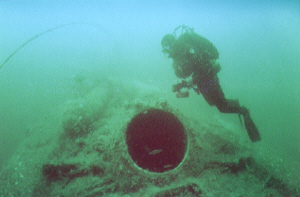
Today the U853 is a popular dive, lying in just 120 feet of water 11 miles off the US East Coast. You can thank the USS Atherton for putting her there.

Today the U853 is a popular dive, lying in just 120 feet of water 11 miles off the US East Coast. You can thank the USS Atherton for putting her there.

The action contributed to Atherton winning her sole battlestar for Atlantic Action in WWII.

Post-VE-Day, she immediately sailed for the Pacific and conducted anti-sub patrols there for a few more months before the Japanese surrendered. The plucky destroyer escort was decommissioned 10 December 1945 and placed in reserve status for 10 years before she got on with her life.

On 14 June 1955, Atherton was transferred to the Japan Maritime Self-Defense Force (JMSDF), becoming one of the first ships of the new Japanese Navy, operating as the destroyer escort JDS Hatsuhi (DE-263, later FF-6) though this is sometimes spelled “Atsuhi” is western sources.

She put in a solid 20 years with the Japanese.

Japanese frigate Atsuhi, commissioned as USS ATHERTON (DE-169). Turned over to JMSDF, 14 June 1955. Paid off June 1975. Transferred to the Philippines, 13 September 1976. NH 46122

DE 263 JDS Hatsuhi – Japan Maritime Self defense Force (1955-75)

NH 46123, Japanese frigate Atsuhi, FF-6

The Japanese returned the then 30-plus-year-old Atherton and her sister-ship, the former USS Amick (DE-168), to the US Navy in 1977. Then, the vintage tin cans began a third career as a Barko ng Republika ng Pilipinas (BRP) naval vessel.

Following a refit in South Korea paid for in part by Washington, the two joined the Philippine Navy 27 February 1980. At the time the island nation was already operating another Cannon-class warship– the former USS Booth (DE-170). The deal also saw Manila buy the condemened sister ships former USS Muir (DE-770) and USS Sutton (DE-771) from the Koreans for a token fee. These two ships were so old and worn out that they were acquired simply with the intention to be cannibalized for spare parts to keep the Atherton, Boothe, and Amick running.

Well, in 1981, Booth (as BRP Datu Kalantiaw PS-76) was sunk during a typhoon, leaving just two DEs in the PI.

The former USS Boothe hard aground after a typhoon in 1981. This left the PI Navy with but two destroyer escorts...

The former USS Boothe hard aground after a typhoon in 1981. This left the PI Navy with but two destroyer escorts…Atherton and Amick

Then Amick, thoroughly worn-out (as BRP Datu Sikatuna PF-5) was scrapped in 1989.

This left Atherton (as BRP Rajah Humabon PF-11), as the only real blue-water warship left in the Philippine Navy. Other than a three-year local refit/lay-up from 1993-1996, this humble 300-foot ship held the line for over two decades.

SOUTH CHINA SEA (April 21, 2009) - Philippine Navy ship BRP Rajah Humabon (PF 11) steams ahead during an exercise with the forward-deployed amphibious assault ship USS Essex (LHD 2) and the amphibious dock landing ship USS Tortuga (LSD 46), as part of exercise Balikatan 2009 (BK09). Essex has been invited by the Republic of the Philippines to participate in BK09, which is an annual combined, joint-bilateral exercise involving U.S. and Armed Forces of the Philippines personnel, as well as subject matter experts from Philippine civil defense agencies. BK09 is the 25th in the series of these exercises, directed by the Joint Chiefs of Staff and requested by the government of the Republic of the Philippines. Essex is commanded by Capt. Brent Canady and is the lead ship of the only forward-deployed U.S. Amphibious Ready Group and serves as the flagship for CTF 76, the Navy's only forward-deployed amphibious force commander. Task Force 76 is headquartered at White Beach Naval Facility, Okinawa, Japan, with a detachment in Sasebo, Japan. (U.S. Navy photo by Mass Communication Specialist 2nd Class Greg Johnson/Released)........Other than the dazzle paint and some commercial navigational radar, she is the same as pictured above in 1945.

SOUTH CHINA SEA (April 21, 2009) – Philippine Navy ship BRP Rajah Humabon (PF 11) steams ahead during an exercise with the forward-deployed amphibious assault ship USS Essex (LHD 2) and the amphibious dock landing ship USS Tortuga (LSD 46), as part of exercise Balikatan 2009 (BK09). (U.S. Navy photo by Mass Communication Specialist 2nd Class Greg Johnson/Released)……..Other than the dazzle paint and some commercial navigational radar, she is the same as pictured above in 1945.

In 2011, the 44-year old USCGC Hamilton (WHEC-715), was transferred to the Philipines by the US State Department and renamed BRP Gregorio del Pilar (PF-15), giving the Atherton her first back up in over 20 years. Another “378” the USCGC Dallas (WHEC-716), was transferred in 2013 as the BRP Ramon Alcaraz (PF-16). A third, ex-USCGC Boutwell (WHEC-719), followed as BRP Andres Bonifacio (FF 17) in 2016.

Today the larger, younger and better equipped Hamilton/Pilar, Dallas/Alcaraz and Boutwell/Bonifacio undertake most blue water missions while the old USS Atherton/JDS Hatsuhi/BRP Rajah Humabon, at a spry 70-years of age, was still considered in active, albeit limited commission, armed, and ready to respond if needed– up until last week.

BRP Rajah Humabon (PS-78)

As such, she was only one of just three ships to still carry working 3-inch Mk22 guns (the other two being a Brazilian river monitor and a Thai sister ship) as well as the last warship in the world to carry the old Oerlikon 20mm in active service. Besides the museum ship USS Slater (DE-766), now sitting dockside in Albany New York, and the pierside training ship USS Hemminger (DE-746) (now HTMS Pin Klao DE-1) in Thailand, Atherton is the last destroyer escort afloat in the world, and the only one since 1992 still in regular naval service.

However, all good things must eventually come to an end, and as noted by the Philippine Navy on 15 March 2018:

“After 38 years of service, the Philippine Navy (PN) has formally retired its oldest warship, the BRP Rajah Humabon (PS-11), one of the last World War II-era warships still in active service, during short ceremonies in Sangley Point, Cavite Thursday morning,” said Philippine Fleet spokesperson Lt. Sahirul Taib in a message Thursday.

The retirement of BRP Rajah Humabon is in-line with the Navy’s Strategic Sail Plan of “moving to legacy vessels to more and capable and modern vessels,” he added.

She will be preserved, turned into one of the exhibits at the Philippine Navy (PN) Museum in Sangley Point, Cavite City. Taib said in a subsequent interview that turning the ship into an exhibit would happen shortly after it is stripped of its navigational equipment and other usable items.

Here in the states, Atherton is remembered by a veterans’ group and has a memorial on display aboard the USS Slater (DE-766) Museum. While a number of scale models are availble to celebrate the class, some of which specifically include Atherton in her Japanese scheme.

Not bad for a ship, class, and type that was considered disposable.

Specs:

Cannon class DE’s via USS Slater.com

Displacement: 1,240 tons standard
1,620 tons full load
Length: 93.3 metres (306.1 ft)
Beam: 11 metres (36.1 ft)
Draft: 3.5 metres (11.5 ft) full load
Propulsion: 4 GM Mod. 16-278A diesel engines with electric drive
4.5 MW (6000 shp), 2 screws
Speed: 21 knots
Range: 10,800 nmi at 12 knots (22 km/h)
Complement: 15 officers 201 enlisted men
Armament: • 3 × single Mk.22 3″/50 caliber guns
• 3 × twin 40 mm Mk.1 AA gun
• 8 × 20 mm Mk.4 AA guns
• 3 × 21 in (533 mm) torpedo tubes
• 1 × Hedgehog Mk.10 anti-submarine mortar (144 rounds)
• 8 × Mk.6 depth charge projectors
• 2 × Mk.9 depth charge tracks

If you liked this column, please consider joining the International Naval Research Organization (INRO), Publishers of Warship International

They are possibly one of the best sources of naval study, images, and fellowship you can find. http://www.warship.org/membership.htm

The International Naval Research Organization is a non-profit corporation dedicated to the encouragement of the study of naval vessels and their histories, principally in the era of iron and steel warships (about 1860 to date). Its purpose is to provide information and a means of contact for those interested in warships.

With more than 50 years of scholarship, Warship International, the written tome of the INRO has published hundreds of articles, most of which are unique in their sweep and subject.

PRINT still has it place. If you LOVE warships you should belong.

I’m a member, so should you be!

Warship Wednesday, March 14, 2018: Always on the edge of history

Here at LSOZI, we are going to take off every Wednesday for a look at the old steam/diesel navies of the 1859-1946 time period and will profile a different ship each week. These ships have a life, a tale all their own, which sometimes takes them to the strangest places. – Christopher Eger

Warship Wednesday, March 14, 2018: Always on the edge of history

Leslie Jones Collection, Boston Public Library,

Here we see the Porter-class destroyer USS Phelps (DD-360) dockside at Charlestown Navy Yard in Boston shortly before she was commissioned in early 1936, note her armament has not been fitted. Though with the fleet just a decade, Phelps always seemed to be just off the portside of some of the most important Naval vessels of WWII and always did everything that was asked of her, picking up twelve battle stars along the way.

The 8-ship Porter class had fine lines and looked more like a light cruiser with their high bridge and four twin turrets than a destroyer. Their displacement was fixed at 1850 tons, the treaty limit at the time, but with their 381-foot oal they were very rakish. Truly beautiful vessels from that enlighten era where warships could be both easy on the eyes and functional. With a 37-knot high speed, they could bring the pain with an eight-pack of 5″/38 (12.7 cm) Mark 12s in four twin Mk22 turrets, which Navweaps refers to as “unquestionably the finest Dual Purpose gun of World War II” in addition to surface target torpedo tubes, a smattering of AAA guns, and an array of depth charges for sub busting. Designed in the early 1930s, all eight ships in the class were completed by February 1937, half built at Bethlehem Steel’s Fore River yard and the other half by New York Shipbuilding.

Our hero, Phelps, was first of the Fore River vessels, laid down 2 January 1934. She is the only Navy ship thus far to tote the name of Rear Admiral Thomas Stowell Phelps, USN, a hero of the Civil War navy.

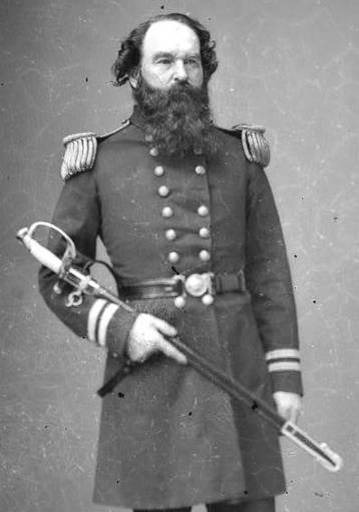
Rear Admiral Thomas Stowell Phelps, USN (1822-1901) Portrait is taken circa 1865-1870 when Phelps was a commander. Photo from: “Officers of the Army and Navy (regular) who served in the Civil War,” published by L.R. Hamersly and Co., Philadelphia, 1892, p. 315. NH 78327

Phelps joined the Navy in 1840 at age 18 and gave the service 44 years of his life, most notably serving as the skipper of the 11-gun Ossipee-class steam sloop USS Juniata during the Civil War, taking her in danger-close to the Confederate batteries at Fort Fisher and helping to capture that rebel bastion. Phelps was named a rear-admiral on the retired list and the old but still beautiful Juniata went on to circumnavigate the globe and was only decommissioned in 1889.

The 11-gun Ossipee-class sloop-of-war USS Juniata in 1889, Detroit Photo. Via LOC. Her class included the ill-fated USS Housatonic.

USS Phelps commissioned 26 February 1936 and, as soon as her shakedown was complete, escorted the beautiful new heavy cruiser USS Indianapolis (CA 35) with President Roosevelt aboard on his Good Neighbor Cruise to South America that included stops in the Caribbean and points south.

USS PHELPS (DD-360). Note her Mark 35 directors above the pilot house, she had another on the after deckhouse– yes, two GFCS on one destroyer, pretty big league for a pre-1939 tin can. Courtesy of The Mariners Museum, Newport News, Va. Ted Stone collection Catalog #: NH 66339

Assigned to the Pacific Fleet by 1941, Phelps was at Pearl Harbor on that fateful day, moored in a nest of destroyers alongside the old tender USS Dobbin (AD-3) in berth X-2 along with fellow destroyers Worden, Hull, Dewey, and Macdonough. Though in an overhaul status and on a cold iron watch, according to her report of that fateful morning her crew observed bombs being dropped from planes diving on Ford Island and on ships moored in vicinity of the target ship USS Utah at 0758 and, by 0802, her guns were loaded and had commenced firing “it having been necessary to reassemble portions of the breech mechanisms which had been removed for overhaul.”

Now that is readiness!

Phelps downed one confirmed Japanese aircraft and took shots at another couple that were probable. By 0926 she was “underway, with boiler power for 26 knots, and stood out to sea via the North Channel,” to take up patrol offshore. The lucky destroyer suffered no casualties.

Pearl Harbor Attack, 7 December 1941 View taken around 0926 hrs. in the morning of 7 December, from an automobile on the road in the Aiea area, looking about WSW with destroyer moorings closest to the camera. In the center of the photograph are USS Dobbin (AD-3), with destroyers Hull (DD-350), Dewey (DD-349), Worden (DD-352) and Macdonough (DD-351) alongside. The ship just to the left of that group is USS Phelps (DD-360), with got underway on two boilers around 0926 hrs. The group further to the right consists of USS Whitney (AD-4), with destroyers Conyngham (DD-371), Reid (DD-369), Tucker (DD-374), Case (DD-370) and Selfridge (DD-357) alongside. USS Solace (AH-5) is barely visible at the far left. Official U.S. Navy Photograph, now in the collections of the National Archives. Catalog #: 80-G-33045

Within days, she was with the fleet looking for some payback, escorting the big fleet carrier USS Lexington (CV-2) on roving raids across the increasingly Japanese-held Western Pacific. By May 1942, she was just 400 miles off the Northern coast of Australia and heavily engaged in the Battle of the Coral Sea. Tragically, Lexington was mortally wounded in the exchange with Vice Admiral Takeo Takagi.

USS Lexington (CV-2) under air attack on 8 May 1942, as photographed from a Japanese plane. Heavy black smoke from her stack and white smoke from her bow indicate that the view was taken just after those areas were hit by bombs. Destroyer in the lower left appears to be USS Phelps (DD-360). The original print was from the illustration files for Rear Admiral Samuel Eliot Morison’s History of U.S. Naval Operations in World War II. U.S. Naval History and Heritage Command Photograph. Catalog #: NH 95579

Though the majority of Lady Lex’s crew survived and were taken off, with the carrier’s Commanding Officer, Captain Frederick C. Sherman, the last to leave, the mighty flattop needed a coup de grace, a task that fell to Phelps.

Our destroyer fired five torpedoes between 19:15 and 19:52, with at least two duds or missed fish being observed. Immediately after the last torpedo hit, Lexington, down by the bow but nearly on an even keel, finally sank.

Last week, Paul Allen’s RV Petrel discovered one of Phelps’ unexploded fish in the debris field for Lexington

A U.S. Mk 15 21″ surfaced launch torpedo near Lexington, one of Phelps’. RV Petrel

Following the Coral Sea, Phelps retired to Pearl in the company of the wounded carrier USS Yorktown and prepared for the next engagement.

(DD-360) At Pearl Harbor, circa late May 1942, following the Battle of Coral Sea and shortly before the Battle of Midway. Official U.S. Navy Photograph, now in the collections of the National Archives. Catalog #: 80-G-66124

Then came Midway, where Phelps was part of TF16, serving as escort and plane guard for USS Hornet (CV 8).

80-G-88908: Battle of Midway, June 1942. A close-up of USS Atlanta (CL 51) with USS Hornet (CV 8) and USS Phelps (DD 360), all of Task Force 16, in the background. The picture was made during the third day of the battle as Atlanta came up to aid the destroyer, which had broken down temporarily because of fuel shortage. Official U.S. Navy Photograph, now in the collections of the National Archives. (2016/09/27).

After Midway, Phelps left for the West Coast where she received an updated AAA suite that saw her marginally effective 1.1-inch and .50-caliber guns swapped out for many more 40mm and 20mm pieces along with the Mk 51 Fire Control System for the former. For her main guns, she swapped out the older Mk33 for a new Mk35 GFCS and added both an SC air search radar set and one SG surface search radar set.

USS Phelps (DD-360) Description: Plan view, forward, taken while she was at the Mare Island Navy Yard, California, 24 November 1942. Circles mark recent alterations to the ship. Photograph from the Bureau of Ships Collection in the U.S. National Archives. Catalog #: 19-N-38915

Plan view, aft, taken while she was at the Mare Island Navy Yard, California, 24 November 1942. Note submarine building ways and cranes in the background. Circles mark recent alterations to the ship. Photograph from the Bureau of Ships Collection in the U.S. National Archives. Catalog #: 19-N-38914

The rest of the war was extremely busy for Phelps, fighting the nightly raids by the Japanese and supporting the invasion of Guadalcanal, bombarding frozen Attu and Kiska in Alaskan waters, marshaling the troopships and closing just off the beach at Makin, Kwajalein, and Eniwetok; the hell of Saipan.

USS Phelps (DD-360) underway at sea, 27 May 1944. Official U.S. Navy Photograph, now in the collections of the National Archives. Note, her # 3 5″ mount has been deleted, the superfiring aft installation. Catalog #: 80-G-276951

In August 1944, Phelps was reassigned to the Atlantic, her place taken in the warm waters of the Pacific by newer destroyer types with more massive AAA suites. It was figured that the fast Porter could be more useful in the ETO.

USS Phelps (DD-360) Off the Charleston Navy Yard, South Carolina, about November 1944. She is painted in camouflage Measure 32, Design 3d. Note that her eight 5-inch twins have been swapped out for five 5″/38 Mark 12 guns in a combination of Mark 38 twin mounts and a single Mark 30 mount superfiring aft. Her GFCS also has been upgraded to a Mk37. Photograph from the Bureau of Ships Collection in the U.S. National Archives. Catalog #: 19-N-73963

She spent the rest of the war on convoy duty and serving in the Mediterranean, arriving back on the West Coast post VE-Day on 10 June and was soon laid up.

USS Phelps (DD-360) moored at Casco Bay, Maine, 9 August 1945. USS McCall (DD-400) and a frigate (PF) are moored with her. Note she now has Measure 21. Official U.S. Navy Photograph, now in the collections of the National Archives. Catalog #: 80-G-332952

Decommissioned 6 November 1945, Phelps was struck from the list 28 January 1947, sold 10 August 1947 to George Nutman Inc., Brooklyn, and subsequently scrapped– just 11 years after her completion.

Of her sisters, only class leader, Porter, was lost, torpedoed in the Battle of the Santa Cruz Islands in 1942. The other six Porters managed to complete the war in one piece and, save for USS Winslow, were paid off by 1946. As for Winslow, she endured for a while longer as an experimental unit and only went to the breakers in 1959.

Besides Phelps’ torpedoes on the bottom of the Coral Sea, she is remembered in maritime art.

Tom Freeman (American, born 1952) U.S.S. Arizona passes Diamond Head on November 28, 1941. U.S.S. Phelps (DD-360) is the escort

Specs:

USS Phelps (DD-360) in her final form. Off the New York Navy Yard, 8 August 1945 in Measure 21. Photograph from the Bureau of Ships Collection in the U.S. National Archives. Catalog #: 19-N-87408

Displacement: 1,850 tons, 2,663 fl
Length: 381 ft (116 m)
Beam: 36 ft 2 in (11.02 m)
Draft: 10 ft 5 in (3.18 m)
Propulsion: 4 Babcock & Wilcox boilers. Geared Bethlehem Turbines,2 screws, 50,000 shp (37,285 kW);
Speed: 37 knots (65 km/h)
Range: 6,500 nmi. at 12 knots (12,000 km at 22 km/h) on 635 tons fuel oil
Complement: 194 (designed) later swelled to 276 with new systems, AAA suite
Sensors: SC search radar, QC sonar
Armor: Splinter protection (STS) for bridge, guns, and machinery
Armament:
As Built:
1 x Mk33 Gun Fire Control System
8 × 5″(127mm)/38cal SP (4×2), though only three turrets (6 guns) fitted
8 × 1.1″(28mm) AA (2×4),
2 × .50 Cal water-cooled AA (2×1),
8 x 21″(533mm) torpedo tubes two Mark 14 quadruple mounts (2×4) with 16 torpedoes carried
2 Depth Charge stern racks, 600lb charges
c1944:
1 × Mk37 Gun Fire Control System,
5 × 5″(127mm)/38cal DP (2×2,1×1),
1 × Mk51 Gun Director,
4 × Bofors 40mm AA (1×4),
8 × Oerlikon 20mm AA (8×1),
8 x 21″(533mm) torpedo tubes two Mark 14 quadruple mounts (2×4) with 8 torpedos carried, later removed by 1945
2 Depth Charge stern racks, 600lb charges
4 300lb K-Gun Depth Charge throwers, 2 stdb, 2 port

If you liked this column, please consider joining the International Naval Research Organization (INRO), Publishers of Warship International

They are possibly one of the best sources of naval study, images, and fellowship you can find. http://www.warship.org/membership.htm

The International Naval Research Organization is a non-profit corporation dedicated to the encouragement of the study of naval vessels and their histories, principally in the era of iron and steel warships (about 1860 to date). Its purpose is to provide information and a means of contact for those interested in warships.

With more than 50 years of scholarship, Warship International, the written tome of the INRO has published hundreds of articles, most of which are unique in their sweep and subject.

PRINT still has its place. If you LOVE warships you should belong.

I’m a member, so should you be!

Warship Wednesday, March 7, 2018: The ‘most fightingest ship’ of the Great North

Here at LSOZI, we are going to take off every Wednesday for a look at the old steam/diesel navies of the 1859-1946 time period and will profile a different ship each week. These ships have a life, a tale all their own, which sometimes takes them to the strangest places.- Christopher Eger

Warship Wednesday, March 7, 2018: The ‘most fightingest ship’ of the Great North

Here we see the British-built Tribal (Afridi)-class destroyer Her Majesty’s Canadian Ship (HMCS) Haida (G63) of the Royal Canadian Navy, as she appeared during WWII. One of Canada’s most celebrated vessels, this “little tin can that could” has an impressive record and is still around today taking the “Queen’s shilling” so to speak.

The Afridi‘s were a new type of destroyer designed for the Royal Navy in the late 1920s off experience both in the Great War and to match the large, modern escorts on the drawing boards of contemporary naval rivals of the time.

The Royal Canadian Navy’s HMCS Huron (G24), in dazzle camouflage, sailing out to sea during the Second World War during one of her countless trans-Atlantic escorting runs. The Tribal-class destroyer, commissioned on July 28,1943, also served in the Pacific theatre during the Korean War under the new pennant number 216.

These 378-foot vessels could make 36+ knots on a pair of geared steam turbines and a trio of Admiralty three-drum boilers while an impressive battery of up to eight 4.7″/45 (12 cm) QF Mark XII guns in four twin CPXIX mountings gave them the same firepower as early WWI light cruisers (though typically just three turrets were mounted).

Gun crew on Tribal-class destroyer HMCS Algonquin cleaning up their 4.7″/45 (12 cm) Mark XII guns after firing at the Normandy Beaches on 7 June 1944. Note that the crewman kneeling in the rear is holding a 4.7″ (12 cm) projectile. Library and Archives Canada Photograph MIKAN no. 3223884

Some 32 Afridi‘s were planned in eight-ship flights: 16 for the RN (named after tribal warriors: HMS Cossack, HMS Eskimo, HMS Sikh, HMS Zulu, et. al), eight for the Royal Australian Navy, and eight for the Canadians. Of the Canadian ships, four were to be built by Vickers in the UK and the other four by Halifax shipyards in Nova Scotia. All the Canadian ships were to be named after First Nations tribes (Iroquois, Athabaskan, Huron, Haida, Micmac, Nootka, Cayuga, etc.)

An unidentified Tribal class destroyer in profile

The subject of our tale, HMCS Haida, was the last of the Canadian Tribals built in the UK, laid down at Vickers 29 September 1941. She commissioned during the height of the Battle of the Atlantic, on 18 September 1943.

HMCS Haida

As noted by Gordon Smith, Naval-History.Net, Haida immediately began working up with the Home Fleet based at Scapa Flow and just a scant two weeks later was operational, heading on a mission to reinforce the icy Spitzbergen garrison and provide a covering force for Lend-Lease minesweepers headed to the Soviets past heavily defended German-occupied Norway.

Then between Nov. 1943 and Jan 1944, Haida would be part of no less than five dangerous runs through U-boat and Scharnhorst-infested waters between the UK and Kola Pen, shepherding freighters to fuel Uncle Joe’s war machine. Speaking of Scharnhorst, Haida was present just over the horizon at the Battle of North Cape when the mighty German capital ship was sent to the bottom.

Next, she was assigned to escort a raiding force to Norwegian waters consisting of the Free French battleship Richelieu, the battlewagon HMS Anson and several fast cruisers. Once that went off uneventfully, Haida was tasked to Operation Neptune, the Normandy Landings, and transferred to the English Channel.

Filling her time escorting forays into mine and E/S-boat infested coastal waters along the French coast, Haida traded naval gunfire and torpedoes with German shore batteries and torpedo boats, coming away unscathed but leaving the Elbing-class torpedo boat T29 dead in the water in a sharp nighttime action in April 1944. One of her sisters, HMCS Athabaskan, was not so lucky and sank in the same action.

When the D-Day balloon went up, she spent her time on the patrol line between Ile de Bas and Ile de Vierge and, on 9 June, with three of her sisterships, engaged four German T-boats and destroyers. The action left one German sunk, another hard aground, and the final pair limping away to lick their wounds.

On 24 June 1944, Haida racked up a confirmed kill on the German U-971 (ObrLt. Zeplien) off Brest in conjunction with the RN destroyer (and sistership) HMS Eskimo and a B-24 Liberator flown by the Free Czechs (Sqdn. 311). The event, as chronicled by Haida, included nine attacks by the destroyers and ended with a surface action in the English Channel as the stricken sub crashed to the surface and men started to abandon ship.

From Haida‘s report:

It was decided to attack without waiting for ESKIMO to regain contact and pattern “G” had been ordered when at 1921 the submarine surfaced about 800 yards ahead at an inclination of about 100 left. Fire was opened from “B” gun and a hit obtained on the conning tower, with the second salvo. High Explosive was used and penetrated the conning tower, starting a fire, the flames being clearly visible through the hole made. No further hits were obtained with main armament and fire was checked as soon as it was apparent that the enemy did not intend to fight. Close range weapons were used during the same period.

Lost was one German submariner, while Haida and Eskimo picked up 52 survivors (including six were injured, three seriously) and brought them to Falmouth in the predawn hours of 25 June.

U-BOAT KILLER’S MASCOT. 26 JUNE 1944, PLYMOUTH, ON BOARD THE CANADIAN DESTROYER HMCS HAIDA, WHICH WITH HMS ESKIMO DESTROYED A U-BOAT IN THE CHANNEL. (A 24385) Dead-eyed Jock Macgregor who was the first to open fire with his Oerlikon on the U-boat destroyed by the HAIDA and HMS ESKIMO. Copyright: © IWM. Original Source: http://www.iwm.org.uk/collections/item/object/205156267

THE ROYAL NAVY DURING THE SECOND WORLD WAR (A 24384) Seaman Jock MacGregor of HMCS HAIDA holds ‘Muncher’ the ship’s pet rabbit by the Oerlikon 20 mm gun Platform. Copyright: © IWM. Original Source: http://www.iwm.org.uk/collections/item/object/205119874

August saw Haida maul a convoy of small German coasters off Ile d’Yeu. In a single wild action on the night of 9 August 1944, she is credited with assisting in the sinking of at least nine Axis ships including two destroyers, two T-boats, a U-boat, a minesweeper, patrol boat, and two armed trawlers.

Canadian Tribal-class destroyers in action, 6 August 1944 against German convoy, 9 enemy ships sunk by RCN CDR Anthony Law, 1946, showing HMCS Haida, HMCS Iroquois and HMS Bellona in their famous night action. Canadian War Museum Photo 19710261-4057

Canadian Tribal-class destroyers in action, 6 August 1944 against German convoy, 9 enemy ships sunk by RCN CDR Anthony Law, 1946, showing HMCS Haida, HMCS Iroquois and HMS Bellona in their famous night action. Canadian War Museum Photo 19710261-4057

By September, the Canadian war baby headed for her home country for the first time, to get a badly needed refit at Halifax. Early 1945 saw her sortie back to Europe where she was engaged off Norway again, escorted some more convoys to Russia, and was among the first Allied ships to enter the key Norwegian port of Trondheim post-VE-Day. Returning to Canada, she was to be made ready to fight in the Pacific against the Japanese but never made it that far before the A-bombs ended the war unexpectedly.

Laid up in reserve, by 1947 she was reactivated and soon put to effective use.

In November 1949, Haida again showed her worth to an ally by standing seaward and plucking the surviving crew of a USAF Boeing B-29 Superfortress of the 2nd BS, 27th BG on its way to RAF Sculthorpe. The aircraft, 42-65289, flew as Dina Midget in WWII over Japan and went down some 385 miles North East of Hamilton, Bermuda. Following the accident, 18 crewmen took refuge in dinghies while two others were drowned. Spotted by SAR aircraft, Haida picked the men up after 76 hours adrift.

HMCS Haida in November 1949 after rescuing 18 members of the crew of a USAF B-29 bomber that crashed in the Atlantic Ocean From the LIFE Magazine Archives – Michael Rougier Photographer

By 1950, she served off Korea as part of the Canadian contribution to the UN forces in that conflict, completing two tours in those far-off waters.

In 1952, an extensive refit saw her reconfigured as a destroyer-escort (pennant DDE-215) which saw her WWII sensors replaced by a more modern SPS-6C air search radar and SQS-10 sonar. Her main armament, those six beautiful 4.7-inch rapid fires, was swapped out for a more conservative pair of twin 4-inch Mk16s. Her depth charges replaced with a Squid ASW mortar. This would be her final configuration for her last decade in active service, and the one she would carry into her later days.

This photo shows the ship’s company in Hong Kong in 1953 (Parks Canada)

Rescued from the streets of Japan, Pom Pom served as Haida’s mascot during the ship’s first tour of duty in Korea (Parks Canada)

A 1930s design in the jet age, Haida was decommissioned in October 1963 after 20 years of hard service.

HMCS HAIDA (DDE215) makes her way towards Lock 4 on the Welland Canal during her farewell Great Lakes tour in 1963

Overall, when compared to her sisters, she was a lucky ship and outlived her family. No less than 12 of the 16 Tribals in British service were lost during WWII and the remaining quartet were all paid off by 1949. All the Tribals in Canadian service were sold to the breakers by 1969. The three Australian ships that were completed (five were canceled) likewise were turned to razor blades.

Tribal-class sister HMCS Huron (DDE-216), port bow view while off Pearl Harbor, Territory of Hawaii. Official U.S. Navy Photograph, now in the collections of the National Archives 80-G-646914:

Haida was the last of her class remaining in any ocean and, after an effort by concerned citizens, she was towed to Toronto and opened as a museum ship in 1965. Over the next three decades, she still hosted sea cadet camps and Canadian Forces events in addition to her work a floating memorial, known as “Canada’s most fightingest ship”.

In 2003, she was moved to Hamilton, Ontario where she had been a National Historic Site ever since, operated by Parks Canada on a seasonal basis.

(Parks Canada)

Earlier this year, she was named ceremonial Flagship of the Royal Canadian Navy with an honorary commanding officer chosen from the Navy, is authorized to fly the Canadian Naval Ensign, and the ship will observe traditional sunrise and sunset ceremonies as well as arrival announcements on the gangway.

(Parks Canada)

Specs:

Displacement:1,959 long tons (1,990 t) tons standard, 2,519 long tons (2,559 t) deep load
Length: 377 ft (114.9 m)
Beam: 37 ft 6 in (11.4 m)
Draught: 13 ft (4.0 m)
Propulsion:
2 shafts; 3-Admiralty 3 drum type boilers
2 × Parsons Marine geared steam turbines, 44,000 shp (33,000 kW);
Speed: 36.5 knots (67.6 km/h; 42.0 mph) (maximum), 32 knots (59 km/h; 37 mph) (service)
Complement: 259 (14 officers, 245 ratings)
Sensors and processing systems:
As G63 (1943–1952):
1 type 268 radar
1 type 271 radar
1 type 291 radar
1 × Mk.III fire control director with Type 285 fire control radar
1 type 144 sonar
1 type 144Q sonar
1 type 147F sonar

As DDE 215 (1952–1963):
1 SPS-6C air search radar
1 Sperry Mk.2 navigation radar
1 × Mk.63 fire control director with SPG-34 fire control radar
1 type 164B sonar
1 type 162 (SQS 501) sonar
SQS 10 sonar

Armament:

As G63 (1943–1952):
3 × 4.7-inch (119 mm)/45 Mk.XII twin guns
1 × 4-inch (102 mm)/45 Mk.16 twin guns
1 × quadruple mount 40 mm/39 2-pounder gun
6 × 20 mm Oerlikon cannons
1 quad launcher with Mk.IX torpedoes (4 × 21-inch (533 mm) torpedo tubes)
1 rail + 2 Mk.IV throwers (Mk.VII depth charges)

As DDE 215 (1952–1963):
2 × 4-inch/45 Mk.16 twin guns
1 × 3-inch (76 mm)/50 Mk.33 twin guns
4 × 40 mm/56 Bofors guns
1 quad launcher with Mk.IX torpedoes (4 × 21 inch (533 mm) torpedo tubes)
2 × Squid ASW mortars

If you liked this column, please consider joining the International Naval Research Organization (INRO), Publishers of Warship International

They are possibly one of the best sources of naval study, images, and fellowship you can find. http://www.warship.org/membership.htm

The International Naval Research Organization is a non-profit corporation dedicated to the encouragement of the study of naval vessels and their histories, principally in the era of iron and steel warships (about 1860 to date). Its purpose is to provide information and a means of contact for those interested in warships.

With more than 50 years of scholarship, Warship International, the written tome of the INRO has published hundreds of articles, most of which are unique in their sweep and subject.

PRINT still has its place. If you LOVE warships you should belong.

I’m a member, so should you be!

Warship Wednesday, Feb. 21, 2018: The Saint and the Terror

Here at LSOZI, we are going to take off every Wednesday for a look at the old steam/diesel navies of the 1859-1946 time period and will profile a different ship each week. These ships have a life, a tale all their own, which sometimes takes them to the strangest places. – Christopher Eger

Warship Wednesday, Feb. 21, 2018: The Saint and the Terror

Catalog #: NH 59924

Here we see the U.S. Mail Steamer Saint Paul of the American Line in her guise as the auxiliary cruiser USS Saint Paul, photographed at the end of the Spanish-American War. The 11,612-ton ocean liner was the fastest thing on the Atlantic merchant trade when put in service, was the first to carry a wireless (and she needed it!) and served in two real-live shooting wars, with mixed results.

Saint Paul, a twin-screw steel passenger liner of the newest sort, along with her sister Saint Louis were ordered by the Philadelphia-based International Navigation Company (led by robber baron Clement Acton Griscom) for use by that firm and their subsidiary American Line and Red Star Line flags. As such, they were something of a keynote in U.S. merchant history. They had 17 watertight compartments (two decades before Titanic), could carry up to 1,540 passengers in a variety of styles (350 1st class, 290 2nd, 900 3rd), and were ultra-modern.

As explained by Kenneth J. Blume, they were the first large liners built in the U.S since 1857 (other large passenger liners were all European in origin) and were ordered to take advantage of subsidies set aside in the Merchant Marine Act of 1891. Further, he says “they were the last such large passenger liners built in the United States until the 1930s.”

Built at William Cramp & Sons Building & Engine Company, Philadelphia (yard # 277 and 278), these ships used quadruple expansion engines fed by double-ended boilers capable of speeding them forward at 20-knots (making International Navigation the first to offer such service across the Atlantic). Further, they had a more “modern” appearance than preceding liners, with two stacks and plumb bows. Built to last, they were completed by the same yard that was at the time working on the cruisers USS Minneapolis (C 13) and Brooklyn (ACR 3) as well as the battleship Iowa (BB 6)

Quadruple expansion engines of SS St. Louis (1894) in the workshop of William Cramp & Sons where they were built. Published in Howell’s Steam Vessels and Marine Engines. p. 11, 1896.

Steamliner SS Saint Paul of the International Navigation Co. 1895. Photo by Johnston, J. S. (John S.) postcard by Detroit Publishing Co.in the collection of the LOC. https://www.loc.gov/item/det1994011748/PP/

Famously, our new ocean liner ran aground off the New Jersey coast in January 1896 and required an extensive $400,000 effort to free her. Meanwhile, the rescue of her passengers and crew was national news for several months.

“THE STRANDING OF THE AMERICAN LINER ST. PAUL ON THE NEW JERSEY COAST, NEAR LONG BRANCH”, published in “Harper’s Weekly” February 1896.

However, she was back in business and in April 1896 she crossed the Atlantic from New York to Southampton in just six days. Over the next two years, she would repeat her crossing 36 times along the same route, which is impressive by any standard.

Her peacetime passenger service came to a halt due to events in Cuba.

At 21:40 on 15 February 1898, the armored cruiser USS Maine suffered a terrible explosion in Havana Harbor while exercising tense gunboat diplomacy with Spain over Cuba, leading to the death of 266 Navy and Marine personnel.

Though the cause of the explosion would not be known anytime soon, the press whipped the event up to the point of conflict.

When war came, the Navy took up dozens of craft from trade including four large passenger liners for conversion to auxiliary cruisers from the American Line/International Navigation Co: the SS New York (which became USS Harvard), SS City of Paris (who became the matching USS Yale) as well as Saint Louis and Saint Paul, the latter pair of which served under their given names.

On 12 March 1898, Saint Paul was taken up for service by the Navy and, sailing to Newport for crew and conversion to an auxiliary cruiser, Capt. Charles Dwight Sigsbee (formerly commander of the stricken Maine) raised the national ensign and took down the American Line house colors. She commissioned on 20 April. The fast liner was given a coat of gray paint, armed with six 5″/40 Mark 4 guns, another six Hotchkiss 6-pounders, and six 3-pounders in a fit-out that lasted just 14 days. Could you imagine a similar thing today?

USS St. Paul (1898) View looking aft on her forecastle, following conversion to an auxiliary cruiser, 1898. Note 5-inch guns, capstans, winch and other deck gear as well as two Marines. The original photograph was taken by C.H. Graves and published on a stereograph card. Courtesy of Commander Donald J. Robinson, USN(MSC, 1979) U.S. Naval Historical Center Photograph. Photo #: NH 89086

Ready for service by the first part of May, the new USS Saint Paul would see the elephant, and soon.

But first, let’s talk about a little Spanish Terror.

In the lead up to the conflict, in 1896 the Spanish Navy ordered a half-dozen Furor-class torpedo destroyers from the shipyards of J & G Thompson of Clydebank in Scotland. These nimble 229-foot 380-ton ships could make 28-knots (when their machinery worked) and carried two 350mm torpedo tubes as well as four Nordenfelt popguns.

A Spanish Terror Class Destroyer in British Waters in about 1897. An unidentified example of the ship class, photographed in about 1897-1898 in British waters and very likely in builders’ hands. Six sisters were built in 1896-1897 by Thompson on the Clyde: AUDAZ (1897-1927), OSADO (1897-1927), PROSERPINA (1897-1931), TERROR (1896-1927), FUROR (1896-1898), PLUTON (1896-1898). NH 88619

NH 111967 Spanish Torpedo Boat Destroyer TERROR

On 28 April 1898, the Spanish Navy’s 1st Squadron, of four cruisers (Infanta Maria Teresa, Vizcaya, Almirante Oquendo, and Cristóbal Colón) and three sister-ship destroyers (Pluton, Terror, and Furor) set out from the Cape Verde Islands for the Caribbean, bound for San Juan, Puerto Rico, then a Spanish colony. RADM Pascual Cervera y Topete’s mission was to rendezvous with other Spanish ships, engage the American squadron blockading Cuba, and ultimately to attack the United States.

Spain’s torpedo-boat flotilla en route from the Canaries to Puerto Rico. William Sontag. NYPL collection 1898. Terror shown in front

The loose Spanish ships sowed panic on the Eastern seaboard as every coastal town just knew they would wake up to Spanish bombardment at any time. However, Cervera’s fleet was in bad shape, with fouled bottoms, dangerously defective (or in some cases even uninstalled) guns, untrained crews, and poor engineering plants. Terror, carrying the flag of Capt. Fernando Villaamil Fernandez-Cueto (destroyer flotilla commander), and commanded by Lt. Francisco de la Bocha y Pérez, was nursing boiler problems.

Saint Paul sortied out from Philadelphia to look for Cervera on 5 May.

The Flying Squadron, under the command of Commodore Winfield S. Schley, joined the search for the Spanish fleet while the fleet four detailed ships, Saint Paul, her American Line companion auxiliary cruiser USS Yale, the similar USS Harvard, and USS Minneapolis, patrolled the waters off Santiago just in case Cervera made it to the Cuban hub.

In the meantime, the Spanish squadron popped up at the French colony of Martinique on 10 May 1898 and, with Terror‘s engines fully immobilized, the little destroyer that couldn’t was left behind while Cervera beat feet to Santiago, Cuba. Alone, the intrepid Lt. Bocha managed to cobble together Terror‘s condemned piping and nurse her solo to San Juan a week later.

Meanwhile, our hero liner-cruiser Saint Paul found the British steam collier Restormel, which was chartered to bring 2,400-tons of badly needed fresh Cardiff coal to Cervera and captured the same just outside of Santiago on 25 May after firing two blanks and one war shot from her 5-inch battery. She later arranged for the steamer to go to Key West as a prize. The British captain reportedly told his American captors he was glad the U.S. wound up with his valuable cargo since the Spaniards did not lift a finger to prevent his capture even though he was under the heavy guns of Castle Morro and a promised battleship escort into Santiago never materialized.

“I am glad you Yankees have the coal since those duffers inside didn’t have the nerve to come out and back me up with their guns when we were right within range,” he reportedly said as the prize crew of bluejackets and leathernecks from Saint Paul came aboard.

Saint Paul next appeared off Fort Caimanera near Guantánamo, where her 5-inch gunners helped plaster the Spanish shore batteries there from just 1,000 yards off the beach. By early June she was off San Juan along with USS Yosemite and the new cruiser USS New Orleans.

The trio effectively blockaded that Spanish Puerto Rican port, which held the aforementioned Terror as well as the ineffective 1,200-ton Velasco-class unprotected cruiser Isabel II (4×4.7-inch guns), and the two 500-ton 3rd class gunboats General Concha (3×4.7inch) and Ponce de Leon. On the morning of 22 June, while a German tramp steamer made for open ocean, the three Spanish warships made a move to test the harbor blockade and Saint Paul was there. A short and ineffective artillery duel resulted in the two larger Spaniards turning back while Terror made a David vs. Goliath torpedo run on our liner.

The auxiliary cruiser St. Paul repulsing the Spanish torpedo-boat destroyer Terror off San Juan de Puerto Rico, June 22, 1898, by Henry Reuterdahl, NYPL Collection

The run ended badly for the unsupported Terror, who never got closer than 5,400 yards to the big American before two 5-inch shells perforated her, one in the engine room. Listing, immobile and taking on water, the stricken torpedo destroyer had to be beached by towing as Saint Paul watched. For Terror, her war was over.

The damaged Spanish destroyer Terror at San Juan. She was allowed to return to Spain when the war ended.

Isabel II, General Concha, and Ponce de Leon again tried to force the American cordon on 28 June to make a hole for an incoming blockade runner, but after an ineffective artillery duel at long range from Saint Paul, the effort was called off. It was the last naval action at San Juan and the Spanish ships finished the war at anchor, eventually sailing home when peace was concluded.

For Saint Paul, she was recalled to New York in July and, reverting to her original design, brought first the 4th and later the 8th Ohio Volunteer regiments to the theater, carrying over 1,300 troops each trip.

This image shows the ST. PAUL embarking troops for Puerto Rico. Her superimposed gun sponson which she was outfitted with while operating as an auxiliary cruiser can be seen overhanging the side of the vessel. Via SpanAm War.com http://www.spanamwar.com/Stpaultroops.htm

It was some of the first major joint Army-Navy operations since the Civil War, and improvisation was key, with troops moving ashore via sugar lighters and cargo nets.

Troops transferring to sugar-lighters at sea. There was a heavy ground swell and the boat rose and fell alongside, making it a difficult task. NH 108558

Each sugar-lighter held one company of men. NH 108559

Her last trip from Puerto Rico, in August, was to bring soldiers home to New York. From there, she steamed to Cramp’s to be disarmed and refitted for merchant service, decommissioned and released by the War Department on 2 September. Her very active wartime life lasted less than five months.

Saint Paul was also notable as the first merchant ship fitted with a Marconi wireless, in 1899. On November 15 of that year Guglielmo Marconi issued The Transatlantic Times, the first newspaper ever published at sea, using information received by radio transmission from his wireless telegraph station on the Isle of Wight.

By November 1898, she was back on the Southampton run, which was her regular route, carrying passengers, mail, and coin. For example, on one 1902 run, she brought “670 passengers eastbound, 1.173 mailbags and $200.000 in gold” to England from New York. It was her bread and butter and in her career she completed more than 200 such crossings across two decades.

William M. Vander Weyde photo of ladies waving bon voyage as St. Paul leaves the pier, from the George Eastman Kodak Museum.

Photographed circa the 1890s or early 1900s. Description: Courtesy of the Saint Paul “Minnesota Dispatch,” 1963. Catalog #: NH 92841

SS St. Paul Bain News Service, 1915, via LOC

ST. PAUL sails, 8/7/14 (LOC)

Then it was back to peacetime liner operations for an uneventful (for us) 19 years other than a 1908 collision with the British Arrogant-class cruiser HMS Gladiator, killing 27 RN personnel and sending the smaller 5,700-ton manowar to the bottom off the Isle of Wright. A British high court held Gladiator responsible.

Then, war came once again.

Saint Paul was taken over by the War Department for use as the troop transport Knoxville on 27 October 1917, making 12 rushed crossings over the Atlantic carrying the boys “over there” to fight the Huns over the next five months. For such duty, the fast transport was given a Navy gun crew to man four newly-installed 6″ guns and painted in Thayer’s quarter-shading camo process. She was credited with carrying more than 30,000 GIs to France.

The Navy, in turn, arranged for the former auxiliary cruiser’s transfer in April 1918 to the sea service and, designated USS Saint Paul (SP 1643), was taken back into Navy service. While being further converted, on 28 April, she flooded and capsized in the North River in New York.

Lot-10821-4: USS Saint Paul (ID# 1643), salvage operations of the auxiliary cruiser during 1918. Shown: First stage of pumping and rolling operation. Courtesy of the Library of Congress. (2017/08/04).

Lot-10821-2: USS Saint Paul (ID# 1643), salvage operations of the auxiliary cruiser during 1918. Shown: As she lay on the bottom

Lot-10821-3: USS Saint Paul (ID# 1643), salvage operations of the auxiliary cruiser during 1918. Shown: 6-inch gun on the starboard side of the foredeck.

Salvage operations continued into 1919 and she was eventually returned to the American Lines in floating condition. Returning to service in the low-rent steerage trade, she was still too uneconomical to run at a profit and by 1923 was retired. She was towed across the Atlantic by Jacob van Heemskerk and broken up at the former naval dockyard at Wilhelmshaven in Weimar Germany, where labor at the time was dirt cheap.

As for her sister, Saint Louis, she also served in the Great War as the armed transport USS Louisville (there was another USS St. Louis in the fleet at the time), but was gutted in a fire in 1920 and scrapped in 1924. As it turned out, the proud “20-knot” liner never made it back to carry civilian passengers after their second war.

Their company likewise faltered. The American Line itself was defunct by 1932 as was the Red Star Line by 1935. The International Navigation Co. endured in a way, merging in 1931 with the Roosevelt Steamship Company under the United States Lines banner.

Curiously, Saint Paul‘s nemesis, the Spanish Terror, outlived her. Returning to Spain following the loss of Puerto Rico in 1899, she was repaired and served in the Spanish Navy in North Africa and European waters until she was retired in 1924.

Our liner is, of course, remembered in various period maritime art.

Specs:
Displacement: 11,612 in commercial service, 14,910 long tons (15,150 t) as aux cruiser
Dimensions 535’6” (bp) x 63′ x 27’5”
Machinery 2 screws, VQE, 6 D/E & 4 S/E boilers, IHP 20000,
Speed: 19.25 knots practical but made 22 knots after funnel caps removed in 1900
Coal: 2677 tons
Complement 281 crew + 1540 passengers as liner,
1898: 357 Navy, 50 Marines
Armament: (1898)
6 5”/40 Mark 4 rapid-fire guns (four fwd, two aft) in open mounts with 600 rounds
6 6 pdr. Hotchkiss with 1800 rounds
6 3 pdr. Nordenfeldt guns (two on promenade deck, four on wings) with 1800 rounds
Extensive small arms locker for Marine detachment
(1917-18)
6 6″/50 Mark 6 guns repurposed from old battleships and cruisers.

If you liked this column, please consider joining the International Naval Research Organization (INRO), Publishers of Warship International

They are possibly one of the best sources of naval study, images, and fellowship you can find. http://www.warship.org/membership.htm

The International Naval Research Organization is a non-profit corporation dedicated to the encouragement of the study of naval vessels and their histories, principally in the era of iron and steel warships (about 1860 to date). Its purpose is to provide information and a means of contact for those interested in warships.

With more than 50 years of scholarship, Warship International, the written tome of the INRO has published hundreds of articles, most of which are unique in their sweep and subject.

PRINT still has its place. If you LOVE warships you should belong.

I’m a member, so should you be!

Warship Wednesday, Feb. 14, 2018: Late 19th Century tech ‘Without Equal’

Here at LSOZI, we are going to take off every Wednesday for a look at the old steam/diesel navies of the 1859-1946 time period and will profile a different ship each week. These ships have a life, a tale all their own, which sometimes takes them to the strangest places. – Christopher Eger

Warship Wednesday, Feb. 14, 2018: Late 19th Century tech ‘Without Equal’

Here we see the Victoria-class ironclad turret-type battleship HMS Sans Pareil taking a break from reserve fleet layup– where she spent most of her short life– to participate in the fleet review held at Spithead on 16 August 1902 for the coronation of King Edward VII. She was the last ship in the Royal Navy to carry the moniker and, when designed in 1885, had several innovative features that made her invincible on the water, or so it seemed.

The two-ship Victoria class were built by the British to fix perceived shortcomings in the preceding six-pack of Admiral-class battleships (10,600 t., 330-feet oa, 4×12″ guns, 16kts on compound engines, up to 18 inches of armor belt) and produced a much more modern ship.

HMS Victoria by William Frederick Mitchell

The Victoria and Sans Pareil were only slightly larger (340-feet) but were the first RN capital ships to use 3-cyl Humphreys triple expansion steam engines powered by 8 cylindrical boilers which offset a thicker overall compound armor package (406mm at its *thinnest* backed by 178mm of wood planks) while still enabling speeds of 16+ knots. With coal bunkerage of 1,200 tons, they could steam an impressive 7,000nm at 10kts, making them capable of showing the Royal colors around the colonies as needed. Designed for 12,000 ihp, they produced over 14K and were considered very successful, able to make 17~ knots, when the sea allowed.

Instructional, picture model of battleship HMS ‘Sans Pareil’ (1887) by Royal Museums Greenwich. The model is inscribed ‘Triple expansion engines ‘H.M.S. Sans Pareil’ Twin screw 12000 I.H.P. By Humphrys Tennant & Co’, ‘Scale 1 1/4 inch – 1 foot’, ‘Low-pressure engine looking forward’, ‘H & T C Batchelor Constructors of Motion Drawings West Kensington London S.W.’ and ‘Intermediate engine looking forward’. To order a print of this go here http://prints.rmg.co.uk/art/516757/instructional-picture-model-of-battleship-hms-sans-pareil-1887#TddCOCoc6heYP1L3.99

Massive twin screws, as shown on sister Victoria

This speed and bulk was weaponized in an impressive pointed bow ram, seen as a valid tactic following the confusing Battle of Lissa in 1866.

Via Postales Navales

However, the biggest departure from the previous designs was in the Victoria‘s twin 16.25″/30 (41.2 cm) Mark I “Elswick 111 ton” guns, some of the largest diameter breechloading guns every mounted. They fired a 1,800-pound shell thrown by a 960-pound black powder SBC charge and were just massive guns, even if they were slow to load (three minutes per shell) and prone to such unsavory teething problems as buckling the deck around them when they fired. Oof.

Drawing of BL 16.25 in caliber 111-ton gun as fitted on HMS Victoria (1885-1893). Section through battery and turret showing 18-inch armor. Date circa 1885 Source ‘The Royal Navy: a history from the earliest times to the present’, volume VII by William Laird Clowes, published 1903 by S. Low, Marston, and company. London. available here https://archive.org/details/royalnavy07clow

Now you see why they took so long to reload…

Picture of British Ammunition at Whale Island ca. 1900 including 16.25″ (41.2 cm) to the far left, note the huge size of the shell and charges stacked next to it, followed by the comparable rounds. The second shell is a 13.5-incher and the third a 12, which look downright puny in comparison. Picture ID Number P01075.019. AWM

HMS Sans Pareil main guns mounted forward. A single 254mm was on the stern

Note the low freeboard…this will be on the test later.

If “Sans Pareil” sounds an unusual name for the RN, the Brits got it honest when they captured the brand-new 80-gun French Tonnant-class ship of the line, Sans Pareil (Without Equal), at the pitched 1794 battle of the Glorious First of June. Though she was mauled and half her crew killed, the Brits towed their trophy into Spithead, mopped the blood off, fixed her back up, and, without even a name change, she became the bane of French privateers and man-o-wars alike for a decade, used as the flagship of both Admirals Lord Hugh Seymour and Richard Montague.

Object no. PAF5578, Repro ID: PW5578’French ship ‘Sans Pareil’ 3rd rate, 80 guns, captured at First of June’watercolourby Dominic Series circa 1800. RMG

To commemorate the former French warship, which was broken up in 1842, a newbuilt screw-driven 81-gun second-rate was commissioned with the same name in 1851 and went on to fight the Russians in the Baltic during the Crimean affair and expand the Empire in China during the Opium Wars. Our very model of a modern major battleship Sans Pareil was the third such vessel to bear the name for the Crown. She was laid down at the Thames Iron Works, Blackwall, on 21 April 1885, ironically two days before class-leader Victoria, which was built at Armstrong in Elswick.

Launched on a sunny day in May 1887, Sans Pareil was floated out into the Thames to great fanfare.

The HMS ‘Sans Pareil’ being towed into the open water, watched by large crowds on smaller boats and on the banks of the Thames. Historic England Archive ref: CC93/00012

HMS ‘Sans Pareil’ on the morning of her launch, Thames Iron Works Royal Greenwich Museum

Sans Pareil was completed in July 1891 and taken into the fleet and was sent to the Med where tensions were on the rise to join her sister in a bit of gunboat diplomacy.

HMS Victoria port astern view. Colourised via Postales Navales

However, the ships, while benefitting from a forward-looking engineering suite, had a very low freeboard and were known as being very “wet” when underway, giving them the nickname of “slippers” as the whole bow tended to slip under the waves when moving forward. This, coupled with developments that made them increasingly obsolete, marginalized the two might new warships.

Then came a disaster.

The brand-new class leader Victoria, while serving as flagship of the Mediterranean Fleet, was lost during maneuvers off Tripoli because of a collision with battleship Camperdown.

HMS Victoria (1888) in a collision with the Admiral Class battleship, HMS Camperdown (1885) during close maneuvers on the 22nd June 1893 off the coast at Tripoli in Lebanon by Reginald Graham Gregory from the collection of Royal Museums Greenwich.

The low freeboard contributing to her sinking within 15 minutes, with half of her crew trapped below as she slipped below the waves a final time. In all, 359 men died that day in one of the worst peacetime accidents in British military history.

Final moments of battleship HMS Victoria, sunk by collision on June 22, 1893, while on maneuvers in the Mediterranean. Ship on the left is HMS Nile.

She is noted as being perhaps the world’s largest known vertical wreck

And that was pretty much that. Sans Pareil was moved back to home waters from the Med after serving with the fleet for only a couple of years and by April 1895 she was paid off.

After a decade of service in the reserve fleet and as a guardship in shallow water, she was quietly sold for scrap in 1907, and her name never issued again.

Specs:


Displacement: 10,470 tons
Length: 370 ft
Beam: 70 ft
Draught: 26 ft 9 in
Propulsion:
Humphreys & Tennant triple expansion engines 2 shafts
8,000 ihp natural draught
14,482 ihp forced draught
Coal: 1200t. 7,000nm @10
Speed:
16 knots (30 km/h) natural draught
17.75 knots (32.87 km/h) forced draught
Complement: 430-550 designed, over 700 in practice
Armament:
2 × BL 16.25-inch 413/30 Mk I guns, forward turret, 208 rounds in the magazine
1 × BL 10-inch 254/32 Mk II gun, rear
12 × BL 6-inch 152/26 BL Mk IV/VI guns
12 × 6-pounder Hotchkiss Mk I singles
6 × 14-inch torpedo tubes, bow, aft and abeam.
Armor:
Belt, Redoubt: 18 in
Bulkheads: 16 in
Turrets: 17 in
Forward screen to battery: 6 in (15 cm)
After screen to battery: 3 in (7.6 cm)
Conning Tower: 14 in (36 cm) (sides), 2 in (5.1 cm) (top)
Deck: 3 in (7.6 cm)

If you liked this column, please consider joining the International Naval Research Organization (INRO), Publishers of Warship International

They are possibly one of the best sources of naval study, images, and fellowship you can find. http://www.warship.org/membership.htm

The International Naval Research Organization is a non-profit corporation dedicated to the encouragement of the study of naval vessels and their histories, principally in the era of iron and steel warships (about 1860 to date). Its purpose is to provide information and a means of contact for those interested in warships.

With more than 50 years of scholarship, Warship International, the written tome of the INRO has published hundreds of articles, most of which are unique in their sweep and subject.

PRINT still has its place. If you LOVE warships you should belong.

I’m a member, so should you be!

Warship Wednesday, Feb.8, 2018: Roll Tide, Vol. 4ish

Here at LSOZI, we are going to take off every Wednesday for a look at the old steam/diesel navies of the 1859-1946 time period and will profile a different ship each week. These ships have a life, a tale all their own, which sometimes takes them to the strangest places. – Christopher Eger

Warship Wednesday, Feb.8, 2018: Roll Tide, Vol. 4ish

Colourised photo by Atsushi Yamashita/Monochrome Specter http://blog.livedoor.jp/irootoko_jr/ Note the distinctive twin side-by-side funnel arrangement

Here we see the Illinois-class pre-dreadnought type battleship USS Alabama (Battleship No. 8) as she appeared at around 1904, just before her inclusion in the Great White Fleet. Sadly, she would never be this beautiful again.

The Illinois-class battlewagons were under construction during but were not able to fully take advantage of, lessons learned by the U.S. in the Spanish-American War. At 12,250-tons, these ships were very hefty due to the fact they packed a quartet of 13″/35 main guns in twin turrets and 14 smaller 6″/40s in casemates into a hull that was slathered in as much as 16.5-inches of steel armor.

Inboard profile of an ILLINOIS class battleship. Drawn by R. G. Serest, 1898. From the Serest Collection, Bethlehem Steel Corp. Archives.

In the end, they weighed three times as much as a frigate of today, though they were arguably shorter in length at just 375-feet. Still, they were capital ships of their time.

Laid down within six weeks of each other (we have a modern Navy to build here, folks!) from three different yards, Illinois (BB-7) was built at Newport News while Alabama was made by the good folks at William Cramp in Philly and the final installment, Wisconsin (BB-9), was built by Union in San Francisco. Though sandwiched in the middle of the three, Alabama was completed first, entering the fleet in October 1900, months (almost a year compared to Illinois) before her two sisters. She was officially the 4th U.S. Navy ship to bear the name.

Alabama proved a popular ship, extensively photographed in her day, and many images of her crew exist today.

U.S. Naval History and Heritage Command Photograph # NH 57497

USS Alabama (Battleship # 8) Ship’s Gunner and Gunner’s Mates, summer 1903. Note the kitten and parrot mascots, the Chief’s pipe and the comment written on the First Class Gunner’s Mate at right (accidental discharge?)

Forward turret crew Gunner's Mates pose by the breech of one of the ship's 13"/35 guns, 1903. Note the ex-Apprentice marks (figure "8" knot badges) worn by two of these men.Photo # NH 57494, from the collections of the United States Naval Historical Center.

Forward turret crew Gunner’s Mates pose by the breech of one of the ship’s 13″/35 guns, 1903. Note the ex-Apprentice marks (figure “8” knot badges) worn by two of these men as well as the flat caps. Photo # NH 57494, from the collections of the United States Naval Historical Center.

Champion guns crew with Lieutenant Lewis J. Clark, 1903. They are posed with a 13-inch shell, on the foredeck in front of the ship's forward 13"/35 gun turret.Photo # NH 57495.

Champion guns crew with Lieutenant Lewis J. Clark, 1903. They are posed with an 1100-pound, 13-inch shell, on the foredeck in front of the ship’s forward 13″/35 gun turret. Photo # NH 57495.

Crew members F. Petry (left) and W.M. Langridge (in gun) pose at the breech of one of the ship's 13"/35 guns, 1903. Note the "A" with figure "8" knot on Petry's shirt. Photo # NH 57496

Crew members F. Petry (left) and W.M. Langridge (in the gun) pose at the breach of one of the ship’s 13″/35 guns, 1903. Note the “A” with figure “8” knot on Petry’s shirt. Langridge also appears prominently in another image above, his pomade being very distinctive. Photo # NH 57496

These same 13″ guns were used in the Navy’s first nine battlewagons from USS Indiana (BB-1) through USS Wisconsin (BB-9) and were pretty effective, with Navweaps noting “During the Battle of Santiago on 3 July 1898, the battleship Oregon (B-3) engaged in a running shoot with the Spanish cruiser Cristobal Colon. Oregon‘s last shots traveled 9,500 yards (8,700 m) and landed just ahead of the Spanish ship, convincing her to surrender.”

Illinois and Alabama, based on the East Coast, were like peas and carrots. They toured Europe and for 15 months steamed around the world with Teddy Roosevelt’s Great White Fleet– joined by Wisconsin halfway through.

Collection Photo #UA 570.11.01 Postcard image of USS Alabama (BB-8) as part of Great White Fleet

However, even before they left on the circumnavigation the entire class was obsolete with the advent of large, fast, all-big-gun battleships such as HMS Dreadnought (21,000-tons, 21-knots. 10×12″ Mk VIII’s).

This led to a three-year modernization, picking up lattice masts and removing such beautiful ornamentation as the bow scrolls and hardwood furnishings. She also ditched the gleaming white and buff scheme for a more utilitarian haze gray.

A greatly modified USS Alabama (Battleship # 8) Off New York City, during the October 1912 Naval Review. U.S. Naval History and Heritage Command Photograph NH 57753.

Returning to the fleet in 1912, Alabama was made part of the doldrums that was the Atlantic Reserve Fleet, where, much like the 1990s-era NRF ships, she was manned by a skeleton crew of primarily NCOs and officers and used to train Naval Militia (the precursor to the Navy Reserve) and midshipmen.

She continued this mission during World War I, transitioning to basic recruit, gunnery and machinist training on the East Coast. She was laid up in November 1919, having served less than two decades in the fleet, with arguably most of that in reserve.

To both shed tonnage to be used to keep modern new dreadnoughts because of limitations in the Washington Naval Treaty and give Army Air Force wonk Brig. Gen. William “Billy” Mitchell, a chance to prove himself, Alabama was decommissioned in May 1920 and subsequently transferred to the War Department’s custody.

There, she joined the old battleship Iowa (BB-4), the slightly more modern but similarly disposed of battleships New Jersey and Virginia, and several captured German ships to include the submarine U-117, destroyer G-102, light cruiser Frankfurt, and battleship Ostfriesland, all to be used by the lumbering Handley Page O/400 and Martin MB-2/NBS-1 bombers of Mitchell’s 1st Provisional Air Brigade operating out of Langley.

The Navy protested vigorously over the Army-organized test, arguing they were borderline rigged to show off a predetermined outcome. The German ships and Iowa went first in July off North Carolina, with Alabama, New Jersey, Texas and Virginia following in September in the Chesapeake.

Ex-USS Alabama (BB-8) Officers pose with gas masks, on the ship’s after deck in September 1921, immediately before the commencement of the bombing tests in which the former USS Alabama was the target. Those present include officers of the U.S. Navy, U.S. Army and a foreign navy (in a white uniform, second from left). Most of the gas masks are marked with a numeral 3 at the top, and one has a numeral 4 in that location. Photo from the 1909-1924 album of Vice Admiral Olaf M. Hustvedt, USN (Retired). Courtesy of Rick Hauck, 2006. U.S. Naval History and Heritage Command Photograph. Catalog #: NH 104541

NH 104539

NH 57483 A white phosphorus bomb explodes on a mast top USS Alabama, while the ship in use as a target in the Chesapeake Bay, 23 September 1921. An Army Martin twin-engine bomber is flying overhead

Ex-USS Alabama (BB-8) takes a direct

Direct hit forward, Battleship Alabama, 1921

Alabama with ex-Texas (far left) and ex-Indiana (2nd from left)

Alabama took a significant punishment over a three-day period, then remained afloat for several days while she filled with seawater via her shattered hull, finally going to the bottom 27 September 1921. Her bones were sold for scrap in 1924.

View on board the ship’s sunken wreck, in Chesapeake Bay, after she had been used as a target for Army bombing tests in September 1921. This photograph looks forward from amidships, showing a boat crane, collapsed smokestacks and other wreckage. Donation of Lewis L. Smith, 1960. U.S. Naval History and Heritage Command Photograph.

Sister Illinois, disarmed in 1924 and converted to a barracks ship (Prairie State), was ultimately sold for scrap in 1956, while Wisconsin was unceremoniously broken up in 1922.

Of course, the Navy went on to commission other Alabamas including the very lucky South Dakota-class battleship (BB-60) which has been preserved in Mobile since 1964…

…and SSBN-731, an Ohio-class ballistic missile submarine commissioned in 1985 and currently in service.

180202-N-ND254-0451 BANGOR, Wash. (February 2, 2018) The Gold Crew of the Ohio-class ballistic missile submarine USS Alabama (SSBN 731) returns home to Naval Base Kitsap-Bangor following a routine strategic deterrent patrol. Alabama is one of eight ballistic missile submarines stationed at Naval Base Kitsap-Bangor, providing the most survivable leg of the strategic deterrence triad for the United States. (U.S. Navy photo by Mass Communication Specialist 2nd Class Nancy DiBenedetto/Released)

However, the old battleship’s silver service lives on.

Presented by the state to the ship’s officers in 1900, it was retained by the Navy in storage until given to the follow-on SoDak class battlewagon in conjunction with a new platter and punchbowl crafted by the Watson Silver Co. in 1942. In 1967, the Navy returned the set to the state archives of Alabama and it has been on display aboard BB-62 since then, though part of the service has been presented to SSBN 731 and is now on permanent display in the boat’s wardroom.

USS Alabama Silver Presentation

Specs:


Displacement: Full load: 12,250 long tons (12,450 t)
Length: 375 ft 4 in (114.40 m)
Beam: 72 ft 3 in (22.02 m)
Draft: 23 ft 6 in (7.16 m)
Installed power: 8 fire-tube boilers
Propulsion: 2 shaft triple expansion engines 10,000 ihp (7,500 kW)
Speed: 16 knots (30 km/h; 18 mph)
Crew: 536
Armament:
4 × 13 in (330 mm)/35 caliber guns
14 × 6 in (152 mm)/40 caliber guns
16 × 6-pounder guns (57 mm (2.2 in))
6 × 1-pounder guns (37 mm (1.5 in))
4 × 18-inch (450 mm) torpedo tubes
Armor:
Belt: 4 to 16.5 in (100 to 420 mm)
Turrets: 14 in (360 mm)
Barbettes: 15 in (380 mm)
Casemates: 6 in (150 mm)
Conning tower: 10 in (250 mm)

If you liked this column, please consider joining the International Naval Research Organization (INRO), Publishers of Warship International

They are possibly one of the best sources of naval study, images, and fellowship you can find. http://www.warship.org/membership.htm

The International Naval Research Organization is a non-profit corporation dedicated to the encouragement of the study of naval vessels and their histories, principally in the era of iron and steel warships (about 1860 to date). Its purpose is to provide information and a means of contact for those interested in warships.

With more than 50 years of scholarship, Warship International, the written tome of the INRO has published hundreds of articles, most of which are unique in their sweep and subject.

PRINT still has its place. If you LOVE warships you should belong.

I’m a member, so should you be!

Happy Groundhog day, in a nautical way

So yeah, it is national rodent meteorologist day…

And in celebration, here is a picture of the Ton-class minesweeper HMS Packington:

Why the connection?

After service in the Royal Navy for a few months in 1959, the little minesweeper was transferred to the fledgling South African Navy and recommissioned as SAS Walvisbaai. Under the South African flag, she served for 41 years during the darkest days of that country’s fight against Soviet/Cuban-backed forces to the North.

Still don’t get it?

The humble 153-foot/440-ton vessel was then sold on the surplus market for a song and subsequently used in 2003 as the R/V Belafonte in the Wes Anderson film The Life Aquatic with Steve Zissou, filling in, of course, for Jacques-Yves Cousteau’s famous R/V Calypso, herself the retired 136-foot Royal Navy minesweeper HM J-826.

Now you get it…

Packington/Walvisbaai/Belafonte is now a yacht, the Mojo, under private ownership.

Calypso, long out of service after sinking in an accident in 1996, is being refurbished under the direction of the Cousteau Society for use as a museum.

« Older Entries Recent Entries »