Category Archives: littoral

Smile, wait for flash

uscg-tactical-bow-gunner-course-tbgc-fires-blank-ammunition-at-a-target-vessel-during-a-simulated-non-compliant-scenario-at-camp-lejeune-nc

U.S. Coast Guard Photo by Petty Officer 2nd Class Brittany Rayne

A student from Tactical Bow Gunner Course (TBGC) fires blank ammunition at a target vessel during a simulated non-compliant scenario at Camp LeJeune, NC. TBGC is designed to train tactical bow gunners for Ports, Waterways, and Coastal Security (PWCS) missions.

The TBGC is a five-day course s for enlisted members E-7 and below designed to train tactical bow gunners for PWCS missions. They get schooled on the M240B, the LA51 Warning Device and the M-870 Remington shotgun (a nice SBS with a 14-inch barrel) as well as security zones; command and control; crew member equipment; and response boat tactics.

The LA51 is a sweet little shotgun-fired flash-bang that is guaranteed to get your attention.

A PT break

Bristling with 20mm and 37mm cannon, .50 cal machine guns and torpedoes, the 80~ foot long plywood wonders that were WWII mosquito boats were pound for pound one of the stoutest warships ever to serve the Navy.

NHHC Photograph Collection, L-File, Unnamed U.S. Navy vessels

Note the huge 30-round 37mm drums and boxes of ammo at the ready. NHHC Photograph Collection, L-File, Unnamed U.S. Navy vessels

Secured to their tender, five PTs float in the calm waters of the Pacific as they are refueled and given rudimentary repairs. The brief recess from the wars is a boon to the officers and men of the PT unit as well. A group of them is gathered under the canvas “canopy” on the center boat, circa early Summer 1945. In the foreground, a crewman gives a gun the check-over.

They are equipped with a 37 mm M4 Automatic Gun– a huge 213-pound autocannon designed by John Browing and taken from P-39 Airacobra and P-63 Kingcobra fighters, as well as at least two 20mm Oerlikon forward, likely a 40mm Bofors single aft, and two twin M2 .50 cal tubs.

The Elco boats look to be those of Motor Torpedo Boat Squadron THIRTY THREE (PTRon 33) under the command of Lt. A. Murray Preston, USNR. They served at Aitape, New Guinea; Morotai in the Halmaheras; and San Pedro Bay and Panay in the Philippines.

Swarmboats, yeah, we got that

Using technology originally designed for the Mars Rover, the Office of Naval Research has developed a kit that can be added to any boat and used to make a swarm of autonomous boats.

Navy officials see the new capability as a force multiplier to make the other guy work harder to get through our technology without putting Sailors at risk.

“It’s a great capability to relieve the Sailor of the dirty, the dangerous, the dull missions out there,” said Rick Simon, the Demonstration Director with Spatial Integrated Systems, one of the contractors working on the project. “Instead of having four patrols boats out there with four or five Sailors on each boat, you have one or two Sailors sitting at an operations center controlling four or five boats.”

The robot boats are inexpensive and expendable. The technology, called CARACaS (Control Architecture for Robotic Agent Command and Sensing) can be put into a transportable kit and installed on almost any boat. The boats can choose their own path, network, then intercept a contact, transmitting situational awareness data back to the control center the whole time.

Demonstrated back in 2014, they escorted a boat through a narrow passage.

The new mission tests is geared for harbor defense. The boats can use cooperative decision making between the boats to handle business in deterring and detaining possible threats.

(Originally appeared in my column at Guns.com)

Maritime Hybrid Warfare Is Coming

An interesting take on the possibility of asymmetric warfare at sea in the future from Adm. James Stavridis in this month’s Proceedings:

stavridis-f0-dec-16

South China Sea, 2019

On a summer’s evening in the sweltering South China Sea, a coastal steamer of nearly 2,000 tons approaches a Vietnamese fishing fleet in the exclusive economic zone of Vietnam, some 150 miles off that nation’s coast. The steamer loiters in the area for an hour or two as night falls. Suddenly from the side of the ship three fast speedboats are deployed, each armed with .50 caliber guns and hand-held rocket launchers. For the next hour, the speedboats attack dozens of fishing craft, spraying them with .50 caliber fire, hitting them with grenades, and shooting at survivors in the water. The surviving fishing boats flee toward the coast, frantically radioing distress calls, which are jammed by small drones operating overhead.

By the time the Vietnamese Coast Guard arrives on scene the next morning, alerted by one of the boats that finally managed to limp into port, there is only blood in the water, mixed with oil and gasoline, and several smoldering hulls. One of the Coast Guard ships strikes a small, crude mine and sustains damage to its hull. On one of the still floating fishing craft, an improvised explosive device goes off when Vietnamese sailors board it searching for clues to the origin of the incident. Vietnamese social networks are flooded with warnings to fishermen that the waters of their traditional fishing grounds are full of terrorists. A series of cyber attacks cripples the Vietnamese offshore radar surveillance system.

China insists its armed forces were not involved and says it suspects gangsters running a protection racket, pirates, or domestic Vietnamese terrorists. Using both social networks and official channels, the Chinese immediately offer to provide protection against further attacks, pointing out that Vietnam appears unable to control its claimed waters and asserting the need to do so itself to safeguard Chinese vessels operating nearby. Similar social network campaigns occur throughout the nations around the western rim of the South China Sea. China uses the opportunity to reassert its claims of sovereignty over the entire South China Sea. Over the next several months, similar attacks occur on a variety of offshore vessels, oil platforms, and natural gas terminals.

Despite protests from a variety of nations around the littoral of the South China Sea, a threat of investigation by the United Nation’s International Maritime Organization, and stern words from the United States, a sense of chaos and instability develops across the most congested shipping channels in the world.

The rest over at USNI’s Proceeding page

Navy’s newest PBs seem to be moving right along

Sailors assigned to Coastal Riverine Squadron Two (CRS-2), conduct a live-fire weapons exercise on a Mark VI Patrol Boat in Santa Rita, Guam, Sept. 30, 2016. CRS-2 is assigned to Commander, Task Force (CTF) 75, the primary expeditionary task force responsible for the planning and execution of coastal riverine operations, explosive ordnance disposal, diving engineering and construction, and underwater construction in the U.S. 7th Fleet area of operations. (U.S. Navy Combat Camera photo by Petty Officer 1st Class Arthurgwain L. Marquez)

The U.S. Navy Mark VI patrol boat is a very well-armed successor to classic PT boats of WWII (sans torpedoes), Nasty boats of Vietnam, and Cold War-era PB Mk IIIs. The Mk IIIs, a heavily  armed 65-foot light gunboat, was replaced by the Mk V SOC (Special Operations Craft), a somewhat lighter armed 82-foot go fast and the 170-foot Cyclone-class patrol ships.

Now the Navy coughed up the Mk VI back in 2012, and plan on obtaining as many as 48 of these boats and are deployed in two separate strategic areas of operation: Commander, Task Force (CTF) 56 in Bahrain and CTF 75 in Guam.

161104-N-ZC343-293 PACIFIC OCEAN (Nov. 4, 2016) A U.S. Navy Mark VI patrol boat wards off a simulated attacker during show of force strait transit exercise involving aircraft carrier USS Carl Vinson and Carrier Strike Group 1. (U.S. Navy photo by Senior Chief Petty Officer Joe Kane/Released)

161104-N-ZC343-293 PACIFIC OCEAN (Nov. 4, 2016) A U.S. Navy Mark VI patrol boat wards off a simulated attacker during show of force strait transit exercise involving aircraft carrier USS Carl Vinson and Carrier Strike Group 1. (U.S. Navy photo by Senior Chief Petty Officer Joe Kane/Released)

At $6-million a pop they are twice as expensive as USCG 87-foot WPBs and with much shorter legs, but they have huge teeth. Notice the 25mm MK38 Mod 2 forward and aft, the M2 RWS mount atop the wheelhouse, and the four crew-served mounts amidships and aft for Dillion mini-guns, M240Gs, MK19 grenade launchers, or other party favors. Of course these would be toast in a defended environment like the China Sea, but are gold for choke points like the Persian Gulf, anti-pirate ops, littoral warfare against asymmetric threats etc.

They also provide a persistent capability to patrol shallow littoral areas for the purpose of force protection for U.S. and coalition forces, as well as safeguarding critical infrastructure.

Sailors assigned to Coastal Riverine Squadron (CRS) 3 Mark VI boat crew provided exercise support during USS Carl Vinson’s (CVN 70) Composite Unit Training Exercise (COMPTUEX), Nov. 4, marking a first for the patrol boat.

Operating off the California coast, the MK VI crew assisted with the COMPTUEX, which aligned with the squadron’s ongoing pre-deployment training.

“The event also coincided with our Final Evaluation Problem as we reach the end of our training cycle and prepare to step off for the squadron’s upcoming deployment,” said Cmdr. Mark Postill, commanding officer, CRS 3.

From the oldest Pearl Harbor survivor– a minesweeper man

Navy Seaman Raymond Chavez is now 104 years old but he remembers one of the first sightings of a Japanese midget submarine hours before the attack and racing back to his ship once the fight was on.

Chavez was one of just 13 men on the crew of the 85-foot long converted wooden-hulled purse seiner USS Condor, pressed into service as a Coast Guard-manned coastal minesweeper (AMc-14).

USS Condor (AMc-14) Photographed in 1941, probably off San Diego, California. Bureau of Ships Collection in the U.S. National Archives - http://www.history.navy.mil Photo #: 19-N-24615

USS Condor (AMc-14) Photographed in 1941, probably off San Diego, California. Bureau of Ships Collection in the U.S. National Archives – http://www.history.navy.mil Photo #: 19-N-24615

While conducting routine sweeps outside the harbor, the crew spotted what is is thought to have been the first enemy contact at 0350– more than four hours before the air attack began– when they saw what they felt to be an enemy submarine.

“He said, Mr.McCoy, we got company,” recalled Chavez, who was at the minesweeper’s helm, remembering the lookout saying to the officer of the deck.

The contact was handed over to the crew of the destroyer USS Ward, who would later fire the first American shot of the Pacific War on the submarine around 0630, while Chavez’s ship was ordered to return to Pearl.

He had only just returned home and gotten asleep when his wife awoke him to the news of the air attack.

“You could see the black smoke from one end to the other,” said Chavez. “The ships were on fire, and burning their oil.”

Rushing back to his ship, he spent the next 10 days underway, first fighting the Japanese, then helping with the recovery.

“I started crying,” said Chavez. “I’m not ashamed to admit it…all the Sailors who were trying to save themselves, and all the dead bodies, and the oil.

As reported by the San Diego Tribune, Chavez is working out regularly and has flown back to Pearl Harbor for the 75th anniversary of the attack on Wednesday.

They towed the Cold War mine line: The Agile/Aggressive/Dash-class MSOs

The U.S. Navy has a long history of mine sweeping, having lost the first modem ships to those infernal torpedoes in the Civil War. As a byproduct of Mr. Roosevelt’s Great North Sea Mine Barrage of the Great War, the Navy commissioned their first class of minesweepers, the Lapwing or “Old Bird” type vessels which lingered into WWII, followed by 1930s-era 147-foot three-ship Hawk-class and the much larger 220-foot Raven and Auk-classes early in the first days of that second great international hate.

Then came the 123-ship Admirable (AM-136)-class of 180-foot/950-ton vessels built during WWII– many of which remained in hard service through Korea before being passed on to allied nations.

With the lessons learned from that conflict, in which the Koreans used literally thousands of Soviet, Chinese and leftover Japanese mines up and down the coastline, a class of MSO (Mine Sweeper Ocean), sweepers was placed on order during that police action, with class leader USS Agressive (MSO-422) laid down at Luders Marine in Stamford, Connecticut 25 May 1951 and commissioned just weeks after the cease fire in 1953

At some 867-tons (fl) and 172-foot overall, they were roughly the same size as the steel-hulled minesweepers Admirable-class ships they were replacing, but they had a bunch of new tricks up their sleeve including using laminated wood construction with bronze and stainless steel fittings and to minimize their magnetic signature.

The main propulsion plant consisted of four Packard 1D1700 non magnetic diesel engines driving twin controllable pitch propellers (CRP). This was one of the earliest CRP installations in the navy.

They were also fitted with a UQS-1 mine-locating sonar, an important next step in minehunting.

UQS-1 mine-locating sonar panel currently at the Museum of Man in the Sea in Panama City. Photo by Chris Eger

UQS-1 mine-locating sonar panel currently at the Museum of Man in the Sea in Panama City. Photo by Chris Eger

Thus equipped, they could sweep moored mines with Oropesa (“O” Type) gear, magnetic mines with a Magnetic “Tail” supplied by three 2500 ampere mine sweeping generators, and acoustic mines by using Mk4(V) and A Mk6 (B) acoustic hammers.

Their armament, when compared to the Admirable-class steel hulls they replaced, was much lighter, consisting of a single Bofors 40mm/60 gun forward and two .50 cals. It should be pointed out the WWII sweepers carried a 3″/50, 4x Bofors, 6x20mm Oerlikons, Hedgehog ASW mortars plus depth charge racks and projectors on a hull roughly the same size.

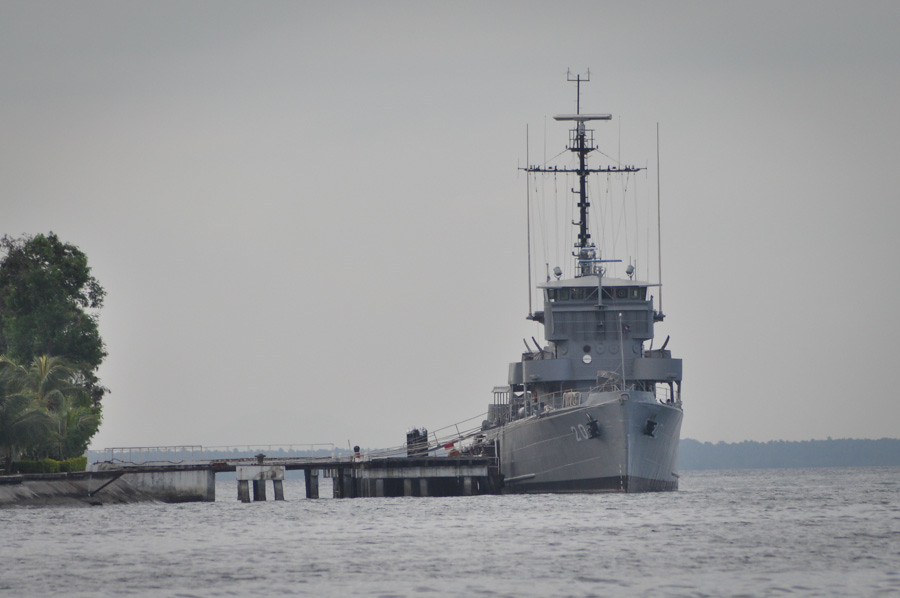
USS Lucid as commissioned, she is the only MSO afloat in the Western hemisphere

USS Lucid as commissioned, she is the only MSO still afloat in the Western hemisphere. Note her 40mm gun.

Some 53 hulls were completed by 1958 by a host of small domestic yards for the U.S. Navy (Luders, Bellingham, Higgins, etc) that specialized in wooden vessels, and often had created PT-boats and sub-chasers during WWII. In addition to this, 15 were built for France, four for Portugal, six for Belgium, two for Norway, one of Uruguay, four for Italy, and six for Holland. The design was truly an international best-seller and in some cases the last hurrah for several of these small yards.

In U.S. service, they were quickly put to work everywhere from the Med to the South China Sea, performing general yeoman tasks for the fleet itself, participating in mine exercises and running sweeping ops in areas that still had the occasional WWII-era contact mine bobbing around. In addition, they helped with missile and torpedo tests, harbor defense exercises, acoustic ranging experiments, noise reduction experiments, located downed aircraft, performed special operations in 1962 during the nuclear tests in the Pacific Ocean, were instrumental in the Palomares hydrogen bombs incident, performed midshipman training cruises to the Caribbean, made repairs to cables and helped in the recovering of boilerplate and capsules for the Mercury and Gemini NASA programs.

Their shallow draft (10-feet in seawater) made them ideal for getting around littorals as well as going to some out of the way locales that rarely see Naval vessels. USS Leader (MSO-490) and USS Excel (MSO 439) became the first U.S. warships ever to visit the Cambodian capital of Phnom Penh when they completed the 180-mile transit up the Mekong River on 27 August 1961, a feat not repeated until 2007. USS Vital (MSO-474) ascended the Mississippi River in May 1967 to participate in the Cotton Carnival at Memphis, Tennessee.

USS Gallant (MSO-489) was used in 1966 for the filming of the Elvis Presley film, Easy Come, Easy Go.

Vietnam is where the class really shined, arriving early to the conflict, taking part in the party, and then sticking around for the clean up afterward.

As early as 1962, USS Fortify (MSO-446) was deployed off the coast of South Vietnam with her minesweeping gear removed and an electronic countermeasures “box” was installed on the fantail. The ship was involved in monitoring and intercepting Viet Cong radio transmissions, vectoring RVN gunboats to interdict large junks coming down the coast from the North that were suspected of furnishing arms and ammunition to cadres in the south. This led to some near-misses with NVA torpedo boats even before the Gulf of Tonkin incident.

Many of the class participated in Operation Market Time (11 March 1965 to December 1972) in an effort to stop the flow of supplies from North Vietnam into the south by sea. According to Navy reports, “The Tonkin Gulf Yacht Club” was very successful, but received little credit. Eventually all the supply routes at sea became non-existent, which forced the North Vietnamese to use the Ho Chi Minh Trail.

USS LEADER (MSO-490) Caption: Is seen from a Saigon based SP-2H Neptune aircraft while on a Market Time patrol during the later 1960s. The plane and ship are exchanging information on coastal traffic in the area. Description: Catalog #: NH 92011

USS LEADER (MSO-490) Caption: Is seen from a Saigon based SP-2H Neptune aircraft while on a Market Time patrol during the later 1960s. The plane and ship are exchanging information on coastal traffic in the area. Description: Catalog #: NH 92011

As part of this effort, the shallow water craft boarded and searched South Vietnamese fishing junks for smuggled weapons and other contraband (during USS Loyalty‘s first patrol alone, her crew boarded 348 junks, detained two and arrested 14 enemy smugglers), served as mother ships for replenishing the needs of “Swift” boats, provided gunfire support to U.S. forces ashore, (on 22 and 23 March 1966 the USS Implict alone fired nearly 700 rounds of 40mm ammunition supporting small South Vietnamese naval craft under fire from enemy shore batteries), gave special operations support to the American Advisory units and performed hydrographic surveys on shoreline depths.

After the war, it was the Aggressive-class MSOs who were tasked with Operation End Sweep–removing mines and airdropped Mark 36 Destructors laid by the U.S. in Haiphong Harbor in North Vietnam and other waterways.

End Sweep's line in action

End Sweep’s line in action

In all some 10 MSO’s were part of Seventh Fleet’s Mine Countermeasures Force (Task Force 78), led by Rear Adm. Brian McCauley, during this six-month operation in the first half of 1973.

At the height of their involvement in Vietnam, the Navy started a mid-life extension and modernization process for roughly half of their MSOs. Running at $1.5 million per ship, the old Packard engines were removed and replaced with new aluminum block Waukesha diesels. The first generation mine sonar was swapped out for the new SQQ-14. As additional space on the foc’sle was needed for installation of the SQQ-14 cabling, the WWII-era 40mm Bofors bow gun was replaced with a mount for a twin 20 mm Mk 68. New sweep gear to include a pair of PAP-104 cable-guided undersea tools were added as was accommodation for clearance divers and two zodiacs powered by 40hp outboards.

Just 19 were updated to the new standard, and the MSO fleet began to severely contract.

Several took some hard knocks, especially when it came to fires.

USS Avenge (MSO-423) was gutted by a fire while drydocked at Bethlehem’s Fort McHenry Shipyard in Baltimore in 1969 and stricken the next year after a survey found her too far gone. An earlier flash fire on USS Exultant (MSO-441) while underway in 1960 claimed five lives though the ship herself was saved. USS Force (MSO-445) was not so lucky when on 24 April 1973 she lost off Guam after when a fuel leak was ignited by the No.1 Engine turbocharger and spread rapidly throughout the ship. USS Stalwart (MSO-493) capsized and sank as a result of fire at San Juan, Puerto Rico, June 25, 1966. USS Enhance (MSO-437), USS Direct (MSO-430) and USS Director (MSO-429) likewise suffered serious fires but were saved.

USS Prestige (MSO-465) ran aground and was stranded in the Naruto Straits, Inland Sea, Japan on 23 Aug 1958 and was abandoned as a total loss. Similarly, USS Sagacity (MSO-469) in March 1970, grounded at the entrance to Charleston harbor, causing extensive damage to her rudders, shafts, screws, keel, and hull, leading her to be stricken that October.

The Royal Navy diesel submarine HMS Rorqual bumped into the USS Endurance (MSO-435) while docking at River Point pier in Subic Bay, Philippines in 1969 while USS Forrestal (CVA-59) collided with the USS Pinnacle (MSO-462) at Norfolk in 1959. In all cases, the damage was slight.

USS Valor (MSO-472), just 15 years old, was found to be “beyond economical repair” in a survey in 1970 and scrapped.

By the end of Vietnam, the MSOs retained were converted to U.S. Naval Reserve Training (NRT) tasking classified as Naval Reserve Force (NRF) ships, used for training their complements of reserve crews one weekend a month two-weeks during the summer. This changed the crews from 7 officers, 70 enlisted (77 total) when on active duty, to 5 officers, 52 enlisted plus 25 reserve while a NRF vessel.

USS Energy (MSO-436) and Firm (MSO-444) were transferred to the Philippines, while USS Pivot (MSO-463), Dynamic, Persistent and Vigor went to Spain. Others, unmodernized, were sold for scrap.

By the 1980s, the European war scenario relied on North Atlantic Treaty Organization (NATO) allies to participate substantially in mine warfare operations, and U.S. mine hunters continued to decline until just the 19 modernized 1950s MSOs, built for Korea and validated in Vietnam, remained in the NRF.

A bow view of the ocean minesweeper USS FORTIFY (MSO 446) underway, 6/8/1982

A bow view of the ocean minesweeper USS FORTIFY (MSO 446) underway, 6/8/1982. National Archives Photo.

A starboard view of the ocean minesweeper USS ILLUSIVE (MSO 448) underway, 8/13/1984

A starboard view of the ocean minesweeper USS ILLUSIVE (MSO 448) underway, 8/13/1984. National Archives Photo.

During this period they often spent much time at the Mine Countermeasures Station at Panama City, Florida where they tested the first versions of the AN/WLD-1 (V) unmanned Minehunting systems, developed to scour the water for bottom and moored mines.

wld-1-2 wld-1-mms

A few NRF MSOs were activated to assist in the Persian Gulf in 1987-88 during the tanker escort period (Operation Earnest Will) that involved Iranian sea mines, typically old Russian M08 contact types, swept.

Three sweepers: USS Fearless (MSO-442), USS Illusive (MSO-448), and USS Inflict (MSO-456), were towed 9,000 miles by the salvage ship USS Grapple (ARS-53) from Little Creek, Virginia, to the Persian Gulf.

While conducting minesweeping operations in the northern Persian Gulf, Inflict discovered and destroyed the first of 10 underwater contact mines deployed in a field across the main shipping channel.

Crewmen handle a minesweeping float on the stern of the ocean minesweeper USS INFLICIT (MSO 456), 4/27/1988

Crewmen handle a minesweeping float on the stern of the ocean minesweeper USS INFLICIT (MSO 456), 4/27/1988. National Archives Photo

Then came the affair with Saddam in 1990.

Four minesweepers, USS Leader (MSO-490), USS Impervious (MSO-449), USS Adroit (MSO-509) and the brand new USS Avenger (MCM-1), were loaded aboard the Dutch heavy lift ship Super Servant 3 on 19 August 1990 at Norfolk and offloaded 5 October 1990 in the middle east.

Impervious, foreground, and Adroit (MSO 509) sit aboard the Dutch heavy lift ship Super Servant 4 as its deck is submerged to permit minesweepers to be unloaded. Photo by PHAN Christopher L. Ryan

Impervious, foreground, and Adroit (MSO 509) sit aboard the Dutch heavy lift ship Super Servant 4 as its deck is submerged to permit minesweepers to be unloaded. Photo by PHAN Christopher L. Ryan

You may not remember now, but Desert Storm at sea was a mine war, with USS Tripoli and USS Princeton (CG 59) rocked by exploding mines. Saddam sewed more than a 1,000 of his deadly easter eggs across the northern Gulf and it was the job of the sweepers, along with allied boats and helicopters and some 20 different EOD clearance teams, to clear the way for a possible D-Day style amphibious invasion by the Marines as well as hacking a path through the danger zone for battleships to approach for NGFS.

And with the victory in the desert, the MSOs were paid off, replaced nominally by a new class of (since disposed of) Osprey-class MHCs and the rest of the Avengers.

Between 1989-1994 the last of the MSOs were decommissioned and stricken with the healthiest four units transferred to the Republic of China Navy (Taiwan) in 1994-95: USS Conquest (MSO-488), USS Gallant (MSO-489), USS Pledge (MSO-492), and USS Implicit (MSO-455) as ROCS Yung Tzu (MSO-1307), ROCS Yung Ku (MSO-1308), ROCS Yung Teh (MSO-1309), ROCS Yung Yang (MSO-1306), respectively, are still in service.

exconquestandgallant

Six were held on red lead row until as late as 2002, when they were scrapped despite the pleas from veterans’ groups to preserve one, with the MARAD claiming it was policy not to donate wooden ships due to the cost and magnitude of the maintenance required for upkeep.

In all, some 50,000 sailors served at one time or another on these wooden ships and are very well organized in The Navy MSO Association.

Finally, the MSO sailors were came across the old USS Lucid (MSO-458) which had been sold as scrap for $40,250 back in 1976 and had been used as a houseboat ever since.

Donated, the ship has become part of the Stockton Historical Maritime Museum since 2011 and is open to the public.

lucid

She is the only MSO preserved in the West.

In Holland, HNLMS Mercuur (A856), after her decommissioning in 1987, was preserved as a museum ship, first in Amsterdam, later in Scheveningen. She will be towed to the city of Vlissingen at some point this winter, and re-open as a museum ship in Vlissingen’s Perry dock around March 2017.

In all, the class served 40 years in a myriad of tasks and a few are still around and kicking.

Not bad for some forgotten old wooden boats.

The ocean minesweeper USS INFLICIT (MSO 456) heads towards the Persian Gulf to support US Navy escort operations, 9/1/1987

The ocean minesweeper USS INFLICIT (MSO 456) heads towards the Persian Gulf to support US Navy escort operations, 9/1/1987

NATO hangs it up on Blackbeard

NATO’s last counter-piracy surveillance aircraft is flying her final mission, as part of the now-shuttered Operation Ocean Shield. The Royal Danish Air Force crew a Boeing Maritime Surveillance Aircraft, a modified Bombardier Challenger 604, and talks about how much the coast of Somalia has changed since the height of pirate activity in the Horn of Africa.

The operation, which began in 2009 as part of a broader international effort to crack down on Somali-based pirates who had caused havoc with world shipping, was conducted alongside Operation Atalanta— the EU operation in the area which current have a frigate each from Holland and Spain supported by a German P-3– and the 25-nation Combined Maritime Forces (CMF) Combined Task Force (CTF) 151, both of which are on-going.

At the height of piracy in January 2011 over 700 hostages and 32 vessels were being held by Somali pirates, with huge ransoms demanded for their release.  Today, no vessels or hostages are being held by Somali pirates. The most recent pirate incident occurred on 22 October 2016, when a chemical tanker, CPO Korea, was attacked by six armed men 330 nautical miles off the east coast of Somalia.

“The global security environment has changed dramatically in the last few years and NATO navies have adapted with it,” NATO spokesman Dylan White said in a statement. “NATO has increased maritime patrols in the Baltic and Black Seas. We are also working to help counter human smuggling in the Mediterranean.”

As for the EU operation, on Friday 25 November 2016, the European Council extended Operation Atalanta’s mandate to deter, disrupt and repress acts of piracy off the coast of Somalia, until 31 December 2018.

Smoke em if you got em

Australian National Maritime Museum Object number 00049309

Australian National Maritime Museum Object number 00049309

Bill Ettershank (owner/skipper) of the KEWARRA, lights one up while out looking for anything unusual in WWII as part of the Australian Volunteer Coastal Patrol. Note the binnacle and sail boom.

This image belongs in a collection that includes many images of members and vessels operated by the Volunteer Coastal Patrol (VCP) in the 1940s. It is believed most of the photographs were taken by the professional photographer and patrol member Peter Luke. Luke’s yacht WAYFARER served with the Volunteer Coastal Patrol on Sydney Harbour and along the NSW coast until the war ended in 1945. In 1944 Peter Luke was one of the co-founders of the Cruising Yacht Club and the Sydney to Hobart yacht race.

The Volunteer Coastal Patrol, the oldest voluntary sea rescue organization in Australia, was established on 27 March 1937.

When World War II was declared in 1939, members of the Patrol affirmed their desire to serve their country as a volunteer service by patrolling Australia’s waterways. In 1940 the Patrol had some 500 vessels and 2,000 members on its register– much the same as the Corsair Fleet formed by volunteers in their personal boats under the aegis of the U.S. Coast Guard at the same time.

During the war, Australian Coastal Patrol members became special constables and guarded commercial wharves, oil installations and bridges. By the war’s end, patrol vessels had patrolled 128,000 miles of harbor and coastal waters and donated 393,000-man-hours of unpaid war service. They were granted the right to fly the Police Nemesis pennant as recognition of this service and the right to fly the New South Wales State Flag as their ensign.

The VCP continued to operate in the post-war period in a purely voluntary capacity, constituting an important element in national security. Its objectives were rewritten to make the organization of value to the country in times of emergency as well as peace. In 1974 Her Majesty Queen Elizabeth bestowed the ‘Royal’ prefix to the Volunteer Coastal Patrol, and the group survives to this day in much the same role as the U.S. Coast Guard Auxillary.

Warship Wednesday Nov. 23, 2016: A long overdue Salute

Here at LSOZI, we are going to take off every Wednesday for a look at the old steam/diesel navies of the 1859-1946 time period and will profile a different ship each week. These ships have a life, a tale all of their own, which sometimes takes them to the strangest places. – Christopher Eger

Warship Wednesday Nov. 23, 2016: A long overdue Salute

Courtesy of D. M. McPherson, 1974. Catalog #: NH 81370

Courtesy of D. M. McPherson, 1974. Catalog #: NH 81370

Here we see the Admirable-class minesweeper USS Salute (AM-294) photographed sometime in 1944. Although she gave her last measure too soon after, her memory and relics endure.

The U.S. Navy has a long history of minesweeping, having lost the first modem ships to those infernal torpedoes in the Civil War. As a byproduct of Mr. Roosevelt’s Great North Sea Mine Barrage of the Great War, the Navy commissioned their first class of minesweepers, the Lapwing or “Old Bird” type vessels which lingered into WWII, followed by 1930s-era 147-foot three-ship Hawk-class and the much larger 220-foot Raven and Auk-classes early in the first days of that second great international hate.

In early 1941, the Navy set its sights on a hybrid class of new steel-hulled oceangoing sweepers built with lessons learned from their previous designs, that of a 180-foot, 750-ton vessel that could both clear mines and, by nature of their forward and aft 3″/50 guns, provide a modicum of escort support. Since they could float in 9’9″ of water, they were deemed coastal minesweepers at first.

Preliminary design plan, probably prepared during consideration of what became the Admirable (AM-136) class. This drawing, dated 2 May 1941, is for a 750-ton (full load displacement) vessel with a length of 180 feet. Scale of the original drawing is 1/8" = 1'. The original plan is in the 1939-1944 "Spring Styles Book" held by the Naval Historical Center U.S. Navy photo S-511-34

Preliminary design plan, probably prepared during consideration of what became the Admirable (AM-136) class. This drawing, dated 2 May 1941, is for a 750-ton (full load displacement) vessel with a length of 180 feet. Scale of the original drawing is 1/8″ = 1′. The original plan is in the 1939-1944 “Spring Styles Book” held by the Naval Historical Center U.S. Navy photo S-511-34

First of the class of what would eventually turn into orders for 147 ships (of which 123 were completed) was USS Admirable laid down as AMc-113, 8 April 1942 in Tampa, Florida.

Another 68 craft, sans mine gear, were completed as PCE-842-class patrol craft.

The hero of our tale– the first to carry her name– USS Salute (AM-294) was laid down 11 November 1942 at Winslow Marine Railway and Shipbuilding Co, Seattle, WA. Commissioned 4 December 1943 with LT Raymond Henry Nelson, Jr., USNR, in command, the addition of ASW gear and an AAA suite (though one of the original design’s 3-inchers were deleted) raised her displacement to 945 tons fully loaded but gave her some defense against Japanese subs and planes.

On board Salute on her builder's trials, note the Winslow Marine flag from her deckhouse

On board Salute on her builder’s trials, note the Winslow Marine flag from her wheelhouse

Salute on trials from Winslow

Salute on trials from Winslow

uss-salute-am-294-built-in-november-1942-by-winslow-marine-railway-and-shipbuilding-co
According to DANFS, she spent most of 1944 working out of Hawaii escorting convoys between Pearl Harbor, Majuro, Kwajalein, Eniwetok, Guam, and Saipan. It was in this work that she picked up her distinctive camo scheme in March 1944.

uss-salute-puget-sound

With LT Jesse Robert Hodges, USNR, assuming command in June, Salute reported to the 7th Fleet at Manus on 8 October 1944 for the Leyte invasion.

Working with her sisters in Mine Division 34 off the Leyte beaches, she helped clear the landing areas and provide cover fire from Japanese air attacks then combed the waters for survivors of the great Battle off Samar.

Between November 1944 and April 1945, a period of just over six months, Salute conducted dangerous pre-invasion sweeps at Ormoc Bay, Mindoro Island, Subic, the Lingayen Gulf, Zambales, Mariveles and off Corregidor in Manila Bay, the Sulu Sea off Palawan, and off the beaches of Legaspi– often while under fire from shore batteries and dodging kamikazes.

It’s not hard to see how she earned five battle stars for her World War II service. She reportedly cleared 143 Japanese naval mines during the Philippines Campaign.

On 9 May, Salute arrived at Morotai to prepare for operations in the Netherlands East Indies (today’s Indonesia).

It was in that chain that, while sweeping off Brunei Bay, Borneo, on 7 June 1945, she struck a mine, which broke the tiny ship’s back. Landing craft came alongside in an attempt to prop up the rapidly swamping ship, but her hull had taken fatal damage and within minutes, her crew was ordered off the ship. Once clear, the lines holding Salute to the landing craft were cut and she was cast loose into the bay where she quickly swamped, broke in two, and sank, her bow coming to rest over her stern.

salute-wreckFrom a report by Lt. James J. Hughes, an officer aboard Salute who survived the explosion:

“The ship was hit mid-ship, right underneath the belly, and it came right up through all the decks,” said Hughes. “Anybody in that area was killed, especially in the engine room; they didn’t have a chance. We hit it about 4:00 in the afternoon and sunk about midnight. We were making the last run of the day.”

Salute suffered nine crewmembers killed or missing and two officers and eight enlisted wounded with the War Department reporting her loss on June 26. She was struck from the Naval Register 11 July 1945.

Located in 90 feet of water at 5° 08’N, 115° 05’E, over the years she became a popular dive site after the Malaysian navy removed her unexploded depth charges, which brings us to recent developments.

Navy divers from Mobile Diving and Salvage Unit (MDSU) 1 along with Royal Brunei navy personnel dove on Salute from USNS Salvor (T-ARS-52), located in 90 feet of water, over a three-day period earlier this month.

The diving operations were the first by the U.S. Navy on the wreckage of Salute and were conducted as part of Cooperation Afloat Readiness and Training (CARAT) 2016.

“These operations provided U.S. Navy divers a unique opportunity to work alongside our Bruneian counterparts on a very meaningful project,” said Lt. Chris Price, detachment officer-in-charge, MDSU 1. “We are preserving our Navy’s rich history and heritage, and giving a very fitting remembrance to these fallen Sailors.”

USS SALUTE (November 16, 2016) U.S. Navy Divers attached to Mobile Diving & Salvage Company ONE divers serving with the Royal Brunei Armed Forces gather for a group photo at the wreckage site of USS Salute (AM-294), which sank in Brunei waters on June 7, 1945, during Cooperation Afloat Readiness and Training (CARAT) Brunei 2016, Nov. 15. CARAT is a series of annual maritime exercises between the U.S. Navy, U.S. Marine Corps and the armed forces of nine partner nations to include Bangladesh, Brunei, Cambodia, Indonesia, Malaysia, the Philippines, Singapore, Thailand, and Timor-Leste. (U.S. Navy photo by Lt. Chris Price/RELEASED)

USS SALUTE (November 16, 2016) U.S. Navy Divers attached to Mobile Diving & Salvage Company ONE divers serving with the Royal Brunei Armed Forces gather for a group photo at the wreckage site of USS Salute (AM-294), which sank in Brunei waters on June 7, 1945, during Cooperation Afloat Readiness and Training (CARAT) Brunei 2016, Nov. 15. CARAT is a series of annual maritime exercises between the U.S. Navy, U.S. Marine Corps and the armed forces of nine partner nations to include Bangladesh, Brunei, Cambodia, Indonesia, Malaysia, the Philippines, Singapore, Thailand, and Timor-Leste. (U.S. Navy photo by Lt. Chris Price/RELEASED)

USS SALUTE (November 16, 2016) U.S. Navy Divers attached to Mobile Diving and Salve Unit ONE place a memorial plaque at the wreckage site of USS Salute (AM-294) which sank in Brunei waters on June 7, 1945, during Cooperation Afloat Readiness and Training (CARAT) Brunei 2016, Nov. 16. (U.S. Navy photo by Lt. Chris Price/RELEASED)

USS SALUTE (November 16, 2016) U.S. Navy Divers attached to Mobile Diving and Salve Unit ONE place a memorial plaque at the wreckage site of USS Salute (AM-294) which sank in Brunei waters on June 7, 1945, during Cooperation Afloat Readiness and Training (CARAT) Brunei 2016, Nov. 16. (U.S. Navy photo by Lt. Chris Price/RELEASED)

Four artifacts– a gas mask, a glass inkwell, and two pieces of china: a larger plate and a smaller plate– were recovered and are being assessed for preservation.

161109-n-th437-008 161109-n-th437-029-1024x682 161109-n-th437-056-1024x682

From a NHHC Underwater Archaeology Branch release:

However, the four pieces are not all in the greatest of condition—the mask especially—and because of the aquatic environment they spent the last 71 years in, they will all require specialized conservation treatment. Conservation is a main component of any underwater archaeology program since artifacts recovered from submerged archaeological sites require special preservation care.

Besides the recent attention, Salute is remembered by a veteran’s website that hosts crew reunion information. In 1995 the group placed a wreath on her wreck during the 50th anniversary of the liberation of Labuan.

Her name was recycled for an Aggressive-class ocean minesweeper USS Salute (MSO-470) commissioned on 4 May 1955. She famously helped look for a lost H-bomb off Spain in 1966 and continued to serve until 1971 when she was broken up prematurely.

The U.S. Navy minesweeper USS Salute (MSO-470) at Luders Marine Construction Co., Stamford, Connecticut (USA), in January 1955.

The U.S. Navy minesweeper USS Salute (MSO-470) at Luders Marine Construction Co., Stamford, Connecticut (USA), in January 1955.

The latter Salute‘s engineering plans are preserved in the National Archives and she was the last to carry the name on the Navy List.

Speaking of plans, the Admirable-class sweepers have been a very popular model over the years:

lindberg-1-130-uss-sentry-am-299-admirable-class-wwii-us-navy-minesweeper

As for Salute‘s Admirable-class sisters, 24 were given to the Soviets in 1945 and never returned, others remained in use by the Navy through the Korean War era, and some were later passed on to the Taiwan, South Korea, the Republic of Vietnam, and the Dominican, Mexican, Myanmar, and Philippine navies.

At least five PCE-842/Admirable-class ships remain in nominal service as patrol craft with the Philippines including BRP Magat Salamat (PS-20), formerly USS Gayety (AM-239), shown below.

https://c2.staticflickr.com/4/3746/9469712901_3a0c96497c_b.jpg

Since 1993, the only Admirable-class vessel left above water in the U.S. is USS Hazard (AM-240).

Now a National Historic Landmark, she was retired in 1971 and, put up for sale on the cheap:

1971-newspaper-ad-for-the-disposal-of-uss-hazard-msf-240-an-admirable-class-minesweeper-of-the-wwii-us-navy

Hazard was installed on dry land at Freedom Park on the Missouri River waterfront in East Omaha where she is open to the public.

Please visit her.

hazard-buried-in-freedom-park

According to the NPS:

The ship was transferred to Omaha with all of her spare parts and equipment intact. The only equipment missing from USS Hazard is the minesweeping cable. All equipment (radio, engines, ovens, electrical systems, plumbing) is fully operational. USS Hazard still retains its original dishes, kitchen utensils, and stationery. USS Hazard is one of the best preserved and intact warships remaining from World War II. USS Hazard is a virtual time capsule dating from 1945.

Specs:

Image by shipbucket

Image by shipbucket

Displacement: 945 t (fl)
Length:     184 ft. 6 in (56.24 m)
Beam:     33 ft. (10 m)
Draft:     9 ft. 9 in (2.97 m)
Propulsion:
2 × Cooper Bessemer GSB-8 diesel engines
National Supply Co. single reduction gear
2 shafts
Speed:     14.8 knots
Complement: 104
Armament:
1 × 3″/50 caliber gun
1 × twin Bofors 40 mm guns
6 × Oerlikon 20 mm cannons
1 × Hedgehog anti-submarine mortar
4 × Depth charge projectors (K-guns)
2 × Depth charge tracks

If you liked this column, please consider joining the International Naval Research Organization (INRO), Publishers of Warship International

They are possibly one of the best sources of naval study, images, and fellowship you can find http://www.warship.org/membership.htm

The International Naval Research Organization is a non-profit corporation dedicated to the encouragement of the study of naval vessels and their histories, principally in the era of iron and steel warships (about 1860 to date). Its purpose is to provide information and a means of contact for those interested in warships.

Nearing their 50th Anniversary, Warship International, the written tome of the INRO has published hundreds of articles, most of which are unique in their sweep and subject.

PRINT still has it place. If you LOVE warships you should belong.

I’m a member, so should you be!

« Older Entries Recent Entries »