Category Archives: mine warfare

Warship Wednesday (on a Thursday) Jan. 11, 2024: Like a Bad Penny

Here at LSOZI, we take off every Wednesday for a look at the old steam/diesel navies of the 1833-1954 period and will profile a different ship each week. These ships have a life, a tale all their own, which sometimes takes them to the strangest places. – Christopher Eger

Warship Wednesday (on a Thursday) Jan. 11, 2024: Like a Bad Penny

Above we see the modified Russian Sokol (Falcon) class destroyer Reshitel‘nyi (also seen in the west transliterated as Rieshitelni, Ryeshitelni, or Reshitelnyy, and often confused with sister Rastoropny) and her crew in Port Arthur in 1904. 

She had…an odd career. 

The Sokol class

Basically the default class of Russian torpedo boat destroyers in the 1900s, the Sokols (sometimes referred to as the Krechet class as the second ship incorporated several minor changes) were a Yarrow design and were one of the world’s fastest such ships when they took to the water, with the lead ship hitting 30.2 knots at 4,500hp on trials– although with the more typical 3,800 hp output they were rated at 29 knots, which was still plenty fast for the era.

An artist’s impression of Sokol

Small and sleek, they were not much larger than torpedo boats, running about 190 feet overall with just a narrow 18.5-foot beam. They could float in just seven feet of water, making them ideal for littoral operations. Displacing around 240 tons, they used 2 VTE steam engines fed by 4 Yarrow boilers and were good for about 600 miles on a maximum 58-ton coal load when chugging along at 15 knots.

Sokol before delivery in 1895 while still in the Glasgow area on trials with her recently arrived Russian crew, but no armament. Via Cassiers Magazine circa 1897

Destroyer Сокол ‘Sokol’ during her travels from Great Britain to St. Petersburg in 1895, after a heavy green paint was applied and her armament installed.

Owl, later Ryanyy, on trials in the Gulf of Finland in May 1901. She would serve in the Baltic Fleet her entire career, survive the Great War, and was captured in Helsingfors by Finnish White Guards in 1918, later becoming S1, the first Finnish destroyer although she was largely just used for training along with four of her sisters. She was the last of the class afloat, only discarded in 1939.

Sokol class destroyer Prytkiy (Quick) formerly Kretchet

Their main armament was two Russian-pattern 15-inch Lessner-type torpedo tubes on aft turnstiles with six Whitehead torpedoes (two loaded, four in the bow cockpit with their warheads in the magazines) while her guns were French: a single 3″/48 Canet gun with 180 shells, and three 47mm 3-pounder Hotchkiss guns with a supply of 800 rounds. They could also carry as many as 18 mines in a pinch.

Sokol class destroyer. Note her large Canet gun forward, three smaller Hotchkiss guns spread out stern and amidships, and her two aft torpedo tubes. Observe the rail track running down the starboard side of the deck. This allowed reload torpedoes to be moved from the bow cockpit to the tubes and could also double as parking for mines, which could be deployed over the side

The crew was about 50 officers and men.

In all, 27 hulls of the Sokol/Krechet class were constructed between November 1894 when the class leader was laid down at Yarrow in Glasgow and the final, Statnyy, laid down by the Nevskiy works in St. Petersburg, was completed in July 1904. In between, two other yards– that of Wm. Crichton’s works in Finland and St. Petersburg and the Izhora Admiralty Works at Kolpino– got in on the contracts. Following Sokol’s lead, they were initially all issued bird names, but in 1902 this was changed to a more dynamic naming convention after attributes (Obedient, Strong, Zealous, et.al.)

Meet Our Tin Can

Laid down at the Nevskiy Works as Kondor in 1900, just after the Tsar’s government had wrestled a 25-year lease on the Chinese harbor at Port Arthur along with a concession to extend the Russian-run Chinese Eastern Railway to the port, the 12th Sokol was also the first of a series of 12 destroyers that would be shipped, incomplete, in sections some 7,000 miles east by rail and boat to be completed at the growing naval base on the Liaotung Peninsula.

These 12 were very slightly longer (200 feet oal vs the 190 feet of the standard Sokol) and heavier (300 tons full load vs 240) with a beam a few inches wider and a draft a few inches deeper. This was to accommodate eight smaller but more efficient Yarrow boilers and bunkers to carry as much as 80 tons of coal, giving them an endurance of 750 miles at 15 knots, something thought beneficial for the Pacific.

At that, Kondor, which had been renamed while incomplete, first to Baklan (Cormorant) and then to Reshitel‘nyi (Resolute) under the new naming convention for the type, took to the water of the Pacific and was commissioned on 14 July 1903.

Russian destroyer Reshitel‘nyi. One of the very few images of her

Of the 12 stretched Sokols sent to Port Arthur in such a manner, all managed to be completed although the final three– Strashnyy, Stroynyy, and Statnyy— were done in the summer of 1904 while the port was under Japanese blockade, so the shakedown period was…difficult.

War!

As covered above, Reshitel‘nyi was the oldest of the dozen modified Sokol class destroyers at Port Arthur during the Russo-Japanese War.

Her first skipper, the noted polar explorer LT Alexander Alekseevich Korniliev, died of pneumonia and severe concussion received in his ship’s first battle with the Japanese fleet in the frigid waters, one that saw the sister destroyer Steregushchiy sent to the bottom while on a scouting mission that bumped into a superior force.

Japanese destroyer IJN Sazanami attempting to tow a sinking Steregushchiy, lost in action against two Japanese cruisers, while Reshitel‘nyi managed to escape. In the fight, Reshitel‘nyi lost one killed and 16 injured– a third of her crew. William Lionel Wylie painting.

Reshitel‘nyi’s second skipper was Capt. (2nd Rate) Fyodor Emilievich Bosse, who had been in command of the two-ship task group when Steregushchiy was lost and was ordered to take over for the ailing LT Korniliev. Bosse, who was also wounded in the engagement, surrendered his command in March 1904 and was invalided back to European Russia (while the railroad was still connected) for recovery– saving him from the disaster that would befall the Tsar’s Pacific Squadron.

Bosse, who commanded the ill-fated task group that left Steregushchiy sunk, Reshitel‘nyi damaged, and himself wounded bad enough to be sent home. He would retire as a rear admiral in 1916 after 40 years of service, survive the Revolution and Civil War, and then go on to be an advisor to the Peruvian Navy during the 1932-1933 Peruvian-Colombian War. He is buried in Lima.

With her third skipper in less than a year, LT Platon Platonovich Travlinsky, the scratch-and-dent Reshitel‘nyi was one of the Russian destroyers on patrol just outside of Port Arthur that spoiled the second Japanese attempt to scuttle four blockships at the entrance, torpedoing them well short of the outer harbor, too far out to fill their intended role.

Russian accounts credit the destroyer Silnyii with hitting two of the blockships while Reshitel‘nyi torpedoed a third.

Second attempt to block Port Arthur, 27 March 1904 William Lionel Wylie RMG PV0976

In July, out of torpedoes, Reshitel‘nyi conducted two successful mine laying operations near the harbor’s approaches.

Escape to China

Russian RADM Wilgelm Vitgeft, the third head of the Russian Squadron at Port Arthur since the war started (the first was sacked and the second killed when his flagship was sunk), was ordered against his better judgment to break out of the besieged port in early August 1904 and form up with a group of armored cruisers that made up the Vladivostok squadron, turning the tables on the Japanese blockade force under Admiral Togo.

In a poor state and with repair facilities in Port Arthur lacking, Reshitel‘nyi was unlikely to be able to break out for Vladivostok and would have to remain in the port to be destroyed or scuttled by her crew should the siege not be lifted.

On the morning of 10 August, Vitgeft took everything he thought that could make it– the battleships Tsesarevich, Retvizan, Pobeda, Peresvet, Sevastopol, and Poltava, the protected cruisers Askold, Diana, Novik and Pallada, and 14 destroyers– out to sea. A few hours later, most of them limped back after being repulsed by Togo. Vitgeft and his staff were killed by a 12-inch salvo from the Japanese battleship Asahi that cleared the bridge of his flagship, Tsesarevich, which, heavily damaged, made for exile in the German treaty port of Tsingtao along with three German-made destroyers.

That afternoon came orders for Reshitel‘nyi to limp out under the cover of darkness to the nearest neutral port with a Russian consulate, Chefoo (now Yantai), some 100 miles directly across the Bohai Strait from Port Arthur on the Shandong Peninsula. There, she would bring vital dispatches for the consul to send on to the higher authorities, among them the details of Vitgeft’s defeat.

But first, let us paint you a picture of Chefoo during the Russo-Japanese War.

It was from Chefoo that the flotsam and jetsam of the combat at Port Arthur washed up. As early as February 1904, shipwrecked Japanese sailors rowed into the harbor in the lifeboats. This was followed by successive waves of Russian refugees and blockade runners of all stripes smuggling contraband across to the besieged garrison via sampan and coaster. Meanwhile, foreign correspondents of all stripes set up shop in Chefoo to turn second and third-hand tittle-tattle into news stories for the hungry masses back home. For example, many of the columns on the war appearing in the New York Times in 1904 were filed from Chefoo.

The indifferent Chinese Qing dynasty’s government at Chefoo was represented by one Admiral Sah aboard the fine German-built protected cruiser Hai Yung (2680 tons, 3×5.9 inch, 8x 4.1 inch, 3 tt), resting at anchor under the protection of a battery of Krupp-made coastal artillery that controlled the harbor.

Ashore was a division of the Qing New Army’s infantry and brigade of cavalry, both of which had Japanese instructors, so there is that.

Western warships also often could be found in the harbor, with the American cruiser USS Cincinnati sharing space that summer with German VADM Curt von Prittwitz’s visiting East Asiatic Squadron, with the old man aboard his flagship, the cruiser Furst Bismarck.

Now back to the story of our little destroyer’s breakout.

Moving out of Port Arthur on the dark night of 10 August, Reshitel‘nyi was able to make 18 knots and miraculously threaded her way through holes in the Japanese screen, arriving at Chefoo at 0605 on the morning of 11 August.

Reshitel‘nyi (spelled “Rieshitelni” on the record), was photographed at Chefoo, China, on 11 August 1904, possibly by U.S. Navy personnel or the American consul. Courtesy of Mr. Boris V. Drashpil, 1982. NH 94358

Her fourth skipper, the eager LT Mikhail Sergeevich Roshchakovsky (formerly of the daring little minelayer Avos who had crept within yards of Japanese warships to lay mines outside of Port Arthur), had a plan of his own which included patching his little warship up enough to be able to sortie south to the only allied port, Saigon in French Indochina, where he could presumably join Admiral Rozhestvensky’s Russian Baltic Fleet (dubbed the Second Pacific Squadron) for their final voyage.

Floating under the radar, so to speak, in the Chinese port without surrendering to internment wasn’t out of the question. At the same time, the damaged Russian light cruiser Askold and the destroyer Grosovoi had taken refuge in the port Wusong on the Yangzi and remained there, fully armed, until they voluntarily accepted internment the next month.

Service aboard shrapnel-riddled Askold in Shanghai

However, even in good repair, the likelihood that Reshitel‘nyi would be able to cover the 1,085 sea miles from Chefoo to Saigon, when her maximum range at 15 knots was only about 750 miles when packed with coal, avoiding prowling Japanese warships along the way, was slim.

Still, she would eventually link up with Rozhestvensky but in a quite different way than what Roshchakovsky had in mind.

Unluckily for Roshchakovsky’s plan, Admiral Sah, sending over officers from his cruiser, ordered the Russian destroyer disarmed within 24 hours or he would eject them from the port. Taking a vote from his crew, who elected to tap out rather than roll the dice at sea with moody engines, Roshchakovsky dutifully handed over the breechblocks from his deck guns, barred his torpedo tubes, and surrendered his small arms locker (13 rifles and two revolvers), in addition to disabling his engines and supplying the Chinese with a list of names of his crew. The Russians signed a pledge not to participate in further hostilities.

Roshchakovsky requested his ship be moved from the outer mole closer to shore where the guns of the cruiser Hai Yung and the Chinese coastal battery could protect it. Just in case, he ordered three small charges placed on the bulkheads in the magazines belowdecks, ready to scuttle if needed.

Reshitel‘nyi was out of the war.

Except she wasn’t.

Not wanting to let a juicy prize slip away, the Japanese destroyers Asashio and Kasumi entered the port shortly after Reshitel‘nyi was disarmed but before she could be moved to the inner harbor and dropped anchor in a position that cornered the Russian tin can. Refusing Admiral Sah’s signals to disarm and be interned or leave immediately, they replied that they would leave the next morning

Putting an armed prize party aboard the disarmed Reshitel‘nyi at 0330 on 11 August from two whale boats, Roshchakovsky confronted the Japanese officer in charge. With his hand on a sheathed sword, the Japanese lieutenant offered two options: immediately go to sea and engage in battle, even if he had to be towed, or surrender. Roshchakovsky selected a third option, and grabbed the Japanese officer, forcing him overboard and following him over the side into the harbor. A volley of fire from the Japanese blue jackets wounded the Russian with a bullet in his thigh.

In the ensuing melee, the Reshitel‘nyi’s crew, which more than outnumbered the two boats of Japanese, armed themselves with wrenches, fire axes, and coal shovels and fought it out, that is, until someone triggered the charges in the magazine, which were lackluster in performance.

Damaged but not sinking, the battle could end only one way, with the Japanese eventually taking over the Russian destroyer. Meanwhile, the waterlogged and bleeding Roshchakovsky and his 55 crew– with two men missing and several wounded– withdrew and made for shore. The Japanese suffered as well, losing at least two of their own.

Dawn came with the Japanese towing the captured Reshitel‘nyi out of the harbor and the Russians proceeding to their consulate, where most would spend the rest of the war.

The body of one of Reshitel‘nyi’s missing was recovered and buried ashore with full military honors, carried by her crewmates and escorted by an armed honor guard provided by Admiral Sah.

The crew of the Reshitel‘nyi in the courtyard of the Russian consulate in Chefoo grave of sailor Volovich. Roshchakovsky is the bearded officer in the center. 

The fisticuffs became worldwide news and were interpreted by newspaper artists around the globe.

The crew was decorated, with Roshchakovsky both the Order of St. Stanislaus, 2nd class with swords, and the Order of St. Vladimir, IV degree with swords and bow. His men received the Order of St. Anne.

They were Russian heroes in a war with few of those and became legends.

The Russians in late 1904 lodged a “Seven Points” letter with the Great Powers protesting China’s Japanese-leaning neutrality including the use by Japan of the Chinese Miano islands as a naval base, the transport of Japanese war material on the Shanhai-Newchwang railway, China’s Hongkew ironworks accepting Japanese military contracts, Chinese soldiers being enlisted in the Japanese Army, the use of Japanese officers in training the Chinese army, Japan paying Manchurian Hunhutses bandits as irregulars, and, last but not least, the Reshitel‘nyi incident in Chefoo.

Illustration of a “shameless geisha” holding Reshitel‘nyi after Japan captured the destroyer in a neutral port, from the Russian magazine Budil’nik. No. 32, 1904.

Of course, the Japanese countered with an equally lengthy list of instances where Russia had abused Chinese good graces during the conflict including the use of Chinese Army uniforms captured during the Boxer rebellion by scouting units in Manchuria and the entire concept of the East Chinese Railroad.

Under the Rising Sun

It turned out that, as Reshitel‘nyi was built to a British Yarrow design and carried common boilers and engines, the British-allied Japanese were able to repair her rapidly.

The breechblocks to her guns were replaced, and her 15-inch torpedo tubes were swapped out for larger 18-inch tubes. The refurbishment took six months, and she entered Japanese service on 17 January 1905 as the destroyer Akatsuki, taking that moniker to obscure the fact that the Japanese had lost a tin can of the same name to a mine the previous May.

Japanese Navy destroyer Akatsuki (ex-Russian Reshitelnyi) underway to participate in the Battle of the Sea of ​​Japan

Placed under the command of Capt. Masasaku Harada, she was with Togo’s fleet as part of his 1st Destroyer Division when it met Admiral Rozhestvensky’s Second Pacific Squadron at Tsushima in May 1905.

Ironically, her last Russian skipper, LT Roshchakovsky, was there as well, sailing on the old Admiral Ushakov-class coastal battleship Admiral Seniavin as the commander of the ship’s bow 10-inch turret. Roshchakovsky had quickly left Chefoo for Russia the previous August and, after meeting with the Tsar personally to brief him of the loss of Reshitel‘nyi, had asked for an appointment with Rozhestvensky’s squadron, joining Seniavin in October only days before the tub left Russia on her 18,000 trip that ended at Tsushima.

While Roshchakovsky and Harada did not personally engage in the swirling fleet action, the battle did not go well for either. Admiral Seniavin was surrendered on the morning of the 28th and became a Japanese prize– with Roshchakovsky becoming a guest of the emperor for the rest of the war. Meanwhile, Akatsuki/Reshitel‘nyi got so turned around in the dark due to heavy seas and harsh weather that she caused Japanese TB No. 69 to capsize and sink– one of Togo’s few losses in the battle.

Following the end of hostilities, Akatsuki/Reshitel‘nyi/Kondor/Baklan picked up her fifth name, Yamahiko (also seen as Yamabiko), and the loss of the original Akatsuki, a war secret, was finally announced. She would be joined in Japanese service by her sister Sokol class sister Silnyy, which had been scuttled at Port Arthur and rebuilt and renamed Fuzuki/Fumizuki.

Also captured by the Japanese were sisters Serdityy, Smelyy, Skoryy, and Statnyy, who were not returned to service. Meanwhile, sisters Storozhevoy, Steregushchiy, Razyashchiy, Rastoropnyy, Strashnyy, and Stroyny had been lost during the conflict.

Yamahiko in the 1914 Janes, the last of her class in Japanese service. Silnyy/Fuzuki had already been hulked in 1913.

Yamahiko in the 1915 Brassey’s

In 1917, our little destroyer was disarmed and removed from Japanese naval service. Working as the coaster Yamahiko Maru for some time, she was scrapped in 1919.

Epilogue

Of the 15 Sokols left in Russian service after 1905, two (Berkut and Prytkiy) were disposed of interwar while the rest were eventually rerated as dispatch vessels or torpedo boats, in the latter tasking picking up larger 450mm tubes. They would endure in the Baltic and Black Sea fleets for another decade, with some transferred to the inland Astrakhan-Caspian Sea flotilla via the Volga.

Baltic Fleet Sokol class destroyers 1912, Ryanyy in front

The Black Sea Sokols, in the 1914 Janes.

The final members retained in Soviet service– Prochnyy, Porazhayushchiy, Retivyy, Strogiy, and Svirepyy— would all be gone by the late 1920s.

The Sokol class destroyer Porazhayushchiy, which served in the Baltic fleet from commissioning until 1918, her crew helped to recover the vital cipher book from the grounded German cruiser Magdeburg in 1914. Porazhayushchiy was later transferred to the Caspian where she retired in 1925.

Following the collapse of Imperial Russia, five of the Sokols in the Baltic fleet– Korshun, Prozorlivyy, Rezvyy, Ryanyy, and Podvizhnyy— were captured by the newly independent Finns at Helsingfors (Helsinki) and Hango in 1918. They would be used by the nascent Finnish Navy as S1-S5 and disposed of throughout the 1930s.

S3 (Finnish destroyer) in commission from 1898 to 1921. Photographed about 1920. This ship was the former Russian Sokol-class Prozorlivyy,

The Finnish S-class boats in the 1931 ed of Janes, which at the time still in numbered two former Russian Sokols picked up in 1918.

Roshchakovsky

Now, we touch on the fate of the unsinkable LT Roshchakovsky.

Repatriated from Japan in January 1906 and still nursing wounds from Tsushima and Chefoo, he was seconded to the Ministry of Foreign Affairs for use as a naval attaché in Greece and Germany until he was able to return to duty with the Baltic Fleet in 1908. He would go on to spend the rest of his career with the Tsarist Navy in minelaying/minesweeping work and in small escorts, including command of the Ohotnik-class mine cruiser (minnykh kreyserov) Pogranichnik in the Great War. By 1916, he was in command of the defenses to Kola Bay and Arkhangelsk, where war material was stacked up.

When the Revolution came, Roshchakovsky was cashiered and denied even a pension despite his 23 years of service. He sat out the Civil War in Norway without taking sides– notably writing White Russian General Denikin and urging him to throw in the towel for the sake of the country-– but would spend the rest of his life filing requests with the Soviets to return to naval service, all of which were officially denied. A trained engineer who had won the Admiral Nakhimov Prize while a cadet in 1896, while in Norway Roshchakovsky worked for a shipbuilding company.

Returning to the Motherland in 1925, he served as head of the foreign department under the board of НиГРЭС, the new Nizhny Novgorod powerplant, until 1928, when he was arrested for his past ties to the old regime and exiled to Siberia for three years.

In 1937, at age 61, Stalin’s NKVD picked him up again and gave him five years in a labor camp due to being a “socially dangerous element.”

Capt. 1st Rank Mikhail Sergeevich Roshchakovsky, three-time winner of the St. Anne in addition to the St. Stanislaus and St. Vladimir, perished in the gulag sometime in 1938, the date and place lost to the butcher.


Ships are more than steel
and wood
And heart of burning coal,
For those who sail upon
them know
That some ships have a
soul.


If you liked this column, please consider joining the International Naval Research Organization (INRO), Publishers of Warship International

They are one of the best sources of naval study, images, and fellowship you can find. http://www.warship.org/membership.htm

The International Naval Research Organization is a non-profit corporation dedicated to the encouragement of the study of naval vessels and their histories, principally in the era of iron and steel warships (about 1860 to date). Its purpose is to provide information and a means of contact for those interested in warships.

With more than 50 years of scholarship, Warship International, the written tome of the INRO has published hundreds of articles, most of which are unique in their sweep and subject.

PRINT still has its place. If you LOVE warships you should belong.

I’m a member, so should you be!

Minehunters, ahoy

Standing NATO Mine Countermeasures Group 1, moving about Scandinavia in April 2023, with Norwegian coast guard cutter HNoMS Nordkapp (A531) trailing, preceded by FGS Rottweil (M1061), FS Céphée (M652), HNoMS Otra (M351), BNS Bellis (M916) and EML Sakala (M314). Foto Mediacentrum Defensie

Lots of interesting news coming from the world of sea mines.

First, from the Baltic, comes news that Standing NATO Mine Countermeasures Group One has been very busy over the late summer and fall. In just one recent nine-day operation in Estonian territorial waters, seven minesweepers/hunters covered an area of more than 22 square nautical miles and classified 228 items as “mine-like” objects.

Of those, 16 were positively identified as historical mines left over from WWI and WWII and neutralized.

“The Baltic Sea was heavily mined during the World Wars, however, some areas more densely than others,” Commander, SNMCMG1 Polish Navy Commander Piotr Bartosewicz said. “Estonian waters are one of the most mined areas in the world and provide a valuable opportunity to train and to increase SNMCMG1’s combat readiness.”

Bartosewicz took charge of SNMCMG1 on behalf of the Polish Navy in July 2023. He leads the group from its flagship Polish Navy ORP Czernicki (511) along with an international staff on board. In addition, the group comprises minehunters: Belgian Navy BNS Crocus (M917), German Navy FGS Bad Bevensen (M1063), Royal Netherlands Navy HNLMS Vlaardingen (M863), and two Polish Navy minesweepers ORP Drużno (641) and ORP Hańcza (642). The group was further strengthened by Allied minehunters from Estonia and Lithuania – ENS Ugandi (M315) and LNS Skalvis (M53), respectfully, during the HODOPS.

Earlier in the summer, as Operation Reassurance (OpRe) assets assigned to SNMCMG1, Royal Canadian Navy Clearance Divers accounted for six mines out of 10 neutralized in waters off Latvia.

They were operating from two of Canada’s venerable Kingston class “coastal defense vessels”HMCS Summerside and HMCS Shawinigan— which are basically offshore patrol assets that can be pressed into service as mine hunters.

MCDV HMCS Shawinigan (MM704) set up for MCM with SNMCMG1 Baltic October 2023. These 181-foot diesel-electric steel-hulled OPVs have done it all since they entered service in the early 1990s. Note the .50 cal M2 in front of her wheelhouse, a weapon not normally mounted. RCN photo

SNMCMG1 rafting in the Baltic in September. The largest ship is the 2,300-ton/242-foot mine defense command ship ORP Kontradmiral Xawery Czernicki (511) in center alongside 540-ton/168-foot Dutch minehunter Zr.Ms. Vlaardingen (M 863), with the Polish 216-ton/126-foot Gardno/207P-class harbor minesweepers ORP Hańcza (642) and ORP Drużno (641) at the top. At the bottom is the 650-ton/178-foot German Frankenthal-Class mine hunter Bad Bevensen (M 1063). The Canadian Kingston class sisters HMCS Summerside and HMCS Shawinigan are sandwiched between Bad Bevensen and Czernicki.

Lacking direct sweep gear, the combination of divers and REMUS ROVs proved a decent substitute on the 30-year-old Kingstons.

Tell me again how LCS can’t get it done?


Meanwhile, in the Black Sea…

NATO allies Turkey, Romania, and Bulgaria, plan to sign an agreement on 11 January to work together to sweep the Black Sea of mines.

Besides historical mines and UXO left over from the 20th Century, the ancient sea has seen numerous floating mines wandering around due to the more recent dust-up in Ukraine, with most being small but still dangerous shallow water (inshore/river) contact mines.

Most of the devices encountered so far have been Soviet M1943 MyaM-type shallow water (inshore/river) contact mines of the type licensed to both Iran (SADAF-01 type) and Iraq (Al Mara type) back in the 1980s, typically seen with very fresh Ukrainian naval markings and contact horns covered.

Last September, the Romanian minesweeper Lt. Dimitrie Nicolescu (DM-29) survived the detonation of a mine some 25 miles off Constanţa.

Enter the Houthi

Finally, it should be remembered that the Yemen Houthi have their own domestically made KS-2 Mersad (trans: Ambush), a High-Explosive (HE), moored, contact-initiated, blast seamine, of which lots of images are making their rounds these days.

First fielded in 2017, the Mersad reportedly contains just 46 pounds of HE and is armed via four simple contact horns connected to an electric detonator powered by 16 AA batteries.

Many have wondered if they were made from repurposed Chinese freon tanks popular in the region.

Welcome to the 21st Century.

Warship Wednesday, Nov. 29, 2023: As Easy as 123

Here at LSOZI, we take off every Wednesday for a look at the old steam/diesel navies of the 1833-1954 period and will profile a different ship each week. These ships have a life, a tale all their own, which sometimes takes them to the strangest places. – Christopher Eger

Warship Wednesday, Nov. 29, 2023: As Easy As 123

Naval History and Heritage Command Photograph NH 109514

Above we see Wickes-class tin can USS Gamble (Destroyer No. 123) steaming into after the review of Pacific Fleet, 13 September 1919, with her sister USS Radford (DD-120) trailing behind.

Brand new and beautiful in this image, she was commissioned 105 years ago today. Gamble would give her last full measure off Iwo Jima and be deep-sixed a month before the end of World War II but don’t worry, she rolled the dice and took a few of the Emperor’s ships with her.

The Wickes

Gamble was one of the iconic first flights of “Four Piper” destroyers that were designed in 1915-16 with input from no less an authority as Captain (later Admiral) W.S. Sims. Beamy ships with a flush deck and a quartet of boilers (with a smokestack for each) were coupled to a pair of Parsons geared turbines to provide 35.3 knots designed speed– which is still considered fast today, more than a century later.

The teeth of these 314-foot, 1,250-ton greyhounds were four 4-inch/50 cal MK 9 guns and a full dozen 21-inch torpedo tubes.

They reportedly had short legs and were very wet, which made long-range operations a problem, but they gave a good account of themselves. Originally a class of 50 was authorized in 1916, but once the U.S. entered WWI in April 1917, this was soon increased and increased again to some 111 ships built by 1920.


Wickes class USS Yarnall (DD-143): Booklet of General Plans – Inboard Profile / Outboard Profile, June 10, 1918, NARA NAID: 158704871


Wickes class USS Yarnall (DD-143): Booklet of General Plans – Main Deck / 1st Platform Deck / S’ch L’t P’f’m, S’ch L’t Control P’f’m, Fire Control P’f’m Bridge, Galley Top, After Dk. House and 2nd Platform Deck. / June 10, 1918, Hold NARA NAID: 158704873

Wickes class. A close-up of her stern top-down view of plans shows the Wickes class’s primary armament– a dozen torpedo tubes in four turnstiles and stern depth charges.

Meet Gamble

Our subject is the first Navy ship to be named in honor of at least two of the quartet of Gamble brothers who served in the War of 1812. The four brothers including Capt. Thomas Gamble (USN) who served aboard USS Onedia during the war and perished while in command of the sloop USS Erie of the Navy’s Mediterranean Squadron in 1818; 1st Lt. Peter Gamble (USN) killed on the USS Saratoga during the Battle of Lake Champlain in 1814; Lt. Francis B. Gamble (USN) who died of yellow fever in 1824 while in command of the USS Decoy of the navy’s West Indies Squadron; and U.S. Marine hero Lt. Col. (Brvt) John Marshall Gamble, the only member of the Corps to command an American warship in battle– the prize ship USS Greenwich in her combat with the British armed whaler Seringapatam in 1813. Only John lived into the 1830s, passing at age 44, still on active duty.

Two of the four brothers Gamble. Midshipman Thomas Gamble, USN (L) via Analectic magazine. Painted by Waldo, and engraved by J.B. Longacre. NH 49483 and Lt. John M. Gamble, USMC (R). Photo from a portrait in possession of his grandson. (Naval History and Heritage Command Photograph NH 49482)

Gamble (Destroyer No. 123) was laid down on 12 November 1917 at Newport News, launched on 11 May 1918 sponsored by a dour relative of SECNAV Josephus “Cup of Joe” Daniels; and commissioned at Norfolk 18 days after the Armistice on 29 November 1918.

Wickes class sisters USS Breese (DD-122) and USS Gamble (DD-123) on the ways at Newport News between November 1917 and May 1918. NH 43018

USS Gamble (DD-123) launched at Newport News, Virginia, on 11 May 1918. Her sistership USS Breese (DD-122) is next to her and launched the same day in a dual ceremony. NH 53813

Same as above, NH 53812

Entering a crowded and rapidly demobilizing fleet that was just coming off the Great War, Gamble would spend the next several months in a series of shakedowns and trials up and down the East Coast from Maine to Cuba but notably was one of the ships escorting the troop transport George Washington, which was carrying President Woodrow Wilson back to the U.S. from peace negotiations in Paris to Boston in February 1919 and again in July.

In May 1919, she was one of the support ships for the legendary first transatlantic flight by the Navy’s Curtiss NC flying boats, helping spot NC-4 through the Azores.

In mid-July 1919, Gamble, along with sisters Breese, Lamberton (Destroyer No. 119), and Montgomery (Destroyer No. 121), were shifted to the Pacific Fleet to join Destroyer Division 12 and made their way to San Diego via the Panama Canal.

USS Gamble (DD-123) and USS Breese (DD-122) photographed circa 1919, probably at Balboa, Panama, Canal zone. Courtesy of Jack Howland, 1983. NH 94956

Once on the West Coast, she would spend most of the next three years haze gray and underway, so to speak, steaming from up and down the West Coast from San Diego to Seattle and out to Pearl and back in a series of tests, maneuvers, and reviews.

Gamble photographed about 1919. NH 53815

Gamble at San Diego, California, circa 1919. NH 53816

USS Gamble (DD-123) photographed on 23 April 1919 with extensive tropical awnings covering her decks. Sister USS Breese (DD-122) is in the background. NH 53814

Gamble with her original DD-123 hull numbers. NH 67684

Destroyers at the Mare Island Navy Yard, 1919 (from left to right): USS Tarbell (Destroyer # 142); USS Thatcher (Destroyer # 162); USS Rizal (Destroyer # 174); USS Hart (Destroyer # 110); USS Hogan (Destroyer # 178); USS Gamble (Destroyer # 123); USS Ramsay (Destroyer # 124); and USS Williams (Destroyer # 108). Donation of Rear Admiral Ammen Farenholt, USN (Medical Corps). NH 42537

USS Gamble (DD-123) at anchor and dressed with flags, circa 1921, following the relocation of her after 4″/50 cal gun to the top of the after deckhouse. NH 59648

Battleship USS Mississippi (BB-41) at sea for maneuvers, during the early 1920s. Wickes class destroyers in the background include USS Radford (DD-120) and USS Gamble (DD-123). NH 46051

Destroyer tender USS Prairie (AD-5) in San Diego Harbor, California, with USS Gamble (DD-123) alongside, circa 1920-1922. NH 105775

U.S. fleet in Balboa, Panama, early 1920s. The center of the photo is the battleship USS New Mexico BB-40, then a cluster of flush deck destroyers including USS Ramsey DD-124, USS Montgomery DD-121, USS Breese DD-122, USS Lamberton DD-119, and USS Gamble DD-123. In the background are the battleship USS Mississippi BB-41, the tin cans USS O’Bannon DD-177, USS MacKenzie DD-175, USS Hugan DD-178, USS Anthony DD-172, and several other destroyers and another battleship in the far distance.

With budget cuts, Gamble was tapped to begin inactivation procedures and was decommissioned on 17 June 1922 and was held in reserve at San Diego.

Recall, and a job change

After nearly a decade on red lead row, Gamble was taken out of mothballs and redesignated a fast destroyer minelayer (DM-15) on 24 May 1930. This saw her head to Mare Island for a general overhaul and conversion.

The Navy had previously converted 14 Wickes and Clemson class ships to this designation in 1920, with the simple swap out of having their torpedo tubes replaced with a set of two 140-foot tracks that could carry approximately 85 1,400-pound Mark VI moored antenna mines (of which the Navy had 50,000 left over from the Great War) to drop over the stern.

The Navy ordered 100,000 Mark VI (MK 6) mines in 1917, carrying a 300-pound charge, and had so many left that even after using thousands during WWII they remained in U.S. service into the 1980s. Gamble and her sisters could carry as many as 85 of these on a pair of rails that ran, port and starboard, down the aft half of the ship.

As noted by Destroyer History.org:

Among the lessons World War I offered the US Navy was the possibility that fast ships could be effective in laying minefields to disrupt enemy operations. The surplus of flush-deckers at the end of the war provided an opportunity to experiment.

The original 14 circa 1920 rated destroyer-minelayers were slowly replaced throughout the 1930s by a smaller group of eight converted flush-deckers taken from mothballs– USS Gamble (DM-15)(DD-123), USS Ramsey (DM-16)(DD-124), USS Montgomery (DM-17)(DD-121), USS Breese (DM-18)(DD-122), USS Tracy (DM-19)(DD-214), USS Preble (DM-20)(DD-345), USS Sicard (DM-21)(DD-346) and USS Pruitt (DM-22)(DD-347).

Jane’s 1931 entry on the type. Note Breese is misspelled as “Breeze.”

Curiously, these ships would retain their white DD-hull numbers but wore Mine Force insignia on their bow, outwardly looking much more destroyer than minelayer.

Wickes-class destroyer USS Ramsey (DM-16)(DD-124) view was taken by Tai Sing Loo, at Pearl Harbor, T. H., circa 1930. Note that she is fitted out as a minelayer (DM) and retains her DD-hull number while wearing a mine-force insignia on her bow. NH 49953

In addition to these minelayers, several Wickes/Clemson class flush deckers were converted during the WWII era to other tasks including eighteen fast minesweepers (DMS), fourteen seaplane tenders (AVD), and six fast “Green Dragon” transports (APD) plus test ship Semmes (AG 24, ex-DD 189) at the Key West Sound School and damage control hulk Walker (DCH 1, ex-YW 57, ex-DD 163) which was reclaimed from commercial service as a dockside restaurant at San Diego.

All eight of the active destroyer-minelayers were formed into Mine Squadron 1 headed up by the old minelayer USS Oglala (CM 4), flagship of Rear Admiral William R. Furlong, commander of Minecraft for the Battle Force of the Pacific Fleet, and forward-based with “The Pineapple Fleet” at Pearl Harbor, where a new conflict would soon find them.

USS Oglala (CM-4); USS Gamble (DD-123/DM-15); USS Ramsay (DD-124/DM-16). (listed L-R) anchored off Cocoanut Island, Hilo Harbor, Hawaii, T.H., 12 December 1931. Mauna Kea Volcano is in the distance. Note that the DMs are still wearing their destroyer hull numbers but with Mine Force insignias. 80-G-409991

Gamble and her crew were busy while in Hawaiian waters in the 1930s, and often helped in search and rescue cases including that of the missing aircraft Stella Australis, the disabled steamer President Lincoln, and the yacht Lanikai.

She was also something of a public relations boat and was tapped to carry Territorial Governor Lawrence M. Judd from Honolulu to Hilo in 1931 then hosted the six-year-old singing and dancing wonder, Ms. Shirley Temple, in 1935.

Besides spending the day on Gamble, Temple was declared a Colonel of the Hawaiian National Guard, inducted as a Waikiki Beach lifeguard, and given a surfboard by Duke Kahanamoku during her 1935 Hawaiian trip.

Gamble (DM-15) dressed with flags while tied up in port, circa 1940 at the Golden Gate International Exposition (World’s Fair) in San Francisco. Note the circular Mine Force insignia, red/blue/white with a black center and outline, on her bow. In the distance is a USCG 240-foot Lake class cutter. Courtesy of the Mariners Museum, Newport News, Virginia. Ted Stone Collection. NH 66812

War!

All MineRon1’s ships were swaying at their berths at Pearl’s Middle Loch on 7 December 1941 when the Japanese attack came in. The squadron was divided into two divisions, with MinDiv2 consisting of Gamble, Montgomery, Breese, and Ramsay.

The response by Gamble, among others, was immediate, opening fire just two minutes after her lookouts saw enemy planes.

From her after-action report:

0745 Heard explosions on Ford Island.
0756 Wave of about 50 Japanese planes attacked battleships and Naval Air Station, Ford Island, planes flying at low altitudes about 500 feet over battleships from the direction of Diamond Head, about 700 feet over Ford Island. Five successive waves of the attack of about 10 planes each.
0758 Went to General Quarters, opened fire with .50 cal. machine guns on planes passing over nest at about 800 feet altitude. Set material condition afirm except for certain protected ammunition passages.
0759 Opened fire with 3″/23 cal. AA guns, firing as planes came within range, fuses set 3 to 8 secs.
0805 Mounted and commenced firing with .30 cal. machine guns on galley deck house.
0810 Commenced making preparations to get underway. Lighted off four boilers.
0925 One Japanese plane shot down by A.A. fire, falling in water on port beam about 1000 yards away from ship. Believed shot down by ROBERTS, W.L., BM2c, U.S.S. Gamble, port machine gunner (#2 machine gun) .50 cal., and JOOS, H.W., GM3c, U.S.S. Gamble (#1 machine gun) starboard.
0930 Division commenced getting underway. U.S.S. Breese underway.
0930 U.S.S. Gamble got underway and cleared mooring buoy.
0937 Japanese planes attacked near main channel entrance.
0955 Temporarily anchored, astern of U.S.S. Medusa.
1005 Underway proceeding out of channel.
1015 Shifted .30 cal. A.A. machine guns to top of pilot house on fire control platform.
1021 Cleared channel entrance. Eight depth charges were armed and the ship commenced off-shore anti-submarine patrol off Pearl Harbor entrance.
1204 Established sound contact with submarine and dropped three depth charges. Position bearing 162° T from Diamond Head Light, distant 2.5 miles.
1255 Proceeded on course 270° T at 20 knots to join friendly forces upon receipt of orders from CinCPac.
1412 Sighted sampan bearing 320° T.
1435 Slowed to investigate but did not search. Sampan position approximately 4 miles south of Barbers point.
1628 Sighted smoke bomb off port bow.
1631 Submarine surfaced.*
1632 Fired one shot 4″ gun and missed, short and to the left. Submarine displayed U.S. colors, and ceased firing. Submarine submerged and fired recognition red smoke bomb.
1647 Proceeded west.
1732 Sighted Enterprise and exchanged calls. Instructed by Commander Aircraft, Battle Force to join Enterprise.
1744 Joined Enterprise and took station as third ship with two other plane guard destroyers.

*The friendly submarine turned out to be the Tambor class boat USS Thresher (SS-200), which was unharmed although a critically ill member of her crew– the reason for her surfacing and heading to port– passed. She again tried to enter the harbor on 8 December but was driven off by depth bombs from a patrol plane and only made it into Pearl under escort from a seaplane tender. Thresher went on to become the most decorated submarine of the war with 15 battle stars and a Navy Unit Commendation.

Gamble would remain off Pearl for the rest of the month, dropping depth charges on at least two further underwater sound contacts, and continue her ASW mission into 1942 when she expanded her operations to Samoa and Fiji, sowing defensive minefields in the waters of both. She also picked up some much-needed extra AAA in the form of a couple of 20mm Oerlikons.

Escorting a convoy to Midway in June, Gamble returned with a high-profile enemy POW, CDR Kunizo Aiso, the former chief engineering officer of the Japanese carrier Hiryu which had been sunk in the pivotal battle.

Carrier flagship Hiryu: Last Moments of Admiral Yamaguchi at the Battle of Midway. oil painting by Renzo Kita, 1943. Most of the ship’s officers chose to ride her to the bottom or were evacuated. Aiso, forgotten in the engineering spaces with a small group of snipes, surfaced after the ship had been left to the sea and managed to take to lifeboats. 

Aiso was the senior Japanese naval officer imprisoned in the U.S. at the time and would be until 1944. Picked up at sea in a crowded lifeboat with 34 other survivors of his carrier after 12 days bobbing around the Pacific some 250 miles west of Midway, the English-speaking officer reportedly did not wish to return to Japan, nor wish his government be informed of his capture, preferring to be recorded as lost with his ship. For the trip to Hawaii, CDR Aiso was issued USN officer khakis and barricaded inside Gamble’s captain’s cabin with the wings cut off the wingnuts of the battle ports.

Finally, picking up 85 Mark VI mines at Pearl for points West, Gamble set off for Espíritu Santo in August 1942 and, from there, Guadalcanal.

DD-123, meet I-123

When it comes to pennant numbers, the meeting that Gamble had on the morning of 29 August some 60 miles east of Savo Island was curious. She came across I-123, a big Japanese I-121-class minelaying submarine, operating on the surface. On her fifth war patrol, she had left Rabaul two weeks prior under the command of LCDR Nakai Makoto and had already given the Marines on Lungga Point heartburn with her deck gun.

Type I-121 Submarine I-23 pictured at Kobe Naval Arsenal on April 28th, 1928

The rolling ship vs submarine combat between DM-15 (formerly DD-123) and I-123 over the course of four hours ended with Makoto and his 71 crewmembers receiving a promotion, posthumously.

Gamble’s report:

While the Japanese lost 131 seagoing Ro- and I-class submarines during World War II (100 by Allied action including mines, 3 in accidents, and 28 by unknown causes) I-123 was only the 12th boat sent to the bottom in the conflict and was one of the Empire’s first early losses.

Gamble was soon back to work.

The very afternoon after she sank I-123, she sped to Nura Island to pick up four shot-down TBF-1 Avenger (Bu. No. 00396) aviators of Torpedo 8 from the Saratoga (LT JG EL Fayle, ARM3c W Velogquz, S1C RL Minning and ARM3c JR Moncarrow), retrieved via her whaleboat from the surf line. She would rescue two more lost Airedales from Palikulo Bay two weeks later, picking up 2nd LT EN Railsbach, USMC, and Ens. EF Grant, USNR, after their SBD burned in.

Gamble was pressed into service at Guadalcanal as a fast troop transport, on the morning of 31 August carrying 158 Marines from Guadalcanal to Tulagi in company with sisters USS Gregory and USS Little, who were equally loaded down with Devil Dogs.

Gamble also was soon performing her primary role once again, that of sowing minefields around the area, planting 42 in a defensive belt in Segond Channel in December 1942.

Speaking of which…

Stopping the “Tokyo Express”

On 7 May 1943, Gamble and sisters Breese and Preble laid mines in the Ferguson Passage/Blackett Strait between Gizo and Wanawana Islands in the Solomons southwest of Rendova. Hidden by a rain squall and with enemy attention diverted by a supporting cruiser-destroyer group, the old four pipers were able to sow 250 sea mines in three rough lines across the strait in just 17 minutes.

Hours later, these mines were stumbled upon by a passing column of first-class Japanese tin cans of DesDiv 15 on an overnight fast troop transport run and sank the Kagero-class destroyer Kuroshio, with 83 lives, and crippled two sisterships– Oyashio and Kagero– which, barely able to maneuver and full of seawater, would be sunk the next day after being spotted by Navy dive bombers from Guadalcanal.

IJN First-class destroyer Hamakaze of the Kagerō-class. Three of her sisters were killed due to mines laid by Gamble and company. 

As noted by Allyn D. Nevitt over at Combined Fleet, “The loss of even one such modern destroyer was fast becoming intolerable to the Japanese; having a crack unit of three erased in one blow was pure catastrophe. American daring and ingenuity in the Blackett Strait had reaped a substantial reward indeed.”

After further service– including supporting the invasion of New Georgia and planting more mines– Gamble was sent to San Francisco in July 1943 for a three-month overhaul at Hunter’s Point Navy Yard. Arriving back in the South Pacific, Gamble spent November 1943 conducting several mining runs off Bougainville in the Solomon Islands in support of the Allied offensive there.

Then, as noted by DANFS:

Through late 1943 and much of 1944, Gamble generally served as convoy escort ship screening for enemy submarines while operating between Guadalcanal and Florida Island in the Solomons; Espíritu Santo; and Noumea, with additional runs to Suva, Fiji; Finschhaven and New Britain Island, New Guinea; Sydney; and Tarawa Atoll in the Gilbert Islands.

Overhaul

In September 1944, Gamble was sent back to the West Coast for four months at the Bethlehem Steel Repair Yard at Alameda. This led to a serious overhaul of her guns, landing all her old 3″/23s and 4-inchers in favor of a homogenized set of 3″/50s and 20mm Oerlikons.

According to her December 1944 plans, her WWII topside armament was mostly emplaced on a series of superstructure platforms except for a forward 3″/50 DP above the CPO quarters just 20 feet from the bow and a 20mm Oerlikon directly behind it in front of the wheelhouse. The ammo magazine was three decks down on the keel amidships and another on astern near the shafts, meaning a chain gang had to be established to hump it up top. The main gun platform was over the galley between the three remaining funnels and held two 3″/50 DPs (port and starboard) with hinged sponsons for the gun crew and two Oerlikons. A small gun tub with two single 20mm Oerlikons (port and starboard) was above Radio 3 next to the stub mast. The stern superstructure gun platform was built atop the crew’s washhouse and armory and held a single 3″/50 DP installed just 22 feet from the stern. Two portable .50 cals were set up midship atop the pilot house and on the main deck at frame 117 (of 177 frames).

She also only had three stacks by this point. 

All told, this fit gave her four 3″/50 DPs, five 20mm Oerlikons, and two .50 cals. She would also be fitted with a twin 40mm Bofors gun, although I am not sure of its placement. Not a lot of throw weight there, but then of course her main armament was in her mine rails and projectors for Mark VI depth charges.

Eight breakaway Carely float-type life rafts were installed to augment the ship’s 26-foot whaleboat and punt. The crew at this time was a skipper (LCDR/CDR) and 8 wardroom officers along with a mix of 132 rates and enlisted (62 Seamans branch, 57 Artificer branch, 4 Special branch, 4 Commissary branch, 5 Messman branch). By this time, she carried SF and SC radar sets and QCL sonar.

She also picked up a new camo scheme.

Camouflage Measure 32, Design 7D drawings prepared by the Bureau of Ships for a camouflage scheme intended for light minelayers of the DM-15 (Gamble) class. This plan, approved by Captain Torvald A. Solberg, USN, is dated 14 June 1944. 80-G-173486 and 80-G-173487.

This readied her for the “Big Show,” the push to Iwo Jima, Operation Detachment, in February 1945.

Back in the thick of it

On D+3, 17 February, Gamble closed into the beach close enough to cover the small minesweepers (YMS) and UDT teams of Sweep 5 and 6 clearing a path in the shoaling waters, shelling Japanese coastal emplacements and positions with her 3-inch and 40mm guns to silence them from harassing the cleaners via the application of 204 rounds of 3-inch AA Common and 254 of 40mm HETSD over seven hours. There, roughly six miles off Mt. Suribachi, she scored a hit on a large ammo dump with secondary explosions as well as silencing several enemy guns and bird-dogging other emplacements for the battlewagons.

Her NGFS report: 

Taking position off the old battlewagon Nevada the next night, she was hit by two small 250-pound bombs dropped by a  Japanese Kawasaki Ki-45 Toryu (Nick) twin-engine bomber that came in low and fast while she was silhouetted by star shells ashore. The bombs effectively wrecked our Gamble.

From her report:

Her crew was removed, and the shattered Gamble was towed to Saipan where she was decommissioned on 1 June 1945, and her name was stricken from the Navy Register three weeks later.

Stripped of anything thought useful, a series of images and videos were captured of her scuttling process, which took place off Guam on 16 July.


“Down Went the Gamble (DM 15).” Gamble was scuttled in June 1945. She was previously hit by Japanese enemy bombs in Feb 1945. Artist: Standish Backus, No.9. U.S. Navy photograph, now in the collections of the National Archives. 428-GX-KN 18978

Gamble received seven battle stars for service in World War II.

Epilogue

As Gamble was scuttled off Guam in deep water, few relics of her remain topside.

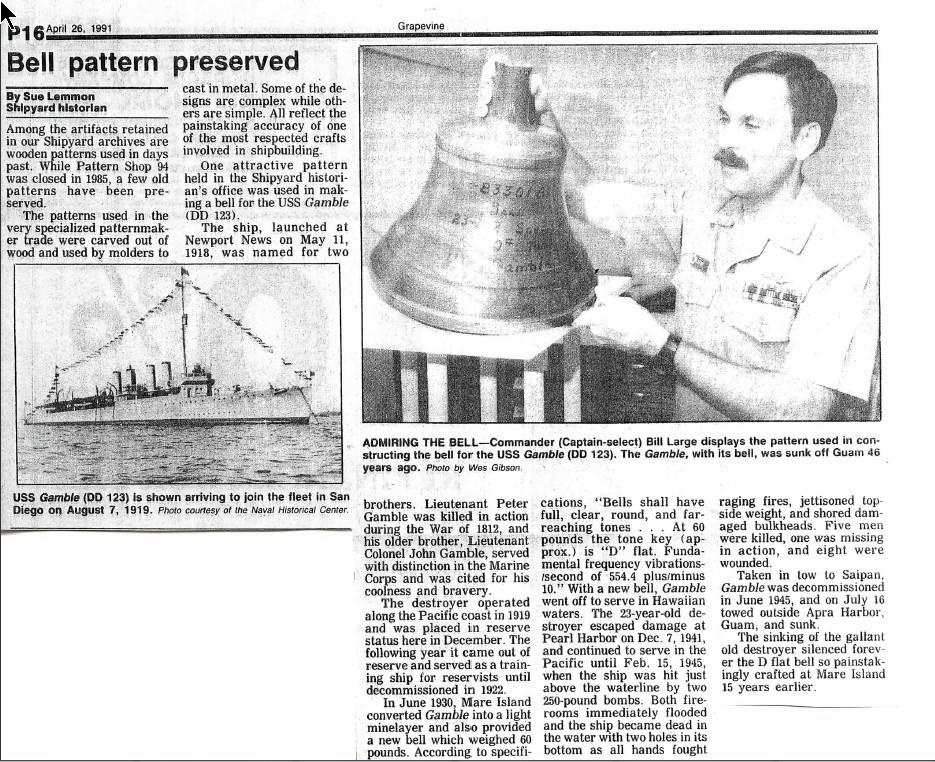
The wooden mold for her D Sharp ship’s bell, cast at Mare Island, resurfaced in 1991.

Her plans, drawings, deck logs, and war history are online in the National Archives. 

As for Shirley Temple, a bosun whistle presented to her by Gamble’s crew in 1935 remained a treasured possession for years. After all, she would meet her future husband, Charles Alden Black, a former Naval intelligence officer, in Hawaii in 1950 so perhaps those long-ago Pearl Harbor USN memories were prized. The whistle remained part of Ms. Temple’s estate and archives until it was sold at a 2015 auction by Theriault’s in New York.

It is undoubtedly in some collector’s display as this is written and perhaps will resurface one day.

Thus far, the Navy has chosen to not reissue the name “Gamble” to a second ship, which is a pity.


Ships are more than steel
and wood
And heart of burning coal,
For those who sail upon
them know
That some ships have a
soul.


If you liked this column, please consider joining the International Naval Research Organization (INRO), Publishers of Warship International

They are possibly one of the best sources of naval study, images, and fellowship you can find. http://www.warship.org/membership.htm

The International Naval Research Organization is a non-profit corporation dedicated to the encouragement of the study of naval vessels and their histories, principally in the era of iron and steel warships (about 1860 to date). Its purpose is to provide information and a means of contact for those interested in warships.

With more than 50 years of scholarship, Warship International, the written tome of the INRO, has published hundreds of articles, most of which are unique in their sweep and subject.

PRINT still has its place. If you LOVE warships you should belong.

I’m a member, so should you be!

Grendel in its Cave, 80 Years Ago

Here we see the Kriegsmarine battleship Tirpitz at Kåfjord in German-occupied Norway, in September 1943. Note the triple torpedo nets surrounding the beast and the flotilla of attending patrol and support craft.

The slightly improved sister to the infamous Bismarck, she would be attacked by an unlikely Beowulf in the form of a trio of British midget submarines while the monster was safe in its Kåfjord cave some 80 years ago today.

Termed Operation Source, after passing through the series of protective torpedo nets, one of the miniature subs, HMS X6, placed two mines of two tons each under the battleship’s keel, while X7 set a third.

Operation ‘Source’, 22 September 1943. Johne Makin (b.1947) via the Royal Navy Submarine Museum Collection.

While all three of the daring British X craft were lost in the resulting explosion and Tirpitz was severely damaged, she was back in service six months later and it would not be until November 1944 that the injured beast was finally slain.

Warship Wednesday, Aug. 9, 2023: The Lost Desert Wind

Here at LSOZI, we take off every Wednesday for a look at the old steam/diesel navies of the 1833-1954 period and will profile a different ship each week. These ships have a life, a tale all their own, which sometimes takes them to the strangest places. – Christopher Eger

Warship Wednesday, Aug. 9, 2023: The Lost Desert Wind

Photo by Stewart Bale Ltd, Liverpool, Imperial War Museums’ Foxhall Collection, no. IWM FL 19059 http://www.iwm.org.uk/collections/item/object/205121477

Above we see the third flight S-class diesel boat, HM Submarine Simoom (P225), underway, likely in 1943, her only year of service. A rather unlucky boat, Simoom fired 15 war shot torpedoes in her career and, although she never hit a target that she intended to punch a hole into, she did manage to spectacularly claim her only “kill” some 80 years ago today.

The mighty S-class

Built to replace the aging boats in RN service, the first pair, HMS Swordfish, and HMS Sturgeon, were ordered in the 1929 program. Small boats, running just over 200 feet in overall length and displacing around 600 tons (900 submerged), they were relatively fast for the day, capable of breaking almost 14 knots on the surface, making them able to catch up to slow-moving merchantmen, and carried a full dozen Mark VIII torpedoes for their six-pack of forward 21-inch tubes. Meanwhile, a 3-inch deck gun and a Vickers light machine gun gave a topside armament. This could be augmented by a dozen mines. Able to operate in shallow waters, with a draft of only 10.5 feet, and able to submerge in 10 fathoms, they could crash dive in just 25-30 seconds with a good crew if needed.

Not bad for a 1920s design.

The 1929 Chatham Dockyard plan of the flight I S-class boats. Chatham would only produce two boats (HMS Shalimar and Sportsman), whereas most were built by Cammell Laird and smaller numbers by Scotts and Vickers.

As noted by Richard Worth in his Fleets of World War II:

“Meant as replacements for the old H-class, they required the same virtues of maneuverability and quick diving. But the Admiralty wanted more– improvements in range, armament, and surface speed. The “S” types became a pillar of His Majesty’s Submarine Force; not remarkable in any respect, rather they performed well all tasks at acceptable levels, a class of well-balanced and workmanlike boats that proved safe and easy to operate.”

A great period color shot of the S-class submarine HMS Seadog (P216), in the foreground moving off, Holy Loch, 1942. The Group 1 T-class submarine HMS Thunderbolt (N25) is in the background. Of note, Thunderbolt was originally HMS Thetis which sank with heavy loss of life in the Mediterranean just before the war and was subsequently salvaged. The two objects seen on her after casing are containers for human torpedo chariots. IWM TR 612

In all, the British would order no less than 73 S-class boats in three flights across 12 construction programs, and they would remain in production from 1930 through 1945, spanning both the interbellum and WWII era. In all, 62 were completed.

Meet HMS Simoom

The name “Simoom” after the desert wind, dates to an 1842 paddlewheel frigate and was used in no less than five other ships by the Royal Navy. The subject of our tale is the sixth and (thus far) final HMS Simoom.

Ordered in the largest batch of S-class boats (20 hulls) under the 1940 war program, she was a third flight vessel and as such had several minor improvements including a slightly higher freeboard forward, a less complicated and simplified engineering layout that allowed a maximum speed approaching 15 knots (one of the batch, HMS Seraph, could hit 16.75 knots). She also had a seventh tube installed, an external one, giving her 13 torpedoes in total. Also, in lieu of a Vickers gun, the 3rd flight S-boats carried a 20mm Oerlikon AAA gun and a primitive air warning RDF receiver. They also carried a Type 138 ASDIC system and a Type 291/291W early-warning radar.

Laid down at Cammell Laird, Birkenhead (a yard that built at least 26 of the class) on 14 July 1941, Simoom was launched the following October and commissioned on 30 December 1942, her construction spanning just under 17 months.

A series of great images were captured of her in April 1943, steaming in conjunction with the captured German Type VIIC U-boat U-570 (HMS Graph, P715).

HM SUBMARINE SIMMOM AND GRAPH AT HOLY LOCH. 20 APRIL 1943, HOLY LOCH. (A 16049) HMS SIMOOM (right) and HMS GRAPH. Copyright: © IWM. Original Source: http://www.iwm.org.uk/collections/item/object/205149055

HM SUBMARINE SIMOOM. 20 APRIL 1943, HOLY LOCH. (A 16041) The SIMOOM from the beam. Copyright: © IWM. Original Source: http://www.iwm.org.uk/collections/item/object/205149047

HM SUBMARINE SIMOOM. 20 APRIL 1943, HOLY LOCH. (A 16047) The SIMOOM from dead ahead. Copyright: © IWM. Original Source: http://www.iwm.org.uk/collections/item/object/205149053

HM SUBMARINES SIMOOM AND GRAPH. 20 APRIL 1943, HOLY LOCH. (A 16048) HMS SIMOOM (nearer) and HMS GRAPH together at Holy Loch. Copyright: © IWM. Original Source: http://www.iwm.org.uk/collections/item/object/205149054

HM SUBMARINE SIMOOM. 20 APRIL 1943, HOLY LOCH. (A 16043) The SIMOOM from the beam. Copyright: © IWM. Original Source: http://www.iwm.org.uk/collections/item/object/205149049

HMS SIMOOM, BRITISH S-CLASS SUBMARINE. 20 APRIL 1943, HOLY LOCH. (A 16045) Copyright: © IWM. Original Source: http://www.iwm.org.uk/collections/item/object/205149051

HM SUBMARINE SIMOOM. 20 APRIL 1943, HOLY LOCH. (A 16043) The SIMOOM from the beam. Copyright: © IWM. Original Source: http://www.iwm.org.uk/collections/item/object/205149049

As detailed by Uboat.net, her wartime service was brief.

Her first war patrol off Northern Norway to provide cover for convoy operations to and from Northern Russia in early 1943 was uneventful as was her second in the Bay of Biscay.

Transferring to the still very active Med, her third patrol, off the West coasts of Corsica and Sardinia was a bust.

Her 4th, providing coverage for the invasion of Sicily harassed some coastal shipping and, in the end, she would sink the Italian destroyer Vincenzo Gioberti on 9 August 1943.

Simoon had fired a brace of six torpedoes at the big boys of RADM Giuseppe Fioravanzo’s 8th Cruiser Division (light cruisers Giuseppe Garibaldi and Emanuele Filiberto Duca d’Aosta) but caught the smaller Vincenzo Gioberti instead, making her the last Italian tin can sunk in the war.

Italian destroyer Vincenzo Gioberti, photographed before World War II. NH 47663

She is believed to have taken 95 men to the bottom with her after dramatically breaking in two parts and sinking. Some 171 survivors of Gioberti were recovered by MAS torpedo boats from La Spezia.

The end of Italian destroyer Vincenzo Gioberti, torpedoed by HMS Simoom on 9 August 1943. She was the last Regia Marina destroyer to be lost in the war against the Allies. Photo by “Storia Illustrata” magazine

Other rather sedate patrols followed.

The mysterious end of Simoom‘s tale came in November while on her 7th patrol.

Via Uboat.net:

2 Nov 1943
HMS Simoom (Lt. G.D.N. Milner, DSC, RN) departed Port Said for 7th war patrol (5th in the Mediterranean). She was ordered to patrol between Naxos and Mikonos, Greece. At 1142B/2 she reported that she did not hold the letter coordinates for November and would use those of October. This prompted Captain S.1 to communicate them the following evening.

On the 5th she was ordered to patrol off the Dardanelles, five nautical miles west of Tenedos.

On the 13th she was ordered to leave her patrol area PM on the 15th passing between Psara and Khios, through 35°06’N, 26°44’E and then on the surface from 34°25’N, 29°59′ E. She was due in Beirut at 0901B/20 but this was later corrected to the 19th.

Simoom did not show up at Beirut. She was declared overdue on 23 November 1943.

At 1729 hours, on 15 November, the German submarine U-565 (KL Fritz Henning) fired a single stern torpedo from 2000 metres at a target described as “probably a submarine” on course 250°, one hit was heard after 3 minutes and 48 seconds. The position recorded was Quadrat CO 3381 (36°51’N, 27°22’E or off the east coast of Kos) and it is unlikely that HMS Simoom was in the area. Post-war analysis concluded that she was probably mined on 4 November 1943 on a new minefield laid off Donoussa Island (ca. 37°06’N, 25°50’E).

Her roll of lost, marked “missing presumed killed” 19 November 1943:

ADAM, William G, Able Seaman, P/JX 344969, MPK
ANGLESEA, John, Engine Room Artificer 5c, D/MX 102924, MPK
BALSON, Lewis F C, Warrant Engineer, MPK
BEDFORD, Maurice A, Ty/Leading Seaman, D/SSX 27992, MPK
BROADBRIDGE, Thomas G, Stoker 1c, C/KX 83568, MPK
CASPELL, George E, Telegraphist, C/JX 163711, MPK
COLE, Edward, Stoker Petty Officer, P/KX 83973, MPK
CROSS, Charles M, Ty/Sub Lieutenant, RNVR, MPK
DAY, Horace C, Signalman, C/JX 207606, MPK
ELLIN, Sidney, Petty Officer Telegraphist, C/JX 135616, MPK
ELLIOTT, Robert, Able Seaman, P/JX 322974, MPK
FRANCIS, Rolland J, Stoker 1c, D/KX 137871, MPK
GARBETT, Basil M, Lieutenant, MPK
GILL, Geoffrey, Able Seaman, C/JX 235129, MPK
GOWLAND, William R, Able Seaman, D/SSX 15958, MPK
GRIFFITH, Ben, Petty Officer, D/J 113001, MPK
HANNANT, James H, Able Seaman, D/JX 202875, MPK
HARRIS, Walter, Stoker 1c, D/KX 134758, MPK
HATTON, Charles W, Able Seaman, C/JX 169095, MPK
HERD, Charles E, Ordinary Seaman, P/JX 281907, MPK
HERSTELL, Norman, Able Seaman, P/JX 347783, MPK
JOHNSON, Robert J, Able Seaman, C/SSX 26525, MPK
JONES, Louis F, Ty/Sub Lieutenant, RNVR, MPK
KENNEDY, Gordon A, Leading Telegraphist, D/JX 154462, MPK
KERR, David A, Engine Room Artificer 4c, P/MX 55013, MPK
LANDING, John, Leading Stoker, P/KX 84477, MPK
LILLYCROP, Francis W, Stoker 1c, P/KX 145412, MPK
LOVELL, Ernest A, Able Seaman, P/SSX 18599, MPK
MARSDEN, Tom, Engine Room Artificer 4c, P/MX 79301, MPK
MASON, George H, Act/Leading Stoker, P/KX 90779, MPK
MAY, Sidney J, Able Seaman, C/SSX 30974, MPK
MCLENNAN, Harold B W, Ty/Act/Leading Telegraphist, C/JX 259236, MPK
MILNER, Geoffrey D N, Lieutenant, MPK
MORTIMER-LAMB, Robert J, Ty/Petty Officer, C/JX 145875, MPK
OLDING, Walter G, Act/Chief Engine Room Artificer, P/MX 46951, MPK
O’LEARY, Michael T, Electrical Artificer 3c, D/MX49539, MPK
RAWE, James A, Act/Chief Petty Officer, RFR, P/JX 136102, MPK
SALMON, Alfred W, Able Seaman, P/JX 295724, MPK
SAUNDERS, Arthur, Able Seaman, P/JX 155201, MPK
SCHOFIELD, Bernard P, Able Seaman, C/JX 241234, MPK
SEABORNE, William J R, Stoker 1c, D/KX 94051, MPK
SHANKS, Thomas S, Ty/Sub Lieutenant, RNVR, MPK
SHARP, Norman, Able Seaman, D/JX 223594, MPK
SHEPHERD, John V, Stoker 1c, P/KX 83132, MPK
SMITH, William J, Stoker 1c, D/KX 145306, MPK
SONGHURST, Thomas J, Stoker 1c, C/KX 83463, MPK
TAYLOR, James, Engine Room Artificer 4c, C/MX 77617, MPK
WARDALE, Irvin, Able Seaman, D/JX 303574, MPK
WILSON, William, Act/Petty Officer, P/SSX 18131, MPK

Epilogue

In 2016, Turkish wreck-hunter Selcuk Kolay found HMS Simoom (P225) about 6 nautical miles northwest of the Turkish Aegean Island of Bozcaada (Tenedos) in 67 meters of water. There was extensive damage near the starboard hydroplane with the conclusion that Simoom had hit a mine while running on the surface. The mine Simoom hit was believed one sown by the German minelayer Bulgaria and the Italian torpedo boats Monzambano and Calatafimi in September 1941.

Likewise, Simoom’s only “kill,” the Italian destroyer Vincenzo Gioberti, had been discovered the year prior.

The Royal Navy’s wartime losses totaled 74 submarines. Of those, no less than 19 were S-class boats.

Across over 3,000 patrols, HM submarines sank 158 enemy combatant ships and damaged 54 others, in addition to sinking 1.6 million tons of enemy merchant shipping. A lot of that came from S-class boats.

Nonetheless, they were small and slow by postwar standards. By 1946, Janes listed just 39 S-class boats under the British fleet’s entry and a half-dozen of those warned “may be discarded in the near future.”

Soon, nine would be transferred to France, Portugal, and Israel.

One, HMS Sidon (P259), was wrecked by its own torpedo explosion on 16 June 1955 then refloated and sunk as a target. Another, HMS Sportsman/French submarine Sibylle, was lost off Toulon in 1952 in a diving accident.

Of the dwindling number of S boats still in RN service, most were withdrawn in the late 1940s and 1950s while still relatively young with just a couple lingering on for a few years longer. HMS Sea Devil, completed just after VE-Day, was paid off for disposal at Portsmouth on 4 June 1962, and was the last of the S class in service with the Royal Navy, completing 17 years of service. She was sold to the shipbreaker Metal Recoveries and arrived at Newhaven on 15 December 1965.

The sparsely used trio of boats operated postwar by Portugal (HMS Saga/NRP Nautilo, HMS Spearhead/NRP Nepunto, and HMS Spur/NRP Narval) were disposed of in 1969.

The last of the class afloat, HMS Springer, was used by Israel until 1972 as INS Tanin and had landed commandos in Egypt during the Six-Day War.

Submarine INS Tanin (ex-HMS Springer) arrives at Port of Haifa in 1959. She would be the last S-class boat


Ships are more than steel
and wood
And heart of burning coal,
For those who sail upon
them know
That some ships have a
soul.


If you liked this column, please consider joining the International Naval Research Organization (INRO), Publishers of Warship International

They are possibly one of the best sources of naval study, images, and fellowship you can find. http://www.warship.org/membership.htm

The International Naval Research Organization is a non-profit corporation dedicated to the encouragement of the study of naval vessels and their histories, principally in the era of iron and steel warships (about 1860 to date). Its purpose is to provide information and a means of contact for those interested in warships.

With more than 50 years of scholarship, Warship International, the written tome of the INRO has published hundreds of articles, most of which are unique in their sweep and subject.

PRINT still has its place. If you LOVE warships you should belong.

I’m a member, so should you be!

Mines, Mines, Mines

Word is that Australia plans to invest the equivalent of $800 Million in new sea mines, sourced from Italy.

Comparatively, the Chinese have an active offensive mining development program counting an estimated 80,000 devices consisting of up to 30 types, including encapsulated torpedo mines and rising mines.

This comes as the Vigilance Offshore Patrol Vessel (OPV), pitched by VARD for the Royal Canadian Navy’s future fleet, was shown off at CANSEC 2023, complete with a stern Cube modular minelaying system installed.

Vigilance Class Offshore Patrol Vessel (OPV) with The Cube System

The system uses 40-foot containers for a wholly “bolt-on” minelaying option

A digital mockup of the Cube minelaying system on HMS Tamar, another small OPV currently in the Pacific. 

Suffice it to say, these could fit inside the open below-deck mission bay of the Independence-class LCS– here seen on USS Cincinnati (LCS-20)– while still leaving the helicopter deck and hangar free.(Photo: Chris Eger)

Meanwhile, here in the States, the Air Force is working on a program for a single B-52 to drop a dozen 2,000-pound mines from a distance of 40 miles off, one that could be very useful in the Pacific one day.

An inert Joint Direct Attack Munition QuickStrike Extended Range mine is attached to a U.S. Air Force B-52H Stratofortress assigned to the 49th Test and Evaluation Squadron, Barksdale Air Force Base, La., in early March 2023. (U.S. Air Force courtesy photo 230524-F-AA323-1002)

From Air Force Strike Command:

A B-52H Stratofortress attached to the 49th Test and Evaluation Squadron validated the ability to deploy inert Joint Direct Attack Munition (JDAM) QuickStrike Extended Range (QS-ER) mines from a standoff distance of more than 40 miles off the coast of Kauai, Hawaii at the Pacific Missile Range Facility in early March 2023.

The QS-ER mine marries the concept of a Mk64 underwater mine to that of the GBU-64v1 JDAM Extended Range variant. The resulting weapon is the 2,000-pound QS-ER mine.

Traditionally mines are employed as unguided gravity weapons, forcing the aircraft to fly at lower altitudes and releasing the mines at multiple intervals rather than single releases. This means the mission cannot be accomplished in a contested waterway without accepting a high level of risk. But the QS-ER program changes this concept completely.

Spotted in the Mississippi Sound: Cool Little Haze Gray AUSVs

So we came across this interesting little guy while wandering around the small craft harbor in Gulfport last week.

A closer look shows lots of solar panels on the folded sail over a torpedo-shaped hull, a forward-facing camera, and a FLIR gimble over the stern.

This is it being towed into the harbor past the Gulfport Yacht Club by a 25~ foot RHIB workboat with sparse markings.

CF 9065 LE. Looks to be a repurposed old CG 26ft RB-S, note the painted-over red sides

They motored up to the recreational boat ramp by the repro Ship Island Lighthouse where a guy with a pickup truck and a wheeled recovery cart was waiting.

Up she comes.

The hull form has a centerline thruster stem/stabilizer.

It could be deployed by two-three men. While we watched they unloaded two of these, towing them each off with a Toyota Tundra.

Stumped? It is an Ocean Aero Triton, which is capable of sailing autonomously for 3 months on solar and wind power at speeds of up to 5 knots.

The TRITON is the world’s first and only Autonomous Underwater and Surface Vehicle (AUSV). It can sail and submerge autonomously to collect data both above and below the ocean’s surface and relay it to you from anywhere, at any time.

The TRITON was built to be versatile and to handle a range of missions across a number of industries. Our pre-packaged payloads will cover 90% of the applications in the defense, research, and off-shore energy sectors, but the system is designed to support rapid NRE efforts for more specific use cases. Optional state-of-the-art payloads include advanced modal communications for high bandwidth data transfer in remote areas as well as obstacle avoidance software/hardware to ensure autonomous reactions to unexpected mission complications.

The Specs, and some shots from Ocean Aero of the Triton submerged:

Click to big up 3452×2154

Warship Wednesday, May 10, 2023: The Sleazy B

Here at LSOZI, we take off every Wednesday for a look at the old steam/diesel navies of the 1833-1954 period and will profile a different ship each week. These ships have a life, a tale all their own, which sometimes takes them to the strangest places.- Christopher Eger

Warship Wednesday, May 10, 2023: The Sleazy B

Naval History and Heritage Command NH 56568

Above we see a view of the slipway at the Newport News Shipbuilding and Drydock Co., some 105 years ago this week, of the Wickes-class four-piper USS Breese (Destroyer No. 122) just after she was launched on Saturday 11 May 1918. Completed too late for the war she was intended for; our humble little tin can would be very busy in the next one.

The Wickes

Breese was one of the iconic first flight of “Four Piper” destroyers that were designed in 1915-16 with input from no less an authority as Captain (later Admiral) W.S. Sims. Beamy ships with a flush deck and a quartet of boilers (with a smokestack for each) were coupled to a pair of Parsons geared turbines to provide 35.3 knots designed speed– which is still considered fast today, more than a century later.

The teeth of these 314-foot, 1,250-ton greyhounds were four 4-inch/50 cal MK 9 guns and a full dozen 21-inch torpedo tubes.

They reportedly had short legs and were very wet, which made long-range operations a problem, but they gave a good account of themselves. Originally a class of 50 was authorized in 1916, but once the U.S. entered WWI in April 1917, this was soon increased and increased again to some 111 ships built by 1920.

Wickes class USS Yarnall (DD-143): Booklet of General Plans – Inboard Profile / Outboard Profile, June 10, 1918, NARA NAID: 158704871

Wickes class USS Yarnall (DD-143): Booklet of General Plans – Main Deck / 1st Platform Deck / S’ch L’t P’f’m, S’ch L’t Control P’f’m, Fire Control P’f’m Bridge, Galley Top, After Dk. House and 2nd Platform Deck. / June 10, 1918, Hold NARA NAID: 158704873

Wickes class. A close-up of her stern top-down view of plans shows the Wickes class’s primary armament– a dozen torpedo tubes in four turnstiles and stern depth charges.

Meet USS Breese

Our warship is the only one named in honor of Kidder Randolph Breese.

Mr. Breese, a Philadelphian, was appointed a Navy midshipman at the age of 15 and saw wartime service on the sloop USS Saratoga off Mexico before his appointment to Annapolis. He later went on to join Commodore Perry’s Japan voyage and in the Paraguay Expedition in the antebellum period of the young republic. Civil War service included serving on the USS San Jacinto during the Trent affair, then with RADM David Dixon Porter for Vicksburg and Fort Fisher. Post-war assignments were varied and included inspecting the battle-damaged ironclad Huascar and command of the Torpedo Station at Newport, where he passed in 1881 at the rank of captain, aged a well-traveled 50.

Laid down on 10 November 1917 at Newport News, she was launched on 11 May 1918 with Mrs. Gilbert McIlvaine, the late Capt. Breese’s daughter, as sponsor, and commissioned on 23 October 1918, just three weeks before the Great War ended.

Notably, she was built side-by-side with her sister USS Gamble (DD-123) and the two were launched on the same day.

Newport News Ship Building Company, Newport News, Virginia. Caption: USS Breese (DD-122) and USS Gamble (DD-123) on the ways between November 1917 and May 1918. Description: NH 43018

USS Breese (DD-122), double launching with USS Gamble (DD-123) at Newport News Shipbuilding and Drydock Co., Newport News, Virginia on 11 May 1918. NH 56567

With the line still hot, just five minutes after she was launched, workmen began putting down the keel plates for sistership USS Bagley (DD-185) on the ways that Breese had just vacated while USS Clemson (DD-186) had her plates installed on Gamble’s freshly vacant berth.

Still, our brand new destroyer was able to get some wartime service in, effectively spending her shakedown on convoy escort duty with the Atlantic Fleet Cruiser Force.

USS Breese (DD-122) photographed circa November 1918, dressed in flags. Note her dazzle camouflage, which she would shed within a year. NH 42836

Immediately after the war wound down, Breese along with Gamble and several of their sisters Destroyer Division 12, would deploy to Cuban waters for most of 1919.

USS Gamble (DD-123) and USS Breese (DD-122) photographed circa 1919, probably at Balboa, Panama, Canal zone. Courtesy of Jack Howland, 1983 NH 94956

USS Breese (Destroyer # 122). Photographed circa 1919. Note that she still wears a small hull number (“122”) in its World War I position below the bridge, as well as a large number in the post-war location on the bow. Courtesy of Jim Kazalis, 1981. NH 92527

Div 12, with Breese along with it, then set out for the Pacific Fleet, where they would be active out of San Diego for the next two years.

USS Breese (DD-122) moored to a buoy circa 1920. NH 56572

USS Breese (DD-122) in San Diego, California, circa 1920. Note her single 3″/23 “anti balloon gun” behind her forward 4-incher. Courtesy of Mr. Donald M. McPherson, Corte Madera, California NH 56573

USS Breese (DD-122) photographed circa 1920. NH 61910

Destroyers nested at San Diego, CA circa 1920; from L-R: USS Radford (Destroyer No. 120), USS Sproston (Destroyer No. 173), USS Breese (Destroyer No. 122), USS Badger (Destroyer No. 126) and USS Montgomery (Destroyer No. 121). NH 50241

Destroyer Divisions 13, 15, 14, 11, and 10 moored in nests, off San Diego, California, circa 1922. Ships in the left foreground nest include (from left to right): USS Breese (DD-122); USS Radford (DD-120); USS Gamble (DD-123); USS Farquhar (DD-304); USS Robert Smith (DD-324); USS Montgomery (DD-121); and USS Lamberton (DD-119). The leftmost ship in the nest at right is USS Kennison (DD-138). Courtesy of ESKC Joseph L. Aguillard, USNR, 1969 NH 69514

Three Wickes (Lamberton) Class Destroyers during a public event at an unknown west coast port, maybe San Diago Ca in the early 1920s. From the left is USS Lamberton DD-119 (lead ship of the modified Wickes Destroyers), USS Breese DD-122, and USS Radford DD-120. Ships were part of Destroyer Force Division 12, Pacific Fleet

U.S. fleet in Balboa, Panama, early 1920s. The center of the photo is the battleship USS New Mexico BB-40, then a cluster of flush deck destroyers including USS Ramsey DD-124, USS Montgomery DD-121, USS Breese DD-122, USS Lamberton DD-119, and USS Gamble DD-123. In the background are the battleship USS Mississippi BB-41, the tin cans USS O’Bannon DD-177, USS MacKenzie DD-175, USS Hugan DD-178, USS Anthony DD-172, and several other destroyers and another battleship in the far distance.

With the Navy flush with destroyers and few destroyermen billets to go around, Breese was decommissioned on 17 June 1922 after just short of four years of service and laid up.

Destroyers refitting at Mare Island. View taken circa 1921-22. Many of these ships are being modified to place the after 4/50 gun atop an enlarged after-deckhouse. Ships present include (listed from the foreground): USS Lamberton (DD-119); unidentified destroyer; USS Breese (DD-122); USS Radford (DD-120); unidentified destroyer; USS Elliot (DD-146); USS Tarbell (DD-142); USS Yarnall (DD-143); USS Delphy (DD-261); USS McFarland (DD-237); USS Litchfield (DD-336); USS Kennison (DD-138); USS Lea (DD-118); and two unidentified destroyers. Collection of Rear Admiral Ammen Farenthold, USN (MC), 1932. NH 50325

Welcome to the Mine Forces

After nearly a decade on red lead row, Breese was taken out of mothballs and redesignated a fast destroyer minelayer (DM-18) on 5 January 1931. This saw her head to Mare Island for a general overhaul and conversion.

The Navy had previously converted 14 Wickes and Clemson class ships to this designation in 1920, with the simple swap out of having their torpedo tubes replaced with tracks that could carry approximately 80 1,400-pound Mark VI moored antenna mines (of which the Navy had 50,000 left over from the Great War) to drop over the side.

As noted by Destroyer History.org:

Among the lessons World War I offered the US Navy was the possibility that fast ships could be effective in laying minefields to disrupt enemy operations. The surplus of flush-deckers at the end of the war provided an opportunity to experiment.

The original 14 circa 1920 rated destroyer-minelayers were slowly replaced throughout the 1930s by a smaller group of eight converted flush-deckers taken from mothballs– USS Gamble (DM-15)(DD-123), USS Ramsey (DM-16)(DD-124), USS Montgomery (DM-17)(DD-121), USS Breese (DM-18)(DD-122), USS Tracy (DM-19)(DD-214), USS Preble (DM-20)(DD-345), USS Sicard (DM-21)(DD-346) and USS Pruitt (DM-22)(DD-347).

Jane’s 1931 entry on the type. Note Breese is misspelled as “Breeze.”

Curiously, these ships would retain their white DD-hull numbers but wear mine-force insignia on their bow, outwardly looking much more destroyer than minelayer.

Wickes-class destroyer USS Ramsey (DM-16)(DD-124) view was taken by Tai Sing Loo, at Pearl Harbor, T. H., circa 1930. Note that she is fitted out as a minelayer (DM) and retains her DD-hull number while wearing mine-force insignia on her bow. NH 49953

In addition to these minelayers, a number of Wickes/Clemson class flush deckers were converted during the WWII era to other tasks including eighteen fast minesweepers (DMS), fourteen seaplane tenders (AVD), and six fast “Green Dragon” transports (APD) plus test ship Semmes (AG 24, ex-DD 189) at the Key West Sound School and damage control hulk Walker (DCH 1, ex-YW 57, ex-DD 163) which was reclaimed from commercial service as a dockside restaurant at San Diego.

All eight of the active destroyer-minelayers were formed into Mine Squadron 1 headed up by the old minelayer USS Oglala (CM 4), flagship of Rear Admiral William R. Furlong, commander of Minecraft for the Battle Force of the Pacific Fleet, and forward-based with “The Pineapple Fleet” at Pearl Harbor, where a new conflict would soon find them.

War!

All MineRon1’s ships were swaying at their berths at Pearl’s Middle Loch on 7 December 1941 when the Japanese attack came in. The squadron was divided into two divisions, with MinDiv2 consisting of Gamble, Montgomery, Breese, and Ramsay.

The response by Breese, among others, was immediate. From her after-action report:

At 0755 two dive bombing planes approached Ford Island from the west at an altitude of 200 ft., in horizontal flight and bombed the sea plane hangar and adjacent gasoline tanks on the west end of Ford Island. The general alarm was sounded, and the anti-aircraft battery manned. This ship opened fire with 50 cal. machine guns at 0757, the first ship to open fire in the Middle Loch area.

In all, Breese got off 1,700 rounds .50 cal. AP/tracer and 45 rounds from her single 3″/23 cal. AAA gun which had been designed primarily to shoot down balloons. Her crew also broke out the light machine guns reserved for use by the landing force– three 30 cal. Lewis machine guns and three M1918 Browning Automatic Rifles. The ship claimed one “kill.”

Four planes were observed by this officer as they were shot down in the Middle Loch area. One of these was hit by a 3″ projectile from this ship, which blew the after part of the fuselage away the remainder of the plane crashed into the west bank of the channel in flames.

By 0917, with an unidentified submarine sighted in the middle of the channel northwest of Ford Island, Breese got underway towards where a periscope had been sighted. She spent the rest of the morning hunting down sound bearings and dropped 11 depth charges on what were thought to be contacts, and Breese may have had a hand in accounting for one of the five Japanese Type A kō-hyōteki midget subs lost in the attack.

Her casualties that day included two gunners suffering minor injuries while working the 3″/23 and minor splinter damage to the ship’s rigging. Likewise, all seven of her DM sisters came through the Japanese strike’s fury and were ready for service. However, Oglala capsized through a series of strange events but would be quickly raised and returned to service as an engine repair ship.

DANFS is almost criminally short on Breese’s subsequent wartime service, summing it up as :

Breese operated in the Central Pacific from 7 December 1941 until 10 October 1944. She then extended her sphere of duty westward to include various islands in the Marianas-Philippine area and continued to serve as a minelayer and patrol ship until 7 November 1945.

Her nine-page War History, in the National Archives, shed much more light on the service.

She would lay one of the first American offensive minefields of the Pacific War, in French Frigate Shoals, and spend much of 1942 on ASW patrol around Hawaii. This would include a sortie to Midway along with USS Allen and USS Fulton, where the three ships picked up 81 men and three officers from the lost carrier USS Yorktown.

Then came some real excitement, detailed via some excerpts from her War History:

The U.S. Navy destroyer USS Tucker (DD-374) sinking on 4 August 1942. Tucker had struck a mine in the area on 3 August 1942, breaking her keel. She was being towed by a motor launch from Espiritu Santo to beach her before she sank when she jack-knifed amidships about 3 1/2 hours later and sank off the northwest corner of Malo Island. The destroyer minelayer USS Breese (DM-18) is standing by, in the foreground. Photographed from a seaplane based on USS Curtiss (AV-4). NH 77031.

Breese (DM-18) underway on 11 December 1943. Note by this point in the war she had three stacks rather than four. NH 107270

Her 7 May offensive mine efforts are detailed by Destroyer History.org:

On 7 May, Radford led GamblePreble and Breese in an offensive operation to the New Georgia Group. Approaching Kolombangara from the south through Ferguson Passage, the three laid 250 mines in 17 minutes across narrow Blackett Strait, a well-known route of the Tokyo Express to Vila. The following night, three unsuspecting destroyers of veteran Japanese Destroyer Division 15—which had conducted more Tokyo Express operations to Guadalcanal than any other division—ran into it from the east at 18 knots enroute home from their advance base at nearby Vila plantation. Kuroshio sank immediately; class leader Kagero and division flagship Oyashio were disabled. Despite rescue barges sent out from Vila, they remained exposed to attacks by American aircraft, which found and bombed them the following day. Both eventually sank.

Then came a very busy string of island-hopping campaigns. 

Breese (DM-18) 22 April 1944 off Aitape, New Guinea. Note her small “18” hull number, reduced stacks (three rather than four), and green camouflage, much like that seen on the APD fast transports of the time. National Archives photo SC259984

Among the eight flush-deck destroyer minelayers, the class earned 44 Pacific battle stars. Breese accounted for 10 of these by herself, including:

  • 7 Dec 41 Pearl Harbor–Midway
  • 12 May 43 – 13 May 43 Consolidation of Southern Solomons
  • 29 Jun 43 – 25 Aug 43 New Georgia-Rendova-Vanunu occupation
  • 1 Nov 43 – 8 Nov 43 Occupation and defense of Cape Torokina
  • 12 Oct 44 – 20 Oct 44 Leyte landings
  • 4 Jan 45 – 18 Jan 45 Lingayen Gulf landing
  • 16 Feb 45 – 7 Mar 45 Assault and occupation of Iwo Jima
  • 25 Mar 45 – 30 Jun 45 Assault and occupation of Okinawa Gunto
  • 5 Jul 45 – 31 Jul 45 3d Fleet operations against Japan

In August and September 1945 Breese swept mines in the East China Sea “Klondike” areas and Van Dieman Straits in the Kyushu-Korean area.

Then, she headed home for good.

She transited the Panama Canal and put into New York on 13 December 1945. She was decommissioned on 15 January 1946 and sold on 16 May 1946.

Epilogue

Breese’s war diaries, plans, and war history are preserved in the National Archives.

Meanwhile, the Hampton Roads Naval Museum’s gallery contains her ship’s bell.

(US Navy Photo by Max Lonzanida/Released)

Breese’s Pearl Harbor skipper, LCDR Herald Franklin Stout (USNA 1926) would go on to earn two Navy Crosses in the Solomon Islands with the “Little Beavers” of DESRON 23 ( Squadron) as skipper of the new Fletcher-class tin can USS Claxton (DD-571). He retired in 1956 as a rear admiral and passed away in 1987, aged 83. The Pascagoula-built destroyer USS Stout (DDG-55) is named after him and has been in service since 1994.

Of the eight flush-deck destroyer minelayers, two were lost during the war, including Breese’s twin, USS Gamble, who was so severely damaged off Iwo Jima while screening the old battleship Nevada that she was towed to the Marianas and scuttled off Guam. The other loss was Navy Unit Commendation recipient USS Montgomery (DM-17)(DD-121), who fouled a drifting mine in Palau in late 1944 and was decommissioned shortly after limping back home.

Besides Gamble and Montgomery, at least 11 other Wickes class destroyers were lost during World War II in U.S. service. The remainder were scrapped between 1945 and 1947.

Today no Wickes-class tin cans survive. The last one afloat, USS Maddox (DD–168), was scrapped in late 1952 after serving in the US, then RN, then Canadian, then Soviet navies.

However, one of the class, USS Walker (DD-163), has been given new life in the excellent alternate history series Destroyermen written by Taylor Anderson.

There has never been another USS Breese.


Ships are more than steel
and wood
And heart of burning coal,
For those who sail upon
them know
That some ships have a
soul.


If you liked this column, please consider joining the International Naval Research Organization (INRO), Publishers of Warship International

They are possibly one of the best sources of naval study, images, and fellowship you can find. http://www.warship.org/membership.htm

The International Naval Research Organization is a non-profit corporation dedicated to the encouragement of the study of naval vessels and their histories, principally in the era of iron and steel warships (about 1860 to date). Its purpose is to provide information and a means of contact for those interested in warships.

With more than 50 years of scholarship, Warship International, the written tome of the INRO has published hundreds of articles, most of which are unique in their sweep and subject.

PRINT still has its place. If you LOVE warships, you should belong.

I’m a member, so should you be!

A fitting cap on the Freedom-variant LCS

In an allegory to the tale of the 16 vessel class, the final monohulled Freedom-variant Littoral Combat Ship, the future USS Cleveland (LCS 31), was christened and launched last weekend at the Fincantieri Marinette Marine, Marinette, Wisconsin Shipyard.

A traditional (for the yard) side launch, while such events are always dramatic, this one proved even more so when PCU Cleveland was involved in a minor collision with a commercial tugboat that was helping her take to the water.

No injuries were reported, and damage to Cleveland was reportedly “limited” and above the waterline.

Even before the incident, the Navy had reported that “Follow-on ships are planned to be launched using a ship lift system,” which translates to the new Fincantieri-awarded USS Constellation (FFG-62) class frigates.

The future Cleveland is the fourth ship to be named in honor of the city of Cleveland, Ohio. Previous USS Clevelands were the World War I cruiser (C 19), the World War II light cruiser (CL 55), and the Vietnam-era amphibious transport dock (LPD 7), decommissioned in 2011.

Sadly, her class has been probably the most troublesome to the Navy in decades.

While the Navy originally wanted as many as 28 Freedom variants in 2005 (and a similar number of trimaran hull Independence-class LCS variants) to replace the 51 old Knox class frigates and 14 Avenger-class mine countermeasures ships, the program as a whole has proved such as let down that this has been capped at 16 Freedoms and 19 Indys.

While the Indys have had their own issues with mechanical failures and hull cracks, a series of propulsion hardware defects (particularly in the transmission and combining gear) led to the Freedoms having numerous high-profile breakdowns at sea that required extensive post-delivery repair and refit– a problem that is likely still not fully corrected.

This led to class leader USS Freedom (LCS-1) to be placed in mothballs in 2021 after 13 years of service, and the first nine vessels of the class (Fort Worth, Milwaukee, Detroit, Little Rock, Sioux City, Wichita, Billings, Indianapolis, and St. Louis) all show up on the Navy’s decommission wish list with planned lay-up dates as early as this year, even though the latter two ships are realistically just past their shakedown period.

While I’d love to see the vessels rebuilt to work properly, even if that meant just swapping them out to a humble diesel-electric plant that actually worked but dropped the speed down significantly, it may be for the best to sideline these albatrosses.

In related news, the Indys seem to be finally kind of hitting their stride and only the first two (Independence and Coronado) have been mothballed. Further, the two oldest that have not completed completed lethality and survivability upgrades– USS Jackson (LCS-6) and USS Montgomery (LCS-8), commissioned in 2015 and 2016, respectively– are now marked for foreign military sales as part of the decommissioning plan. 

A baker’s dozen is in active service, with USS Santa Barbara (LCS-32) just commissioned three weeks ago and the final four-pack set to join the fleet in a few years. 

The future USS Kingsville (LCS 36)— the 18th Independence-variant LCS and the first warship named for the town near Naval Air Station Kingsville, Texas– will be christened during a 10:00 a.m. CST ceremony on Saturday, April 23, in Mobile, Alabama.

I’ve been to the commissioning of two of these thus far, including limited tours, and was impressed with the design even though I would like for them to be much better armed, especially when it comes to ASW and AAW.

Plus, they are increasingly getting outfitted with NSM anti-ship missiles and are seeing some real West Pac in USINDOPACOM deployments.

Moreover, their helicopter decks are huge for their size, allowing them to embark a lot of different packages. For instance, all these were recently aboard USS Montgomery (LCS 8):

Speaking of which, a group of shots taken by the “Scorpions” of Helicopter Maritime Strike Squadron (HSM) 49 off San Diego earlier this month just captured four Indys at play off the coast in an ad-hoc surface action group. Reportedly the first ever LCS IPEX (integrated phase exercise) with a four-ship SAG. 

Four LCS underway, in early April 2023: USS Manchester (LCS 14), USS Kansas City (LCS 22), USS Montgomery (LCS 8), USS Mobile (LCS 26)

Four LCS underway, early April 2023: USS Manchester (LCS 14), USS Kansas City (LCS 22), USS Montgomery (LCS 8), USS Mobile (LCS 26)

Four LCS underway, early April 2023: USS Manchester (LCS 14), USS Kansas City (LCS 22), USS Montgomery (LCS 8), USS Mobile (LCS 26)

I have to admit, something like this, paired with a flag DDG for air defense and loaded up with full  MH60/MQ-8C air dets, could be of some actual use.

It’s an idea that has been around for a minute. As suggested in a 2021 USNI article by LCDR Christopher Pratt: 
 
An LCS’s offensive capability comes primarily from weapons organic to the LCS hull, the SUW mission package, and the aviation detachment’s MH-60S Seahawk helicopter. Deploying multiple SUW-configured LCSs in a SAG would increase the targeting radius of the ships’ weapons and the lethality of their combined aviation detachments.
 
Two mutually supporting LCS SUW mission packages could triple the integrated sensor coverage, increasing weapons employment range.6 Multiple LCSs could combine intelligence, surveillance, and reconnaissance (ISR) data from all SAG assets, including the embarked MH-60S Seahawks and the MQ-8 Fire Scout unmanned aircraft systems. Equipped with a multisensor targeting/surveillance system and surface-search radar, the MQ-8 is a valuable scouting platform. Two Fire Scouts operating concurrently in separate sectors theoretically could increase the surveillance range by 300 nautical miles, feeding ISR data into a common operational picture.7 The MH-60S is equipped with a Multi-Spectral Targeting System well-suited for integration into the kill chain. Two MH-60Ss and two MQ-8s would increase surveillance capacity and over-the-horizon targeting capabilities for weapons such as the Naval Strike Missile.
 
And that’s just two LCSs working together. What if it is a four-pack or a six-pack?

Simon Lake’s Defender found?

Simon Lake, the famed mechanical engineer and naval architect, who held hundreds of patents relating to submarine vessels, engines, and other concepts, built his first operational submersible in 1894 at age 28.

Simon Lake and his “Argonaut” submarine in dry dock. Note that it had wheels and was intended to crawl the ocean floor. Via Popular Science 1901

Later, his more mature designs were built for service to the Tsar of Russia, the Kaisers of both Austria and Germany as well as Uncle Sam.

Simon Lake’s O-12 (SS-73) retained his trademark stern and amidships planes (shown folded down in the outboard view). Note the separate flooding ports in the watertight superstructure. Drawing by Jim Christley, text courtesy of U.S. Submarines Through 1945, An Illustrated Design History by Norman Friedman. Naval Institute Press. Via Navsource

One of his more peculiar designs was the Newport-built commercial submarine Simon Lake XV, which was later renamed Defender.

Defender at Bridgeport Connecticut. Photo courtesy Submarine Force Museum & Library

Just 92 feet overall, she displaced but 200 tons. Fitted with three torpedo tubes, Lake modified the small boat for diver operations while submerged, a concept he thought would be useful for both mine clearance and salvage work.

The experimental submarine was built in 1902 by Simon Lake, and refitted as a salvage craft, on the ways before launching at Bridgeport, Connecticut, on 1 January 1929. It was taken to New London, Connecticut, to undergo tests of safety and rescue devices with the salvaged submarine S-4. The new escape hatch, slightly open, can be seen in the bow, directly beneath the eye bolt. Description: Courtesy of the San Francisco Maritime Museum, San Francisco, California, 1969. Catalog #: NH 69034

Although the inventor tried several times to interest the navy and others with public experiments with Defender, and a failed attempt to salvage gold from the lost British frigate HMS Hussar— which had rested at the bottom of New York City’s East River since the Revolutionary War– with the boat, he never managed to sell it or the design.

Amelia Earhart dressed for deep sea diving off the submarine Defender, off Block Island, Rhode Island, July 1929

Illustration of Defender, with a possible conversion to a Sightseeing Submarine

After Lake passed in 1945, Defender was hauled out to sea and scuttled by the Army Corps of Engineers in Long Island Sound.

Now, a group of divers led by Richard Simon of Shoreline Diving are pretty confident they have found the old boat.

The wreckage was first imaged as part of a bathymetric survey conducted by the National Oceanic and Atmospheric Administration and a sonar survey of the Long Island Sound conducted by Eastern Search and Survey. Both surveys marked the wreckage as “unidentified.” Simon, who had been researching Defender for years, noticed that the unidentified wreckage was consistent with that of submarine and of Defender’s dimensions. The team conducted further research before diving the target aboard Simon’s vessel R/V Integrity. The dive, research, and surface support team consisted of: Richard Simon, Bob Foster, Jeff Goodreau, Wayne Gordon, Austin Leese, Joe Mazraani, Kurt Mintell, Harold Moyers, Kevin Ridarelli, Jennifer Sellitti, and Eric Simon.
 
Members of the team attempted to dive the wreck on April 14, 2023, but poor tidal conditions prevented them from diving. The team revisited the site two days later, on April 16, 2023. Simon oversaw deck operations while divers Steve Abbate and Joe Mazraani descended to the wreckage. The pair found an intact submarine. The length, the size, and shape of protrusions on the submarine’s distinct keel, and the shape and location of diving planes characteristic of Lake-built vessels helped identify Defender.
 
Additionally, the proximity of the wreckage to the mud flats where Defender was beached prior to being scuttled further confirmed the identification.
 
“It is such a thrill to finally put our hands on this important piece of maritime history,” said Abbate. Abbate, who made the dive the day before his sixtieth birthday, added, “It’s also an incredible birthday present!”


Forward hatch on Defender/Diver Steve Abbate inspects one of Defender’s propellers | Photos courtesy Joe Mazraani 

More here.

« Older Entries Recent Entries »