Warship Wednesday, 11 March 2026: Mighty Morrill
Here at LSOZI, we take a break every Wednesday to explore the old steam/diesel navies of the 1833-1954 period, profiling a different ship each week. These ships have a life, a tale all their own, which sometimes takes them to the strangest places.- Christopher Eger
If you enjoy my always ad-free Warship Wednesday content, you can support it by buying me a cup of joe at https://buymeacoffee.com/lsozi As Henk says: “Warship Coffee – no sugar, just a pinch of salt!”
Warship Wednesday 11 March 2026: Mighty Morrill

Detroit Publishing Collection in the Library of Congress. LC-D4-9007
Above we see, roughly some 125 years ago, the U.S. Revenue Cutter Morrill, forward, just off the sleek yacht Pathfinder, “standing guard at the first turn,” during the Canada’s Cup yacht race on Lake Ontario in 1901, when Pathfinder hosted the judges. The race was won by the Invader of Mr. Aemilius Jarvis, for the Royal Canadian Yacht Club, besting the yacht Cadillac of the Chicago Club in three of four races.
While dressed in gleaming white and buff, Morrill was a fighter when needed and had already seen service in one war with the “Mosquito Fleet” and had another on the schedule.
Meet Morrill
Our subject is the only U.S. warship named for President Ulysses S. Grant’s circa 1876-77 Treasury Secretary, Lot Myrick Morrill, a former Maine governor and longtime U.S. Senator who passed in 1883. As such, the vessel continued the cutter service’s common naming convention, which repeatedly used the names of past Treasury Secretaries, dating back to Alexander Hamilton.
Part of a trend in the 1880s-90s to build new cutters that could double as gunboats and dispatch boats for the Navy in time of war, USRC Morrill was steel-hulled and had a steam plant capable of pushing her at 13 knots on a compound steam plant (engine cylinders measuring 24 and 38 inches, with a 30-inch stroke). At the same time, her auxiliary schooner rig could be used to extend cruising range.
Some 145 feet overall with a 24-foot beam, Morrill displaced 288 tons and had a draft of just over 12 feet on a standard load. She was a forerunner of the six slightly larger 205-foot “Propeller-class” plow-bowed cruising cutters built 1896-98.

USRC Morrill, circa 1898-1917, while stationed on the Great Lakes, via the Edward J. Dowling Collection, University of Detroit-Mercy

USRC Morrill, circa 1898-1917, while stationed on the Great Lakes, via the Edward J. Dowling Collection, University of Detroit-Mercy

USCG Morrill, circa 1916-1917 (note her “Coast Guard” life rings), while stationed on the Great Lakes, via the Edward J. Dowling Collection, University of Detroit-Mercy

USRC Morrill, circa 1898-1917, while stationed on the Great Lakes, via the Edward J. Dowling Collection, University of Detroit-Mercy

USRC Morrill, circa 1898-1917, while stationed on the Great Lakes, via the Edward J. Dowling Collection, University of Detroit-Mercy
Morrill’s peacetime armament was a single light 6-pounder 57mm Hotchkiss QF gun forward, which could be quickly doubled and augmented with a 3-inch mount in time of war, with weight and space reserved for the extra ordnance. Cutters of the era typically shipped with 55 service rounds for their main gun and 110 blank charges for drill, salutes, or “shots across the bow.”

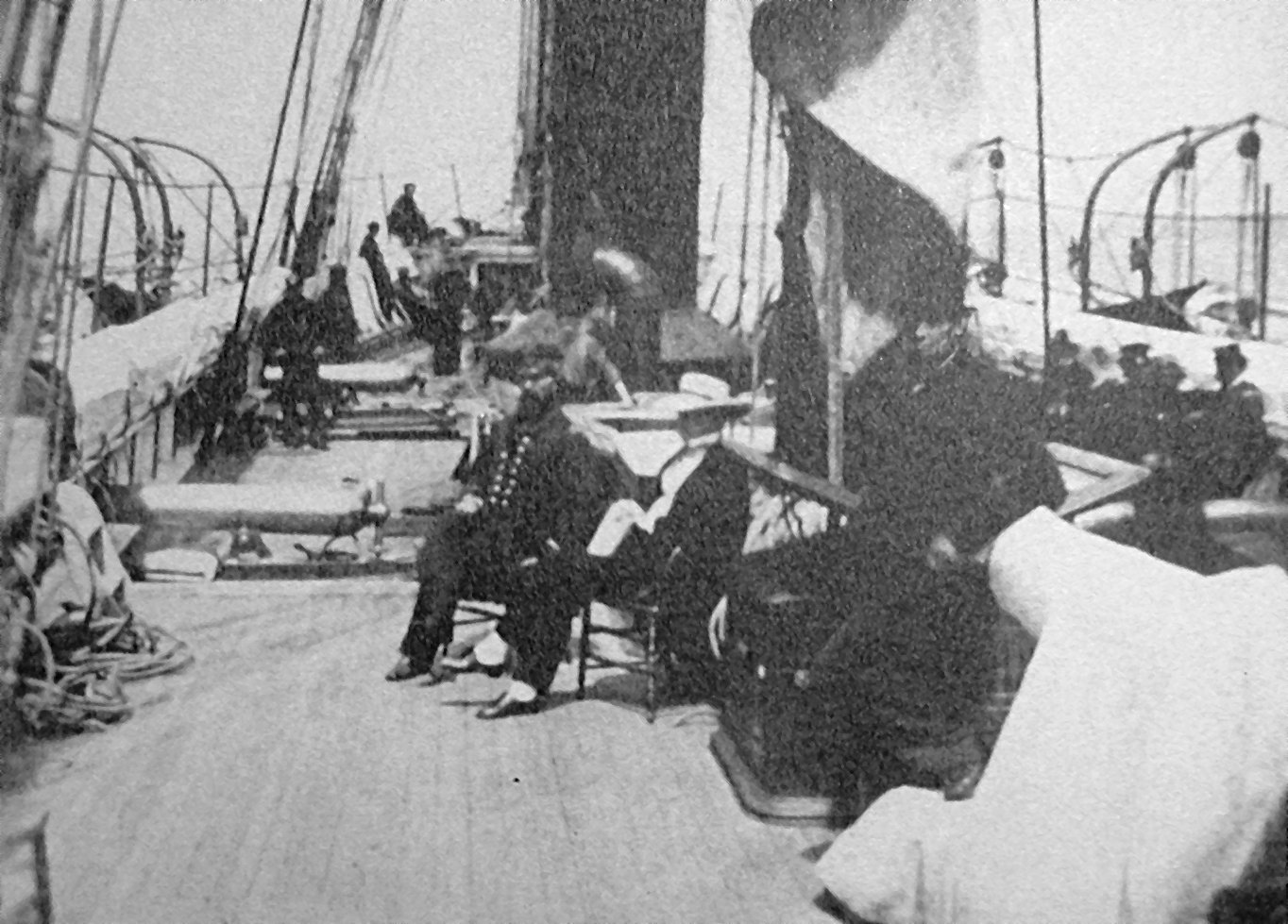
2nd LT Godfrey L. Carden instructing a 6-pounder gun crew aboard the Revenue Cutter Morill in South Carolina waters, circa 1892. Note the rarely-seen USRSC officer’s sword. Carden would later become the Captain of the Port for New York City in the Great War. USCGH Photo 210210-G-G0000-1002
A significant small arms locker of rifles and revolvers could arm half of her 40-man crew for duty ashore or in seizing vessels, be they bandits and smugglers in peacetime or enemy shipping in war. The service of the era was often called upon to restore law and order ashore, as exemplified in a famous incident where a squad from the revenue cutter McLane landed in Cedar Key, Florida, in 1890 to reclaim the town from its pistol-toting mayor and his gang of ruffians!
Morrill’s berth deck enlisted accommodations were considered spacious for the period and, if needed, would “readily admit of 70 men.”
Her magazine included provision for several large electrically detonated “wrecking mines” packed with as much as 238 pounds of guncotton, used in destroying derelicts– or in reducing hazardous icebergs and blasting paths in the ice sheet both on the Great Lakes and North Atlantic.
Back in the days of wooden-hulled fishing vessels and cargo schooners (sometimes loaded with buoyant cargo such as timber), abandoned vessels could often remain afloat for weeks and remain an enduring hazard to navigation, requiring the dangerous task of sending a wrecking crew in a small boat to rig the gun cotton mines to a waterlogged, unstable hulk.

Cutter destroying a derelict ‘A subject for Dynamite’ drawn by W. Taber, engraved by H. Davidson.

Derelict located by Revenue Cutter Seneca had drifted 285 miles, circa 1900. NARA 56-AR-006

Revenue Cutter McCulloch, attaching mines to destroy a derelict, circa 1900. National Archives Identifier 158884024. NARA Local Identifier 56-AR-63

Revenue Cutter Miami, Preparing to place mines to destroy derelict, circa 1900

Revenue Cutter Onondaga, Loading mines for destroyed sunken wreck, circa 1900. NARA AR-066
Built in 1889 by the Pusey and Jones Corp., Wilmington, Delaware, for a cost of $72,600, USRC Lot M. Morrill (typically only ever seen as “Morrill” in paperwork) was commissioned on 10 October of that year.
In typical Revenue Cutter fashion, her crew crossed decked from an older cutter that was decommissioned in the same stroke– the Civil War-era USRC Naugatuck, which had been based at New Bern, North Carolina since 1865.
Taking up Naugatuck’s old beat– which her experienced crew was familiar with– Morrill was stationed at Wilmington, North Carolina, for her first homeport.
In March 1891, our new cutter performed a then novel inland passage, a military experiment, making it the 155 miles from Charleston, South Carolina, to Fernandina, Florida via the North Edisto, Ashley, Wadmalaw, Stono, and Amelia rivers. She did so with sometimes just a foot of water under her keel and just 30 feet of wetted width between banks as opposed to her 24-foot beam! It was often slow going, especally in tight bends, and in some stretches the charts of the river were quite bad, but via leading with a small boat ahead of her bow dropping lead to verify depth, the task was accomplished in three winding days, only running up on a mudbank once –some six miles up the Wadmalaw– and able to free herself with minor effort. At night, the cutter lay up, ablaze with electric light, proving much the attraction to the locals who came out to watch the curious “bluejackets” in the marsh.
Still, she proved, at least in theory, that a squadron of torpedo boats could run the shallow brackish and fresh waterways from Philadelphia to Fernandina– save for a short break between Moorehead City, North Carolina, and Bulls Bay, South Carolina– keeping well hidden from a European blockading squadron.
With Morrill’s officers dutifully updating their chart and leaving range stakes behind them, it was deemed that, with a little minor dredging here and there, a blue water vessel under 175 feet overall drawing less than 11 feet could make the run from Philly to Florida almost completely inland, enabling dispersed operations of torpedo boat squadrons which could run out from river mouths and shoreline bays to strike enemy battlelines then retreat into their havens.

It should be noted that the USS Cushing (Torpedo Boat #1), which entered service in 1890, was only 140 feet overall with a draft of just less than five feet, and it was only when Farragut (TB-11) joined the fleet in 1899 that American torpedo boats stretched longer than 175 feet.
While the river haven tactic wasn’t actively pursued much further in the U.S., Morrill’s marsh cruise did help lay the way for today’s Intracoastal Waterway, which has rambled 3,000 miles from Boston to Brownsville since 1949 and is key for the movement of commerce in the country today.
Anyway, speaking of Fernandina, Florida, and points south, in early January 1895, Cuban exile leader Jose Marti completed preparations in the area to attempt to ignite a revolt against Spanish colonial despotism in his homeland. He and his followers purchased three small ships, the Amadis, Baracoa, and Lagonda, then outfitted them to carry his freedom fighters and supplies to Cuba. These were foiled by the Treasury Department, which had been ordered to southern Florida to abort such filibuster activities, with Morrill helping with the seizure of Lagonda at Fernandina directly.
From 1895 to 1898, cutters, including our Morrill, Boutwell, Colfax, Forward, McLane, and Winona, patrolled the Straits of Florida to enforce neutrality laws amid attempts to launch illegal expeditions to Cuba. According to Commandant Capt. Charles F. Shoemaker, these efforts required constant vigilance. One tug, Dauntless, was seized by cutters no less than three times. The cutters seized seven ships (besides Dauntless, including all three of Marti’s), detained 12 suspected violators, and disrupted two organized filibustering plots (Marti’s and one by Cuba Gen. Enrique Collazo) before the USS Maine mysteriously exploded in Havana harbor in February 1898.
Remember the Maine!
With the war drum beating, Morrill and her fellow cutters were soon mobilized a full month before war was declared by Congress on 25 April 1898.
On 24 March, President McKinley ordered Morrill, along with the cutters Gresham (206 foot), Manning (206 foot), Windom (170 foot), Woodbury (138 foot), Hamilton (133 foot), Hudson (94 foot), Guthrie (85 foot) and Calumet (95 foot), “with their officers and crews, be placed under the direction of the Secretary of the Navy, and cooperate with the Navy, until further orders…”
Before the conflict was over, 13 revenue cutters were transferred to naval service, staffed by 98 officers and 562 enlisted RCS men. Eight would serve at sea with the North Atlantic Squadron, one (McCulloch) famously fought with Dewey in the Philippines, and four patrolled the U.S. West Coast.
Morrill proceeded to Norfolk Navy Yard and was gently made ready for war, largely via adding at least one extra deck gun, which had varied widely in reports from a second 6-pounder to a gun as large as a 6-incher! Her crew was boosted to nine officers (including a surgeon) and 47 enlisted, allowing for an extra gun crew and ammo handlers.
Morrill’s wardroom during the Spanish-American War:
- Captain Horatio Davis Smith, commanding
- First Lieutenant John Cassin Cantwell, executive
- Second Lieutenant F.A. Levis, navigator
- Second Lieutenant C.S. Craig
- Third Lieutenant Henry G. Fisher
- Chief Engineer E.P. Webber
- First Assistant Engineer William Robinson
- Second Assistant Engineer F.G. Snyder
- Surgeon J. Spencer Hough

USRC Morrill at the Norfolk Navy Yard, Portsmouth, Virginia, 22 April 1898. Photograph from the Bureau of Ships Collection in the U.S. National Archives. 19-N-19-21-10
Morrill and her fellow cutters Hudson, Hamilton, and Windom would join the 1st division of the North Atlantic Squadron under the bewhiskered Commodore John Adams Howell (USNA, 1858, best known to history for his early locomotive torpedo). A veteran of the Battle of Mobile Bay, Howell’s division included his flag, the 4,800-ton USS San Francisco I (Cruiser No. 5), the cruiser Montgomery (C-9), four monitors, and 15~ gunboats, with many of the latter being armed yachts quickly converted.
Morrill linked up with the three-masted 204-foot Annapolis-class gunboat USS Vicksburg (PG-11) for the first time on 31 March at Hampton Roads. The two would become partners off Havana, with Vicksburg’s logs mentioning our cutter at least 31 times between then and 14 August. The two worked in conjunction with Vicksburg’s sistership Annapolis, the 275-foot armed yacht USS Mayflower (PY-1), and the plucky 88-foot armed tug USS Tecumseh (YT-24, ex-Edward Luckenbach).
On 24 April 1898, the up-armed Morrill, Hudson, and Hamilton, bound for Howell’s “Mosquito Fleet,” passed through Hampton Roads and, after asking formal permission of the Commodore, proceeded to Key West. From that point, they joined the Navy ships of the Cuban blockading fleet.
After delivering dispatches to the flagship USS New York, Morrill joined the blockade station 5 miles west of the Havana entrance on 5 May and soon captured the Spanish schooner Orienta. One of 25 seized Spanish merchantmen sold as prizes at Key West on 21 June 1898, Orienta must have been either very small or in poor condition, or both, as the vessel, including cargo and equipment, only brought $350 at auction (about $12K when adjusted for inflation) — the lowest of all 25.
It was off Havana that Vicksburg and Morrill became targets for Spanish coastal batteries mounting heavy 10- and 12-inch German pieces for about 20 minutes, with Smith noting in his official report, “came very close” and damaged the bridge with a fragment of shrapnel.
As chronicled in Our War with Spain for Cuba’s Freedom by Trumbull White:
The Spanish set a trap one day during the blockade. The wily Spaniards arranged a trap to send a couple of our ships to the bottom. A small schooner was sent out from Havana harbor to draw some of the Americans into the ambuscade. The ruse worked like a charm. The Vicksburg and the Morrill, in the heat of the chase and in their contempt for Spanish gunnery, walked straight into the trap that had been set for them. Had the Spaniards possessed their souls in patience but five minutes longer, not even their bad gun practice would have saved our ships, and two more of our vessels would lie at the bottom within two lengths of the wreck of the ill-starred Maine.
Friday evening, the Vicksburg and the Morrill, cruising to the west of Morro Castle, were fired on by the big guns of the Cojimar batteries. Two shots were fired at the Vicksburg, and one at the Morrill. Both fell short, and both vessels, without returning the fire, steamed out of range. It would have been folly to have done otherwise. But this time the Spaniards had better luck. The schooner they had sent out before daylight ran off to the eastward, hugging the shore, with the wind on her starboard quarter. About three miles east of the entrance to the harbor, she came over on the port tack. A light haze fringed the horizon, and she was not discovered until three miles offshore, when the Mayflower made her out and signaled the Morrill and Vicksburg.
Captain Smith, of the Morrill, and Commander Lilly, of the Vicksburg, immediately slapped on all steam and started in pursuit. The schooner instantly put about and ran for Morro Castle before the wind. By doing so, she would, according to the well-conceived Spanish plot, lead the two American warships directly under the guns of the Santa Clara batteries. These works are a short mile west of Morro and are a part of the defenses of the harbor. There are two batteries, one at the shore, which has been recently thrown up, of sand and mortar, with wide embrasures for eight-inch guns, and the other on the crest of the rocky eminence which juts out into the water of the gulf at the point.
The upper battery mounts modern 10-inch and 12-inch Krupp guns behind a six-foot stone parapet, in front of which are twenty feet of earthwork and a belting of railroad iron. This battery is considered the most formidable of Havana’s defenses, except Morro Castle. It is masked and has not been absolutely located by the American warships. It is probably due to the fact that the Spanish did not desire to expose its position that the Vicksburg and Morrill are now afloat.
The Morrill and Vicksburg were about six miles from the schooner when the chase began. They steamed after her at full speed, the Morrill leading until within a mile and a half of the Santa Clara batteries. Commander Smith, of the Vicksburg, was the first to realize the danger into which the reckless pursuit had led them. He concluded it was time to haul off and sent a shot across the bow of the schooner.
The Spanish skipper instantly brought his vessel about, but while she was still rolling in the trough of the sea, with her sails flapping, an 8-inch shrapnel shell came hurtling through the air from the water battery, a mile and a half away. It passed over the Morrill between the pilothouse and the smokestack and exploded less than fifty feet on the port quarter. The small shot rattled against her side. It was a close call.
Two more shots followed in quick succession, both shrapnel. One burst close under the starboard quarter, filling the engine room with the smoke of the explosion of the shell, and the other, like the first, passed over and exploded just beyond.
The Spanish gunners had the range, and their time fuses were accurately set. The crews of both ships were at their guns. Lieutenant Craig, who was in charge of the bow 4-inch rapid-fire gun of the Morrill, asked for and obtained permission to return fire. At the first shot, the Vicksburg, which was in the wake of the Morrill, slightly in-shore, sheared off and passed to windward under the Morrill’s stern.
In the meantime, Captain Smith also put his helm to port, and was none too soon, for as the Morrill stood off, a solid 8-inch shot grazed her starboard quarter and kicked up tons of water as it struck a wave 100 yards beyond. Captain Smith said afterward that this was undoubtedly an 8-inch armor-piercing projectile, and that it would have passed through the Morrill’s boilers had he not changed his course in the nick of time.
All the guns of the water battery were now at work. One of them cut the Jacob’s ladder of the Vicksburg adrift, and another carried away a portion of the rigging. As the Morrill and the Vicksburg steamed away, their aft guns were used, but only a few shots were fired. The Morrill’s 6-inch gun was elevated for 4,000 yards and struck the earthworks repeatedly. The Vicksburg fired but three shots from her 6-pounder.
The Spaniards continued to fire shot and shell for twenty minutes, but the shots were ineffective. Some of them were so wild that they roused the American “Jackies” to jeers. The Spaniards only ceased firing when the Morrill and Vicksburg were completely out of range.
If all the Spanish gunners had been suffering from strabismus, their practice could not have been worse. But the officers of both the Morrill and Vicksburg frankly admit their own recklessness and the narrow escape of their vessels from destruction. They are firmly convinced that the pursuit of the schooner was a neatly planned trick, which almost proved successful.
If any one of the shots had struck the thin skin of either vessel, it would have offered no more resistance than a piece of paper to a rifle ball.
The accurate range of the first few shots is accounted for by the fact that the Spanish officers had ample time to make observations. The bearings of the two vessels were probably taken with a range-finder at the Santa Clara battery, and, as this battery is probably connected by wire with Morro, they were able to take bearings from both points, and by laborious calculations, they fixed the positions of the vessels pretty accurately. With such an opportunity for observation, it would have been no great trick for an American gunner to drop a shell down the smokestack of a vessel.
As soon as the ships sheered off after the first fire, the Spanish gunners lost the range, and their practice became ludicrous. If they had waited five minutes longer before opening fire, Captain Smith says it would have been well-nigh impossible to have missed the target.
By 28 May, Morrill was assigned duty as a guard ship at Tampa, which grew tense a week later when three Spanish warships were said to be closing on the roadstead there. She remained in the greater Tampa area until early August, when she was ordered to rejoin the blockade off Matanzas on the 11th, one that she was released from on the 14th with the cessation of hostilities.
She was then ordered to tow the small torpedo boat USS Ericsson back to Norfolk, where she arrived on the 21st. Morrill would be held there for another month on naval orders in reserve, just in case she was needed for further war service. She had suffered no casualties during the war and only very minor damage.
In addition to Orienta, Morrill is noted in her USCG history as also seizing the 3,364-ton French steamer, Lafayette, in conjunction with Annapolis, and the Espana, a little Spanish fishing sloop. Espana is marked as taken by the Morrill about three miles off Mariel, just after a sharp engagement. The USS Newport was close at hand at the time, and a prize crew made up from both ships brought the capture into Key West. The Espana sold at auction for $1,350 in prize money. Lafayette was later released after it was determined that she was not carrying Spanish soldiers or contraband and was permitted to continue to Havana, her declared destination.
Two of Morrill’s officers were later awarded Bronze West Indies Naval Campaign Medals under the authority of a joint resolution of Congress, approved on 3 March 1901.
White hull days
On 28 September 1898, after nearly a decade of tough service, Morrill, her extra wartime armament landed, left Norfolk for Philadelphia, to receive new boilers and undergo dry docking. Once complete, she shipped to her new homeport on the Great Lakes, replacing the larger 205-foot cutter Gresham, which had been cut in two to move to the East Coast during the SpanAm War, and the service was in no mood to bisect again to send her back.
Morrill arrived at her new home on Lake Michigan in Milwaukee on 19 November, closing out her busy year.
Later, shifting to Detroit, she would begin a very quiet time in her career, stretching some 17 years. Underway during the open shipping season, she patrolled the waters of Lakes Huron, St. Clair, Erie, and Ontario, aiding vessels in distress and enforcing navigation laws. When the ice came, she was laid up during the winter months.
Morrill became part of the service’s first Vessel Traffic Service (VTMS), established on 6 March 1896, to track the movement and anchorage of vessels and rafts in the St. Mary’s River from Point Iroquois on Lake Superior to Point Detour on Lake Huron.
Originally named the River Patrol Service, this first VTMS was comprised of the Revenue Cutter Morrell and lookout stations at Johnson’s Point, Middle Neebish Dyke, and Little Rapids Cut. The stations were connected by telegraph lines linked back to the Pittsburgh Steamship Company offices in Sault Sainte Marie. Throughout the next several years, many lookout stations were established and then closed as needs and funding levels fluctuated. At one point, there were as many as 11 active stations along the river. During the early days, lookouts communicated with passing ships by kerosene lanterns and signal flags. Often, messages were delivered to passing ships by lookouts rowing out to them in small dinghies.

USRC Morrill at a Great Lakes port, circa 1898-1917. Courtesy of Donald M. McPherson. NH 45730

An image from a dry plate negative of the freighter William E. Corey passing alongside an unidentified, white-hulled vessel at anchor, circa 1905, is almost certainly the Morrill. Library of Congress – Detroit Publishing Co. Collection LC-D4-21878
She performed lots of local community service, including providing the honor guard and salutes for Civil War monument dedications (for instance, at Two Rivers, Wisconsin, in 1900, and another at Kenosha the same summer).

The U.S. Revenue Cutter W.P. Fessenden (center), along with other vessels in the harbor at Kenosha, Wis., for the unveiling of the Soldiers Monument in Library Park on Decoration Day, May 30, 1900. The ship on the left is the steam yacht Pathfinder owned by F. W. Morgan, Chicago, Ill. On the right outboard is the U.S. Revenue Cutter Morrill, and inboard of that is the venerable U.S.S. Michigan. The photograph is part of the Louis Thiers Collection of the Kenosha History Center. It was taken by Louis Milton Thiers (1858-1950) and created from a glass plate negative.
In addition to her regular duties, she also patrolled many regattas, including the T. J. Lipton Cup regatta off Chicago, Illinois, in August of 1904.
In 1906, her cruising grounds included the waters between Niagara Falls through Lakes Erie, St. Clair, and Huron to the Straits of Mackinac.
It seems during this period that her port side was her most photogenic.

U.S. Revenue Cutter Morrill, at Detroit with her glad rags flying, likely for July 4th between 1900 and 1910. Note her boat in the water. Detroit Publishing Collection in the Library of Congress. LC-D4-34826

USRC Morrill before WWI, circa 1907, with her bow gun covered in canvas. Note the large building in the background, dressed with a Sherwin-Williams paint ad. Detroit Publishing Collection in the Library of Congress. LC-D4-22466

USRC Morrill before WWI. Note her understated bow scroll and 6-pounder. Detroit Publishing Collection in the Library of Congress. LC-D4-9016

Morrill at the Goodrich Company dock in Manitowoc, Wisconsin. Port bow view of vessel at dock near harbor entrance, with lighthouse at right in 1912. Wisconsin Maritime Museum P82-37-10-62C
Morrill, the revenue cutter Tuscarora, and eight reserve gunboats: USS Dubuque (PG-17), at the time the training ship by the Illinois Naval Militia; USS Don Juan de Austria (Wisconsin Naval Militia), USS Wolverine (Pennsylvania Naval Militia), USS Dorothea and USS Essex (Ohio Naval Militia), USS Gopher (Minnesota Naval Militia), USS Hawk (Naval Militia of New York) and USS Yantic of the Michigan Naval Militia, were the featured guests of the Chicago Yacht Club’s August 10-17, 1912 Great Naval Pageant which included 400 swabs from the training station at Lake Bluff, fireworks, and the conclusion of a cruise of 2,000 motorboats carrying 15,000 passengers from the Central Plain and inland rivers to Chicago to “rediscover” Lake Michigan.
As the club had 10 bona fide warships on hand, a mock battle was staged with large yachts, armed with saluting cannons, fleshing out the battle line.
As for the naval pageant, preparations were underway to defend Chicago against an August 10 naval attack. Under the command of the gunboat Dubuque, the attacking fleet of the Hawk, Gopher, Don Juan de Austria, and the revenue cutter Morrill from Lake Erie would be pitted against the Tuscarora, Yantic, Wolverine, Dorothea, and Essex. No part of Chicago, from Michigan Avenue to Oak Park, would be safe from the 4” guns trained on the City which could drop 4” shells with precision anywhere within the City limits. Hydroplanes traveling 40 mph were also to be used to determine whether this type of craft would be of assistance in warfare.
From 12-14 September 1912, Morrill and Dubuque patrolled the course of the speedboat races held by the Motor Club of Buffalo in the Niagara River.

Morrill and USS Dubuque (PG-17) at the Niagara motor boat races in September 1912. Edward J. Dowling Collection, University of Detroit-Mercy

Morrill at the opening of the Livingstone Channel in the Detroit River on October 19, 1912. Edward J. Dowling Collection, University of Detroit-Mercy
She also clocked in on more sobering duties. In the late summer of 1913, she found the lost 6,322-ton ore carrier SS Charles S. Price turned turtle, 13 miles northeast of Port Huron, Michigan, “taking every witness with her.”
The Kaiser to St. Helena!
On 4 August 1914, Morrill, along with other cutters, was ordered to “observe neutrality laws” after the outbreak of the Great War in Europe. This kicked into overdrive when the service, now part of the U.S. Coast Guard, was transferred to the Navy on 6 April 1917 with the country’s entry into the war.
Morrill was soon pulled from her familiar Great Lakes home in Detroit to patrol the Atlantic coast for German submarines out of Philadelphia with the 4th Naval District.
Leaving Detroit on 10 November 1917, she called at Quebec City on her way out and found herself in crowded Halifax on the afternoon of 5 December, anchoring near Dartmouth Cove to take on fuel and water.
Being jammed out of the main roadway saved her from destruction the next morning, with the cutter and her crew spending a fortnight in a very different Halifax, rendering aid and assistance.

Halifax explosion, with HMS Highflyer shown in the channel, via the Halifax Naval Museum
As detailed by the NHHC in Morrill’s DANFS entry:
Just after 0800, 6 December, the old French Line freighter Mont Blanc, carrying a full cargo of bulk explosives, was involved in a collision with the Norwegian steamship Iona in the Narrows of Halifax Harbor. A fire broke out on Mont Blanc, and at 0905, the ship and cargo exploded in a tremendous blast that shook all of Halifax.
The most reliable casualty figures list 1,635 persons killed and 9,000 injured in the tragedy. Sixteen hundred buildings were destroyed, and nearly 12,000 more within an area of 16 miles were severely damaged. Property damage was estimated at $35 million.
Morrill, not seriously damaged, turned her attention to the needs ashore. A rescue and assistance party under 2d Lt. H. G. Hemingway rendered valuable aid while the cutter stood by to tow other craft from the danger zone.
Morrill departed Halifax on 18 December. Her services had come to the attention of Sir Cecil Spring Rice, the British Ambassador to the United States, in a letter dated 9 January 1918, Josephus Daniels, Secretary of the Navy, noted that Morrill, “though considerably damaged by the violent explosion of munitions on another ship, was the first to render assistance to the distressed inhabitants of the stricken city.”

Morrill in Navy service, photographed during World War I. NH 45729
The cutter-turned-gunboat would remain part of the 4th Naval District throughout 1918 and well into 1919, retaining her prewar skipper, Capt.(T) George E. Wilcox, USCG.
This notably included responding to the tanker SS Herbert L Pratt, which struck a mine laid by U-151 off Cape Henlopen in June 1918.

SS Herbert L. Pratt (American tanker, 1918) under salvage after striking a mine off Cape Henlopen, southeast of Lewes, Delaware, on 3 June 1918. Note the tug alongside. This ship later served as USS Herbert L. Pratt (ID # 2339). U.S. History and Heritage Command Photograph NH 14

USS SC-71 and USS SP-544 (ex-yacht Sea Gull) tied up with another Section Patrol boat at the Cape May Naval Base, Sewells Point, New Jersey, circa 1918. The ship in the background is a Coast Guard Cutter, probably USCGC Morrill. A Curtiss HS-2L seaplane is taxiing by. NH 42452

Morrill in dry dock at Camden, New Jersey, in December 1918. Courtesy of D.M. McPherson, 1974. NH 79741
Back to a changing Coast Guard
After 21 months under Navy orders, Morrill returned to USCG duties and was reassigned to the Lakes Division on 28 August 1919.
The two-time warrior, back on her old Detroit station, resumed a quiet life of patrolling regatta, saving lives, and interdicting smuggling– the latter a task grown more common after the Volstead Act took effect in 1920 and Motown became a hotbed of bootlegging from Canada.

Morrill, 1921, Janes, showing her with two 6-pounders and assigned to Detroit
In October 1925, she was reassigned to Boston to serve as a mothership for small fast picket boats attempting to keep “Rum Row” under control just off Cape Cod. It was on the way to her new station that, while near Shelbourne, Nova Scotia, one of her whaleboats with 10 enlisted aboard overturned in the cold water while returning to the cutter at night from liberty ashore. Tragically, nine of them perished, one of the USCG’s worst peacetime losses of life. The bodies were later recovered and brought back to Boston by the cutter Tampa for proper burial.
Morrill would again suffer at the hands of the sea in November 1926 when she sliced in two the George O. Knowles Wharf in Provincetown, at the northern tip of Cape Cod, during a storm, causing $100,000 worth of damage ashore and leaving the cutter aground.

Via the Scrapbooks of Althea Boxell, Provincetown History Preservation Project.

Via the Scrapbooks of Althea Boxell, Provincetown History Preservation Project.

Via the Scrapbooks of Althea Boxell, Provincetown History Preservation Project.

Via the Scrapbooks of Althea Boxell, Provincetown History Preservation Project.

Pulled off the shore at Provincetown, and was soon back to work. In April 1927, she came to the rescue of the grounded schooner Etta Burns, which turned out to be a rumrunner with 500 cases of booze aboard.
Morrill saved the crew– then put them in shackles.

With new 165 and 240-foot cutters on the way, Morrill was decommissioned at Boston on 19 October 1928, completing an almost 40-year career.
She was sold to the Deepwater Fishing and Exploration Corp. (Antonio De Domenico) of New York City for the princely sum of $7,100. Renamed Evangeline, it doesn’t seem she saw much commercial use as the former cutter burned to the waterline at Rockway, Long Island, on 30 July 1930.
Epilogue
Few relics of Morrill remain. The USCG chose not to name another cutter after her, despite her honorable record, including service in two wars. Her plans and logbooks are in the National Archives, although not digitized.
Morrill’s SpanAm War skipper, Horatio Davis Smith, extensively documented voyages of various cutters, including the cutter Golden Gate doing “good service” during the 1906 San Francisco earthquake and transporting President Taft across the bay in 1909, and the cutter McCullough being the first to pass through the Suez Canal. He retired and later wrote an early history of the Revenue Marine Service. He passed in Massachusetts in 1918, aged 73.
Her Great War skipper, George E. Wilcox, went on to command the Coast Guard destroyer Downes out of New London– one of 31 destroyers that formed the Coast Guard Destroyer Force during the Rum War– and was head of the service’s Personnel Bureau when he passed in 1931, aged 50. He is buried at Arlington.

Several young officers served aboard our cutter who went on to make their mark on history. Besides the above-mentioned Godfrey Cardin— who led 1,400 men (fully one quarter of the mobilized service!) as the Captain of the Port of New York during the Great War, future admirals Joseph Francis Farley (a later USCG Commandant) and Detlef Frederick Argentine de Otte— a mustang who enlisted in the cutter service as a seaman in 1886 and retired in 1931 as one of just sixteen Commodores (later promoted to RADM on the retired list) in the history of the Coast Guard.
Morrill’s third lieutenant during the Mont Blanc disaster in Halifax, Henry G. Hemingway, later served as the gunnery officer aboard the USS San Diego in 1918 and survived the mining of that cruiser by the U-156. He went on to command the cutter Snohomish in 1923 during a search-and-rescue case off Port Angeles that defied belief and earned him the Gold Lifesaving Medal for his actions in saving the entire crew of the SS Nika during a gale.
Nicknamed “Soo Traffic,” the U.S. Coast Guard Vessel Traffic Service St. Marys River carries the lineage of the old River Patrol Service, which Morrill joined in 1898, and is still in operation after almost 130 years. They logged some 61,532 vessels, including ferries, tour boats, tankers, and freighters, as they transited through the St. Marys River in 2010.
Thanks for reading!
Meminisse est ad Vivificandum – To Remember is to Keep Alive
***
If you like this column, please consider joining the International Naval Research Organization (INRO), Publishers of Warship International
They are possibly one of the best sources of naval study, images, and fellowship you can find. http://www.warship.org/membership.htm
The International Naval Research Organization is a non-profit corporation dedicated to the encouragement of the study of naval vessels and their histories, principally in the era of iron and steel warships (about 1860 to date). Its purpose is to provide information and a means of contact for those interested in warships.
With more than 50 years of scholarship, Warship International, the written tome of the INRO has published hundreds of articles, most of which are unique in their sweep and subject.
PRINT still has its place. If you LOVE warships, you should belong.
I’m a member, so should you be!