Tag Archives: old warships

Warship Wednesday Aug 26, 2015: The Finnish Lighthouse Battleships

Here at LSOZI, we are going to take off every Wednesday for a look at the old steam/diesel navies of the 1859-1946 time period and will profile a different ship each week. These ships have a life, a tale all of their own, which sometimes takes them to the strangest places. – Christopher Eger

Warship Wednesday, Aug 26, 2015: The Finnish Lighthouse Battleships

ilhm

Here we see the Väinämöinen-class panssarilaiva (“armored-ship”) FNS Ilmarinen of the Merivoimat (Finnish Navy) dropping it like its hot on some pesky Red Army positions in 1941. This big Baltic bruiser and her slightly older sister were a matter of Finnish pride from the 1920s through World War II– and gave the Russkies a far bit of heartburn at the same time.

In 1809 when the Russians carved the Duchy of Finland away from the Swedish Empire, Finland was largely left to their own bit, even being allowed to keep their local rule (the Diet), form their own army units, military academy, and a small navy (the Suomen Meriekipaasi)– the latter of which served well when the Brits came a calling in the Baltic during the Crimean War.

Well by 1878, Tsar Alexander II decided to Russify the Finns and implemented conscription into the segregated units of the Russian army, disbanded the navy, and a host of other measures that only ensured that by 1918, with the Tsars swept away, Finland broke free of St. Petersburg’s yoke.

They formed a new, independent Finnish Army (Maavoimat) and Navy (Merivoimat), fought a brief but brutal civil war against Bolshevik-backed Red Guards, and kept an eye peeled for the day when the Soviets decided to renegotiate the status of Finn sovereignty.

While the Merivoimat inherited a dozen or so small ex-Imperial Russian Navy gunboats, torpedo slingers and minesweepers left behind post-1918; as well as a corps of professional former mariners and officers to sail them, they needed some legit vessels if they expected to keep the Red Banner Fleet out.

They were in luck with the respect that in Turku there was a shipyard, Crichton-Vulcan, which had repaired Russian naval ships as well as constructed small boats. (The company later became Finnish mega yard Wärtsilä in 1936). In the mid-1920s the Germans were restricted from building certain military ships (um, U-boats, battleships, cruisers, you know, all the good stuff), but they struck a deal to build three small Vetehinen/Vesikko-class U-boats submarines at Crichton-Vulcan to improved WWI designs, which, though the ships never sailed for Germany, helped keep the flower of their submarine industry nurtured until 1933 when the gloves came off.

Therefore, in 1927 Parliament approved a plan to build two rather unique armored ships (panssarilaiva) as well as order some off-the-shelf motor torpedo boats from the UK to help round out their burgeoning fleet.

These two ships were laid down at Crichton-Vulcan within a month of each other in 1929.

Väinämöinen

Väinämöinen

Layout of the Väinämöinen class

Layout of the Väinämöinen class

Weighing in at 3,900 tons and with a 305-foot long hull, today these ships would be considered a frigate. At the time, the size made them either large destroyers or small cruisers.

finn battleship 2

However, unlike either of those types, these ships were glacially slow, with a top speed of just 14 knots on their good German-supplied Krupp engines. Further, they could only keep this speed up for a few days as they carried only enough fuel oil to make it 300~ miles away from port before they had to turn back for more.

Different guns of Väinämöinen nicely visible: the huge 254 mm main guns, 105 mm multi-purpose guns and 40 mm Vickers AA guns.

Different guns of Väinämöinen nicely visible: the huge 254 mm main guns, 105 mm multi-purpose guns, and 40 mm Vickers AA guns.

But that’s OK because they weren’t designed to run or to chase down ships on the high seas, these ships were designed to lurk in 15 feet of shallow water close to Finland’s craggy coastline, and plaster approaching Red Navy amphibious assaults or Red Army troops ashore.

They were given four 254mm/45cal Bofors guns (if you do the math, those are 10-inch guns there, homie!). These big guys could hurl a 496-pound AP shell at a rate of 2-3 per minute per tube out to 33,140 yards.

Via Navweaps

Via Navweaps

Via Navweaps

Via Navweaps

In effect, allowing one of these destroyer-sized ships to blast off a dozen sumo-wrestler-sized shells in the first 60 seconds of an engagement.

The two twin 10-inch turrets were augmented by eight 105mm/50cal. Bofors DP guns in four turrets that could coat either shore or airborne targets with 15 rounds per minute per tube, allowing 120 55.6-pound shells to rip out from the ship in 60 seconds.

WNFIN_41-50_m1932_front_pic

These had a range of land targets to 19,900 yards and could reach as high as 40,000 feet to pluck random enemy aircraft down.

A very tall centerline fire direction center/tower directed the fall of shot, giving these two ships an instantly recognizable silhouette.

Väinämöinen Photo colorized by irootoko_jr http://blog.livedoor.jp/irootoko_jr/

Väinämöinen Photo colorized by irootoko_jr

Class leader Väinämöinen was commissioned on 28 December 1932 while follow-on sister Ilmarinen was commissioned in 1934.

Prior to WWII, the two ships sailed the summer months around the idyllic waters of the Eastern Baltic and wintered near the shipyard at Turku when the ice came, then hit repeat.

With Mannerheim aboard

With Mannerheim aboard

A great view over the front of the bow from above the rangefinder

A great view over the front of the bow from above the rangefinder

They took part in the fleet parade at Spithead, where they participated in the festivities for the coronation of King George VI-- but had to be towed due most of the way due to their short legs

They took part in the fleet parade at Spithead, where they participated in the festivities for the coronation of King George VI– but had to be towed due most of the way due to their short legs

When the Soviets picked a fight that led to the Winter War of 1939-40, the two ships sailed to secure the Ahland Islands between Finland and Sweden but were soon forced back to port with the coming winter.

daea0b93d55764ce1578b94ef88cd96a finn battleship

While in Turku, the ships, whitewashed as camouflage and powered by shorelines to prevent exhaust from giving them away, fought off a number of Soviet bomber attacks, receiving slight damage.

Finnish coastal defense ship Ilmarinen anchored at Turku harbor, Finland, 10 Mar 1940

Finnish coastal defense ship Ilmarinen anchored at Turku harbor, Finland, 10 Mar 1940

When Finland came into World War II proper against the Soviets in 1941, both ships proved very active in supporting advancing troops ashore.

However, Ilmarinen soon ran into trouble when, accompanying a German fleet to seize Soviet-held islands off Estonia, struck a sea mine on 13 September 1941 and sank with heavy loss of life, some two-thirds of her crew in all.

Soviet propaganda poster of the sinking of the Finnish battleship Ilmarinen but is labeled Väinämöinen 

Väinämöinen had a more charmed existence, patrolling the Gulf of Finland with a force of patrol boats and minelayers and waiting for an eventual Soviet naval thrust that never came.

These ships camo'd well. Photo colorized by irootoko_jr http://blog.livedoor.jp/irootoko_jr/

These ships camo’d well. Photo colorized by irootoko_jr

The Reds did not forget the big V, however, and demanded she be turned over as reparations after the war, to which the Finnish Navy reluctantly agreed, handing the proud ship to her new communist masters on 29 May 1947.

vain va

Renamed Viborg after the Russian name for the Finnish city of Viipuri seized by the Soviets in 1944 and still part of Russia, the ship served the Baltic Fleet for two decades until she was scrapped in Leningrad.

As for Ilmarinen, she was discovered off Estonia in 230 feet of water, turned turtle but otherwise intact. If you speak Finnish, there is a very interesting documentary about her discovery, here.

Specs

lopull

Displacement: 3,900 t
Length: 305 feet
Beam: 55.5 feet
Draught: 14.5 feet
Propulsion: Diesel-Electric “Leonard System” powertrain, four Krupp engines 875 kW, two shafts, 3,500 kW (4,800 hp)
Speed: 14.5 kt (15.5 on trials)
Range: 700 nm on 93 tons of fuel oil
Complement: 403 (September 11, 1941)
Armament design:
4×254mm/45cal. Bofors (2×2)
8×105mm/50cal. Bofors DP (4×2)
4×40mm/40cal. Vickers AA (4×1)
2×20mm/60cal. Madsen AA (2×1)
1941:
4×254mm/45cal. Bofors (2×2)
8×105mm/50cal. Bofors DP (4×2)
4×40mm/56cal. Bofors AA M/36S (1×2, 2×1)
4×20mm/60cal. Madsen AA (4×1)
1944
4 × 254 mm/45cal. Bofors
8 × 105 mm/50cal. Bofors
4 × 40 mm/56cal. Bofors M/36
8 × 20 mm/60cal. Madsen

If you liked this column, please consider joining the International Naval Research Organization (INRO), Publishers of Warship International

They are possibly one of the best sources of naval study, images, and fellowship you can find http://www.warship.org/

The International Naval Research Organization is a non-profit corporation dedicated to the encouragement of the study of naval vessels and their histories, principally in the era of iron and steel warships (about 1860 to date). Its purpose is to provide information and a means of contact for those interested in warships.

Nearing their 50th Anniversary, Warship International, the written tome of the INRO has published hundreds of articles, most of which are unique in their sweep and subject.

I’m a member, so should you be!

Warship Wednesday Aug 12, His Majesty’s Frozen U-boat Busting Bulldog

Here at LSOZI, we are going to take off every Wednesday for a look at the old steam/diesel navies of the 1859-1946 time period and will profile a different ship each week. These ships have a life, a tale all of their own, which sometimes takes them to the strangest places. – Christopher Eger

Warship Wednesday, Aug 12, His Majesty’s Frozen U-boat Busting Bulldog

varristant 1942 at a bouy png

Here we see the modified V-class destroyer HMS Vansittart (D64) of the Royal Navy tied to a buoy in 1943. The hardy ship was a member of a huge group of WWI-era British tin cans that pulled yeoman service in the twilight of their lives.

In 1916, the Admiralty was in dire need of as many destroyers as they could find to fight the ever-growing U-boat menace that threatened to cut the British Isles off and hand victory to the Kaiser. This led to a crash emergency order of up to 107 Admiralty V-class flotilla leaders.

The Brit’s previous design– the 275-foot/1,075-ton S-class– mounted three 4-inch popguns, a pair of 18-inch torpedo tubes and could make 36 knots on two boilers. Well, the new V-boats were much larger at 312-feet/1,360-tons, higher to allow for a large wireless suite, needed three boilers, but upped the armament to a quartet of QF 4 in Mk.V mounts and 3 21 inch torpedo tubes a triple tube arrangement.

The first ship, Valentine, was laid down in August and completed just seven months later. By the end of the war, these hardy boats numbered some 67 hulls afloat and the remaining 40 were canceled.

Now enter the subject of our tale: HMS Vansittart (D64).

Laid down at William Beardmore and Company, Dalmuir, on New Year’s Day 1918 (no holidays off during wartime) she was completed after the war and only commissioned 5 November 1919.

Built to a modified W-class design, she shipped 1,550-tons largely due to her heavier suite of 4 x BL 4.7 in (120-mm) Mk.I guns, each capable of firing a 50-pound semi-armor piercing shell to 14,450 meters and a full half-dozen torpedo tubes rather than the original trio.

Vansittart served with the 4th Destroyer Flotilla and the Mediterranean squadrons then was laid up in 1925 due to the overall draw-down of the RN in those lean years. For the next 14 years, she was part of the Maintenance Reserve at Rosyth, staffed by reservists occasionally on summer training, and was reactivated in August 1939 as the drumbeat of a new war called.

By September 12, she was part of the 15th Destroyer Flotilla and serving on convoy duty in the Channel, protecting the BEF crossing into Europe. Next, Vansittart shipped to Norway and took part in the pivotal destroyer clash that was the Battle of Narvik, where she was damaged by German aircraft, then promptly returned to convoy duty and the evacuation of Rotterdam in May.

On 1 Jul 1940, as Britain stood alone in the War, she took out German Type VIIB U-boat U-102 in the North Atlantic south-west of Ireland, in position 48°33’N, 10°26’E, by 11 depth charges then proceeded to pick up 26 survivors from the British merchant Clearton, U-102′s last victim.

U-102 took all 43 hands including Kptlt. Harro von Klot-Heydenfeldt to the bottom.

Vansittart at the time had a very photogenic mascot.

A bulldog named Venus stands at the helm of the HMS Vansittart, a British Destroyer, c.1941

A bulldog named Venus stands at the helm of the HMS Vansittart, a British Destroyer, c.1941

Venus was one god looking pooch

Venus was one god looking pooch

More gratuitous Venus

More gratuitous Venus

1941 saw Vansittart assisting in mine laying operations off the French coast and spending a few days in May searching for SMS Bismarck.

She was adopted by the town of Kidderminster during the Warship Week National Savings drive in December 1941. The RN got their money’s worth out of the Great War-era ship, later allowing Hereford to adopt the old girl as well in the war.

THE MAYOR OF KIDDERMINISTER, ALDERMAN O W DAVIES, VISITS HMS VANSITTART - THE TOWN'S ADOPTED SHIP. 11 JUNE 1942 IWM photo A 10786

THE MAYOR OF KIDDERMINSTER, ALDERMAN O W DAVIES, VISITS HMS VANSITTART – THE TOWN’S ADOPTED SHIP. 11 JUNE 1942 IWM photo A 10786 (The officer shaking hands with the mayor of Kidderminster is Lt Cdr Thomas Johnston DSC, who captained HMS Vansittart from 1942 to 43 including the relief of Malta)

In February 1942, she reported to Gibraltar and took part in the epic resupply convoys to besieged Malta including Operation Pedestal where she helped screen HMS Eagle from both air and submarine attacks.

By 1943, she was undergoing a six-month refit at Middleborough from which she emerged with a more potent AAA defense, and traded in half her torpedo tubes for more ASW weapons, but restricted to just 25 knots.

Photo09ddVansittart1CH

This put her back to escorting merchant convoys in the Atlantic for the rest of the war, including some very hard service in the ice zones.

Chipping away ice on the deck of H.M.S. Vansittart on convoy escort duty in the Arctic

Chipping away ice on the deck of H.M.S. Vansittart on convoy escort duty in the Arctic

Chipping away ice on the deck of H.M.S. Vansittart on convoy escort duty in the Arctic feb 1943

Soon after VE Day, unneeded for the war in the Pacific, she was placed up for disposal along with the rest of the ships of her class still in the Atlantic.

As a whole, these hardy little ships gave their full measure, with many going down fighting.

One, Vehement, was lost to a mine in the North Sea in 1918. Two others, Verulam and Vittoria were lost to the Bolsheviks in the Baltic in 1919, and 9 would go on to meet their end at the hands of Axis forces in WWII.

At least 35 of the class survived the war only to be unceremoniously paid off and sold to the breakers between 1945 and 1948. The last afloat, the Australian-manned HMAS Vendetta (D69), was scuttled off Sydney on 2 July 1948.

The hero of our story is not immune to this fate, being sold to BISCO for scrap on 25 February 1946.

She is remembered on a .26 Euro stamp issued to commemorate the 70th anniversary of the Malta run.

S12080064

Specs:

Image via Shipbucket http://www.shipbucket.com/images.php?dir=Real%20Designs/Great%20Britain/DD%20D64%20Vansittart.png

Click to big up. Image via Shipbucket

Displacement: 1,140 tons standard, 1,550 tons full
Length: 300 ft. o/a, 312 ft. p/p
Beam: 30 ft.
Draught: 10 ft. 11 in
Propulsion: 3 Yarrow type Water-tube boilers, Brown-Curtis steam turbines, 2 shafts, 27,000 shp
Speed: 34 kn
Reduced to 25 kn 1943
Range: 320-370 tons of oil
3,500 nmi at 15 kn
900 nmi at 32 kn
Complement: 111 as designed, 150 by 1943
Type 271 surface warning Radar fitted 1942
Armament: As-built 1920:
• 4 x BL 4.7 in (120-mm) Mk.I guns mount P Mk.I
• 2 x QF 2 pdr Mk.II “pom-pom” (40 mm L/39)
• 6 × 21-inch Torpedo Tubes
1943 LRE conversion:
• 3 × BL 4.7 in (120mm) Mk.I L/45 guns
• 1 × QF 12 pounder 12 cwt naval gun
• 2 × QF 2 pdr Mk.II “pom-pom” (40 mm L/39)
• 2 × 20mm Orkelion cannons
• 3 × 21-inch Torpedo Tubes (one triple mount)
• 2 × depth charge racks
• Hedgehog anti-submarine mortar

If you liked this column, please consider joining the International Naval Research Organization (INRO), Publishers of Warship International

They are possibly one of the best sources of naval study, images, and fellowship you can find http://www.warship.org/

The International Naval Research Organization is a non-profit corporation dedicated to the encouragement of the study of naval vessels and their histories, principally in the era of iron and steel warships (about 1860 to date). Its purpose is to provide information and a means of contact for those interested in warships.

Nearing their 50th Anniversary, Warship International, the written tome of the INRO has published hundreds of articles, most of which are unique in their sweep and subject.

I’m a member, so should you be!

Warship Wednesday Aug 5, 2015: 225 Years of Semper Paratus

Here at LSOZI, we are going to take off every Wednesday for a look at the old steam/diesel navies of the 1859-1946 time period and will profile a different ship each week. These ships have a life, a tale all of their own, which sometimes takes them to the strangest places. – Christopher Eger

Warship Wednesday, Aug 5, 5015: 225 Years of Semper Paratus

In honor of the Coast Guard’s 225th Birthday this week, this one is a no-brainer.

11825575_10153209771722933_819207768072706866_n

Here we see the oldest vessel in the U.S. Coast Guard and one of the last ships afloat and in active service that dates from World War II (although from the other side), the Gorch Fock-class segelschulschiff training barque USCGC Eagle (WIX-327), America’s only active-duty square-rigger.

The Gorch Focks

Designed by John Stanley, the Gorch Fock-class school ships, three master barques with 269-foot long steel hulls, 18,000 sq. feet of square-rigged sails fore and main and gaff-rigged mizzens were perhaps the best training ships built in the 20th Century.

Horst Wessel at sea 1938

Horst Wessel at sea 1938

First ordered to replace the lost Segelschulschiff Niobe, which capsized in 1932, SSS Gorch Fock was ordered the same year from Blohm and Voss in Hamburg and completed in just 100 days. Then, with a need to greatly expand the German Kriegsmarine soon followed sisters SSS Horst Wessel in 1936, SSS Albert Leo Schlageter in 1937, Mircea for the Romanian Navy in 1937, and SSS Herbert Norkus in 1939.

Horse Wessel

The subject of our story, Horst Wessel was a happy ship, commissioning 17 September 1936, and spent summer cruises in 1937-39 roaming the globe with a crew of German officer cadets and craggy old chiefs and officers that dated back to the Kaiser’s time.

Importantly for history, her christening was the scene of an image that is perhaps more famous than she was.

August Landmesser was a worker at the Blohm + Voss shipyard in Hamburg. He appeared in a photograph refusing to perform the Nazi salute at the launch of the naval training vessel Horst Wessel on 13 June 1936.

“He had been a Nazi Party member from 1931 to 1935, but after fathering children with a Jewish woman, he had been found guilty of “dishonoring the race” under Nazi racial laws and had come to oppose Hitler’s regime. In February 1944 he was drafted into a penal unit, the 999th Infantry Battalion, where he was declared missing in action and presumably killed.”

An excellent 37-page translation of her 1937 Cruise Book is online and makes for interesting reading as does as a 50-page photo album.

Horst Wessel (the future USCGC Eagle) at the Mürwik Naval Academy in Flensburg, Germany during 1937, two years prior to the start of WWII. Eight years later the situation would be much different: the academy was the seat of government for Adm. Karl Dönitz, who briefly presided over what remained of the Third Reich from 30 April – 8 May 1945.

Crewmen on Horst Wessel performing a totenwacht over a dead comrade

Crewmen on Horst Wessel performing a totenwacht over a dead comrade

Horst Wessel

Horst Wessel

Her German Eagle figurehead

Her German Eagle figurehead

When war came, the training fleet was laid up with Herbert Norkus, never fully completed, sunk at the end of the conflict, Gorch Fock herself scuttled in shallow waters off Rügen in an attempt to avoid her capture by the Soviets, who raised her and used her anyway as the training ship Tovarishch for decades, Schlageter damaged by a mine then confiscated and sold in poor shape to Brazil and Horst Wessel with an interesting story of her own.

Armed with several 20mm flak mounts, Horst Wessel had shuttled around the relatively safe waters of the Baltic and came out of the war unscathed.

Coming to America

The Coast Guard Cutter EAGLE laying at a shipyard in Bremerhaven, Germany, 1946, being rigged and outfitted for her voyage to the United States. Note bombed out buildings in background

The Coast Guard Cutter EAGLE laying at a shipyard in Bremerhaven, Germany, in 1946, being rigged and outfitted for her voyage to the United States. Note bombed outbuildings in the background

Won by the U.S. in a lottery of captured but still salvageable German ships, she was sailed to the U.S. Coast Guard Academy where she took the place of the 188-foot Danish merchant academy training ship Danmark, who interned during the war, had trained thousands of USCG and Merchant Marine officers.

Horst Wessel arrived with a mix of new USCG plankowners including 6 officers and 55 men, who shadowed a German volunteer crew consisting of the vessel’s former skipper, Kpt/Lt. Barthold Schnibbe and 48 men, and was commissioned 15 May 1946, as USCGC Eagle while Danmark was returned to her proper owners that September after Eagle was ready for deployment.

A plaque with the names of her mixed first USCG/last German cruise. It could probably be considered the last Atlantic crossing by the Kriegsmarine. 

Since then she has been used extensively with a core USCG cadre crew of six officers and 55 enlisted personnel and as many as 150 cadets on summer and even yearlong cruises. During the past seven decades, it can be said that she has sailed with over 10,000 swabs holystoning her decks and rigging her lines.

Eagle under U.S. Flag 1954. Note that she did not receive her distinctive red racing stripe until 1976-- the last ship in the Coast Guard to do so

Eagle under U.S. Flag 1954. Note that she did not receive her distinctive red racing stripe until 1976– the last ship in the Coast Guard to do so

She has been inspected by just about every sitting President since Truman including JFK, a former Navy man.

August 15, 1962--President john F. Kennedy addressing Cadets while visiting on board the U.S Coast Guard Academy training bark EAGLE,

August 15, 1962–President John F. Kennedy addressing Cadets while visiting on board the U.S Coast Guard Academy training bark EAGLE,

President Kennedy reviewed USCGC Eagle’s crew in 1962. Note the M1 Garands, still a staple of the USCGA.

Eagle allows future officers to put into practice the navigation, engineering, damage control, and other professional theories they have previously learned in the classroom.

ATLANTIC OCEAN - Photo of events aboard the Coast Guard Cutter Eagle July 6, 2012. U.S. Coast Guard photo by Petty Officer 2nd Class Patrick Kelley.

ATLANTIC OCEAN – Photo of events aboard the Coast Guard Cutter Eagle July 6, 2012. U.S. Coast Guard photo by Petty Officer 2nd Class Patrick Kelley.

Upper-class trainees have a chance to learn leadership and service duties normally handled by junior officers, while underclass trainees fill crew positions of a junior enlisted person, such as helm watches at the huge double wooden wheels used to steer the vessel.

The sails are set aboard the U.S. Coast Guard Cutter Eagle Wednesday, July 27, 2011. The Eagle is underway on the 2011 Summer Training Cruise, which commemorates the 75th anniversary of the 295-foot barque. U.S. Coast Guard photo by Petty Officer 1st Class NyxoLyno Cangemi

The sails are set aboard the U.S. Coast Guard Cutter Eagle on Wednesday, July 27, 2011. The Eagle is underway on the 2011 Summer Training Cruise, which commemorates the 75th anniversary of the 295-foot barque. U.S. Coast Guard photo by Petty Officer 1st Class NyxoLyno Cangemi

Everyone who trains on Eagle experiences a character-building experience gained from working on a tall ship at sea.

U.S. Coast Guard Academy Third Class Cadet Brandon Foy climbs the rigging Tuesday, July 12, 2011, aboard the Coast Guard Cutter Eagle. Foy is one of 137 cadets sailing aboard the 295-foot barque during the 2011 Summer Training Cruise, which commemorates the 75th anniversary of the ship. U.S. Coast Guard photo by Petty Officer 1st Class NyxoLyno Cangemi

U.S. Coast Guard Academy Third Class Cadet Brandon Foy climbs the rigging Tuesday, July 12, 2011, aboard the Coast Guard Cutter Eagle. Foy is one of 137 cadets sailing aboard the 295-foot barque during the 2011 Summer Training Cruise, which commemorates the 75th anniversary of the ship. U.S. Coast Guard photo by Petty Officer 1st Class NyxoLyno Cangemi

To maneuver Eagle under sail after her rerigging to a larger set of canvas than the Germans used, the crew must handle more than 22,000 square feet of sail and five miles of rigging.

The sails are set Saturday, June 25, 2011, aboard the Coast Guard Cutter Eagle in the Atlantic Ocean between Iceland and the United Kingdom. U.S. Coast Guard photo by Petty Officer 1st Class NyxoLyno Cangemi

The sails are set Saturday, June 25, 2011, aboard the Coast Guard Cutter Eagle in the Atlantic Ocean between Iceland and the United Kingdom. U.S. Coast Guard photo by Petty Officer 1st Class NyxoLyno Cangemi

Over 200 lines control the sails and yards, and every crewmember, cadet, and officer candidate, must become intimately familiar with the name, operation, and function of each line.

The crew aboard the Coast Guard Cutter Eagle work to take in the sails as the ship heads to Corpus Christi, Texas, July 2, 2010. Crewmen work in the rigging nearly 100 feet above the water. U.S. Coast Guard photo by Petty Officer 2nd Class Patrick Kelley.

The crew aboard the Coast Guard Cutter Eagle work to take in the sails as the ship heads to Corpus Christi, Texas, July 2, 2010. Crewmen work in the rigging nearly 100 feet above the water. U.S. Coast Guard photo by Petty Officer 2nd Class Patrick Kelley.

While she has the nickname of “America’s Tall Ship” and is seen around the world waving the flag, her bread and butter are training cadets from the U.S. Coast Guard Academy as well as NOAA Officer Candidates and the occasional Navy, and Merchant Marine, and foreign allied maritime officers as well.

The crew aboard the Coast Guard Cutter Eagle work to take in the sails as the ship heads to Corpus Christi, Texas, July 2, 2010. Crewmen work in the rigging nearly 100 feet above the water. U.S. Coast Guard photo by Petty Officer 2nd Class Patrick Kelley.

The crew aboard the Coast Guard Cutter Eagle work to take in the sails as the ship heads to Corpus Christi, Texas, July 2, 2010. Crewmen work in the rigging nearly 100 feet above the water. U.S. Coast Guard photo by Petty Officer 2nd Class Patrick Kelley.

And all those sails don’t raise themselves

These ships have proven durable, with Gorch Fock returning to Germany from Russia in 2003 and resuming her old name as a museum ship, Mircea entering her 77th year of service to the Romanian Navy this year, and Albert Leo Schlageter— sailing under the name Sagres III for Portugal since 1961– all still in active service.

Truth be told, only the sad Herbert Norkus, which never sailed anyway, has been lost from the original five-ship class.

Further, since the war ended, another five ships have been built to the same, although updated, design. These include yet another Gorch Fock (built for West Germany in 1958), Gloria (1967, Colombia), Guayas (1976, Ecuador), Simón Bolívar (1979, Venezuela), and Cuauhtémoc (1982, Mexico).

In short, nine tall ships are running around the earth to the same general specs.

And the best traveled of the pack is Eagle, who is all ours and hopefully will see another 75 years under sail.

CARIBBEAN OCEAN - The U.S. Coast Guard Cutter Eagle transits the Caribbean Ocean under full sail Monday, June 7, 2010. Crewmembers assigned to the Eagle "America's Tall Ship" set sail from New London, Conn., in April for the annual Summer Training Program. U.S. Coast Guard photo by Petty Officer 2nd Class Jetta H. Disco.

CARIBBEAN OCEAN – The U.S. Coast Guard Cutter Eagle transits the Caribbean Ocean under full sail on Monday, June 7, 2010. Crewmembers assigned to the Eagle “America’s Tall Ship” set sail from New London, Conn., for the annual Summer Training Program in April. U.S. Coast Guard photo by Petty Officer 2nd Class Jetta H. Disco.

ATLANTIC OCEAN - The Coast Guard Cutter Eagle sails through dense fog, Tuesday, July 17, 2012. The crew of the Eagle take extra safety precautions when sailing through fog, such as sounding the foghorn and standing extra lookouts. U.S. Coast Guard photo by Petty Officer 2nd Class Erik Swanson.

ATLANTIC OCEAN – The Coast Guard Cutter Eagle sails through dense fog, Tuesday, July 17, 2012. The crew of the Eagle takes extra safety precautions when sailing through the fog, such as sounding the foghorn and standing extra lookouts. U.S. Coast Guard photo by Petty Officer 2nd Class Erik Swanson.

(June 26, 2005) ONBOARD THE USCGC EAGLE - A view from the bowsprit onboard the Eagle during a cadet summer training patrol.The U.S. Coast Guard Cutter EAGLE, designated 'America's Tallship' is a three masted, square- rigged sailing vessel. She is normally homeported in New London, Connecticut, and sails each summer for months at a time, visiting ports around the U.S. and abroad. EAGLE has a long history in service as a training vessel. After she was built and commissioned in 1936, she served as training vessel for cadets in the German Navy. In the 1940s, EAGLE began service as a training platform for Coast Guard Academy officer candidates. Today, nearly all future officers have the opportunity to sail onboard the EAGLE, learning skills such as leadership, teamwork, seamanship, and navigation. (Coast Guard photo by Ensign Ryan Beck)

(June 26, 2005) ONBOARD THE USCGC EAGLE – A view from the bowsprit onboard the Eagle during a cadet summer training patrol. The U.S. Coast Guard Cutter EAGLE designated ‘America’s Tallship’ is a three-masted, square-rigged sailing vessel. Coast Guard photo by Ensign Ryan Beck)

Guantanamo Bay, Cuba (May 20)--The Coast Guard Cutter Eagle sails into Guantanamo Bay to spend the night. The Eagle is involved in training exercises in the Carribean. USN photo by FINCH, MICHAEL L LCDR

Guantanamo Bay, Cuba (May 20)–The Coast Guard Cutter Eagle sails into Guantanamo Bay to spend the night. The Eagle is involved in training exercises in the Caribbean. USN photo by FINCH, MICHAEL L LCDR

The Coast Guard Cutter Eagle sails through the ocean as the moon's reflection beams across the sea. (U.S. Coast Guard photo by Petty Officer 2nd Class Walter Shinn)

The Coast Guard Cutter Eagle sails through the ocean as the moon’s reflection beams across the sea. (U.S. Coast Guard photo by Petty Officer 2nd Class Walter Shinn)

Seaman Katy Turner (right) of Cincinnati, Ohio, and Petty Officer 1st Class Ted Hubbard of West Springfield, Mass., work from one of Coast Guard Cutter Eagle's small boats to inspect and clean the hull prior to entering port Thursday, Aug. 6, 2009. Conducting small boat operations is one of the most dangerous evolutions for the crew because the small boats are lowered manually by crewmember, rather than by a mechanical hoist.

Seaman Katy Turner (right) of Cincinnati, Ohio, and Petty Officer 1st Class Ted Hubbard of West Springfield, Mass., work from one of Coast Guard Cutter Eagle’s small boats to inspect and clean the hull before entering port Thursday, Aug. 6, 2009. Conducting small boat operations is one of the most dangerous evolutions for the crew because the small boats are lowered manually by crewmembers, rather than by a mechanical hoist.

The Coast Guard Cutter Eagle is seen on a foggy Sunday morning at the Coast Guard Yard, Baltimore, Nov. 17, 2013. The Eagle, a 295-foot barque home-ported in New London, Conn., is a training ship used primarily for Coast Guard cadets and officer candidates. (U.S. Coast Guard photo by Petty Officer 3rd Class Lisa Ferdinando)

The Coast Guard Cutter Eagle is seen on a foggy Sunday morning at the Coast Guard Yard, Baltimore, Nov. 17, 2013. The Eagle, a 295-foot barque home-ported in New London, Conn., is a training ship used primarily for Coast Guard cadets and officer candidates. (U.S. Coast Guard photo by Petty Officer 3rd Class Lisa Ferdinando)

ATLANTIC OCEAN - The Coast Guard Cutter Eagle sails through dense fog, Tuesday, July 17, 2012. The crew of the Eagle take extra safety precautions when sailing through fog, such as sounding the foghorn and standing extra lookouts. U.S. Coast Guard photo by Petty Officer 2nd Class Erik Swanson.

ATLANTIC OCEAN – The Coast Guard Cutter Eagle sails through dense fog, Tuesday, July 17, 2012. The crew of the Eagle takes extra safety precautions when sailing through the fog, such as sounding the foghorn and standing extra lookouts. U.S. Coast Guard photo by Petty Officer 2nd Class Erik Swanson.

Although she long ago landed her German eagle for an American one, which carries the Coast Guard seal (while the old one collects dust as a war trophy at the USCGA Museum) and her original wheel carries her Horst Wessel birth name, it also carries her new monicker as well.

Her original German figurehead is on display at the USCGA Museum

Her original German figurehead is on display at the USCGA Museum

The figurehead of the Coast Guard Cutter Eagle is seen on a foggy Sunday morning at the Coast Guard Yard, Baltimore, Nov. 17, 2013. The Eagle, a 295-foot barque home-ported in New London, Conn., is a training ship used primarily for Coast Guard cadets and officer candidates. (U.S. Coast Guard photo by Petty Officer 3rd Class Lisa Ferdinando)

The figurehead of the Coast Guard Cutter Eagle is seen on a foggy Sunday morning at the Coast Guard Yard, Baltimore, Nov. 17, 2013. The Eagle, a 295-foot barque home-ported in New London, Conn., is a training ship used primarily for Coast Guard cadets and officer candidates. (U.S. Coast Guard photo by Petty Officer 3rd Class Lisa Ferdinando)

(June 23, 2005) - ONBOARD THE USCGC EAGLE - A U.S. Coast Guard Academy cadet takes the helm during a summer training patrol onboard the Coast Guard Cutter EAGLE. The three masted, square-rigged sailing vessel is normally homeported in New London, Connecticut, and sails each summer for months at a time, visiting ports around the U.S. and abroad. EAGLE has a long history in service as a training vessel. After she was built and commissioned in 1936, she served as training vessel for cadets in the German Navy. In the 1940s, EAGLE began service as a training platform for Coast Guard Academy officer candidates. Today, nearly all future officers have the opportunity to sail onboard the EAGLE, learning skills such as leadership, teamwork, seamanship, and navigation. (Coast Guard photo by Ensign Ryan Beck)

(June 23, 2005) – ONBOARD THE USCGC EAGLE – A U.S. Coast Guard Academy cadet takes the helm during a summer training patrol onboard the Coast Guard Cutter EAGLE. The three-masted, square-rigged sailing vessel is normally homeported in New London, Connecticut, and sails each summer for months at a time, visiting ports around the U.S. and abroad.  (Coast Guard photo by Ensign Ryan Beck)

The helm of the Coast Guard Cutter Barque Eagle. Coast Guard photo by PA1 Donnie Brzuska, PADET Jacksovnille, Fla.

The helm of the Coast Guard Cutter Barque Eagle. Coast Guard photo by PA1 Donnie Brzuska, PADET Jacksonville, Fla.

In celebration of the Coast Guard’s 225th, the commanding officer of the Coast Guard Cutter Eagle and the U.S. Postal Service will be unveiling a special edition stamp commemorating the Coast Guard’s birthday this week.

11060456_1133923276625082_866789299529642671_n

In an oil painting on masonite, renowned aviation artist William S. Phillips depicts two icons of the Coast Guard: the cutter Eagle, and an MH-65 Dolphin helicopter, the standard rescue aircraft of the Coast Guard.

The ceremony will take place on Friday appx. 10:30 a.m. August 7 at the Oliver Hazard Perry Pier at Fort Adams State Park, Newport, R.I.

Eagle will be open to the public for tours at approximately 12 p.m. following the commemorative stamp unveiling ceremony.

In the event of inclement weather, the ceremony will take place in the visitor center across from the pier.

In Newport, Eagle will be open for free public tours:

* Friday from 12 p.m. to 7 p.m.
* Saturday from 11:00 a.m. to 7 p.m.
* Sunday from 10 a.m. to 5 p.m.

Cutter Eagle by John Wisinski (ID# 90138)

Cutter Eagle by John Wisinski (ID# 90138)

If you cannot make Newport, the Eagle has her own social media account that is regularly updated and on a long enough timeline, she will be in a port near you.

Specs:

CGCEagleLength – 295 feet, 231 feet at waterline
Beam, greatest – 39.1 feet
Freeboard – 9.1 feet
Draft, fully loaded – 16 feet
Displacement – 1824 tons
Ballast (lead) – 380 tons
Fuel oil – 23,402 gallons
Anchors – 3,500 lbs. port, 4,400 lbs. starboard
Rigging – 6 miles, standing and running
Height of mainmast – 147.3 feet
Height of foremast – 147.3 feet
Height of mizzenmast – 132.0 feet
Fore and main yard – 78.8 feet
Speed under power – 10 knots
Speed under full sail – 17 knots
Sail area – 22,300 square feet
Engine – 1,000 horsepower diesel Caterpillar D399 engine replaced 700hp original diesel
Generators – two-320 kilowatt Caterpillar 3406 generators
Training complement – 6 officers, 54 crew, 20 temporary active duty crew when at sea, 140 cadets average.
Maximum capacity – 239 people

If you liked this column, please consider joining the International Naval Research Organization (INRO), Publishers of Warship International

They are possibly one of the best sources of naval study, images, and fellowship you can find http://www.warship.org/

The International Naval Research Organization is a non-profit corporation dedicated to encouraging the study of naval vessels and their histories, principally in the era of iron and steel warships (about 1860 to date). Its purpose is to provide information and a means of contact for those interested in warships.

Nearing their 50th Anniversary, Warship International, the written tome of the INRO has published hundreds of articles, most of which are unique in their sweep and subject.

I’m a member, so should you be!

Warship Wednesday, July 29, 2015: The saddest story of World War II– 70 years ago today

Here at LSOZI, we are going to take off every Wednesday for a look at the old steam/diesel navies of the 1859-1946 time period and will profile a different ship each week. These ships have a life, a tale all of their own, which sometimes takes them to the strangest places. – Christopher Eger

Warship Wednesday, July 29, 2015, The saddest story of World War II

1504x1060

1504×1060

Here we see the Portland-class heavy cruiser USS Indianapolis (CA-35) as she appeared before the war in New York. Tomorrow marks the 70th anniversary of her tragic passing, often cited as the worst disaster in U.S. Naval history. As she was torpedoed on the other side of the International Date Line, at the site of her wreck it is already that time.

We have covered this tragic vessel several times including the Svedi photo collection and a set of papers that we submitted to Navsource and the NHC on her 1936 Friendship cruise, so we’ll keep it short.

The two-ship class of “10,000-ton” heavy cruisers was sandwiched between the half-dozen 9,000-ton Northamptons built in the late 1920s and the seven more advanced New Orleans-class cruisers built in the late 1930s. As such, the twin Portlands were advanced for their time, carrying nearly a thousand tons more armor and 9x 8″/55 (20.3 cm) Mark 12 guns. They had weight and space available to accommodate a fleet admiral and staff if needed.

Indianapolis was laid down by New York Shipbuilding Corporation on 31 March 1930 and was the first warship to carry the name, commissioning 15 November 1932.

2814x2244

2814×2244

Her prewar career was peaceful and she carried FDR on a trip to South America in 1936 and others.

Narrowly escaping Pearl Harbor by being at sea far to the southeast of Hawaii, she soon was earning battle stars the hard way in New Guinea, the Aleutians (where she pummeled the Japanese troopship Akagane Maru, sending her and her soldiers to the bottom of the cold North Pacific), Tarawa, Makin, Kwajalein, the Marianas, Palau, the Philippine Sea and onto the Home Islands.

View from off her starboard bow, at the Mare Island Navy Yard, California, following overhaul, 1 May 1943. White outlines mark recent alterations to the ship. Note new forward superstructure, 8

View from off her starboard bow, at the Mare Island Navy Yard, California, following overhaul, 1 May 1943. White outlines mark recent alterations to the ship. Note new forward superstructure, 8″/55 triple gun turrets, starboard anchor, anchor gear on the forecastle, and paravane downrigging chains at the extreme bow. USS Minneapolis (CA-36) is in the background, stripped for overhaul. Photograph from the Bureau of Ships Collection in the U.S. National Archives.

For a good bit of that time, she served as the 5th Fleet flagship of Vice Admiral Raymond A. Spruance.

Admirals Spruance, Mitscher, Nimitz, and Lee aboard USS Indianapolis, Feb 1945

Admirals Spruance, Mitscher, Nimitz, and Lee aboard USS Indianapolis, Feb 1945

LVTs moving in during the invasion of Saipan, 15 June 1944. Heavy cruiser firing in the background is USS Indianapolis

LVTs moving in during the invasion of Saipan, 15 June 1944. Heavy cruiser firing in the background is USS Indianapolis

At Okinawa, she spent a week solid smacking around Japanese shore positions with her big 8 inchers while dodging kamikazes. On 31 March 1945, she was unlucky enough to be severely damaged by one of these flying meatballs and, losing 9 men, set course for Mare Island Naval Yard in California for repairs.

Once patched back together, it turned out the War Department had a mission for her.

In San Francisco, she took aboard parts and 141-pounds of enriched uranium (about half of the world’s supply at the time) for the inefficient Little Boy atomic bomb, which would later be dropped on Hiroshima, producing about 15 kilotons of sunlight when she vaporized in August.

Racing the 6,000 miles from San Fran to Tinian island in just ten days (with a short stop in Hawaii), she arrived unescorted and delivered her payload on 26 July, which would go on to a history of its own only 11 days later.

However, Indy would no longer be afloat by the time Hiroshima’s mushroom cloud peaked.

This photo was taken 27 July 1945, the day before she sailed from Guam to her doom, as documented by the ship's photographer of USS Pandemus (ARL 18), on the back of the photo. This is probably the last photo taken of her. Caption on back of photo:

This photo was taken on 27 July 1945, the day before she sailed from Guam to her doom, as documented by the ship’s photographer of USS Pandemus (ARL 18), on the back of the photo. This is probably the last photo taken of her. Caption on back of photo: “USS Indianapolis (CA 35) taken: 1530 27, July 1945, Apra Harbor, Guam, from USS Pandemus RL 18 as it passed heading for the sea. The picture was taken by Gus Buono”. U.S. Navy photo from the Collection of David Buell.

At 12:14 a.m. on July 30, 1945, the USS Indianapolis was torpedoed by I-58, a Japanese B3 type cruiser submarine in the Philippine Sea and sank in 12 minutes after sending off a distress call. The sub’s commander took her to be an Idaho-class battlewagon and unloaded six torpedoes in her direction, of which 2-3 hit.

Indianapolis was not equipped with sonar or hydrophones, or provided with a destroyer escort despite her captain’s request– the only case in which a capital ship was left unescorted so late in the war.

Of 1,196 men on board the stricken cruiser, approximately 300 went down with the ship. The remainder, about 900 men, were left floating in shark-infested waters sans lifeboats and supplies for the most part. By the time the dwindling survivors were spotted (by accident) four days later only 317 men were still alive.

Survivors of the sinking of the Indianapolis are taken to a hospital on Guam after their rescue in August, 1945.

Survivors of the sinking of the Indianapolis are taken to a hospital on Guam after their rescue in August 1945.

After the war her skipper, Captain Charles B. McVay III, was sent to the mast in a travesty of justice– the only U.S. captain of more than 350 to face trial for having his ship sunk by the enemy in the war. At the trial, the skipper of I-58, which had been captured and scuttled by the Navy in 1946, even testified that McVay was not at fault.

Although cleared by history, McVay later committed suicide. The Navy later adjusted his record, posthumously.

Indianapolis‘s sister ship, USS Portland (CA–33), was decommissioned in 1946 and languished on red lead row until she was scrapped in 1962 although she earned 16 battle stars, making her one of the most decorated ships in the U.S. fleet.

There are several monuments to the Indianapolis and her wreck was located in 2001.

Her bell, removed from the ship at Mare Island in 1945 to save weight, is preserved at the Heslar Naval Armory in Indianapolis.

0403580

There is also a good bit of maritime art to commemorate her.

Indianapolis by Michel Guyot

Indianapolis by Michel Guyot

rev05111_4

She is remembered by a vibrant USS Indianapolis organization, many books, a completed made for TV movie (which was horrible), and a new film with Nick Cage that is currently shooting.

Thirty-two men are still alive from the crew of the USS Indianapolis, including Richard Stephens, 89, who eagerly awaits the Cage film.

“I think it’s going to be a good movie,” said Stephens, who was 18 when he and the others received the command to abandon ship.

He visited the set in Mobile, Ala., earlier this month where the film is being shot on location using Mobile Bay and the USS Alabama museum as a backdrop. “I told (Cage) I didn’t like fictional movies, and they should be trying to show more respect, they should be using the facts. He said it’s going to be pretty true to facts.”

Specs:

3150x1869 Click to very much bigup

3150×1869 Click to very much bigup

Displacement: 9,800 long tons (10,000 t)
Length: 610 ft. (190 m)
Beam: 66 ft. (20 m)
Draft: 17 ft. 4 in (5.28 m)
Propulsion: 8 × White-Foster boilers, single reduction geared turbines, 107,000 shp (80,000 kW)
Speed: 32.7 kn (37.6 mph; 60.6 km/h)
Complement: 629 officers and enlisted (peace), 1,269 officers and men (wartime as flag)
Armament: 9 × 8 in (200 mm)/55 cal guns (3×3)
8 × 5 in (130 mm)/25 cal AA guns
8 × .50 in (12.7 mm) machine guns
Aircraft carried: 2-5 OS2U Kingfisher floatplanes

If you liked this column, please consider joining the International Naval Research Organization (INRO)

They are possibly one of the best sources of naval lore http://www.warship.org/naval.htm

The International Naval Research Organization is a non-profit corporation dedicated to the encouragement of the study of naval vessels and their histories, principally in the era of iron and steel warships (about 1860 to date). Its purpose is to provide information and a means of contact for those interested in warships.

Nearing their 50th Anniversary, Warship International, the written tome of the INRO has published hundreds of articles, most of which are unique in their sweep and subject.

I’m a member, so should you be!

Warship Wednesday July 22, 2015: The (Giant) Messenger God

Here at LSOZI, we are going to take off every Wednesday for a look at the old steam/diesel navies of the 1859-1946 time period and will profile a different ship each week. These ships have a life, a tale all of their own, which sometimes takes them to the strangest places. – Christopher Eger

Warship Wednesday, July 22, 2015: The (Giant) Messenger God

1977 HMS Hermes R-12 with her bows nearly out of the water.

Here we see the Centaur-class aircraft carrier HMS Hermes (R12) bouncing around the North Atlantic with her bow mostly out of the water in 1977. She currently is the oldest flattop in active service (though armed with just 7 elderly and increasingly cranky Sea Harriers) and has had one hell of a ride.

British carrier problems

During WWII, the Royal Navy saw the writing on the wall in the respect that, to remain a first-rate naval power with a global reach, it needed a fleet of modern aircraft carriers. Entering the war in 1939 with three 27,000 ton Courageous-class carriers converted from battlecruiser hulls, the 22,000 ton battleship-hulled HMS Eagle, the unique 27,000 ton HMS Ark Royal, and the tiny 13,000-ton HMS Hermes (pennant 95, the world’s first ship to be designed as an aircraft carrier)– a total of six flattops, within the first couple years of the war 5/6th of these were sent to the bottom by Axis warships and aircraft.

Further, while two 32,000-ton Implacable-class and four 23,000-ton Illustrious-class carriers, laid down before the war were able to join the fleet, they just made up for the losses of the prewar vessels.

The Brits designed an innovative armed merchantman (CAM ships, for catapult aided merchantman, some 35 freighters armed with a single rocket-assisted Hurricane or Spitfire ready for a one-way trip) and picked up a legion of escort carriers loaned from the Americans to help fight off German Condor patrol bombers and U-boats. However, fleet operations in far-off areas away from the support of land-based RAF fighters needed fast and well-armed flattops.

That’s where the 16 planned Colossus-class light carriers, 4 Audacious-class, 4 Malta-class supercarriers (57,000-tons), and 8 Centaur-class fleet carriers came in. Ordered and designed between 1942-45, these 32 British ships would have been the envy of any navy in the world.

While the Maltas never made it off the drawing board, just 2 Audacious’s were finished (in the 50s), and most of the Colossus-class were likewise completed much after the war (some as late as the 1960s then rapidly sold or junked), the Centaurs were likewise abbreviated to just 4 much-delayed ships. One of these is the hero of our story.

Enter Hermes

HMS Hermes was laid down at Vickers-Armstrong on 21 June 1944, two weeks after the Allies stormed ashore at D-Day. She was the last of the quartet of Centaurs whose construction was started. Originally to be named HMS Elephant, she picked up the messenger of the god’s moniker of the old carrier (Pennant #95) sunk by the Japanese in 1942.

Envisioned to be the middle ground between the Colossus light carriers and the Malta supercarriers, these 737-foot long, 29,000-ton ships were fast enough (28 knots) to serve with the fleet, could cross the Atlantic or steam as far away as the Falklands (remember this) or Cape of Good Hope on a single bunker load of fuel oil and could carry some 60~ piston engine fighters and bombers (smaller than an American carrier of similar size due to their armored flight deck and hangar).

Washdown

NBC Washdown

However, WWII ended before any of the Centaurs could be completed and the four ships under construction, Hermes included, were sidelined.

She languished after the war and was only finished on 18 November 1959 (after 15 years at the builders) with a much-altered plan that included an angled flight deck to allow the operation of jet-powered aircraft at sea.

Hermes10_6

One of the last ships completed with 40mm Bofors DP AAA guns, she could carry as many as 40 aircraft in a mixed flight wing that included downright chunky Supermarine Scimitars, de Havilland Sea Vixen fighters, and turboprop-powered Fairey Gannet ASW aircraft together with Westland Whirlwind (British-built Sikorsky S-55/H-19 Chickasaw) helicopters.

hermes-10-at-sea

Spending most of the 1960s in the Indian Ocean and Persian Gulf area (the Brits were the preeminent naval force in the Gulf at the time), by 1968 Hermes‘ wing had been updated to include a dozen Sea Vixens, 7 Buccaneer strike planes, Wessex choppers (British-built turbine-powered development of the Sikorsky SH-34 Seabat) and 5 Gannets in AEW roles.

The 63 foot long, 30-ton Blackburn Buccaneer was the same size as the later F-14 Tomcat and could carry up to 6-tons of ordnance including the British Red Beard or WE.177 tactical nuclear bombs to a range of some 2,300 nautical miles. The Brits still had these in service as late as 1994, but couldn’t use them in the Falklands as Hermes had her CATOBAR system removed. They likely would have come in very handy if she hadn’t and there were still some in the fleet.

A Sea Vixen launching from HMS Hermes.

A Sea Vixen launching from HMS Hermes.

The F-4 Phantom was successfully tested from her decks, but it was deemed that she wouldn’t be able to carry enough (just 12, landing the rest of wing ashore) to matter.

Rare colour image of two Fleet Air Arm Buccaneers on the catapults of HMS Hermes, 1968. XT282 (325) XV152 (324) of 809 Squadron. She lost her catapults in 1970

Rare color image of two Fleet Air Arm Buccaneers on the catapults of HMS Hermes, 1968. XT282 (325) XV152 (324) of 809 Squadron.

In 1970, her catapults and arrester wires were removed (as were her old Bofors and radars) and she was converted to a “commando carrier” capable of carrying a Royal Marine battalion. Her air wing was some 20 Marine helicopters. She was also given storage and handling areas for 4 LCVP landing craft.

She was modified to carry as many as 800 Royal Marines. Dig those L1A1 SLRs (semi-auto Enfield made FN FALs)

She was modified to carry as many as 800 Royal Marines. Dig those L1A1 SLRs (semi-auto Enfield made FN FALs)

When the Harrier came out, Hermes was given a ski jump to help those VSTOL beauties take off (they would land vertically so no arrester wires were needed) and her wing was fleshed out by ASW helicopters to allow her to carry out the NATO sea control mission concept if needed.

Harrier jump jets on the Deck of HMS Hermes

Harrier jump jets on the Deck of HMS Hermes

By 1982, with the Malta’s never built, the Colossus and Audacious-class carriers all retired, and Hermes‘s own sister ships HMS Centaur (R06), HMS Albion (R07), and HMS Bulwark (R08) decommissioned in 1965, 1972 and 1981 respectively, she was at the same time the largest, oldest and most effective carrier left in the Royal Navy with only the smaller and barely broke-in 19,000-ton “Harrier carrier” HMS Invincible to back her up.

Ironically both carriers were up for sale at the time, as Parliament was determined to get the UK out of the carrier business.

Then came the Falklands.

With the nearest RAF base some 4,000 miles away at Wideawake Airfield, Ascension Island, the aircraft that the RN could carry to the Malvinas were the only ones that would be available to defend the British attempt to retake the colony.

Royal Marines line up for a weapons check in the hanger of HMS Hermes in the South Atlantic on their way to the Falklands in 1982

Royal Marines line up for a weapons check in the hanger of HMS Hermes in the South Atlantic on their way to the Falklands in 1982. Note the hangar crammed full of Harriers and the big Sea Kings on a deck above.

Hermes carried an impressive (for her size) complement of 26 RN Sea Harriers and RAF Harriers (more than half of the British combat aircraft deployed to the conflict) as well as up to 22 big Sea Kings at one time or another (though most were cross-decked to other platforms) and was flagship of Rear Adm. Sandy Woodward’s Task Force 317.8 for the war.

HMS HERMES' flight deck as she sails from Portsmouth for the South Atlantic. Five Sea Harriers of No 800 Squadron Fleet Air Arm

View looking aft down HMS HERMES’ flight deck as she sails from Portsmouth for the South Atlantic. Five Sea Harriers of No 800 Squadron Fleet Air Arm are visible on the crowded flight deck in front of a mass of Sea Kings. At the time of sailing, the crew had not had time to organize the stowing of aircraft or supplies. IWM (FKD 674)

Hermes gunner with a WWII era 20mm in the Falklands

Hermes gunner in anti-flash gear with a WWII era 20mm in the Falklands

The 100~ ship (though only 27 warships) combined fleet, the largest British flotilla formed since 1956 in the Suez crisis, departed the UK on 5 April and after an epic 25-day trip arrived in the 200-mile exclusion zone surrounding Falklands, with the Argentinians beginning their attacks on the force the very next day.

Harrier of No 1 Squadron RAF is prepared for a sortie on the flight deck of HMS HERMES, 1982.

Harrier of No 1 Squadron RAF is prepared for a sortie on the flight deck of HMS HERMES, 1982.

Arriving in the Falklands, her Harriers conducted both air support for the troops ashore and held up a pretty good CAP against attacking Argentine Mirages and Skyhawks. In all the RN and RAF Harriers (just 38 aircraft, mostly operating from Hermes) flew over 1,500 sorties in the 45 days while on station before the British Jack was hoisted over Port Stanley once more, and were credited with 20 air-to-air kills.

Air group at the height of the Falklands Conflict:
800 NAS – 16 Sea Harrier FRS.1
826 NAS – 5 Sea King HAS.5
846 NAS – 5 Sea King HC.4
No. 1 Squadron RAF – 10 Harrier GR.3

Petty officer aboard HMS Hermes crossing equator on way back to the UK from the Falklands

A petty officer aboard HMS Hermes crossing equator on way back to the UK from the Falklands

Steel beach party on HMS Hermes note sea harrier and sea king

Steel beach party on HMS Hermes note Sea harrier and the sea king

When Hermes sailed back into Portsmouth, she and the Task Force was greeted by everything that floated.

HMS Hermes being welcomed back after the Falklands War,

HMS Hermes being welcomed back after the Falklands War

hermes

Her Royal Navy career ended 12 April 1984 and she was paid off while on her 15th skipper.

However, although she was the last of her class afloat and her keel had forty years on it, she was still valuable.

Refitted, she was sold to India in 1987 and took the name INS Viraat (R22) and, homeported in Mumbai, she has served the Indian Navy for 28 continuous years, undergoing a further five refits while in Indian service.

INS Viraat, 2002

INS Viraat, 2002

Her current name means, “Giant” and she was the largest ship ever operated by the Indian Navy until they bought the 65,000-ton Admiral Gorshkov from the Russians and brought her in service as INS Vikramaditya in 2013.

Viramaditya’ (foreground) and ‘Viraat.’ Indian Navy photo

Vikramaditya’ (foreground) and ‘Viraat.’ Indian Navy photo

Admiral-Sandy-Woodward-le-011

Of note, Admiral Sir John Forster “Sandy” Woodward GBE, KCB passed the bar 4 August 2013. In his last public act, he decried the decommissioning of Britain’s carrier force before the new Queen Elizabeth class could be brought online, leaving the country that invented the type without a flattop for the first time in a century.

Hermes/Viraat is currently the last British-built ship serving with the Indian Navy, and the oldest aircraft carrier in service in the world, and with over 70 years under her keel and two new carriers on the builder’s ways, its time for the old girl to retire.

She is to decommission by 2016 and be retained as a museum ship.

From the Hindu Times:

The retirement call was forced, in part, by the dwindling fleet of Sea Harrier fighters operating from the deck of Viraat. While the limited upgrade Sea Harrier (LUSH) programme bestowed the fighters with modern avionics and beyond visual range (BVR) strike capability, the ageing airframe has been a concern. Not more than seven Sea Harriers are available at the moment — some of them cannibalized (used as ‘Christmas Tree’ for spares) to keep the relatively agile ones airworthy.

“Thanks to the Navy’s stringent maintenance regimen, we have been able to operate Viraat without major glitches until now. But the Harrier fleet has dwindled so much that within the Navy, Viraat is often referred to as a ‘One Harrier carrier’. No point flogging it any further,” an official said.

A very active veterans group preserves her memory (as well as that of the other 9 HMS Hermes dating back to 1796) in the UK.

HMS Broadsword with HMS Hermes, Falklands. Official painting by John Alan Hamilton for the MoD. (c) Mrs B.G.S. Hamilton (widow); Supplied by The Public Catalogue Foundation

HMS Broadsword with HMS Hermes, Falklands. Official painting by John Alan Hamilton for the MoD. (c) Mrs. B.G.S. Hamilton (widow); Supplied by The Public Catalogue Foundation

Sadly, the Royal Navy has not carried the name on its roles since 1985.

Specs:

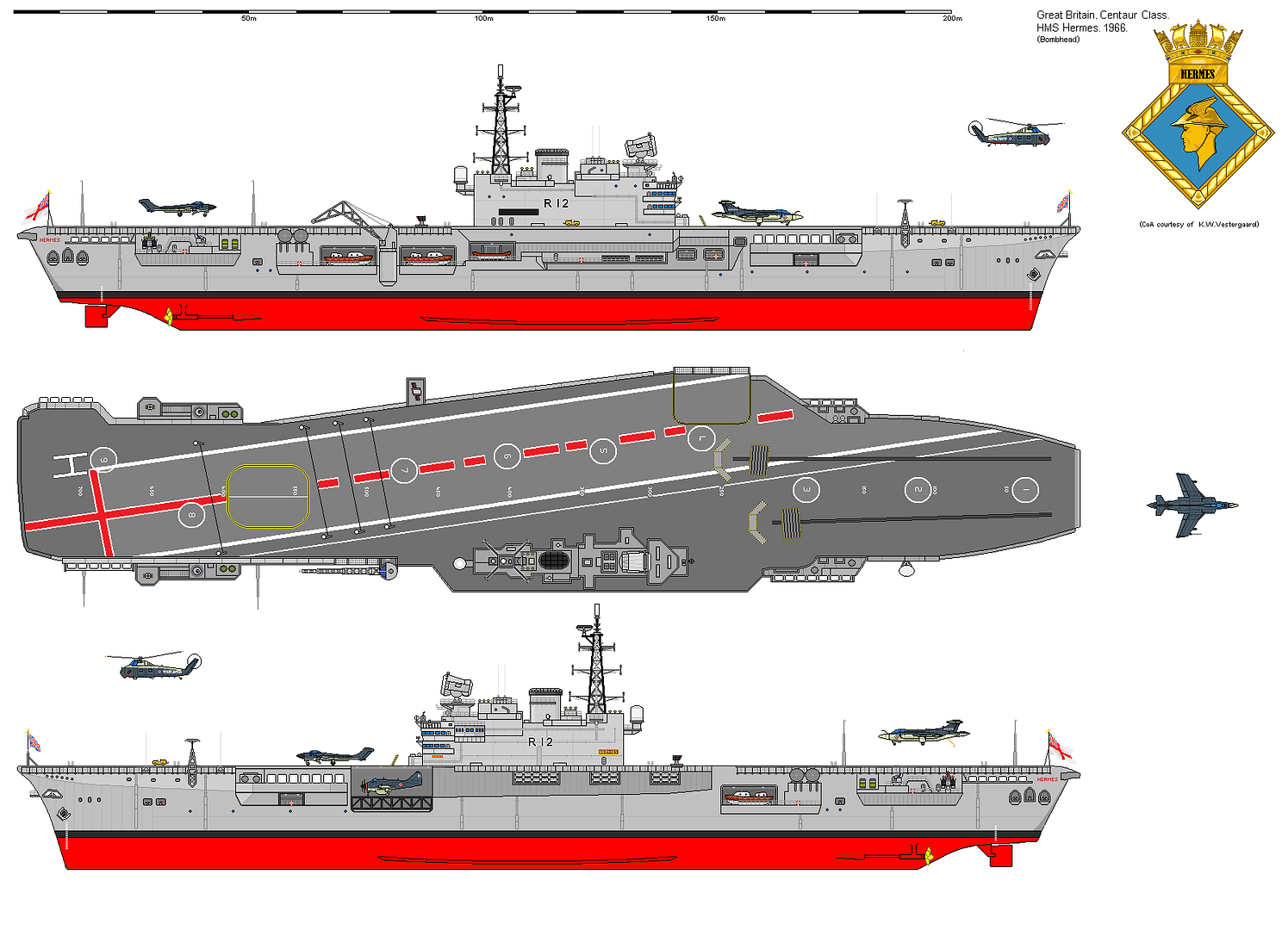
Hermes, 1966, via Shipbucket http://img.photobucket.com/albums/0703/catherine.fisher/Hermes13-31.png~original

Hermes, 1966, via Shipbucket

Hermes, 1982, via Shipbucket http://img.photobucket.com/albums/0703/catherine.fisher/Hermes13-31.png~original

Hermes, 1982, via Shipbucket

As Viraat, 1990, via Shipbucket http://www.shipbucket.com/Real%20Designs/India/CV%20R22%20Viraat%201990.png

As Viraat, 1990, via Shipbucket

Displacement: 22,000 tons 28,700 tons full load
Length: 737 ft. (224.6 m)
Beam: 130 ft. (39.6 m)
Draught: 28.5 ft. (8.7 m)
Installed power: 78,000 hp (58,000 kW)
Propulsion: 2 shaft geared steam turbines, 4 Admiralty 3-drum boilers
Speed: 28 knots (52 km/h)
Range: 7,000 nmi (13,000 km) at 18 kn (33 km/h)
Sensors: Radar Type 982, Type 983, Type 275, Type 974
Complement: 2,100 including carrier air wing. 1970-75 as Commando Carrier: 1500 plus up to 800 Marines.
Armament: 32 40mm Bofors guns (2 × 6), (8 × 2), (4 × 1) removed in 1970, replaced with 2 Sea Cat missile system launchers. During Falklands, her armament was increased with the addition of numerous small gun mounts.
Armor: 1.2-inch flight deck, Hangar deck
Aircraft carried: 7-60 depending on year and role

If you liked this column, please consider joining the International Naval Research Organization (INRO), Publishers of Warship International

They are possibly one of the best sources of naval study, images, and fellowship you can find http://www.warship.org/

The International Naval Research Organization is a non-profit corporation dedicated to the encouragement of the study of naval vessels and their histories, principally in the era of iron and steel warships (about 1860 to date). Its purpose is to provide information and a means of contact for those interested in warships.

Nearing their 50th Anniversary, Warship International, the written tome of the INRO has published hundreds of articles, most of which are unique in their sweep and subject.

I’m a member, so should you be!

Warship Wednesday July 15, 2015: The Great War’s Granite State

Here at LSOZI, we are going to take off every Wednesday for a look at the old steam/diesel navies of the 1859-1946 time period and will profile a different ship each week. These ships have a life, a tale all of their own, which sometimes takes them to the strangest places. – Christopher Eger

Warship Wednesday July 15, 2015: The Great War’s Granite State

Click to big up

Click to big up

Here we see the Connecticut-class battleship, USS New Hampshire (BB-25) at age 12 in the Gatun Locks of the Panama Canal. At this point of her life the young girl had already been in two real live shooting wars, had sunk a friendly battleship, and had but three years to live.

As part of the international naval race, the Connecticut-class was the top of the line in your U.S. predreadnought ships of the line. A century ago, the Connecticuts were the best and most intensely beautiful warships in the US Navy.

Connecticut herself was such an important ship that a crowd of some 30,000 civilians as well as most of the entire active battle fleet of the Atlantic Squadron was present for her commissioning in 1906. As a 15,000-ton ship with 11-inches of armor belt and carrying four 12-inch guns, she was a hoss.

USS Connecticut with a bone in her mouth on trials, 1906

USS Connecticut with a bone in her mouth on trials, 1906

Of course, the commissioning of the all-big-gun HMS Dreadnought the very same year, with her 10×12-inch guns, 21-knot top speed, and up to 12-inches of armor in a 21,000-ton package, the Connecticut was already sadly and badly obsolete.

That didn’t stop the Navy from finishing five sisters, Louisiana, Vermont, Kansas, Minnesota, and our hero, New Hampshire by 1908, spread across four east coast shipyards. Antiquated before they were even finished.

View of the ship’s bow decoration, taken while the battleship was in dry-docks at the New York Navy Yard, Brooklyn, New York, 6 January 1909. Note gilt-work on the eagle figurehead and associated decorations, stockless anchors in hause pipe, stocked anchor on billboard further aft, Sailors leaning on the bow bulwark, jack at half-mast, bell mounted in front of the ship's pilothouse, and barred portholes. Photograph from the Bureau of Ships Collection in the U.S. National Archives / USNHC # NH 19-N-4-8-21, via Navsource. Click to very much big up

View of the ship’s bow decoration, taken while the battleship was in dry-docks at the New York Navy Yard, Brooklyn, New York, 6 January 1909. Note gilt-work on the eagle figurehead and associated decorations, stockless anchors in hawsepipe, stocked anchor on billboard further aft, Sailors leaning on the bow bulwark, jack at half-mast, bell mounted in front of the ship’s pilothouse, and barred portholes. Photograph from the Bureau of Ships Collection in the U.S. National Archives / USNHC # NH 19-N-4-8-21, via Navsource. Click to very much big up

New Hampshire was laid down 1 May 1905 (just days before the pivotal Battle of Tsushima Strait., the apogee of predreadnought battlewagons). She was built alongside sistership USS Kansas at New York Shipbuilding Corporation in Camden, NJ at a cost of $3,748,000 and was commissioned 19 March 1908– then was rushed into front line service.

New Hampshire on trails note no main 12 inch guns have been fitted.

New Hampshire on trails note no main 12 inch guns have been fitted. Also note her twin military masts.

On her shakedown cruise, New Hampshire schlepped a provisional Marine regiment from Hampton Roads to Panama to protect the Canal there. You see her five sisters, all completed the year before, had set off on an around the world cruise of the Great White Fleet, and she was left holding the line until they returned and, afterwards, was one of the first ships made “combat ready” by replacing her original military masts with lattice cage masts, trading gleaming white and buff for haze gray, and landing her ornate bow crest seen above.

USS_New_Hampshire(BB-25)_NH76548

23

In March 1911, she got to warm up her four 12 inch /45 Mark 5 guns as well as her extensive (20 gun!) mixed set of 7 and 8 inchers on the former battleship USS Texas. Renamed the USS San Marcos, that 1892-era 6,300-ton vessel was one of the nation’s first modern heavy warships. By 1911, she was barely considered a warship anymore by modern standards so it made sense that her 12-inches of armor plate should be tested on the New Hampshire‘s still relatively modern guns.

USS New Hampshire B-25 firing on the target ship San Marcos (ex-Texas) at Tangier Sound in Chesapeake Bay, March 1911. This photograph is of historical interest as it was one of the first gun shoots where a spotter in the cage masts was used to spot fall of shot.  Previously, each gun layer or turret captain utilizing their turret gunsights was responsible.  This new technique increased the maximum possible engagement range from 12,000 yards (11,000 m) up to about 24,000 yards (22,000 m). Also note the ship's wake and that firing a broadside did not push the ship sideways. U.S. Naval Historical Center Photograph # NH 73105. Photo colorized by irootoko_jr   http://blog.livedoor.jp/irootoko_jr/  Oh yeah, and CLICK TO BIG UP

USS New Hampshire B-25 firing on the target ship San Marcos (ex-Texas) at Tangier Sound in Chesapeake Bay, March 1911. This photograph is of historical interest as it was one of the first gun shoots where a spotter in the cage masts was used to spot fall of shot. Previously, each gun layer or turret captain utilizing their turret gunsights was responsible. This new technique increased the maximum possible engagement range from 12,000 yards (11,000 m) up to about 24,000 yards (22,000 m). Also note the ship’s wake and that firing a broadside did not push the ship sideways. U.S. Naval Historical Center Photograph # NH 73105. Photo colorized by irootoko_jr  Oh yeah, and CLICK TO BIG UP

And the 870 lbs. AP shells of New Hampshire did their job very well, destroying her above the waterline and holing her below so many times she sank at her moorings and the current was allowed to flow without hindrance from side to side.

The below images are from Navsource via USNIP, 1938, courtesy of Pieter Bakel, and are attributed to Lt.Cdr. Radford Moses, USNR who was among the inspectors of the old San Marcos after New Hampshire was done with her.

texas30

texas28

texas27

texas26

texas25

texas8

After sinking San Marcos, New Hampshire trained mids from Annapolis and conducted peacetime cycles of training and flag waving missions abroad.

In April 1914, she was among the ships who landed shore parties to occupy Veracruz.

By the time the U.S. entered WWI, New Hampshire was relegated to train gunnery and engineering rates in Chesapeake Bay and by September 1918 was tasked with escorting convoys across the North Atlantic.

In the Hudson River, New York, 27 December 1918. Note wartime modifications, including removal of some of the seven-inch and three-inch broadside guns and fitting of blast deflection shields on the "cage" mast fire control positions. Photo courtesy of Larry Bonn. Text courtesy of USNHC # NH 2891

In the Hudson River, New York, 27 December 1918. Note wartime modifications, including removal of some of the seven-inch and three-inch broadside guns and fitting of blast deflection shields on the “cage” mast fire control positions. Photo courtesy of Larry Bonn. Text courtesy of USNHC # NH 2891

Then came magic carpet rides bringing Doughboys back from ‘Over There’ through the first part of 1919.

Lloyd Brown, a 104-year-old World War I veteran takes a moment to pause as he remembers being in the Philadelphia Naval Shipyard with his ship the day WW I ended, at his home in Charlotte Hall, Maryland, on November 9, 2005. Brown remembered Armistice Day in 1918 as few, ever so few, veterans can. "For the servicemen there were lots of hugs and kisses," he recalls Brown, a teenage seaman aboard the battleship USS New Hampshire when the fighting stopped. "We were so happy that the war was over." Brown added, "There's not too many of us around any more." An estimated 2 million Americans served in Europe after the U.S. entered the war in 1917. Lloyd Brown passed away in April of 2007, at the age of 105. (AP Photo/Chris Gardner)

Lloyd Brown, a 104-year-old World War I veteran takes a moment to pause as he remembers being in the Philadelphia Naval Shipyard with his ship the day WW I ended, at his home in Charlotte Hall, Maryland, on November 9, 2005. Brown remembered Armistice Day in 1918 as few, ever so few, veterans can. “For the servicemen there were lots of hugs and kisses,” he recalls Brown, a teenage seaman aboard the battleship USS New Hampshire when the fighting stopped. “We were so happy that the war was over.” Brown added, “There’s not too many of us around any more.” An estimated 2 million Americans served in Europe after the U.S. entered the war in 1917. Lloyd Brown passed away in April of 2007, at the age of 105. (AP Photo/Chris Gardner)

Peacetime service after the war for the relatively young ship (she was but a decade old) was more of the same midshipmen cruises and flag-waving.

On Nov. 10, 1923, in one of the saddest days for any naval buff, all six of the Connecticuts were stricken from the Naval List and very soon after scrapped in accordance with the terms of the Washington Naval Treaty.

By the end of 1924, the entire class was nothing but so much re-purposed steel, although it’s likely that some of her smaller mounts were retained in storage and used during WWII to arm merchantmen.

Perhaps the only tangible piece of the old battleship New Hampshire is her 72-piece silver service and bell. Expertly made by New Hampshire’s W.B. Durgin Co. and presented to the PCS in 1908, it is currently on display at the New Hampshire Historical Society in Concord.

Via Robert Dole, Maritime Quest.

Via Robert Dole, Maritime Quest.

Her bell is preserved at Portsmouth. Image by Jim Cerny

Her bell is preserved at Portsmouth. Image by Jim Cerny

Specs:

uss-bb-25-new-hampshire-1908-battleship

Displacement: 16,000 long tons (16,000 t)
Length: 456 ft. 4 in (139.09 m)
Beam: 76 ft. 10 in (23.42 m)
Draft: 24 ft. 6 in (7.47 m)
Propulsion: 12 Babcock & Wilcox boilers
16,500 ihp (12,300 kW)
Speed: 18 kn (21 mph; 33 km/h)
Complement: 827 officers and men
Armament:
4 × 12 in (305 mm)/45 cal Mark 5 guns
8 × 8 in (203 mm)/45 cal guns
12 × 7 in (178 mm)/45 cal guns
20 × 3 in (76 mm)/50 cal guns
12 × 3 pounder guns
4 × 1 pounder guns
4 × 21 in (530 mm) torpedo tubes
Armor:
Belt: 6–11 in (152–279 mm)
Barbettes: 6–10 in (152–254 mm)
Turret Main: 8–12 in (203–305 mm)
Turret secondary: 7 in (178 mm)
Conning tower: 9 in (229 mm)

If you liked this column, please consider joining the International Naval Research Organization (INRO), Publishers of Warship International

They are possibly one of the best sources of naval study, images, and fellowship you can find http://www.warship.org/

The International Naval Research Organization is a non-profit corporation dedicated to the encouragement of the study of naval vessels and their histories, principally in the era of iron and steel warships (about 1860 to date). Its purpose is to provide information and a means of contact for those interested in warships.

Nearing their 50th Anniversary, Warship International, the written tome of the INRO has published hundreds of articles, most of which are unique in their sweep and subject.

I’m a member, so should you be!

Warship Wednesday July 8, 2015: Colombia’s Grande Dame, with a bit of British influence

Here at LSOZI, we will take off every Wednesday for a look at the old steam/diesel navies of the 1859-1946 time period and will profile a different ship each week. These ships have a life, a tale all of their own, which sometimes takes them to the strangest places. – Christopher Eger

Warship Wednesday, July 8, 2015, Colombia’s Grande Dame, with a bit of British influence

ARC Cartagena river gunboat (Canonero fluvial), commisoned in 1929 and participant in the war against Peru in 1932 decommissioned in 1986

Here we see the Colombian river gunboat (cañonero fluvial) ARC Cartagena (C-31, later C-134), the lead ship of her class of shallow draft warships somewhere in the chocolate milk waters of the Amazon.

Colombia in 1928 had no navy to speak of and was in trouble.

While it had a naval tradition and had built officer training schools twice before, by 1909 the schools had been shuttered and the only vessels flying the Colombian flag were merchant ships. However, the country had a vast interior, controlled by rivers (the massive Magdalena, Amazon and Putumayo systems), and was threatened along its borders by a much stronger regional power, Peru.

With that in mind, the Colombian government negotiated for a trio of newly built gunboats in the UK for use both along the coastline for defense, and on the river system against interlopers pushing the limits of their borders. Ordered in 1929 for a combined cost of £ 200,000 at Yarrow in Glasgow were the threesome named Cartagena, Barranquilla, and Santa Marta.

10645137_776090452452523_6261113309966995021_n

These 138-foot gunboats, displacing just 150 tons, were beamy at nearly 24 feet, giving them a length-to-beam ratio of nearly 1:5. This translated to a draft of just four feet (48 inches) when fully loaded. If only carrying a light load of diesel oil in her bunkers, they could navigate in just two feet of calm water.

Armed with an Armstrong 12-pdr [3″/40 (7.62 cm)] 12cwt quick-firing gun forward and a quartet of Vickers water-cooled machine guns, their 34-member crew could man all of the mounts and still be able to send a small (squad-sized) landing party ashore or to board suspect ships.

To help train the first generation of modern Colombian naval personnel, the Latin American government picked up several hardy British and French mariners (it was the Great Depression after all, and experienced sailors were available by the boatload) led by one Captain Ralph Douglas Binney CBE, RN.

Binney

Binney

Binney was a remarkably English chap. Born in 1888 in Cookham, Berkshire, by 1907 he had earned his commission as a lieutenant in the King’s Navy and served during the Great War on the pre-dreadnought HMS Britannia then spent the 20s on more modern battlewagons including HMS Collingwood and HMS Royal Sovereign before ending his time at sea with the RN as skipper of the monitor HMS Marshal Soult in 1931. Moving to the reserve list, the Colombians picked up Binney as an adviser soon after.

With his help and the cadre of European instructors, the Colombians opened the Escuela de Grumetes (Navy Sailors School) and the Escuela de Cadetes (Navy Officers School), which still exist today.

By the end of 1931, all three gunboats were complete, and British contract crews crossed the Atlantic in an epic 24-day voyage (their Gardner diesel could only make 15 knots wide open and, as they ran at half that to sip fuel, it took little time).

In 1933, primed with their new boats, the infant Colombian Navy (with the ships fleshed out by British and French sailors and dubbed La Flotilla Fluvial, The River Flotilla) made a sortie into the river systems to wave the flag and let the Peruvians know what’s up.

ARC Cartagena river gunboat (Canonero fluvial)

Note the basic rangefinder atop the superstructure for her 12-pounder.

Finding out that the Peruvian Army had sent about 1,000 men to the disputed river ports of Leticia and Tarapacá in the Amazon, the Colombians picked the latter to make their point. There, Barranquilla, leading four transports, landed a 700-man Colombian battalion and bombarded the Peruvian positions on Valentine’s Day, scattering the invaders without casualty– despite being strafed by Peruvian Air Force Vought O2U Corsairs operating from sandbar landing strips.

Win one for the gunboats!

Then, in the March 26-28 action (remembered as the Battle of Güepí) Cartagena, serving as flag, and Santa Marta took on a battalion-sized group of Peruvians on the Putumayo River at Guepi and Port Arthur. Landing Colombian infantry within a stone’s throw of the enemy positions and covering their advance Boom Beach-style, the twin cañoneros lit up the night and fired until they had largely exhausted their ammunition, again shrugging off a raid from the Peruvian air force– this time from Curtiss F-11 Goshawk floatplanes.

Peruvian F-11s. These planes were armed with a pair of .30 light machine guns and could carry two small bombs

Peruvian F-11s. These planes were armed with a pair of .30 light machine guns and could carry two small bombs.  In a twist of fate, the Colombians utilized the talents of private German pilots to airlift troops and supplies to the isolated region, landing Fokker trimotors in remote jungle strips.

At the end of the day, the crews of the gunboats nailed the Colombian tricolor on top of Peruvian fortifications.

Win two for the gunboats.

On April 16 the Peruvians struck back, mounting a Krupp 1894 75mm field piece on a river steamer San Miguel and, packing it full of soldiers, ran down the Putumayo and took a Colombian position under fierce attack.

Cartagena raced to the scene and, in an exchange of naval gunfire along the riverbanks at night, forced the San Miguel to beat feet– although Cartagena took a 75mm shell through part of her stack without casualties.

A larger sortie supported by aircraft was repulsed two weeks later with the help of Santa Marta.

Win three (and four) for los canoneros!

sternFollowing these actions, the Peruvians went to the bargaining table, and the so-called Colombia–Peru War was ended by May through the kind services of the League of Nations. All told both sides suffered less than 200 casualties in the entire conflict, but the three gunboats were without a doubt the MVPs.

Peace led to the Colombians adding destroyers to their naval list and further increasing their fleet. In addition, after tasting the near misses from airplane-dropped bombs (some of the 117-pounders dropped from the Goshawks were lobbed from 5,000 feet), the gunboats each picked up a single high-angle 20 mm Oerlikon Mk 4 AAA piece.

With the drums of a Second World War beating in the distance, an American naval mission arrived in Colombia in January 1939 to incorporate the Colombian forces in the defense of the nearby Panama Canal. Although the country did not declare war on Germany until November 26, 1943, the gunboats nonetheless stood watch along the coast for U-boats long before that date.

As for Binney, when the balloon went up in Europe in 1939, he resigned from his desk in the Colombian Naval Ministry and picked up where he left off in British service, holding down staff positions in Alexandria and London. Sadly, on Friday, 8 December 1944, on a crowded Birchin Lane in the City of London, Binney saw a couple of rough chaps pull off a smash-and-grab raid on a jewelry shop. He alone stepped forward in an attempt to stop the pair as they escaped in a car and were callously run down by the fleeing criminals. His friends and colleagues established a fund to ensure that his selfless heroism would not be forgotten – and that other such acts would be appropriately recognized. Today this fund still exists as the Police Public Bravery Award– commonly referred to as The Binney.

Now back to Latin America.

The river gunboats remained in service for another generation, with Santa Marta retiring in 1962, her parts used to keep her two sisters running.

A series of images of her late in her career remain to give a look at her circa 1950s appearance:

Speaking of running, in the mid-1960s both Cartagena and Barranquilla were re-engined and their 12-pdr, Oerlikon and Vickers swapped out for a (slightly) more modern Bofors 40mm/60 cal Mk I and a half-dozen air-cooled M1919’s.

Cartagena and Barranquilla put in time for their country in a third war, the epic low-intensity guerrilla war between the government, paramilitary groups, narco-traffickers, and insurgents such as the Revolutionary Armed Forces of Colombia (FARC), M-19 and the National Liberation Army (ELN).

Throughout the ’60s and ’70s, The two gunboats often towed barges set up as floating barracks behind them packed with Marines and, just as they did in 1933, provided gunfire support for her landing force going ashore.

Barranquilla, pushing 40, was laid up in the 1970s and cannibalized to keep the more famous, and class leader Cartagena, in operation.

Her day came on 26 July 1986, with 51 years of service behind her; she was decommissioned and landed ashore, her feet dry. She was disarmed except for her Bofors (minus breech), her machinery removed, and all fluids drained.

ARC Cartagena river gunboat (Canonero fluvial), commisoned in 1929 and participant in the war against Peru in 1932 decommissioned in 1986c

Note her Bofors forward and yes, that is as deep as her hull goes, hence the large above-deck superstructure.

ARC Cartagena river gunboat (Canonero fluvial), commisoned in 1929 and participant in the war against Peru in 1932 decommissioned in 1986bShe is retained as a museum, open to the public, at Naval Base ARC Leguizamo, although plans are afoot to dismantle her and transfer the vessel to another base where she would be restored.

ARC Cartagena river gunboat (Canonero fluvial), commisoned in 1929 and participant in the war against Peru in 1932 decommissioned in 1986a

Specs:

Displacement: 142 tons full
Length: 137.5 feet
Beam: 23.49 feet
Draft: 2-4 feet
Machinery: 2 300hp Gardner semi-diesels (replaced by Detroit Diesels in the 1960s)
Diesel oil bunkering: 24 tons full load
Range: 2100 nm at 15 knots, nearly twice that at 8.
Speed: 15.5 knots on trials, 10 knots cruising
Crew: 2 officers, 32 enlisted (as built) later 39 after 1960s modernization. Up to 100~ infantry
Armament:
12-pdr [3″/40 (7.62 cm)] 12cwt QF (1931-60)
40mm Bofors (After 1960, Cartagena and Barranquilla only)
20mm AAA (Fitted 1939)
4 Vickers, later swapped out for M1919 Brownings, later swapped for M60 GPMGs and M2s in Cartagena by 1980s.

If you liked this column, please consider joining the International Naval Research Organization (INRO), Publishers of Warship International

They are possibly one of the best sources of naval study, images, and fellowship you can find http://www.warship.org/

The International Naval Research Organization is a non-profit corporation dedicated to the encouragement of the study of naval vessels and their histories, principally in the era of iron and steel warships (about 1860 to date). Its purpose is to provide information and a means of contact for those interested in warships.

Nearing their 50th Anniversary, Warship International, the written tome of the INRO has published hundreds of articles, most of which are unique in their sweep and subject.

I’m a member, so should you be!

Warship Wednesday June 24, 2015: The hard times of a peacetime tin can

Here at LSOZI, we are going to take off every Wednesday for a look at the old steam/diesel navies of the 1859-1946 time period and will profile a different ship each week. These ships have a life, a tale all of their own, which sometimes takes them to the strangest places. – Christopher Eger

Warship Wednesday June 24, 2015: The hard times of a peacetime tin can

Here we see the Crosley-class high speed transport USS Ruchamkin (DE-228/APD-89/LPR-89), at sea sometime after 1963. The type of taskings for the Ruchamkin from 1945-69 were the same laundry list of fleet services that are forced on today’s LCS type vessels.

Originally laid down as one of the 252 planned Rudderow-class destroyer escorts, her original mission was to bust subs, kill torpedo and patrol boats, capture random enemy merchant ships threaten enemy destroyers and cruisers with her own steel fish and show the flag as required. Just under 1,800-tons and 306-feet long, these hardy ships would be classified as sloops or corvettes in other navies, but the term destroyer escort seemed a better fit for the USN and their pair of 5 inch /38 dual purpose mounts, 4 x 40 mm Bofors, 10 x 20 mm single mount Oerlikons, torpedo tubes and depth charges allowed them to punch out of thier weight class.

However the war outstripped these ships, with the first, USS Riley (DE-579) only commissioning in March 1944, just 22 of these tin cans were completed as DEs.

Another 50 were completed to a modified design and purpose– that of the high speed transport (APD). You see with the Pacific island hopping campaign in high speed in 1944, the Navy realized these DEs could float in just 11 feet of seawater, which meant they could get pretty close into old Hirohito’s backyard. To maximize their usefulness, these ships were redesigned from the stack back with the aft 5-incher and torpedo tubes never fitted and davits for a quartet of LCPRs (landing craft, personnel, ramped).

She carried four of these craft, which could land her embarked company all in one wave

She carried four of these craft, which could land her embarked company all in one wave

These 35-foot long V-Bottomed plywood craft could tote 39 troops ashore from as far as 50 miles out to sea; however they usually were launched as close as possible as these craft wallowed along at about 10-knots when wide open.

This allowed the 306-foot ship to carry (briefly) a company-sized (160~) unit of Army infantry or Marines and land them right on top of the beach.

The Rudderow type DE compared to the eventual Crosby type APD, note the differences aft of the stack

The Rudderow type DE compared to the eventual Crosby type APD, note the differences aft of the stack

The subject of our study, USS Ruchamkin, named after 24-year-old LT (JG) Seymour D. Ruchamkin, late of the destroyer USS Cushing (DD-376) and gave his last full measure on that ship off Savo Island, was laid down at Philadelphia Naval Yard 14 February 1944 as a DE. She was completed to the APD type and commissioned 16 September 1945, two weeks too late to serve in WWII.

USS Ruchamkin (APD-89) at anchor off Cannes, France, in 1952 during the Cannes Film Festival. Don Karr USS Ruchamkin

USS Ruchamkin (APD-89) at anchor off Cannes, France, in 1952 during the Cannes Film Festival. Don Karr USS Ruchamkin

Instead, she spent the next 24 years in and out of commission (joining red lead row three different times) spending about 15 winters with the active fleet.

Pierside in Charlotte Amalie, St. Thomas, Virgin Islands. 1960s

Pierside in Charlotte Amalie, St. Thomas, Virgin Islands. 1960s

In that time she trained midshipmen and naval reservists, was used as an amphibious warfare ship for the first generation of SEALs, roamed the Med, Pacific, and the Caribbean, waved the flag, and generally saw peaceful service.

View underway at sea off her stern, Pierside in Charlotte Amalie, St. Thomas, Virgin Islands.

View underway at sea off her stern,

USS Ruchamkin (APD-89) coming along side USS Rigel (AF-58) to receive stores, during Operation Steel Pike I, October 1964. Photo by Jim McCoy navsource

USS Ruchamkin (APD-89) coming along side USS Rigel (AF-58) to receive stores, during Operation Steel Pike I, October 1964. Photo by Jim McCoy navsource

One of her LCPRs Pierside in Charlotte Amalie, St. Thomas, Virgin Islands.

One of her LCPRs Pierside in Charlotte Amalie, St. Thomas, Virgin Islands.

However even peace can be hazardous.

On 14 November 1952, while on an exercise with troops embarked, the 10,000 ton tanker Washington smacked her portside amidships, nearly slicing the boat in two. As a testament to the design of these warbabies, she held up and remained afloat (thought losing seven men) and was back in service just four months later after repairs.

USS RUCHAMKIN APD 8915 November 1952, one day after USS Ruchamkin (APD-89) had been rammed by SS Washington, a 10,000 ton tanker. Note her damage amidships

USS RUCHAMKIN APD 8915 November 1952, one day after USS Ruchamkin (APD-89) had been rammed by SS Washington, a 10,000 ton tanker. Note her damage amidships

Her closest brush with war, besides tracking the occasional Soviet submarine, was when she earned the Navy Unit Commendation for evacuating civilians from the Dominican Republic in 1965, a task that her 160 spartan troop bunks and ability to operate from shallow water ports made her ideal.

scan00041-evacuation-domrep1965

She then served as a support ship for Polaris missile tests and the exploration of the wreck of the USS Scorpion before her third and final decommissioning at Little Creek on 24 November 1969.

She was sold to the Navy of the Republic of Colombia for $156,820 who used her as the ARC Córdoba (DT-15) until 1980, primarily as an escort vessel.

She sits in about three feet of still water sandwiched between a recreation of the Taj Mahal and a mountainside

She sits in about three feet of still water sandwiched between a recreation of the Taj Mahal and a mountainside

The Colombians disarmed her and donated her to Jaime Duque Grisales, an icon of Colombian air travel. Her new owners dismantled her, transported the old girl to “Colombia’s Disneyland” Parque Jaime Duque and reassembled her on site by 1983. There she sits today in a shallow pond some 620 miles inland and at an elevation of 8000 feet just outside of Bogata, a feat not often accomplished by naval vessels.

But her stern till holds her secret

But her stern till holds her secret

A very active veterans association, USS Ruchamkin.org exists to continue her memory here in the states.

USS Ruchamkin.org http://ussruchamkin.org/index.html

Painting by Don Renz via USS Ruchamkin.org

Specs

From Destroyer Escorts In Action (Osprey)

From Destroyer Escorts In Action (Osprey)

Displacement: 1,740 tons (1,770 metric tons) (fully loaded)
Length: 306 ft. (93.3 m) (overall)
Beam: 36 ft. 6 in (11.1 m)
Draft: 11 ft. (3.4 m) (fully loaded)
Propulsion: General Electric steam turbo-electric drive engine
Two 3-bladed propellers solid manganese-bronze 8 ft. 5 in (2.6 m) diameter
Speed: 24 knots (most ships could attain 26/27 knots)
Range: 5,500 nautical miles at 15 knots (10,200 km at 28 km/h)
Radar: Type SL surface search fixed to mast above yardarm and type SA air search only fitted to certain ships.
Sonar: Type 128D or Type 144 both in retractable dome.
Direction Finding: MF direction finding antenna fitted in front of the bridge and HF/DF Type FH 4 antenna fitted on top of mast.

Armament: (As designed DE)
Main guns: 2 x 5 inch /38 dual purpose mount
Anti-aircraft guns: 4 x 40 mm Bofors were fitted in the twin mounts in the ‘B’ and ‘X’ position. 10 x 20 mm single mount Oerlikons cannon positioned four next to the bridge behind ‘B’ gun mount, two on each side of the ship in sponsons just abaft the funnel, and two on the fantail just forward of the depth charge racks.
Torpedo tubes: three 21-inch (533 mm) torpedo tubes in a triple mount were mounted just aft of the stack.
Hedgehog: British-designed ahead-throwing anti-submarine mortar which fired 24 bombs ahead of the ship, this was situated on the main deck just aft of ‘A’ gun mount.
Depth charges: Approximately 200 were carried. Two sets of double rails each side of the ship at the stern, each set held 24 charges; eight K gun depth charge throwers each holding 5 charges, were situated each side of the ship just forward of the stern rails.

As completed (APD)
Complement: 12 Officers, 192 Enlisted.
Armament: 1 × 5″/38 caliber gun
6 × 40mm Bofors AA (3 × 2), removed 1963 in FRAM update
6 × 20mm Oerlikon AA (6 × 1), removed 1963 in FRAM update. Replaced by M2s.

If you liked this column, please consider joining the International Naval Research Organization (INRO), Publishers of Warship International

They are possibly one of the best sources of naval study, images, and fellowship you can find http://www.warship.org/

The International Naval Research Organization is a non-profit corporation dedicated to the encouragement of the study of naval vessels and their histories, principally in the era of iron and steel warships (about 1860 to date). Its purpose is to provide information and a means of contact for those interested in warships.

Nearing their 50th Anniversary, Warship International, the written tome of the INRO has published hundreds of articles, most of which are unique in their sweep and subject.

I’m a member, so should you be!

Warship Wednesday June 24, 2015: The Cursed Lion from Brazil

Here at LSOZI, we are going to take off every Wednesday for a look at the old steam/diesel navies of the 1859-1946 time period and will profile a different ship each week. These ships have a life, a tale all of their own, which sometimes takes them to the strangest places. – Christopher Eger

Warship Wednesday, June 24, 2015: The Cursed Lion from Brazil

Photo colorized by irootoko_jr http://blog.livedoor.jp/irootoko_jr/

Photo colorized by irootoko_jr http://blog.livedoor.jp/irootoko_jr/   Note the huge Brazilian ensign

Here we see the ironclad warship Aquidabã (also spelled Aquidaban) of the Marinha do Brasil as she looked in 1893 while on a visit to the U.S. The largest country in Latin America, Brazil had by the 1870s perhaps the strongest Navy south of the Equator and our subject was its pride and joy for some two decades.

Built by Samuda Brothers at Cubitt Town on the Isle of Dogs in London, the firm had much experience with crafting ships for foreign navies. They had built the Mahroussa for Egypt, Prussia’s SMS Kornpirnz, Japan’s Fuso, Argentina’s ARA Almirante Brown, and the Independcia for Peru. It was no surprise that buoyed by wins in the Platine & Paraguayan wars (1849–70) and looking to expand the Empire, the Brazilian Navy went to Samuda for the 5,550-ton ironclad Riachuelo ( 4 × 9.2″ guns) in 1881 and her slightly smaller one-off half-sister Aquidabã in 1883.

A090-f11

Some 280 feet long, this early battleship tipped the scales at 4,950 tons on a full load and could make nearly 16-knots when all of her eight cylindrical boilers lit. Armed with the same main battery as Riachuelo, she carried a pair of Whitworth 9.2-inch guns in two turrets set off the center line, en echelon, with the forward turret offset to port and the aft turret to starboard. A battery of smaller 5.5-inch breech-loaders, Nordenfelt 1-pounders, and impressive five 18-inch Whitehead torpedo tubes rounded her out.

She was sheathed in up to 11-inches of good English compound armor.

Aquidabã at Hampton Roads 1893

Aquidabã at Hampton Roads 1893 Click to big up

Named after the Aquidabã River system in the country (and the scene of the last battle of the War of Paraguay), she was called the aço Lion (Steel Lion) as she replaced older wooden ships in the line.

Arriving in Brazil on 29 January 1886 to much fanfare, she was placed into commission. By 1890, the Navy had become comfortable enough with their showboat to take the Lion to the high seas, embarking on an 11,000-mile cruise around the Americans, stopping at the U.S. and elsewhere.

Then came a rebellion.

In November 1891, Aquidabã played a decisive role in response to the attempted coup against Deodoro da Fonseca. She fired a 9.2-inch shell at the Police Station of São Bento, damaging the steeple of the Church of Nossa Senhora da Lapa Merchant in the center of Rio de Janeiro in the process– shooting off the cross.

The fuze didn’t go off and the shell is still on display there, but many of the more religious members of her crew felt her cursed after that. For good reason, it turned out…

Click to big up

Click to big up

She returned to the states in April 1893, taking part in the Colombian Exhibition in Hampton Roads along with the international fleet– where several of the larger images were taken in this post.

LOC picture 4615x2625 of Aquidaba that is colorized above. Click to very much big up

LOC picture 4615×2625 of Aquidaba that is colorized above. Click to very much big up

Then, upon return to Brazil, she was promptly caught up in another rebellion, this time on the side of the rebels. This naval rebellion, the Revolta da Armada, occurred when the former Minister of Marine took the ship as his flag and led a yearlong campaign that involved the mutinous ships exchanging gunfire on a near-daily basis with coastal defense batteries ashore.

By the end of it, Aquidabã‘s machinery was in such a poor state of repair due to lack of access to port facilities and spares that she could only limp along at 4-knots, had almost no shells left, and was burning the crummiest grade of coal that could be imagined. Her armament was beefed up by a number of 3-pounder Garnder and Hotchkiss field pieces shipped aboard, but they were more pop-guns than anything.

If our Lion was Goliath, then the torpedo boat Gustavo Sampaio was her David

If our Lion was Goliath, then the torpedo boat Gustavo Sampaio, above, was her David

Then, on 16 April 1894, the government-controlled torpedo boat Gustavo Sampaio managed to pump a fish into the bow of the once-proud Aquidabã and, her front compartments open to the sea, she settled in the mud as her crew fled after thoroughly wrecking her.

Aquidabã in drydock at Cobras Island note torpedo hole

Aquidabã in drydock at Cobras Island note torpedo hole

The result of the torpedo hit on the Brazilian battleship Aquidabã on April 16th, 1894. Battleship sank in shallow water and was later refloated. Note the 2 thickness of teakwood sandwiched over the iron hull in a composite. Via http://brasilianafotografica.bn.br/brasiliana/discover?query=Aquidab%C3%A3+&submit=Ir

Bow damage on the Brazilian Rebel Turret Ironclad Battleship Aquidaban, 1894

She was refloated, renamed Vinte e Quatro de Maio (you can’t have the name of a mutinous ship on the naval list to inspire others), and sent to the Vulcan yard at Stettin Germany for repair then Elswik in New Castle, on the River Tyne in England, for modernization.

There she picked up 15 Nordenfelt machineguns (as a defense against torpedo boats!) two large fighting towers to replace her auxiliary sail rig, new engines, and a new topside structure.

Now that's a different look. Click to big up

Now that’s a different look. Click to big up

All was forgiven by 1896 and she was back to her original name and representing Brazil at the Chicago International Expedition in the U.S. where President Grover Cleveland reviewed her. Then followed uneventful peacetime service that ended for the mighty Lion a decade later.

A090-f10

At 22: 45hs on 21 January 1906, while at anchor four miles southeast of Angra do Reis at Jacuacanga Cove, Aquidabã suffered a magazine explosion similar to that of many of the predreadnought steel ships of the era.

She was utter wrecked in an explosion that was described as a disintegration by many who witnessed it and sank quickly in 60 feet of water with only 96 survivors from a crew of over 400 that was fleshed out by some 81 visiting midshipmen– the flower of the Brazilian officer corps which included at least one son of the sitting Naval Minister. Those lost included Rear Admiral Rodrigo José da Rocha and Rear Admiral John Candido Brazil.

News of the loss was carried far and wide, even if it was only a footnote among the other news of the day.

news

A memorial was erected to her in 1913.

Specs:

A090-f04
Displacement: 4950 tons
Length: 280.2 ft. (85.4 m)
Beam: 52.03 ft. (15.86 m)
Draft: 18.04 ft.
Propulsion: Mixed; sailing with three bark-rigged masts, 8 cylindrical coal boilers linked to three steam engines generating 4,500 hp on two props.
Speed: 15.6 knots
Range; 6000 miles at 10 knots.
Crew: 303
Armament:
Four × 9.2 in (230 mm) guns (2 × 2)
Four × 5.5 in (140 mm) 70-pounder guns (4 × 1)
13 × 1 pounder guns (13 × 1) (removed 1895)
15 Nordenfelt machineguns fitted 1895
Five × 18-inch torpedo tubes (through “portholes”)
Armor: 178 to 280 mm on the sides of the hull; 254 mm in the main turret and 254 mm in the superstructure.

If you liked this column, please consider joining the International Naval Research Organization (INRO), Publishers of Warship International

They are possibly one of the best sources of naval study, images, and fellowship you can find http://www.warship.org/

The International Naval Research Organization is a non-profit corporation dedicated to the encouragement of the study of naval vessels and their histories, principally in the era of iron and steel warships (about 1860 to date). Its purpose is to provide information and a means of contact for those interested in warships.

Nearing their 50th Anniversary, Warship International, the written tome of the INRO has published hundreds of articles, most of which are unique in their sweep and subject.

I’m a member, so should you be!

Warship Wednesday June 17, 2015: Big Paul

Here at LSOZI, we are going to take off every Wednesday for a look at the old steam/diesel navies of the 1859-1946 time period and will profile a different ship each week. These ships have a life, a tale all of their own, which sometimes takes them to the strangest places. – Christopher Eger

Warship Wednesday, June 17, 2015: Big Paul

USS Saint Paul off Yokosuka, Japan, 21 May 1966. Click to big up

USS Saint Paul off Yokosuka, Japan, 21 May 1966. Click to big up

Here we see the Baltimore-class cruiser, USS Saint Paul (CA-73) coming at you bow-on. She was a hard charger who never stopped in 26 years at sea.

When the early shitstorm of 1939 World War II broke out, the U.S. Navy, realized that in the likely coming involvement with Germany in said war– and that country’s huge new 18,000-ton, 8x8inch gunned, 4.1-inches of armor Hipper-class super cruisers– it was outclassed in the big assed heavy cruiser department.

When you add to the fire the fact that the Japanese had left all of the Washington and London Naval treaties behind and were building giant Mogami-class vessels (15,000-tons, 3.9-inches of armor), the writing was on the wall.

That’s where the Baltimore-class came in.

These 24 envisioned ships of the class looked like an Iowa-class battleship in miniature with three triple turrets, twin stacks, a high central bridge, and two masts– and they were (almost) as powerful. Sheathed in a hefty 6 inches of armor belt (and 3-inches of deck armor), they could take a beating if they had to. They were fast, capable of over 30-knots, which meant they could keep pace with the fast new battlewagons they looked so much like as well as the new fleet carriers that were on the drawing board as well.

While they were more heavily armored than Hipper and Mogami, they also had an extra 8-inch tube, mounting 9 8 inch/55 caliber guns whereas the German and Japanese only had 155mm guns (though later picked up 10×8-inchers, thanks for keeping me straight Tom!). A larger suite of AAA guns that included a dozen 5 inch /38 caliber guns in twin mounts and 70+ 40mm and 20mm guns rounded this out.

In short, these ships were deadly to incoming aircraft, could close to the shore as long as there was at least 27-feet of seawater for them to float in and hammer coastal beaches and emplacements for amphibious landings, and take out any enemy surface combatant short of a modern battleship in a one-on-one fight.

Class leader Baltimore was laid down 26 May 1941, just six months before Pearl Harbor, and was commissioned 15 April 1943.

Saint Paul, the 6th ship of the class, was laid down at Bethlehem Steel Company at Quincy, Mass on 3 February 1943.

USS Saint Paul (CA-73), a Baltimore-class cruiser note vertrep markings. She swapped her seaplanes for choppers in 1949

USS Saint Paul (CA-73), a Baltimore-class cruiser note vertrep markings. She swapped her seaplanes for choppers in 1949

As such, Paul, just the 2nd U.S. Naval ship named for the Minnesota city, was completed late in the war, only being commissioned 17 February 1945.

Whereas the original ships of the class mounted Mk 12 8-inch guns, Saint Paul was completed with the more advanced Mk 15 guns in three 300-ton triple turrets. These long-barreled 203mm guns could fire a new, “super-heavy” 335-pound shell out to 30,000 yards and penetrate 10-inches of armor at close ranges. It should be noted that the older cruisers used a 260-pound AP shell.

USS Saint Paul bombarding communist positions off Vietnam, Oct 1966

USS Saint Paul bombarding communist positions off Vietnam, Oct 1966

After shakedown, she was off the coast of Japan in July, getting in the last salvos fired by a major warship on a land target in the war when she plastered the steelworks in Kamaishi from just offshore, putting those big new 8-inchers to good use.

Watercolor

Watercolor “U.S.S. ST. PAUL – Let Go Port Anchor” by Arthur Beaumont, 1946

Then at the end of the war, a funny thing happened: the five almost new Baltimores that came before Saint Paul was decommissioned and laid up in reserve, whereas CA-73 remained on post. Further, many of the follow-on ships that were to come after her were never ordered, and some of these never completed. In all, just 14 Baltimore-class cruisers were built, with Saint Paul arguably seeing the most continuous service.

In Korea, Saint Paul saw hard use and made her 8-inchers a regular hitter, completing her first naval gunfire support on Nov. 19, 1950. It would be far from her last.

USS Saint Paul bombarding communist positions near Wonsan, Kangwon Province, Korea, 20 Apr 1951

USS Saint Paul bombarding communist positions near Wonsan, Kangwon Province, Korea, 20 Apr 1951

USS Saint Paul bombarding communist positions near Hungnam, South Hamgyong Province, Korea, 26 Jul 1953

USS Saint Paul bombarding communist positions near Hungnam, South Hamgyong Province, Korea, 26 Jul 1953

HO3S-1 helicopter landing on USS Saint Paul off Wonsan, Kangwon Province, Korea, 17 Apr 1951

HO3S-1 helicopter landing on USS Saint Paul off Wonsan, Kangwon Province, Korea, 17 Apr 1951. Her guns look sad…but are probably just depressed for cleaning as they had lots of chances to get dirty at the time.

Heavy cruiser USS Saint Paul (CA-73) lights up the night while firing her 8 inch guns off the coast of Hungnam, North Korea 1950

Heavy cruiser USS Saint Paul (CA-73) lights up the night while firing her 8-inch guns off the coast of Hungnam, North Korea 1950

Hungnam, Songjin, Inchon, Wonsan, Chongjin, Kosong, et. al. She racked up a steady total of hits onshore targets and picked up some Chinese lead in exchange from shore batteries. In all, Saint Paul earned eight Battle stars for her Korean War service, the hard way.

Much like she fired the last shots into Japan, she also completed the last naval gun mission into Korea, at a Chinese emplacement at on 27 July 1953 at 2159– one minute before the truce took effect.

USS SAINT PAUL (CA-73) near Wonsan, Korea just before signing of truce at Panmunjon. A 5

USS SAINT PAUL (CA-73) near Wonsan, Korea just before the signing of truce at Panmunjon. A 5″ shell is fired from the ship against the Communist shore batteries. This round is believed to have been the last fired on enemy positions by UN Naval units before the armistice.
NARA FILE #: 80-G-625878

Still, as after WWII, while most of her sisters took up space on red lead row, she remained in service. Tragically, in 1962, 30 of her crewmen were killed in a turret explosion in peacetime drills.

Heavy cruiser USS Saint Paul (CA-73) "Manning the Rails" off Pearl Harbor, July, 1959. [2607 × 1481]

Heavy cruiser USS Saint Paul (CA-73) “Manning the Rails” off Pearl Harbor, July 1959. [2607 × 1481]

After about 1963, when the Iowas were laid up, her guns and those of the few cruisers still left on active duty were the largest ones available to the fleet. This led to her spending most of her service as either a squadron or fleet flag.

This gave her a chance in 1964 to fill in as the battered cruiser “Old Swayback” in the iconic Otto Preminger/John Wayne film In Harm’s Way

The Duke on St.Paul aka Old Swayback

The Duke on St.Paul aka Old Swayback

By 1966, she earned a regular spot on the gun line off Vietnam, where she spent most of the next four years, earning another 9 Battlestars for an impressive total of 18 (1 WWII, 8 Korea, 9 RVN).

Tony D’Angelo, <em>USS St. Paul,</em> details the satisfaction of rounds on target and the danger of swapping fuses on the ship’s guns.

Tony D’Angelo, USS St. Paul, remembers conducting harassment and interdiction fire, along with supporting the Marines near the DMZ, during his deployment to Vietnam.

USS Saint Paul bombarding the Cong Phy railroad yard 25 miles south of Thanu Hoa, Vietnam, 4 Aug 1967; note splashes from coastal gun batteries

USS Saint Paul bombarding the Cong Phy railroad yard 25 miles south of Thanu Hoa, Vietnam, 4 Aug 1967; note splashes from coastal gun batteries

Big up. More Vietnam work

Big up. More Vietnam work

St. Paul in Da Nang

St. Paul in Da Nang

url

USS Saint Paul (CA-73) approaching USS Boston (CAG-1) off the coast of Vietnam, September 1968. Courtesy of John Jazdzewski.

USS Saint Paul (CA-73) approaching USS Boston (CAG-1) off the coast of Vietnam, September 1968. Courtesy of John Jazdzewski.

In the late 60s, as part of Project Gunfighter at Indian Head Naval Ordnance Station, Saint Paul picked up an experimental shell to use in her 8-inchers, a saboted 104mm Long Range Bombardment Ammunition (LRBA) round that had an estimated range of 72,000 yards.

In 1970, Big Paul, using LRBA, made some of the longest gunfire missions in history when she fired on Viet Cong targets some 35 miles away, destroying six structures. At the time, she was the last big-gun heavy cruiser in the United States Navy.

Video of her firing after the intro…

Then, on 30 April 1971, for the first time since 1945, Saint Paul was taken out of commission after three Pacific wars. Only sisterships Chicago and Columbus, who had long before traded in their 8-inchers for Tartar and Talos missiles, lasted longer.

In the end, Saint Paul was stricken from the Naval List on 31 July 1978 and scrapped in 1980.

She was remembered in the USS Minneapolis-Saint Paul (SSN-708), the twenty-first Los Angeles-class submarine, in commission from 1984 to 2008.

The USS Saint Paul Association keeps her memory alive.

Her 1,000-pound brass bell is located in St. Paul’s city hall, where the city seems to take good care of it.

Specs:

uss-ca-73-saint-paul-1968-heavy-cruiser-1

Displacement: 14,500 long tons (14,733 t) standard
17,000 long tons (17,273 t) full load
Length: 673 ft. 5 in (205.26 m)
Beam: 70 ft. 10 in (21.59 m)
Height: 112 ft. 10 in (34.39 m) (mast)
Draft: 26 ft. 10 in (8.18 m)
Propulsion: Geared steam turbines with four screws
Speed: 33 knots (61 km/h; 38 mph)
Complement: 61 officers and 1,085 sailors
Armament: 9 × 8 inch/55 caliber guns (3 × 3)
12 × 5 inch/38 caliber guns (6 × 2)
48 × 40 mm Bofors guns
24 × 20 mm Oerlikon cannons
Armor: Belt Armor: 6 in (150 mm)
Deck: 3 in (76 mm)
Turrets: 3–6 inches (76–152 mm)
Conning Tower: 8 in (200 mm)
If you liked this column, please consider joining the International Naval Research Organization (INRO), Publishers of Warship International

They are possibly one of the best sources of naval study, images, and fellowship you can find http://www.warship.org/

The International Naval Research Organization is a non-profit corporation dedicated to the encouragement of the study of naval vessels and their histories, principally in the era of iron and steel warships (about 1860 to date). Its purpose is to provide information and a means of contact for those interested in warships.

Nearing their 50th Anniversary, Warship International, the written tome of the INRO has published hundreds of articles, most of which are unique in their sweep and subject.

I’m a member, so should you be!

« Older Entries Recent Entries »